
Forklift Fit for Tight German Container Loading: Steel Export
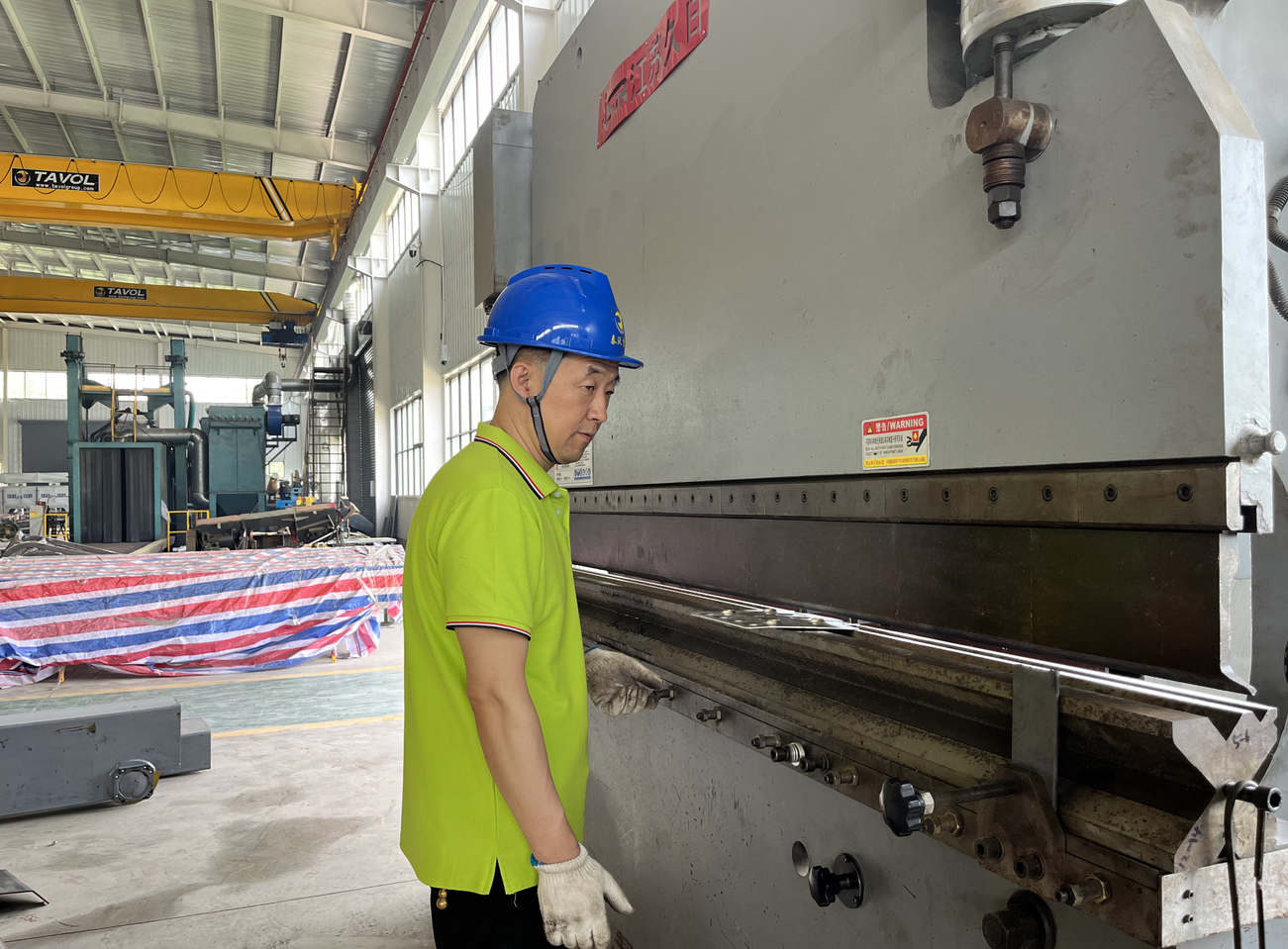
Fabrication precedes loading: plate bending for forklift structural components inside an in-house workshop.
Structural steel rarely fails container loading because of weight. It fails because of geometry. A fabricated beam, frame section or bracing assembly arrives at the dock long, often irregular, and completely unforgiving of lateral error. It has to travel through a container door, rotate inside a space that offers almost no side clearance, and settle without touching cargo already stowed. That is a fit problem well before it becomes a lifting problem.
The loading pattern examined here comes from a verified machinery-export application in steel structure and metal fabrication, where finished structural components are handled at an indoor/outdoor loading dock with tight container space maneuvering ahead of shipment to German projects. The matched equipment in that application is deliberately plain: standard forks, no special attachment, working together with overhead crane assistance. Understanding why that combination is specified — and what it demands of the machine underneath it — is the practical question facing exporters who configure a material handling forklift for repeat container work rather than occasional lifts.
The Dock Is Where Schedule Risk Collects
A fabricator can absorb a slow cut, a slow weld, a slow paint cycle. What it cannot easily absorb is a container that misses its loading window because a component would not seat. Freight bookings, inspection slots and inland connections downstream of the dock are fixed; the loading operation is the last flexible hour in the chain, and it is usually the one that compresses the most.
In that hour, the variables that decide success are not headline lifting capacity. They are dimensional: how wide the machine is, how tightly it turns, how much of the container interior it can see, how much lift is available before the mast adds height, how far the forks reach under an unbalanced load, and whether the overhead guard clears the door opening. These are specification decisions made months before the container arrives.
A 3-tonne diesel counterbalance in the TAVOL CPCD30 configuration, for example, measures 2,855 mm overall length, 1,230 mm overall width and 2,125 mm top guard height, with a minimum turning radius of 2,550 mm and a minimum right-angle channel width of 4,305 mm when handling a 1,000 × 1,200 mm pallet. The equivalent 3-tonne dual fuel forklift CPQYD30 shares that same 2,855 × 1,230 × 2,125 mm footprint. The 3-tonne electric forklift CPD30 keeps the same 2,855 mm length and 1,230 mm width but stands at a 2,080 mm top guard height. Those differences are small on a specification sheet and consequential at a container door.
What the Verified Loading Application Actually Specifies
Before discussing configurations, it is worth stating the loading task in the terms recorded in the source application, because the constraints are more specific than the general phrase “container loading” suggests.
| Parameter | Verified specification |
|---|---|
| Industry | Steel structure & metal fabrication; machinery export; container loading & freight handling |
| Working condition | Indoor/outdoor loading dock, tight container space maneuvering |
| Project type | Export container loading; structural steel component handling |
| Function | Lifting and positioning irregular-shaped structural components into shipping containers |
| Operation mode | Standard fork operation combined with overhead crane assistance |
| Matched equipment | Standard forks, no special attachment |
| Special requirement | Precise maneuvering in confined container space; capable of handling long and irregular structural loads |
Read as a whole, the specification describes a two-machine workflow, not a single-machine one. The forklift carries and positions; the overhead crane supplies the orientation that a counterbalance truck cannot generate in a confined space.
Why Standard Forks Are the Specification, Not a Compromise
Buyers new to this application often ask why a clamp, rotator or other attachment is not the obvious answer for irregular steel. The verified record answers it directly: standard forks, no special attachment. The reasoning is structural rather than commercial. Attachments add mass and stack-up height to the carriage, and they consume lift height and effective capacity that a container interior does not have to spare. They also add a hydraulic circuit and a second failure point to a task where a component that slips inside a closed container cannot be recovered with a crane from outside.
Keeping the carriage simple moves the orientation problem to where it belongs. The overhead crane rotates and presents the component; the forklift receives it on standard forks, carries it to the door, and sets it precisely. The trade-off is honest and worth stating plainly: a forklift working alone cannot replace that crane assist for long or irregular structural loads. What the truck must do is be stable, dimensionally predictable and precise enough that the crane operator can hand off and let go.
Technical Explanation: Mast, Forks and Load Centre
Three specification families decide whether a container forklift can do this work repeatedly: the mast, the forks, and the honesty of the load chart.
Mast configuration
TAVOL diesel, dual fuel and electric models in the 3-tonne class are offered with 2-stage masts of 3 m, 3.5 m and 4 m, three-stage (triple mast) versions of 4.5 m, 5 m, 5.5 m and 6 m, plus container mast and full free mast variants. For dock work the relevant distinction is not maximum lift height but how much lift is available before the mast structure adds height above the carriage. A full free mast allows the forks to rise within the mast profile before the inner sections extend, which matters when a component has to be lifted and held under a container roof line. Buyers who specify only by tonne rating and lift height routinely discover this after the first container.
Fork length and load centre
Fork length can be selected from 1,220 mm, 1,370 mm, 1,520 mm, 1,670 mm or 1,820 mm. Longer forks support long components that must span the carriage rather than balance on a short pair, and they reduce the number of re-positioning moves inside the container. The caution is standard engineering rather than a product limitation: rated capacity is declared at a 500 mm load centre, and a component whose mass sits further forward reduces the usable capacity accordingly. A long fabricated section that looks comfortable on a 3-tonne rating may not be, and the load chart — not the brochure — should decide the model.
Structure, hydraulics and contact loads
Steel components do not load a carriage gently. The TAVOL design uses a reinforced frame for high structural strength and impact resistance, with Q235 carbon structural steel and Q355 low-alloy high-strength structural steel in the build. Mast tilt is 6° forward and 12° backward, which is the working envelope used to break a component free of its rest and to settle it flat. Diesel models in this class lift at 450 mm/sec and lower at 420 mm/sec at full load; the electric CPD30 lifts at 350 mm/sec and lowers at 400 mm/sec at full load. Tyres can be supplied as pneumatic or solid on request, and the choice is a dock-surface question as much as a traction one.
One dimensional check is easy to overlook and expensive to discover late: the top guard height. The diesel and dual fuel 3-tonne models stand at 2,125 mm, the electric CPD30 at 2,080 mm. Whether that clears the container door opening, the dock canopy and the crane hook path is a site measurement, not an assumption.
Drivetrain Fit by Yard Constraint
The verified dock is described as indoor/outdoor, which is precisely the condition where drivetrain choice stops being an ideology and becomes an operational calculation. Where the machine spends most of its hours, and what fuel or charging infrastructure exists at that spot, decides more than any general preference for diesel or electric.
Diesel: the outdoor default
The diesel forklift range covers CPCD20, CPCD25, CPCD30, CPCD35 and CPCD40 at 2 t, 2.5 t, 3 t, 3.5 t and 4 t respectively. Engine options include Xinchai, Quanchai, Isuzu, Mitsubishi, Yanmar, Kubota and PSI, so a buyer can align the forklift Japanese engine preference with the service and parts reality of their own market. Full-load gradeability is stated at 15% and 20% empty for the 3-tonne class, with drive speed of 18/20 km/h, which suits an outdoor yard where the truck must cross rough ground between the fabrication bay and the dock.
Dual fuel LPG and gasoline: the continuity option
The CPQYD20, CPQYD25, CPQYD30 and CPQYD35 dual fuel forklift models run on LPG and gasoline, with the 3-tonne CPQYD30 using a Nissan engine. The documented operational case for dual fuel is fuel-supply resilience: switching to the lower-cost or available fuel source is credited with fuel cost savings of up to 15% and, more importantly for a loading dock, uninterrupted operation when one fuel type runs short. The procedure is disciplined rather than casual — bring the truck to a stop and let the engine idle, select the mode on the dashboard, wait 5–10 seconds for the system to stabilise, then resume and monitor for the first few minutes. Switching under heavy load or on a slope is explicitly excluded.
Electric lithium: the enclosed-dock option
The CPD30, CPD35 and CPD40 electric forklift models use lithium iron phosphate batteries with a quick charger, no watering and no acid handling. The documented advantages over lead-acid are charging time reduced by roughly 70%, a battery lifespan of 3–5 times longer at 2,000+ cycles against 500–800, energy efficiency up to 30% higher, and a total cost of ownership 20–30% lower over five years despite a higher purchase price. The boundary is equally clear: electric is the natural fit for enclosed or emission-sensitive docks and multi-shift warehouse work, not for rough outdoor yards where a diesel's gradeability and refuelling simplicity still win.
| Model family | Capacity | Verified notes | Dock condition it suits |
|---|---|---|---|
| CPCD30 | 3 t, 500 mm load centre | 2,855 × 1,230 mm; 2,550 mm turning radius; 15/20% gradeability | Outdoor yard plus dock, mixed surface |
| CPCD35 | 3.5 t, 500 mm load centre | 21,500 N maximum traction; same 2,855 mm length and 1,230 mm width | Heavier sections needing reserve capacity |
| CPQYD30 | 3 t dual fuel LPG & gasoline | Nissan engine; 2,855 × 1,230 × 2,125 mm; 21,000 N traction | Sites with seasonal or uncertain fuel supply |
| CPD30 | 3 t lithium electric | LiFePO4 with quick charger; 2,080 mm top guard; 350 mm/sec lift | Enclosed, emission-controlled dock areas |

A diesel counterbalance configured with standard forks — the equipment match recorded for structural steel container loading.
What a German-Bound Shipment Changes
The container does not change because the destination is Germany. The consequences of a badly loaded one do. A longer inland leg and a fixed receiving schedule mean the container is packed once and cannot be reworked at the far end without cost and delay, so first-time-right loading carries more weight than it does on a short domestic run. Europe is listed among TAVOL's main export markets, alongside Southeast Asia, South America, the Middle East, Africa, Australia and North America, and export represents 70% of the company's sales volume — a detail that matters less as a credential than as an indication of how routine export packing documentation is for the supplier.
Practically, German-bound work pushes two decisions earlier. First, the loading plan is agreed before the machine is specified, because component sequence determines whether a mast with more free lift or a longer fork set is needed. Second, the drivetrain question is settled by where the truck operates, not by destination preference: an indoor dock with emission constraints argues for the lithium electric option, while an open yard with a long carry distance argues for diesel.
Long-Term Fit: What Repeat Loading Actually Demands
A single container can be loaded with a borrowed truck and a tolerant crane operator. A steel exporter loading containers month after month is running an availability problem, and availability is built from routine, parts and documentation rather than from a headline specification.
Routine that prevents dock downtime
The verified pre-shift routine for a diesel counterbalance is deliberately short: check engine oil, hydraulic fluid and coolant; inspect tyres for wear, damage or incorrect inflation; test brakes, horn, lights and backup alarm; check forks and mast for cracks, bends or hydraulic leaks; start the engine and confirm no unusual noise, smoke or warning lights. The safety note attached to that routine is unambiguous — never operate with a malfunctioning brake or hydraulic leak, wear the seatbelt, and report any abnormality before starting work. On the lithium side, opportunity charging during breaks rather than waiting for full depletion is the practice associated with longer battery life, with weekly inspection of terminals, cables and connectors and no charging in unventilated enclosed spaces.
One supplier across the two-lift workflow
The application pairs a forklift with overhead crane assistance, and that pairing is where supplier structure becomes an operational advantage rather than an administrative one. Shandong Tavol Machinery Co., Ltd. manufactures forklifts, cranes and agricultural machinery, with the full range researched, developed and manufactured in-house. The company was founded in 2003 and has 23 years of experience in heavy machinery manufacturing, operating a 40,000 m² facility with around 300 employees, an annual output of 3,000 units and a 25-engineer R&D team.
For a steel exporter, that means the truck and the crane that lift the same component can come from one technical team, one spare-parts inventory and one after-sales channel, instead of two suppliers who each consider the other's equipment out of scope when a component will not seat. It also means the second machine, and the third, can be specified against the same dimensional logic rather than renegotiated from scratch.
Market Context Behind the Decision
The wider picture supports treating drivetrain choice as a staged decision rather than a one-off conversion. The global forklift market was valued at USD 81.4 billion in 2025, according to Grand View Research. Lithium-ion penetration in global counterbalanced forklifts stood at 17.5% in 2024, according to Interact Analysis — meaningful adoption, but still a minority share, which is consistent with diesel remaining the working default in outdoor yards and heavy fabrication sites. On the supply side, China exported USD 1.26 billion of parts for fork-lift trucks in 2024, according to WITS, which is the practical foundation of the parts-cost argument that Chinese-built trucks rest on.
Two cautions belong with those figures. Research houses publish different growth methodologies for the electric and lithium segments, so segment forecasts should be read as directional rather than precise. And for safety framing, ANSI/ITSDF B56.1-2020 is the reference standard for low-lift and high-lift trucks effective through 2025 — a useful benchmark for buyers assembling an acceptance file, not a substitute for local site rules.
Comparison with Established Alternatives, and the Boundaries
Against a legacy Western brand diesel counterbalance, the documented comparison for TAVOL equipment is a purchase cost 20–40% lower at comparable load capacity and lifting height, spare parts cost around 30% lower, comparable fuel efficiency and engine performance, similar maintenance intervals, and faster delivery with OEM customisation available. Those are the claims as recorded, and they hold within a defined scope.
| Dimension | TAVOL diesel counterbalance | Legacy Western brand |
|---|---|---|
| Purchase cost | 20–40% lower at comparable capacity and lift height | Brand premium built into price |
| Spare parts | Around 30% lower cost, global parts network, OEM support | Established distribution but higher parts pricing |
| Delivery and customisation | Faster delivery, OEM customisation available | Longer lead times on configured units |
| Core performance | Comparable load capacity, lift height and engine performance | Reference point for the comparison |
| Service dependency | Requires the buyer's own service capability or a developing dealer network | Dense existing network in mature markets |
Four boundaries deserve equal weight:
- Crane assist remains essential. Long or irregular structural components cannot be rotated and seated inside a confined container by a forklift alone; removing the overhead crane from the workflow is not a documented option.
- Capacity is declared at a 500 mm load centre. Long forks and forward-biased loads reduce usable capacity, and the load chart must be applied to the real pick point rather than to the nominal rating.
- Dimensions must be checked against the door, not assumed. Top guard height differs between drivetrains — 2,125 mm on the diesel and dual fuel 3-tonne models against 2,080 mm on the CPD30 — and clearance is a site measurement.
- Where an existing service network or a named brand is a strict procurement condition, a legacy Western brand may still be the correct choice. Dual fuel also carries a more complex fuel system than a single-fuel machine, and lithium electric carries a higher upfront price.
Future Outlook
Two directions look reasonable on current evidence. The first is gradual electrification of the enclosed part of the dock: with lithium at 17.5% of counterbalanced units in 2024 and charging times roughly 70% shorter than lead-acid, the case strengthens every time a fabricator encloses a loading bay or faces emission limits on indoor operation. The second is dual fuel as a transitional answer for yards where fuel supply is seasonal or unreliable, where a documented saving of up to 15% on fuel cost and the avoidance of fuel-shortage downtime outweigh the extra complexity of a two-fuel system.
What is unlikely to change is the geometry. Containers will remain tight, structural steel will remain long and irregular, and the crane-plus-forklift pairing will remain the practical way to load it. The specification work therefore belongs where it has always belonged: in fork length, mast type, guard height and load centre, decided against a real loading plan rather than a generic capacity figure.
FAQ
What lifting capacity is needed for structural steel container loading?
The verified application relies on standard forks with overhead crane assistance rather than a capacity-maximising attachment, and TAVOL offers the CPCD30 at 3 t and CPCD35 at 3.5 t, both rated at a 500 mm load centre with an overall length of 2,855 mm, width of 1,230 mm and minimum turning radius of 2,550 mm. Rated capacity applies at 500 mm; long components that shift the centre of gravity forward reduce usable capacity, so the model should be matched to the real component weight and pick point.
Which mast and fork specification supports tight container maneuvering?
Available masts are 2-stage at 3 m, 3.5 m and 4 m, three-stage (triple mast) at 4.5 m, 5 m, 5.5 m and 6 m, plus container mast and full free mast variants. Fork lengths can be 1,220 mm, 1,370 mm, 1,520 mm, 1,670 mm or 1,820 mm. The 3-tonne models state a minimum right-angle channel width of 4,305 mm with a 1,000 × 1,200 mm pallet, and a full free mast allows lift within the mast profile before the sections extend, which matters under a container roof line.
When is overhead crane assistance required instead of forklift-only loading?
In the recorded application, lifting and positioning irregular-shaped structural components into shipping containers is carried out by standard fork operation combined with overhead crane assistance, with the stated requirements being precise maneuvering in confined container space and the ability to handle long or irregular structural loads. Where a component cannot be reoriented inside the container by the truck itself, the crane supplies rotation while the forklift carries and positions. Shandong Tavol Machinery manufactures overhead cranes and gantry cranes alongside forklifts.
Which drivetrain suits an indoor/outdoor loading dock?
Diesel CPCD models are described for outdoor and rough-terrain use with 15/20% full-load and empty-load gradeability in the 3-tonne class. Dual fuel LPG and gasoline CPQYD models are documented for sites with unstable or seasonal fuel supply, with fuel cost savings of up to 15% from switching to the lower-cost source and no stoppage during shortages. Lithium electric CPD models are documented for indoor warehousing and clean, zero-emission environments. Where the truck spends most of its hours and what fuel or charging infrastructure exists at that point determine the answer.
What routine checks keep a loading-dock forklift available?
The documented pre-shift routine for a diesel counterbalance covers engine oil, hydraulic fluid and coolant levels; tyre wear, damage and inflation; brakes, horn, lights and backup alarm; forks and mast for cracks, bends or hydraulic leaks; then a start-up check for unusual noise, smoke or warning lights. Operation with a malfunctioning brake or hydraulic leak is excluded. On dual fuel units, fuel modes are switched only at idle or with the engine off, followed by 5–10 seconds for the system to stabilise.
What are the standard purchasing terms and acceptance criteria?
Recorded terms are a minimum order quantity of 1 unit; delivery terms of EXW, FOB, CFR, CIF, FCA, DDU or DAP; pre-shipment test as the acceptance criterion; and payment by T/T or L/C.
How should purchase price be weighed against long-term parts and service continuity?
Compared with a legacy Western brand diesel counterbalance, TAVOL equipment is recorded at 20–40% lower purchase cost at comparable load capacity and lifting height and around 30% lower spare parts cost, with a global spare parts network, OEM support and similar maintenance intervals. The limit is explicit: where an existing service network or a named brand is a strict procurement condition, the legacy brand may still be preferred. The manufacturer was founded in 2003, runs in-house R&D with a 25-engineer team, and produces 3,000 units annually.
A consolidated product, configuration and company overview is available as a downloadable PDF: TAVOL Company Profile.
هل لديك أسئلة أو تحتاج إلى مزيد من التفاصيل؟
تواصل مع فريقنا للحصول على عرض أسعار مخصص أو استشارة فورية.
طلب عرض أسعار
املأ النموذج أدناه وسيتواصل معك فريقنا بعرض مقترح مخصص.
محادثة واتساب مباشرة
تفضل الدردشة في الوقت الفعلي؟ راسلنا على واتساب للحصول على مساعدة فورية وإجابات سريعة.
- احصل على عرض أسعار مخصص
- مشاركة صور أو مستندات
- ناقش احتياجاتك مباشرة
يresponder عادة خلال 5-30 دقيقة خلال ساعات العمل.