
Forklift Supplier Evidence for Steel Export Container Loading
Forklift Supplier Evidence for Steel Export Container Loading
In steel structure fabrication and machinery export, the forklift is usually the least documented item in a project that is otherwise specified in detail. A welded frame, a racking module or a machined assembly either fits inside a shipping container and travels safely, or the delivery stops at the loading dock. Container loading tests a material handling forklift in ways that a warehouse duty cycle does not: a confined box, long and irregular steel components, and a dock that has to serve both indoor and outdoor movement on the same shift.
This article is written as an independent reference for procurement, engineering and logistics teams that need to verify a supplier before ordering container forklifts for steel and metal fabrication exports. It sets out six categories of evidence worth requesting, explains what each category actually proves, and uses documented TAVOL Forklift material as a worked example of what that evidence looks like when it exists.
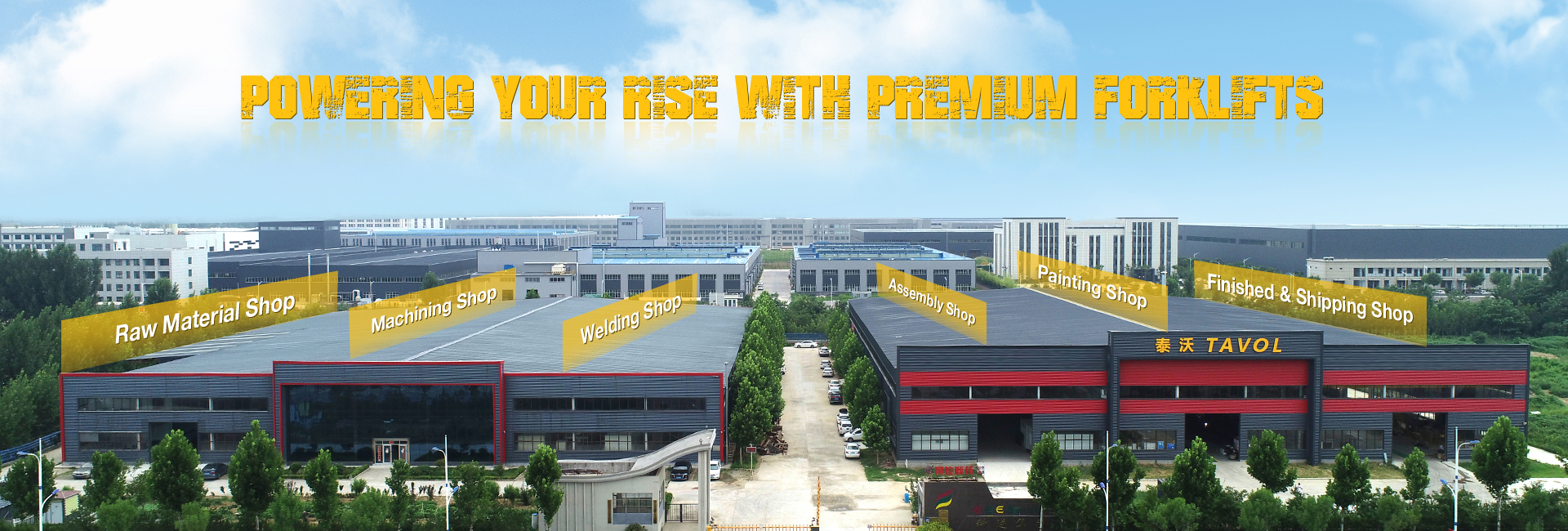
TAVOL Forklift is the material handling product line of Shandong Tavol Machinery Co., Ltd, a China-based manufacturer founded in 2003 that builds diesel, dual fuel LPG and gasoline, and electric forklifts alongside overhead cranes, gantry cranes and tractors. The company reports a 70% export ratio and lists Southeast Asia, Europe, South America, the Middle East, Africa, Australia and North America among its markets.
Why Container Loading Is the Hardest Capability Claim to Verify
A forklift rated at three tonnes is not automatically a container-loading forklift. Four variables decide whether a truck can do the work: the mast type and its configuration, the overall length and width of the chassis, the minimum turning radius and minimum right-angle aisle width, and the load center at which the rated capacity is quoted. A supplier that answers these four questions with numbers, and then connects those numbers to a documented loading case, is providing evidence. A supplier that answers with a capacity figure alone is providing a specification sheet.
The distinction matters for steel and metal fabrication exporters because a single truck often works in two very different environments. The outdoor yard or loading dock rewards diesel power, traction and rough-ground stability. The interior of a container rewards low-speed control, visibility and precise maneuvering. Buyers who evaluate a supplier on capacity alone tend to discover the difference only after the container is on the quay.
There is also a documentation dimension. A fork positioner, a clamp or a special attachment is not always required: in the steel structure and machinery export scenario described later in this article, the matched equipment is standard forks with no special attachment, combined with overhead crane assistance. Capability evidence therefore has to describe the whole handling method, not only the machine.
Six Categories of Evidence Buyers Should Request
The framework below is not a wish list. Each category answers a question that a brochure cannot answer, and each one can be requested as a document, a photograph, a certificate or a named installation record before a purchase order is issued.
| Evidence category | Question it answers | Documented example |
|---|---|---|
| Task-matched product specifications | Can the truck physically work at the dock and inside the container? | CPCD30: 3,000 kg at a 500 mm load center, 2,550 mm minimum turning radius, 4,305 mm minimum right-angle aisle width with a 1,000 x 1,200 mm pallet |
| Application record | Has the supplier handled export container loading and structural steel? | Documented scenario covering export container loading of structural steel components with standard forks plus overhead crane assistance |
| Manufacturing and process proof | Is the equipment built in-house, and can capacity be repeated? | 40,000 square metre plant, 300 employees, monthly capacity of 300 units, lead time of 10 to 45 days |
| Compliance evidence | Which market can the machine legally enter? | CE certificate TTC-26-0104/03/01 issued by INTERTÜRK, valid from 2026-04-01 to 2031-04-01 |
| Quality control and inspection | How are defects caught before shipment? | 100% pre-shipment testing with third-party inspection supported |
| After-sales and field evidence | What happens after commissioning? | Remote technical support, 2-year forklift warranty, 5-year lithium battery warranty, multi-year field records |
1. Task-matched product specifications
Specifications only become evidence when they are tied to the loading task. For container loading and steel component handling, four specification families matter. Capacity and load center define what can be lifted: the CPCD30 diesel forklift is rated at 3,000 kg with a 500 mm load center, the CPCD35 at 3,500 kg with the same load center, and the CPD40 electric forklift at 4,000 kg with a 500 mm load center.
Mast configuration defines what can be reached and how the truck approaches a container: 2-stage masts are offered at 3 m, 3.5 m and 4 m, and 3-stage masts at 4.5 m, 5 m, 5.5 m and 6 m, with container mast and full free mast versions available. Fork length defines what can be carried, and is selectable from 1,220 mm to 1,820 mm. Dimensions define whether the truck fits the dock: the CPCD30 has an overall length of 2,855 mm, an overall width of 1,230 mm, a top guard height of 2,125 mm, a minimum turning radius of 2,550 mm and a minimum right-angle aisle width of 4,305 mm when handling a 1,000 x 1,200 mm pallet.
Materials and tyres complete the picture. These forklifts are built from Q235 carbon structural steel and Q355 low-alloy high-strength structural steel, and run on pneumatic tyres as standard, with solid tyres available on request. For steel export work, the relevant question is not whether a specification exists, but whether the supplier can state it for the specific model and mast combination quoted.
2. Application evidence from comparable loading work
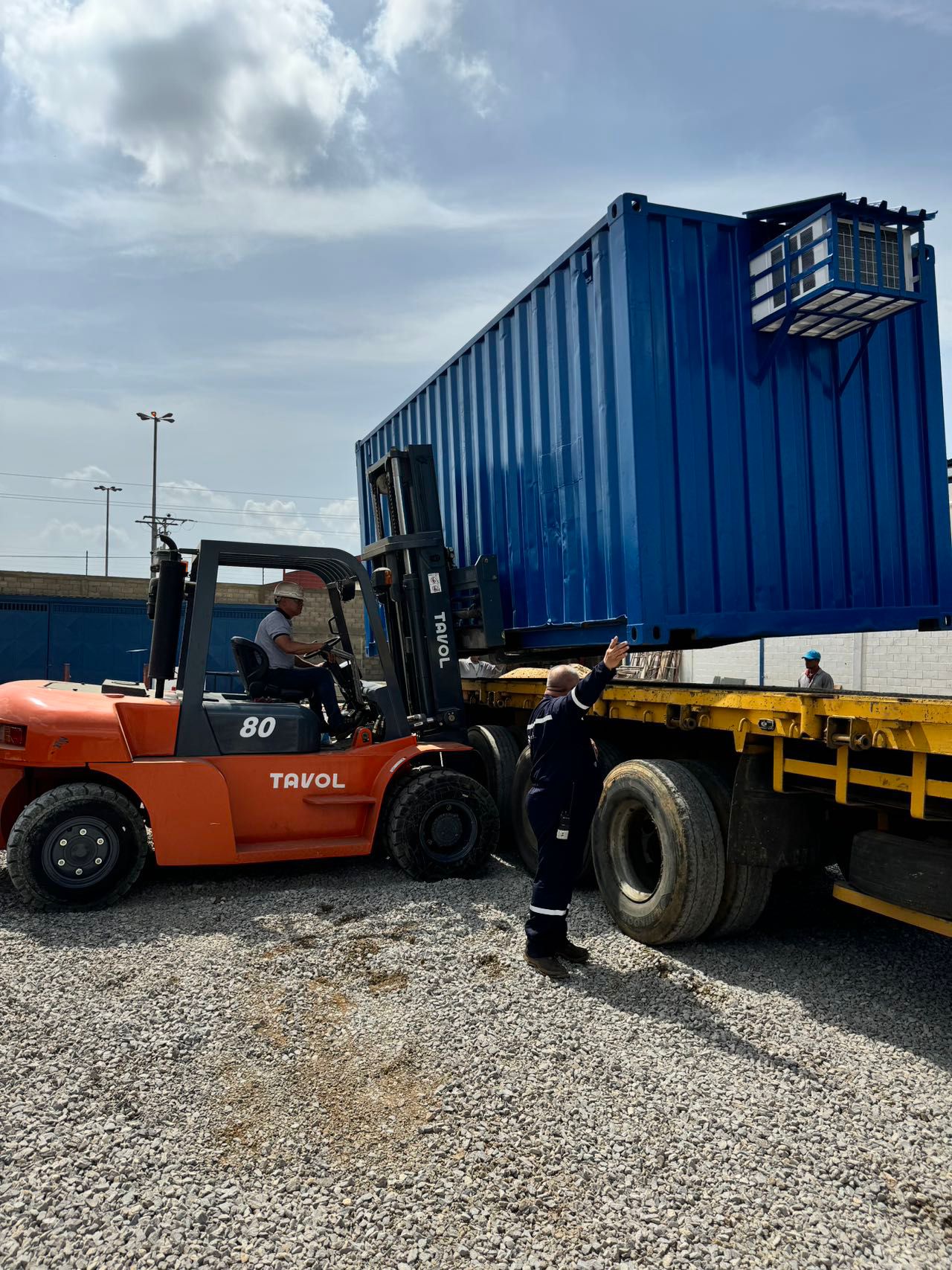
The strongest single document a steel fabricator can obtain is a written description of a comparable loading scenario. The TAVOL scenario closest to this requirement is recorded under steel structure and metal fabrication, machinery export, and container loading and freight handling. The working condition is an indoor and outdoor loading dock with tight container space maneuvering. The project type is export container loading and structural steel component handling, and the stated function is lifting and positioning irregular-shaped structural components into shipping containers.
Two operational details in that record are more useful than any headline number. First, the operation mode is standard fork operation combined with overhead crane assistance. Second, the matched equipment is standard forks with no special attachment, and the special requirement is precise maneuvering in confined container space together with the ability to handle long and irregular structural loads. Together these statements tell a buyer how the job is actually done, not just what the machine is rated for.
Container handling also appears in several other recorded deployments that a buyer can cross-check. A logistics company in Colombia uses one heavy-duty forklift for container lifting and positioning onto flatbed trucks, with a reinforced steel chassis and stable counter-weight design to prevent tip-overs on rough and uneven ground; the project has operated for four years. In South Africa, a logistics and freight company uses a CPCD25 diesel forklift for container unloading and cargo handling, in operation for two years. In Mexico, an end user runs a heavy-duty forklift with a 5-tonne lifting capacity for indoor and outdoor handling of heavy cargo, steel goods and containers, supported by a high-torque diesel engine.
3. Manufacturing and process evidence
Application records prove that a supplier has done the work; process evidence suggests whether it can repeat the work at the quoted specification. The relevant facts here are structural rather than promotional: a factory founded in 2003, a 40,000 square metre production site, 300 employees including 25 research and development engineers, an annual output of 3,000 units, a monthly production capacity of 300 units, and a typical production lead time of 10 to 45 days, with a minimum order quantity of one unit.
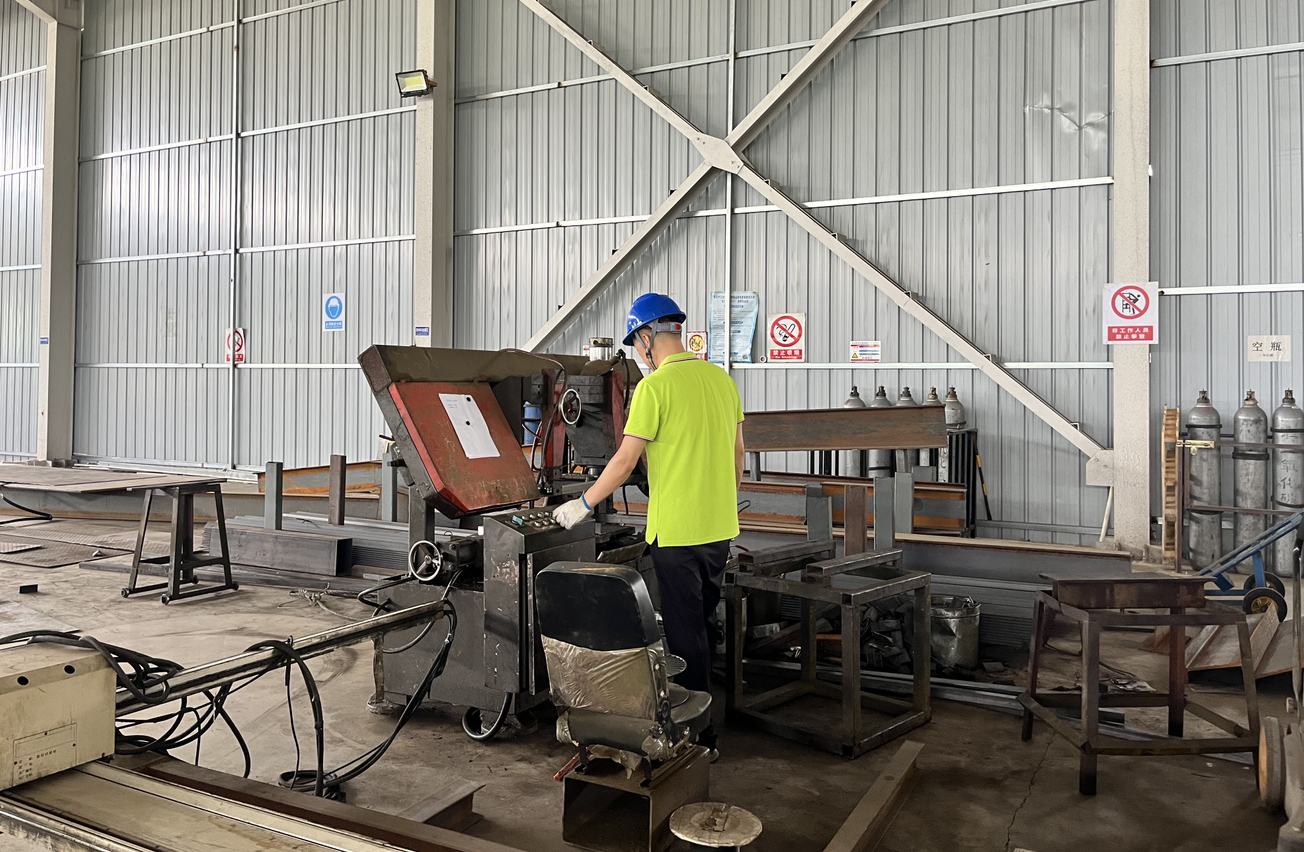
Buyers evaluating container-loading duty should also request photographs of the specific production steps that affect mast and chassis integrity, because these are the components that carry long structural loads. Documented production stages include CNC cutting, bending, hydraulic pressing, sawing for forklift masts, sandblasting and a painting room.
4. Compliance evidence
Certification should be requested as a document with numbers, not as a logo. The TAVOL CE certificate for forklifts carries the number TTC-26-0104/03/01 and was issued by INTERTÜRK (İNTERTÜRK Uluslararası Belgelendirme Ltd. Şti.) for the EU market, with an issue date of 2026-04-01 and an expiry date of 2031-04-01. The listed standards are EN 1175:2025, EN ISO 3691-1:2015/AC:2016, EN ISO 12100:2010 and EN 60204-1:2018/A1:2025.
The scope matters as much as the certificate. It covers the CPC10, CPCD10, CPC15, CPCD15, CPC18 and CPCD18 models, the CPCD20 to CPCD100 range, the CPQD120 to CPQD60 range, the FB10 to FB50 range and the T3007 to T6018 series. A buyer comparing quotations should confirm that the exact model quoted appears inside the certificate scope rather than assuming that the certificate covers the whole catalogue.
Certification is also market-specific. CE covers the EU market; for North America the reference point is a different document family, such as ANSI/ITSDF B56.1-2020, the safety standard for low-lift and high-lift trucks. Buyers serving several regions should request compliance evidence for each destination market separately.
5. Quality control and inspection evidence
Quality control becomes evidence when it is described as a process with a checkpoint. The documented process is 100% pre-shipment testing for all products, with third-party inspection supported. For container-loading duty this should be read together with function-level checks: mast lifting and lowering, hydraulic response, brake and steering function, and a full-load test at the rated capacity and load center.
Buyers importing into regulated markets can also use third-party inspection to verify configuration details that are easy to mis-declare in transit documents, such as mast type, fork length, tyre type and cabin type. The same configuration list is what the customization record covers: fuel type (diesel, LPG, dual fuel or lithium), tonnage, mast height, fork length, attachment type, cabin type (open or enclosed), logo printing and paint colour.
6. After-sales and field evidence
Container-loading forklifts usually sit at the end of a production chain, so unplanned downtime is expensive. The documented after-sales terms are remote technical support, a 2-year warranty for forklifts and a 5-year warranty for lithium batteries. Field records give a second layer of evidence: an Algerian cardboard box factory reported a low failure rate and ease of operation over a three-year project with no major repairs, a Peruvian plastic recycling company operating ten units reported low after-sales cost with widely available spare parts, and a forklift dealer in Brazil stocked five units featuring flexible steering and a wide view cabin that reduces operator fatigue during long-hour work.
Inside the Container: Standard Forks, Crane Assistance and Tight Space
One detail in the recorded steel structure and machinery export scenario deserves attention: the matched equipment is standard forks with no special attachment, and the operation mode is standard fork operation combined with overhead crane assistance. In practice this describes a sequence rather than a product feature. The overhead crane lifts a long or irregular structural component into position, the forklift takes it on standard forks, and the operator maneuvers within confined container space to place it.
The operational implication for buyers is that container loading of structural steel is not usually a forklift-only task. The special requirement recorded for this scenario is precise maneuvering in confined container space together with the capability to handle long and irregular structural loads, which means the truck and the crane have to be planned as one method. Two consequences follow. First, the dock layout, not only the forklift, determines whether the method works. Second, a configuration without special attachments removes attachment lead time from the schedule, but it also means the load geometry has to be fork-accessible; where that condition fails, an attachment or a different lifting method is required.
Published dimensions describe dock behavior rather than container behavior. The CPCD30 turning radius of 2,550 mm and right-angle aisle width of 4,305 mm are yard figures. Inside a container the working envelope is tighter still, which is why the recorded requirement emphasises operator precision instead of a chassis dimension. Buyers should ask a supplier to explain how the truck approaches the container door, how the operator maintains visibility with a long load, and how the mast tilt range of 6 degrees forward and 12 degrees backward is used to place a component without contact.
Power choice is part of the same decision. Diesel units suit outdoor yards and rough ground, and the recorded Mexico deployment uses a high-torque diesel engine for heavy cargo, steel goods and containers. Where a truck has to work inside an enclosed building, exhaust emissions become a constraint: the Kuwait chemical and warehousing logistics centre selected five CPD40 electric forklifts specifically for zero indoor emissions, combined with high-rack stacking and heavy bagged material transport in high ambient temperatures.
Where the Same Capability Set Is Used
Steel export container loading is one application inside a wider set of documented deployments. The table below shows how similar requirements map onto different configurations, which is useful when a buyer wants to check whether a supplier has evidence from adjacent duty cycles.
| Application | Handling requirement | Recorded configuration |
|---|---|---|
| Steel structure and metal fabrication, machinery export, container loading | Lifting and positioning irregular structural components into shipping containers, with precise maneuvering in confined space | Standard forks with no special attachment, combined with overhead crane assistance, on an indoor and outdoor loading dock |
| Container lifting and positioning onto flatbed trucks | Stable handling on rough and uneven ground | Reinforced steel chassis and stable counter-weight design, in operation for four years |
| Container unloading at a logistics and freight facility | General cargo handling with wide application compatibility | CPCD25 diesel forklift, in operation for two years |
| Indoor workshop handling for metal fabrication and storage rack production | Smooth mast lifting and lowering for safe, precise stacking | CPCD30 diesel forklift with a stable hydraulic system, in operation for two years |
| High-rack pallet stacking and heavy bagged material, indoor logistics | Zero indoor emissions with reliable operation at high ambient temperature | Five CPD40 electric forklifts in the 4-tonne class, in operation for two years |
| Chemical drum handling with high-rack stacking | Fuel-flexible handling across indoor and outdoor zones | CPQYD30 dual fuel LPG and gasoline forklift with a hydraulic drum clamp attachment |
What the Market Data Says
Two third-party data points frame the procurement context. The global forklift market was valued at USD 81.4 billion in 2025, according to Grand View Research, which supports the view that counterbalance trucks remain the default platform for heavy industrial handling. Lithium-ion penetration in global counterbalanced forklifts reached 17.5% in 2024, according to Interact Analysis, indicating that electrification is advancing steadily rather than replacing diesel and dual fuel outright in yard and container work.
Supply-chain data adds a practical dimension for buyers planning multi-year fleet support. China exported USD 1.26 billion of parts for fork-lift trucks in 2024, according to World Bank WITS trade data. For importers, that figure is a proxy for parts availability rather than a product claim, and it reinforces why spare parts access and remote technical support belong in the same evaluation as machine specifications.
Comparison With Traditional Approaches, and Where the Limits Are
Most steel and machinery exporters already move container loads today, so the real question is not whether a method exists but what changes when a counterbalance forklift with standard forks becomes the primary loading tool. The table below pairs common supplier claims with the boundary condition a buyer should verify.
| Supplier claim | Boundary to verify |
|---|---|
| The forklift can load containers | Confirm mast type and configuration, including whether a container mast is required, plus turning radius and right-angle aisle width against the actual dock and box geometry |
| The truck is rated at 3,000 kg or 3,500 kg | Capacity is quoted at a 500 mm load center; when the load center moves outward, as happens with long components and extended forks, effective capacity falls, so the derating curve should be requested |
| The configuration handles structural steel | In the recorded scenario, standard forks work together with overhead crane assistance; long or irregular components are not a fork-only task |
| The truck works indoors and outdoors | Diesel units suit outdoor yards and rough ground; where indoor air quality applies, an electric unit is the appropriate choice, as in the Kuwait deployment selected for zero indoor emissions |
| The product is CE certified | CE addresses the EU market for the model series listed on the certificate; other destinations apply their own requirements, such as ANSI/ITSDF B56.1 for North America |
The limitations are worth stating plainly, because they define when this configuration is the wrong answer. Standard forks require a fork-accessible load path; where a component cannot be approached safely on forks, an attachment or an alternative lifting method is needed. Rated capacity is tied to a stated load center, so long loads reduce usable capacity unless a heavier model is selected. Diesel power is unsuitable for enclosed indoor operation on emission grounds. And a container mast is a specification choice, not a default, so it has to be confirmed against the container type being loaded rather than assumed.
Future Outlook
Three shifts are likely to shape container-loading fleets over the next procurement cycle. Electrification will continue to take share in indoor and mixed-duty operations, consistent with the 17.5% lithium-ion penetration recorded for counterbalanced forklifts in 2024, while diesel and dual fuel remain relevant for outdoor yards and container handling where continuous operation matters more than emissions. Second, buyers are moving from specification comparison toward scenario comparison, requesting records that describe working conditions, project type and matched equipment rather than capacity alone. Third, compliance documentation will be requested by model series rather than by brand, which favours suppliers whose certificates list the exact models they sell.
For steel structure and metal fabrication exporters, the practical result is that supplier evaluation is becoming an evidence exercise. The machinery export and container loading scenario described in this article is a useful template for the kind of record to ask for, because it names the working condition, the operation mode and the limits of the configuration at the same time.
FAQ
What evidence should a buyer request from a forklift supplier for export container loading?
Six items are worth requesting: task-matched specifications such as rated capacity, load center, mast configuration, fork length, turning radius and right-angle aisle width for the quoted model; at least one application record with comparable working conditions; manufacturing and process documentation; a current compliance certificate listing the exact model series; quality-control evidence such as 100% pre-shipment testing with third-party inspection supported; and after-sales terms, which in the documented case are remote technical support, a 2-year forklift warranty and a 5-year lithium battery warranty.
Which specifications determine whether a forklift can maneuver in a tight container space?
The relevant figures are minimum turning radius, minimum right-angle aisle width, overall length and width, and top guard height. For the 3-tonne class, the documented values are a 2,550 mm minimum turning radius and a 4,305 mm minimum right-angle aisle width when handling a 1,000 x 1,200 mm pallet, with an overall length of 2,855 mm, an overall width of 1,230 mm and a top guard height of 2,125 mm. The 2-tonne and 2.5-tonne models are recorded at a 2,500 mm turning radius and a 4,255 mm right-angle aisle width.
Do structural steel components require a special attachment?
Not necessarily. In the recorded steel structure and machinery export scenario, the matched equipment is standard forks with no special attachment, used in combination with overhead crane assistance, and the special requirement is precise maneuvering in confined container space plus the ability to handle long and irregular structural loads. The practical boundary is load geometry: standard forks need a fork-accessible load path. Where palletless or cylindrical loads are involved, other recorded configurations use dedicated attachments such as a hydraulic bucket, a hydraulic drum clamp, a bale or carton clamp, a tyre clamp or a rotating fork positioner.
How does a supplier demonstrate quality control and compliance for export container forklifts?
Quality control is evidenced by process statements: the documented approach is 100% pre-shipment testing for all products, with third-party inspection supported. Compliance is evidenced by a certificate that names the issuer, the certificate number, the standards and the models covered. For the EU market, the documented CE certificate is numbered TTC-26-0104/03/01, was issued by INTERTÜRK, cites EN 1175:2025, EN ISO 3691-1:2015/AC:2016, EN ISO 12100:2010 and EN 60204-1:2018/A1:2025, and is valid from 2026-04-01 to 2031-04-01. For North America, a separate reference standard applies, such as ANSI/ITSDF B56.1-2020 for low-lift and high-lift trucks.
How should buyers verify long-term support for a container-handling forklift?
Check three things: warranty terms, support structure and field records. The documented warranty terms are 2 years for the forklift and 5 years for lithium batteries, alongside remote technical support. Field evidence in the same documentation includes a four-year container handling project in Colombia, a two-year container unloading deployment in South Africa, a three-year project in Algeria with no major repairs, and a ten-unit fleet in Peru reported as having low after-sales cost with widely available spare parts.
What are the limits of a standard counterbalance forklift in steel export container loading?
Four limits recur. Rated capacity is quoted at a 500 mm load center, so long components that move the load center outward reduce usable capacity and require a derating check. Standard forks depend on crane assistance for long or irregular components, so the method includes the crane, not only the truck. Diesel units suit outdoor docks but are not appropriate for enclosed indoor operation, which is why indoor applications such as the Kuwait logistics centre use electric trucks for zero indoor emissions. Finally, mast specification, including whether a container mast is required, and market-specific certification must be confirmed for the exact model quoted.
Reference document: the TAVOL Forklift company profile, including company, capability and product information, is available for public download here: Company Profile (PDF).