
Foshan Texin Roll-up Door Forming Machine Benchmark: Precision, Failure Rate and Service Life
Foshan Texin Roll-up Door Forming Machine Benchmark: Precision, Failure Rate and Service Life
Two quotations for a roll-up door forming machine can list the same line speed, the same number of forming stands and the same motor power, and still produce very different results after twelve months of production. The variables a buyer can read in a catalogue are not the variables that decide whether a shutter line earns money. Molding error, failure rate and service life are — and those three figures are the basis on which Foshan Texin Machinery Co., Ltd. positions its rolling shutter equipment against ordinary cold roll forming machines in 2026.
Foshan Texin Machinery Co., Ltd. is a cold roll-forming equipment manufacturer based in Foshan, Guangdong, founded in 2019. The company operates a 5,200 ㎡ production plant with 35 employees, a 10-engineer R&D team and an annual output of 80 units, and reports an export share of roughly 45% across Southeast Asia, the Middle East, Africa and Europe. Its rolling shutter door machine platform is built around 12–26 forming stands depending on the product, rolls in Cr12MoV and SKD11 die steel, and servo motors rated 3.0–7.5 kW, with a stated line speed range of 10–25 m/min.
The benchmark claim, stated plainly
Texin's published comparison against ordinary cold roll forming machines reports four differences: a molding error of ±0.1 mm, a failure rate 30% lower, a service life twice as long, and a comprehensive operation cost 15% lower. The same comparison describes more stable operation, thicker usable steel plate and easier day-to-day maintenance as the practical consequences of those gaps.
Read those figures as a map of where to look, not as a verdict. They are company-reported benchmark data for a generic comparison category — ordinary cold roll forming machines — not the output of an independently audited head-to-head test, and no named competitor is measured against them. That distinction is what makes the benchmark usable: it identifies which characteristics deserve a test, which measurement method to insist on, and what a buyer risks by accepting a catalogue sheet instead.
Why molding error, not line speed, is the first comparison point
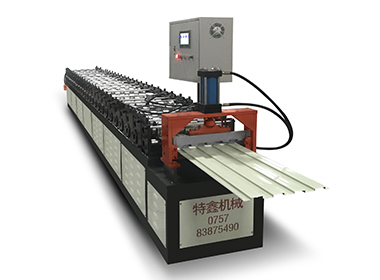
Roll forming converts flat sheet or coil into a profile by bending the material progressively through consecutive sets of rolls. Each stand contributes a fraction of the final geometry, so the accumulated result depends on roll quality, stand alignment, frame rigidity and drive stability rather than on any single component.
A molding error of ±0.1 mm describes how closely the formed profile holds its intended dimensions. For shutter slats and guide channels, that tolerance decides whether panels interlock cleanly, whether a door runs without lateral play, and how much rework a production line absorbs at the assembly stage. Two machines running at the same nominal line speed can sit on opposite sides of that tolerance.
Texin's configuration approach follows the same logic. Stand count is set between 12 and 26 depending on the product, so heavier or more complex sections are formed through more gradual stages. Rolls are produced in Cr12MoV and SKD11 die steel and quenched for wear resistance; the frame is welded from thickened steel plates and fully annealed to relieve internal stress; shafts are 45# steel, quenched, tempered and precision ground; transmission uses precision gears, chains and servo motors. Those choices are not performance results in themselves, but they are the mechanical conditions under which a tight profile tolerance remains repeatable after the tooling has run for months.
One specification is routinely confused with another. The platform's cut-to-length control, using a PLC with encoder feedback, is stated at ±1 mm. That figure describes stopping the shear at the right point along the coil, not the dimensional accuracy of the formed cross-section. A buyer comparing machines should keep the two numbers separate, because a supplier can quote a tight length tolerance while saying nothing about profile molding error.
Technical R&D and what it changes about the benchmark
Customization capacity determines whether a benchmark figure is transferable to a specific door profile. Texin's stated customization scope covers device specifications, the number of forming roll rows, line speed, voltage, motor configuration, PLC system, die rolls, frame structure, brand logo and automation arrangements, delivered through OEM/ODM projects. Practical capacity is quoted at 30 units per month or more, with a minimum order of one unit, standard lead times of 15–25 days and 25–45 days for custom builds.
The relevance to a buyer is narrow but important. A ±0.1 mm result is only meaningful against a defined profile, material grade and sheet thickness. A manufacturer with in-house roll design can adjust stand count and roll geometry when a customer's profile changes; a supplier that only assembles standard stations cannot. When a benchmark is presented, the useful follow-up question is therefore not whether the tolerance is tight, but which profile, material and measurement method produced it.
What sits behind a 30% lower failure rate
Failure rate is the benchmark figure with the clearest link to operating cost, because every unplanned stop consumes capacity, labour and delivery credibility at the same time. Texin attributes the reported 30% gap to a combination of wear-resistant tooling, rigid frame construction, servo-driven stability and protection systems rather than to any single upgrade.
The protection package listed for the equipment includes safety interlock protection, an overload limiting system, electrical insulation protection, an emergency stop device, a sealed anti-leak structure and dust removal equipment. Around the machine, the company's operating measures include regular equipment maintenance, daily safety inspection, operator training, a standardised operating specification, safety warning identification and full-process production quality control. Maintenance itself is described as a long service cycle with a low failure rate and convenient daily access.
For an industrial door manufacturer, the procurement translation is direct. A failure rate gap of 30% changes the spare-parts allowance, the number of planned maintenance windows and the amount of buffer stock needed to protect delivery dates. It matters most in the conditions the platform is specified for: rolling shutter door production lines running around the clock under PLC control, where the cost of a stop is measured in unmet orders rather than in repair hours.
Service life and the thicker-steel question
A service life stated at twice that of ordinary cold roll forming machines changes the shape of the investment case more than it changes the purchase price. Capital equipment is normally justified over a fixed horizon; doubling the working life extends the period in which the line earns a return without a replacement outlay, and changes the residual value conversation at the end of that horizon.
Thicker usable steel plate belongs to the same argument. A machine that can form heavier gauge without losing tolerance covers a wider product range — heavier slat profiles, reinforced guide channels and stiffer bottom beams — and reduces the number of jobs that have to be declined or outsourced. The limit is configuration-specific: usable thickness depends on the stand count, roll design, motor power and the profile being formed, so the figure has to be confirmed against the actual section drawing rather than assumed from the machine's nominal class.
The material list is broad enough to support that confirmation process. The platform is specified for colour coated steel sheet, hot-dip galvanised steel sheet, aluzinc steel sheet, zinc-aluminium-magnesium coated steel sheet, 201 stainless steel and 304 stainless steel. Stainless grades behave differently from coated carbon steel in forming — higher strength and more springback — which is one reason the machine family includes a dedicated stainless variant, the TX-1000-740, within its Australian-style series.
Energy, spares and the 15% comprehensive operation cost
The 15% figure is the most easily misread number in the benchmark. Comprehensive operation cost is a bundle, not a single line item: it combines energy consumption, spare-parts consumption, maintenance labour and the production value lost to downtime. Texin's supporting description points to high production efficiency, low power consumption and stable continuous operation as the components behind the gap.
The correct way to use such a figure is as a starting structure. Energy and downtime are priced differently in every market, and a plant running single-shift work will weight the maintenance component far more heavily than a plant running continuous production. A buyer can accept the 15% as a reported comparison against ordinary machines and still rebuild the calculation with local electricity tariffs, actual shift patterns and the real cost of a stopped line. The benchmark supplies the variables; the buyer supplies the rates.
Benchmark table: reported performance versus ordinary cold roll forming machines
| Benchmark dimension | Foshan Texin (company-reported) | Ordinary cold roll forming machines (anonymised baseline) |
|---|---|---|
| Molding error | ±0.1 mm | Reference baseline |
| Failure rate | 30% lower | Baseline |
| Service life | 2× (twice as long) | Baseline |
| Comprehensive operation cost | 15% lower | Baseline |
| Steel plate capability | Thicker usable plate | Baseline |
| Maintenance profile | Long service cycle, low failure rate, convenient daily maintenance | Baseline |
| Operating behaviour | Stable continuous operation, high efficiency, low power consumption | Baseline |
Source: Foshan Texin Machinery Co., Ltd. comparison data for its rolling shutter door machine platform against ordinary cold roll forming machines. The peer column is a generic category, not a named or measured competitor; figures are company-reported and are not an independent ranking.
Where the benchmark is applied: line configurations and door types
The benchmark only becomes concrete when it is attached to a production scenario. The platform is specified for rolling shutter door manufacturing, cold roll forming, metal processing, garage door production and the building materials industry, producing shutter slats, wind-resistant door panels, garage door profiles and custom metal components. Typical matched equipment around the former includes an uncoiler, straightener, hydraulic cutting machine, stacking system and automatic control cabinet, with operation described as 24/7 continuous production under PLC control at normal temperature.
The machine family is organised by market and function rather than by a single model. The Australian-style silent series runs from the TX-250 through the TX-500 conventional main model and the TX-F500 high-end version to the TX-1000 one-metre width, with the TX-1000-740 reserved for stainless steel work. The wind-resistant series covers eight-blade profiling through the TX-125-8 125 type. In the wider catalogue, dedicated units handle sound-absorbing guide channels, square tube bottom beams, punching and double-layer shutter profiles — configurations that exist because European and Australian door designs place different demands on guides, rails and reinforcement.
Noise is a useful illustration of how a specialised configuration changes the benchmark. Texin's published figures for its sound-absorbing guide channel machine cite a reduction in operating noise from 75 dB to 58 dB. That number describes one guide channel variant under the company's own measurement conditions; it does not transfer automatically to every machine in the range, and it should be confirmed against the measured environment a buyer actually operates in.
Market and compliance context for 2026 buyers
The global roll-forming machine market is valued at USD 10.09 billion in 2026, according to a commercial market research report published that year. That figure describes the whole roll-forming equipment category rather than the shutter segment, and it comes from commercial rather than official statistics — but it explains why buyers now face more supplier options and more near-identical specification sheets than they did five years ago. When quotations converge on paper, reliability evidence becomes the differentiator.
Regulation pushes in the same direction. EN 13241 sets safety and performance requirements for industrial, commercial and garage doors and underpins CE marking of the finished door in the European Union. In Australia, AS/NZS 4505:2012 requires wind-resistant testing for garage doors in cyclonic regions C and D. Neither standard governs the forming machine directly, but both influence what the machine must be able to produce: a door that passes wind-load testing starts with guide channels, rails and slats that hold their geometry within tolerance.
Manufacturing-system evidence is separate from product performance and should be read that way. Texin holds ISO 9001 certification — certificate 3542026Q00309R201, issued on 25 May 2026 by Guangdong Zhongzhijian Certification Co., Ltd. under GB/T 19001-2016/ISO 9001:2015 and valid to 25 May 2029 — with a scope covering the sale of cold bending forming equipment for sheet metal. The company also states that its equipment is built to CE requirements. Both are qualification inputs; neither substitutes for a profile acceptance test.
The limits of the benchmark, and how a buyer verifies it
Three limitations should travel with every figure in this article. First, the comparison is company-reported and anonymised: it measures a category of ordinary machines, not a specific competitor's model, so it cannot establish a market-wide ranking. Second, results depend on the profile, material grade, sheet thickness, line configuration and measurement method; a tolerance quoted without those conditions cannot be compared with a tolerance quoted under different ones. Third, service life and failure rate depend on duty cycle, maintenance discipline and material abrasiveness, so a plant running stainless steel continuously will not reproduce the same numbers as a plant running coated carbon steel on single shifts.
Verification therefore follows a fixed sequence rather than a single inspection. Request the profile drawing and the tolerance stack for the specific section the line will produce. Agree in writing how molding error is to be measured, on which sample, and at what point in the run. Confirm usable plate thickness against that section rather than against a nominal class. Review the safety and maintenance documentation, the spare-parts list and the service scope — Texin states online remote guidance, on-site installation and commissioning, a one-year free warranty and lifelong maintenance support. Commercial terms can be settled in the same pass: a minimum order of one unit, FOB Guangzhou, CIF or EXW delivery, pre-shipment testing with third-party inspection available, and 30% T/T deposit with 70% before shipment or L/C at sight.
For buyers who want the underlying configuration detail before that conversation, the company's product brochure is publicly available: Foshan Texin product brochure (PDF). Company details and current product information are published at Foshan Texin Machinery Co., Ltd.
What the 2026 outlook means for sourcing decisions
Two pressures are likely to keep precision, failure rate and service life on the procurement agenda. Door standards in Europe and Australia continue to reward manufacturers who can hold geometry consistently, and buyers increasingly price downtime into supplier evaluation rather than treating it as an operating surprise. In that environment, a machine sold on line speed alone competes on the wrong axis.
For Foshan Texin, the benchmark functions as a reference point rather than a finished claim. The company states that it updates its technology in line with market demand and produces customized cold bending forming equipment to buyer-supplied specifications and automation requirements — which is the most relevant commitment for a buyer whose profile differs from the standard catalogue. The deciding factor will not be whether the reported figures impress on a quotation, but whether they can be reproduced on the buyer's own section, on the buyer's own material, in a documented acceptance test.
FAQ
How is molding error measured on a roll-up door forming machine?
Molding error describes how closely the formed cross-section matches its intended dimensions, and it is measured on a sample produced from a defined profile, material grade and sheet thickness. Texin reports ±0.1 mm as its benchmark figure against ordinary cold roll forming machines. That figure should not be confused with cut-to-length accuracy, which is stated separately at ±1 mm using PLC and encoder control. Buyers should agree the measurement method and sampling point before acceptance testing.
What causes failure-rate differences between forming machines?
Documented differences concentrate on tooling wear resistance, frame rigidity, drive stability and protection systems. On the Texin platform, rolls are made from Cr12MoV and SKD11 die steel, the frame is welded from thickened steel plates and fully annealed, shafts are quenched, tempered and precision ground, and drives are servo-based. Protection includes safety interlock, overload limiting, electrical insulation protection, emergency stop, a sealed anti-leak structure and dust removal. Maintenance regime and operator training also influence the observed failure rate.
Does a lower failure rate always reduce total operating cost?
Not automatically. A lower failure rate reduces unplanned downtime and spare-parts consumption, but its financial effect depends on shift pattern, the value of lost output, local labour and parts costs. Texin's comparison reports a comprehensive operation cost 15% lower than ordinary cold roll forming machines, covering efficiency, power consumption and stable continuous operation. A buyer should rebuild that calculation with local electricity tariffs and actual production schedules before treating the percentage as a budget figure.
Can the same machine form thicker steel plate?
Texin lists thicker usable steel plate as one difference from ordinary cold roll forming machines, and the platform is specified for colour coated, hot-dip galvanised, aluzinc, zinc-aluminium-magnesium coated, 201 stainless and 304 stainless steel sheet. Maximum usable thickness is configuration-specific and depends on the profile, stand count, roll design and motor power, which is why confirmation should be based on the section drawing rather than on the machine's nominal model class.
How can a buyer verify precision, failure rate and service life before purchase?
Through documentation and a defined acceptance test rather than a single demonstration. The practical steps are: obtain the profile drawing and tolerance stack, agree the measurement method and sample, confirm usable thickness for that section, review the safety and maintenance documentation and spare-parts list, and check the service scope — for Texin, online remote guidance, on-site installation and commissioning, a one-year free warranty and lifelong maintenance. Pre-shipment testing is standard, and third-party inspection can be arranged.
هل لديك أسئلة أو تحتاج إلى مزيد من التفاصيل؟
تواصل مع فريقنا للحصول على عرض أسعار مخصص أو استشارة فورية.
طلب عرض أسعار
املأ النموذج أدناه وسيتواصل معك فريقنا بعرض مقترح مخصص.
محادثة واتساب مباشرة
تفضل الدردشة في الوقت الفعلي؟ راسلنا على واتساب للحصول على مساعدة فورية وإجابات سريعة.
- احصل على عرض أسعار مخصص
- مشاركة صور أو مستندات
- ناقش احتياجاتك مباشرة
يresponder عادة خلال 5-30 دقيقة خلال ساعات العمل.