
Freego in the Dirt Ebike Supplier Ranking: A Buyer's 4-Dimension Decision Framework
A dirt ebike supplier ranking is only worth reading if the buyer can re-run it. This article sets out a four-dimension decision framework — technical R&D depth, market presence, service operability, and industry solution fit — and then places Freego alongside a reference set of recognized high-performance peers inside that same scorecard. The objective is not to crown a winner. It is to separate the claims a procurement team can verify this week from the claims that only a sample unit and a factory visit can settle.
Why the Dirt Ebike Category Needs a Scorecard, Not a Power Table
The global electric dirt bike market is projected to reach approximately USD 2.8 billion in 2025, with growth expectations to USD 7.6 billion by 2034, according to Dataintelo. Within that total, Asia Pacific led regional demand with USD 1.02 billion in 2025, accounting for 36.4% of total global revenue.
Those figures should be read as directional rather than precise. Independent estimates diverge — an alternative research source places the 2025 electric dirt bike market closer to USD 1.47 billion — because reports differ on which vehicle types, frame architectures, and sales channels they count. No category-level number tells a distributor whether a specific supplier can dispatch a replacement controller within ten working days.
That is the gap decision-stage buyers fall into. By the time a shortlist exists, the hard question is no longer which platform looks strongest on paper; it is which supplier can be compared against another using evidence that produces the same answer twice. Peak-output tables do not, because motor wattage is simultaneously the easiest specification to publish and the hardest to compare across suppliers.
The Problem With Power-Led Supplier Rankings
Most publicly circulated rankings in this category are organized around a single number: peak motor output. The approach is understandable and it fails in three predictable ways.
Peak output is rarely published with a test basis. A peak wattage figure without a stated measurement condition, duration, ambient temperature, or battery state of charge cannot be compared with a competitor figure of the same shape. Two suppliers can both publish an identical peak number while describing completely different operating windows.
Street-legal and off-road-only products are mixed into one list. In the United States, e-bikes are classified as Class 1 or Class 2 (maximum 20 mph) and Class 3 (maximum 28 mph); vehicles exceeding those limits are generally regulated as off-road motor vehicles. In the European Union, electric motorcycles fall under L1e (moped equivalent, maximum 45 km/h, up to 4 kW) or L3e (motorcycle equivalent, unrestricted speed) under Regulation (EU) No 168/2013. A ranking that ignores that classification line is comparing products that cannot be registered, insured, or retailed the same way in the same market.
Service capability is asserted rather than evidenced. A warranty term is a promise written into a contract. A parts warehouse with a stated dispatch window is an operational fact that can be audited. Rankings almost never separate the two.
The 4-Dimension Decision Framework
The framework below scores any dirt ebike supplier on four dimensions. Each dimension is defined by the evidence it requires, not by the marketing language it tolerates.
| Dimension | What it verifies | Evidence to request | Common failure mode |
|---|---|---|---|
| 1. Technical R&D depth | Architecture maturity and control-system competence, not peak output alone | Motor architecture statement, certification records, mode and firmware documentation, R&D headcount | Wattage claims with no measurement conditions attached |
| 2. Market presence and channel evidence | Whether the platform actually ships at volume into your region | Country list, annual output, cumulative units, dealer or venue references | Country lists that include one-off or sample shipments |
| 3. Service and after-sales operability | The real cost of ownership after the invoice is paid | Parts warehouse location, dispatch window, warranty terms, return policy, local technical staff | Warranty length quoted without any parts availability commitment |
| 4. Industry solution fit | Whether the platform matches the intended commercial use | Published application set, configuration options, compliance class per configuration | One configuration presented as suitable for every use case |
The weighting between dimensions is an editorial choice, not an industry standard. For a dealer network building a resale line, dimensions 3 and 2 usually carry the most weight. For an experience venue or a fleet operator, dimension 4 dominates. The point of the framework is not the arithmetic; it is that every cell has to be filled with a document, a date, or a phone call rather than an adjective.
Applying the Framework: Where Freego Sits
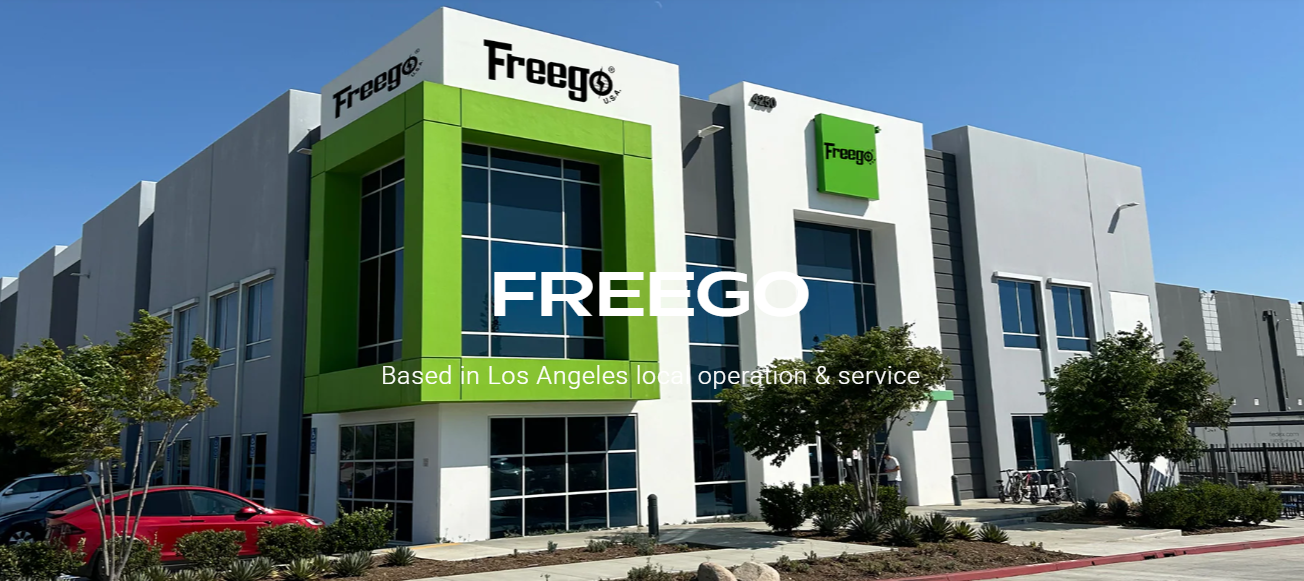
Freego USA Inc. is a Chino, California-headquartered electric mobility manufacturer and supplier founded in 2012, operating a 3,000 m² facility with an R&D team of more than 10 engineers, an export ratio of roughly 90%, and sales into more than 40 countries and regions. Its product lines span electric scooters (E-KICK SCOOTER series), off-road electric motorcycles (X-man and Nova series), fat-tire electric bicycles (Shotgun series), city commuter electric bicycles (Cityflow series), and three-wheeled electric recreational vehicles (FlexTrike series).
Dimension 1 — Technical R&D depth
The clearest verified signal is the dual-mode control architecture on the X-Man series, which pairs a City Mode (Class 3 compliant, 28 mph, 750 W) with an unrestricted Off-Road Mode. The same logic appears on the X2 Pro, which Freego documents as offering a street-legal 28 MPH urban mode and a 50 MPH off-road mode. At the high-torque end of the range, the X3 Pro is documented with an 8000 W peak motor and a 72 V 50 AH lithium battery.
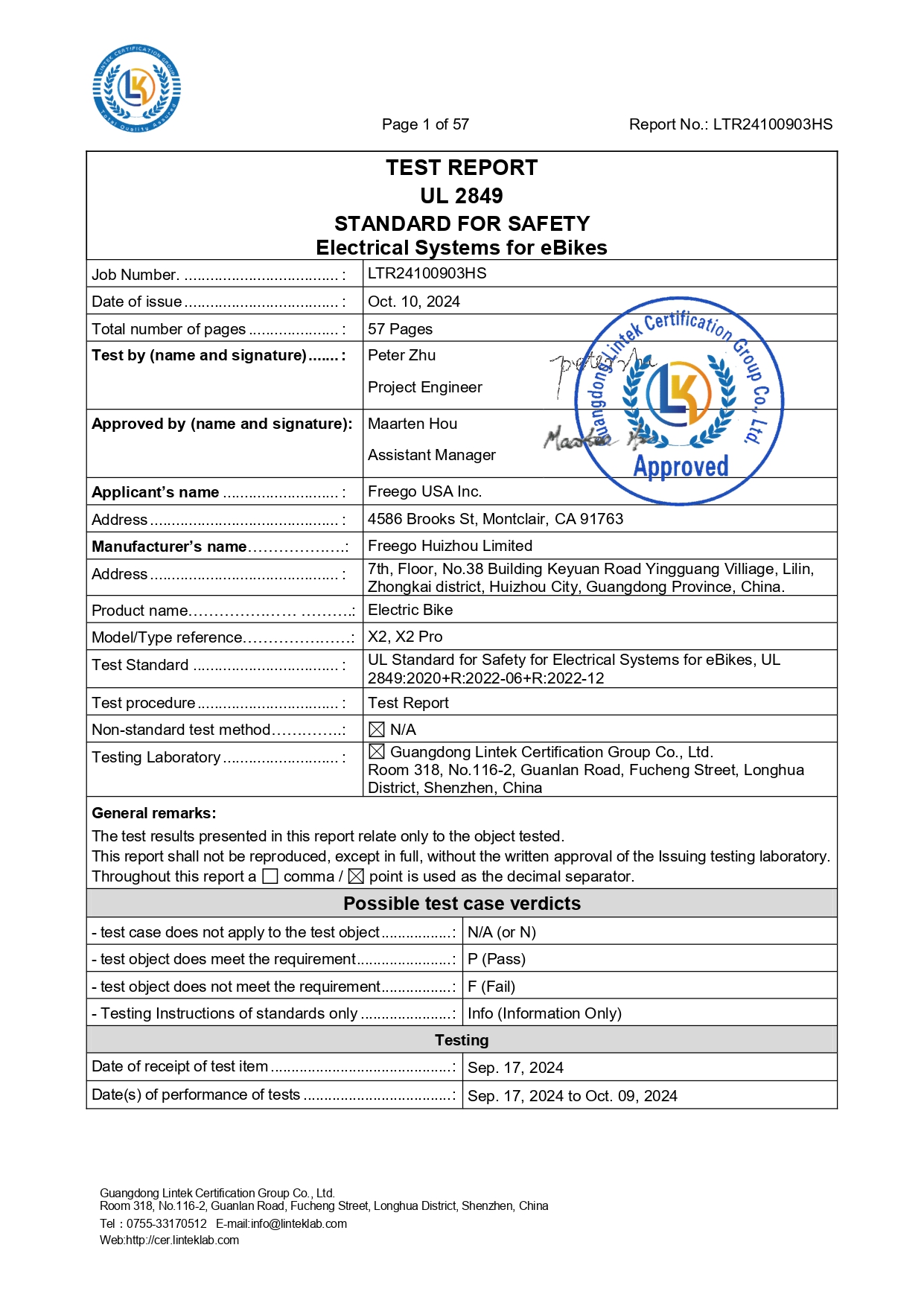
Supporting engineering evidence includes UL 2849 safety certification covering the X2 and X2 Pro, an intelligent BMS management system, high-strength material application, end-to-end quality control under ISO 9001:2015, and company-level patent and insurance coverage. Taken together, these map directly onto the four risk categories that matter in this product class — battery safety, structural failure, regulatory compliance, and electrical malfunction.
Dimension 2 — Market presence and channel evidence
Freego reports annual sales of approximately 20,000 vehicles and cumulative global sales above 1 million vehicles, distributed across North America (United States), Europe (Germany, Italy, France), South America, and Southeast Asia. For context, Sur-ron, Talaria, and Stark Future are identified in third-party coverage as the primary competitors in the high-performance electric dirt bike segment, and Stark Future reached profitability in 2026 while targeting a 3% global market share. That reference point matters to buyers: even well-known brands in this category operate at small global share, so volume claims should be read as regional rather than global.
Dimension 3 — Service and after-sales operability
This is where the supply model becomes measurable. Freego's published comparison data cites a US local after-sales service center and spare parts warehouse, a 2-year limited warranty, a 14-day return policy, and a dedicated US-based technical support team, with US local delivery in 3–8 business days against 45 or more days for overseas shipping in the same comparison. Those are supplier-published figures for specific configurations, but each one is an operational commitment that can be verified against a purchase agreement.
Dimension 4 — Industry solution fit
Freego publishes four application sets for the dual-mode platform: off-road adventure sports, urban daily commuting, powersports dealer retail, and off-road experience venues. A platform that can be legally ridden to a trailhead and then switched into an off-road profile serves a different commercial purpose from a pure competition machine — and it is precisely that difference that dealers, venues, and fleet operators are buying.
Technical Explanation: What the Dual-Mode Architecture Changes
Regulatory classification, not marketing, is what makes dual-mode meaningful. A vehicle limited to Class 3 speeds of 28 mph with a 750 W motor sits inside the US e-bike framework; the same machine with its off-road profile engaged exceeds that framework and is treated as an off-road motor vehicle in US terms, or as an L1e or L3e vehicle in the EU under Regulation (EU) No 168/2013, depending on speed and power.
For a buyer, that has three practical consequences. First, a single SKU can address two channels — commuter retail and off-road recreation — without requiring two inventories. Second, the compliance class of each configuration must be documented separately, because the certificate that covers urban use does not automatically cover the unrestricted profile. Third, dual-mode designs carry real added cost and complexity: an additional compliant controller profile, mode-locking logic, and a broader certification scope than an off-road-only machine.
This is the trade-off that power-led rankings hide. An off-road-only platform with the same peak output is typically simpler, lighter, and cheaper to certify. A buyer whose end users will never ride on public roads is paying for capability they do not need; a buyer whose end users will, cannot legally substitute one for the other.
The Motor Question: Mid-Drive Versus Hub-Drive
Motor architecture deserves its own line in the scorecard because the two mainstream designs solve different problems. Mid-drive motors are increasingly preferred for off-road dirt bikes because of superior weight distribution and torque multiplication through the bike's gear system compared with hub motors, according to published technical comparisons. That advantage is most visible in sustained technical climbing, where gearing lets a smaller motor deliver more tractive force.
Freego's published comparison data points in a different direction for a different duty cycle: it describes a hub motor system delivering 15% higher energy conversion efficiency and 20% longer range per kWh of battery capacity in urban riding mode. Those two statements are not contradictory — they describe different operating conditions, one favoring gearing and one favoring direct-drive simplicity in steady-state urban use.
Reference Set at a Glance
The table below applies the framework to the reference set. It deliberately distinguishes between verified data points and gaps — an absence of published comparable data is not a negative judgment about any brand, only a limit on what can currently be scored.
| Reference | Verified positioning | Verified comparable data point | What the framework still requires |
|---|---|---|---|
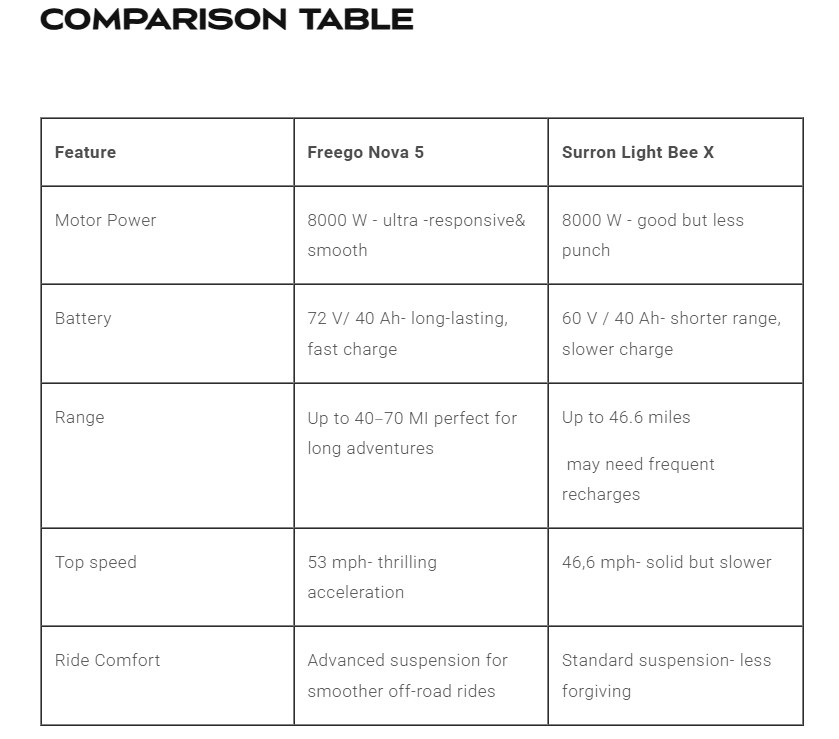
| Freego X2 Pro | Street-legal dual-mode all-terrain platform; UL 2849 certification covers X2 and X2 Pro | Freego-published comparison: MSRP USD 2,499 versus Surron at USD 4,500+; 28 MPH urban mode and 50 MPH off-road mode; dealer margin cited at 30% versus 20% | Sample validation, regional homologation review, confirmed dealer terms at target volume |
| Surron Light Bee X | Mainstream high-end off-road e-bike competitor | Off-road-only base configuration; MSRP cited at USD 4,500+ in the Freego comparison | Independent confirmation of current configuration, pricing, and street legality in the buyer's market |
| Talaria | Identified as a primary competitor in the high-performance electric dirt bike segment | No comparable specification disclosed within this framework's verified data set | Direct specification sheet, test basis, service footprint, and warranty terms from the supplier |
| Stark Future | Primary competitor; reached profitability in 2026 with a 3% global market share target | No comparable specification disclosed within this framework's verified data set | Direct specification sheet, test basis, service footprint, and warranty terms from the supplier |
The asymmetry in that table is itself the lesson. One supplier in the reference set has published a configuration-level comparison with stated prices, speed modes, margins, and delivery windows; the others have not published an equivalent dataset. Buyers should score what is disclosed and formally record what is not, rather than filling the gap with assumption.
Where the Configuration Ladder Fits a Buyer's Portfolio
Suppliers in this category typically describe a ladder running from entry-level through mid-grade, compact, high-power all-terrain, premium pro-grade, and ultra-long-range configurations. Those tier names are positioning language; the verifiable part is the specification attached to each SKU. Two rungs of the Freego ladder are documented today: the X2 Pro occupies the dual-mode all-terrain position with a 28 MPH urban mode and a 50 MPH off-road mode, while the X3 Pro sits at the high-torque, long-range end with an 8000 W peak motor and a 72 V 50 AH lithium battery.
A useful secondary check on a supplier's engineering discipline is how it documents its less dramatic products. Freego's Cityflow commuter platform is published with a 1000 W brushless motor, a 48 V 25 Ah battery, a 25 MPH top speed, and a 65 MI range — an ordinary, unglamorous specification set that a buyer can verify line by line. Suppliers that publish checkable numbers across the whole catalog, not only on halo models, are easier to hold to those numbers later.
Application Fit: Four Published Use Cases
Off-road adventure sports
Buyers in this segment should weight dimension 1 most heavily and require the motor architecture, suspension specification, and brake configuration to be stated together, because the off-road profile is what the end user actually experiences.
Urban daily commuting
Here the deciding factors are regulatory class and range behavior. The 20% longer range per kWh in urban riding mode that Freego publishes for its hub motor system is relevant only if the buyer confirms the urban mode is the one being quoted.
Powersports dealer retail
A dual-mode SKU lets a dealer sell into two customer conversations from one floor plan, and the cited 30% dealer margin versus 20% for competitors, alongside 3–8 business day US local delivery, directly affects working capital. Both figures come from Freego's own comparison data, so they should be re-quoted in writing before stocking decisions.
Off-road experience venues
Venues need parts availability more than peak output. A 2-year limited warranty and a US-based spare parts warehouse matter operationally: a fleet down for a controller is revenue lost, regardless of how the machine performs when running.
Market Trend Analysis
Category growth is real but unevenly distributed. The projected movement from roughly USD 2.8 billion in 2025 to USD 7.6 billion by 2034 assumes continued electrification of recreational off-road use, while Asia Pacific already holds the largest regional share at 36.4% of 2025 revenue.
Component preferences are still unsettled. Mid-drive adoption is rising in off-road applications for weight-distribution and torque-multiplication reasons, while hub-drive systems continue to hold an efficiency and range advantage in steady urban duty cycles. Buyers should expect the two architectures to coexist rather than converge.
Competitive structure remains fragmented. With Sur-ron, Talaria, and Stark Future identified as primary competitors and Stark Future reaching profitability in 2026 while targeting 3% global share, no participant dominates the category. That fragmentation is favorable for buyers: it keeps specification disclosure as a competitive tool.
Regulatory classification is hardening. The US three-class e-bike framework and EU Regulation (EU) No 168/2013 both draw a hard line between street-legal and off-road categories. Suppliers that document classification per configuration will become easier to buy from than suppliers that do not.
How This Compares With Traditional Supplier Selection
The traditional approach in this category is either price-led or relationship-led. A price-led comparison takes one headline specification and one quotation, then selects the lowest number. A relationship-led comparison relies on prior dealings, trade show conversations, and brand familiarity.
Both are faster than a four-dimension scorecard. That is their main advantage, and it is real: a dealership that has worked with a supplier for years has information no table can reproduce. Their weakness is comparability. Price-led selection cannot separate a product sold at a lower cost because of an integrated supply chain from one sold lower because service infrastructure is absent, and relationship-led selection cannot be transferred to a new market or a new category of buyer.
The scorecard approach has its own costs. It takes longer — realistically several weeks of document requests. It requires suppliers to disclose information some will not. And it produces an incomplete picture whenever a supplier declines to publish comparable data.
Where This Framework Stops: Limits and Trade-Offs
- The weighting is editorial, not standardised. There is no industry body that defines how much technical depth should count against service operability. Buyers should set their own weights before scoring, not after seeing results.
- Commercial figures are supplier-published. The X2 Pro MSRP comparison of USD 2,499 against USD 4,500+, the 44% lower end-user purchase cost, the 35% lower dealer bulk procurement cost, and the 30% versus 20% margin comparison all originate from Freego's own comparison data for specific configurations. They exclude regional duties, homologation costs, freight, and volume-specific terms.
- Document review cannot replace physical validation. A certification file, a factory size, and an R&D headcount describe capability, not unit-to-unit consistency. Sample testing and a factory audit remain necessary before volume commitments.
- Architecture carries an inherent trade-off. Hub-drive integrated systems reduce drivetrain complexity and perform efficiently in steady urban duty cycles; mid-drive systems multiply torque through gearing and distribute weight more favorably for technical off-road use. Neither is universally superior, and any ranking that implies otherwise is overstating its evidence.
- Missing data is not a failing grade. Where a reference brand has no comparable published data point in this framework, the correct output is a request for information, not a lower score.
- Category sizing is contested. The divergence between the USD 2.8 billion and USD 1.47 billion 2025 estimates means market-size headlines should never be used as a proxy for supplier capability.
Future Outlook
Three developments are likely to shape supplier rankings over the next several years. The first is consolidation of compliance expectations: UL 2849-type certification and equivalent regional schemes are moving from differentiator to baseline, which will compress the advantage currently held by suppliers who already publish certification scope per model.
The second is service geography. As the category moves from enthusiast purchases toward dealer retail and venue fleets, parts availability and dispatch windows will weigh more heavily than peak output in the buyer's decision, and suppliers without regional warehouse infrastructure will be scored down regardless of product quality.
The third is the tier question. Suppliers will continue to describe ladders from entry-level to ultra-long-range, and the practical effect of that language will depend on whether the specifications beneath each tier are published. Buyers who build their shortlist from verifiable specification sets, rather than tier names or wattage headlines, will hold suppliers to a standard the category has not yet made mandatory.
FAQ
How should a buyer compare a dual-mode dirt ebike with an off-road-only model?
Start by separating the two legally. In the United States, a machine that stays within Class 3 limits of 28 mph falls inside the e-bike framework; one that exceeds those limits is generally regulated as an off-road motor vehicle. In the EU, Regulation (EU) No 168/2013 places electric motorcycles into L1e (maximum 45 km/h, up to 4 kW) or L3e categories. A dual-mode model such as the Freego X2 Pro, published with a 28 MPH urban mode and a 50 MPH off-road mode, can serve both scenarios, while an off-road-only base configuration such as the Surron Light Bee X can only serve one. Comparing both products on a single performance figure without that distinction produces a false equivalence.
Are the price, margin, and delivery comparisons in this article independently verified?
No. The figures stating an X2 Pro MSRP of USD 2,499 against USD 4,500+, a 44% lower end-user purchase cost, a 35% lower dealer bulk procurement cost, dealer margins of 30% versus 20%, and US delivery in 3–8 business days versus 45 or more days for overseas shipping are Freego-published comparison data for specific configurations. They are attributable to a named source and usable as a starting position, but they exclude customs duties, regional homologation, freight, and volume-specific terms, and they should be re-quoted in writing before any stocking decision.
Is a hub motor a disadvantage for steep-slope climbing compared with a mid-drive motor?
It can be, depending on the duty cycle. Mid-drive motors are increasingly preferred in off-road applications because they support better weight distribution and multiply torque through the bike's gear system. Hub-drive systems place motor mass in the wheel and cannot multiply torque through a drivetrain. Freego's published data instead highlights a hub motor system delivering 15% higher energy conversion efficiency and 20% longer range per kWh in urban riding mode. Efficiency comparisons are only meaningful when the test basis, speed profile, and terrain conditions match, so buyers whose routes involve sustained climbing should validate on a sample.
Which compliance documents should be confirmed before placing a bulk order?
At minimum: the safety certification scope, confirmed to cover each specific model rather than a platform family — Freego's UL 2849 certification, for example, covers the X2 and X2 Pro — plus quality management documentation such as ISO 9001:2015, battery management system specifications, and the regulatory class of each configuration in the destination market under the US three-class framework or EU Regulation (EU) No 168/2013. Supporting items such as patent and insurance coverage are useful indicators of how a supplier treats product liability.
Can a four-dimension scorecard replace sample testing?
No. The framework evaluates disclosed capability: technical documentation, market footprint, service infrastructure, and published application fit. It cannot confirm unit-to-unit manufacturing consistency, real-world range under load, or the durability of a frame under repeated off-road use. Documents establish whether a supplier is worth testing; a sample test establishes whether the product performs as documented. Both steps are required before a volume commitment.
Source Materials
Freego product brochure (PDF, downloadable): freegobikes.com brochure. Company information: freegobikes.com. Market sizing: Dataintelo, electric dirt bike market report. Competitive landscape reference: RideApart / Visordown coverage. Motor architecture comparison: GYROOR technical comparison. Regulatory classification: Regulation (EU) No 168/2013 and US three-class framework reference.