
Freeze-Dried Durian in Ice Cream: A Format Selection Guide
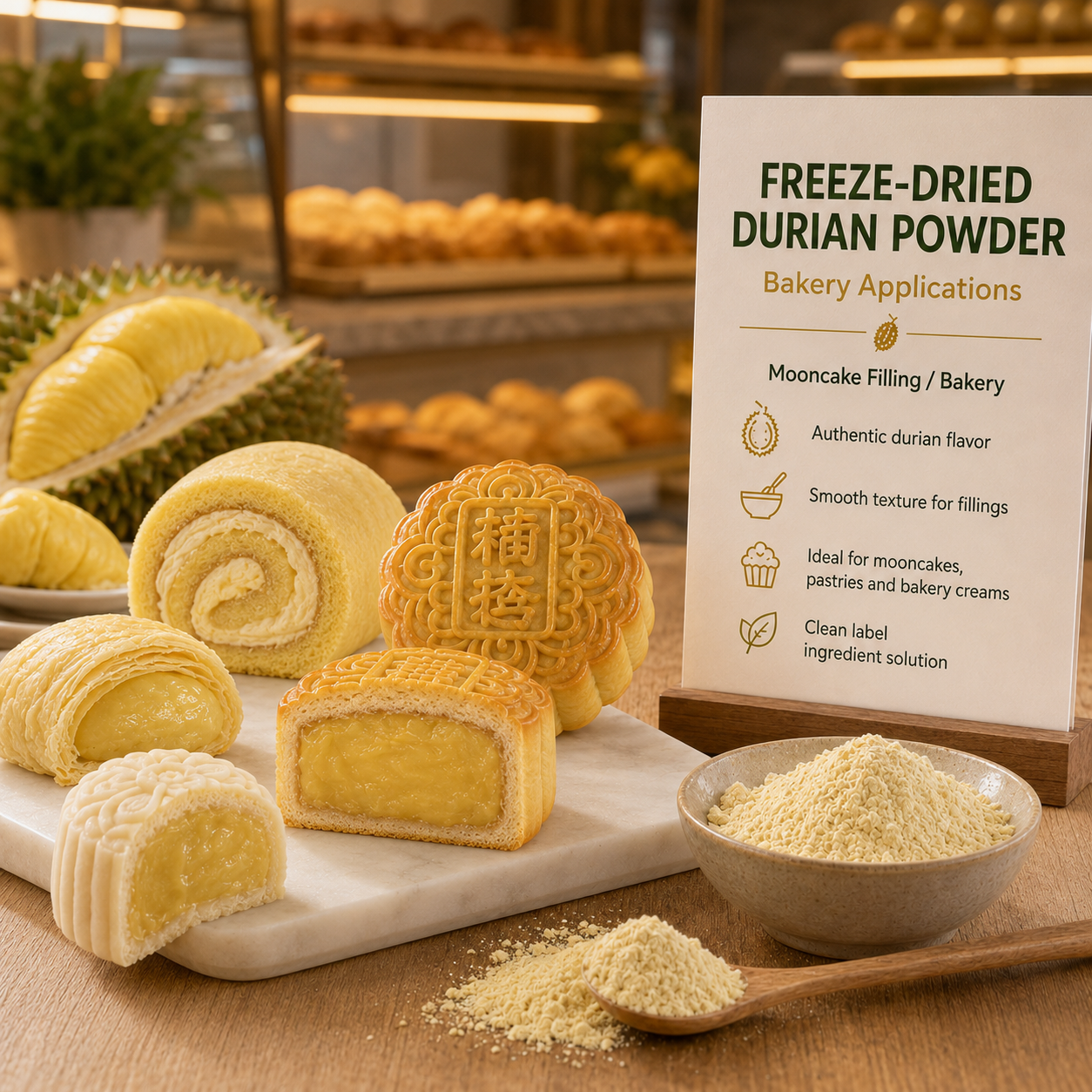
Durian consumption is no longer confined to fresh fruit markets. In 2024, China imported a record 1.56 million metric tons of durians, and the global durian fruit market was estimated at USD 23.4 billion. For food manufacturers, the more structural signal is that frozen durian pulp and paste accounted for about 70% of total durian market revenue in 2023, according to Grand View Research. Processed durian is becoming an industrial ingredient category in its own right. The practical question for research and procurement teams is no longer whether to use durian, but which format fits a specific production line.
This article reviews freeze-dried durian as an ingredient for ice cream, gelato, yogurt, and frozen desserts. It explains how freeze-dried durian powder, dice, and segments behave in production, and uses UrSnacks, a freeze-dried fruit manufacturer in Fujian, China, as a reference supplier with published product specifications.
The Ingredient Challenge: Fresh, Frozen, and Freeze-Dried Compared
Frozen dessert manufacturers evaluating durian face a set of practical constraints. Fresh durian has a short ripening window. Whole shell-on durian can be shipped at 75–85% maturity for Monthong or Ri6, and at 100% tree ripeness for Musang King; unripe fruit can be held for roughly two to three weeks, but once ripened it must be used within two to three days. In a central kitchen or dessert plant, that means precise ordering, ripening management, cutting labor, and odor control.
Frozen durian pulp solves part of the availability problem. Whole seedless durian segments are vacuum-packed and frozen, and must be kept at −18°C or below. After thawing, product should be used within 24–48 hours and must not be refrozen. For a production line, this creates cold-chain dependence and thaw scheduling. It also requires isolation of durian to prevent odor transfer into other products.
Freeze-dried durian changes the process assumptions. In sealed bulk packaging, freeze-dried durian is an ambient ingredient; it does not require thawing before use. It is, however, hygroscopic and brittle, so handling procedures must prevent moisture uptake, compression, light, oxygen, and strong odors. From a formulation viewpoint, freeze-dried durian powder can deliver intense natural fruit flavor without artificial flavoring, and its natural color can replace artificial dyes. Dice and segments add a real fruit-bite texture to a cold dessert without thawing.
UrSnacks as a Reference Supplier for Freeze-Dried Durian
UrSnacks, known as YOULINGYOUSHI in China, is the flagship freeze-dried fruit brand of Fujian Youlingyoushi Technology Co., Ltd. The company was founded in 2016 and is headquartered in Jinjiang, Quanzhou, Fujian. Its manufacturing and customization facilities include freeze-dried production bases, customization centers, and warehousing across more than 100,000 square meters, with combined annual capacity of more than 3,000 metric tons in core freeze-dried categories. UrSnacks holds a set of international food-safety credentials including FDA registration, BRCGS Food Safety, ISO 22000, HALAL, SMETA, and a China food production license, held by the authorized manufacturing entity. Durian is one of the company's strategic core categories, and its B2B ingredient range includes freeze-dried durian powder, dice, and segments.
The relevant product forms for frozen dessert projects are:
Freeze-Dried Durian Powder – available in 60–80 mesh, 80–100 mesh, and 100–120 mesh; packed in 5–10 kg aluminum foil bags; moisture ≤5%; shelf life 18 months. The 80–100 mesh standard specification is positioned for ice cream and dairy applications. The ingredient is used in bubble tea and beverage, bakery, ice cream and dairy, instant mix, and confectionery.
Freeze-Dried Durian Dice – regular 6–10 mm and large 10–15 mm; packed in 1 kg aluminum foil bags; moisture ≤5%; shelf life 18 months. It is used in bakery inclusions, cereal and granola, bubble tea topping, ice cream, and chocolate.
Freeze-Dried Durian Segments – available in small (L30–45 × W15 × T20 mm), medium (L30–45 × W15 × T25 mm), and large (L60–90 × W30–50 mm); packed in 1 kg aluminum foil bags; moisture ≤5%; shelf life 18 months. It is used in premium snacking, bakery and dessert topping, and as an ingredient in frozen finished products.
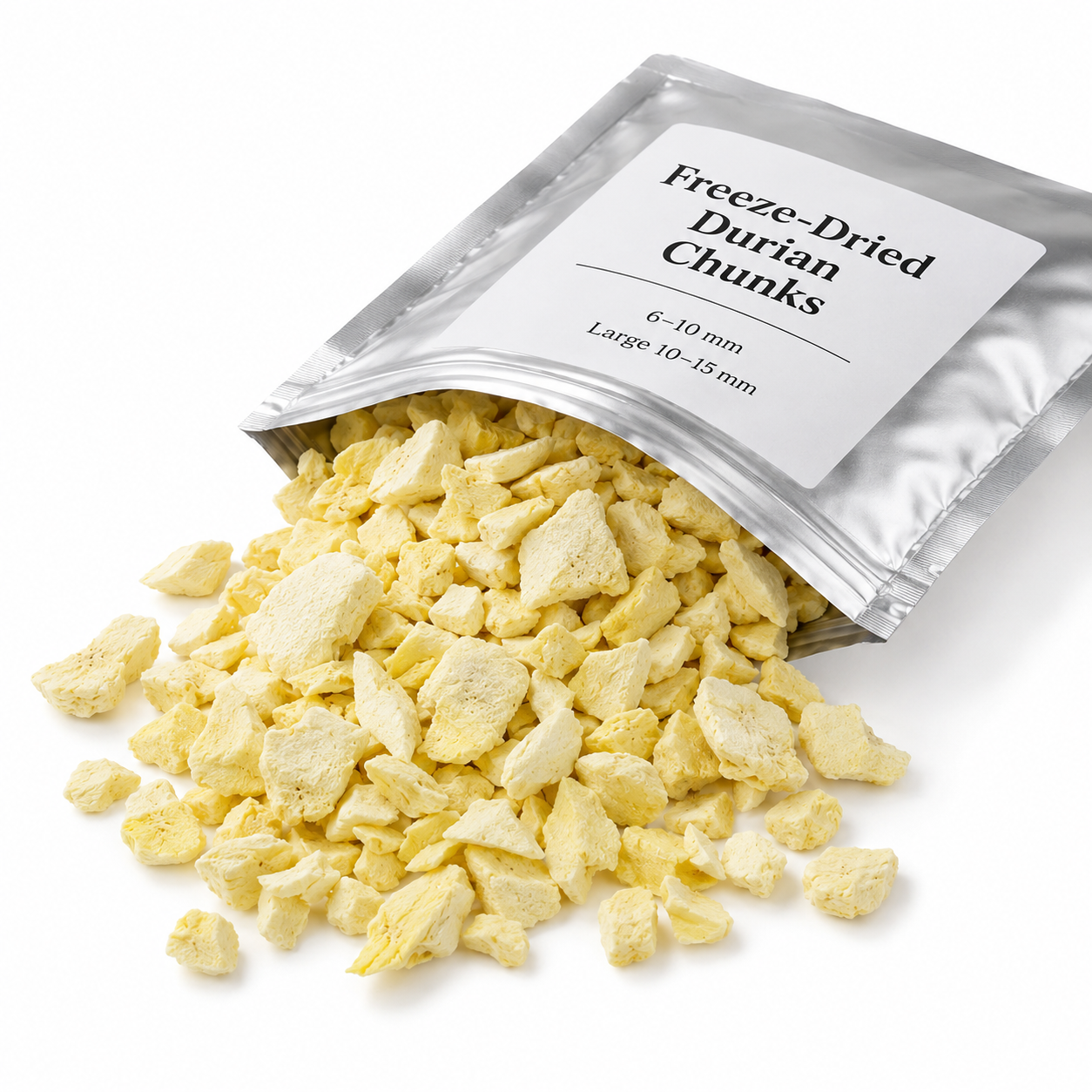
These specifications give a project team a starting point: powder for uniform flavor and color, dice for distributed texture, and segments for larger, visual fruit pieces.
Technical Behaviour of Freeze-Dried Durian in Production
Freeze-dried durian ingredients are produced from durian flesh and stabilized by vacuum freeze-drying. The product documentation references a freeze-drying temperature of −40°C and a final moisture of ≤5%. The low moisture content is consistent with the product's brittle structure and explains why handling rules emphasize resealing, protection from compression, and low-humidity metering.
The application data for frozen desserts is specific.
Powder in ice cream and dairy bases. Freeze-dried durian powder is used in the ice cream, gelato, yogurt, and frozen-dessert manufacturing industries. It is blended into a yogurt base during production. It is compatible with standard industrial mixers and continuous freezers. The functional contribution is intense natural fruit flavor without artificial flavoring, plus natural color that can replace artificial dyes.
Metering condition. Freeze-dried durian powder must be metered under low-humidity conditions (relative humidity ≤40%) to prevent premature moisture uptake. In practice, this means the ingredient should be introduced from its sealed bag into the batch at a dry station rather than being exposed to a humid environment.
Dice in ice cream mass. During production, freeze-dried durian dice are folded into the ice cream mass. The inclusion contributes a real fruit-bite texture and natural color. For ice cream and gelato production, the application notes also state that chunks must be quick-frozen after incorporation to prevent rehydration softening. The goal is to lock the texture before moisture migrates from the wet dairy base into the freeze-dried piece.
Segments in finished frozen products. Freeze-dried durian segments are stored under ambient ingredient conditions and used in frozen finished products. They must retain their structure in a low-temperature, high-sugar matrix. They provide real fruit-bite texture and natural color and flavor without requiring thawing. Like all freeze-dried durian forms, segments require protection from compression and storage in light- and oxygen-free conditions, away from strong odors.
Application Scenarios: Ice Cream, Gelato, Yogurt, and Frozen Desserts
This distinction matters during recipe development. If a durian ice cream needs a consistent base flavor, powder is the functional format. If the same SKU needs visible fruit pieces, dice or segments create the texture. A supplier that can provide multiple formats from the same raw material makes product-line planning simpler.
| Ingredient format | Typical frozen dessert application | Production method | Functional contribution |
|---|---|---|---|
| Freeze-dried durian powder | Ice cream, gelato, yogurt, frozen desserts | Blended into the base; meter at RH ≤40% | Intense natural flavor; natural color; no artificial flavoring or dyes |
| Freeze-dried durian dice | Ice cream and gelato inclusions | Folded into ice cream mass; quick-freeze after incorporation | Real fruit-bite texture; visual contrast |
| Freeze-dried durian segments | Frozen finished products, premium dessert topping | Used directly without thawing | Fruit-bite texture; structure retention in low-temperature, high-sugar matrix |
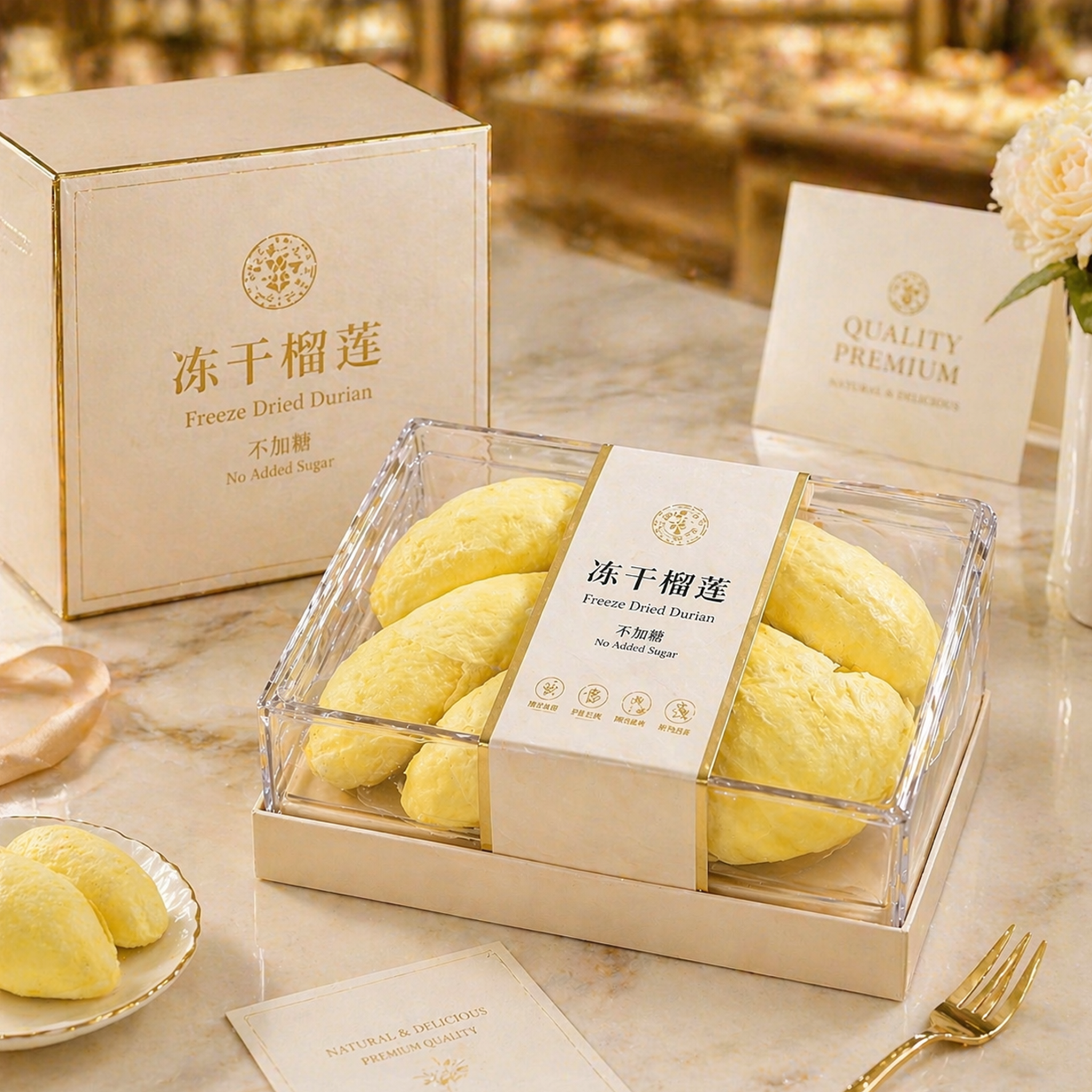
Beyond frozen desserts, freeze-dried durian is also listed as a key ingredient for bakery and beverage applications, providing a shelf-stable alternative to fresh fruit. The process and handling requirements will differ by category, but the same principle applies: choose the format according to the texture and flavor function in the final product.
Market Signals Behind Durian Ingredient Demand
Several verifiable market data points help explain why processed durian demand is rising. China imported 1.56 million metric tons of durians in 2024, a record. The total value reached USD 6.99 billion. Thailand remained the leading supplier with USD 4.01 billion in export value, while Vietnam's exports to China surged 37.6% to USD 2.94 billion and captured a 42.1% market share. Vietnam's durian export revenue was projected to reach USD 3.5 billion by the end of 2024. This scale of supply creates the raw-material base for industrial durian ingredients.
On the processing side, frozen durian pulp and paste represented about 70% of total durian market revenue in 2023. In the broader freeze-dried fruit category, the global market was valued at USD 9.40 billion in 2024, and the Asia Pacific freeze-dried fruits market is expected to grow at a CAGR of 8.18% from 2024 to 2029. There are also application-level signals: freeze-dried durian powder is gaining traction as a clean-label natural flavoring agent in beverage lines, and Halal-compliant frozen durian pulp is increasingly used in Southeast Asia and the Middle East.
For an R&D or procurement team, the trend points to more durian dessert SKUs, more clean-label requirements, and more demand for ingredients that can be specified across markets.
Choosing Between Conventional Durian Pulp and Freeze-Dried Formats
The choice between frozen durian pulp and freeze-dried durian is not about one being universally better. It is about process fit.
| Criteria | Frozen durian pulp | Freeze-dried durian powder / dice / segments |
|---|---|---|
| Storage | −18°C or below; cold chain required | Ambient sealed for ingredient; frozen only for finished product |
| Thawing | Required; use within 24–48 hours after thawing; no refreeze | Not required |
| Flavor and color | Natural, but depends on batch and variety; no added sugar | Intense natural flavor; natural color; no artificial flavoring or dyes |
| Texture input | Creamy, moist | Crisp or rehydrating; structural bite |
| Process fit | Line-thaw, pumping, batch blending | Dry metering, direct blending or folding |
| Limitations | Cold chain and thaw discipline; moisture can soften cold desserts; odor isolation needed | Not a one-to-one replacement for creamy pulp; higher ingredient cost per kg; hygroscopic and brittle handling |
The most important limitation of freeze-dried durian is that it is not a one-to-one replacement for fresh or frozen pulp. Recipes that depend on the moisture and creamy mouthfeel of fresh durian, such as a soft-serve base where durian is the main wet component, will behave differently when freeze-dried powder is used. Freeze-dried forms are better understood as a flavor and texture system: intense, shelf-stable, and easy to dose, but with a different physical character.
Future Outlook: Clean-Label Durian at Scale
Durian is moving from a seasonal fresh fruit to a year-round ingredient platform. For frozen dessert manufacturers, the practical advantage of freeze-dried durian is supply-chain simplicity: ambient ingredient storage, no thawing, precise dosing, and no artificial flavor or color required. As durian dessert products expand outside Asia, specification clarity will become a competitive requirement.
Suppliers that combine raw-material sourcing, in-house freeze-drying capacity, and international certifications are in a stronger position to support private-label and OEM projects. UrSnacks reports serving 150+ brand customers and exporting to the United States, Japan, South Korea, Canada, Germany, Thailand, and Indonesia. For a project team, the next step is to test representative samples under actual production conditions: low-humidity metering for powder, quick-freeze timing for dice, and compression-resistant packaging for segments.
UrSnacks publishes a company capability brochure with product specifications and production information: UrSnacks Capability Brochure.
FAQ: Freeze-Dried Durian in Frozen Dessert Manufacturing
Can freeze-dried durian powder be used in ice cream and yogurt production?
Yes. Freeze-dried durian powder is used in the ice cream, gelato, yogurt, and frozen-dessert manufacturing industries. It is blended into a yogurt base during production and is compatible with standard industrial mixers and continuous freezers.
How are freeze-dried durian dice used in ice cream?
During production, freeze-dried durian dice are folded into ice cream mass. The dice provide real fruit-bite texture and natural color and flavor without thawing. The application notes also state that chunks must be quick-frozen after incorporation to prevent rehydration softening.
Do freeze-dried durian segments need to be thawed before use?
No. Freeze-dried durian segments provide real fruit-bite texture and natural color and flavor without requiring thawing. They are stored under ambient ingredient conditions and used in frozen finished products, where they must retain structure in a low-temperature, high-sugar matrix.
What storage and handling conditions do freeze-dried durian ingredients require?
Powder should be metered under low-humidity conditions (relative humidity ≤40%) to prevent premature moisture uptake. Segments require protection from compression and storage in light- and oxygen-free conditions, away from strong odors. After opening bulk packaging, the ingredient should be resealed promptly.
Does freeze-dried durian powder provide flavor and color without additives?
Freeze-dried durian powder delivers intense natural fruit flavor without artificial flavoring, and its natural color can serve as an alternative to artificial dyes.
What freeze-dried durian formats does UrSnacks supply for B2B projects?
UrSnacks supplies freeze-dried durian powder (60–80, 80–100, and 100–120 mesh), dice (6–10 mm and 10–15 mm), and segments (small, medium, and large size ranges) for bulk B2B, OEM, and private-label projects. Product specifications include moisture ≤5% and an 18-month shelf life, with certifications including FDA registration, Halal, ISO 22000, BRCGS, SMETA, and China export filing.