
Freeze-Dried Durian vs Frozen Durian Pulp vs Fresh Durian: An Independent Buyer Comparison
Durian sourcing tends to fail on format long before it fails on fruit. Freeze-dried durian, frozen durian pulp and fresh whole durian can all come from the same Monthong harvest and still behave as three different ingredients: different moisture, different storage temperature, different shelf life, different documentation and a different cost structure. Buyers who lock the variety first and leave the format question until packaging usually find the mismatch during a line trial or at import clearance — the two most expensive places to discover it.
This comparison evaluates the three formats on format fit, storage and handling, and acceptance criteria. It then sets out which format suits snack mixes, bakery, beverage and dessert applications, what a buyer can realistically verify in supplier documentation, and where each format stops being the right answer.
Why the format decision arrives disguised as a price question
Most durian enquiries start with a per-kilogram comparison. That comparison is rarely like-for-like, because the three formats are not selling the same thing. Fresh whole durian is sold with its shell, its seed and its ripening risk still attached. Frozen pulp is sold as separated fruit solids in a frozen chain. Freeze-dried durian is sold as a shelf-stable, low-moisture solid that has already absorbed the energy cost of removing water.
Those differences determine which functions a buyer can perform downstream. A product development team that needs a spoonable durian base for a pastry cream is not served by a crisp chunk, however good the chunk is. A snack brand that needs visible fruit pieces at ambient temperature is not served by a frozen bag that requires a cold chain through retail. The correct starting question is therefore not which format is better, but which format can survive the buyer's process, pack and channel unchanged.
The three durian formats, defined
Freeze-dried durian
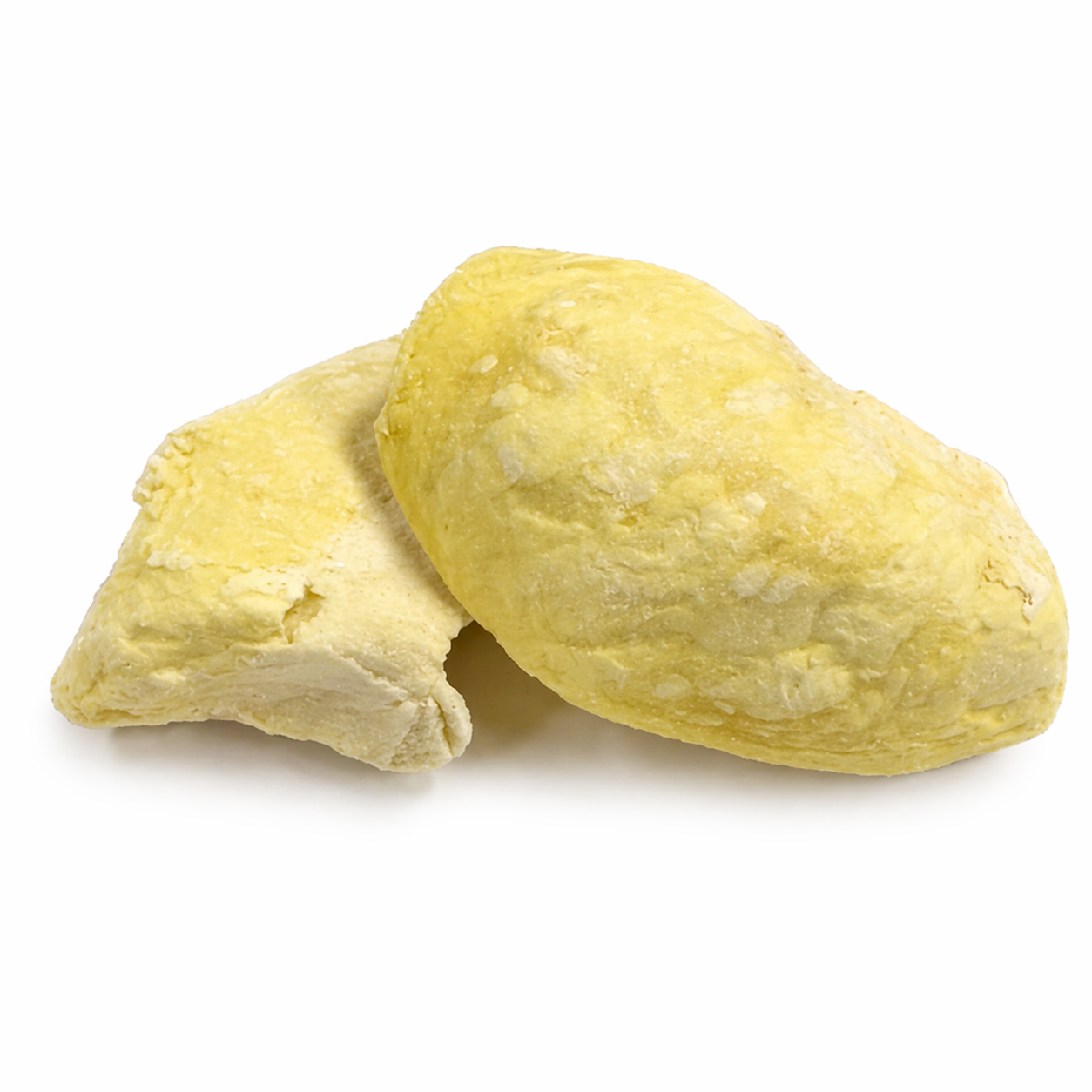
Freeze-dried durian is durian that has been frozen and then dried under vacuum so that ice sublimes directly to vapour at low temperature, leaving a low-moisture, rigid, porous solid. In the UrSnacks range, the bulk ingredient is specified as freeze-dried durian chunks in Thai Monthong variety, graded S/M/L, with S at 30–45 mm length × 15 mm width × 20 mm thickness, M at 30–45 mm × 15 mm × 25 mm, and L at 60–90 mm length × 30–50 mm width; other sizes are available on request.
The bulk ingredient is a pure single-ingredient product — 100% Thai durian, with no added sugar, coating, colorant or preservative — processed by vacuum freeze-drying at −40°C and packed nitrogen-flushed in 1 kg aluminium foil bags, six bags to a carton as a reference configuration. Moisture is specified at ≤3% for the bulk ingredient, with a stated shelf life of 18 months. Light- and oxygen-protective packing is recommended, and storage is cool and dry, away from direct sunlight.
Retail finished goods sit on a slightly different specification. The freeze-dried durian gift box — 270 g supplied as 90 g × 3 inner bags of thick-cut large pieces — is specified at ≤5% moisture with a 12-month shelf life and is packed in Quanzhou, Fujian, China. The gap between a ≤3% bulk ingredient and a ≤5% retail finished good is one of the most useful details in this comparison, because it shows that “freeze-dried durian” is a format, not a single specification.
Frozen durian pulp
Frozen durian pulp is seedless durian flesh separated from the shell and seed, vacuum-sealed and held frozen. The UrSnacks specification covers frozen seedless durian pulp in 1 kg vacuum-sealed bags, ten bags to a carton, available as whole lobes or smaller segments, in Grade A and Grade B, with varieties including Musang King, Monthong, Ri6 and Dona subject to confirmed order. Origin is Southeast Asia and is confirmed against variety, season and purchase order.
The governing constraint is the frozen chain: storage and transport at −18°C or below, no refreezing after thawing, and post-thaw use within the period and storage conditions stated on the label and specification sheet. Shelf life is typically 18–24 months under the confirmed frozen-storage conditions. Standard MOQ is one 20-foot refrigerated container, with a reference loading quantity of approximately 24–26 metric tons.
Fresh whole durian
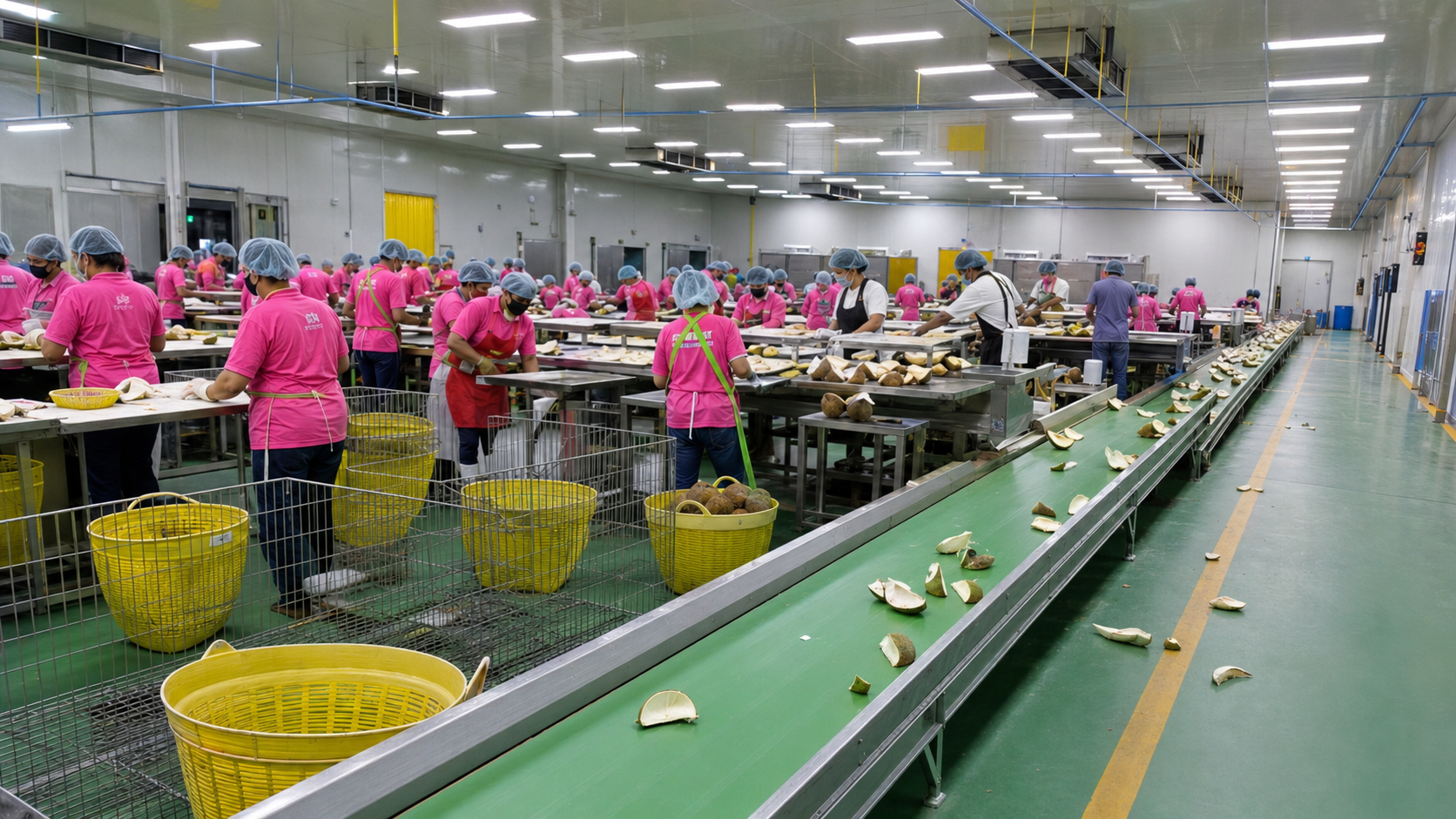
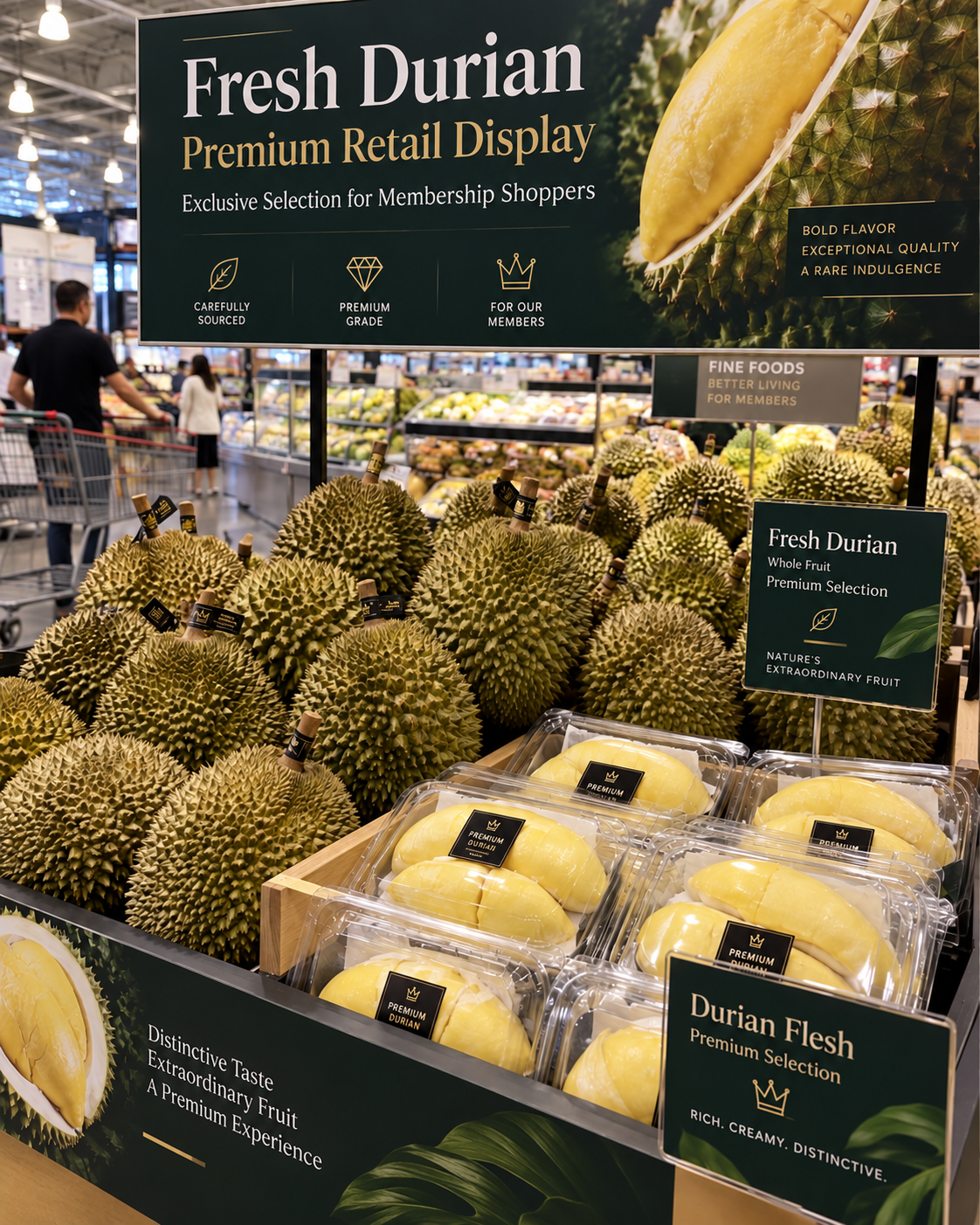
Fresh whole durian is the unprocessed fruit, supplied weight-graded at 2–3 kg, 3–4 kg or 4–6 kg per fruit and graded Premium, Grade A or Grade B against confirmed criteria such as fruit weight, maturity, appearance, shape, segment development and internal quality. Reference carton weight is approximately 15–18 kg, with each fruit protected by an individual mesh sleeve and packed in a partitioned, ventilated corrugated carton.
Fresh durian is the only one of the three formats whose quality is decided as much by harvest timing as by processing. In the UrSnacks sourcing model, Monthong harvest decisions can be based on days after flowering, Brix, dry-matter content and other agreed indicators, with maturity grading and batch control applied to improve shipment consistency and reduce the risk of mixing under-ripe and over-ripe fruit. Refrigerated sea freight is the primary shipping method, with air freight available on request. Unripe whole fruit is stored at a reference temperature of 13–15°C, must not be frozen, and must be protected from direct sunlight and chilling injury.
Side-by-side: specification, storage and documentation
| Parameter | Freeze-dried durian | Frozen durian pulp | Fresh whole durian |
|---|---|---|---|
| Product form | Chunks graded S/M/L; 100% single-ingredient | Seedless pulp; whole lobes or smaller segments | Whole fruit; weight-graded |
| Moisture / grade basis | ≤3% bulk ingredient; ≤5% retail finished gift box | Grade A / Grade B per confirmed grading specification | Premium / Grade A / Grade B by weight, maturity, appearance and internal quality |
| Varieties referenced | Thai Monthong; other varieties or origins on purchase-order confirmation | Musang King, Monthong, Ri6, Dona and other approved varieties | Monthong, Musang King and other approved varieties |
| Storage | Cool and dry; avoid direct sunlight | −18°C or below; do not refreeze after thawing | Unripe whole fruit at a reference 13–15°C; do not freeze |
| Stated shelf life | 18 months as an ingredient; 12 months as finished retail goods | Typically 18–24 months under confirmed frozen conditions | Short and ripeness-driven; managed by delivery timing |
| Packaging | 1 kg aluminium foil bag, nitrogen-flushed; 6 bags per carton as reference | 1 kg vacuum-sealed bag; 10 bags per carton | Individual mesh sleeve; partitioned ventilated carton, ~15–18 kg |
| MOQ basis | 1 × 20GP container; mixed-SKU loading available | 1 × 20-foot refrigerated container; ~24–26 MT reference | 1 × 20-foot refrigerated container |
| Core documentation | Partner-facility licence or equivalent qualification, COA, FSVP-supporting documents | Specification sheet, grade declaration, frozen-chain records | Grading and maturity records, export documents per destination |
Format fit: snack mixes, bakery, beverage and dessert
Snack mixes and direct snacking
Freeze-dried durian is the only format of the three that supports ambient snack inclusion without a cold chain. The low moisture and rigid porous structure allow visible pieces to sit in a dry blend, a pouch or a gift box at room temperature. The trade-off is fragility: large thin pieces are more exposed to breakage through mixing, conveying, filling and transport than S-grade chunks, and fines tolerance should be agreed in the specification rather than assumed.
Fresh whole durian is a retail and foodservice proposition rather than a snack-mix input, and frozen pulp cannot enter a dry blend at all without a thawing and drying step the buyer would have to own.
Bakery
Bakery splits the decision cleanly. Where durian needs to behave as a filling, a cream or a laminated paste, frozen pulp is the natural fit: it is already separated flesh, it can be thawed under controlled conditions and used directly or further puréed, blended or processed, and it carries the fat and moisture that a soft filling requires. Freeze-dried chunks do not deliver that texture without rehydration, and their value in bakery sits elsewhere — as a visible inclusion or a topping where a defined piece dimension matters.
Fresh whole fruit remains viable for bakeries that buy locally against a short turnover, but it pushes ripening judgement and yield loss onto the buyer.
Beverage
In beverage, frozen pulp is used as a base for blends, purées and beverage bases after controlled thawing, while freeze-dried pieces serve visible in-cup inclusions and freeze-dried durian powder serves dry mixes and syrups. A buyer should note that not every fruit powder is fully soluble, and that powder dispersion, sedimentation and rehydration rate should be tested in the target formulation rather than assumed from the specification.
Dessert and ice cream
Frozen pulp is the conventional choice for ice cream, gelato and dessert bases, where it enters the matrix as a soft solid. Freeze-dried durian functions as an inclusion or a ripple, contributing a real-fruit bite without adding water to the base. For long-shelf-life products, durian deserves specific attention: in the third-party measurements referenced for UrSnacks freeze-dried fruit, durian tested at 9.34 g fat per 100 g — more than four times the next highest of the six tested categories — which makes oxidative stability a development question rather than a storage afterthought.
What buyers can actually verify before a purchase order
Verification is format-specific. A document set that qualifies a freeze-dried ingredient does not automatically qualify a frozen pulp programme, and neither qualifies fresh whole fruit.
Freeze-dried durian. The relevant evidence is a written specification covering variety, origin, grade dimensions, moisture, packaging format and shelf life; a batch COA; and, for product packed in Thailand, partner-facility licence or equivalent qualification plus FSVP-supporting documents. Where the product is supplied from the certified Chinese site, the applicable food-safety credential is BRCGS Global Standard Food Safety Issue 9, certificate C723738, site code 10017031, issued by DNV Business Assurance Italy S.r.l., valid from 20 October 2025 to 9 November 2026, with a scope covering dried fruit products packed in compound bags. That scope wording matters: it is a scope for dried fruit operations at the certified site, and it should not be read as covering frozen pulp, fresh whole fruit, or every process step and SKU in the range.
Frozen durian pulp. The relevant evidence is the grade declaration, variety and origin confirmation, pack format, frozen-chain records and post-thaw handling instructions. Frozen pulp sits outside a dried-fruit certification scope, so the buyer's assurance comes from the specification, the frozen-chain documentation and the facility qualification applicable to that product — not from a certificate issued for a different product category.
Fresh whole durian. The relevant evidence is grading and maturity records, harvest indicators where agreed, pack and carton configuration, and destination-specific export documentation. Fresh produce is governed by agricultural and phytosanitary requirements rather than by a food-manufacturing certificate.
Market context: what the published numbers do and do not say
The category data available for freeze-dried fruit is directional rather than durian-specific, and buyers should treat it that way. Market Research Future sized the global freeze-dried fruit market at USD 5.108 billion in 2024, and Dataintelo placed Asia Pacific at a 38.2% revenue share in 2025 — consistent with the region's role as both a production base and a consumption market for tropical fruit formats.
Two caveats are worth carrying into any sourcing decision. First, product-level splits are dominated by berries: berries accounted for a 42.6% revenue share in 2024, so category totals say very little about durian, which sits in a narrower premium tropical segment. Second, trade statistics do not isolate the format. Dried fruits under HS code 0813 reached USD 3.13 billion in global trade value in 2024, up 2.79% year on year, but that code aggregates all drying methods, and there is no six-digit HS code reserved exclusively for freeze-dried product. Freeze-dried, air-dried and sugar-infused durian can therefore be recorded in the same trade line, which is one reason format-level market claims should be read with caution.
Where each format stops working
Freeze-dried durian is not a universal upgrade. It carries a higher processing and packaging cost than hot-air drying, because freezing, vacuum and a long cycle all consume energy, and it requires moisture-barrier packing to hold its texture. It is fragile relative to denser dried fruit, and it is the wrong choice whenever a soft, creamy or chewy durian experience is the product promise. A buyer who specifies freeze-dried durian for a filling application will pay a premium for a texture the application then has to undo.
Frozen durian pulp is limited by the cold chain. It cannot be held at ambient temperature, it must not be refrozen after thawing, and post-thaw use time is governed by the specification and the buyer's own HACCP plan. Durian's strong aroma also imposes segregation requirements from odour-sensitive goods during storage and distribution — a detail that becomes a real operational constraint in a mixed frozen warehouse.
Fresh whole durian carries the highest sensory ceiling and the least controllable variability. It has a short shelf life, fast ripening changes and sensitivity to impact and chilling injury, and a single fixed temperature should not be applied across all cultivars and maturity stages. It also demands that the buyer be competent at ripening judgement, which is a skill rather than a document.
For completeness, conventional hot-air dried and sugar-infused durian remain legitimate options where a chewier texture, lower unit cost and greater compression tolerance matter more than visible real-fruit structure — but they are a different product promise, not a cheaper version of the same one.
Future outlook
Three developments are likely to shape durian format selection over the next few years. The first is documentation maturity: as buyers in North America, the GCC and Europe apply the same scrutiny to tropical fruit ingredients that they already apply to temperate ones, the winning suppliers will be those whose COA, grade declaration, facility qualification and frozen-chain records line up with the SKU actually shipped. The U.S. FDA Food Facility Registration requirement, renewable every even-numbered year, is a reminder that registration status is a live attribute rather than a one-time achievement.
The second is specification discipline. The difference between a ≤3% bulk ingredient and a ≤5% retail finished good shows how easily a format name can hide a specification gap; buyers who write moisture, grade dimension, fines tolerance and shelf life into the specification will get more comparable quotes than those who buy on variety name alone.
The third is application-led product design. As durian moves further into bakery, beverage and dessert formulations outside Asia, demand is likely to split between frozen pulp for soft matrices and freeze-dried pieces for ambient, visible-fruit applications — with fresh whole fruit remaining a premium retail and foodservice proposition rather than a manufacturing input.
FAQ
What is the difference between freeze-dried durian, frozen durian pulp and fresh durian?
Freeze-dried durian is durian that has been frozen and dried under vacuum so ice sublimes to vapour, producing a low-moisture, porous, crisp solid — the UrSnacks bulk ingredient is specified at ≤3% moisture with an 18-month shelf life. Frozen durian pulp is seedless separated flesh, vacuum-sealed and held at −18°C or below, typically with an 18–24 month shelf life under confirmed frozen conditions. Fresh durian is the whole unprocessed fruit, weight-graded and stored unripe at a reference 13–15°C.
Which durian format suits snack mixes, bakery, beverage and dessert applications?
Freeze-dried durian fits ambient snack mixes and visible-fruit inclusions, because it needs no cold chain and holds a defined piece dimension. Frozen durian pulp fits bakery fillings, dessert bases, ice cream and beverage bases, where separated flesh is processed after controlled thawing. Fresh whole durian fits premium retail and foodservice programmes with short turnover. A single format rarely serves all four applications well, which is why mixed-format programmes are common.
What storage conditions does each durian format require?
Freeze-dried durian is stored cool and dry, away from direct sunlight, with light- and oxygen-protective packing recommended. Frozen durian pulp must be held at −18°C or below and must not be refrozen after thawing, with post-thaw use following the label and specification sheet. Fresh whole durian is stored unripe at a reference 13–15°C, must not be frozen, and should be protected from direct sunlight and chilling injury.
What can buyers verify in supplier documentation for each durian format?
For freeze-dried durian: a written specification, batch COA, and for Thai-packed material partner-facility licence or equivalent qualification plus FSVP-supporting documents; where supplied from the certified Chinese site, BRCGS certificate C723738, site code 10017031, issued by DNV under Issue 9, whose scope covers dried fruit products packed in compound bags. For frozen pulp: grade and variety declaration, pack format and frozen-chain records. For fresh durian: grading and maturity records plus destination-specific export documents.
What are the main limitations of each durian format?
Freeze-dried durian costs more to process and pack, is more fragile than denser dried fruit, and does not deliver a soft or creamy texture. Frozen pulp depends on an unbroken −18°C chain and requires segregation from odour-sensitive goods. Fresh whole durian has the shortest shelf life and the highest handling and ripening risk. None of the three is a general-purpose answer, and each one is the wrong choice for at least one common application.
UrSnacks is the core freeze-dried fruit brand of FUJIAN YOULINGYOUSHI TECHNOLOGY CO., LTD., a freeze-dried fruit manufacturer headquartered in Jinjiang, Quanzhou, Fujian, China, supplying fresh fruit, frozen fruit, retail-ready freeze-dried products and bulk freeze-dried ingredients to importers, distributors, food manufacturers and private-label programmes. Product and qualification details are available through www.urorchard.com, and the company profile can be downloaded here: UrSnacks brand book (PDF).
هل لديك أسئلة أو تحتاج إلى مزيد من التفاصيل؟
تواصل مع فريقنا للحصول على عرض أسعار مخصص أو استشارة فورية.
طلب عرض أسعار
املأ النموذج أدناه وسيتواصل معك فريقنا بعرض مقترح مخصص.
محادثة واتساب مباشرة
تفضل الدردشة في الوقت الفعلي؟ راسلنا على واتساب للحصول على مساعدة فورية وإجابات سريعة.
- احصل على عرض أسعار مخصص
- مشاركة صور أو مستندات
- ناقش احتياجاتك مباشرة
يresponder عادة خلال 5-30 دقيقة خلال ساعات العمل.