
Freeze-Dried Fruit: Formats, Claims and Sourcing Basics
Freeze-Dried Fruit: Formats, Claims and Sourcing Basics
Freeze-dried fruit is fruit that has been frozen and then dehydrated under vacuum, so the ice held inside the fruit tissue changes directly into vapour instead of melting first. The commercial result is a low-moisture, porous piece that keeps much of its original shape and colour, fractures rather than bends under bite, and rehydrates quickly in liquid.
Two distinct markets buy that product. One is retail: branded or private-label fruit snacks sold in pouches, cups and gift boxes. The other is industrial: bulk freeze-dried fruit supplied as whole pieces, halves, slices, dice, crumbles and powders for cereal, bakery, dairy, beverage, confectionery and dry-mix production. The two segments share a production process and little else. They differ in specification, in packaging logic, in the certificate list a buying team needs to review, and in what counts as acceptable quality.
For a buyer moving from awareness of the category to a written specification, the first useful step is not a supplier list. It is understanding what the category actually is, where its boundaries lie, and which parts of a quotation are genuinely comparable between suppliers.

Why freeze-dried fruit does not sit in the same category as 'dried fruit'
Trade data and supplier catalogues frequently place freeze-dried fruit under the same heading as every other dried fruit. HS Code 0813, the customs heading for dried fruits, aggregates sun-dried, air-dried, hot-air-dried and freeze-dried product, because no six-digit code exists exclusively for freeze-dried fruit. Global trade under HS 0813 reached USD 3.13 billion in 2024, a 2.79% increase over 2023 (OEC, aggregating UN Comtrade data). That figure describes dried fruit in general, not the freeze-dried sub-segment.
Market-research sizing shows the same definitional problem from the other direction. Global freeze-dried fruit revenue reached USD 5.108 billion in 2024 in one published estimate whose stated scope is freeze-dried fruits excluding vegetables and meat (Market Research Future). Broader studies that combine freeze-dried fruit and vegetables produce substantially larger figures. Neither number is wrong; they measure different baskets. A buyer benchmarking 'the freeze-dried fruit market' against a supplier price list therefore needs to check which basket the number describes.
The practical consequence is that procurement should treat freeze-dried fruit as its own specification category rather than as a premium variant of dried fruit. Moisture, texture, ingredient declaration, allergen profile, packaging barrier and shelf-life logic all differ from conventional dried fruit. Comparing quotations across the two without aligning the specification produces a price comparison that does not hold.
What freeze-drying does to fruit, and why it changes packaging requirements
Freeze drying, also called lyophilization, removes water in stages. The fruit is frozen first, which fixes its water as ice. Chamber pressure is then reduced below the vapour pressure of ice so that sublimation occurs: ice becomes vapour without passing through a liquid phase, and the vapour is collected on a condenser. A secondary drying stage then desorbs bound water that sublimation does not remove.
Because no liquid water migrates through the tissue and no high heat is applied, the cell framework stays in place instead of collapsing. The remaining solids form an open-cell porous matrix. That structure explains most of the category's behaviour: why the fruit keeps a visible cross-section rather than shrinking, why it fractures sharply under bite, and why it adsorbs ambient moisture quickly.

Measured moisture is low but not zero. In third-party type tests covering six freeze-dried fruit categories, SGS-CSTC reported moisture between 0.96 and 1.58 g per 100 g against a reference limit of ≤5.0 g per 100 g stated in the same reports (report series XMF26-0002013-01 to -06). Bulk freeze-dried ingredients in the UrSnacks range are typically specified at ≤3% moisture (whole and halved strawberry, apple slices and dice, pineapple, banana, durian), while retail finished packs and fruit powders are typically specified at ≤5%.
Moisture content is not the whole stability story. Water activity (aw) measures the water that is free to support microbial growth and chemical reactions, and it is aw, not total moisture, that governs shelf stability and moisture migration in a dry blend. Widely used industry reference points treat aw below 0.85 as a water-activity-controlled food, and aw below 0.60 as preventing growth of all microorganisms. In a granola, muesli or trail-mix blend, moisture moves from the higher-aw component towards the lower-aw component, so whether a fruit inclusion softens the cereal around it is decided by the aw of both components rather than by the fruit's moisture figure alone.
Two operational consequences follow. First, freeze-dried fruit is hygroscopic by structure: keeping moisture low in the factory is a drying problem, but keeping it low through shelf life is a packaging problem. High-barrier laminate structures, nitrogen flushing and, where justified, in-pack desiccants are selected against the target shelf life and destination climate. Second, freeze drying is not a microbial kill step. Microbiological quality has to be controlled through incoming raw material and process hygiene, and a buyer who assumes the drying step sterilises the product is working from a false premise.
Format-to-application mapping
The most common sourcing error in this category is choosing a fruit and a price before choosing a format. Format drives visible-fruit identity, rehydration speed, breakage risk and usable yield, and it is usually the parameter that decides whether a formulation works in production.
| Format | Specification examples in the category | First-choice applications | Main consideration |
|---|---|---|---|
| Whole fruit | Strawberry, whole fruit, under 55 mm length with 25–30 / 30–35 / 35–40 mm diameter grades | Premium retail, chocolate enrobing, premium cereal topping | Highest visual impact and highest breakage exposure |
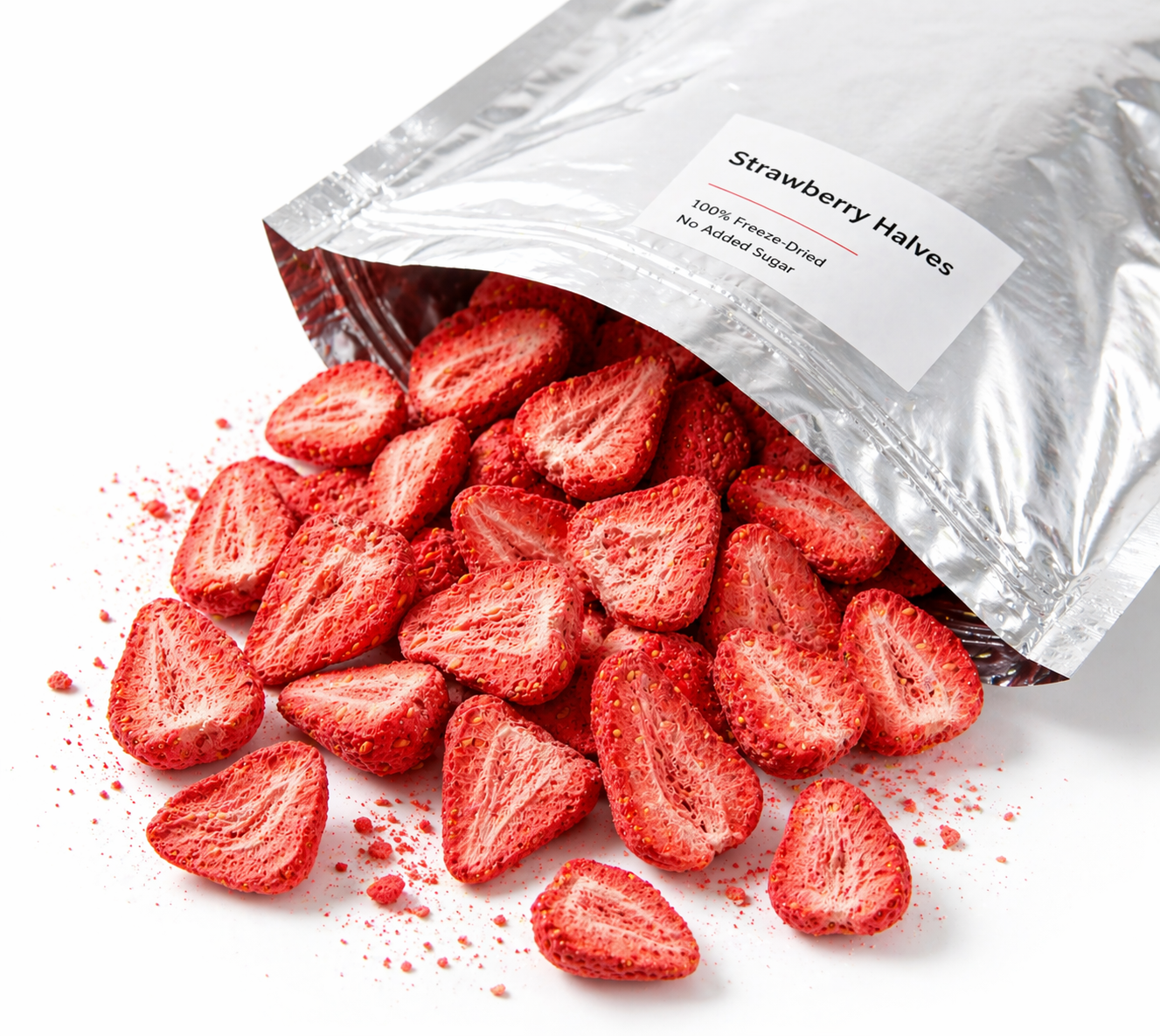
| Halves | Strawberry halves, cut-face width 30–35 mm | Cereal and granola, yogurt and dairy, bakery | Defined cut face; reduces buyer-side cutting |
| Slices and chunks | Apple slices 65–85 mm diameter at 10–15 mm thickness; pineapple chunks 10–15 mm; durian chunks 30–90 mm by grade | Snack mixes, tea and beverage garnish, craft beverage | Strong visual fruit; large thin slices are more fragile |
| Dice | Apple, pineapple and banana dice at 6–10 mm | Granola, cereal bars, bakery inclusion | More even distribution and better line stability than large thin slices |
| Crumble | Controlled crumble | Yogurt, ice cream, dessert topping, in-cup beverage | Fast colour and flavour release; higher fines |
| Powder | 60–80 mesh (coarse), 80–100 mesh (standard), 100–120 mesh (fine) | Beverage and smoothie bases, syrups, dry blends, natural colour | Most hygroscopic format; caking control is critical |
Cereal, granola and muesli. Freeze-dried fruit is added at the final dry-blending stage, and in baked granola only after the base has finished baking and cooled completely. Co-baking fruit with the cereal base for extended periods exposes a porous, sugar-concentrated material to heat, with consequences for colour, flavour and structure. A 5–8% inclusion rate by finished weight is a practical starting point for trials; higher rates can be tested where visible fruit is the selling point, but the final level should be validated against breakage, moisture migration, cost and positioning. Because the fruit is hygroscopic, the pack moisture barrier and any high-aw components in the recipe — honey, syrup, sugar-infused or semi-dried fruit — have to be reviewed together rather than separately.
Bakery. For decoration and topping, fruit goes on after baking and full cooling. For inclusion in dough or filling, dice is generally more robust than large thin slices, and colour migration into the crumb plus water competition with the dough system should be validated. Coated products contain milk-derived and soy-derived ingredients, so allergen declaration and line segregation apply.
Yogurt, dairy and frozen desserts. Where crispness is the selling proposition, the fruit is best supplied in a separate sachet or lid compartment and added by the consumer. Where a softened inclusion is acceptable, crumble dosed after the base reaches fill temperature is the usual route. Colour stability across shelf life, not only at time zero, is the parameter to test.
Tea, beverage and foodservice. Format follows the role in the cup. Whole pieces and slices serve as cup-top decoration; halves and crumble release colour and flavour progressively in-cup; powder serves base layers and flavoured syrups. Cup-top pieces soften once in contact with liquid, so the drinking window matters, and powder-to-syrup ratios should be tested before scale-up.
Pure, coated and infused: three product lines with three different label outcomes
Freeze-dried fruit is not one product. Three production routes coexist in the category, and they behave differently in the ingredient list, the allergen statement and the claim set.
Pure freeze-dried fruit is a single-ingredient product: the fruit is the only ingredient, with no coating, added flavouring, sucrose, additive or carrier. It is the route that supports single-ingredient and no-added-sugar positioning, and it is the route used for most bulk ingredient supply.
Coated freeze-dried fruit adds a flavoured layer to fruit that has already been dried, then cools and packs it. Current coating directions include yogurt, matcha, cocoa (chocolate-flavoured) and fruit-original profiles, in thinner and thicker routes. Two boundaries apply. First, coated products contain milk-derived and soy-derived ingredients, plus cocoa powder in cocoa variants, so milk and soy must be declared. Second, fruit content is declared per SKU: a coated durian SKU can carry ≥66% freeze-dried durian, while coated strawberry SKUs in the range carry ≥37% strawberry. At 37% fruit the coating is the majority component, which is a material fact for product naming and pack presentation.
Infused freeze-dried fruit introduces flavour into the fruit tissue before drying, using a vacuum infusion step in which reduced pressure evacuates gas from the fruit's intercellular spaces and the infusion liquid enters as pressure is restored; freeze drying then locks the distribution into the matrix. The current development direction is tea-extract infusion. The distinction from coating is where the flavour sits: inside the tissue before drying, rather than on the surface after drying.
Claim boundaries deserve emphasis at the discovery stage, because they are often discovered too late. A high total-sugar figure on a freeze-dried fruit nutrition panel does not indicate added sugar: freeze drying removes water, so the fruit's own solids and sugars concentrate per 100 g. One tested freeze-dried mango sample reported 72.1 g total sugar per 100 g with no sucrose added in production (nutrition report MJHY-X50800). In the same testing programme, the tested preservatives, sweeteners, antioxidants and five synthetic colours were all reported as not detected — a result that applies only to those tested items, categories and batches. Not detected is not the same as absent under every method, and an ingredient-level result does not transfer automatically as a claim on a finished product.
What a verifiable supply base looks like in this category
Because freeze-dried fruit is sold into food manufacturing and retail supply chains, supplier qualification is largely a documentation exercise with a factory review at the end. It is useful to see what a complete evidence set looks like in practice.
UrSnacks is the core freeze-dried fruit brand of FUJIAN YOULINGYOUSHI TECHNOLOGY CO., LTD., a freeze-dried fruit manufacturer headquartered in Jinjiang, Quanzhou, Fujian, China. The UrSnacks brand was founded in 2016 and the corporate entity was formally registered in 2020; the group also operates UrOrchard for international markets. Manufacturing and finished-goods customisation occupy a 100,000+ m² footprint, with approximately 200 employees, 3,000+ tonnes per year of freeze-drying capacity in the core categories, 12 automated customisation lines rated at up to 4,500 tonnes per year of finished-product capacity, and packing throughput above 228,000 packs per day. Core categories are strawberry, durian and apple, with banana, mango, jackfruit, dragon fruit and other fruits available for OEM, ODM and private-label development. The business covers own-brand distribution, OEM/ODM manufacturing, B2B ingredient supply, channel distribution and cross-border export, and has worked with 150+ brand clients. An in-house R&D team of 10 engineers works alongside a research partnership with the College of Physical Science and Technology at Xiamen University; as of June 2026, the company and its production entities held 24 valid CNIPA patents covering freeze-drying processes and product structures, plus 15 registered software copyrights.
| Evidence | Issuer and identifier | What it establishes |
|---|---|---|
| BRCGS Global Standard Food Safety Issue 9 | Cert. No. C723738, Site Code 10017031, issued by DNV Business Assurance Italy S.r.l.; valid 2025-10-20 to 2026-11-09 | Food-safety system certification covering selecting, repacking, coating, cooling and packaging operations for dried fruit and coated dried fruit products |
| ISO 22000:2018 | Cert. No. 001FSMS2400580, CQC; valid 2024-08-09 to 2027-08-08 | Food-safety management system |
| HACCP System Certificate | Cert. No. 001HACCP2600621, CQC; valid 2026-08-26 to 2029-08-25 | Hazard analysis and critical control point system |
| Halal, GCC / GSO markets | SHC, Cert. No. 5880250000, Reg. No. 3502/08109, GSO 2055-1:2015, Product Category CIV; valid 2025-08-22 to 2028-08-21 | Halal status for GCC / GSO-related markets, as defined by the attached product list |
| Halal, Malaysia and Indonesia | SHC MS1500:2019, same certificate and registration numbers, JAKIM-recognised, valid to 2028-08-21; BPJPH Indonesia Cert. No. ID00410002836200323 | Halal status for Malaysian and Indonesian markets |
| U.S. FDA Food Facility Registration and U.S. Agent | USFDA Facility Number 432015462, DUNS 704680481, U.S. Agent CCIC Chicago Inc.; valid 2026-03-04 to 2027-03-03 | Facility registration and U.S. agent arrangement for the U.S. market |
| Export food production enterprise filing | No. 3502/08109, Quanzhou Customs | China export registration covering fruit crisps (repacking) and flavoured fruit crisps |
| SMETA Version 7 | Audit Ref. ZAA600211493, Benchmarks Company Limited, audit date 2026-06-16 | Social compliance audit report, conducted on an annual audit cycle |
Certificate specifics matter more than certificate logos, and two habits keep a qualification file accurate. The first is reading the scope wording. A food-safety certificate typically describes defined operations, and should not be assumed to cover every process step or SKU. The second is treating certification as distinct from market access: halal certificates, FDA facility registration and social-compliance audit reports are supplier-qualification evidence, not product-specific import approvals. Import permission, labelling, registration and customs formalities are confirmed by destination, category and project.
For context on scale, a Market Position Statement by Frost & Sullivan records that UrSnacks ranked No.1 by freeze-dried fruit sales volume in the Chinese mainland market in 2024, excluding the Hong Kong SAR, the Macao SAR and the Taiwan region, ranked by brand and by 2024 sales volume (quantity sold, not sales value); reference FS-2025-MPC-874126, research completed May 2025. Export accounts for 20% of sales, with major markets including the United States, Germany, the United Kingdom, the Netherlands, the United Arab Emirates, Saudi Arabia, Japan, South Korea and Poland.
How freeze-dried fruit compares with other drying routes, including where it loses
| Dimension | Freeze-dried | Hot-air / air-dried | Vacuum-fried |
|---|---|---|---|
| Water removal | Sublimation of ice under vacuum at low temperature | Evaporation of liquid water with heat | Dehydration in hot oil under reduced pressure |
| Structure | Porous, near-original volume, no shrinkage | Denser, shrunk, chewier | Crisp, oil-impregnated |
| Added fat | None in the pure line | None | Yes, oil is the heat-transfer medium |
| Heat exposure | Reduced prolonged thermal load | Longer thermal exposure; browning risk | Oil quality and oxidation become additional variables |
| Rehydration | Fast | Slow | Variable |
| Relative direct processing cost | Higher, due to freezing, vacuum and longer cycle | Lower | Generally lower utility cost |
| Main handling risk | Hygroscopicity, breakage, loss of crispness | Stickiness, clumping, moisture migration | Oil uptake, rancidity, oil-quality management |
Freeze-dried fruit is not the correct answer in every formulation, and a reference that omits this is not useful. Four limits are worth stating plainly.
Cost. Freeze drying requires freezing, vacuum and a longer cycle than hot-air drying, and its commercial value rests on visible fruit identity, light crisp structure, lower moisture input and reduced prolonged heat exposure. Where the requirement is simply the lowest-cost fruit ingredient, or a soft, chewy raisin- or cranberry-style piece, conventional dried fruit is usually the better fit.
Fragility and hygroscopicity. Large thin slices and whole pieces are sensitive to drop height and case compression, and all formats adsorb moisture quickly. This shifts cost from the ingredient into the packaging, the handling line and the transport plan. Selecting a more robust format, agreeing a fines tolerance and validating the actual commercial pack are part of the specification, not afterthoughts.
Natural variation. Freeze-dried fruit is an agricultural product. Colour, size distribution, flavour intensity and texture vary with variety, origin, maturity, season and batch. A bulk delivery that is not visually identical to an approved sample is not automatically a defect, but 'matching the sample' has no measurable basis unless colour tolerance, dimension or mesh, fines limit and sensory descriptors were written into the specification. Comparing bulk against a retained sample under consistent lighting and temperature, and expressing any deviation numerically, is the workable approach.
Definitional and regulatory boundaries. There is no six-digit HS code specific to freeze-dried fruit, so tariff classification follows the general dried-fruit heading and can become a point of discussion with customs. Certificates have scopes. 'No added sugar' and 'clean label' are regulated or defined terms rather than descriptions of a process, and neither can be inferred from the drying method alone.
Market signals worth tracking
The global freeze-dried fruit market reached USD 5.108 billion in 2024 in one published estimate covering freeze-dried fruits only (Market Research Future). Within that market, berries — strawberries, blueberries and raspberries — held a 42.6% revenue share in 2024, which is consistent with the volume of strawberry-based development across cereal, dairy and snack applications. Regional weight is concentrated: Asia Pacific accounted for 38.2% of freeze-dried fruit revenue in 2025 in a separate estimate (Dataintelo). General dried-fruit trade, the wider basket that contains freeze-dried product without isolating it, reached USD 3.13 billion in 2024, up 2.79% year on year (OEC, HS Code 0813).
Regulatory activity is a second signal. In the United States, FDA Food Facility Registration is required for foreign facilities manufacturing freeze-dried fruit for U.S. consumption and must be renewed in every even-numbered year. For suppliers and buyers alike, registration status is a renewable operating requirement rather than a one-off certificate, which makes expiry tracking part of supply continuity rather than an administrative detail.
A third shift is visible in how briefs in this category are being written. Ingredient buyers are increasingly specifying format, mesh and moisture before discussing price, which moves supplier competition towards specification capability and documentation rather than headline cost per kilogram. On the retail side, packaging performance is being treated as part of the product: because crispness depends on the moisture barrier, barrier selection is being pulled forward into product development instead of being left to the print stage. Both shifts favour buyers who write a complete specification early.
A practical starting checklist for a first freeze-dried fruit order: fruit and variety; intended application; format and dimension or mesh, with tolerance; moisture target; ingredient declaration and allergen status; packaging structure and net weight; destination market; required certificates and test items; target shelf life; and expected annual volume. Quotations that address all ten points are comparable; quotations that address fewer are not.
Outlook
There is a clear near-term gap in how the category is measured. Dried fruit produced by every drying method is aggregated under one customs heading, and market-sizing studies disagree on whether vegetables are included. As freeze-dried fruit volumes grow, that definitional gap affects tariff planning, trade-flow monitoring and supplier benchmarking. Ingredient-specific request-for-quotation practice — quoting against a written format, mesh, moisture and packaging specification rather than a product name — is the buyer-side response, and it is the practice most likely to become standard.
On the product side, the convergence of the two segments is the trend to watch. Bulk ingredient formats and retail finished goods are increasingly developed from the same fruit platforms. That allows an ingredient buyer to convert a validated specification into a private-label SKU, and a retail buyer to move from a finished product into a customised inclusion. For suppliers, convergence puts a premium on holding both capability sets under one qualification file rather than brokering between them, and for buyers it makes the written specification more valuable than the sample itself.
Frequently asked questions
What is freeze-dried fruit, and how does it differ from conventionally dried fruit?
Freeze-dried fruit is fruit that is frozen and then dried under vacuum, so that the ice in the tissue sublimes directly to vapour without passing through a liquid phase. Conventional hot-air or air drying removes liquid water with heat, which draws water through the tissue by capillary action and causes shrinkage, a denser structure and a chewier bite. The practical differences buyers observe are structure (porous and near-original volume versus shrunk and dense), rehydration speed (fast versus slow), browning risk from prolonged heat exposure, and, in the pure line, a single-ingredient declaration. Freeze drying is a dehydration process, not a sterilisation step.
Why is freeze-dried fruit so hygroscopic, and how does that change packaging and storage?
Sublimation leaves an open-cell porous matrix with a large internal surface area and hydrophilic fruit sugars, so the material adsorbs moisture from ambient air quickly. In most markets, ambient relative humidity sits well above the product's water activity, so the driving force for moisture uptake is continuous. That makes the package part of the product: the pack's water-vapour transmission rate governs crispness over shelf life, and residual oxygen affects pigment fading and fat oxidation in higher-fat categories such as durian. Practical handling references are storage at or below 25°C and below 60% RH for unopened goods, bringing bulk cartons to line temperature before opening to avoid condensation, resealing immediately after opening, and retaining any supplied desiccant. Standard shelf life is 18 months for B2B ingredients and 12 months for finished retail goods, confirmed per SKU, packaging structure and destination market.
Which cut format should a buyer choose for a given application?
Format should be selected by function rather than appearance. Whole fruit and slices maximise visual recognition and are used for premium retail, cup-top garnish and chocolate enrobing. Halves and dice suit cereal, granola, bars and bakery inclusion, where controlled dimensions distribute more evenly and behave better on automated lines. Crumble suits yogurt, ice cream and dessert toppings because it releases colour and flavour quickly across a wide surface. Powder, typically supplied between 60–80, 80–100 and 100–120 mesh, suits beverage bases, syrups, dry blends and natural colour applications, and is the most hygroscopic format. A larger format carries more visible fruit but more breakage risk; a smaller format is more stable but reduces visible-fruit identity. Testing two adjacent formats on the buyer's own line before locking a specification is the reliable approach.
Can a freeze-dried fruit SKU support 'no added sugar' or 'clean label' positioning?
Clean label describes a short, recognisable ingredient list; 'no added sugar' is a regulated claim about sugars added during processing, and it is not the same as 'sugar-free' or 'low sugar'. A pure freeze-dried fruit product whose only ingredient is the fruit can support single-ingredient and no-added-sugar positioning, because no sucrose is added in production. Coated and infused products cannot, because they contain added coating or infusion ingredients, and coated products also contain milk-derived and soy-derived ingredients that must be declared. A high total-sugar figure on the nutrition panel does not by itself indicate added sugar: removing water concentrates the fruit's own sugars per 100 g. One tested freeze-dried mango sample reported 72.1 g total sugar per 100 g with no sucrose added in production. An ingredient-level result does not transfer automatically to a finished-product claim, which must be assessed against the actual formulation and destination-market rules.
Where is freeze-dried fruit the wrong choice as an ingredient?
Three situations. First, where the only objective is the lowest ingredient cost — freeze drying requires freezing, vacuum and a longer cycle than hot-air drying, and its value lies in visible fruit identity, light crisp structure and lower moisture input rather than in being the cheapest route. Second, where the product requires a soft, chewy raisin- or cranberry-style fruit piece, since freeze-dried fruit is crisp and porous by design. Third, where a formulation or pack cannot tolerate the material's handling characteristics: large thin slices are sensitive to compression and drop impact, powders cake on moisture uptake, and every format requires a moisture barrier matched to the target shelf life. In higher-moisture systems, freeze-dried fruit should not be used without moisture-migration and packaging validation.
What should a buyer verify before approving a freeze-dried fruit supplier?
Check four layers in order. First, verify the food-safety system certification and read its scope wording: a certificate describing selecting, repacking, coating, cooling and packaging of dried fruit and coated dried fruit products covers specific operations and should not be read as covering every process step or SKU. Second, verify market-specific credentials for the destination: halal certification for GCC, Malaysian or Indonesian markets, and U.S. FDA Food Facility Registration with a U.S. Agent for the United States, noting that registration is renewable in every even-numbered year. Third, where the buyer supplies retail, review the social-compliance audit. Fourth, request category-matched third-party test reports — a mango specification must be supported by mango data, not another fruit's report — together with batch COA and traceability documentation. None of these documents constitutes market access on its own: import permission, labelling and customs formalities are confirmed by destination, category and project.