
Freeze-Dried Fruit Pieces: Cut, Coating and OEM Fit
Freeze-Dried Fruit Pieces: Cut, Coating and OEM Fit
Piece format, not fruit variety alone, decides how freeze-dried fruit behaves on a production line. This industry reference explains how cuts, dimensions, coatings and bulk packing are specified, what the evidence covers, and where the limits sit.
Freeze-dried fruit pieces are freeze-dried fruit supplied in a defined physical form — whole, slice, dice, chunk, crumble or powder — rather than as an unspecified dried fruit. Because the fruit has already been frozen and dried under vacuum, the piece is low in moisture, porous and structurally light. Its size, cut face and surface treatment determine how it doses, how it survives conveying, and how it appears in the finished product.
For buyers in the evaluation and execution stages, that makes piece configuration a specification decision rather than a packaging decision. Two suppliers can quote on the same fruit and deliver materially different products if the cut, dimension, tolerance and fines limit are not written down.
UrSnacks is the core freeze-dried fruit brand of FUJIAN YOULINGYOUSHI TECHNOLOGY CO., LTD., a freeze-dried fruit manufacturer headquartered in Jinjiang, Quanzhou, Fujian, China, with over 100,000 m² of freeze-drying and finished-goods customization footprint across domestic and international sites. The company was established in 2016 by a founding team with more than 20 years of combined food-industry experience, and also operates UrOrchard for international markets. Its freeze-dried range covers strawberry and durian as core categories, with apple and banana in the main range and mango, dragon fruit (pitaya), jackfruit and other fruits available for OEM/ODM, private label and customized production.
Piece Format Is the Specification, Not the Packaging
Freeze-drying removes water by sublimation: the fruit is frozen, then the ice passes directly to vapour under vacuum, leaving a low-moisture, open-cell structure that keeps the fruit's shape and colour but fractures sharply under load. Because that structure is open and hydrophilic, three practical consequences follow for anyone buying freeze-dried fruit pieces.
- Dosing and appearance are not interchangeable. A 6–10 mm dice distributes evenly through a dry blend; a 30–45 mm chunk reads as a visible fruit piece on a retail shelf. Asking one format to do the other's job usually ends in reformulation.
- Breakage is a cost line, not a defect note. Every handling step — mixing, conveying, filling, transit — creates fines, and the largest, thinnest formats create the most. A fines tolerance has to be agreed rather than assumed.
- Moisture behaviour belongs to the specification. Freeze-dried pieces are hygroscopic; crispness at the point of consumption depends on the pack barrier and handling as much as on the incoming moisture figure.
The market context explains why this has become a live procurement topic rather than a technical footnote. Global freeze-dried fruit revenue reached USD 5.108 billion in 2024, with the berries segment accounting for a 42.6% revenue share and Asia Pacific holding a 38.2% revenue share in 2025. As demand broadens beyond direct snacking into cereal, dairy, bakery, beverage and private label channels, the same fruit is requested in several cuts at once — and each cut behaves differently.
What Freeze-Dried Fruit Pieces Actually Covers
In the current UrSnacks bulk ingredient range, B2B formats are supplied as powder, granules, dices, chunks, slices and crumbles, with particle or mesh size, cut, grade, bulk-pack format and end-use adaptation specified per project. Retail finished forms are developed as slices, strips, chunks and pieces, in pure freeze-dried or coated products.
| Piece format | Specified dimension examples from the current range | Typical application fit |
|---|---|---|
| Whole / halved | Freeze-dried strawberry, whole fruit length under 55 mm, diameter S 25–30 mm / M 30–35 mm / L 35–40 mm; halves length under 55 mm × cut-face width 30–35 mm | Premium cereal topping, chocolate enrobing, direct snacking, retail packs |
| Slice | Apple thin slices 3–5 mm; large thick slices diameter 65–75 mm × 10 mm or 75–85 mm × 10–15 mm | Snacking, bakery decoration, beverage garnish, visual-led retail SKUs |
| Dice | Apple dice 6–10 mm; pineapple dice 6–10 mm; banana dice 6–10 mm | Granola and cereal, bars, bakery inclusion, dairy and frozen desserts |
| Chunk | Pineapple chunks 10–15 mm; durian chunks S 30–45 mm L × 15 mm W × 20 mm T, M 30–45 mm L × 15 mm W × 25 mm T, L 60–90 mm L × 30–50 mm W | Direct snacking, bubble tea topping, premium retail and gifting |
| Crumble | Crumble is offered as a B2B ingredient format across categories; dimension confirmed per project | Yogurt and dairy, ice cream inclusion, cereal topping, even colour release |
| Powder | Strawberry, durian, mango and dragon fruit powder at 60–80 / 80–100 mesh, with 100–120 mesh for strawberry and durian | Beverage bases and syrups, dry mixes, bakery and confectionery, natural colour |
Two points are worth noting on the numbers above. First, the ranges are cut-specific and grade-specific: a strawberry can be ordered as whole fruit or as halves, and a durian chunk can be specified as S, M or L, but the dimension and the grade are separate lines on the specification. Second, the powder route is a distinct format family rather than a by-product of piece production — mesh size is specified, and natural seed specks may be present unless a de-seeded fine powder is requested.
The Specification Sheet Buyers Should Lock Before Sampling
Freeze-dried fruit is an agricultural product. Composition, colour, size and sensory profile vary naturally by variety, origin, maturity, season and production batch. That is precisely why the written specification, rather than an approved sample photograph, is the reference document in a well-run program.
A complete piece specification covers product name, raw-material composition, product form and cut, dimension or mesh with tolerance, moisture, colour tolerance against a reference standard, fines or intact-ratio limit, packaging, storage conditions, shelf life and allergen status. Coated SKUs additionally state fruit content percentage; infused SKUs additionally state the tea ingredient wording.
On moisture, the current bulk piece formats in the UrSnacks range are specified at ≤3% — whole and halved strawberry, apple slices and dice, pineapple chunks and dice, banana slices and durian chunks — while powder formats sit at ≤5% for strawberry and dragon fruit and ≤4% for durian. Third-party measured moisture across six categories (apple, strawberry, jackfruit, dragon fruit, mango, durian) ranged from 0.96 to 1.58 g/100 g in SGS-CSTC type tests XMF26-0002013-01 to -06, against a reference limit of ≤5.0 g/100 g applied in those reports. Those figures describe the tested batches; delivery is governed by the mutually confirmed specification and the corresponding batch documents.
Coating and Infusion: Two Ways to Change a Piece
Process and flavour customization in the current range covers two value-added routes: flavour infusion and coating. Coating directions include chocolate, matcha, yogurt and fruit-original profiles, with thin or thick coating options. Flavour infusion uses a pre-freeze-drying process to introduce flavour into the fruit tissue before drying; current development focuses mainly on tea-extract infusion, including jasmine-tea profiles, with formula and flavour combinations developed per project.
Coating is applied to fruit that has already been freeze-dried, then cooled and packed — the piece is not re-dried. Because the coating system is fat-continuous rather than water-based, it sets by cooling and does not wet the porous core, and the set layer adds a degree of moisture protection. That process route is reflected in the certificate scope for the coated line, which covers selecting, coating, cooling and packaging of coated dried fruit products in compound bags.
What changes commercially. Coated pieces are a different product class from pure freeze-dried pieces, and the differences are label-visible:
- Allergens. Coated products contain milk-derived and soy-derived ingredients, with cocoa powder added in cocoa variants, so milk and soy must be declared.
- Claim eligibility. Coated products are not eligible for “no added sugar” or single-ingredient clean-label positioning. Only the pure line — where the fruit is the sole ingredient — supports that route.
- Fruit content. Fruit content is declared per SKU: the coated durian 58 g SKU is specified at freeze-dried durian ≥66%, and the coated strawberry 22 g, 29 g and 38 g SKUs at strawberry ≥37%. At 37%, the coating is a substantial share of the piece, which is why the product name and visual presentation should lead with the coating rather than overstate the fruit.
- Handling sensitivity. Coated pieces are sensitive to heat, temperature cycling, compression, abrasion and moisture. Reported failure modes in the field include coating softening and sticking under excessive heat, cracking or flaking from transport vibration and stacking pressure, and loss of gloss or surface bloom on some fat-based cocoa or chocolate-flavoured coatings after temperature cycling.
For buyers pursuing a pure, single-ingredient story, the relevant evidence sits with the pure line. In the six-category SGS type tests, the tested preservatives (benzoic acid, sorbic acid, dehydroacetic acid), sweeteners (saccharin sodium, cyclamate), antioxidants (BHA, BHT) and five synthetic colours (tartrazine, amaranth, carmine, sunset yellow, brilliant blue) were not detected. That statement applies only to those tested items, categories and batches, which is why additive and claim wording should be confirmed against the specific SKU, formulation and destination-market rule.
How Piece-Format Production Is Built and Verified
UrSnacks freeze-dries at −40°C and packs bulk pieces in food-grade aluminium foil bags with nitrogen-flushed sealing and cartons — for example whole and halved strawberry at 1 kg per bag, 1 kg × 6 bags per carton, apple at 10 kg per bag, and durian chunks at 1 kg per bag, 1 kg × 6 bags per carton. Quality control runs end to end and covers sourcing and incoming raw materials, freeze-drying, finished-product customization, warehousing and pre-shipment release, supported by supplier evaluation and origin documentation.
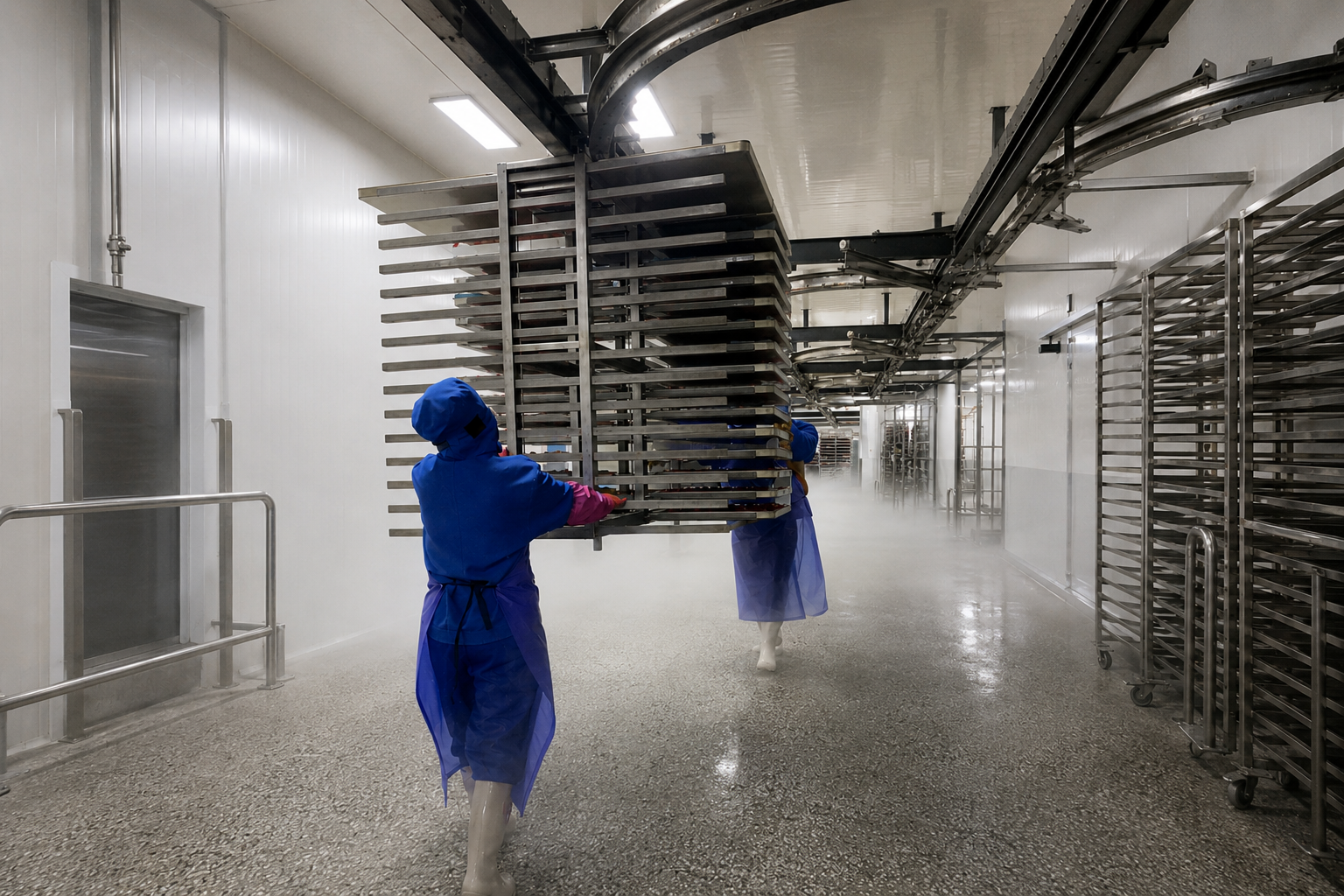
Capacity and capability data relevant to a piece program: core-category freeze-drying capacity of more than 3,000 metric tons per year (approximately 250+ tons per month), 12 finished-product packing and customization lines with designed finished-product capacity of more than 4,500 metric tons per year (approximately 375+ tons per month), and packing throughput above 228,000 packs per day — split between coated lines at approximately 160,000 per day (durian approximately 100,000, strawberry approximately 60,000) and pure lines at approximately 68,000 per day (durian approximately 15,000, strawberry approximately 32,000, apple approximately 21,000). Capacity continues to expand, and actual available capacity is confirmed by SKU, process, packaging format and production schedule.
Product and process development is supported by an in-house R&D team of 10 engineers and a cooperation with the School of Physical Science and Technology, Xiamen University, focused on the fundamental mechanisms of freeze-drying. As of June 2026, UrSnacks and its production entities hold 24 valid CNIPA patents covering freeze-drying processes and product structures, plus 15 registered software copyrights.
Certificates and their scope. The production facilities are certified to BRCGS, ISO 22000, HACCP and HALAL standards, have completed SMETA (Sedex) audits and hold China's Food Production License (SC). Relevant production entities have completed U.S. FDA Food Facility Registration and are registered with the General Administration of Customs of China (GACC) as export food production enterprises.
| Credential | Reference details | What it covers |
|---|---|---|
| BRCGS Global Standard Food Safety, Issue 9 | Certificate No. C723738; Site Code 10017031; issued by DNV Business Assurance Italy S.r.l.; 2025-10-20 to 2026-11-09 | Selecting and packaging of dried vegetable and dried fruit products; selecting, coating, cooling and packaging of coated dried fruit products in compound bags |
| ISO 22000:2018 | Certificate No. 001FSMS2400580; China Quality Certification Centre (CQC); 2024-08-09 to 2027-08-08 | Food safety management system; food chain category C II |
| HACCP System Certificate | Certificate No. 001HACCP2600621; CQC; 2026-08-26 to 2029-08-25 | Packaging of dried vegetable and dried fruit products; production of coated dried fruit products |
| Halal — GCC/GSO | Certificate No. 5880250000; Reg. No. 3502/08109; GSO 2055-1:2015; Shandong Halal Certification Service; 2025-08-22 to 2028-08-21 | Product category CIV; scope defined by the attached product list |
| Halal — Malaysia / Indonesia routes | MS1500:2019 certificate under the same certificate and registration numbers, recognized by JAKIM; BPJPH Indonesia certificate ID00410002836200323, issued 2023-05-04 | Halal-certified processed fruit and vegetable products; the Indonesian scope covers products across attached lists |
| U.S. FDA Food Facility Registration and U.S. Agent | Facility No. 432015462; DUNS 704680481; document issued through CCIC Xiamen; U.S. Agent: CCIC Chicago Inc.; 2026-03-04 to 2027-03-03 | Registration and U.S. Agent designation for Jinjiang Youlingyoushi Food Co., Ltd. under the U.S. Bioterrorism Act of 2002, Title III, Section 305 |
| China export food production enterprise filing | Filing No. 3502/08109; Quanzhou Customs; long-term validity | Fruit chips (sub-packaging); flavored fruit chips |
| SMETA (Sedex) audit | Audit Reference ZAA600211493; audit date 2026-06-16; SMETA Version 7, four pillars | Labour standards, health and safety, environment and business ethics; an audit report under an annual cycle rather than a fixed-term certificate |
Certification scope wording should be read against the exact SKU and process, not against the certificate logo. A BRCGS, ISO 22000 or HACCP certificate is not an import approval, and the FDA document is a facility registration and U.S. Agent arrangement rather than an FDA-issued certificate. Product-specific import permission, labelling, registration and sanitary requirements are confirmed by destination, category and project.
Application Fit: Where Freeze-Dried Fruit Pieces Work
Piece format selection follows function. The application guidance below reflects the scenarios in which freeze-dried fruit pieces are currently supplied.
Granola, muesli and ready-to-eat cereal
Dice, granules or crumbles are the practical formats; large thin slices are the most breakage-sensitive option for mixing, conveying and filling. Freeze-dried fruit should be added at the final dry-blending stage, after baking and full cooling in baked granola, using a 5–8% inclusion rate as a starting point for trials and adjusting by fruit type, piece size and positioning. In dry blends, moisture migrates toward the lower-activity component, so pack barrier performance and any syrup or honey component are the variables to control.
Beverages, tea and dry mixes
The format choice follows the role in the cup. Whole pieces and slices carry cup-top visual impact; crumble releases flavour and colour progressively in-cup; powder at 80–120 mesh disperses into base layers, syrups and dry mixes. Whole and sliced toppings soften once in contact with liquid, so the serving-to-drinking window matters. Powder is the most hygroscopic format and needs the strongest moisture barrier and prompt dosing after opening.
Yogurt, dairy and frozen desserts
Crumble is the usual inclusion format. Where crispness is the selling point, supplying the fruit in a separate sachet or lid compartment keeps texture out of the shelf-life equation; where softening is acceptable, colour stability across shelf life should be validated rather than assumed. Coated variants contain milk and soy and require allergen review before use in dairy or children-oriented products.
Bakery and confectionery
Decoration is applied after baking and full cooling; dice can be used as a dough or filling inclusion where a softened texture is acceptable. A heating step is a formulation decision, not a detail — concentrated fruit sugars after dehydration can cause caramelisation, bitter notes and colour loss, and any temperature and time window needs its own validation.
Retail and private-label formats
Finished retail forms include strips, slices, chunks and pieces, from 15 g single-serve formats through to sharing packs and gift boxes, in pure freeze-dried or coated products. Packaging options include pouches, boxes, cups and gift packs, with customizable net weight, materials, logo, colour printing, multilingual labels and channel-exclusive SKUs, plus nitrogen flushing and desiccants depending on shelf-life target and destination conditions.
Freeze-Dried Pieces Compared with Conventional Dried Fruit and Vacuum-Fried Chips
Freeze-drying is one of three common dehydration routes for fruit, and each produces a different piece.
| Comparison dimension | Freeze-dried pieces | Conventional hot-air dried fruit | Vacuum-fried fruit chips |
|---|---|---|---|
| Structure and texture | Light, porous, near-original volume; fractures sharply | Denser, visibly shrunk, softer and chewier | Crisp but oil-impregnated, closer to a fried-chip bite |
| Fat introduced by the process | No frying oil used as heat-transfer medium | Typically low fat | Edible oil is the heat-transfer medium; oil uptake is a sourcing variable |
| Moisture handling | Highly hygroscopic; crispness depends on packaging barrier and handling | Higher moisture and stickiness; clumping and bridging need managing | Moisture plus oil oxidation and rancidity to manage |
| Mechanical behaviour | Brittle; sensitive to compression and drop; large thin slices most fragile | Tolerates compression; flow and dosing affected by stickiness | Generally robust in handling |
| Typical fit | Visible real fruit, low moisture input, dry blends, dairy, beverage, premium positioning | Chewy inclusions and cost-led mainstream formulations | Traditional chip experience with stronger seasoning carry |
The boundary is worth stating plainly. Freeze-dried pieces cost more per kilogram than conventional hot-air dried fruit in most cases, they are more fragile in handling, and they are more sensitive to moisture pickup. If a formulation needs a soft, chewy fruit inclusion, tolerates higher moisture input, or is driven primarily by the lowest raw-material cost, conventional dried fruit is usually the better choice. Freeze-drying becomes the appropriate route when the requirement is a non-fried piece, a light crisp structure, visible real-fruit identity and low moisture input — and the cost should then be judged on value per finished product, including usable yield and fines, rather than on price per kilogram alone.
OEM, ODM and Private Label: How Piece Programs Are Configured
Freeze-dried fruit piece programs typically run through one of four cooperation structures, and the choice depends on who owns the product definition.
- OEM manufacturing covers mass production to a customer-confirmed product, process, formula or flavour, packaging and quality specification.
- ODM product development includes product definition, raw-material selection, process and flavour development, sampling and validation, packaging design, mass-production specification and project commercialization.
- Private label production is based on mature or customized SKUs, labels, packaging and channel-exclusive specifications.
- B2B freeze-dried ingredient supply serves industrial, foodservice and further-processing customers who incorporate the fruit into their own formulations.
Commercially, OEM and private-label finished goods start from approximately 600 kg per order, and different freeze-dried products and SKUs can be combined in the same container; bulk freeze-dried ingredients use a standard MOQ of one 20-foot container, with mixed-SKU container loading supported and finished goods and ingredients potentially sharing a container where loading conditions allow. Mature OEM and private-label programs typically require about 25–30 working days, subject to product specification, packaging-material approval and production schedule; ODM adds development, sampling, process and flavour validation and packaging confirmation before scheduling. Standard shelf-life positioning is 18 months for B2B freeze-dried ingredients and 12 months for finished retail products, confirmed per SKU, packaging structure and destination market in the final specification.
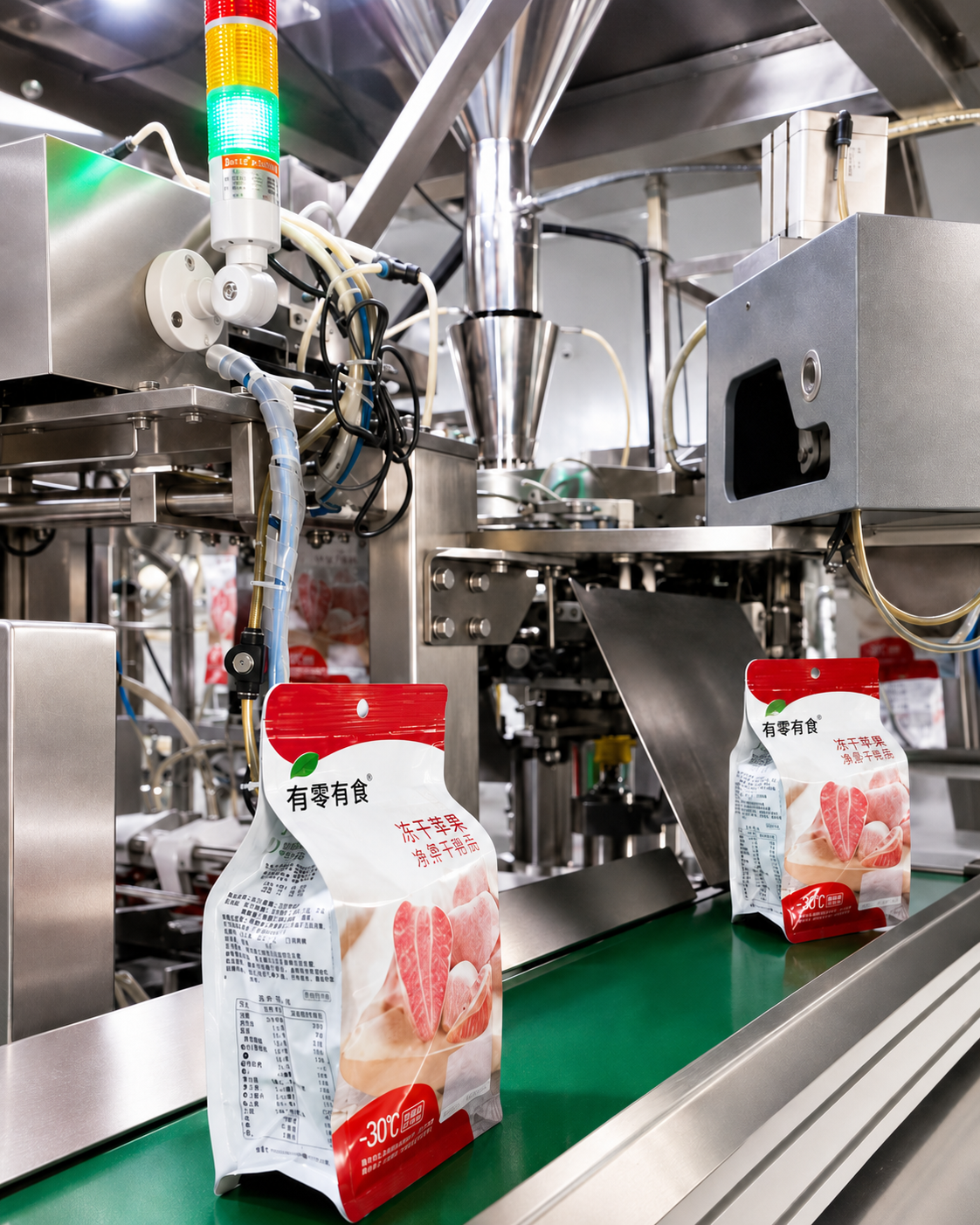
On demonstrated scale-up, three reference points are on record. A South Korean end-brand serving the convenience-store channel converted a proven coated freeze-dried strawberry platform into a customized OEM program, closing at a full 40HQ container in approximately four months. A Japanese end-brand retail customer ordered 5 metric tons of freeze-dried strawberry ingredients, converted in around four months, and subsequently moved into planning for a freeze-dried apple OEM project. Supply to national discount-snack chains has run since 2021 across a combined partner and chain network of more than 40,000 stores, where two core SKUs — freeze-dried durian and freeze-dried strawberry — reached a combined peak monthly supply volume of more than 3 million packs, and where new-product co-development extended the relationship beyond core-SKU supply. Across channels the company has worked with more than 150 brand clients, spanning e-commerce, premium grocery, mass-market snack retail, modern tea and beverage, quick commerce and warehouse club channels.
Project-level support covers requirement confirmation, sampling, process and formula, packaging and labelling, production scheduling, container loading and delivery through a dedicated account manager; NDA support protects customer formulas, process concepts, packaging and channel information; and production, testing, batch and traceability documents can be provided by project to support customer audits and quality review.
Limits and Boundaries Buyers Should Plan Around
Piece configuration is a genuine capability, but it is bounded. The following constraints are the ones that most often affect a first order.
- Dimensional feasibility is fruit-specific. The achievable range for a cut depends on fruit structure, mechanical strength and process capability. Target dimension, tolerance and whole-to-fines ratio should be confirmed through samples before the commercial specification is locked.
- Natural variation is normal, not a deviation. Colour, flavour balance, crispness, particle size and visual yield vary by variety, origin, maturity, season and batch. A golden sample plus measurable acceptance ranges is the workable control; an expectation of visually identical lots is not.
- Breakage and fines must be agreed. Large thin slices and whole pieces are the most fragile through mixing, conveying, filling and transport. Where fines matter commercially — for example in premium visual-led SKUs — a fines limit belongs in the specification, and format should be re-selected if the limit cannot be held.
- Crispness is a packaging outcome as much as a product outcome. Freeze-dried pieces are hygroscopic; reference practice is to handle and store below 60% RH, avoid temperature cycling, reseal opened packs immediately and keep the supplied desiccant. Powder is the most hygroscopic format.
- Coated pieces carry additional constraints. Milk and soy declaration, no eligibility for no-added-sugar or single-ingredient claims, and higher sensitivity to heat, cycling, compression and abrasion.
- Analytical statements have a defined scope. “Not detected” results apply only to the tested items, categories and batches, at the reporting limits of the stated methods. Ingredient nutrition data cannot be transferred to a finished-product label; finished-product nutrition must be recalculated from the actual formulation and the applicable labelling rule.
- Certificates are not import approvals. Market access, labelling, registration and sanitary requirements are confirmed per destination, category and project.
- Operational figures are confirmed per order. MOQ, lead time, shelf life and available capacity are confirmed by SKU, process, packaging format and production schedule, and capacity continues to expand.
- Freeze-drying is not a microbial kill step. Microbiological quality depends on raw-material control, plant sanitation and post-process handling, and should be specified and verified accordingly.
Market Trend Analysis
Three verifiable signals frame the piece-format discussion, and one caution belongs alongside them.
First, scale and product mix. Global freeze-dried fruit revenue reached USD 5.108 billion in 2024, with the berries segment at a 42.6% revenue share — which is consistent with why strawberry-based piece formats dominate enquiries for whole, halved, sliced and coated pieces. Asia Pacific held a 38.2% revenue share in 2025, aligning with the region's role as both a production base and a fast-growing consumption market.
Second, trade volume. Global trade in dried fruits under HS Code 0813 reached USD 3.13 billion in 2024, up 2.79% year on year. That figure should be read carefully: HS 0813 aggregates all drying methods, so it does not isolate freeze-dried product, and market-size estimates also diverge depending on whether freeze-dried vegetables are included in the definition. The practical implication for buyers is that published category numbers are useful for direction, not for sizing a specific SKU opportunity.
Third, regulatory obligation. U.S. FDA Food Facility Registration is required for foreign facilities manufacturing freeze-dried fruit for U.S. consumption and is renewable every even-numbered year under the Bioterrorism Act and FSMA framework. Registration is an obligation, not a quality endorsement, and importers should also confirm their own responsibilities under the applicable supplier verification framework.
On the supply side, one data point is directly attributable: according to a Market Position Statement by Frost & Sullivan, UrSnacks ranked No.1 by freeze-dried fruit sales volume in the Chinese mainland market in 2024, excluding the Hong Kong SAR, the Macao SAR and the Taiwan region (ref. FS-2025-MPC-874126; research completed May 2025; ranking by brand, by 2024 sales volume, meaning quantity sold rather than sales value). That ranking describes volume position in one market and should not be read as a product-quality or price claim.
Future Outlook
The direction of travel in freeze-dried fruit is towards specification discipline at piece level. As freeze-dried fruit moves deeper into cereal, dairy, bakery, beverage and private-label programs, the buyer's central question shifts from “can you supply the fruit?” to “can you hold a written piece specification across lots, and can you evidence it?”
That shift favours suppliers who can control cut, dimension, moisture, fines, coating and bulk packing as specified parameters rather than as incidental outcomes, and who can support the documentation that retail and import customers now request as standard. It also raises the value of the specification sheet itself: as more buyers run multi-SKU programs across several markets, the written specification and batch documentation become the working commercial instrument, while the sample becomes evidence rather than the agreement. Coated and infused formats extend the range of flavour experiences available on the same base fruit, at the cost of added allergen, claim and handling considerations that buyers should plan for before launch rather than after.
FAQ
What does OEM freeze-dried fruit production cover, and how does it differ from ODM and private label?
OEM production covers mass production to a customer-confirmed product, process, formula or flavour, packaging and quality specification — the customer owns the specification. ODM product development is the model in which the manufacturer performs development: product definition, raw-material selection, process and flavour development, sampling and validation, packaging design, mass-production specification and project commercialization. Private label production is based on mature or customized SKUs, labels, packaging and channel-exclusive specifications, and is essentially a branding question rather than a specification-authorship question. A single project can combine OEM and private label; only ODM moves product development to the manufacturer. A fourth route, B2B freeze-dried ingredient supply, serves customers who use the fruit inside their own formulation.
Can freeze-dried fruit pieces be customized by cut, dimension and particle size?
Yes, within the limits set by fruit structure, mechanical strength and process capability. Bulk ingredient formats in the current range include powder, granules, dices, chunks, slices and crumbles, with particle or mesh size, cut, grade, bulk-pack format and end-use adaptation specified per project. Documented examples include strawberry whole fruit in S, M and L diameter grades and strawberry halves, apple thin slices at 3–5 mm and large thick slices at 65–75 mm × 10 mm or 75–85 mm × 10–15 mm, pineapple chunks at 10–15 mm and dice at 6–10 mm, banana slices at 3–5 mm, durian chunks in S, M and L sizes, and powder at 60–80, 80–100 and 100–120 mesh. Target dimension, tolerance and whole-to-fines ratio should be confirmed through samples before the specification is locked, because feasibility varies by fruit and cut.
Which coating options apply to freeze-dried fruit pieces, and what does that change on the label?
Coating directions include chocolate, matcha, yogurt and fruit-original profiles, with thin or thick coating options selected according to the desired fruit-to-coating balance. Fruit content is declared per SKU: the coated durian 58 g SKU is specified at freeze-dried durian ≥66%, and the coated strawberry 22 g, 29 g and 38 g SKUs at strawberry ≥37%. Coated products contain milk-derived and soy-derived ingredients, with cocoa powder in cocoa variants, so milk and soy must be declared as allergens. Coated products are not eligible for “no added sugar” or single-ingredient clean-label claims; those apply only to the pure line, in which the fruit is the sole ingredient. Coated pieces are also more sensitive to heat, temperature cycling, compression and abrasion than pure pieces.
What are the MOQ and lead-time baselines for OEM, private label and bulk ingredient programs?
OEM and private-label finished goods, together with the own-brand finished range, start from approximately 600 kg per order, and different freeze-dried products and SKUs can be combined in the same container. Bulk freeze-dried ingredients use a standard MOQ of one 20-foot container, with mixed-SKU container loading supported and finished goods and ingredients potentially combined where loading conditions allow. Mature OEM and private-label programs typically take about 25–30 working days, subject to specification, packaging-material approval and production schedule; ODM requires additional development, sampling and validation time. All figures are confirmed per SKU, process, packaging format and production schedule.
Which certifications cover coated and piece-format production, and what do they not cover?
Relevant credentials include BRCGS Global Standard Food Safety Issue 9 (Certificate No. C723738, Site Code 10017031, issued by DNV Business Assurance Italy S.r.l., valid 2025-10-20 to 2026-11-09), ISO 22000:2018 (Certificate No. 001FSMS2400580, CQC, valid 2024-08-09 to 2027-08-08), HACCP System Certificate (Certificate No. 001HACCP2600621, CQC, valid 2026-08-26 to 2029-08-25), halal credentials for GCC/GSO markets (GSO 2055-1:2015), Malaysia and Indonesia routes (MS1500:2019, BPJPH), U.S. FDA Food Facility Registration with U.S. Agent (Facility No. 432015462), China export food production enterprise filing (No. 3502/08109) and a SMETA four-pillar audit under SMETA Version 7 (Audit Reference ZAA600211493). The BRCGS scope covers selecting and packaging of dried fruit products and selecting, coating, cooling and packaging of coated dried fruit products in compound bags, which should be read against the exact SKU and process. None of these constitutes an import approval, and product-specific import permission, labelling, registration and sanitary requirements remain destination-specific.
How should freeze-dried fruit pieces be stored and handled after opening?
Store unopened product sealed in a cool, dry and dark place, with reference practice of handling and storage below 60% RH and away from heat sources, water sources and strong odours. Refrigeration is generally not required for properly packed shelf-stable product. After opening, minimise exposure to ambient air and reseal immediately, retaining the supplied desiccant, and use within the validated open-pack period. Bulk cartons should be brought to line temperature before opening to avoid condensation, and stacking limits should be observed to avoid crushing porous pieces. High-fat categories such as durian benefit from additional protection against light and oxygen, and powder — the most hygroscopic format — should be dosed promptly after opening. Standard shelf life is 18 months for B2B ingredients and 12 months for finished goods, confirmed per SKU, packaging structure and destination market.
Further reference: the UrSnacks brand book is available as a downloadable PDF at ursnacks-brand-book.pdf. Company information: www.urorchard.com.