
Freeze-Dried Fruit in 40,000+ Discount-Snack Stores: Hero SKUs and End-Cap Use
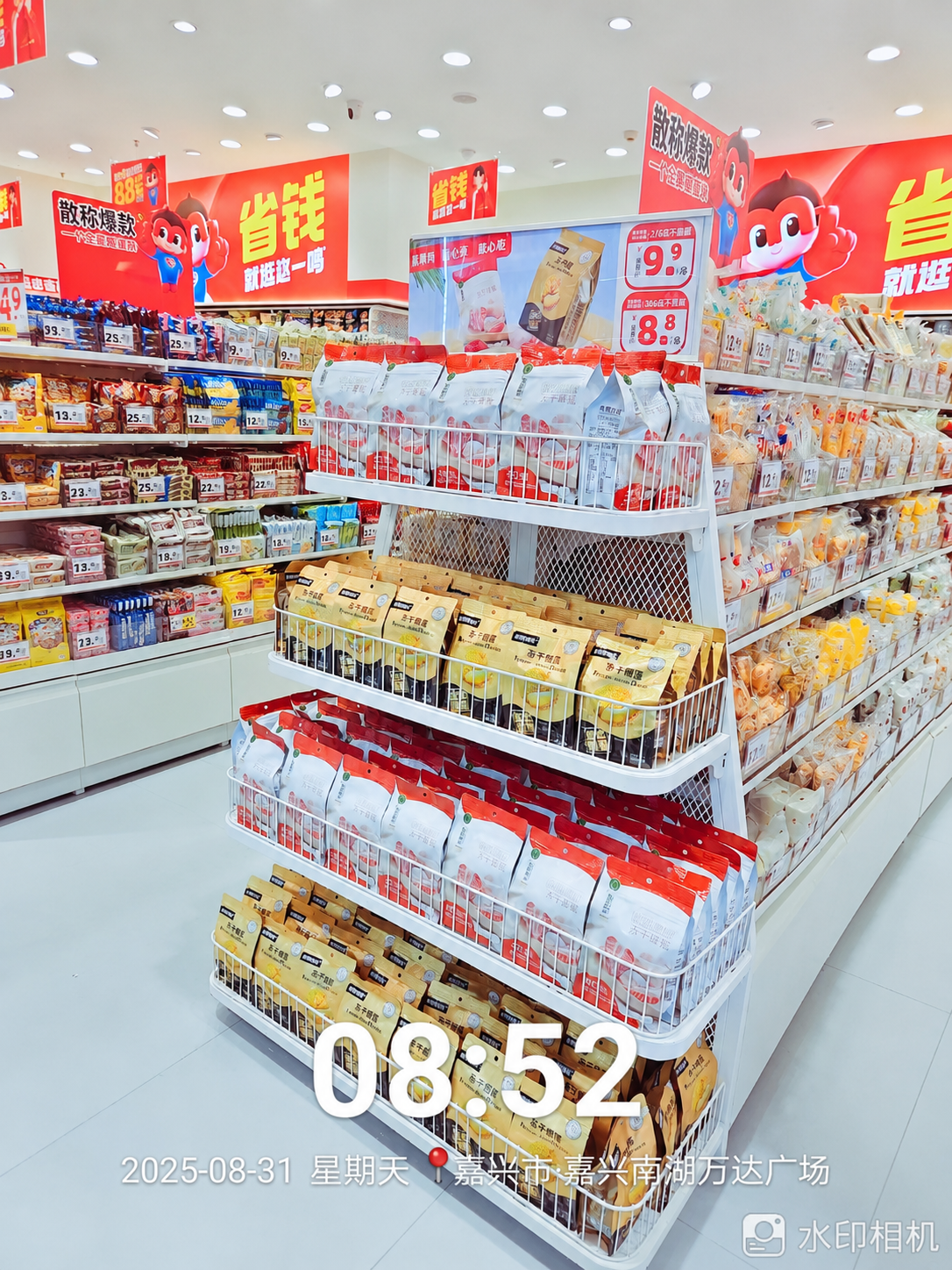
Discount-snack retail has become one of the most consequential channels for packaged fruit snacks. Rather than competing on assortment breadth the way a supermarket does, these chains compete on rotation: fewer SKUs, very high footfall, and a shopper who returns often and expects the shelf to be worth the trip again. For a freeze-dried fruit supplier, that changes the questions that matter. The relevant question is no longer whether the product can be made, but which SKUs can carry a program across tens of thousands of storefronts — and where on the floor those SKUs belong.
Scale is the reason this channel deserves its own sourcing framework rather than being treated as one more retail account. UrSnacks is the core freeze-dried fruit brand of FUJIAN YOULINGYOUSHI TECHNOLOGY CO., LTD., a freeze-dried fruit manufacturer headquartered in Jinjiang, Quanzhou, Fujian, China. The brand supplies major discount-snack retail groups and nationwide chain retailers, represented by Mingming Henmang Group and Wancheng Group, under a cooperation that began in 2021. The combined partner and chain network behind that cooperation covers more than 40,000 stores, and products have reached approximately 95% of Mingming Henmang Group's stores. Cooperation continues on a multi-year, ongoing basis.
This reference examines how a four-fruit range — freeze-dried durian, strawberry, apple and banana — is mapped to main-shelf, end-cap and traffic-driving placements, what supply evidence sits behind that map, and where the model has genuine limits.
Why the Discount-Snack Shelf Rewards a Different Product Decision
A discount-snack store is not a scaled-down supermarket. Its economics depend on three things: frequency of visit, speed of shelf movement, and the price-to-experience ratio of each item it carries. Because square metres are scarce, every facing has to justify itself in weeks, not seasons. Products that read clearly in three to five seconds and generate repeat purchase get depth; products that require explanation get cut.
Freeze-dried fruit fits this logic better than most fruit-snack formats, for reasons that are structural rather than promotional. It is ambient-stable and needs no cold chain. It keeps recognisable fruit shape and colour, so it identifies itself on shelf. It carries a crisp bite that is distinct from the chewy texture of conventional dried fruit. And it does not require the shopper to understand a new category before buying.
The opportunity that a 40,000-door network creates is the volume profile. A single chain at that scale does not order in pallets — it orders in production campaigns. Serving it requires freeze-drying capacity, finished-product packing capacity, and replenishment coordination that can absorb high-frequency repeat orders without breaking specification consistency across store batches. That is a supply question first and a marketing question second.
What Makes a Hero SKU in a Ten-Thousand-Store Network
In this channel, a hero SKU is not simply the best-selling item. It is the SKU that anchors a category block: the product that a shopper will make the trip for, that turns over fast enough to justify permanent facings, and that pulls secondary purchases alongside it. Three conditions tend to determine whether a freeze-dried fruit SKU can play that role.
- Distinctive flavour identity. The product must be recognisable on its own, not interchangeable with other fruit snacks in the same block.
- A format that reads instantly. Whole pieces, halves and coated pieces communicate value faster than crumbles or powder in a retail setting.
- Repeat rate high enough to hold depth. Hero status is earned by re-purchase, not by first-trial novelty.
Within the UrSnacks discount-snack program, the two SKUs that reliably meet those conditions are freeze-dried durian and freeze-dried strawberry. Both are supplied as coated products with a light-flavour coating route, which balances the fruit's natural acidity or pungency with a smoother surface and a more consistent bite across batches. Coated strawberry has exceeded 2.18 million packs in monthly offline shipments, and coated durian has exceeded 1.71 million packs, which is the kind of velocity a chain buyer can build a permanent block around.
The Core Range: Durian and Strawberry as Anchors, Apple and Banana as Basket Builders
The four-fruit range is not an assortment list — it is a placement strategy. Durian and strawberry occupy the high-frequency anchor positions. Apple and banana broaden basket fit, adding a second and third purchase tier without competing with the anchors for the same shopper occasion.
Freeze-dried durian: the value-perception anchor
Durian carries a strong flavour identity and a high perceived value in Asian snacking contexts. In the 58 g coated format, the product declares freeze-dried durian content of at least 66% with a light vegetable-oil coating, packed 24 bags per carton. A 32 g single-serve coated pouch serves checkout and impulse positions in the same carton configuration. Because the fruit identity is so specific, durian works as the SKU that justifies a trip — the item a shopper comes in for and leaves with something else beside.
Freeze-dried strawberry: the high-frequency workhorse
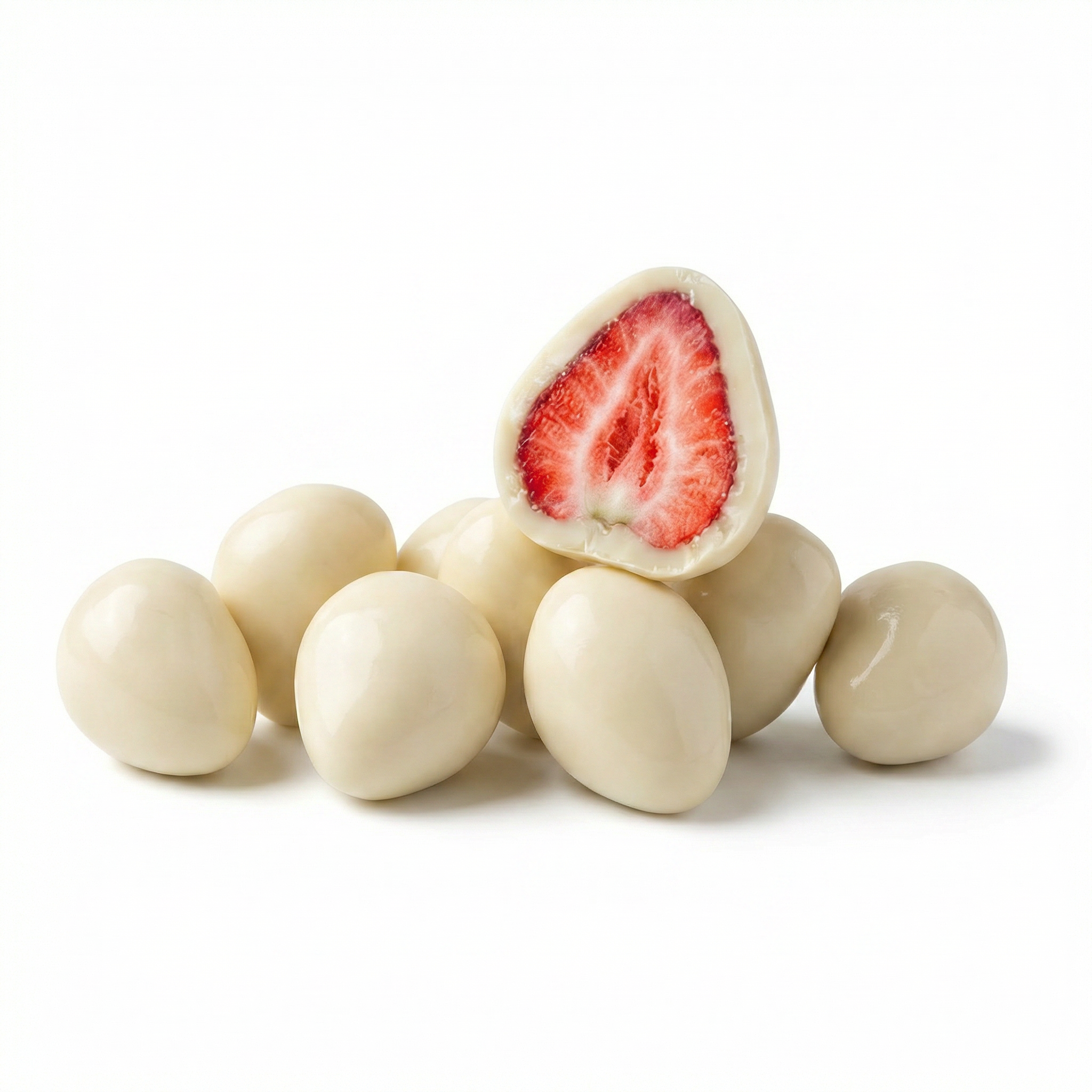
Strawberry is the highest-acidity category in the measured range, which makes it the most compatible with dairy-style and confection-style coatings, and one of the most recognisable fruit forms on shelf. The coated line is supplied in 78 g share packs (16 bags per carton), 38 g single-serve pouches and 22 g single-serve pouches, plus a 15 g stick pack carrying roughly four whole strawberries per stick. That spread lets a chain run one flavour across three different shelf jobs — main shelf, sharing and checkout — without adding a second supplier or a second specification file.
Freeze-dried apple and banana: widening the basket
Apple and banana are positioned as basket builders. Apple is measured at 0.47 g fat per 100 g in the referenced tested batches and is supplied as a single-ingredient product — 58 g original pouches, 38 g apple strips, and a 15 g apple-strip paper cup suited to checkout and impulse positions. Banana is supplied as 96 g multipack boxes containing three individually wrapped pieces of approximately 32 g each, in chocolate-flavoured and yogurt-coated versions, each declaring at least 67% freeze-dried whole banana and 0 g trans fat.
The commercial function is straightforward. Anchors drive trip frequency; basket builders raise units per basket and give the shelf a lower-intensity, family-oriented tier so that the category block is not limited to shoppers who already like durian.
The Supply Engine Behind Store-Level Execution
Shelf strategy only survives if replenishment holds. The capacity profile behind this program is what makes a 40,000-store footprint operational rather than theoretical.
- Core-category freeze-drying capacity: 3,000+ tons per year, approximately 250+ tons per month.
- Finished-product customization: 12 packing and customization lines, with designed finished-product capacity of 4,500+ tons per year.
- Packing throughput: 228,000+ packs per day — coated series approximately 160,000 per day (durian approximately 100,000; strawberry approximately 60,000) and pure series approximately 68,000 per day (durian approximately 15,000; strawberry approximately 32,000; apple approximately 21,000).
- Peak supply: during peak months, freeze-dried durian and freeze-dried strawberry together reach a combined monthly supply volume of 3 million+ packs.
Manufacturing is spread across multiple sites rather than concentrated in one plant. The layout includes freeze-drying bases in Thailand, Jiangsu and Shandong, together with a Jinjiang finishing and customization centre that carries the 12 customized production lines. That configuration matters for a chain program because it separates the fruit-drying step from the finishing and packing step, so capacity pressure in one category does not automatically stall another.
For buyers evaluating the same channel, the practical parameters are consistent with the finished-goods side of the business: OEM and private-label finished goods start from approximately 600 kg per order, different freeze-dried products and SKUs can be combined in the same container, and mature programs typically run on a lead time of roughly 25–30 working days, subject to packaging-material approval and production schedule.
Placement Mechanics: Main Shelf, End-Cap and Traffic-Driving Programs
Placement in a discount-snack store is a set of three distinct jobs, and each job has a different pack-format optimum.
Main shelf
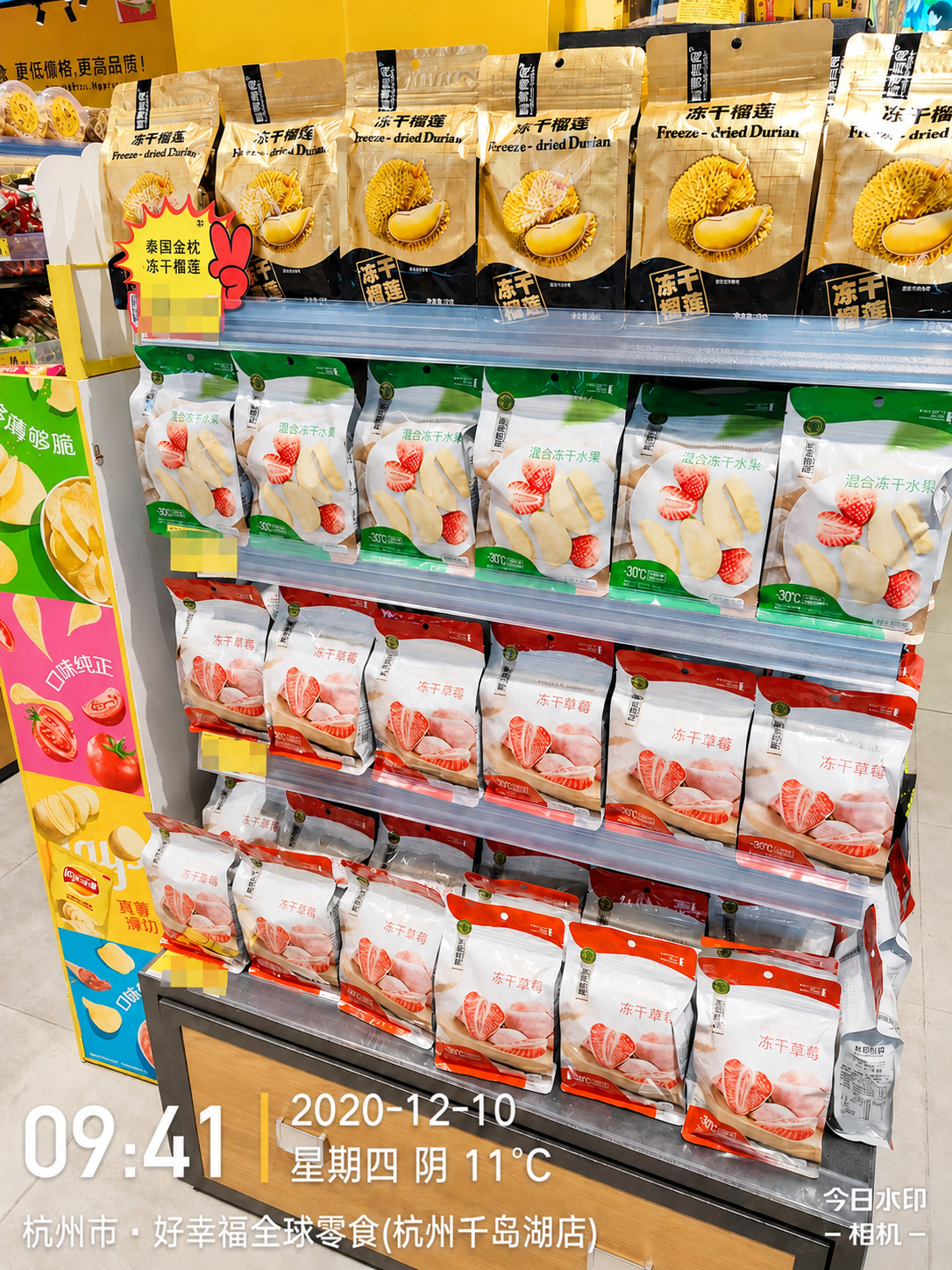
The main shelf carries the SKUs that must never be out of stock. Facings width here is earned by repeat rate, which is why the coated durian and coated strawberry hero products hold the eye-level block, with apple pouches occupying the adjacent, lower-intensity tier. The pack format that suits main shelf is the 38–58 g single bag: large enough to feel like a real purchase, small enough to sit at a mainstream price point.
End-cap and seasonal display
End-caps in this channel are used less for clearance and more for occasion blocks — sharing, gifting, flavour editions. Formats that work here are the 78 g strawberry share pack and the 96 g banana multipack boxes, both of which present well when stacked and can carry a seasonal block without requiring new artwork at every rotation. The 270 g Thai Monthong durian gift box, supplied as three 90 g inner bags, sits further up the same ladder for gifting seasons.
Traffic-driving hero placement
The traffic-driving position is the first-aisle or entrance hotspot where a single product has to justify the shopper's decision to walk in. Durian is the natural candidate because its identity is unmistakable and its perceived value is high. The design constraint is that the pack must survive that exposure: freeze-dried fruit is hygroscopic, and a placed product that softens on display loses both crispness and shelf presence very quickly.
Pack Format and Placement Fit
| Product (as specified) | Net weight / format | Carton configuration | Typical placement |
|---|---|---|---|
| Freeze-Dried Durian — 58 g Durian · Coated | 58 g single bag, light vegetable-oil coating | 24 bags / carton | Main shelf, hero block |
| Freeze-Dried Durian — 32 g Durian · Coated (Original) | 32 g single-serve pouch | 24 bags / carton | Checkout, impulse |
| Freeze-Dried Strawberry — 78 g Strawberry · Coated (Original) | 78 g share pack | 16 bags / carton | End-cap, sharing |
| Freeze-Dried Strawberry — 38 g Strawberry · Coated (Original) | 38 g single-serve pouch | 24 bags / carton | Main shelf, hero block |
| Freeze-Dried Strawberry — 15 g Strawberry Stick · Original | 15 g stick pack, approx. 4 whole strawberries per stick | Approx. 200–300 sticks / carton | Checkout, impulse |
| Freeze-Dried Apple — 58 g Apple · Original | 58 g single bag, single ingredient | 16 bags / carton | Main shelf, family tier |
| Freeze-Dried Apple — 15 g Apple Strips · Original · Paper Cup | 15 g paper cup | Per project | Checkout, impulse |
| Freeze-Dried Banana — 96 g Banana · Yogurt (Box) | 96 g box (3 pcs × approx. 32 g), ≥ 67% banana | 32 boxes / carton | End-cap, gifting |
The pattern is consistent: single-serve packs of 15–38 g for checkout and impulse; 58–78 g for the main shelf and sharing; multipack boxes above 90 g for end-cap and gifting blocks. A chain that wants one supplier to cover all three placement jobs is asking for a range, not a product.
Market Trend Analysis
The channel strategy sits inside a category that has been growing on its own terms. Global freeze-dried fruit market size reached USD 5.108 billion in 2024, according to Market Research Future's freeze-dried fruit market report. Within that total, the berries segment dominated with a revenue share of 42.6% in 2024 — which is consistent with strawberry's role as a high-frequency anchor in retail programs. Asia Pacific held a 38.2% revenue share in 2025, per Dataintelo's freeze-dried fruits market research report, reflecting both consumption growth and the concentration of freeze-drying capacity in the region.
Trade data tells a parallel but less precise story. Global trade value of dried fruits under HS Code 0813 reached USD 3.13 billion in 2024, a 2.79% increase from 2023, according to OEC's aggregation of UN Comtrade data. That figure aggregates all drying methods, because there is currently no 6-digit HS code reserved exclusively for freeze-dried fruit — a data limitation that buyers should keep in mind when using customs figures to size the freeze-dried segment specifically.
On the supply side, UrSnacks ranked No.1 by freeze-dried fruit sales volume in the Chinese mainland market in 2024, per a Frost & Sullivan Market Position Statement (ref. FS-2025-MPC-874126; ranking by brand, by 2024 sales volume, excluding the Hong Kong SAR, the Macao SAR and the Taiwan region). What the discount-snack channel adds to that picture is distribution format: it is the mechanism by which a premium-format fruit product reaches a mainstream price tier without changing what the product is.
Comparison with Traditional Solutions — and Where Freeze-Dried Fruit Falls Short
Freeze-dried fruit is not the correct answer for every slot on a discount-snack shelf, and treating it as a universal upgrade is a common sourcing error. The honest comparison runs across four routes.
| Route | Typical shelf role | Where it wins | Where freeze-dried fits better |
|---|---|---|---|
| Air-dried / dehydrated fruit | Main shelf, value tier | Lower direct processing cost; chewier bite; better compression tolerance in packing and transport | When visible fruit shape, a light crisp structure and lower moisture input are the point of the product |
| Vacuum-fried fruit chips | Snack-chip block | Familiar chip texture; stronger seasoning carry; generally lower utility cost | When a non-fried format and a real-fruit core are the positioning |
| Candied / sweetened dried fruit | Confectionery-adjacent | Controlled sweetness; longer chew; low unit cost | When the fruit needs to be the sole ingredient on the label |
| Freeze-dried fruit | Main shelf, end-cap, hero | Shape and colour retention; crisp bite; no cold chain; 12-month finished-goods shelf life | — |
Three limitations deserve to be stated plainly, because they determine whether a discount-snack program will actually work.
- Unit cost is structurally higher. Freeze-drying requires freezing, vacuum and a longer cycle than hot-air drying. In a channel built on price-to-experience, the format only pays back when rotation is fast enough to absorb that cost. If a chain cannot turn the SKU, freeze-dried fruit is the wrong entry.
- The product is fragile and hygroscopic. Large thin slices break under stacking pressure and transport vibration; fines accumulate in the pack; moisture pickup softens the bite and ends the product's reason for being on shelf. Barrier packaging, seal integrity and carton cushioning are part of the specification, not accessories to it.
- Coated lines carry allergen declarations. The coated products contain milk-derived and soy-derived ingredients and are therefore not eligible for single-ingredient clean-label or no-added-sugar positioning. Buyers who need a short ingredient list should select from the pure single-ingredient line rather than the coated anchors.
Future Outlook
The direction of this channel is moving from supply to co-development. After consistent delivery performance on the core SKUs, Mingming Henmang Group commissioned the development of seven new products in 2026, and following launch those products received positive consumer feedback. That extended the relationship from large-scale supply of core SKUs into new-product co-development and continued product launches.
That shift has implications for how buyers should qualify suppliers. A chain that has already validated a supplier's ability to hold specification across thousands of doors is unlikely to return to open tendering for every new flavour or format — it is more likely to test whether the supplier can develop. The capability set that matters next is the one behind the finished product: OEM production to customer-confirmed process, formula and packaging specifications; ODM development covering product definition, raw-material selection, sampling and validation through mass-production specification; and private-label execution on mature or customized SKUs with channel-exclusive specifications. Process and flavour routes in this range include coating directions such as chocolate, matcha, yogurt and fruit-original profiles with thin or thick coating options.
For suppliers and buyers alike, the practical conclusion is that discount-snack retail has become a proving ground rather than an outlet. The channel's demands — depth of facings, pack-format breadth, peak-month replenishment, and now new-product development — describe what a freeze-dried fruit manufacturer needs to be able to do before it can credibly serve a 40,000-store network at all.
Frequently Asked Questions
Why do freeze-dried durian and strawberry function as hero SKUs in discount-snack stores, while apple and banana do not?
Hero status in this channel is determined by repeat rate and flavour identity, not by category size. Freeze-dried durian has a distinctive, unmistakable flavour profile and a high perceived value in Asian snacking contexts; freeze-dried strawberry has the highest measured acidity in the range, which makes it broadly compatible with dairy-style and confection-style coatings, and it has one of the most immediately recognisable fruit forms on shelf. Both have demonstrated velocity at scale — coated strawberry has exceeded 2.18 million packs in monthly offline shipments and coated durian has exceeded 1.71 million packs. Apple and banana serve a different function: apple is a mild, single-ingredient, low-fat option suitable for family and children-oriented tiers, and banana is supplied as multipack boxes in chocolate-flavoured and yogurt-coated versions. They broaden basket fit rather than anchor trip frequency.
How much volume can a 40,000-store discount-snack network absorb for freeze-dried fruit?
The reference figure from the UrSnacks discount-snack program is that during peak supply months, the two core SKUs — freeze-dried durian and freeze-dried strawberry — reach a combined monthly supply volume of more than 3 million packs. That volume is supported by core-category freeze-drying capacity of 3,000+ tons per year (approximately 250+ tons per month), 12 finished-product packing and customization lines with designed finished-product capacity of 4,500+ tons per year, and packing throughput of 228,000+ packs per day. Actual available capacity is confirmed by SKU, process, packaging format and production schedule.
What packaging formats fit main-shelf, end-cap and checkout placement in this channel?
Placement and pack format are matched by function. Single-serve packs of approximately 15–38 g suit checkout and impulse positions; the 15 g strawberry stick pack and the 15 g apple-strip paper cup are typical of this role. Main-shelf hero positions are served by 38–58 g single bags, including the 58 g and 32 g coated durian formats and the 38 g coated strawberry pouch. End-cap and sharing blocks use larger formats such as the 78 g coated strawberry share pack and the 96 g banana multipack boxes, with the 270 g durian gift box positioned further up the gifting ladder. Freeze-dried fruit is hygroscopic and fragile, so barrier structure, seal integrity and carton cushioning are specified rather than assumed.
What supply and compliance evidence should a buyer verify before placing a discount-snack chain program with a freeze-dried fruit manufacturer?
Buyers should verify the manufacturing entity, the certificate scope wording, and the specific SKU's inclusion in that scope. UrSnacks production facilities are certified to BRCGS, ISO 22000, HACCP and HALAL standards, have completed SMETA (Sedex) audits, and hold China's Food Production License (SC). Relevant production entities have completed U.S. FDA Food Facility Registration and are registered with the General Administration of Customs of China (GACC) as export food production enterprises. Halal documentation covers multiple markets, including GSO-related requirements, MS1500:2019 and BPJPH Indonesia. On the commercial side, OEM and private-label finished goods start from approximately 600 kg per order with mixed-SKU container loading available, and mature programs typically run on a lead time of roughly 25–30 working days.
What are the limits of freeze-dried fruit in a discount-snack retail setting?
Three limits matter. First, freeze-drying carries a structurally higher unit cost than hot-air drying, so the format depends on fast rotation to work commercially. Second, the product is fragile and hygroscopic: large thin slices break under stacking and transport, fines accumulate, and moisture pickup ends the crisp bite, which means barrier packaging and handling are part of the specification. Third, coated lines contain milk-derived and soy-derived ingredients and are not eligible for single-ingredient clean-label or no-added-sugar positioning; buyers needing a short ingredient list should select from the pure single-ingredient range. Freeze-dried fruit is also the wrong choice where a shelf genuinely needs a soft, chewy, compression-tolerant product.
Reference material: the UrSnacks brand book is available for download at https://cdn.socialarks.com/sbsp/25291/common/2026/0917/ursnacks-brand-book.pdf.pdf.