
Freeze-Dried Fruit in Snack Mix: Scenario Fit for Coated Strawberry, Apple and Banana Pieces
HTNXT Industry Reference · Snack Mix, Trail Mix and Dry-Blend Inclusions
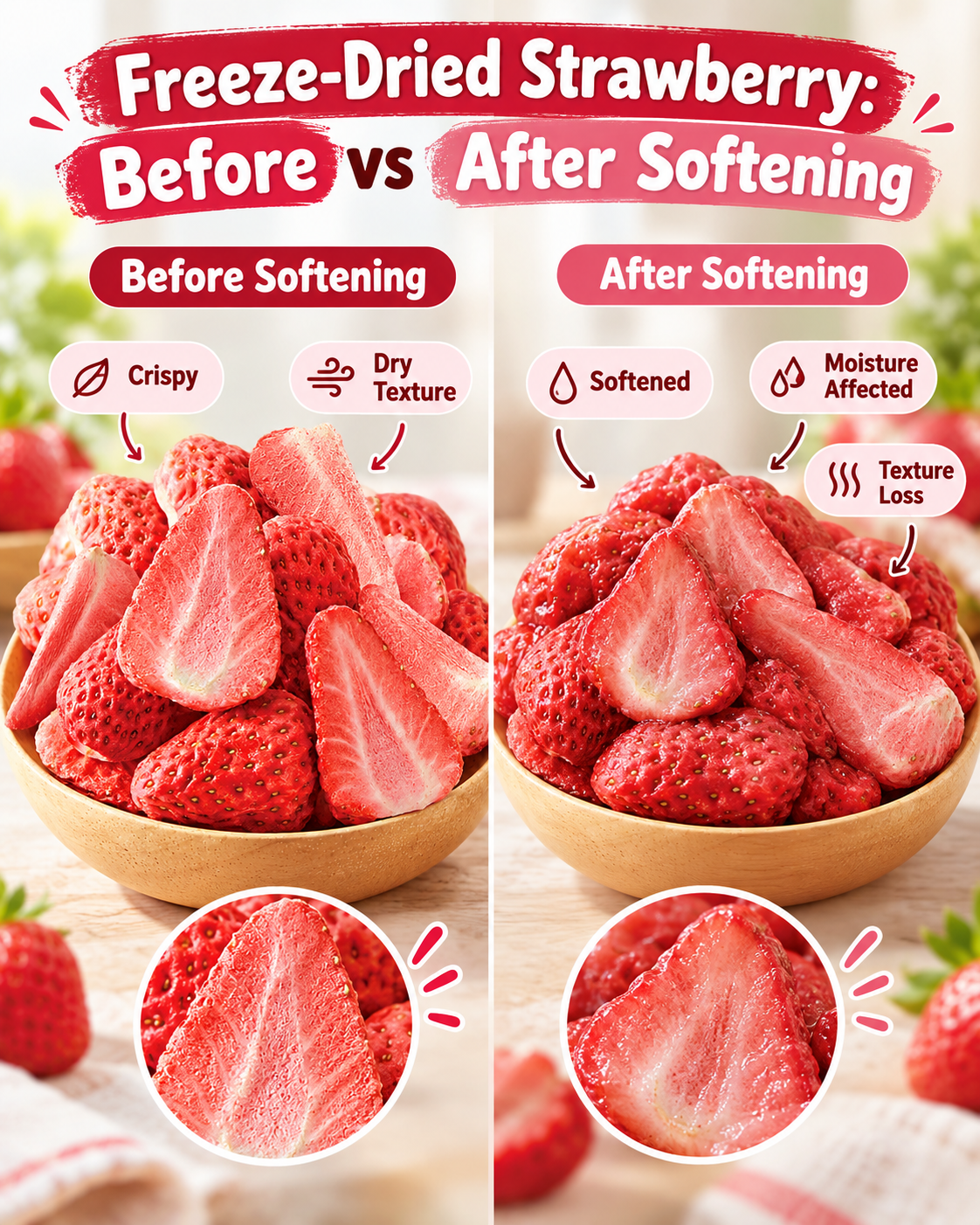
Crispness inside a snack mix is a formulation and packaging outcome, not only a raw-material specification. The comparison shows the same freeze-dried strawberry before and after moisture uptake.
Snack mix is the application where a freeze-dried fruit inclusion is judged less by how it tastes on its own than by what it does to everything around it. Strawberry, apple and banana pieces all appear in trail mixes, granola blends, breakfast mixes, breakfast-cup formats and coated snack clusters, but they behave differently in the same bag — and once a flavoured coating is added, the dominant failure modes change. The question stops being only “will the fruit go soft” and becomes “will the coated pieces fuse into a cluster, will the coating turn tacky in a hot container, and will loose flakes of coating end up in the pack.”
Freeze-dried fruit is a very low-moisture, porous and brittle ingredient. Third-party tested moisture across six UrSnacks freeze-dried fruit categories — apple, strawberry, jackfruit, dragon fruit, mango and durian — measured 0.96–1.58 g/100 g, against the reference limit of ≤5.0 g/100 g applied in those reports. That low moisture is exactly what makes the ingredient useful in a dry blend, and it is also what makes it a net receiver of moisture from every other component in the pack. For a snack-mix program, the practical work is therefore not choosing a fruit; it is choosing a coating, a format, a pack barrier and an acceptance routine that keep the pieces separate and crisp for the declared shelf life.
Why a snack mix is the hardest environment for a freeze-dried inclusion
In a dry blend, moisture moves from the higher water-activity component toward the lower one. Freeze-dried fruit sits at the low end of that gradient, which means that in most cereal, granola and snack-mix systems it is the receiver rather than the source of moisture. This single mechanism explains most of the complaints attributed to the fruit itself.
The usual moisture sources in a snack mix are honey, syrup-based binders, coatings, and semi-dried or sugar-infused fruit components. A second source is outside the pack: an insufficient moisture barrier allows ambient humidity to soften both the cereal base and the fruit, particularly on humid production floors and in hot, humid destination markets. A third is process order — fruit added before a baked base has fully cooled, or co-baked with the base, exposes the porous structure and its concentrated fruit sugars to heat that can caramelise, dull colour and damage structure.
Water activity, not moisture percentage, governs this behaviour. Water activity measures free, available water on a 0–1 scale, while moisture content measures total water. Two materials with the same moisture figure can behave very differently in the same bag. Widely used reference thresholds place dried fruits in roughly the 0.60–0.75 water-activity range and powders in the 0.20–0.60 range, and FDA practice treats water activity below 0.85 as a water-activity-controlled food. For an inclusion in a dry blend, the useful question is which component holds the highest water activity, because that is the moisture source the pack has to be engineered around.
What actually fails in the pack: clusters, tackiness, cracking and flaking
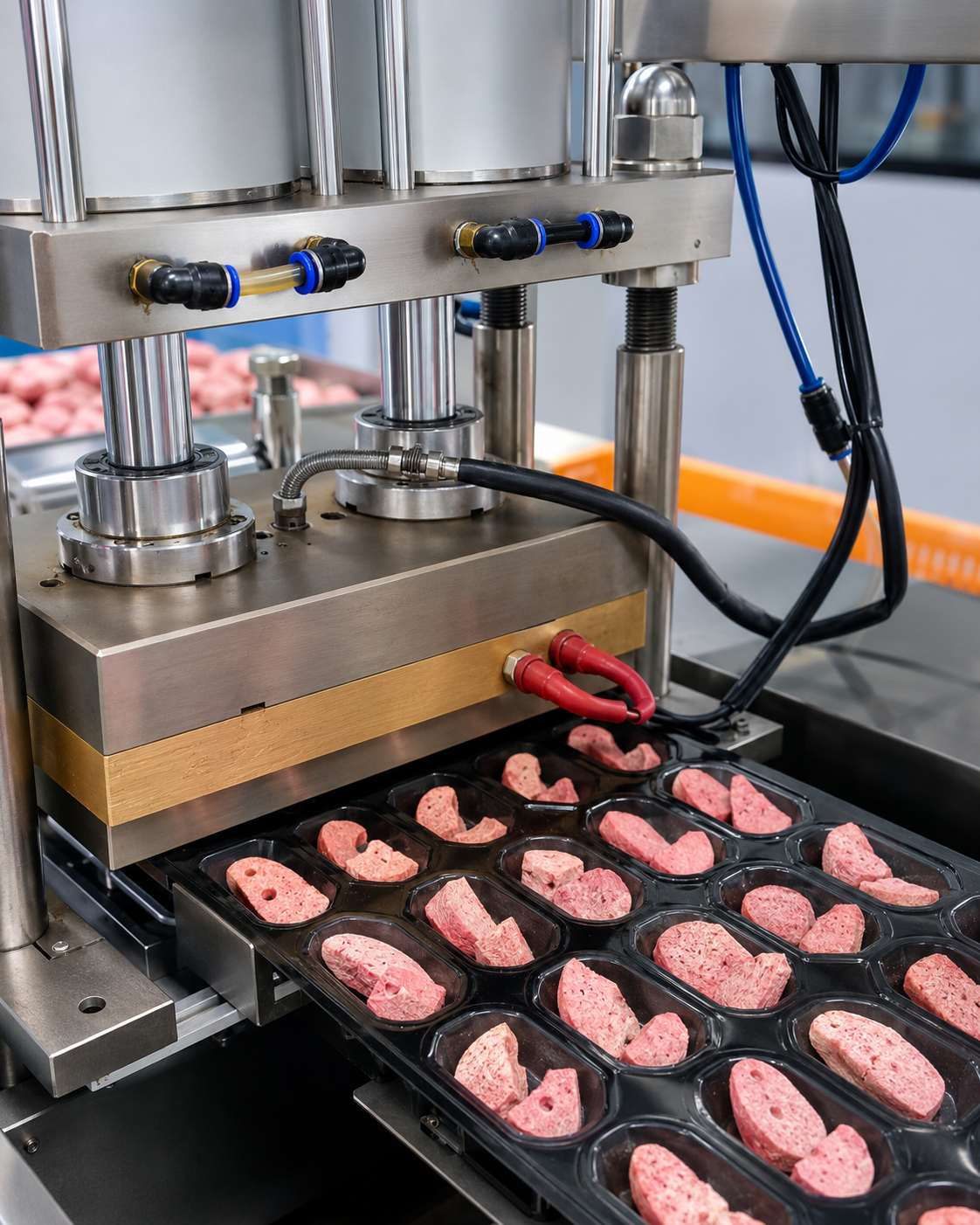
Coated freeze-dried fruit moves through selecting, coating, cooling and packaging. Coating set quality and cooling control are decided before the pieces ever reach a snack-mix line.
A flavoured coating on freeze-dried fruit is applied after drying, then cooled and packed; the fruit is not re-dried. Because the coating is a fat-based system with very low free water, it sets by cooling rather than by drying, so it does not wet the porous core, and the set layer acts as an additional moisture barrier. That mechanism brings a benefit and a new risk set at the same time.
The observable defects in a snack mix are consistent: pieces sticking together or forming clusters; coating softening or becoming tacky; coating cracking or partially flaking off; excessive coating fragments loose inside the pack; loss of gloss, dullness or surface streaking; a whitish or greyish bloom on some fat-based cocoa or chocolate-flavoured coatings; and loss of crispness after moisture pickup. These separate into three causal families.
| Failure family | Typical trigger | Visible in the pack as |
|---|---|---|
| Thermal | High temperature or repeated temperature cycling, including hot-climate transport, warehousing and retail display | Softened or tacky coating, pieces clustering, dull or bloomed surface on fat-based cocoa coatings |
| Mechanical | Transport vibration, stacking pressure or excessive free movement inside the pack | Cracked or flaked coating, coating fragments, broken fruit pieces, fines |
| Moisture | Seal failure, insufficient moisture barrier, condensation, or a higher-activity component such as honey, syrup or semi-dried fruit in the same blend | Loss of crispness, softening, chewiness, and secondary flavour deterioration |
The troubleshooting order matters because the three families look similar on a complaint photo. The workable sequence is: confirm storage and transport conditions after receipt; inspect package integrity; identify the dominant defect; compare other unopened packs from the same batch; review transport and handling; then take corrective action. Where a whitish or mottled surface appears on a cocoa-based coating, the first step is to establish whether it is a crystallisation-related appearance change in a fat-based coating and to rule out moisture damage before treating it as a cosmetic issue.
Choosing a coating by scenario, not by flavour preference
Coating choice in a snack mix is a decision about temperature exposure, allergen declaration and claim eligibility, not only about taste. UrSnacks develops three product directions — pure freeze-dried fruit, coated freeze-dried fruit and infused freeze-dried fruit — and the coated range covers yogurt-style, matcha, cocoa or chocolate-flavoured and fruit-original profiles, in thinner and thicker coating routes. Fruit content is declared per SKU: a 58 g coated durian SKU states freeze-dried durian ≥66%, and coated strawberry SKUs at 22 g, 29 g and 38 g state strawberry ≥37%.
| Coating route | Documented points to confirm | Fits a snack mix when |
|---|---|---|
| No coating (pure) | Fruit is the only ingredient; no sucrose added during production; supports single-ingredient and short-ingredient-list positioning | The blend is temperature-stable, allergen-free is a requirement, and the fruit must read as real fruit rather than confectionery |
| Yogurt-style (milk-based) | Contains milk-derived and soy-derived ingredients; milk and soy must be declared; not eligible for no-added-sugar or single-ingredient claims | The mix has an established milk allergen statement and the coating is part of the flavour architecture rather than decoration |
| Cocoa / chocolate-flavoured (compound) | Below the statutory cocoa-solids minima the product must be described as chocolate-flavoured or compound-coated, not “chocolate”; bloom risk exists after temperature cycling | The route and last-mile logistics can hold a stable temperature and the naming on pack follows the coating rule |
| Light vegetable-oil coating | Contains soy; lighter surface layer, used on fruit such as durian to limit stickiness | Fruit-led appearance matters more than a sweet coating profile and soy can be declared |
Two practical rules follow from this table. First, choose the coating thickness against the desired fruit-to-coating balance: a thinner coat gives a more fruit-led profile, a thicker coat a richer and more indulgent one. Second, treat allergen declaration and naming as fixed constraints rather than late-stage artwork issues, because a coated inclusion changes the allergen profile of the whole blend and can change how the product may legally be named.
Apple, strawberry and banana are not interchangeable in a mix
The three fruits commonly requested for snack mixes occupy different functional slots. Selected by measured characteristics, in the tested batches referenced above, apple recorded total acid of 16.93 g/100 g as malic acid, fat of 0.47 g/100 g and dietary fibre of 8.83 g/100 g — the mildest base and the most oxidatively stable of the tested categories. Strawberry recorded the highest total acid at 66.33 g/100 g as malic acid, with moisture of 1.01 g/100 g, which is why it reads as berry impact and colour rather than as a neutral filler. Banana is supplied in bulk as slices of 3–5 mm and dice of 6–10 mm, non-fried with no oil added, at a declared moisture of ≤3%.
Format availability differs by fruit and by whether the piece is coated. Bulk freeze-dried apple is offered as large thick slices, dice of 6–10 mm and thin slices of 3–5 mm at ≤3% moisture; bulk freeze-dried strawberry is offered whole, as halves and as powder at 60–80, 80–100 and 100–120 mesh; freeze-dried banana is offered as 3–5 mm slices and 6–10 mm dice. Coated banana in the documented range is supplied as whole coated fruit in a 96 g multipack box — three individually wrapped pieces of approximately 32 g, with banana content ≥67%, 0 g trans fat, and a chocolate-flavoured compound or yogurt-powder coating — rather than as a dimension-controlled coated dice. Where a mix requires coated dice or crumble, that geometry should be confirmed as a project specification rather than assumed from the pure-format list. Apple, similarly, appears in the documented range primarily as a pure single-ingredient ingredient and as retail strips, not as a coated piece.
A workable division in a three-fruit mix is therefore: apple dice as the mild base that carries the blend without dominating it; strawberry as the colour and acidity anchor; and banana, coated or uncoated, as the piece that carries flavour identity. Because strawberry and banana differ so widely in acidity, the same inclusion rate produces a completely different flavour direction depending on which fruit is dosed, and the sensible approach is to set the anchor fruit first and then adjust the second fruit against it.
Inclusion rate and format: the two levers that decide breakage and crispness
For a dry mix, a starting range of 5–8% of finished weight is a practical trial level, and 15–20% can be tested where visible fruit is a core selling point. Final dosage should be set by fruit type, piece size and positioning rather than adopted from any single figure. Process order carries equal weight: in a baked granola base, the fruit is added only after baking is complete and the base has fully cooled, at the final mixing stage, using low shear and short mixing time to limit breakage and powder formation. Prolonged contact with honey, syrup or other sticky high-moisture components should be avoided, and final mixing is best carried out in a dry, low-humidity environment.
Format drives survival. Large thin slices carry the highest breakage risk on automated lines and over long transport routes; where a visual-led SKU shows excessive fines, switching to dice or a controlled crumble usually restores line stability while keeping visible fruit. In practice this means dice and crumble for granola, cereal bars and bakery inclusions; crumble for yogurt, ice cream and cereal toppings; whole pieces and slices for cup-top and visual garnish roles; and powder where colour and flavour release must be even and no additional water can be introduced.
Pack barrier is the decisive variable — not film thickness
Because the porous structure of freeze-dried fruit has a large internal surface area and hydrophilic sugars, it adsorbs moisture quickly. The driving force is the gap between the product's water activity and ambient relative humidity, and in most markets that gap is large and continuous. Low moisture is achieved in the factory; keeping it low is achieved by the package.
Film thickness alone is not a specification. The controlling factors are water-vapour barrier performance, oxygen barrier where relevant, seal integrity, puncture and transport damage resistance, and the target shelf life. Final package construction should be validated for the specific SKU, fill weight and logistics conditions — and revalidated when a pack format is carried over from traditional dried fruit, which is one of the most common and most avoidable errors. Nitrogen flushing and in-pack desiccants are selected by shelf-life target and destination climate rather than applied by default. Storage guidance for the finished pack is sealed, cool, dark and dry, preferably at or below 25 °C and below 60% relative humidity, with immediate resealing after opening; powder is the most hygroscopic format and may need a stricter internal handling target around 40% relative humidity, subject to SKU-specific validation. Standard shelf life is 18 months for B2B freeze-dried ingredients and 12 months for finished goods, confirmed per SKU, packaging structure and destination market.
Where crispness is the core consumer claim and the mix also contains a sticky or higher-activity component, a separate sachet or lid compartment is often the cleaner engineering answer than trying to hold crispness in a shared headspace. That decision belongs in the pack design stage, not in a post-launch complaint review.
Acceptance checks before a snack-mix lot is released
| Checkpoint | What is verified | Evidence retained |
|---|---|---|
| Specification lock | Form and cut, dimension or mesh, moisture, colour tolerance against a reference standard, fines or intact-ratio limit, fruit content percentage for coated SKUs, allergen status, packaging, storage, shelf life and any customer-specified test items | Signed specification plus a golden sample and retained samples |
| Incoming inspection | Carton condition, moisture pickup, seal condition, lot number, quantity, label version and required documents, followed by sampling against the agreed sensory and size criteria | Incoming inspection record; quarantine, photographs and samples where a deviation is found |
| Sample-vs-bulk comparison | Delivered lot compared with the retained sample under consistent lighting, temperature and assessor; deviation expressed numerically rather than qualitatively | Deviation classification: normal natural variation within specification, unspecified parameter, handling or transport effect, or genuine batch deviation |
| Thermal and transport review | Storage and transport temperature records, stacking configuration, headspace and cushioning, drop height on the line, and an advance plan for hot-climate container, warehousing and last-mile conditions | Temperature records, container and route information, handling instructions |
| Pre-shipment release | Lot number, final COA or test results, packaging and label version, net weight and case pack, shipping marks, quantity, manufacture and shelf-life data, load plan and required export documents | Pre-shipment inspection report against the enterprise standard; buyer-appointed third-party inspection such as SGS, BV, Intertek or CTI can be arranged before shipment, or samples can be approved before loading |
| Finished-pack validation | Moisture migration and crispness in the actual commercial pack under representative storage, assessed at 2 and 4 weeks, plus fines after mixing, conveying, filling and simulated transport | Trial report with acceptance limits agreed in advance |
The single most useful discipline in this workflow is writing down what “matching the sample” means. If colour tolerance, dimension or mesh, fines limit, coated fruit percentage and sensory descriptors were never written into a specification, a later dispute has no measurable basis, and the difference between normal batch variation and a genuine deviation cannot be established.
Where coated freeze-dried fruit does not fit
Scenario fit is only credible if the boundaries are stated. Five boundaries apply directly to coated strawberry, apple and banana pieces in snack mixes.
Claims. Coated products contain milk-derived and soy-derived ingredients, and cocoa variants additionally contain cocoa powder, so milk and soy must be declared. Coated products are not eligible for “no added sugar” or single-ingredient clean-label positioning. Even on the pure line, “no sucrose added during production” does not mean low sugar or sugar-free: representative tested samples in the supporting data contained roughly 52.3–78.5 g total sugar per 100 g, because dehydration concentrates the fruit's own sugars per unit weight.
Naming. A cocoa-based coating below the statutory minimum cocoa solids must be described as a chocolate-flavoured or compound coating rather than “chocolate.” Where the coating is the majority component — at 37% fruit the coating is the larger share — the product name should lead with the coating to avoid a misleading presentation.
Thermal exposure. A fat-based coating sets by cooling and is therefore sensitive to heat and repeated temperature cycling. In hot-climate destinations, container, warehousing and last-mile conditions should be evaluated in advance rather than assumed, and stacking, headspace and cushioning should be agreed to limit compression damage.
Geometry. Coated formats are not automatically available in every cut. A mix that depends on coated dice or coated crumble should confirm that geometry as a project specification; where the coated range is documented as whole fruit or coated pieces, assuming a dimension-controlled coated dice is a sourcing risk rather than a safe default.
Two safety assumptions that should not be made. Freeze drying is not a microbial kill step, and low moisture is not by itself a food-safety claim. Shelf stability of the finished mix should be validated against actual water activity, formulation, packaging and storage conditions. Nor does low moisture guarantee permanent crispness: moisture describes the product at the time of testing, while retaining crispness through shelf life depends on the pack barrier and handling.
What this means for supplier selection on a snack-mix program
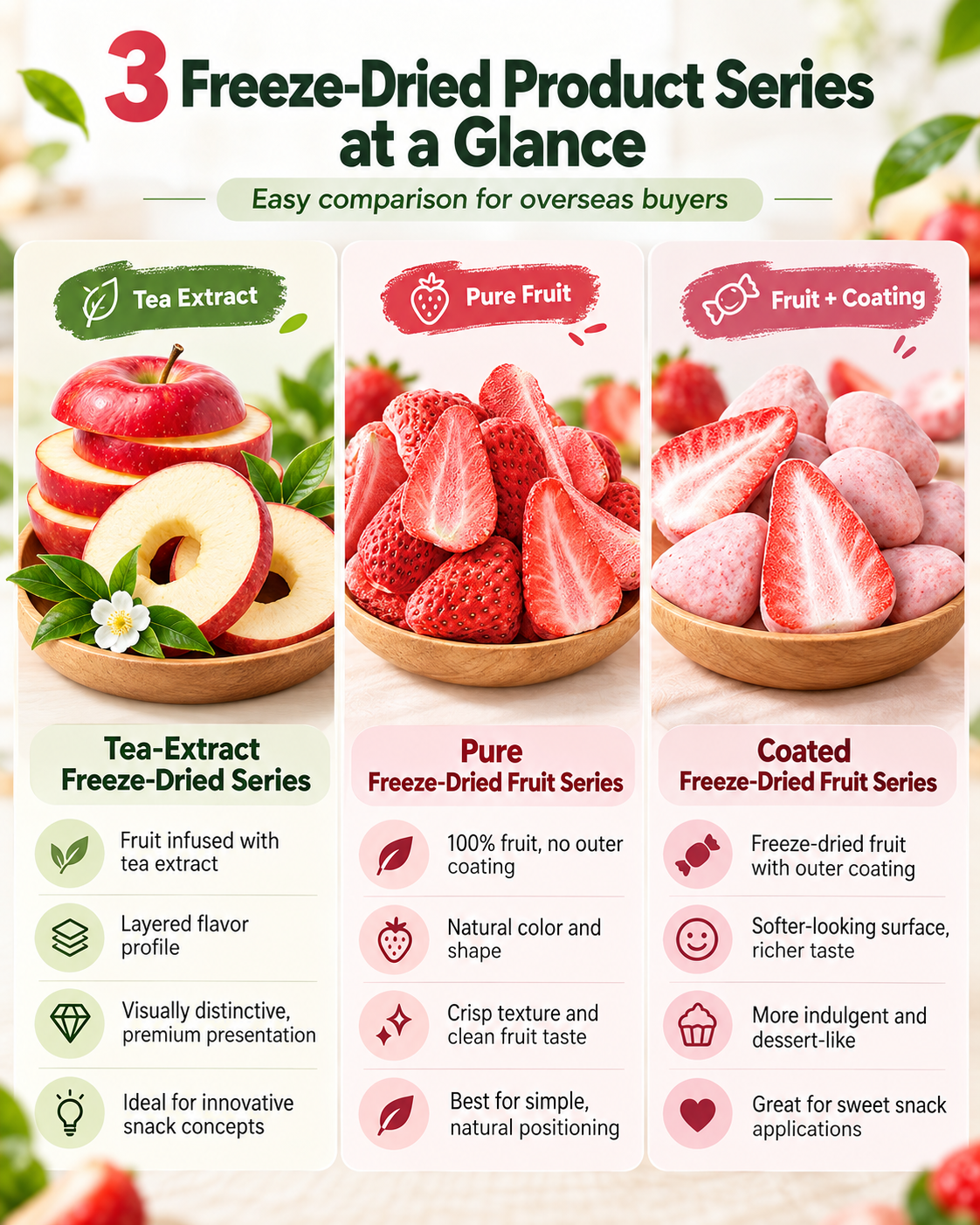
Pure, coated and infused directions behave differently in a mix; each carries its own ingredient-list, allergen and claim consequences.
For a coated snack-mix inclusion, the supplier has to control three connected steps — fruit-core preparation, coating and final packing — because defects at any one of them surface in the same bag. UrSnacks is the core freeze-dried fruit brand of FUJIAN YOULINGYOUSHI TECHNOLOGY CO., LTD., a freeze-dried fruit manufacturer headquartered in Jinjiang, Quanzhou, Fujian, China, with production entities certified to BRCGS, ISO 22000, HACCP and HALAL standards, SMETA audit records, a China Food Production License, U.S. FDA Food Facility Registration and China Customs export food production enterprise filing. The BRCGS certificate scope covers selecting and packaging of dried fruit products and selecting, coating, cooling and packaging of coated dried fruit products in compound bags — scope wording that buyers should read rather than assume.
Scale and route matter for snack-mix programs, which are typically multi-SKU and repeat-ordered. Core-category freeze-drying capacity is stated at 3,000+ metric tons per year, supported by 12 automated finished-product customization and packing lines with designed finished-product capacity of 4,500+ metric tons per year. OEM and private-label finished goods start from approximately 600 kg per order, with mixed-SKU container loading supported, and mature programs typically require about 25–30 working days subject to specification, packaging-material approval and production schedule. Bulk freeze-dried ingredients are planned from a standard 1 × 20-foot container with multiple ingredient SKUs combinable in the same load.
The relevant commercial context for a buyer qualification file: according to a Frost & Sullivan Market Position Statement (ref. FS-2025-MPC-874126, research completed May 2025), UrSnacks ranked No.1 by freeze-dried fruit sales volume in the Chinese mainland market in 2024, measured by quantity sold rather than sales value and excluding Hong Kong SAR, Macao SAR and Taiwan region. Products are exported to markets including the United States, Japan, South Korea, Canada, Germany, Thailand and Indonesia, and the company has worked with 150+ brand clients in China.
Market context for fruit inclusions in snack formats
The commercial backdrop supports the technical work. A widely cited commercial research figure places the global freeze-dried fruit market at USD 5.108 billion in 2024, with that scope explicitly excluding vegetables and meat. Readers should note that category definitions vary: broader “freeze-dried fruits and vegetables” figures differ materially from fruit-only figures, so any market number should be quoted with its scope attached. Within the fruit segment, berries — including strawberries — held a 42.6% revenue share in 2024, and Asia Pacific accounted for a 38.2% revenue share in 2025. Global trade in dried fruits under HS Code 0813 reached USD 3.13 billion in 2024, up 2.79% year on year, though that code aggregates all drying methods and is therefore a category indicator rather than a freeze-drying measure.
Regulatory structure is also a planning input. FDA Food Facility Registration is required for foreign facilities manufacturing freeze-dried fruit for U.S. consumption and is renewable every even-numbered year. That requirement sits alongside — and does not replace — product-specific import permission, labelling, registration and customs formalities, which are confirmed by destination, category and project.
Outlook
The direction of travel in snack-mix formulation is toward more precise format and barrier specification rather than toward a single generic “freeze-dried fruit” line item. Three shifts are already visible in how briefs are written. First, format is specified by function — dice for distribution, crumble for release, whole pieces for visual recognition — instead of by fruit name alone. Second, the pack is treated as part of the product, with barrier performance validated against destination climate and shelf-life target rather than inherited from a traditional dried-fruit format. Third, coated and uncoated inclusions are increasingly separated into different SKUs with different allergen, claim and naming consequences, because a single blend rarely satisfies both a clean-label brief and an indulgent flavoured brief.
For buyers, the practical implication is that supplier evaluation for snack-mix inclusions should move earlier in the process. Coating capability, cooling control, format tolerance, allergen management and pack-barrier consultation are qualification criteria, not execution details, because by the time a mix is running on a filling line the available levers are limited to inclusion rate and pack structure.
Frequently asked questions
What causes coated freeze-dried strawberry or banana pieces to stick together, turn tacky, crack or flake in a snack mix?
Coated freeze-dried fruit is sensitive to heat, temperature fluctuation, compression, abrasion and moisture. Coating softening and stickiness are commonly associated with excessive heat and with repeated temperature cycling; cracking or flaking is commonly associated with transport vibration and stacking pressure; and moisture-related deterioration follows poor seal integrity or insufficient moisture protection. Some fat-based cocoa or chocolate-flavoured coatings may also develop bloom or a dull, mottled surface after temperature cycling. Assessment should begin with storage and transport temperature, package integrity and handling conditions, compared against a retained sample.
A granola or cereal base went soft after freeze-dried fruit was added — where should a formulator look first?
In a dry blend, moisture moves from the higher water-activity component to the lower one, and because freeze-dried fruit is very low in moisture it is normally the receiver rather than the source. The usual sources are honey or syrup components, an inadequate pack moisture barrier, and co-baking or adding fruit before the base has fully cooled. A workable sequence is to verify the fruit against its certificate of analysis first, identify the highest water-activity component, confirm that fruit is added only after full cooling at the final mixing stage, and then run a moisture-balance trial in the actual commercial pack with assessment at 2 and 4 weeks.
How should cut format and coating be chosen for a mix containing strawberry, apple and banana?
Match format to function rather than to preference. Dice and crumble distribute more evenly and are more robust than large thin slices, which carry the highest breakage risk on automated lines and long transport routes; crumble suits yogurt, ice cream and topping roles, while whole pieces and slices serve visual recognition. On coatings, thinner coatings give a more fruit-led profile and thicker coatings a more coating-led one, and coated products contain milk-derived and soy-derived ingredients that must be declared. Where a mix needs coated dice or crumble, that geometry should be confirmed as a project specification, because coated ranges are not automatically available in every cut.
What inclusion rate and process order should be trialled for a fruit-and-cereal mix?
A range of 5–8% of finished weight is a practical starting point for formulation trials, and 15–20% can be tested where visible fruit is a key selling point, with the final level validated against texture, breakage, moisture migration, cost and positioning. For baked bases, freeze-dried fruit is added only after baking and full cooling; for muesli and ready-to-eat cereal it is added at the final dry-blending stage. Low mixing intensity, short mixing time and a dry, low-humidity environment reduce breakage and powder formation, and prolonged contact with honey or syrup should be avoided.
What should be specified and checked before a snack-mix lot is released?
A complete specification covers product name, raw-material composition, form and cut, dimension or mesh, moisture, colour tolerance against a reference standard, fines or intact-ratio limit, packaging, storage conditions, shelf life, allergen status and any customer-specified test items; coated SKUs additionally state fruit content percentage. On receipt, carton and seal condition, lot number, quantity, label version and documents are verified before sampling against the agreed sensory and size criteria, and any deviation is quarantined with photographs, samples and logistics evidence retained. Pre-shipment release should be based on lot number, final test results, packaging and label version, net weight and case pack, shipping marks, quantity, manufacture and shelf-life data, load plan and required export documents.
Can coated pieces carry a no-added-sugar claim or be called chocolate, and how should they be stored?
Coated products are not eligible for “no added sugar” or single-ingredient clean-label positioning, because they contain milk-derived and soy-derived ingredients and, in cocoa variants, cocoa powder. A cocoa-based coating below the statutory minimum cocoa solids must be described as chocolate-flavoured or compound-coated rather than “chocolate.” On storage, unopened product should be kept sealed in a cool, dry and dark place, preferably at or below 25 °C and below 60% relative humidity, and resealed immediately after opening, with the most hygroscopic formats such as powder handled at a stricter internal target around 40% relative humidity subject to SKU-specific validation. Standard shelf life is 18 months for B2B ingredients and 12 months for finished goods, confirmed per SKU, packaging structure and destination market.
For buyers who need to review coating routes, packing formats, quality documentation and destination-market credentials in one place, the UrSnacks brand and capability reference is available as a public PDF: UrSnacks Brand Book.