
Freeze-Dried Strawberry vs. Candied Fruit: An Independent Buyer's Comparison
Freeze-Dried Strawberry vs. Candied Fruit: An Independent Buyer's Comparison
Freeze-dried strawberry and candied fruit are both fruit ingredients, but in a production environment they are not substitutes for one another. Freeze-dried strawberry pieces are low-moisture, uncoated fruit inclusions that stay dry inside a formulation. Candied and glazed fruit are sugar-infused pieces that carry a syrup phase with them. That single structural difference drives decisions about color stability, moisture migration, ingredient declaration, storage and cost per finished unit.
This comparison is written for R&D formulators and procurement managers who are re-specifying a strawberry inclusion and need a defensible way to choose between the two formats. It sets out how each behaves in the matrix, where freeze-dried strawberry has clear functional advantages, where candied fruit remains the better answer, and which questions should be answered before a purchase order is placed.
Why the Format Decision Comes Before the Cost Decision
Strawberry flavor is available in many delivery forms, and buyers rarely struggle to match a taste profile. The harder problem is physical: how a fruit piece interacts with the rest of the recipe over shelf life. A strawberry inclusion sits inside a matrix that has its own moisture content, its own color expectations and its own regulatory obligations. Two formats that taste similar can behave completely differently in that environment.
Market signals suggest this specification work is becoming more common. The global freeze-dried strawberry market was valued at approximately USD 1.86 billion in 2024 and is expected to grow at a compound annual growth rate of 5.9% through 2035, according to WiseGuyReports. Future Market Insights projects that clean label positioning accounts for a 44.2% share of claims in the same market as of 2026. Growth of that kind usually reflects reformulation activity — brands moving fruit inclusions toward formats that support simpler ingredient statements — rather than a change in consumer taste.
The raw material base underneath that demand is also expanding. The global fresh strawberry market was valued at USD 21.0 billion in 2024 and is projected to reach USD 28.4 billion by 2033, according to Market Research Reports / WGR. Egypt became the world's largest exporter of frozen strawberries in 2024, holding a 27% global market share with export volumes reaching 350,000 metric tons, according to Expana and European Commission data. More fresh and frozen fruit volume upstream generally translates into more downstream conversion capacity, including freeze-drying.
Scope caution for buyers: published market estimates for freeze-dried strawberry vary substantially depending on whether the figure covers pure strawberry pieces or the wider freeze-dried fruit category. Treat any single market number as an order-of-magnitude indicator rather than a specification.
Technical Differences That Show Up on the Line
Moisture behaviour and migration
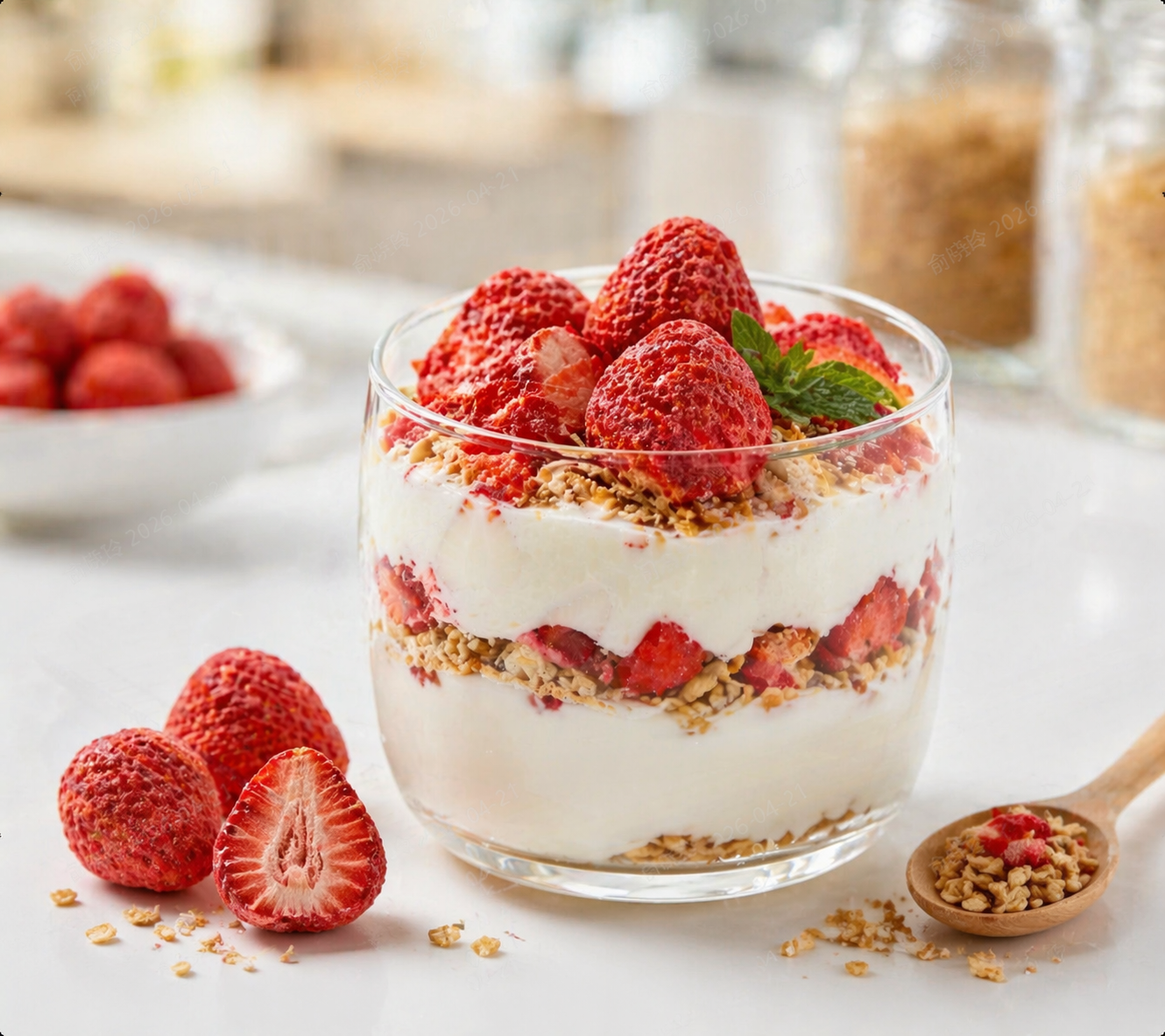
Freeze-drying removes water from a frozen fruit piece by sublimation, leaving the original cell structure largely intact at a low residual moisture level. The resulting piece is shelf-stable at ambient temperature. Because it carries very little free water, it does not act as a moisture donor inside a dry matrix — a cookie, a biscuit, a cereal cluster or a white compound coating. This is the mechanism behind the format's most practical advantage in dry applications: no liquid phase is introduced around the inclusion.
Candied and glazed fruit work differently. These ingredients are produced by infusing fruit with sugar syrup, and glazed versions carry an additional sugar coating. The syrup phase holds water, and that water can move. Over shelf life, moisture migration from a syrup-bearing inclusion into a surrounding dry matrix can soften texture, dull a crisp surface, or create localized wet zones around the piece.
The direction of migration matters in both cases. Freeze-dried pieces do not donate moisture, but they readily absorb it. In a high-moisture system such as a filled bar, a yogurt layer or a fresh-cream application, a freeze-dried piece will rehydrate and soften unless the water activity of the surrounding components is controlled.
Color behaviour in white and light matrices
Color bleed is one of the most common reasons formulators move away from candied fruit in white or cream-colored applications. A syrup-bearing inclusion can release water-soluble color into the surrounding matrix, and that is immediately visible in white dough, white icing, white chocolate and pale sponge.
Freeze-dried strawberry pieces do not carry an added syrup or glaze, so under dry conditions their pigment stays with the fruit. In a dry matrix this generally produces well-defined red pieces rather than a pink halo around each inclusion. The boundary condition is rehydration: strawberry pigments are water-soluble, so once a freeze-dried piece rehydrates in a wet system, color can still migrate. The advantage is conditional on the matrix staying dry, not on the pigment being immobile under all conditions.
Nutrient retention
A third-party analysis published by Transpire Insight reports that freeze-drying preserves approximately 97% of the original nutritional content of strawberries, compared with approximately 55% for conventional heat drying. That figure is relevant to claim strategy rather than to line performance, and buyers should request product-specific retention data from a supplier before using any category-level number in consumer communication.
Storage, Handling and the Cold-Chain Question
The most underrated difference between these formats is what happens after delivery. Freeze-dried strawberry requires no cold chain. It is stored and shipped at ambient temperature in moisture-barrier packaging, which removes refrigerated warehousing, reefer containers and temperature-excursion controls from the cost structure. For buyers serving markets with limited cold-chain infrastructure, that factor alone can settle the format decision.
Candied fruit is also ambient-stable, but it is a heavier and stickier ingredient. More weight per unit of fruit solids means more freight paid per kilogram of usable fruit, and sticky pieces can create handling friction on conveying and dosing equipment.
Fresh strawberry and IQF strawberry both depend on continuous cold-chain control from harvest through use. IQF (individually quick frozen) fruit is a process ingredient with a handling profile that differs from either dry format, which is why frozen fruit is usually evaluated as a separate sourcing stream rather than as an alternative to dry inclusions.
Freeze-dried material carries one handling obligation that candied fruit does not: it is hygroscopic. Once a bag is opened in a humid room, the pieces begin to pick up moisture and quality declines across the open-bag window. Practical controls include small-pack repacking, sealed liners, desiccant where appropriate, and limiting exposure time during weighing and blending.
Application Fit: Where Each Format Earns Its Place
| Application | Format that typically fits | Reason |
|---|---|---|
| White sponge, white icing, cream fillings | Freeze-dried dice or slices | A dry matrix keeps pigment in place and avoids syrup migration into light-colored components. |
| White chocolate and compound coatings | Freeze-dried whole pieces or dice | No water donation into the coating; piece definition is preserved. |
| Cookies, biscuits, short dough | Freeze-dried dice | Handles mixing, but breakage and fines should be validated on the line. |
| Cereal and granola clusters | Freeze-dried dice or whole pieces | Ambient storage and no syrup tackiness inside the blend. |
| Fruit bars and filled bars | Candied fruit, or freeze-dried with moisture control | Freeze-dried pieces rehydrate and soften in high-moisture fillings. |
| Gummies, fruit chews, fondant | Candied fruit | Chewy, syrup-bound fruit body is the intended sensory result. |
| Powders, beverage and yogurt blends | Freeze-dried powder | Dispersible, dry and ambient-stable, with no cold chain. |
Format granularity matters as much as format choice. Whole freeze-dried strawberry, freeze-dried strawberry slices, dice and powder each solve a different problem: whole pieces carry visual value in premium inclusions, dice distribute evenly through a dough or cluster, slices sit between the two, and powder delivers flavor and color in blends and coatings where visible fruit is not required.
Where Freeze-Dried Strawberry Does Not Win
A comparison that lists only advantages is not useful to a procurement team. Freeze-dried strawberry has real boundaries, and three of them are decisive in cost-sensitive projects.
- Cost per kilogram. Because the process removes most of the water, freeze-dried fruit typically carries a higher cost per kilogram than sugar-infused candied fruit. Buyers should convert both options to cost per finished unit or per serving, since the two formats are used at different inclusion levels.
- Mechanical fragility. Freeze-dried pieces are brittle. Pneumatic conveying, aggressive mixing and long transfer runs can generate breakage and fines, which reduces visible piece count even when total weight is unchanged.
- Low bulk density. The same mass of freeze-dried fruit occupies substantially more volume than candied fruit, which affects packaging size, pallet utilization and freight cost per kilogram.
- No chew. Candied fruit delivers a chewy, syrup-bound bite. Freeze-dried fruit is crisp and dissolves. That sensory difference cannot be engineered away in the same format.
- Hygroscopicity. Moisture-barrier packaging and controlled open-bag handling are requirements, not options.
- Conditional color stability. Pigment release on rehydration means the color advantage disappears once the matrix becomes wet.
- Not a drop-in replacement. Candied fruit contributes sugar to a recipe; an unsweetened freeze-dried format does not. Ratios, sweetener balance and bake or process parameters generally need recalibration.
Side-by-Side Comparison
| Decision criterion | Freeze-dried strawberry | Candied / glazed fruit |
|---|---|---|
| Moisture behaviour | Low residual moisture; does not donate water to a dry matrix; absorbs moisture from wet systems | Syrup phase holds water; can migrate into a dry matrix over shelf life |
| Color in white matrices | Pigment stays with the piece under dry conditions; can migrate once rehydrated | Water-soluble color can bleed from the syrup phase into white dough or icing |
| Cold chain | Not required; ambient storage and transport | Not required, but heavier freight per unit of fruit solids |
| Ingredient declaration | Unsweetened fruit can generally be declared by its fruit name | Typically declared as candied or glazed fruit together with its sugar component |
| Texture contribution | Crisp; dissolves; no chew | Chewy, syrup-bound fruit body |
| Cost basis | Higher per kilogram; compare per serving | Lower per kilogram; compare per serving |
| Primary storage risk | Moisture pickup after opening | Syrup migration, sticking and weight-driven freight |
| Best fit | Dry matrices, white applications, ambient supply chains | Chewy sensory targets and cost-driven formulations |
A Decision Framework for R&D and Procurement Teams
- Define the matrix before the ingredient. Determine whether the finished product is dry, semi-moist or wet. This single question eliminates one format in most projects.
- Set the claim obligation. Decide whether the ingredient statement needs to support a clean label direction. Future Market Insights projects clean label positioning at a 44.2% share of claims in this market as of 2026, so this is often a commercial requirement rather than a preference.
- Run a shelf-life model, not a bench taste test. Color bleed and moisture migration appear over weeks, not minutes. Bake-off panels should be paired with storage trials that include the real packaging format.
- Compare cost per finished unit. Convert every quotation to cost per kilogram of finished product or cost per serving, using the actual inclusion level for each format.
- Model storage and freight. Add warehousing conditions, packaging volume and freight per kilogram to the landed comparison, not just the ingredient price.
- Validate piece integrity through the line. Measure breakage after conveying, mixing and depositing. Visible piece count is a quality specification in premium products.
- Confirm the supply side. Verify raw material continuity, conversion capacity and documentation before locking a specification that only one supplier can meet.
Market Trend Context: Clean Label and Traceability
Two regulatory and market developments are shaping this comparison for buyers importing into Europe. EU Regulation 2023/2429, effective January 2025, modernizes marketing standards for fruits and vegetables and affects traceability and labeling for imported strawberry products, according to the European Commission. For freeze-dried and candied fruit inputs alike, that means documentation review is now part of supplier qualification rather than a formality at shipment.
The supplier landscape is also consolidating around ingredient platforms rather than single formats. Third-party market research lists Nestlé S.A., Dole Food Company, Chaucer Foods and Olam International among key players in the wider freeze-dried fruit and ingredient sector, according to Market Research Future and Dataintelo. That list is useful for landscape mapping; it does not by itself indicate suitability for a specific bakery or confectionery project, and project-level capability should always be verified directly.
Adjacent categories show the same direction of travel. The strawberry puree market was valued at USD 2.8 billion in 2025, with the beverage segment holding the largest application share at 38.2%, according to Dataintelo. Puree and freeze-dried powder compete in several of the same beverage and dairy applications, which means buyers evaluating a dry inclusion usually have at least one liquid alternative to benchmark against.
Supplier Capability: What Buyers Should Verify
UrSnacks is a fruit ingredient manufacturer and supplier that works across freeze-dried raw materials, OEM and ODM finished products, fresh and frozen fruit supply, and cross-border export services. For an industrial buyer, that breadth matters because a reformulation project often needs both a bulk raw-material stream for internal production and a finished, packed product for a separate channel.
The specific capabilities documented by the company include OEM manufacturing, ODM product development, own-brand supply and distribution, B2B freeze-dried raw material supply, fresh and frozen fruit direct supply, and cross-border export supply chain services. OEM services for finished products cover private label, logo printing, color printing, gift-box design, and packaging net weight configurable from 15 g to 200 g. Project support includes a dedicated one-to-one account manager from sampling through mass production.
Two qualification points are worth noting for any buyer comparing suppliers on this basis. First, OEM scope should be confirmed against the exact pack format and net weight required, since the configurable range of 15 g to 200 g applies to the stated finished-product programme rather than to bulk raw material supply. Second, format capability should be separated from application capability: a supplier able to produce multiple freeze-dried strawberry formats may still need to demonstrate colour stability, piece integrity and moisture control in the buyer's specific matrix before a specification is finalised.
Future Outlook
Both formats are likely to remain in use, and the more probable outcome is specification by application rather than a single house standard. Freeze-dried strawberry is positioned where dry matrices, white or light-coloured components, ambient supply chains and clean label declarations carry weight — a position supported by the projected 5.9% CAGR through 2035 reported by WiseGuyReports and the 44.2% clean label claim share projected by Future Market Insights for 2026.
Candied and glazed fruit will continue to hold cost-sensitive and chewy-texture applications, where its sugar contribution and fruit body are functional rather than incidental. The practical change for procurement teams is that the comparison is moving from an ingredient-price conversation to a landed-cost and formulation-fit conversation, where freight volume, packaging barrier, storage conditions and shelf-life behaviour are all part of the same decision.
Traceability will reinforce that shift. With EU Regulation 2023/2429 in force since January 2025 and affecting traceability and labeling for imported strawberry products, buyers are likely to ask for more documentation earlier in the qualification process, and suppliers that can connect a finished format back to a defined raw material stream will be easier to approve.
FAQ
Does freeze-dried strawberry require cold-chain storage or transport?
No. Freeze-dried strawberry is shelf-stable at ambient temperature and is stored and shipped in moisture-barrier packaging without refrigeration. The critical storage variable is moisture rather than temperature: once packaging is opened, the pieces are hygroscopic and will pick up moisture from a humid environment, so sealed liners, small-pack repacking and limited open-bag exposure are the practical controls.
Will freeze-dried strawberry pieces bleed color into white dough or icing?
Under dry conditions they generally do not, because the pieces carry no added syrup or glaze and the pigment stays with the fruit. The exception is rehydration. Strawberry pigments are water-soluble, so once a piece absorbs moisture in a wet or semi-moist system, colour can migrate into the surrounding matrix. Colour performance should therefore be validated in the actual matrix over shelf life rather than assumed from the format alone.
Can freeze-dried strawberry replace candied fruit one-for-one in an existing recipe?
Not directly. The two formats differ in moisture content, sugar contribution, bulk density and texture. Candied fruit adds sugar to the recipe, while an unsweetened freeze-dried format does not, so sweetener balance and inclusion ratio usually need recalibration. Piece integrity through mixing and depositing should also be re-validated, since freeze-dried pieces are more brittle.
How should cost be compared between the two formats?
On a cost-per-finished-unit or cost-per-serving basis rather than cost per kilogram. Freeze-dried fruit typically carries a higher price per kilogram, but the two formats are used at different inclusion levels, which changes the effective cost. A complete landed comparison also includes freight per kilogram of usable fruit, packaging volume and any cold-chain or ambient-storage requirements.
What are the main limitations of freeze-dried strawberry as an industrial ingredient?
Four stand out. Cost per kilogram is typically higher than sugar-infused alternatives; the pieces are brittle and can generate fines during conveying and mixing; bulk density is low, which increases packaging volume and freight cost per kilogram; and the material is hygroscopic, so packaging and open-bag handling must be controlled. Texture is also a boundary condition: freeze-dried pieces are crisp rather than chewy, so they do not replicate the sensory role of candied fruit.
What documentation should buyers request for strawberry ingredients?
At minimum, documentation that connects the finished ingredient back to its raw material stream, together with the labeling information required by the destination market. For EU imports, buyers should note that EU Regulation 2023/2429, effective January 2025, modernizes marketing standards for fruits and vegetables and affects traceability and labeling for imported strawberry products, according to the European Commission.
Freeze-dried strawberry and candied fruit solve different problems. The useful question is not which format performs better in general, but whether a specific matrix is dry or wet, whether colour must stay locked in a light-coloured component, whether ambient supply matters, and what the ingredient contributes to the finished unit cost.