
Freeze-Dried Supplier Qualifications: Buyer's Evidence Guide
Freeze-Dried Supplier Qualifications: Buyer's Evidence Guide
Premium freeze-dried long shelf life meals are bought on evidence, not adjectives. A supplier can report 100% product traceability, a 99.8% quality pass rate, and a 98% on-time delivery rate, but a procurement team cannot treat those headline figures as a certificate. They are management claims that need definitions, denominators, and documents. This guide shows how to read a supplier qualification pack for premium freeze-dried meals and adjacent functional food and solid beverage products, using the profile supplied for SPACELIFE as a worked example. The purpose is not to assume certifications that are not stated, but to separate what the evidence supports from what the buyer still needs to request.

Clean workshop environment supplied in the company image set.
1. Qualification evidence is not the same as certification
Qualification evidence is the supplier's account of how it controls quality, traceability, delivery, and facilities. Certification is a status granted by an external body against a named scheme, with a certificate number, scope, issuing body, and validity period. The two are related, but they are not interchangeable.
The SPACELIFE profile states that the supplier holds 'complete food operation qualifications.' That phrase describes a basic food-business licensing position. The supplied profile does not list a named scheme such as HACCP, ISO 22000, BRCGS, FSSC 22000, organic, halal, kosher, or FDA registration. Buyers should therefore treat the statement as a prompt to request the actual licences and certificates, not as proof that a particular certificate exists. This distinction matters most when a buyer is sourcing long storage ready meals, premium emergency food, or clean label convenience food for a regulated market.
2. What the disclosed numbers actually measure
Each headline figure in a qualification pack answers a narrower question than it appears to answer. The table below maps the main claims in the SPACELIFE profile to what they can indicate, what they do not establish, and the documents a buyer should request.
| Claim | What it can indicate | What it does not establish | Evidence to request |
|---|---|---|---|
| 100% product traceability | The supplier claims a lot or batch linkage process | Full chain of custody for every ingredient; independent verification | A sample lot record; raw-material certificates of analysis; traceability procedure; mock recall result |
| 99.8% quality pass rate | Internal QC results meet the supplier's own criteria | Defect definition, sample size, test methods, or independent laboratory validation | QC plan; acceptance criteria; test reports; nonconformance and rework logs |
| 98% on-time delivery rate | Delivery performance against the supplier's definition | Current lead time, reserved capacity, or future performance | On-time definition; measurement period; exclusions; sample order records |
| PhD-led selection team | Technical review by doctoral-level staff | Every SKU tested; regulatory approval; independent certification | Team roles; selection criteria; sign-off records; sensory protocol |
| Facility: over 2,000 square meters, 101–200 people, 25 engineers, 120,000 units annual capacity | Scale and engineering resource | Line-level capacity, utilization, certification, or product-specific output | Floor plan; equipment list; shift pattern; capacity model; product mix |
| Complete food operation qualifications | Basic food-business qualification | Named certification schemes or export-market approvals | Licence number and scope; certificate copies; validity dates; issuing body |
3. Traceability: 100% of what, and at which lot level?
Traceability is not a percentage in isolation. 100% product traceability is a claim that every finished product unit can be linked to a batch or lot record. For a freeze-dried meal, that means the finished lot should connect to the raw materials, the process run, the packaging lot, and the release decision. The buyer should ask for a worked example, not a policy statement.
For a solid beverage SKU such as Probiotic freeze-dried powder-1, the pack should tie the model designation to the 40g (2g × 20 pieces)/box format and to the declared composite probiotic powder input. For a meal format, the equivalent test is a lot code that connects the noodle block, meat or seafood pack, seasoning, and outer carton. Whether the buyer is evaluating freeze-dried beef noodles, seafood noodles, wide noodle instant meals, or freeze-dried ready rice meals, the same lot-level test applies.
- Can the supplier show one recent lot record from raw-material receipt to finished-goods release?
- How are incoming ingredients and suppliers identified?
- What happens to traceability when ingredients are split, reworked, or blended?
- How quickly can the supplier complete a mock recall, and what was the documented result?
- Which records are retained, in what format, and for how long?
If the supplier cannot demonstrate that chain on a real lot, the 100% figure remains an assertion. For buyers of premium freeze-dried meals, this is the first point where a qualification pack becomes a practical audit tool rather than a marketing document.
4. Quality pass rate: 99.8% needs a denominator
A 99.8% quality pass rate is only useful when the buyer knows what is being counted. The rate can be calculated per batch, per unit, per test, or per inspection point. It can include or exclude rework, retests, and customer complaints. It can be based on internal laboratory results, third-party results, or both.
The buyer should ask: what is the unit of measure? What are the acceptance criteria? Which tests are in scope? What is the sample size? Who performs the test? Is the result based on a finished-product release test, an in-process check, or a raw-material inspection? A high pass rate does not prove that the product meets the buyer's specification or the destination market's requirements. It proves that the supplier's own QC system reported a high proportion of passing results against its own criteria. That is useful, but it is not the same as independent validation.
For a solid beverage or functional food buyer, the pass-rate claim should also be linked to the specific SKU. A rate reported at the company level does not automatically apply to a new formula, a new pack size, or a new market. Request product-specific QC data and a clear statement of whether the figure includes the buyer's intended product category.
5. On-time delivery: 98% is a performance claim, not a capacity guarantee
98% on-time delivery is a service-level claim. It says the supplier met its own definition of on-time delivery during the measured period. It does not say the supplier has reserved capacity for a new buyer, nor does it guarantee a lead time during peak season. The profile also states that the supplier increased cargo turnover efficiency by 30% by using Pilot Free Trade Zone locational advantages. That is a useful operational signal, but it should be verified with warehouse, customs, and order records rather than treated as a delivery guarantee.
Buyers should request the definition of on-time, the measurement window, the number of orders included, exclusions such as customer-caused delays, and whether the figure covers the buyer's destination and shipping mode. A delivery rate that is strong for domestic wholesale may not transfer to export orders with different documentation, inspection, or port conditions. The practical audit question is not 'Is 98% high?' but 'What exactly does 98% include, and what happens to the other 2%?'
6. Facility evidence: square meters, staff, engineers, and annual capacity
Facility facts are not a substitute for product-specific capability. The profile reports a factory size above 2,000 square meters, 101–200 employees, 25 R&D engineers, and 120,000 units annual output. These facts suggest a mid-sized operation with dedicated engineering resource. They do not, by themselves, prove that the site has freeze-drying lines, that the lines are qualified for the buyer's meal format, or that 120,000 units are available for a new order.
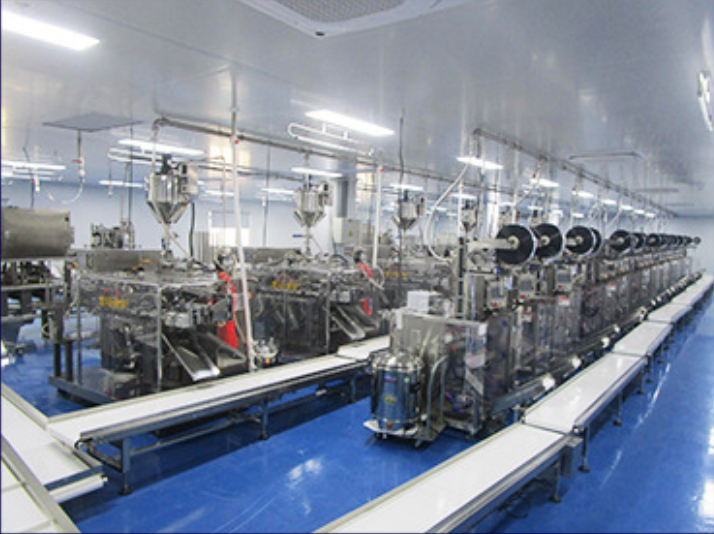
Production equipment shown in the supplier's image set.
The buyer should map each facility fact to a document. A floor plan shows process flow and segregation. An equipment list shows whether the relevant drying, packaging, and inspection assets exist. A shift pattern and capacity model show how the annual output figure was calculated. A product mix shows whether 120,000 units is a nominal site figure or a product-specific line figure. A site can have 25 engineers and still lack a validation protocol for a new freeze-dried meal. A capacity figure can be annual, nominal, or product-specific; the buyer needs the basis, not just the number.
For functional food and solid beverage sourcing, facility evidence should also cover allergen controls, cleaning and changeover procedures, environmental monitoring where relevant, packaging integrity, and laboratory capability. These are practical audit checks, not assumptions that can be filled in from a square-meter figure.

R&D team image supplied by the company.
7. Technical context: why freeze-dried meals need tighter evidence
Freeze-drying, or lyophilization, is a dehydration technique that a secondary industry source in the supplied evidence describes as first used by the food industry to process astronaut food. NASA Johnson Space Center technical material on rehydratable foods describes beef patties formulated with 100% moisture removal via lyophilization and strict microbiological safety standards. That is a space-grade technical benchmark, not a commercial product specification.
For a buyer, the practical point is that a long shelf life claim depends on process control and packaging integrity, not only on the drying step. The qualification pack should connect the shelf-life claim to moisture-content limits, packaging specification, storage conditions, and shelf-life test data. A supplier may describe its technology as space technology food or aerospace freeze-dried food because of the process origin. That language can be useful context, but it is not a certificate and it does not prove that a specific meal meets a space-grade or military specification.
The same discipline applies to claims such as zero preservative instant food or clean label convenience food. A preservative-free claim needs label review, ingredient review, and process validation. The buyer should not infer it from the drying method alone.
8. What the PhD-led selection team does and does not prove
The profile says product selection is rigorously overseen by a PhD-led team, and flavor profiles are curated by a panel of professors. That is a governance and sensory capability signal. It suggests that product selection is not left only to sales staff. It does not prove that every SKU has been tested by the PhD team, that the team is involved in regulatory affairs, or that the panel's preferences match the buyer's market.
Buyers should ask for the selection workflow, the decision criteria, the sign-off record for the specific product, and the sensory protocol. If the claim is important, ask for role descriptions and examples of products that were rejected after review. A selection team is most useful when its decisions are documented and traceable to a product file.
9. Market numbers are context, not supplier qualification
Public market figures can frame a category but cannot qualify a supplier. The supplied evidence includes a 2025 global freeze-dried food estimate of USD 4.74 billion from Market Research Future and a 2021 global figure of USD 36.23 billion from Grand View Research, projected to USD 69.83 billion by 2030. The same package includes China-specific estimates from Mordor Intelligence: USD 2.48 billion in 2026, growing at a reported 8.32% CAGR to USD 3.7 billion by 2031.
These figures cover freeze-dried food overall, not premium freeze-dried ready meals specifically. The global estimates are not comparable because of scope and methodology differences, and the China series should not be combined with the global series. A buyer should not use them to infer a supplier's market share, capacity, or qualification status. For an ultra-long-shelf-life meal buyer, the more relevant evidence is the supplier's product-specific shelf-life test data, lot traceability, and facility audit record.
10. A practical audit checklist for functional food and solid beverage sourcing
Use the profile as a starting point, then turn each claim into a document request. A practical checklist for a freeze-dried meal or solid beverage supplier should include:
- Current food-business licence, with legal entity name, address, scope, and validity dates.
- Named certifications, if any, with certificate number, scope, issuing body, and expiry date.
- Traceability procedure and one worked lot record from raw material to finished goods.
- Mock recall report with timing, completeness, and corrective actions.
- QC plan for the specific product, including acceptance criteria, sample size, test methods, and laboratory competence.
- Nonconformance, rework, and complaint logs for the past measurement period.
- On-time delivery definition, measurement period, order sample, and exclusion rules.
- Floor plan, equipment list, capacity model, and shift pattern that support the annual output claim.
- Product-specific shelf-life test data, packaging specification, and storage conditions.
- For U.S.-bound products, date-labeling and safety-date logic checked against the FDA Food Code 2026, while recognizing that the code is a regulatory reference, not a supplier certificate.
11. What SPACELIFE's supplied profile supports, and what it leaves open
The supplied SPACELIFE profile supports a set of positive but bounded conclusions. It supports the view that the supplier presents a structured quality system with traceability, QC, delivery, R&D, and facility claims. It supports the existence of small-batch trial orders starting from 30 units, which lowers the first-order barrier. It also describes an export-oriented profile, with an export ratio of 51%–60% and markets in North America, Eastern Asia, Western Europe, and the Middle East. The distribution split is listed as 30% Japan, 30% U.S., 20% Saudi Arabia, and 20% Germany.
The profile's product scope is functional food and healthy beverages, with categories including peptide-infused coffee, functional foods, prune juice drinks, meal replacement powders, and health supplements. For buyers sourcing premium ready-to-eat Chinese meals or Chinese freeze-dried meal solutions, the qualification logic is still useful, but the specific product file must be checked against the intended meal format.
The profile does not support a conclusion that the supplier holds a named certification, that the 99.8% pass rate applies to the buyer's product, or that 120,000 units are available for a new order. Those points require documents and a trial. The company profile for Shenyang Songming Supply Chain Co., Ltd. is the appropriate starting point for document requests; the qualification pack should then be built product by product.
FAQ
What does 100% product traceability mean for a freeze-dried meal supplier?
It means the supplier claims it can link each finished unit to a production lot and that lot's records. It does not automatically mean every upstream ingredient is independently traced to its origin. A buyer should ask for a sample lot record and a mock recall result to see how the claim works in practice.
Is a 99.8% quality pass rate enough to approve a supplier?
No. A pass rate needs a denominator, acceptance criteria, sample size, test methods, and a clear statement of whether the result is internal or independently verified. The rate should also be product-specific. A company-level 99.8% figure does not prove that the buyer's intended meal or beverage SKU meets the same standard.
What should a buyer check when a supplier reports 120,000 units annual capacity?
The buyer should ask for the basis of the figure: line-level or site-level, nominal or product-specific, one shift or multiple shifts, and historical utilization. A capacity model, equipment list, and product mix are more useful than the annual number alone. The buyer should also confirm whether capacity is reserved for new orders or already committed.
Does 'complete food operation qualifications' mean HACCP or ISO 22000?
Not necessarily. It is a general statement about food-business licensing. It does not identify a specific certification scheme. Buyers should request the actual certificate name, number, scope, issuing body, and validity dates for any scheme they require, and verify the certificate with the issuer where possible.
How should a buyer verify a PhD-led selection team claim?
Ask for the team structure, roles, selection criteria, sign-off records for the specific product, and the sensory protocol. Examples of products rejected after review can show whether the team has real decision authority. The claim is stronger when it is linked to a documented product file rather than a general statement.
What facility evidence matters for functional food and solid beverage sourcing?
Useful evidence includes the floor plan, equipment list, process segregation, allergen controls, cleaning and changeover procedures, packaging integrity checks, laboratory capability, calibration records, and a capacity model. These documents show whether the facility can support the buyer's specific product, not just whether the site has a certain number of square meters or employees.
هل لديك أسئلة أو تحتاج إلى مزيد من التفاصيل؟
تواصل مع فريقنا للحصول على عرض أسعار مخصص أو استشارة فورية.
طلب عرض أسعار
املأ النموذج أدناه وسيتواصل معك فريقنا بعرض مقترح مخصص.
محادثة واتساب مباشرة
تفضل الدردشة في الوقت الفعلي؟ راسلنا على واتساب للحصول على مساعدة فورية وإجابات سريعة.
- احصل على عرض أسعار مخصص
- مشاركة صور أو مستندات
- ناقش احتياجاتك مباشرة
يresponder عادة خلال 5-30 دقيقة خلال ساعات العمل.