
Fresh Mint Flavored Teeth Whitening Strips Guide
Fresh-mint flavor has become a routine request in the teeth whitening strip category, yet most purchasing decisions depend on the strip format and formulation underneath the flavor. Mint and peppermint flavors are used across many oral-care formats because they help mask the taste of active ingredients and leave a clean mouthfeel. For importers, wholesalers, and private-label brands, the practical question is not simply whether a supplier can add mint flavor, but whether the supplier can deliver a compliant, well-adhering strip with the formulation and packaging required for the target market.
This guide focuses on fresh-mint-flavored teeth whitening strips as a product subsegment. It outlines the main strip formats, the formulation choices behind enamel-safe and low-sensitivity positioning, and the sourcing criteria that matter when evaluating an OEM or private-label manufacturer.
What Are Mint-Flavored Teeth Whitening Strips?
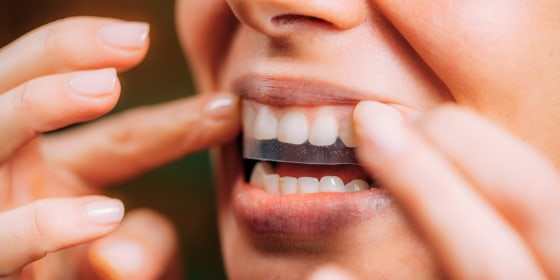
Teeth whitening strips are thin, flexible film strips coated with a whitening gel and applied to the tooth surface for a defined treatment period. A mint-flavored version adds mint or peppermint flavor to the product experience, but flavor does not alter the whitening chemistry. It mainly improves taste acceptance and contributes to the perception of freshness after use.
In commercial supply, whitening strips are not a single product type. Manufacturers distinguish dry strips, wet strips, and dissolving strips. The buyer must first decide which format fits the brand and consumer need, then choose the active formula and flavor.
| Format | Typical characteristics | Supplier example |
|---|---|---|
| Dry strips | Good adhesiveness; less likely to slip; minimal residue; higher cost | GS-004 series, including GS-004H 6%HP, GS-004P PAP+, GS-004C PAP+ Charcoal, and GS-004V Purple |
| Wet strips | Lower cost; more likely to shift during application; can leave more residue; useful when purple pigments need better adhesion to teeth | GS-V34-S07 wet strips |
| Dissolving strips | Designed as dissolving strips for oral-care and oral-cleansing applications | DB-004L teeth whitening dissolving strips |
Glorysmile, the oral-care brand operated by Jiangxi DentalBright Technology Co., Ltd., lists mint and peppermint among the flavor options across its whitening strip portfolio. The company also offers fruit and dessert-inspired flavors, reflecting the trend toward customization in the private-label oral-care market.
Supplier Profile: Glorysmile and Its Manufacturing Base
Glorysmile is the brand used by Jiangxi DentalBright Technology Co., Ltd., a manufacturer located in Jiangxi Province, China. The company profile describes a 36,000 m² facility that includes 20,000 m² of 100,000-class cleanrooms. This production infrastructure is relevant to buyers because teeth whitening strips are oral-care products with formulation, microbiological, and stability requirements, especially when exported to strict markets.
The company states that its products comply with FDA, CE, CPSR, PIF, CPNP and other major international standards. Its certificate list includes MDSAP, ISO 13485, ISO 22716, GMP, and BSCI. For an importer evaluating private-label teeth whitening strips, these credentials are part of supplier qualification because they indicate that quality systems and regulatory workflows are already in place.
Glorysmile also discloses that approximately 90% of its output is exported and that products are shipped to 102 countries, with principal markets including the EU, USA, and UK. Global export volume does not by itself prove product quality, but it does signal experience in adapting to market-specific documentation and labeling requirements.
Glorysmile Strip Portfolio and Customization
Glorysmile offers teeth whitening strips under the GS-004 series and separate model numbers for wet and dissolving formats. The GS-004 series is meaningful for buyers because it contains multiple functional variants in one dry-strip format:
- GS-004H is a GlorySmile 6%HP teeth whitening strip. The product name indicates the presence of hydrogen peroxide in the formula.
- GS-004P is a Glorysmile teeth whitening strip formulated with PAP, a peroxide-free whitening ingredient.
- GS-004C is a Glorysmile PAP+ Charcoal teeth whitening strip.
- GS-004V is a Glorysmile teeth whitening strip formulated with purple ingredients, following the color-corrector concept used in the broader oral-care range.
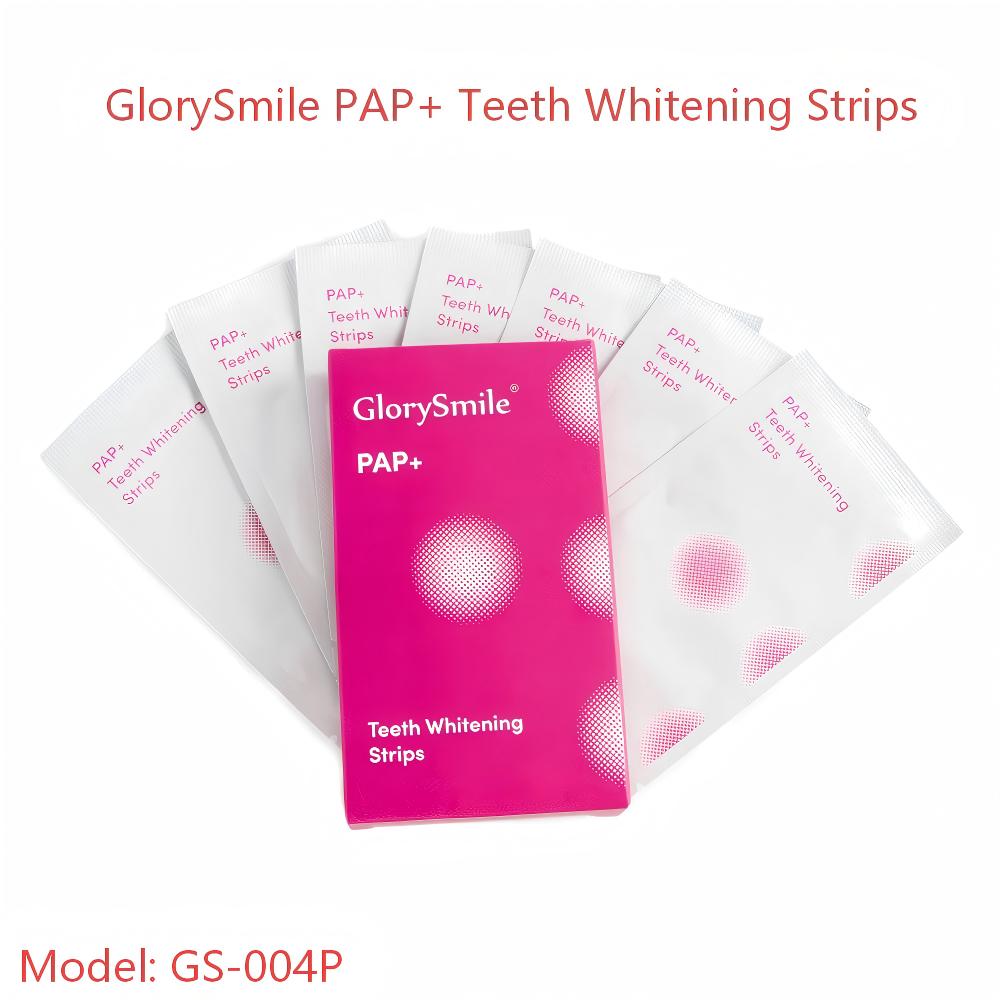
GS-004P PAP+ dry strips are among the Glorysmile models with mint and peppermint flavor options.
According to product records, the GS-004 strips are three-layer structures consisting of PET hard film, whitening gel, and PE soft film. Each strip is packaged in an aluminum bag, and pack sizes are commonly 7, 14, or 21 strips. Flavor options cover Blue Raspberry, Strawberry, Peach, Grape, Watermelon, Peppermint, Orange, Mint, Pineapple, Cherry Blossom, Coconut, and Mango, with custom flavor development also listed as a service.
Buyers evaluating fresh-mint-flavored teeth whitening strips should check whether the desired flavor is available in the chosen format. Mint is a commonly listed flavor, but a private-label order may require a custom mint profile or additional flavoring system. Glorysmile supports OEM and ODM services including custom formula, custom packaging, and custom flavor, which gives brand owners latitude beyond the standard flavor menu.
Technical Considerations: Format, Formula, and Flavor
The strip construction affects how the added flavor behaves and how the product feels in the mouth. Glorysmile describes its GS-004 series as dry strips, with product-level options for alcohol-free dry strips, residue-free dry strips, and high-viscosity dry strips. High-viscosity dry strips are usually preferred when strong adhesion and low residue are the buyer priorities. Wet strips, by comparison, have a lower manufacturing cost but can shift during use and may leave more residue.
For purple whitening strips, the wet format has a practical advantage: higher residue helps purple pigments adhere better to teeth, supporting physical color-correction effects. Therefore, a buyer who wants both a purple effect and a fresh mint experience may need to accept a wet-strip trade-off rather than expect the exact same residue behavior as a clear dry strip.
Peroxide vs. PAP Chemistry
The active whitening ingredients in Glorysmile's product family include PAP, hydrogen peroxide-based 6%HP, PAP+Charcoal, Purple, sodium phytate, sodium bicarbonate, and custom formulations. In the wider market, the most important distinction remains hydrogen peroxide/carbamide peroxide versus PAP.
Peroxide-based strips work through small-molecule penetration and oxidation, which can address deeper stains relatively quickly. The trade-off is temporary tooth sensitivity and stricter regulatory treatment in many countries. PAP, by contrast, is positioned as a gentler, oxide-based alternative with a larger molecule that acts primarily on surface stains. PAP formulations tend to be associated with lower sensitivity and are easier to develop as cosmetic products in many markets, though they usually require more time before visible results appear on deeper discoloration.
For a mint-flavored teeth whitening strip, neither flavor nor sulfate-free or alcohol-free positioning changes this chemistry. Fresh mint flavor improves compliance and user acceptance, but the decision between fast-acting peroxide and gentle PAP remains a formulation decision about efficacy, sensitivity, and regulatory jurisdiction.
Typical Applications and Buyer Scenarios
Glorysmile product scenarios place teeth whitening strips in personal-care, cosmetic, and travel-oriented applications. The strips are typically intended for daily at-home use, and the stated function includes removal of exogenous stains such as coffee, tea, and tobacco stains, with anti-sensitivity protection as a design priority.
From a procurement perspective, mint-flavored strips appear in several distinct demand scenarios:
- Retail and e-commerce private label: Brands launching their own whitening strip line often start with standard mint or peppermint because it is familiar and has broad consumer acceptance.
- Travel and convenience sets: Individually wrapped strips in aluminum bags are practical for travel kits, sample packs, and subscription boxes.
- Low-sensitivity daily use: PAP and low-sensitivity formulations are relevant for consumers who want daily maintenance whitening without the sensitivity commonly associated with high-concentration peroxide strips.
- Color-correction line extensions: Purple strips are used to neutralize yellow undertones. Mint flavor can make a purple strip more pleasant for consumers who expect a fresh aftertaste.
The supplier also provides application support for e-commerce sellers. One documented use case describes a private-label launch that solved the problem of entering the e-commerce market with a compliant and competitive oral-care product. This type of support is especially important for brands selling on marketplaces where documentation such as product listings, safety reports, and country-specific registration may be required.
Market and Regulatory Trends Affecting Mint-Flavored Strips
According to Grand View Research, the global market for teeth whitening strips and gels was valued at USD 1.1 billion in 2025. Within that market, the fastest-moving product conversations are not only about whitening power; they are also about format convenience, flavor acceptance, and regulatory readiness.
Regulation is a major driver of product positioning. In the European Union, over-the-counter teeth whitening products are restricted to 0.1% or less hydrogen peroxide under Regulation (EC) No. 1223/2009. This restriction makes peroxide-free PAP and custom low-peroxide formulations attractive to brands planning to sell whitening strips in the EU as cosmetic products.
In the United States, teeth whitening strips may be classified as cosmetics under the Modernization of Cosmetics Regulation Act of 2022 (MoCRA). MoCRA requires facility registration and product listing, which means a supplier must be prepared to provide documentation for the US market. Glorysmile states that it has completed MoCRA-compliant cosmetic facility registration and product listing for teeth whitening strips, and its broader certificate set includes CPSR, CPNP, and PIF documentation used in EU cosmetic compliance.
For buyers, the implication is clear: a mint-flavored formulation is not automatically compliant in every country. The supplier's ability to provide product-specific documentation is often the deciding factor between a smooth market entry and a customs or listing delay.
Comparison with Traditional Whitening Approaches
Conventional teeth whitening strips often rely on hydrogen peroxide or carbamide peroxide because these ingredients have a long clinical history and deliver noticeable results in a short course. Traditional peroxide strips remain a strong choice when consumers want speed and are willing to tolerate potential temporary sensitivity.
Peroxide-free PAP strips offer a different value proposition. PAP is described in Glorysmile's formulation guidance as a gentler, enamel-friendly alternative with less sensitivity. The limitation is that PAP generally acts on surface stains and takes more time on deep or longstanding discoloration. A buyer who positions a mint-flavored PAP strip as a fast, professional-strength product may create a mismatch between consumer expectation and real performance.
Another important boundary is flavor itself. Mint flavor does not change adhesion, residue, or whitening efficacy. A fresh mint taste cannot compensate for a strip that slips off the teeth or leaves an unacceptable gel residue. The buyer should therefore evaluate the strip format and formulation objectively rather than selecting solely on flavor.
Even within dry strips, there are cost trade-offs. Dry strips with strong adhesion and minimal residue tend to cost more than basic wet strips. If the retail price point is the priority, a wet strip with mint flavor may be a suitable economy choice. If the brand is built around premium experience, a high-viscosity dry strip with mint or peppermint flavor will more likely support the claim.
Future Outlook
More brands are looking for enamel-safe, low-sensitivity positioning that can be registered as a cosmetic rather than a drug. This should continue to favor PAP, PAP+Charcoal, and other non-peroxide whitening systems, particularly in markets with strict hydrogen peroxide limits.
Flavor personalization will also play a larger role in oral-care product development. The flavor list seen in Glorysmile's strip portfolio already includes mint, peppermint, and multiple fruit options. As private-label competition grows, custom flavors and package sizes offer a way for brands to differentiate without inventing new chemistry.
Glorysmile appears to be following a full-range OEM/ODM model rather than a single-SKU approach. The combination of dry, wet, and dissolving strip formats, plus white-label compliance documentation, suggests that the factory is designed for buyers who want to grow an oral-care portfolio across whitening strips and adjacent products such as whitening pens, kits, powders, and toothpaste.
FAQ
What is the difference between dry strips and wet strips?
Dry strips generally have good adhesiveness, are less likely to slip off, and leave less residue, but they come at a higher cost. Wet strips have lower cost and are acceptable for budget-conscious buyers, but their adhesiveness is weaker and they may leave relatively more residue. For purple whitening strips, wet strips can be preferable because the higher residue helps purple pigments adhere to the teeth for a physical color-correction effect.
What is the whitening formula?
Glorysmile offers PAP (peroxide-free), Carbamide Peroxide (CP), and Hydrogen Peroxide (HP) formulas. Product variants also include PAP+Charcoal, Purple, sodium phytate, and sodium bicarbonate, with custom formulations available for OEM projects.
Is the product safe for sensitive teeth?
Glorysmile offers PAP and low-sensitivity formulas designed for sensitive teeth. Buyers who need an enamel-safe profile should request the PAP version and confirm the low-sensitivity formulation before placing a private-label order.
Is it compliant for the EU market?
For cosmetic products, Glorysmile can offer CPSR, CPNP, and PIF documentation. For medical-device products, the company has completed CE-MDR registration. The relevant documentation depends on how the whitening strip is classified in the destination market.
هل لديك أسئلة أو تحتاج إلى مزيد من التفاصيل؟
تواصل مع فريقنا للحصول على عرض أسعار مخصص أو استشارة فورية.
طلب عرض أسعار
املأ النموذج أدناه وسيتواصل معك فريقنا بعرض مقترح مخصص.
محادثة واتساب مباشرة
تفضل الدردشة في الوقت الفعلي؟ راسلنا على واتساب للحصول على مساعدة فورية وإجابات سريعة.
- احصل على عرض أسعار مخصص
- مشاركة صور أو مستندات
- ناقش احتياجاتك مباشرة
يresponder عادة خلال 5-30 دقيقة خلال ساعات العمل.