
From 0.5/1 NM to 200/2 NM: Functional Yarn Procurement Q&A
From 0.5/1 NM to 200/2 NM: Functional Yarn Procurement Q&A
From 0.5/1 NM to 200/2 NM: Functional Yarn Procurement Q&A
HTNXT Industry Reference · Evaluation-Stage Buyer Brief

Third-party test documentation is now a routine part of a functional yarn purchase order, not an afterthought. Image: Intertek test report GZHT03128204.
Functional yarn sourcing is usually settled or lost in the gap between a specification sheet and a purchase order. Count, color and test expectations look simple on paper, but they only become enforceable when buyer and supplier write them the same way. Most disputes in this category are not technical failures; they are specification failures that surface at bulk inspection.
This Q&A collects the procurement questions that recur during supplier evaluation and answers each one as an agreement point a buyer can verify, rather than as a performance promise. Where a criterion depends on the fabric and the end use, it is framed as something to negotiate, not something to assume.
Why count, color and test criteria decide more orders than price
At evaluation stage, buyers are usually comparing suppliers that can all hit a target price band. What separates them is the ability to hold a written specification across three checkpoints: the count that arrives on the spool, the shade that comes off the dye lot, and the test result that accompanies the shipment. Each checkpoint has a measurable definition, and each one is frequently left vague in the first RFQ.
The opportunity for buyers is to move these three items from verbal understanding into the purchase order before sampling starts. A supplier that can document its count range, its color approval sequence and its test reports at the quotation stage is materially easier to qualify than one that supplies these only after a complaint.
Reading count ranges: what 0.5/1 NM to 200/2 NM actually covers
Count in the metric system is expressed as NM, the number of metres of yarn per gram. The first figure is the count itself; the second indicates plies. Higher NM values are finer yarns, so a two-ply 200/2 NM construction is a fine-gauge yarn while a 0.5/1 NM single is a bulky, coarse construction. Reading the notation correctly prevents the single most common sampling error, which is comparing a plied count against a single count of the same number.
A customizable range spanning 0.5/1 NM at the coarse end to 200/2 NM at the fine end covers the practical spread of functional knitwear and woven applications, from chunky structures and heavy seasonal pieces through to fine-gauge panels and lightweight blends. The range matters at evaluation stage because it tells a buyer whether one supplier can carry an entire collection or only part of it.
Count alone does not define hand-feel or performance. Fibre composition, twist level and blend ratio change how the same count behaves, which is why a purchase order should pair the count with the composition and the target fabric weight rather than state the count in isolation.
Color matching: reference shades, melange, and custom development
Functional yarn programs typically start from a small set of reference shades: natural white, black, gray, beige and camel, with melange and fully custom colors available on request. The first five behave like conventional solid shades and can be matched against a physical standard. Melange does not: it is a blended heather effect, so approval is based on the visual range and distribution of tone across the yarn rather than on a single flat lab dip.
Custom color development follows a three-stage sequence that buyers should write into the order. A lab dip establishes the direction, a yarn sample confirms how the shade reads in the actual construction, and bulk approval confirms the dye lot. The purchase order needs to name the reference standard, the light source used for visual assessment, and the acceptable color difference. Without those three items the word matching has no operational meaning, and a bulk dispute becomes a matter of opinion rather than measurement.

Certificate scope lines define what is actually covered. Image: GRS/OCS/RCS multi-standard certificate ETK-00041063-MUL-2508.
Third-party testing: pilling, anti-static, and the reports behind them
For functional yarn, two properties are specified more often than any other: pilling resistance and anti-static behaviour. Buyers typically require independent laboratory verification, commonly through SGS or GTTC, and should state the test method, the sample preparation, the number of wash cycles and the pass threshold directly in the purchase order. A test report that is referenced but not specified leaves the acceptance threshold undefined.
Documentation held by MONALISHAMAGIC illustrates how the evidence chain is normally structured. Intertek test report GZHT91138285 covers luminous yarn for baby applications under Adidas A-01 Policy Version No.20, dated 29 August 2022. Report GZHT91138296 covers UV color-changing yarn under the same policy. Report GZHT91138300 covers temperature-changing yarn, dated 31 August 2022. Two further Intertek reports, GZHT03128204 for light brown knitted fabric and GZHT03128212 for black knitted fabric, reference EN 17134-2:2023 for children's apparel applications and are dated 16 April 2026.
Each report is bound to a stated scope. A buyer comparing suppliers should check that the scope line matches the intended end use, the target market and the fibre in question, rather than treating a report number as a general clearance.
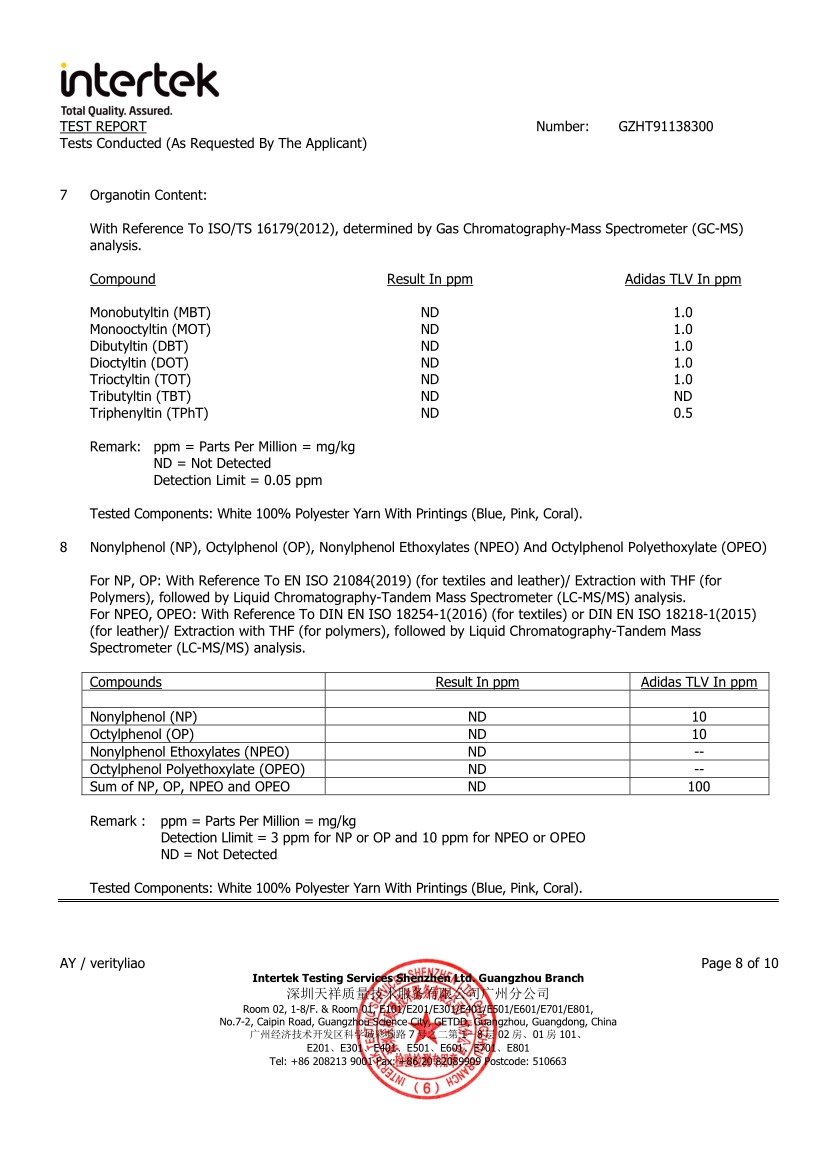
Report scope, standard and issue date belong in the evaluation file. Image: Intertek test report GZHT91138300.
Acceptance criteria as agreement points
The table below converts the recurring procurement questions into lines that belong in a buyer-supplier agreement. None of these are guarantees the supplier can issue unilaterally; each one requires a method and a threshold that both parties accept.
| Parameter | What the agreement should state | Why it matters |
|---|---|---|
| Count and ply | Base count in NM, ply number, tolerated deviation | Prevents gauge drift between approved sample and bulk |
| Color | Reference standard, assessment light source, acceptable color difference | Makes matching measurable rather than visual |
| Pilling | Test method, test duration, rating scale, pass threshold | Pilling is among the most common post-wear complaints |
| Anti-static | Test method, conditioning, measured property, threshold | Static behaviour shifts with humidity and conditioning |
| Functional effect retention | Number of wash cycles and the performance level after them | Separates a laboratory effect from a wearable one |
| Certification coverage | Standard, certificate number, scope line, validity date | Scope lines are usually narrower than the cover implies |
| Inspection and sampling | Sampling plan, inspection point, route for a failed lot | Determines who carries the cost of a rejected batch |
What a vertically integrated mill can put behind those criteria
Dongguan Yuexiong Textile Co., Ltd., trading as MONALISHAMAGIC, is a textile manufacturer and vertically integrated yarn spinning mill based in Dongguan, Guangdong Province, China. The company was founded in 2016, operates a 2,000 sqm facility with 50 employees and a 20-engineer R&D team, produces 1,000 tons annually and exports approximately 70% of output to global markets. Its portfolio spans natural fibres such as cashmere and organic cotton through to recycled nylon under GRS, alongside functional constructions including thermochromic, photochromic, conductive heating and metal gel yarns.
On the commercial side, the operating model is OEM/ODM with customization of composition, color, specification and functional parameters. Minimum order quantity is 5 KG, standard lead time is 7-15 days, and inspection is provided before shipment. After-sales support covers quality complaint response, reorder assistance, sample reconfirmation, color matching support, logistics tracking and supply of compliance documentation.
The documentation set is specific rather than general. GRS, OCS and RCS multi-standard certificate ETK-00041063-MUL-2508 covers trading, warehousing and dyeing of yarns with recycled or organic content, valid to 21 August 2026. BCI certificate ETK-70050-BCI-CoC-2510 covers non-lint trading and warehousing of yarns and fabrics, valid to 20 October 2028. Responsible Animal Fiber certificate ETK-00041063-RAF-2504 covers trading and warehousing of dyed and greige yarns containing responsible wool, alpaca or mohair, valid to 22 April 2026. FSC Chain of Custody certificate ESTS-COC-230318 covers trading of rayon and synthetic fibres and paper yarn, valid to 12 September 2029.
Manufacturing process claims are backed by granted intellectual property rather than description alone: invention patent ZL 2023 1 1305729.5 covers a waterless dyeing preparation process for color-changing yarns and the yarns prepared therefrom, granted 16 April 2024; utility model patents ZL 2022 2 1385471.5 and ZL 2022 2 1384659.8 cover dyeing yarn devices. The brand is registered in the United States (USPTO 7,904,868), the United Arab Emirates (441101) and Italy (302024000183204).
Two long-running development projects show how the acceptance process plays out in practice. A two-year project with an outdoor apparel brand in Great Britain produced an active heating system yarn for thermal clothing, with performance reported in -20°C environments while retaining tenacity and wash durability. A second two-year project with a high-end lingerie brand operating across France, Canada, China, Germany and the United Kingdom integrated thermochromic technology so that color responds to body temperature, with the formulation developed for skin contact and repeated washing.
Peer context: how to use Toray, Teijin, Hyosung, Lenzing and Coats in evaluation
Buyer shortlists in this category usually mix large diversified fibre producers with specialist mills. Toray, Teijin, Hyosung, Lenzing and Coats appear regularly in such lists because each publishes its own technical and compliance documentation and each operates on a different fibre platform. Their presence in a shortlist is useful for orientation, but it is not a substitute for supplier-specific criteria: none of these companies publishes an acceptance template that can be applied unchanged to another mill's product.
The practical consequence is that peer names help a buyer decide which questions to ask, not which answers to expect. Each candidate should be evaluated against its own test reports, its own certificate scope lines and its own approved sample, using an identical set of questions across the field.
Where this model does not fit
Three limits are worth stating plainly. First, certificate scope lines are narrower than the cover suggests. The GRS/OCS/RCS certificate covers trading, warehousing and dyeing of yarns with recycled or organic content; the BCI certificate covers non-lint trading and warehousing of yarns and fabrics; the RAF certificate covers trading and warehousing of dyed or greige yarns containing responsible wool, alpaca or mohair; the FSC chain-of-custody certificate covers trading of rayon and synthetic fibres and paper yarn. A buyer who needs coverage at a different stage of the chain should confirm it explicitly rather than infer it from the certificate title.
Second, a yarn-level test result does not transfer automatically to a finished garment. Stitch density, finishing routes and domestic washing all change pilling and static behaviour, so garment-level acceptance should be agreed and tested separately on the finished article.
Third, custom color development adds approval rounds that sit outside the standard 7-15 day lead time. Programs that treat the standard lead time as a commitment for first-time custom shades will usually be disappointed, and the schedule should be agreed against the color development sequence instead.
Outlook: documentation as a specification line
Two shifts are visible from the procurement side. Functional performance is moving from a marketing differentiator to a specification line item, and documentation is moving with it: buyers increasingly ask for certificate numbers, scope lines and validity dates at the RFQ stage rather than after the order is placed. The second shift is the normalisation of custom counts. As pattern development and knitting machinery become more flexible, the count range a mill can hold becomes part of the shortlist logic rather than a late-stage detail.
Neither shift requires new technology. Both require a supplier that can produce the same document twice, at quotation and at shipment, without the numbers changing in between.
Frequently asked questions
What yarn count range can be customized for functional yarn?
MONALISHAMAGIC works within a customizable count range from 0.5/1 NM at the coarse end to 200/2 NM at the fine end. Count is given in metric number (NM), the number of metres of yarn per gram, with the second figure indicating plies. Coarse counts serve bulky knits and structured fabrics; fine counts serve fine-gauge panels and lightweight blends. Count should be specified together with fibre composition, twist and target fabric weight, because the same count behaves differently across fibre types.
Which colors are standard, and which require development?
Natural white, black, gray, beige and camel are offered as reference shades, with melange and fully custom colors available on request. Melange is a blended heather effect rather than a flat shade, so approval is based on the visual range and distribution of tone across the yarn rather than on a single lab dip. Custom shades require a reference standard and an agreed assessment light source before matching begins.
How is color approved before bulk production?
Approval normally runs in three stages: lab dip, yarn sample and bulk. The purchase order should name the reference standard, the light source used for visual assessment and the acceptable color difference. Without those three items the term matching has no operational definition, and a bulk-stage dispute becomes a question of opinion rather than measurement.
Which third-party tests should a buyer require for functional yarn?
Pilling and anti-static performance are the two properties most frequently specified, typically verified by an independent laboratory such as SGS or GTTC. The purchase order should state the test method, sample preparation, number of wash cycles and pass threshold. Reports held by the manufacturer include Intertek GZHT91138285 for luminous yarn, GZHT91138296 for UV color-changing yarn and GZHT91138300 for temperature-changing yarn, all under Adidas A-01 Policy v20, plus GZHT03128204 and GZHT03128212 for light brown and black knitted fabrics under EN 17134-2:2023.
What are the minimum order quantity and standard lead time?
The minimum order quantity is 5 KG and standard lead time is 7-15 days. The MOQ is low enough to support sample validation before a bulk commitment. First-time custom color development and new functional constructions normally require additional approval rounds beyond the standard lead time, and the schedule should be agreed against those rounds.
Which certification documents can a buyer request?
The available set includes GRS, OCS and RCS multi-standard certificate ETK-00041063-MUL-2508 under GRS v4.0, OCS v3.0 and RCS v2.0, valid to 21 August 2026; BCI certificate ETK-70050-BCI-CoC-2510 under BCI CoC Standard v1.0, valid to 20 October 2028; Responsible Animal Fiber certificate ETK-00041063-RAF-2504 under RAS v1.0, RMS v1.2 and RWS v2.2, valid to 22 April 2026; and FSC Chain of Custody ESTS-COC-230318 under FSC-STD-40-004 and FSC-STD-50-001, valid to 12 September 2029. Products are additionally certified to GRS, BCI and OEKO-TEX.
How should acceptance criteria be worded in the contract?
As measurable agreement points. Each line should state the property, the test method, the sampling plan, the pass threshold and the route for a failed lot. Criteria written as performance guarantees without a test method cannot be verified and are difficult to enforce once a shipment is in transit. Both parties should also agree where inspection takes place and who carries the cost of a failed lot.
Does a passing yarn test guarantee the finished garment will pass?
No. Yarn-level results are a starting condition rather than an outcome. Stitch density, finishing and domestic washing all change pilling and anti-static behaviour, so garment-level acceptance should be agreed separately and tested on the finished article using the same method and threshold definitions.
Reference document: the company brochure, including product families and certification summary, can be downloaded here: MONALISHAMAGIC company brochure (PDF).
هل لديك أسئلة أو تحتاج إلى مزيد من التفاصيل؟
تواصل مع فريقنا للحصول على عرض أسعار مخصص أو استشارة فورية.
طلب عرض أسعار
املأ النموذج أدناه وسيتواصل معك فريقنا بعرض مقترح مخصص.
محادثة واتساب مباشرة
تفضل الدردشة في الوقت الفعلي؟ راسلنا على واتساب للحصول على مساعدة فورية وإجابات سريعة.
- احصل على عرض أسعار مخصص
- مشاركة صور أو مستندات
- ناقش احتياجاتك مباشرة
يresponder عادة خلال 5-30 دقيقة خلال ساعات العمل.