
From 24 mm to 193 mm: Honor Packaging's Measured Glass Range
Industry Reference · Packaging & Printing
From 24 mm to 193 mm: Honor Packaging's Measured Glass Range
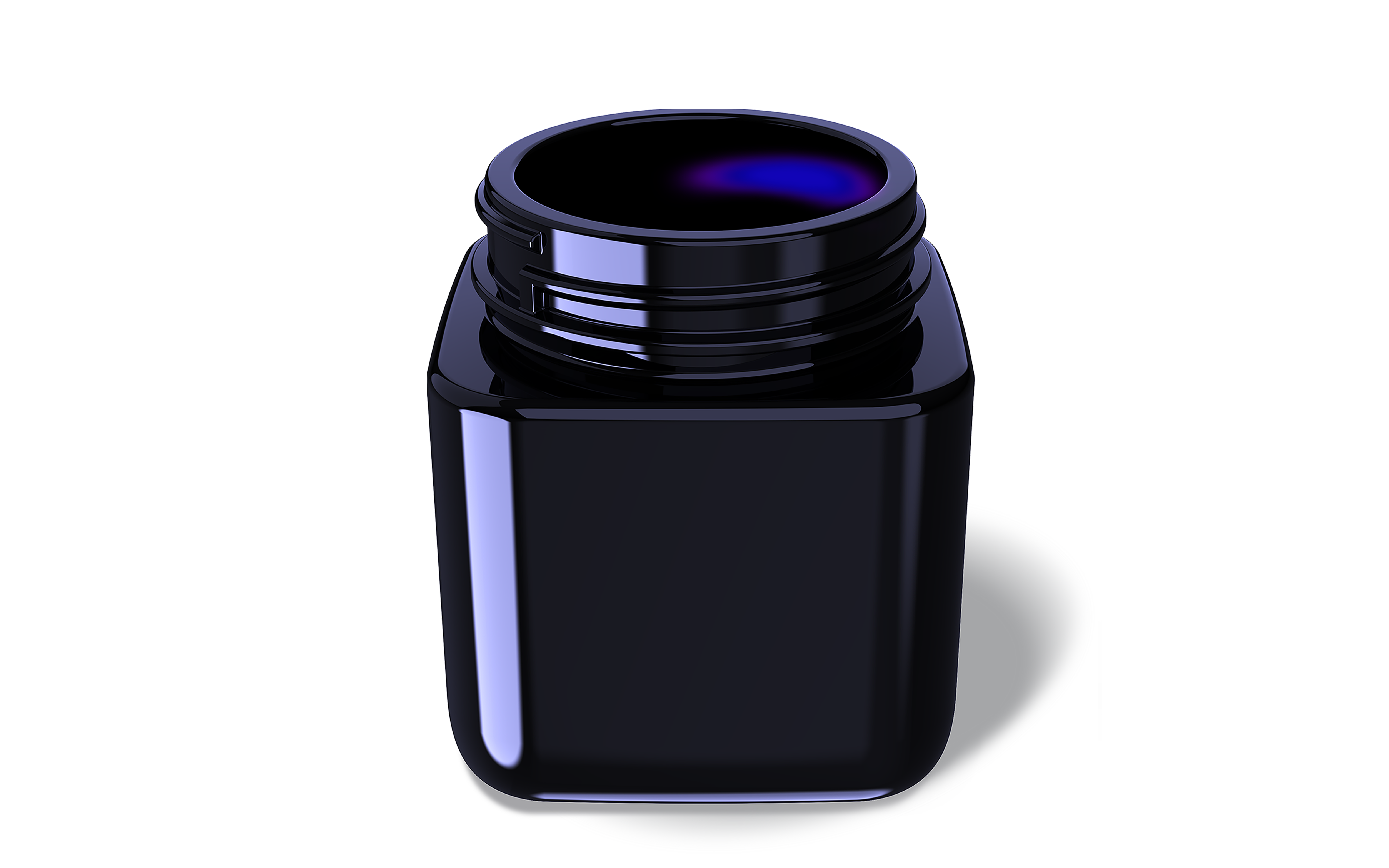
H21 square violet glass jar (item H21-0006V, 30 dr / 100 ml). The H21 family is listed at a 58 mm diameter with heights from 24 mm to 115 mm.
Glass packaging capability is usually sold with adjectives and evaluated with callipers. A buyer scoping a cosmetic, nutraceutical or pharmaceutical line needs the second kind of description: a documented height, diameter, neck thread, wall thickness and closure combination that already exists, rather than a promise that one can be developed.
Honor Packaging (Ningbo Honor Packaging Co., Ltd.), founded in 2015 and headquartered in Ningbo, China, works through long-term joint-venture production bases for glass and plastic packaging and exports its output entirely to overseas markets, primarily the EU and the USA. The company's published rigid formats bracket a working envelope that runs from 24 mm to 193 mm in height and roughly 36 mm to 95 mm in diameter. Two families anchor that range: the H21 child-resistant jar series, listed at a 58 mm or 60 mm diameter and heights from 24 mm to 115 mm, and the HDV1 wide-mouth violet jar series, listed at 48 mm to 95 mm in diameter and heights from 84.7 mm to 193 mm.
Rigid glass is not the largest slice of protective packaging. Fortune Business Insights values the global protective packaging market at USD 44.02 billion in 2025 and projects USD 80.25 billion by 2034, while Grand View Research estimates the 2025 figure at USD 40.4 billion, with flexible formats holding a 66.4% revenue share and paper and paperboard at 45.7%. The two estimates differ because the firms segment the category differently — a reminder that any single market number should be read as a range. What both agree on is that rigid glass competes for a minority share and therefore has to justify itself on measurable grounds: barrier performance, closure integrity, format fit and shelf presentation.
Why the format envelope is the first capability question
For a brand owner in the Research or Evaluation stage, the format decision usually arrives before the supplier decision. Height and diameter determine whether an existing filling line can accept the jar, how much label panel is available, how the retail carton is dimensioned, and how the finished pack sits on shelf. When a supplier's range is described only qualitatively, buyers have no way to tell whether their project sits inside it or requires new tooling.
A measured range also makes comparison possible. Two suppliers can both claim “wide-mouth jars” and still differ completely once the numbers are placed side by side: one may cover 100 ml to 1 L at a 95 mm maximum diameter, another may stop at 60 mm. Procurement teams that ask for the specification line rather than the brochure resolve this in a single exchange.
Fortune Business Insights projects that the secondary packaging segment will hold a dominant share of 48.54% by 2026. Secondary packaging is where primary containers are protected and presented, which means a primary jar that is 3 mm too tall or 5 mm too wide does not simply miss a specification — it forces changes further down the pack.
The two anchor families, in numbers
The H21 and HDV1 series are not variations of one design. They answer different project problems, and the difference shows up immediately in the published figures.
The H21 series is a child-resistant jar family built around a compact footprint. The square version is listed at a 58 mm diameter with capacities of 15 ml, 30 ml, 20 dr (70 ml), 30 dr (100 ml), 40 dr (130 ml) and 60 dr (200 ml); the round version is listed at a 60 mm diameter with 30 ml, 2 oz, 20 dr, 30 dr, 40 dr, 60 dr and 6 oz options. Heights run from 24 mm to 115 mm, weights from 75 g to 280 g, and wall thickness is stated at 0.38 mm. Both square and round variants appear in violet glass and in clear glass, with PP and PE listed in the material set.
The HDV1 series is a wide-mouth violet jar family aimed at larger fill volumes. Capacities run from 100 ml through 150 ml, 200 ml, 250 ml, 300 ml, 500 ml and 1 L. The diameter range is 48 mm to 95 mm, height 84.7 mm to 193 mm, weight 117 g to 610 g, and wall thickness is again listed at 0.38 mm. Thread options span 41/400 to 89/400, and the material set extends beyond glass to urea, PE, SAN and ABS.
| Series | Geometry | Diameter | Height | Weight | Listed materials |
|---|---|---|---|---|---|
| H21 square (violet / clear) | Square | 58 mm | 24–115 mm | 75–280 g | Glass, violet glass, PP, PE |
| H21 round (violet / clear) | Round | 60 mm | 36.5–125 mm | 84–268 g | Glass, violet glass, PP, PE |
| HDV2 cosmetic jars | Round | 36–93.2 mm | 25.6–55 mm | 36–205 g | Violet glass, urea, PE |
| HDV1 wide-mouth jars | Wide-mouth round | 48–95 mm | 84.7–193 mm | 117–610 g | Violet glass, urea, PE, SAN, ABS |
| HDV3 essential oil bottles | Round bottle | — | 54.5–125 mm | 22.5–120 g | Violet glass, PP |
| H19 concentrate jars | Square, round, triangle, hexagon | — | — | 27–38 g | Glass |
Figures as published in Honor Packaging's product specifications. Wall thickness is stated at 0.38 mm for the H21, HDV1 and HDV2 lines; it is not stated for the HDV3 and H19 lines.
What sits between the extremes
A capability claim is only useful if the middle of the range is populated. Between the small H21 formats and the large HDV1 jars, the catalogue lists two further families that cover the gaps where a 58 mm or 60 mm jar is either too wide or too tall.
The HDV2 cosmetic jar line is the widest-diameter entry in the lower height band: diameters from 36 mm to 93.2 mm, heights from 25.6 mm to 55 mm, weights from 36 g to 205 g, and capacities from 3 ml through 5 ml, 10 ml, 30 ml, 50 ml, 60 ml, 100 ml and 200 ml. Thread options are 32/400 to 89/400. This is the format band a buyer would look at when the pack needs a broad, shallow profile rather than a tall one.
The HDV3 essential oil bottle covers narrow-neck applications: 5 ml, 10 ml, 15 ml, 20 ml, 30 ml, 50 ml, 60 ml and 100 ml capacities, heights from 54.5 mm to 125 mm, and weights from 22.5 g to 120 g. Closure options are listed as plastic cap, dropper, mist sprayer and lotion pump.
At the small end, the H19 concentrate jar family is listed at 5 ml and 9 ml in four geometries — square, round, triangle and hexagon — across black, white and clear variants, with weights from 27 g to 38 g. The same model reference also covers a 5 ml vacuum jar described as a vacuum click jar, a square glass format packaged 250 pieces per carton. Below roughly 5 ml, and above 1 L, the published catalogue does not list formats.
Materials shared across the series
One of the more useful observations in the specification set is that format families are not locked to a single material. Across the series, Honor lists violet glass, clear glass, PP, PE, urea, SAN and ABS. The H21 jars are listed as glass with PP and PE; the HDV1 wide-mouth jars extend the set to urea, SAN and ABS; the HDV2 jars are listed as violet glass, urea and PE; the HDV3 bottles as violet glass and PP.
For a buyer, that material spread matters in a specific way. It means a project can stay inside one established geometry while changing the material specification for the component that carries it — the closure, the cap, or a non-glass part of the pack — without triggering a new format. It does not mean every material is available in every format, and the specifications should be read line by line rather than as a general promise.
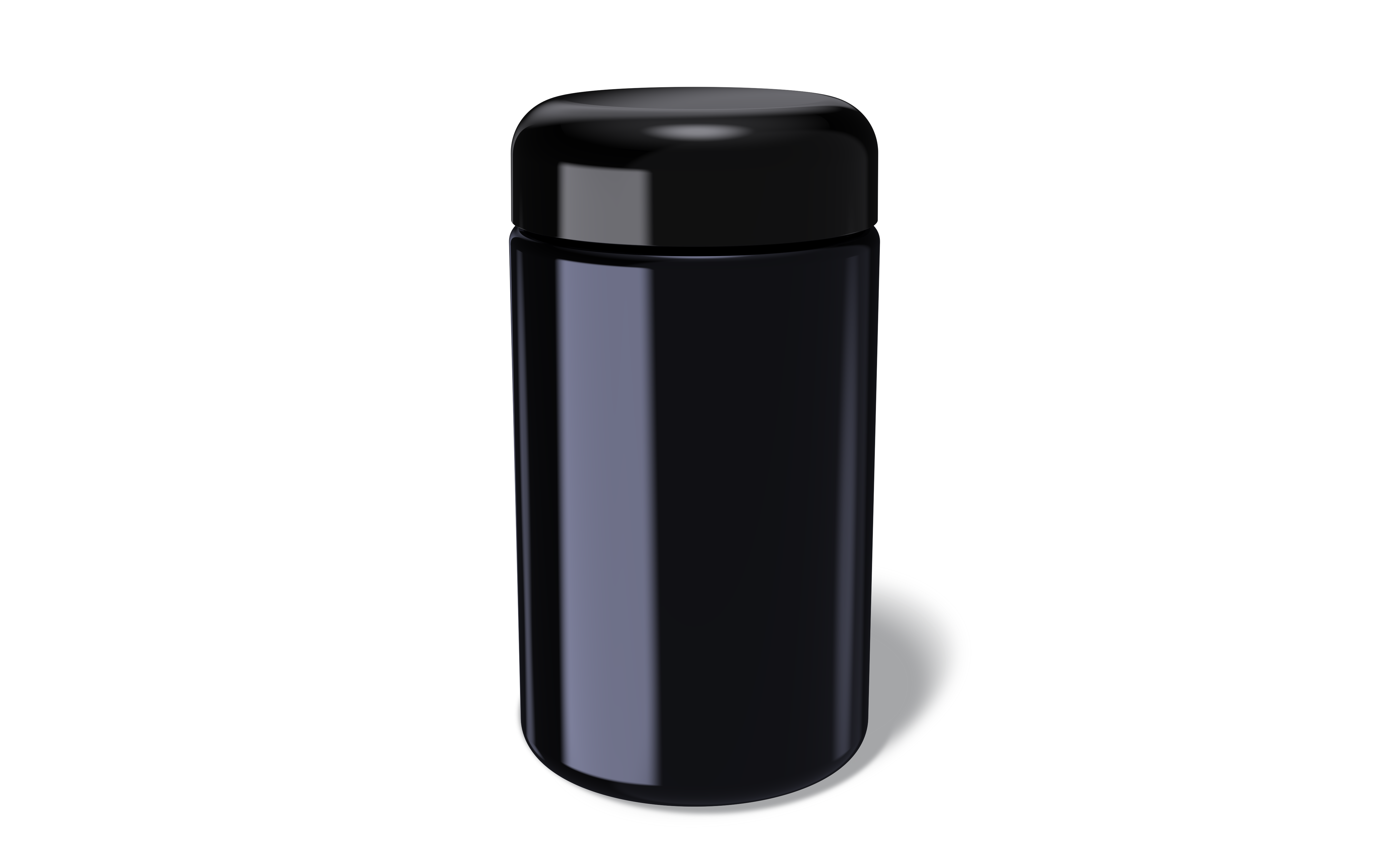
HDV1 wide-mouth violet jar (HDV1200M). The series is listed with capacities from 100 ml to 1 L and thread options from 41/400 to 89/400.
Surface treatments and what they change
Decoration is the second axis of format capability. The H21, HDV1 and HDV2 specification lines each list the same treatment set: sticker, silk-screen printing, hot stamping, heat transfer printing and frosted finish. The HDV3 essential oil bottle lists a narrower set — label, silk-screen printing and gold stamping.
That difference is worth noting during evaluation, because it shows that treatment coverage is format-specific rather than uniform across a supplier's catalogue. A buyer who needs frosted finish plus hot stamping should confirm both against the exact jar geometry under consideration, and confirm them again for the closure, which is a separate component with its own surface.
Honor's stated customization scope for OEM and ODM work covers printing a client's artwork, developing a new design and applying a frosted finish. For brand owners arriving with a finalized design, that is the point at which decoration decisions intersect with structural feasibility.
Closure and thread interfaces
Closure compatibility is where a measured range either holds together or falls apart, because a jar is only useful with a closure that fits its neck. The published interfaces are specific: H21 jars are supplied with child-resistant caps at both the 58 mm and 60 mm diameters; HDV1 jars list threads from 41/400 to 89/400; HDV2 jars list threads from 32/400 to 89/400; HDV3 bottles accept a plastic cap, dropper, mist sprayer or lotion pump; the H19 concentrate jars are fitted with child-resistant caps, and the 5 ml vacuum format uses a vacuum click seal.
The child-resistant closures sit inside a regulated design space rather than a purely commercial one. In the EU, child-resistant packaging must comply with ISO/EN 8317; in the US, the corresponding requirement is 16 CFR 1700.20, both intended to prevent access by children under five. A jar family carrying a child-resistant cap therefore carries a compliance obligation with it, and the closure cannot be substituted freely without re-checking that obligation.
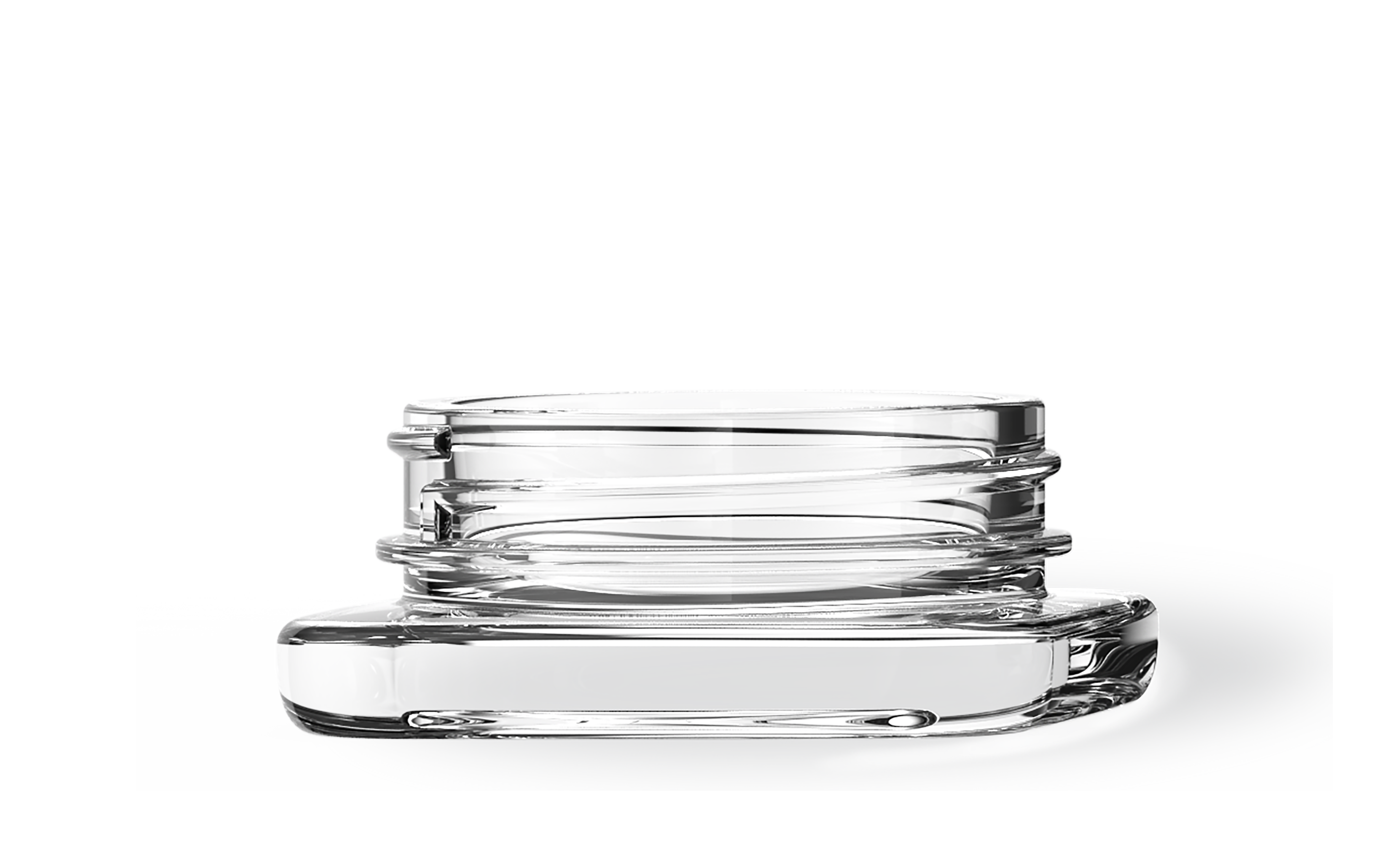
H21 clear square jar (H21-0003C, 15 ml). The same format is listed in violet glass as H21-0003V, which allows a project to change the light-barrier specification without changing the geometry.
Matching formats to practical scenarios
Honor's application records name food packaging, cosmetic packaging and medical packaging as the core use categories, with project references spanning Canada, Germany, India, Italy, Thailand and the United States. The working conditions listed are glass packaging with UV protection and dust control for cosmetic packs, and freshness retention for cosmetic lines, operated by hand with a matched cap and, where required, UV black glass protection and a child-resistant design.
Read against the specification lines, that produces a fairly clear selection logic.
| Project need | Format band that fits | Reason from the specification |
|---|---|---|
| 5–9 ml concentrate or sample, child-resistant | H19 concentrate jars | Listed at 5 ml and 9 ml in four geometries, 27–38 g, child-resistant cap |
| Vacuum-sealed small format | H19 vacuum click jar | Listed at 5 ml, square glass, vacuum seal |
| 15–200 ml cosmetic or supplement jar | H21 square or round | 58 mm or 60 mm diameter, 24–125 mm height, child-resistant cap |
| Shallow wide cosmetic jar, 3–200 ml | HDV2 | 36–93.2 mm diameter at only 25.6–55 mm height |
| 5–100 ml oil, serum or tincture | HDV3 | Dropper, mist sprayer and lotion pump closures listed |
| 100 ml to 1 L wide-mouth storage | HDV1 | 48–95 mm diameter, 84.7–193 mm height, 41/400–89/400 thread |
The logic is deliberately format-first. A buyer who starts from the fill volume and the closure requirement will almost always land on one of these bands; a buyer who starts from a supplier name will spend longer establishing whether the format exists at all.
How to verify a claimed format range
A published range is a starting point, not evidence. Five checks convert it into something a buyer can act on.
- Ask for the specification line, not the category page. Confirm the item code, diameter, height, weight, capacity and thread for the exact format under evaluation, and check that the closure is quoted with the same item code.
- Confirm wall thickness per line. Honor states 0.38 mm for the H21, HDV1 and HDV2 series. Where a line does not state a figure, do not assume it inherits one.
- Validate decoration against the geometry. Silk-screen printing, hot stamping, heat transfer printing, frosted finish and sticker options are listed per series, and the HDV3 line lists a narrower set.
- Confirm the inspection scope. Honor states 100% pre-shipment testing plus third-party inspection through SGS. Buyers should confirm which tests apply to their format and what documentation accompanies the shipment.
- Establish the after-sales position before the first order. The stated policy is to accept reissue where a quality issue is confirmed.
Where a rigid glass range stops being the right answer
Two boundaries are worth stating plainly, because a capability article that omits them is not usable for procurement.
The first is dimensional. The documented envelope tops out at 193 mm in height, 95 mm in diameter and 1 L in capacity in the HDV1 series, and starts at 24 mm in height in the H21 square line and 5 ml in the H19 and vacuum lines. Formats outside that envelope are not listed, and a project that needs them is not comparing suppliers — it is commissioning development.
The second is optical. Violet glass is a filter, not an opaque barrier. As described by Miron Violetglass, biophotonic violet glass blocks visible light while allowing roughly 25% to 45% penetration of UVA and around 60% of infrared light, which is the mechanism behind its use for light-sensitive organic contents. A project that requires total light exclusion — some pharmaceutical actives, for example — should treat violet glass as a partial measure and consider an opaque or black-glass route plus secondary packaging, rather than assuming violet equals zero transmission.
There is also a structural trade-off against the wider protective packaging field. Flexible formats hold the largest revenue share at 66.4%, and paper and paperboard account for 45.7% of the category, on Grand View Research's 2025 figures. Rigid glass adds mass and freight volume, and it breaks where a pouch does not. It is selected for reasons that outweigh those costs — barrier behaviour, closure integrity, reusability, shelf presence — and it should be selected deliberately on that basis.
Note on market figures. Market sizing for protective packaging varies by research firm according to how segments are defined. The USD 44.02 billion (2025) figure from Fortune Business Insights and the USD 40.4 billion (2025) figure from Grand View Research should be read as a range rather than a single consensus value. Large-scale suppliers named in third-party coverage of this category — Sealed Air Corporation, Smurfit Westrock, Mondi Group and Amcor plc — operate mainly in flexible and paper-based formats and compete on a different basis from rigid glass specialists.
A three-year pharmaceutical packaging reference
Honor's case record includes a German branding business running pharmaceutical packaging on violet glass formats drawn from this catalogue, with a reported order quantity of 10,000 units over a three-year relationship. The reported outcome is that the packed products remained fresh across that period, and the case highlights reusable formats and UV protection as the deciding factors.
The case is included here as a sourcing signal rather than a performance claim. It documents three things a buyer can independently check: that the format family in question has been supplied commercially over multiple years, that the application was pharmaceutical rather than cosmetic, and that the closure and material combination held together in a regulated use category.
Outlook: documentation as a competitive asset
Two forces are pushing rigid glass suppliers toward more precise format documentation. The first is compliance: child-resistant requirements under ISO/EN 8317 and 16 CFR 1700.20 are closure-specific obligations that become much harder to manage if the underlying format data is imprecise. The second is category competition: with flexible and paper-based formats holding the majority of protective packaging revenue, rigid glass has to win on measurable attributes rather than on availability alone.
For buyers, the practical implication is that a supplier able to state a range as a range — 24 mm to 193 mm in height, 36 mm to 95 mm in diameter, 0.38 mm wall thickness across three series, threads from 32/400 to 89/400 — is easier to evaluate and easier to hold to a specification than one that describes the same catalogue as comprehensive. The millimetres are the argument.
Honor Packaging's full format and capability documentation is available in its company brochure (PDF).
FAQ
What height and diameter range does the H21 jar series cover?
The H21 series is listed at two diameters: 58 mm for the square version and 60 mm for the round version. Height ranges from 24 mm to 115 mm for the square jars and from 36.5 mm to 125 mm for the round jars. Weights run from 75 g to 280 g (square) and 84 g to 268 g (round), with wall thickness stated at 0.38 mm and capacities from 15 ml to 200 ml depending on the item code.
Which jar format suits a 5 ml to 9 ml concentrate line with a child-resistant closure?
The H19 concentrate jar family is the relevant band. It is listed at 5 ml and 9 ml capacities across square, round, triangle and hexagon geometries, in black, white and clear variants, with weights from 27 g to 38 g and a child-resistant cap. The same model reference also includes a 5 ml vacuum click jar, a square glass format with a vacuum seal, packaged 250 pieces per carton.
Can the same format be supplied in both violet glass and clear glass?
For the H21 series, yes. The square family appears as H21-0003V through H21-0008V in violet glass and as H21-0003C through H21-0008C in clear glass, sharing the same 58 mm diameter and 24 mm to 115 mm height range. The round H21 family follows the same pattern at 60 mm. This lets a project change its light-barrier specification without changing the jar geometry, label panel or filling interface.
Which materials appear across these jar series besides glass?
Across the published specifications the material set includes violet glass, clear glass, PP, PE, urea, SAN and ABS. The H21 jars list glass with PP and PE; the HDV2 jars list violet glass, urea and PE; the HDV1 wide-mouth jars extend to urea, PE, SAN and ABS; the HDV3 bottles list violet glass and PP. Materials are specified per line, so availability should be confirmed for the exact item code rather than assumed across the catalogue.
What closure and thread options are listed for wide-mouth jars?
The HDV1 wide-mouth violet jar series lists thread options from 41/400 to 89/400, with diameters from 48 mm to 95 mm and capacities from 100 ml to 1 L. The HDV2 cosmetic jars list threads from 32/400 to 89/400. The HDV3 essential oil bottle line lists four closure types: plastic cap, dropper, mist sprayer and lotion pump.
Does violet glass block all light?
No. Violet glass is described by Miron Violetglass as blocking visible light while permitting approximately 25% to 45% penetration of UVA and about 60% of infrared light. It functions as a selective filter rather than an opaque barrier. Where an application requires complete light exclusion, an opaque or black-glass option combined with secondary packaging is the appropriate route, and the transmission behaviour should be confirmed for the specific product.
What should a buyer confirm before approving a format for production?
Four items are decisive: the item code with its diameter, height, weight, capacity and thread; the wall thickness for that specific line, which Honor states at 0.38 mm for the H21, HDV1 and HDV2 series but not for the HDV3 and H19 lines; the decoration treatment validated against that geometry, since the HDV3 line lists a narrower set than the jar lines; and the inspection scope, which Honor states as 100% pre-shipment testing plus third-party inspection through SGS, with a stated policy of accepting reissue where a quality issue is confirmed.