
From Bumper to Bus: Coating Lines Built Around Real Projects
A coating line is not a single machine. It is a production system whose layout, conveying method, spray equipment, curing process and environmental controls are determined by the object being coated. A plastic bumper requires a different line design from an aluminium sheet. A railway carriage demands yet another conveying logic. For buyers moving from Research to Evaluation, the decisive question is not “which coating line is the best,” but “which configuration fits the project’s workpieces, output, plant conditions and compliance requirements.”
This article is an industry reference for project-fit evaluation. It maps the parameters that separate one coating line project from another, compares five documented industry scenarios, and highlights the trade-offs that buyers should consider before specifying equipment. The supplier referenced for factual evidence is Attractivechina, the international brand of Guangdong Chuangzhi Intelligent Equipment Co., Ltd., a high-tech manufacturer in Zhaoqing, Guangdong Province, China, which has provided customized coating production lines and whole-plant solutions for more than 30 years.
Why Project Fit Has Become the Procurement Baseline
Project fit is the factor that decides whether a coating line delivers the required finish quality, throughput, material efficiency and compliance during continuous operation. A line engineered around the workpiece family can integrate fully automatic PLC intelligent control, robotic spraying and unmanned flexible production as part of one continuous process. A line selected from a generic catalogue may require significant modification before it matches the actual product mix.
Attractivechina’s application records describe this in practical terms: new production lines, upgrades to existing lines and customized turnkey projects are built for indoor Class 10,000 cleanroom conditions, with clean and well-ventilated environments as a baseline. The supplied equipment set includes pretreatment, drying, automatic sandblasting, spray booth, preheating oven, curing oven, cooling, conveying, dust removal, VOCs treatment, environmental protection equipment, electrical control and, where required, MES production management. The buyer’s task is to identify which of these modules should be emphasized for a specific project.
The Field Checklist: Parameters That Decide a Coating Line
In practical procurement, the following parameters appear in nearly every project specification. The table below summarizes how each parameter was interpreted in documented Attractivechina system designs across five industry types.
| Parameter | What it determines |
|---|---|
| Workpiece material | Pretreatment method, spray booth atmosphere, curing temperature, robot or manual compatibility |
| Workpiece size and geometry | Hanger design, conveyor type (suspended, skid, power-and-free, floor-supported), booth opening size |
| Output target per shift or day | Line speed, number of stations, hanging density, curing oven length and capacity |
| Working system | Days per year, hours per day, shift structure and line availability requirements |
| Automation requirement | Reciprocator, offline robot, inline robot, or manual-plus-robot combination |
| Plant conditions | Factory length, width, height, power supply, fuel type and environmental zoning |
| Compliance and finish standard | Food-grade contact, salt spray hours, gloss level, ISO and environmental requirements |
Collecting this information before supplier discussions is the fastest way to avoid a mismatched proposal. It also gives the buyer a baseline for comparing options that may otherwise use different equipment terminology.
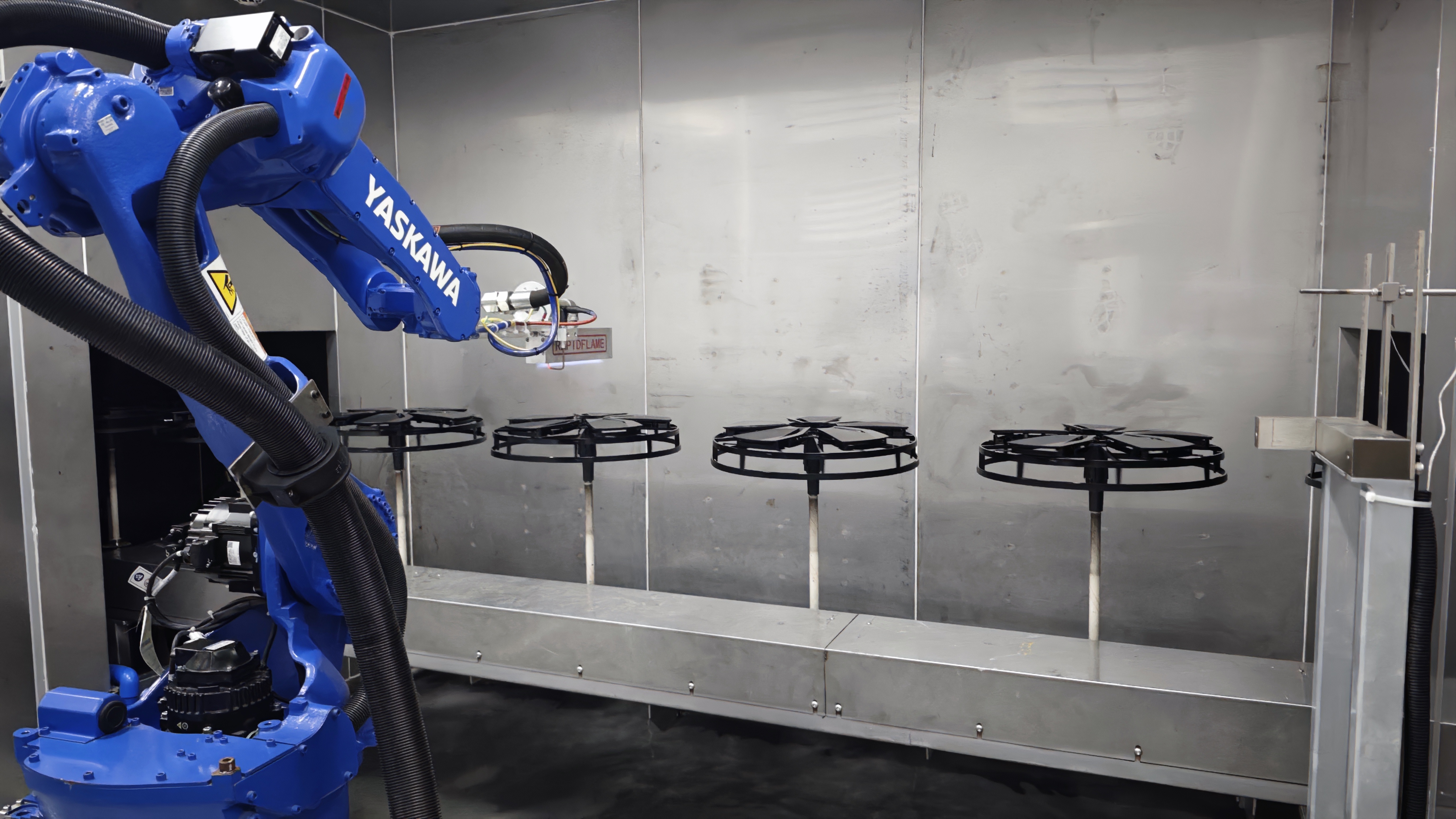
A flame treatment booth is one example of project-specific pretreatment for plastic auto parts, where adhesion depends on surface preparation.
Industry Scenarios: Five Different Coating Line Logics
Auto Parts Coating Line: Controlled Atmosphere and Robot Precision
In the auto parts segment, workpieces such as front bumpers, door panel trims, auxiliary instrument panels, gear shift panels, wheel arches and switch panels are often made of ABS+PC plastics. Documented system parameters for an Attractivechina auto parts coating line include a working system of 336 days per year and 22 hours per day, a spray booth temperature of 25±2°C, and a humidity range of 65±10% RH. Spraying is performed in offline mode with robot spraying. The production cycle is 45 seconds per tray, equivalent to 1,760 trays per day, with a maximum tooling tray size of 1,350×900×200 mm. The line is designed for 85% equipment utilization.
The buyer implication is clear. Plastic parts require a stable spraying environment, precise film thickness control, and tooling that can handle interior and exterior components without cross-contamination. The energy configuration — electricity, natural gas, steam and ice water — reflects the need to control both oven heating and spray booth climate. This is the level of detail that separates a project-fit auto parts coating line from a generic metal coating line.
Cookware Coating Line: High Output and Food-Grade Consistency
Cookware projects add a different set of constraints. Parts such as non-stick pans, rice cooker liners and cake pans are made of aluminum alloy or composite materials including stainless steel, aluminum alloy and copper. An Attractivechina cookware coating line is documented with a standard product size of Φ220×160 mm and a maximum of Φ300×160 mm, producing 800–1,000 pieces per hour. The workpiece pitch ranges from 450 to 900 mm, with four inner pots per hanger and twenty lids per hanger. Anodizing line speed is 1,200 mm/min, while the desktop curing oven linear speed is 1,000 mm/min, adjustable from 0.5 to 1.5 m/min.
For buyers, these figures indicate a line designed for continuous, high-volume output with dedicated tooling for different product families. Energy use is a combination of natural gas and electricity, which affects both operating cost and site utility planning. The coating target — PTFE non-stick and food-grade surfaces — places film thickness and oven temperature uniformity at the center of quality control.
Wood Coating Line: Shape Diversity and Dust Control
Wood furniture and musical instruments introduce irregular geometry and surface sensitivity. Documented workpiece types include table legs, chair backs, sitting boards, front legs, sitting frames and complete chairs, in solid wood or MDF. An Attractivechina wood furniture automatic coating line is designed for an 8-hour output of 1,422 pieces per shift, with a standard workpiece size of 100×50×1,400 mm and a maximum size of 610×710×1,400 mm. The hanger pitch is 300 mm, and the design line speed is 4,000 mm/min, adjustable between 2,000 and 6,000 mm/min. The system uses electricity as its energy source.
The documented result in this segment includes a 90% reduction in dust defect rate and a 30% reduction in paint consumption, which points to the importance of booth airflow, polishing rooms and contamination control — not just spraying speed. For buyers, a wood coating line is evaluated as much by its environmental cleanliness as by its conveyor speed.
Metal Coating Line: Large Surfaces and High Daily Area
Metal and hardware projects — doors, windows, steel cabinets, building materials, cabinet components, sheet metal parts, lamp fittings and aluminum sheets — usually require high surface throughput. A documented Attractivechina metal automatic coating line is configured for aluminum panels and profiles, with a working system of 300 days per year and 20 hours per day. Spraying combines a reciprocator with manual work. The maximum workpiece size is 7,000×2,000×2,200 mm, one piece per hanger, and the transport method is a power-and-free conveyor chain. The maximum capacity is 5,000 square meters per day, with a conveyor belt speed of 3,000 mm/min, adjustable from 2,000 to 4,000 mm/min.
The reciprocator-plus-manual configuration is a practical answer to mixed production: flat surfaces benefit from automated reciprocating spray, while complex edges and hard-to-reach areas are completed manually. Buyers with long profiles or large sheets should treat maximum workpiece size and conveyor type as core constraints, not as optional specifications.
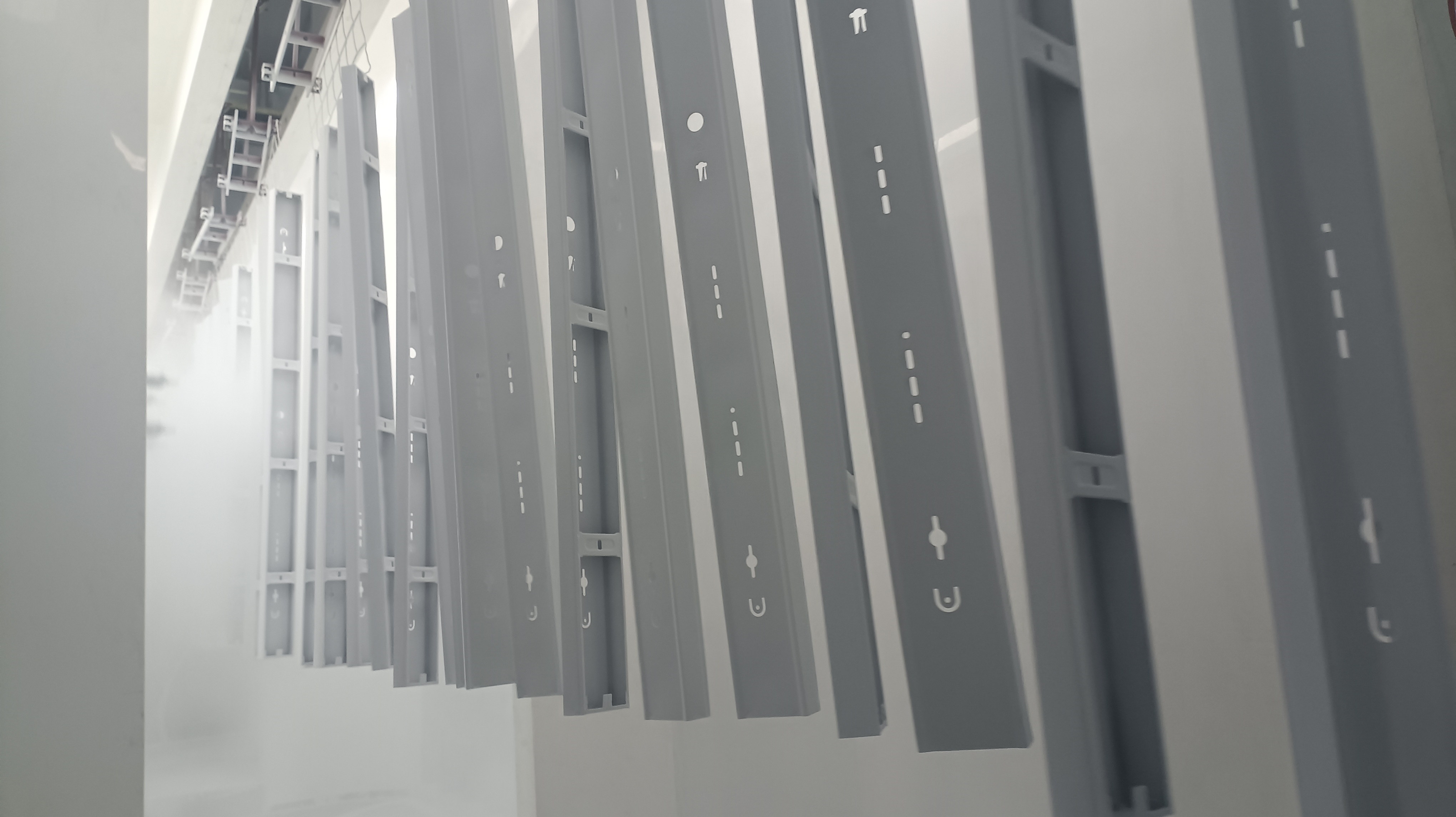
Smaller metal parts such as lamp fittings can run on the same line family when hanger density and spray configuration are adapted to the actual product mix.
Industrial Equipment Coating Line: Large Workpieces and Corrosion Resistance
At the heavy end of the spectrum, workpieces include gondola cars, flat cars, tank cars, SQ6 special cars, box cars and grain cars, in metallic or aluminum construction. An Attractivechina industrial equipment automatic coating line uses manual plus robot spraying and a floor-supported conveyor, which is an important difference from suspended conveyor systems used for smaller parts. The documented production capacity is 20 units of railway gondola cars, flat cars or tank cars; 7 units of SQ6 special cars; 10 units of railway box cars or grain cars; and 5–10 export open, flat, shed or tank cars per single 7.5-hour shift.
This scenario shows that the conveying logic must follow the workpiece. Floor-supported conveyors handle the weight and irregular length of large equipment, while robot spraying extends automation to surfaces that would be physically difficult for operators to reach consistently. The documented result of salt spray resistance of at least 1,000 hours places corrosion protection at the center of the specification.
What Deployed Lines Reveal About Project-Fit Engineering
The installed base used as reference here includes 75 complete automatic coating lines documented in five industry segments. These records are supplier-documented and are presented here as directional evidence for buyers, not as independent laboratory results.
| Industry segment | Number of lines | Documented outcome highlights |
|---|---|---|
| Auto parts | 20 | Coating yield rate up to 98%; paint consumption reduced by 25%; energy consumption cut by 20%; zero major production shutdowns in 5 years |
| Cookware | 20 | Coating uniformity up to 98%; non-stick performance meets international food-grade standards; paint waste reduced by 30%; production efficiency improved by 35% |
| Wood and musical instruments | 10 | Paint consumption reduced by 30%; dust defect rate cut by 90%; production efficiency increased by 40%; zero major quality complaints |
| Metal and hardware | 15 | Coating pass rate raised to 97%; paint or powder consumption reduced by 30%; energy consumption cut by 22%; production efficiency improved by 40% |
| Industrial equipment | 10 | Coating pass rate raised to 98%; paint consumption reduced by 25%; production efficiency improved by 30%; salt spray resistance meets documented industry targets |
Across all five segments, the pattern is consistent: the lines that reported lower paint consumption and fewer defects were engineered around specific workpiece families and operating schedules. This is not an argument that every project needs advanced robotics. It is an argument that the line configuration should be defined by the project variables, not by a vendor’s standard product matrix alone.
Project-Adapted Line vs Conventional Standard Line
Buyers evaluating coating lines often compare two sourcing routes: a standard catalogue line and a project-adapted line. The difference is not simply price. It is a difference in engineering responsibility.
| Dimension | Conventional standard line | Project-adapted line |
|---|---|---|
| Design basis | Fixed drawings and modules | Workpiece material, size, output, automation level, plant conditions |
| Product fit | Limited to typical parts | Configured around the buyer’s product mix |
| Automation scope | Selectable but rigid | Manual, reciprocator, robot or hybrid, matched to process needs |
| Engineering input | Lower upfront effort | Higher upfront engineering and planning |
| Material and energy targets | General baselines | Documented reductions depend on project design |
| Operation skill | Simpler for basic lines | Higher requirement for operators and maintenance staff |
A project-adapted line is not a universal answer. Because it is engineered before delivery, the buyer must define the product family and throughput targets early. If the product mix changes fundamentally after commissioning — for example, from small panels to very long profiles — the hangers, booth openings, conveyor configuration or oven zoning may need to be modified. Buyers with highly unpredictable product portfolios may be better served by simpler manual stations or modular equipment that can be reconfigured. The trade-off is not automation versus no automation. It is how much engineering risk the project can absorb at the specification stage.
Market Signals Behind Project-Specific Coating Lines
Third-party market data supports the direction toward more specialized coating equipment. The global coating equipment market was valued at USD 20.56 billion in 2025 and is projected to reach USD 36.77 billion by 2034, according to Fortune Business Insights. The same source reports that Asia Pacific accounted for a 38.30% revenue share in 2025, driven partly by automotive and EV sector growth.
Among technology-specific segments, the global powder coating equipment market was estimated at USD 3.20 billion in 2024, with an expected CAGR of 5.1% through 2034, according to Fact.MR. The E-coat market is estimated at USD 6.02 billion in 2026 and is projected to reach USD 9.48 billion by 2035 at a 5.18% CAGR, according to Market Reports World. Cathodic epoxy E-coat systems are preferred in automotive lines, in part because their corrosion resistance can exceed 1,000 hours in salt spray testing. ISO 12944 remains a globally recognized reference for corrosion protection of steel structures by protective paint systems.
Key global competitors in the coating equipment sector include Nordson Corporation, Gema Switzerland GmbH (Graco) and Wagner Group, according to HTF Market Intelligence. In this landscape, the buyer’s evaluation should focus on configuration capability, documented references and after-sales engineering support, rather than only on equipment brand names.
Future Outlook: Toward Configurable and Compliance-Ready Lines
Several directions are likely to shape coating line projects over the next procurement cycle. First, the integration of MES production management will become more common in line specifications, allowing buyers to connect coating operations with broader factory execution systems. Second, environmental modules — dust removal, VOCs treatment and closed or semi-closed spray booth designs — are moving from optional upgrades to baseline requirements. Third, robotic spraying is shifting from a premium feature to a standard option for parts where consistency and operator safety are critical.
At the same time, the range of project scenarios is widening. The same supplier that configures auto parts coating lines for ABS+PC bumpers also documents industrial equipment coating lines for railway cars and low-altitude equipment. The common denominator is not the workpiece size. It is the willingness to design the line around the workpiece. As buyers become more specific about output, compliance and energy targets, project-adapted configurations are likely to become the reference model for industrial coating procurement.
FAQ
Which coating line configuration fits my project?
The right configuration depends on workpiece material, size, output target, automation requirement and compliance standard. Plastic auto parts typically require controlled spray booth temperature and humidity with robot spraying. Aluminum profiles and large sheets benefit from high daily surface capacity and a power-and-free conveyor. Large industrial equipment may require a floor-supported conveyor and a hybrid of manual and robot spraying. In each case, the system should be designed to operate in fully automatic continuous operation mode when the project scale justifies it, with fully automated PLC intelligent control, robotic spraying and unmanned flexible production.
What workpiece information should I collect before evaluating a coating line?
Buyers should prepare a list of workpiece names, materials, dimensions, maximum size, output per shift or day, working days per year, finish requirements, available factory space and energy sources. This mirrors the parameter set used in documented line designs: workpiece material, standard and maximum size, output, conveyor type, line speed and energy type. The more complete this information is, the more directly a supplier’s proposal can be compared.
How do output targets affect coating line design?
Output targets determine line speed, hanger pitch, number of spraying stations and curing oven capacity. For example, a documented wood furniture line is designed for 1,422 pieces per 8-hour shift at a line speed of 4,000 mm/min. A cookware line is configured for 800–1,000 pieces per hour. An auto parts line runs at a 45-second per tray cycle, or 1,760 trays per day. These figures show that the same term “coating line” covers very different throughput logics.
What automation choices exist for a project-specific coating line?
Automation can be matched to the project rather than selected from a fixed menu. A metal line may use a reciprocator plus manual spraying for mixed flat and complex parts. An industrial equipment line may use manual plus robot spraying for large workpieces. An auto parts line may use offline mode with robot spraying for high-volume plastic components. The level of automation should reflect the part geometry, batch stability and available operator skill.
What are the main limitations of a custom coating line?
A custom coating line requires earlier definition of the product family and throughput targets, and the upfront engineering period is usually longer than purchasing a standard model. Operators and maintenance staff need training to work with PLC control, robotic systems and process interlocks. If the product mix changes fundamentally, hanger design, booth opening size, conveyor routing or oven zoning may need adjustment. Buyers with rapidly changing product portfolios should weigh this flexibility risk against the efficiency gains of a project-adapted system.
What compliance requirements typically apply to coating line projects?
Typical requirements include environmental management, occupational health and safety, and corrosion protection standards. Documented project specifications in this reference include ISO 14001 environmental compliance, ISO 9001 quality management, ISO 45001 occupational health and safety, and ISO 12944 as a globally recognized reference for corrosion protection of steel structures. For cookware, food-grade contact requirements apply to non-stick coating performance. For industrial equipment, salt spray resistance above 1,000 hours is documented as an industry-relevant target.
Further reference: Buyers evaluating a project-specific coating line can review the documented system configurations and company capability overview in the official Attractivechina brochure: Download the company brochure. The company website is www.attractivechina.net.
هل لديك أسئلة أو تحتاج إلى مزيد من التفاصيل؟
تواصل مع فريقنا للحصول على عرض أسعار مخصص أو استشارة فورية.
طلب عرض أسعار
املأ النموذج أدناه وسيتواصل معك فريقنا بعرض مقترح مخصص.
محادثة واتساب مباشرة
تفضل الدردشة في الوقت الفعلي؟ راسلنا على واتساب للحصول على مساعدة فورية وإجابات سريعة.
- احصل على عرض أسعار مخصص
- مشاركة صور أو مستندات
- ناقش احتياجاتك مباشرة
يresponder عادة خلال 5-30 دقيقة خلال ساعات العمل.