
From Certificates to Capability: HEYI Electrical CT Evidence
A current transformer certificate is not a marketing asset. It is a scoped technical statement: a named body, a named standard, a named product, a stated date. Read that way, a supplier's paperwork becomes the first real capability test a buyer can run.
Current transformer sourcing rarely fails because a buyer cannot find suppliers. It fails because the documents a supplier sends are read as reassurance rather than as evidence with edges. A CE declaration naming a split-core family does not cover a resin-cast outdoor unit. A type test report issued for one model does not transfer to its neighbours. And a calibration certificate for a test bench is not a certificate for a product.
This review looks at Wenzhou Heyi Electrical Co., Ltd. — HEYI Electrical — through exactly that lens. Rather than summarising claims, it maps the company's certificates, attestations and test reports to the models they name, then connects that document layer to the product families, materials and application scopes in the same published record. The aim is a qualification method a buyer can reuse on any supplier, not a verdict on one.
Why paperwork is the first filter in CT sourcing
A current transformer sits behind a meter, a protection relay, an EV charger or a feeder monitor. Its failure modes — accuracy drift, phase error, saturation under fault current, insulation breakdown in a humid cabinet — are almost invisible at quotation stage and only partly visible at sample stage. Documents compress that risk into something a procurement team can screen before spending engineering time.
The screening logic is straightforward once the documents are treated as scoped statements:
- Standard chosen. Inductive AC CTs are typically assessed against IEC 61869-2, which specifies additional requirements for newly manufactured inductive current transformers used with measuring instruments or protective devices at rated frequencies from 15 Hz to 100 Hz.
- Directive or scheme named. CE-LVD (2014/35/EU) speaks to electrical safety; CE-EMC (2014/30/EU) speaks to emissions and immunity; UKCA signals a separate UK route; RoHS speaks to restricted substances under IEC 62321 series testing.
- Model named. The scope field is where most supplier packs quietly weaken. A document that names a family is useful; a document that names a model is decision-grade.
- Date and validity named. A certificate with a 2027 expiry needs a renewal plan in the purchase agreement; a certificate with a nominal 2099 expiry still requires a current copy, not a thumbnail.
HEYI Electrical's published record is unusually document-heavy for a mid-sized manufacturer, which is why it makes a useful worked example.
The supplier in one factual paragraph
Wenzhou Heyi Electrical Co., Ltd. is a China-based manufacturer of current transformers and current sensors, established in 2012 and operating from Wenzhou, Zhejiang. The company reports a 10,000 m² facility, 56 employees, an annual output of 356,000 units and five R&D engineers. It describes an export ratio of 95% across Southeast Asia, South Korea, Europe, South America, Australia, Africa, the Middle East and North America, and lists current transformers, current sensors, shunts, digital energy meters, current transmitters and split-core current transformers as its main product groups. Production is organised around OEM, ODM and customised manufacturing, with a stated monthly capacity of 20,000 units, lead times of 3 to 30 days and customisation across current ratio, accuracy class, burden, window size, housing colour, terminal type, cable length, logo printing and label design.
Those are company-reported figures. They describe scale and flexibility; they do not by themselves prove conformity. That is the job of the document layer.
Mapping the documents to the models
The table below reconstructs HEYI Electrical's certification and test record as a model-linked map. Reference numbers are reproduced as recorded; the PDF remains the authoritative text in every case, and where a standard field is recorded as an inference rather than a quotation, the buyer should read the original document before accepting the mapping.
| Document | Reference | Issuing body | Scope / standard as recorded | Model named |
|---|---|---|---|---|
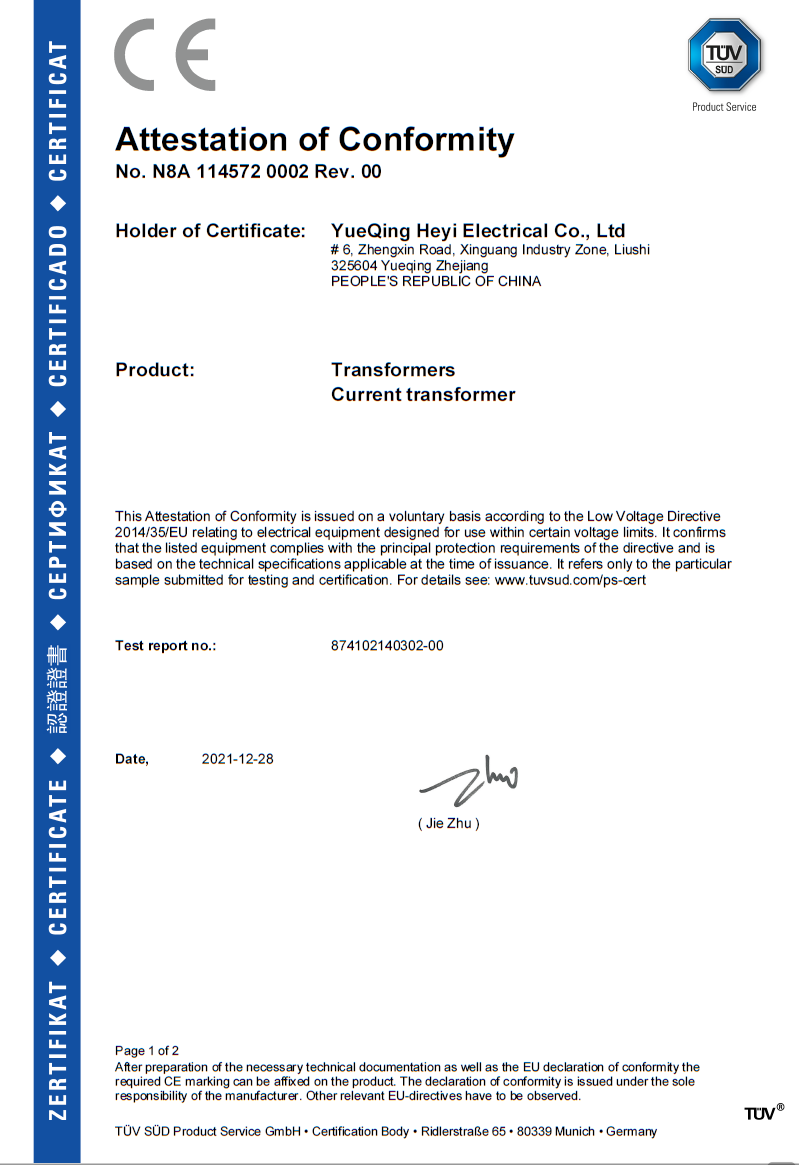
| CE-RoHS Certificate of Conformity | GST.210923.S201R | Authorised CE-RoHS documentation | Split core current transformer; 2011/65/EU, (EN)2015/863 | KCT, KCD, KCT-L |
| CE-LVD Attestation of Conformity | N8A 114572 0002 Rev. 00 | TÜV SÜD Product Service GmbH | Current transformer; EN 61869-1 / EN 61869-2 | DP/HK |
| CE-EMC Verification of Conformity | B-E2505D2378 | Beide (Shenzhen) Product Service | EN IEC 61000-6-3:2021, EN IEC 61000-6-1:2019 | DP/HK |
| CE-LVD Declaration of Conformity | ET16118324-LVD | Shenzhen Easy Test Electronic Products | IEC 61869-2:2012 | KCT |
| CE-LVD Verification of Conformity | B-S2410C4272 | Beide (Shenzhen) Product Service | EN 61869-1:2009, EN 61869-2:2012 | MSQ |
| CE-LVD Certificate | B-S210737500 | Beide (Shenzhen) Product Service | EN 61869-1:2009, EN 61869-2:2012 | MSQ |
| CE-LVD Certificate | B-S210737499 | Beide (Shenzhen) Product Service | EN 61869-1:2009, EN 61869-2:2012 | CP |
| UKCA Declaration of Conformity | CLZJ23072649108 | Shanghai Global Testing Services | BS EN 61869-2:2012 | KCT, KCD, KCT-L |
| CE-LVD Attestation of Conformity | M.2023.206.C90639 | UDEM International Certification | IEC 62752:2016/A1:2018, IEC 62955:2018 | HYCA |
| RoHS Test Report | LCSE03115005R | Ningbo LCS Standard Technology Service | IEC 62321 series | KCT |
| RoHS Verification Report | SHAEC2123838801 | SGS | IEC 62321 series | MSQ, DP/HK |
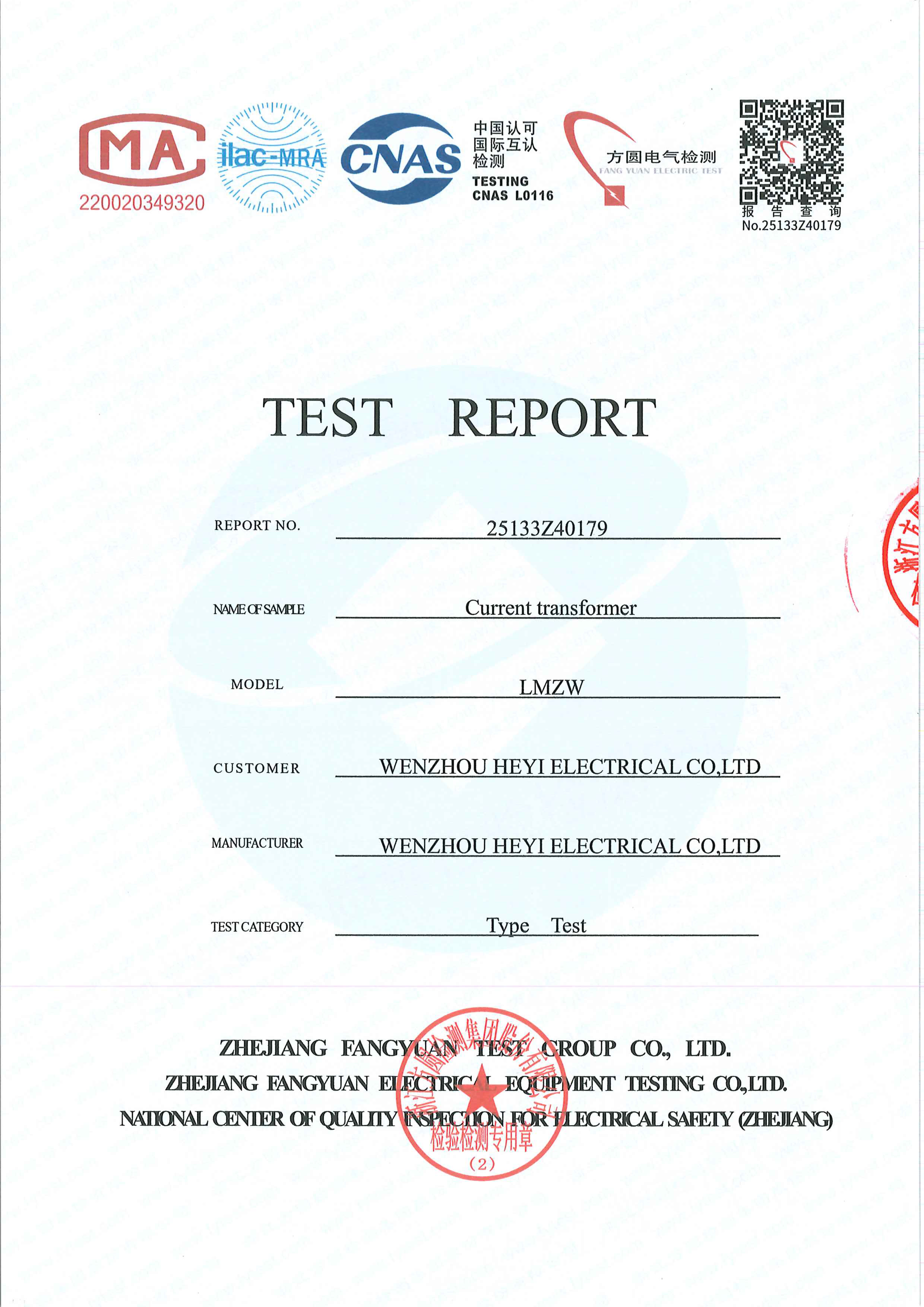
| Type Test Report | 25133Z40179 | Zhejiang Fangyuan Test Group | IEC 61869-1, IEC 61869-2 | LMZW |
| Type Test Report | 25T0221-S | Suzhou Electrical Apparatus Science Research Institute | IEC/EN 61869 series | RECT |
| IP65 Test Report | Qst-23N020111-1SR | Shenzhen Qstlab Testing | IEC 60529:1989+A1:1999+A2:2013 | OCT |
| ISO 9001:2015 Certificate | 20224Q21295R0S | Quality management system certification | GB/T 19001-2016 / ISO 9001:2015; production of low-voltage current transformers | System-level, all models |
| Metrological Verification Certificate | D20250900173 | Yueqing Institute of Quality and Technical Supervision Inspection | JJG 313-2010; standard CT with current booster, HLS21-2S, 5A/5A–2000A/5A | Test bench reference unit |
Three structural observations follow from the map itself, and all three are more useful to a buyer than any individual certificate.
First, coverage is layered rather than uniform. The split-core family (KCT, KCD, KCT-L) carries CE-RoHS and UKCA; KCT additionally carries a CE-LVD declaration under IEC 61869-2:2012. The busbar split-core DP/HK carries the TÜV SÜD CE-LVD attestation plus CE-EMC. MSQ and CP carry CE-LVD certificates under EN 61869-1:2009 and EN 61869-2:2012. HYCA carries a CE-LVD attestation written against IEC 62752 and IEC 62955 rather than IEC 61869 — appropriate, because it is a residual-current sensor, not a measuring CT.
Second, the type test layer is narrow and specific. Two type test reports appear: 25133Z40179 for LMZW and 25T0221-S for RECT. Both are the most demanding documents in the set, because a type test verifies a design against a standard on representative samples rather than verifying a production lot. Neither transfers to another model.
Third, several catalogue models sit outside the model-named document set. FRC flexible Rogowski coils, DASN three-phase units, SDH window-type CTs and the C2/C3 Hall effect sensors appear in the product portfolio and are listed as related items on the metrological verification record, but no model-specific conformity document for them appears in this evidence pack. For a buyer, that is a request, not a rejection: it defines the next document to ask for.
The distinction buyers most often miss: product conformity versus bench traceability
HEYI Electrical's record includes four metrological documents: D20250900173 for a standard current transformer with current booster, model HLS21-2S, ratio 5A/5A to 2000A/5A, verified under JJG 313-2010; D20250900172 for a current load box, model HL04, under JJF 1264-2010; and D20250900170 and D20250900171 for a withstand voltage tester, model BF2670AM, under JJG 795-2016.
These are bench documents. They establish that the reference transformer, the load box and the dielectric tester used in routine testing were themselves verified by a provincial institute of quality and technical supervision. They do not certify any product. Their value is indirect but real: a 100% routine test regime is only as meaningful as the equipment behind it, and publishing bench traceability is a stronger signal of test discipline than most suppliers offer.
The routine regime itself is described in HEYI Electrical's capability record as 100% routine test, accuracy test, insulation resistance test, withstand voltage test, appearance inspection and pre-shipment inspection. Type tests prove the design; routine tests catch the unit. A supplier that documents both, and separately, is easier to audit than one that documents neither.
Product range as second-order evidence
A certificate proves that a design was assessed. A product range shows whether the supplier can hold that discipline across geometries, current levels and environments. HEYI Electrical's catalogue spans fifteen model families, and the documented subset aligns with recognisable CT archetypes:
| Family and models | Form factor and listed range | Documented materials | Document layer in this pack |
|---|---|---|---|
| MSQ, CP, SDH, DX/DM | Solid-core, square-window, busbar and DIN-rail CTs; listed measurement up to 6000 A for MSQ, CP and DX/DM and up to 10,000 A for SDH; listed accuracy 1.0 / 0.5 / 0.5S / 0.2 / 0.2S | ABS/PC plastic, silicon steel or nanocrystalline cores, pure copper enameled wire | MSQ and CP: CE-LVD certificates and verification; MSQ: SGS RoHS report |
| KCT, KCD, KCT-L | Split-core and clamp-on CTs and transmitters; listed 0–1000 A, outputs 5 A / 1 A / mA / mV / RS485 / 4–20 mA | PA plastic, silicon steel sheets, ferrites, pure copper enameled wire | CE-RoHS, UKCA, CE-LVD (KCT), RoHS test report (KCT) |
| DP/HK | Busbar split-core, large-window retrofit CT; listed 0–8000 A, window up to 80 × 160 mm | PC plastic, silicon steel sheets, pure copper enameled wire | TÜV SÜD CE-LVD attestation, CE-EMC verification, SGS RoHS |
| HYCA | Residual current sensor for EV charging; DC up to 2 kHz, 6 mA DC and 30 mA AC switching output per IEC 62752, resolution 0.2 mA | Nylon plastic, copper | CE-LVD attestation M.2023.206.C90639 |
| OCT | Outdoor waterproof split-core CT; listed IP65, UV protection, 0–8000 A | Plastic housing with epoxy resin, silicon steel, pure copper enameled wire | IP65 test report under IEC 60529 |
| LMZW | Outdoor resin-cast busbar CT; 0.66 kV, IP65, UV protection, 0–1000 A | Hydrophobic epoxy resin, silicon steel sheet, pure copper enameled wire | Type test report 25133Z40179 |
| RECT | Extended-range revenue-grade CT; listed 0.15S class, IP65, 0–1000 A | Epoxy resin, silicon steel sheets, pure copper enameled wire | Type test report 25T0221-S |
| FRC, DASN, C2/C3 | Flexible Rogowski coil (100–10,000 A), three-phase integrated CT (0–1000 A), Hall effect DC sensor (0–1000 A) | Silicone and copper; ABS/PC, silicon steel or nanocrystalline; ABS/PC, nanocrystalline | No model-specific conformity document in this pack |
Ranges and accuracy classes above are catalogue statements, not certified values. That separation matters: a listed 0.2S class on MSQ or CP tells a buyer what the supplier intends to build, while the CE-LVD certificate tells them the design was assessed for safety against EN 61869-1 and EN 61869-2. Neither document independently proves metrological performance on the unit shipped. Only a type test combined with routine test records and a sample measurement begins to close that gap.
Materials as inspectable specification
Material declarations are the cheapest form of supplier verification available to a buyer, because they can be checked by eye, by datasheet and, where needed, by a laboratory. The same handful of materials recurs across the HEYI Electrical portfolio, and each carries a specific engineering meaning.
- Pure copper enameled wire. Appears across every family. Winding conductor resistivity and cross-section drive loss, thermal rise and, at small ratios, secondary burden behaviour. Substituting copper for aluminium is one of the most common silent downgrades in low-cost CTs.
- Silicon steel sheets and nanocrystalline materials. Core material sets saturation behaviour, permeability and size. Silicon steel is the conventional choice for measuring cores; nanocrystalline cores are specified where higher permeability or a more compact build is needed, as listed on MSQ, CP, SDH, DASN, DX/DM and C2/C3.
- Ferrites. Specified on the split-core families KCT, KCD and KCT-L, where the goal is high-frequency noise suppression alongside power-frequency measurement.
- PA, PC, ABS/PC and nylon housings. Housing polymer choice tracks mechanical and thermal duty: PC on the large-window DP/HK, PA on split-core KCT and KCD, nylon on the HYCA residual-current sensor.
- Epoxy, hydrophobic epoxy and silicone. Outdoor units — OCT, LMZW and RECT — use resin systems for moisture and UV resistance, with hydrophobic epoxy specified on LMZW. FRC uses silicone for a flexible, non-saturating construction.
A buyer can use this list three ways: as an RFQ input, as a sample-inspection checklist, and as a change-control clause. If a purchase order says pure copper enameled wire and the incoming inspection finds otherwise, the material declaration becomes contractual leverage rather than a brochure line.
Where the documented portfolio fits
Application scope in HEYI Electrical's catalogue maps closely to where low-voltage CTs are actually installed: EV charging infrastructure, smart grid and switchgear panels, smart poles and IoT cabinets, energy management systems, solar, wind and storage, smart buildings and data centres, home energy monitoring, PLC and DCS integration, rail transit, marine and offshore, chemical and metallurgy, and utility substation billing.
A few pairings are unusually specific and worth noting. KCD is listed against metro line deployments where split-core RS485 measurement avoids cable disconnection. OCT is aimed at overhead line monitoring and railway trackside duty, consistent with its IP65 test report. LMZW is positioned for marine, offshore, chemical and metallurgy environments where resin-cast construction and hydrophobic surfaces matter. RECT is aimed at utility and substation billing, utility-scale solar and wind, and data-centre sub-billing — the applications where revenue-grade accuracy is the purchase reason. FRC addresses heavy industry and smelting, portable test meters, and lightning or transient current capture, which is where a non-saturating air-core sensor earns its place.
Market context: growth, and a segment boundary
Grand View Research values the global current transformer market at USD 2.8 billion in 2025 and reports that the medium-voltage segment led with a 50.5% revenue share in that year. Mordor Intelligence notes growing adoption of Rogowski coil current transformers for harmonic monitoring and for installation in tight spaces. Both signals point the same direction: demand is broadening beyond the conventional panel-mounted measuring CT into retrofit, power-quality and space-constrained monitoring.
Standards are broadening in parallel. IEC 61869-10:2017 covers low-power passive current transformers with analogue output for measurement or protection at 15 Hz to 100 Hz, and IEC 61869-14:2018 addresses current transformers for DC applications above 1.5 kV. Buyers evaluating EV charging, DC bus monitoring or low-power sensor architectures should expect supplier documentation to reference these parts of the series, not only IEC 61869-2.
The boundary this creates for HEYI Electrical is visible in its own documents. Its ISO 9001 scope reads "production of low-voltage current transformers", and its model families are catalogued at low-voltage ratings such as 0.66 kV. A buyer sourcing medium-voltage switchgear CTs — the segment holding the largest reported revenue share — should not read this evidence pack as coverage of that requirement. It is a low-voltage portfolio with strong documentation, and the gap is a scope gap, not a quality judgement.
Document-led qualification versus the traditional approach
| Approach | What it filters effectively | Where it breaks down |
|---|---|---|
| Brochure-first review | Range breadth, form factors, headline accuracy classes, price positioning | Catalogue accuracy is a design intent, not a tested result; brochures rarely state which model a certificate covers |
| Price-first comparison | Landed cost at quotation stage | Ignores renewal cycles, test records and material substitution, all of which surface as lifetime cost |
| Document-led qualification | Standard chosen, model named, issuing body, validity window, bench traceability, material specification | Slower to run, and still cannot replace sample measurement of ratio error and phase displacement |
The third row has its own limits, and they should be stated plainly. Three stand out in this particular evidence pack. The certificates largely name families rather than individual variants, so a buyer ordering a custom ratio, a non-standard burden or a modified window size is, strictly, outside the named scope until the supplier confirms otherwise in writing. Several conformity documents cite standards as recorded in a register rather than as quoted from the certificate body, so the PDF must be read before the mapping is accepted. And no independent accuracy, phase-error or saturation data appears in the pack at all — type test reports confirm design assessment, not the metrological performance of the specific unit a buyer will receive.
No verified head-to-head supplier dataset was available for this review, so no ranking or comparative performance claim is made here. The method, not the score, is the deliverable.
A qualification checklist a buyer can reuse
| Step | What to request | What a complete answer looks like | Warning sign |
|---|---|---|---|
| 1 | Quality system certificate with scope text | Named standard and a scope covering the product line being quoted | Logo only, scope cropped out |
| 2 | Conformity documents for the exact model family | Reference number, issuing body, directive or standard, issue and expiry dates | Family certificate offered for a different family |
| 3 | Type test report for the exact model | Report number, laboratory, standard, sample description | Report cited but not supplied in full |
| 4 | Routine test regime description | Named tests per unit: accuracy, insulation resistance, withstand voltage, appearance, pre-shipment | "100% tested" with no test list |
| 5 | Test bench calibration or verification records | Instrument model, verification standard, issuing institute, date | Presented as product certification |
| 6 | Material declaration per model | Conductor, core, housing and encapsulation named | Generic "high quality materials" |
| 7 | Renewal calendar | Expiry dates listed by document, with owner and action date | Only long-dated or open-ended certificates shown |
| 8 | Sample measurement | Ratio error and phase displacement at stated burden, measured by buyer or third party | Refusal to support independent measurement |
Applied to HEYI Electrical, steps 1 to 6 are largely answerable from the published record, with the family-to-variant caveat noted above. Step 7 is actionable today: the ISO 9001 certificate runs to 20 November 2027, the Beide CE-LVD verification for MSQ to 22 October 2027, the UKCA declaration to 26 July 2028, the CE-EMC verification for DP/HK to 8 June 2028, the UDEM attestation for HYCA to 20 September 2028, and the metrological verifications to 14 and 15 September 2027. Step 8 remains entirely with the buyer.
Future outlook
Three shifts are likely to change how CT documentation is read over the next buying cycles. Certification is becoming a moving target rather than a one-off milestone: the mix of 2027 and 2028 expiries in this pack implies renewal activity every year, and buyers who build renewal clauses into framework agreements will avoid the familiar mid-project scramble. Second, the standards family is expanding faster than supplier documentation practice — IEC 61869-10 and IEC 61869-14 already address low-power passive and DC applications that barely featured in low-voltage CT catalogues a decade ago, so buyers in EV charging and DC bus monitoring should specify which part of the series applies before requesting certificates. Third, model-level evidence is becoming the differentiator: as more suppliers publish family-level declarations, the ones who can name a model, a report number and a bench verification for each variant will win technically evaluated tenders.
For a manufacturer of HEYI Electrical's size, the strategic question is not whether to hold certificates — it already holds a broad set — but whether the document layer keeps pace with the catalogue. The three families without model-specific documents in this pack are the clearest illustration of that gap, and closing it is a documentation task, not a manufacturing one.
FAQ
Start with the quality management certificate and read its scope sentence, then request conformity documents for the exact model family being quoted, then the type test report for the exact model, then the RoHS or material declaration. Ask for the full PDF rather than an image. HEYI Electrical's record can be screened in that order because each layer answers a different question: system discipline, product conformity, design verification and substance compliance.
No. In this document set the model coverage is explicit: KCT, KCD and KCT-L are named on the CE-RoHS certificate and the UKCA declaration; DP/HK on the TÜV SÜD CE-LVD attestation and the CE-EMC verification; MSQ and CP on CE-LVD certificates under EN 61869-1:2009 and EN 61869-2:2012; HYCA on a CE-LVD attestation written against IEC 62752 and IEC 62955. Models outside those names require their own confirmation, and a custom ratio or modified housing falls outside a family-level scope until the supplier states otherwise in writing.
A type test verifies that a design meets a standard, using representative samples, and is issued once per design; HEYI Electrical cites 25133Z40179 for LMZW under IEC 61869-1 and IEC 61869-2, and 25T0221-S for RECT. A routine test is performed on every unit; the stated regime covers 100% routine test, accuracy test, insulation resistance test, withstand voltage test, appearance inspection and pre-shipment inspection. Type tests support design confidence, routine tests support lot confidence, and procurement decisions generally need both.
Materials define the electrical and environmental envelope before any test is run. Pure copper enameled wire determines winding loss and thermal behaviour; silicon steel, ferrite or nanocrystalline cores set saturation and permeability; PA, PC, ABS/PC and nylon housings track mechanical and thermal duty; epoxy, hydrophobic epoxy and silicone govern outdoor moisture and UV resistance. Because materials are inspectable at sample stage, they are the cheapest independent check a buyer has, and a written material declaration converts into a change-control clause.
The catalogue targets low-voltage measurement, monitoring and protection: EV charging, switchgear and smart grid panels, solar, wind and storage, data centres and building sub-metering, rail transit, overhead line and trackside monitoring, marine and offshore, chemical and metallurgy, and utility billing. The boundary is voltage class — the ISO 9001 scope names low-voltage current transformers and the listed models are low-voltage designs, so medium-voltage switchgear CT requirements sit outside this evidence pack.
What the evidence supports
Read as a capability argument, HEYI Electrical's documentation supports three claims and withholds a fourth. It supports a broad, model-linked conformity record across split-core, busbar, solid-core, residual-current, outdoor and revenue-grade families. It supports a test discipline visible in both a stated 100% routine regime and verified bench instrumentation. It supports material specifications specific enough to be inspected and contracted. It does not, on its own, support a metrological performance claim for any individual unit — and no supplier's paperwork can.
That is the practical takeaway for a buyer at evaluation stage: use the documents to decide who deserves a sample request, then use the sample to decide who deserves the order. HEYI Electrical's product brochure, including the model families referenced in this review, is available for download at HEYI Electrical product brochure.
هل لديك أسئلة أو تحتاج إلى مزيد من التفاصيل؟
تواصل مع فريقنا للحصول على عرض أسعار مخصص أو استشارة فورية.
طلب عرض أسعار
املأ النموذج أدناه وسيتواصل معك فريقنا بعرض مقترح مخصص.
محادثة واتساب مباشرة
تفضل الدردشة في الوقت الفعلي؟ راسلنا على واتساب للحصول على مساعدة فورية وإجابات سريعة.
- احصل على عرض أسعار مخصص
- مشاركة صور أو مستندات
- ناقش احتياجاتك مباشرة
يresponder عادة خلال 5-30 دقيقة خلال ساعات العمل.