
From Claim to Evidence: Qualifying an Industrial Ice Cream Machine
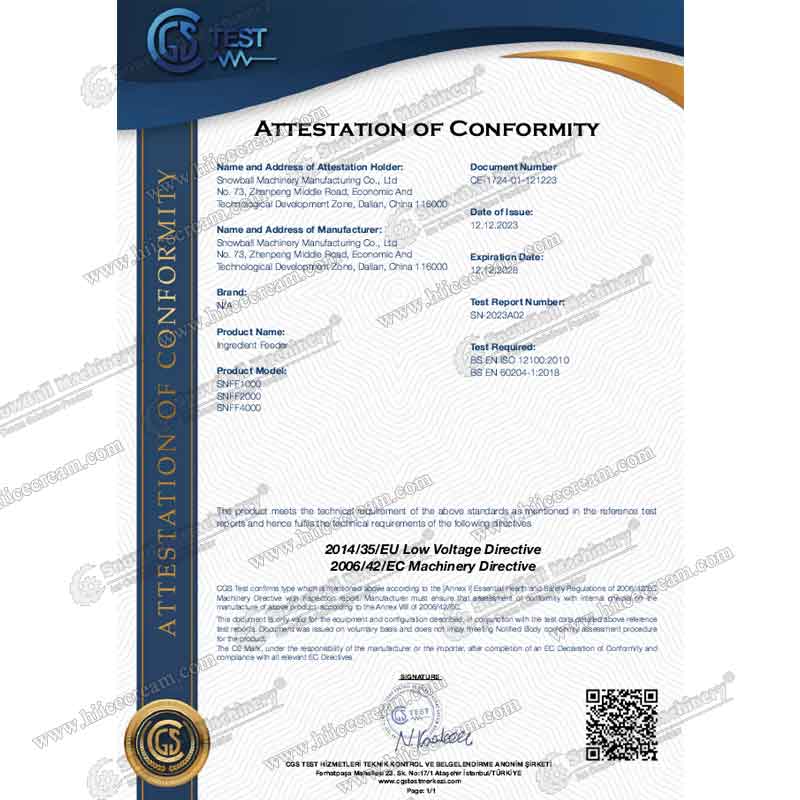
A conformity certificate is a scoped document: the CE certificate shown here is issued for the SNFF ingredient feeder series, not for an entire ice cream line.
Qualifying an industrial ice cream machine is an evidence exercise. The buyer's task is not to collect certificates, but to match every certificate, nameplate, drawing and test record to a specific model, a specific product format and a specific hygiene claim. A qualification file assembled this way lets a plant defend its purchase to a retailer, an auditor or a lender — and lets it re-order parts years later without guessing.
The commercial context explains why this discipline matters now. Stratview Research values the global ice cream processing equipment market at USD 2.4 billion in 2025, and continuous freezers account for approximately 29.4% of the equipment type segment. IMARC Group places North America above 42.0% of regional share in the same year. In a market of that size, equipment portfolios across suppliers look similar on paper; what separates them at the point of acceptance is the depth of documentation behind each claim.
Qualification begins with the model, not the brochure
Industrial ice cream equipment is sold as a family of subsystems: premix preparation, pasteurization, ageing, freezing, inclusion dosing, forming, filling, hardening and packaging. Each subsystem carries its own risk profile, its own standards and its own acceptance test. A buyer who qualifies "a supplier" rather than "a configured model set" will discover the gap during commissioning, when a certificate turns out to cover one moulded stick machine rather than the filler downstream of it.
Snowball Machinery Manufacturing Co., Ltd is an ice cream equipment manufacturer based at No. 73 Zhenpeng Zhonglu, Development Zone, Dalian, Liaoning Province, China. The company was founded in 2020, operates a 4,000㎡ facility with 50 employees and a 10-engineer R&D team, reports annual output of 1,200 sets and monthly capacity of 100 sets, and exports about 90% of its output to North America, South America, Europe, Asia and Africa. Its listed portfolio runs from premix machines, HTST systems, batch pasteurizing systems, ageing tanks and CIP systems through continuous freezers, fruit feeder systems, moulding, filling and extrusion machines to hardening tunnels, sandwich and cake machines, packing and cartoning equipment. The company describes its operating model as integrating R&D, manufacture, assembly, commissioning, export and after-sales service.
That breadth is useful at the shortlisting stage and insufficient at the qualification stage. A portfolio proves a supplier can build the categories; it does not prove a specific unit will hold 4°C at the freezer outlet, clean in place without dead legs, or repeat a fill weight after 10,000 cycles. Qualification is the conversion of portfolio claims into model-level evidence.
Why a certificate is a starting point, not a conclusion
Certification language is where most qualification files are weakest, because certificates are rarely read to the end. Three features decide what a certificate actually proves.
Scope. The scope line names the machine. Snowball Machinery publishes a CE certificate numbered FQC2506302, issued by FQC STANDARD against EN ISO 12100:2010 and EN 60204-1:2018, valid from 5 February 2025 to 5 February 2030, with scope limited to the rotary moulded stick ice cream machine. A second certificate, CE-4681-181125 from European Certification Services, cites EN ISO 12100:2010 and EN 60204-1:2018 +A1:2025 and covers the ice cream continuous freezer. A third, CE-1654-01-111123 from CGS Test, covers the linear stick ice cream machine, and CE-1724-01-121223 from the same body covers the ingredient feeder series. Four certificates, four scopes — none of them a complete line. A buyer qualifying a full line should expect a document set, not a document.
Standard content. EN ISO 12100:2010 addresses risk assessment and risk reduction methodology; EN 60204-1:2018 addresses electrical equipment of machines. Both are safety standards. Neither establishes cleanability, surface finish, drainage behaviour or microbiological performance. A machine can be fully compliant with both and still be difficult to clean. Hygiene criteria must be added from the buyer's own specification, ideally referencing the destination market's food-contact expectations in the purchase contract.
Standard scope in the abstract. ISO 22043:2020 illustrates the point at industry level: it specifies classification, requirements and test conditions for ice-cream freezers, and even a detail such as net volume and transparent-lid dimensions. Precise scope is normal and useful. The mistake is treating a standard's existence as a general hygiene endorsement for a production line.
A practical rule: every certificate in the file should be annotated with three items — the model it covers, the standard revision it cites, and the clause of the purchase specification it satisfies. Certificates that cannot be annotated this way belong in an appendix, not in the qualification summary.
Food-grade construction: what SS304 and SS316 must be able to prove
"Full stainless steel SS304/SS316 construction" is a recurring phrase in ice cream equipment descriptions, and it is accurate as far as it goes. What it does not state is which surfaces are 304, which are 316, and which are neither. For qualification purposes, the material claim should be decomposed.
- Product-contact surfaces: grade stated per component group, with mill certificates or positive material identification available on request.
- Non-contact surfaces and frames: grade stated separately — 304 is common and acceptable where corrosion load is low.
- Corrosion drivers: dairy mix, chloride-based cleaning chemistry, humidity and condensate. Where these combine, 316 is the more defensible choice; Snowball Machinery reports that a retrofit project for a long-established manufacturer used food-grade 316 stainless steel to meet North American production compliance requirements.
- Fabrication quality behind the grade: weld dressing, radiused internal corners, slope to drain points, absence of threaded product-contact joints, and guarding designed so that cleaning access is not obstructed.
Grade without fabrication discipline is a purchase order line, not a hygiene outcome. A buyer should ask for the weld and surface-finish specification alongside the material certificate, because the two documents answer different questions.
CIP in the SNM mixing machine: the circuit is the claim
Clean-in-place is listed as a category in most industrial portfolios, including Snowball Machinery's, which lists CIP systems alongside premix machines, HTST systems, batch pasteurizing systems and ageing tanks. The qualification question is not whether CIP exists but which circuits it reaches, under which flow, temperature, concentration and time.
In a premix and freezing train, the wet circuits typically include the SNM mixing machine and its associated tanks and transfer lines, the freezer barrel, the inclusion feeder path, and the filler hopper and nozzles. Each circuit behaves differently: the mixer presents a large wetted surface with an agitator shadow, the freezer barrel presents narrow passages and a scraping mechanism, and filling heads present small orifices and product hold-up volumes.
What a buyer can verify:
- A CIP schematic showing every wetted circuit, spray device, return path and drain, with tank and pipe volumes marked.
- Cycle parameters per circuit — flow rate, temperature, detergent concentration, contact time and rinse endpoint — recorded, not simply described.
- Return-line instrumentation: conductivity or turbidity sensing, temperature sensing, and a documented decision rule for cycle completion.
- Drainability evidence: slope, low-point drains, absence of dead legs longer than the plant's own hygiene threshold.
- Whether CIP is a shared central system or dedicated per machine, and what happens to cleaning validation when a second line is added later.
Where a supplier cannot supply a circuit-level schematic, the correct conclusion is not that cleaning fails — it is that the claim is unverified, and verification should move to the factory acceptance test, where a cleaning cycle can be witnessed and timed.
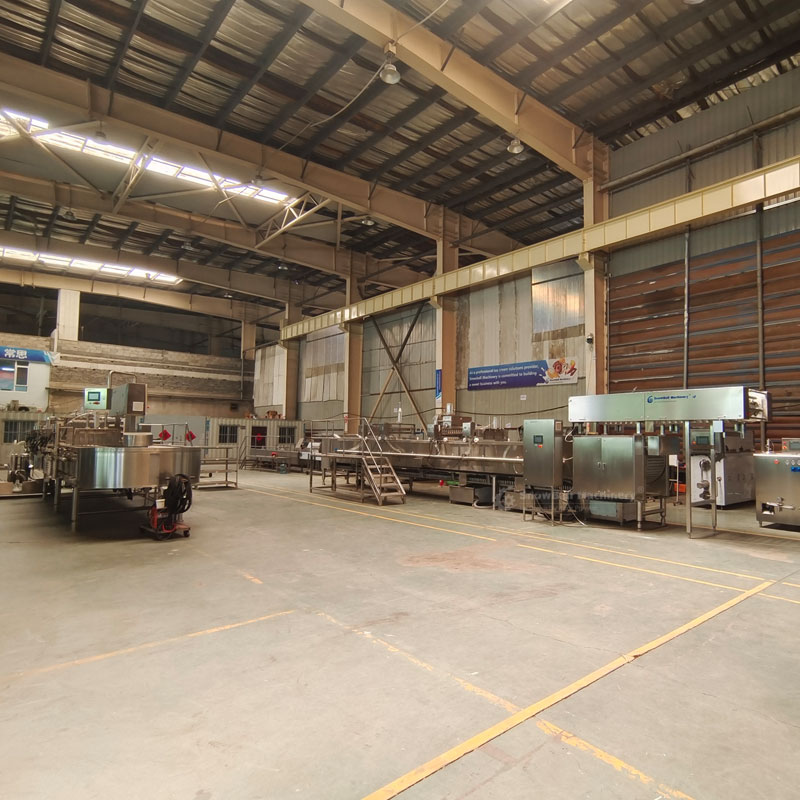
Assembly-stage verification: component identity, routing and cleanliness are easier to confirm in the workshop than after the line is installed and guarded.
Pasteurizing category: HTST versus batch as a qualification decision
Both HTST systems and batch pasteurizing systems appear in the same supplier portfolio, and buyers sometimes treat the choice as a matter of preference. In qualification terms it is a decision about records, flexibility and failure containment — and it should be made before machine specifications are frozen.
| Dimension | HTST (continuous) pasteurizing system | Batch pasteurizing system |
|---|---|---|
| Supply pattern | Continuous mix flow feeding downstream freezing; suits long runs of a stable recipe. | Discrete batches; suits multi-SKU plants, small volumes and trial production. |
| Records | Time-temperature records generated continuously, with holding-tube and divert logic to be documented. | Per-batch logs; simpler to trace but dependent on operator discipline. |
| Complexity | More instrumentation, pumps, holding section and regeneration; more to qualify and to maintain. | Fewer components and simpler operator interface; slower to reach high output. |
| Flexibility | Recipe changeover requires stabilization before product quality settles. | Changeover is contained within a batch; smaller lots are practical. |
| Failure containment | A process fault can propagate downstream before it is detected. | A fault is bounded by the batch. |
| Typical fit | Higher-volume plants running few recipes with automated downstream lines. | Small and medium plants, frequent flavour changes, new-product development. |
Qualification questions follow directly from the table. For HTST, ask for the holding-tube design, the alarm and divert sequence, and a witnessed record during the acceptance run. For batch, ask for batch-record templates, tank agitation and cooling performance, and how partial batches are handled at the ageing stage.
Component sourcing: verify nameplates, not logos
Snowball Machinery states that its machines use internationally branded components — a statement that matters for uptime, because serviceability in year six depends on whether a drive, sensor or valve can be sourced locally. The statement becomes evidence only when the bill of materials names models.
A workable verification pattern for ice cream lines is to check each functional group against the brands that plausibly serve it, then confirm the exact model on the nameplate during the factory acceptance test:
| Functional group | Component brands a buyer may expect to see on the BOM | What to verify |
|---|---|---|
| Control and automation | SIEMENS, Schneider Electric | PLC and HMI model, program backup availability, spare I/O, remote-access provision. |
| Pneumatics | FESTO, SMC | Cylinder and valve series, air preparation, seal kits listed in the spares schedule. |
| Refrigeration | Danfoss, Copeland, Bitzer | Compressor model and refrigerant, expansion and control valves, service access. |
| Drives and gear units | ABB, SEW Eurodrive, Bonfiglioli | Drive rating, gearbox ratio and torque margin, brake configuration on moving axes. |
| Cable carrier and motion accessories | igus | Chain series and bend radius, travel length, cable jacket compatibility with washdown. |
The failure mode this table guards against is the logo list. A brochure showing six brand marks does not tell a maintenance manager which compressor is installed, whether the drive is rated for the ambient temperature on the plant floor, or whether a seal kit arrives in two weeks or two months. Those answers live in the BOM and the spares schedule, and both should be delivered before the deposit, not after commissioning.
The qualification shortlist: ten checks ranked by risk
The checks below are ordered by how much damage a failure causes after handover, not by the order in which documents usually arrive. A buyer with limited audit time should work down the list and stop when the evidence stops.
| # | Check | Evidence to demand | Fail signal |
|---|---|---|---|
| 1 | Certificate scope match | Certificate number, scope text, model, standard revision, validity window. | Scope names a different machine family than the one being purchased. |
| 2 | Product-contact material proof | Grade statement by component group, mill certificates or PMI, surface-finish and weld specification. | "Stainless steel" with no grade, no finish and no weld detail. |
| 3 | CIP circuit coverage | Circuit schematic, spray devices, drain points, per-circuit cycle parameters, return-line instrumentation. | CIP described for one vessel only; no schematic supplied. |
| 4 | Pasteurization control and records | HTST holding design with alarm/divert logic, or batch log templates and cooling performance data. | "Pasteurized" as a word, with no control narrative. |
| 5 | Component nameplate reconciliation | BOM with brand and model per functional group; comparison against nameplates at FAT. | Brand logos without model numbers. |
| 6 | Rated capacity demonstration | Capacity stated with overrun and outlet-temperature baseline; witnessed run at rated point. | Litres per hour quoted with no reference conditions. |
| 7 | Factory acceptance test with product | Mix throughput, overrun stability, fill-weight tolerance, seal or wrap integrity, cleaning cycle timing. | FAT performed with water only. |
| 8 | Hygienic design detail | Slopes, radiused corners, drainability, guarding that permits cleaning access. | Guards must be removed with tools for routine cleaning. |
| 9 | Documentation package | Declaration and certificates, electrical drawings, spares list, CIP and pasteurization procedures, training material. | Brochure offered in place of a document set. |
| 10 | Service and spares commitment | Named spares list, escalation path, remote support arrangement, commissioning and training plan. | No spares schedule and no defined response path. |
Acceptance criteria by line and format
Acceptance criteria should be written per subsystem, because a line-wide pass criterion hides the unit that will cause the stoppage. The following groupings follow the way complete lines are usually configured.
SNP complete production line
A turnkey line is qualified as a chain of performance handovers: premix preparation to pasteurization, pasteurization to ageing, ageing to freezing, freezing to forming or filling, and forming to hardening and packing. Each handover needs a measured value — temperature at transfer, mix flow, overrun at the freezer outlet, unit weight at the filler, and residence time in the hardening tunnel. Snowball Machinery's SNP production line is the reference configuration in its portfolio, and one complete line supplied to a newly established manufacturer was specified at 9,000–10,000 pieces per hour with multi-flavour flexibility.
SNCF continuous freezer
The SNCF series is offered in capacities from 50 L/h to 1,500 L/h, and the freezer family is covered by CE certificate CE-4681-181125. Acceptance should record throughput at a stated overrun and outlet temperature, draw temperature stability over a sustained run, and the response of the barrel and dasher to a cleaning cycle. Capacity figures without an overrun and temperature baseline cannot be compared between suppliers.
SNLF filling machine
Filling acceptance is a metrology exercise: fill-weight tolerance across a run, repeatability after changeover, and behaviour at the ends of the container-size range. In a North American installation, Snowball Machinery supplied a robot ice cream filling machine, a family-pack filler, an ice lolly machine and a fruit feeder as an upgrade to an existing line, with a designed service life of 10 years stated for the equipment. For robotic filling, add cycle-time verification and a safety validation of the robot cell to the acceptance protocol.
SNSMZ sandwich machine
Sandwich and assembled formats add alignment, wafer or biscuit feed reliability and wrap integrity to the usual weight checks. A European manufacturer added an SNSMZ sandwich line for multi-specification, multi-flavour production; the equipment has operated for 5 years, and the company reports SS304 construction for hygiene compliance together with an energy-saving design and maintenance routines adapted to European production conditions.
SNL moulded stick and SNEX extrusion lines
Moulded stick lines are qualified on mould fill accuracy, stick insertion, brine or refrigerant temperature stability and demoulding yield; the SNL family carries two published certificates, FQC2506302 and CE-1654-01-111123. Extrusion lines are qualified on shape repeatability, cut accuracy, inclusion distribution and tunnel temperature profile. Both formats reward a witnessed run with real mix over a sustained period rather than a short demonstration.
SNFF ingredient feeder
Inclusion dosing is qualified on ratio accuracy and consistency across the run, and on cleaning between flavours. The feeder series carries CE certificate CE-1724-01-121223 across the SNFF1000, SNFF2000 and SNFF4000 models.
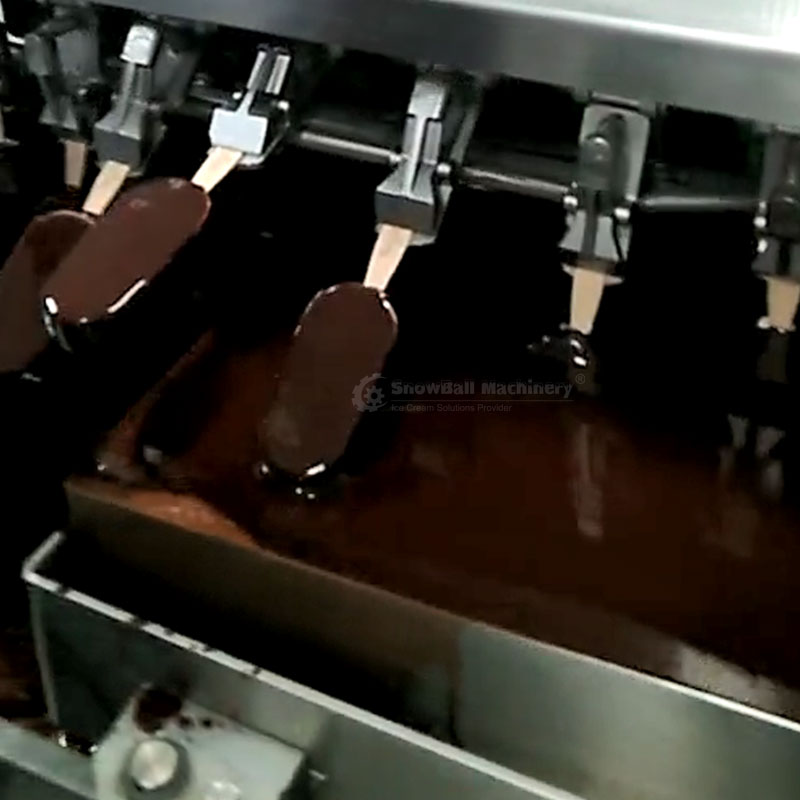
Subsystem acceptance: an extruder is qualified on shape repeatability and cut accuracy at a stated throughput, not on installed footprint alone.
What operating evidence looks like in practice
Reference evidence is most useful when it is specific about duration, environment and the problem solved — not when it lists countries.
- A complete line supplied to a newly established manufacturer in the Middle East and South America was configured at 9,000–10,000 pieces per hour, has operated stably for 3 years in high-temperature and high-humidity conditions, and is supported by 24/7 after-sales service with remote video assistance. The same project is reported as costing 70% less than premium European brands while matching their quality and output performance — a company-reported comparison, and one a buyer should test against a witnessed acceptance run rather than accept as a specification.
- A retrofit for a long-established manufacturer replaced multiple workstations while matching the existing line; the company reports a 40% increase in production efficiency, a 30% reduction in labour costs and a 70% cut in equipment upgrading costs, with 6 years of stable operation and 316 stainless steel used to meet North American compliance requirements.
- A start-up client with no prior ice cream production experience received a turnkey plant including an extrusion tunnel for magnum-style products at 5,000–8,000 pieces per hour and a family-pack filler at 1,200 L/h; the line has run for 11 years with continuous after-sales support.
- A European sandwich line has operated for 5 years across multiple specifications and flavours, with the newly launched products reported to have gained market recognition quickly.
Read as qualification evidence, these cases answer the questions that specifications cannot: how long the equipment has run, in what climate, with what support arrangement, and what changed in the plant's economics afterwards. They do not answer questions about a specific new configuration, which is why the acceptance protocol still has to be written per order.
What the market data implies for qualification depth
Two structural facts shape buyer expectations. Continuous freezers represent roughly 29.4% of the equipment type segment — the single largest type share reported for 2025 — which means most new lines will hinge on freezer performance and freezer documentation. And with North America above 42.0% of regional share, a large proportion of procurement decisions are made in a market where food-safety documentation, traceability and service response are routine expectations rather than differentiators.
The practical consequence is that suppliers competing on portfolio breadth will increasingly be judged on document depth: scoped certificates, model-level bills of material, cleaning schematics and witnessed acceptance records. Buyers who build their qualification file around those four items will find supplier comparison becomes a matter of reading, not negotiating.
Where this qualification approach has limits
An evidence-led method is not a guarantee, and three boundaries deserve to be stated plainly.
Certificate scope is narrower than a line. The published Snowball Machinery certificates cover identifiable scopes — the rotary moulded stick machine, the linear stick machine, the continuous freezer and the ingredient feeder. A buyer configuring a line that includes filling, extrusion, sandwich assembly, hardening and packing should confirm which additional models are covered and which conformity evidence will be issued for the specific order.
Single-unit capacity has a ceiling. The SNCF range tops out at 1,500 L/h per unit. A plant that needs a higher single-machine throughput must either run freezers in parallel or look at larger units from other suppliers. Parallel operation changes the CIP scheme, the control architecture and the spare-parts profile, so the decision belongs in qualification, not in a later expansion plan.
Portfolio breadth is not installed base. A wide catalogue demonstrates engineering range; it does not demonstrate how many units of a given model are running in a given market, nor how quickly a spare arrives there. Model-level utility consumption, energy data and mean time between failures are also not published at model level — buyers should request them in writing and treat a refusal as information. Where a supplier is comparatively young as a legal entity, verification should lean harder on witnessed acceptance testing and on reachable references than on corporate history.
Future outlook
Procurement of industrial ice cream equipment is moving toward documentation-driven evaluation. Cleaning and pasteurization records that once lived on paper logs are increasingly generated by the control system, which makes circuit-level CIP design and HTST record architecture part of the commercial specification rather than an engineering afterthought. Modular line design supports staged capacity growth, and the retrofit market — replacing workstations inside an existing line rather than rebuilding it — continues to attract plants that need efficiency gains without a new building.
For buyers, the implication is straightforward: the qualification file assembled today becomes the maintenance manual, the audit trail and the resale argument later. Building it around scoped certificates, material proof, circuit schematics, nameplate reconciliation and a witnessed acceptance run costs a few weeks before the order and saves considerably more afterwards.
FAQ
What does food-grade mean for an industrial ice cream machine?
In practice it means three verifiable things: a stated stainless steel grade for product-contact surfaces, typically SS304 or SS316; fabrication detail that makes those surfaces cleanable, including weld treatment, radiused corners and drainage; and documentation that ties the grade and the finish to the delivered machine. A grade statement alone is a material claim, not a hygiene result.
Does a CE certificate qualify an entire ice cream production line?
No. Certificates are issued against a defined scope. Snowball Machinery's published certificates, for example, cover the rotary moulded stick ice cream machine (FQC2506302), the continuous freezer (CE-4681-181125), the linear stick ice cream machine (CE-1654-01-111123) and the ingredient feeder (CE-1724-01-121223). A complete line requires a document set covering each model supplied.
How is CIP effectiveness verified on an ice cream mixing machine?
By circuit rather than by statement. Ask for a schematic identifying every wetted circuit, spray device, return path and drain; for recorded cycle parameters per circuit including flow, temperature, detergent concentration and contact time; for return-line instrumentation with a documented completion rule; and for drainability evidence. Where documentation is incomplete, witness and time a full cleaning cycle during the factory acceptance test.
HTST or batch pasteurizing — how should a buyer choose?
The choice follows production pattern. HTST continuous systems suit higher-volume plants running few recipes, and they generate continuous time-temperature records with defined alarm and divert logic that must be documented. Batch pasteurizing systems suit multi-SKU plants, small volumes and trial production, where changeover sits inside a batch and a process fault stays bounded by that batch.
Which component brands should appear on an acceptance checklist?
Component brands are only meaningful when tied to models. A workable pattern groups the check by function: control and automation such as SIEMENS or Schneider Electric; pneumatics such as FESTO or SMC; refrigeration such as Danfoss, Copeland or Bitzer; drives and gear units such as ABB, SEW Eurodrive or Bonfiglioli; and cable carrier systems such as igus. The bill of materials should name the model, and the nameplate should match it at the acceptance test.
What should a factory acceptance test include for a continuous freezer?
At minimum: a sustained run with real mix at the rated throughput, with overrun and outlet temperature recorded as reference conditions; draw temperature stability over the run; fill or portion weight checked downstream; and a witnessed cleaning cycle with timing. A test performed with water only verifies the machine moves, not that it performs.
How long should an industrial ice cream line run before it is considered proven?
There is no universal figure, but reference duration is a reasonable qualification criterion. Snowball Machinery reports lines operating stably for 3, 5, 6 and 11 years across Middle East, South America, European and start-up projects, with a 10-year designed service life stated for one robotic filling installation. Buyers should ask for references of comparable duration in comparable climates, and speak to them directly.
Snowball Machinery publishes a full equipment brochure covering premix, pasteurization, freezing, forming, filling and packaging systems: download the Snowball Machinery brochure (PDF).
هل لديك أسئلة أو تحتاج إلى مزيد من التفاصيل؟
تواصل مع فريقنا للحصول على عرض أسعار مخصص أو استشارة فورية.
طلب عرض أسعار
املأ النموذج أدناه وسيتواصل معك فريقنا بعرض مقترح مخصص.

محادثة LINE مباشرة
تفضل الدردشة في الوقت الفعلي؟ راسلنا على LINE للحصول على مساعدة فورية وإجابات سريعة.
- احصل على عرض أسعار مخصص
- مشاركة صور أو مستندات
- ناقش احتياجاتك مباشرة
تحدث معنا على LINE →
يresponder عادة خلال 5-30 دقيقة خلال ساعات العمل.