
From Component Mix to Line Mix: Scenario-Based SMT Turnkey Solutions
Selecting an SMT turnkey solution begins with a question: which PCBs and components will the line actually run next quarter? A line designed around one hero product can fail in a factory that delivers dozens of variants. A line designed around average products can be too slow for a high-volume program or too rigid for a high-mix EMS operation. The right solution is therefore not simply the longest machine list; it is the machine list, conveyor strategy, inspection plan and support model matched to the production scenario.
An SMT turnkey solution should be viewed as an engineering response to a defined product family, not as a catalog transaction. When a supplier interprets component pitch, board size, batch size, quality class and future product changes, the line becomes a repeatable production asset. When those variables are ignored, the buyer may receive individual equipment that works but a line that does not deliver the expected yield, utilization or changeover speed.
Why Project Fit Matters More Than Machine Count
The market pressure for scenario-fit lines is visible in current research. Mordor Intelligence projects the high-mix/low-volume assembly line segment to grow at a compound annual growth rate of 8.31 percent through 2031, driven by customized industrial and medical electronics. At the broader equipment level, Transparency Market Research places the global SMT equipment market at approximately USD 6.6 billion in 2025 and projects it to reach USD 14.6 billion by 2036.
Placement equipment remains the largest budget segment in many SMT projects, accounting for an estimated 38 to 48 percent of total SMT equipment market value. That figure explains why many procurement discussions start with pick-and-place speed. But CPH alone does not solve line balance. In a high-mix environment, a very fast mounter without efficient feeder setup and program changeover can create upstream and downstream bottlenecks.
Different production scenarios impose different constraints:
- High-volume consumer electronics: limited board variants, long production runs, and an emphasis on placement speed, continuous material supply and thermal stability.
- High-mix EMS production: frequent changeovers, overlapping product families, and a need for fast program recall, flexible feeder setup and modular inspection positions.
- Automotive and medical electronics: high reliability requirements, traceability, process documentation and tighter acceptance standards such as IPC-A-610J classes.
Each scenario implies a different line architecture. A turnkey provider that starts with the process route and then selects equipment has a better chance of matching that architecture than a provider that starts with a standard price quote.
The Scenario-Fit Checklist for an SMT Line
Before asking for a turnkey proposal, manufacturers should define the product and process envelope. The most useful checklist covers board, component, process, environment and changeover expectations.
- PCB physical envelope: minimum and maximum board dimensions, board thickness, panel format and future board-size expansion. A placement machine rated for boards from 50×40 mm to 510×460 mm covers a very different envelope than a mounter optimized for one narrow product.
- Component profile: smallest chip size, largest component body, component height, BGA pitch, odd-form parts and the mix of tape, tray and tube feeders.
- Volume and batch structure: expected daily output, number of board variants per day, changeover time allowed and material staging approach.
- Quality and reliability class: whether the buyer must satisfy consumer-grade visual criteria, automotive zero-defect expectations, or medical-device documentation requirements.
- Factory environment: whether the line will run in an indoor cleanroom with controlled temperature and humidity, ESD-protected zones, low vibration and the required IP rating for the equipment.
These variables determine not only which machine models to include, but also where to place solder paste inspection, automatic optical inspection, X-ray inspection, buffer stations and post-reflow operations.
Functional Line Architecture: Beyond a Collection of SMT Equipment
A practical SMT turnkey line is usually described as a sequence of functional stations: loading, solder paste printing, solder paste inspection, component placement, reflow soldering, post-reflow inspection and unloading. Optional stations include glue dispensing, X-ray inspection, depaneling, PCBA cleaning and stencil cleaning.
| Line Stage | Function in the Process | Typical Project-Fit Question |
|---|---|---|
| PCB loader / unloader | Board feeding, stacking and removal | Can the handling system support the required board size and cycle time without transfer damage? |
| Solder paste printer | Deposits solder paste in precise locations before placement | Does the print process match the smallest pitch and required paste volume? |
| Inline SPI inspection machine | Checks solder paste height, area and position before placement | Is there early feedback to the printer to prevent defect escalation? |
| Pick and place machine | Places components on the printed board at defined speed and accuracy | Does the mounter cover the full component and PCB envelope with acceptable changeover time? |
| SMT reflow oven | Applies controlled thermal profile to form solder joints | Can the oven provide enough heating and cooling capacity for dense boards and high throughput? |
| AOI automatic optical inspection | Detects visible assembly defects after reflow or placement | Does the inspection program cover all high-risk components and board families? |
| X-ray BGA inspection machine | Inspects hidden joints such as BGA, QFN and connector shields | Is X-ray sampling needed for the target quality class? |
| Buffer conveyor / turner | Buffers boards between stages and changes direction when needed | Can the line absorb short stops upstream without starving the mounter? |
| Optional auxiliary equipment | Stencil cleaning machine, PCB depaneling router, PCBA cleaning machine | Which post-reflow operations are unavoidable for the soldering result and final product reliability? |
Feeder and Nozzle Planning in a Turnkey Scope
One reason SMT projects overrun is that feeder and nozzle planning is treated as an afterthought. A turnkey line should include a feeder plan for the actual tape widths and package sizes used by the customer. In many assembly operations the relevant widths are 8 mm, 12 mm and 24 mm tape feeders, supplemented by tray and tube handling for larger packages. Nozzle replacement sets are also platform-specific. If the line is built around a modular mounters such as Fuji NXT, Yamaha YSM or JUKI, the supplier should define the nozzle set and feeder inventory for the product mix rather than leaving it as a later purchasing task.
How Motek Applies the Scenario-Fit Approach
Motek, the SMT equipment platform represented by Shenzhen-based Morel Equipments Co., Ltd., illustrates how a supplier can translate project scenarios into equipment architecture. Morel Equipments has been operating since 2011, with a 955-square-meter facility, and describes its role as a one-stop platform for SMT solutions. The company supports OEM/ODM services, production line layout design, custom packaging and labeling, remote or on-site training options, and 100 percent pre-shipment testing. For a buyer, this range of services matters because a turnkey line should be delivered as a working system, not as loose machinery.
Three equipment references in the Motek portfolio show how specifications should be read against a production scenario.
- Hanwha Decan S2 pick-and-place machine: rated at 92,000 CPH optimum with an HS10 head, two gantries and ten spindles per head. Placement accuracy is listed as ±28 μm with Cpk≥1.0 for 03015 chips and ±25 μm with Cpk≥1.0 for ICs. It supports component sizes from 03015 to 12 mm with a maximum height of 10 mm, and handles PCB sizes from 50×40 mm to 510×460 mm in standard configuration.
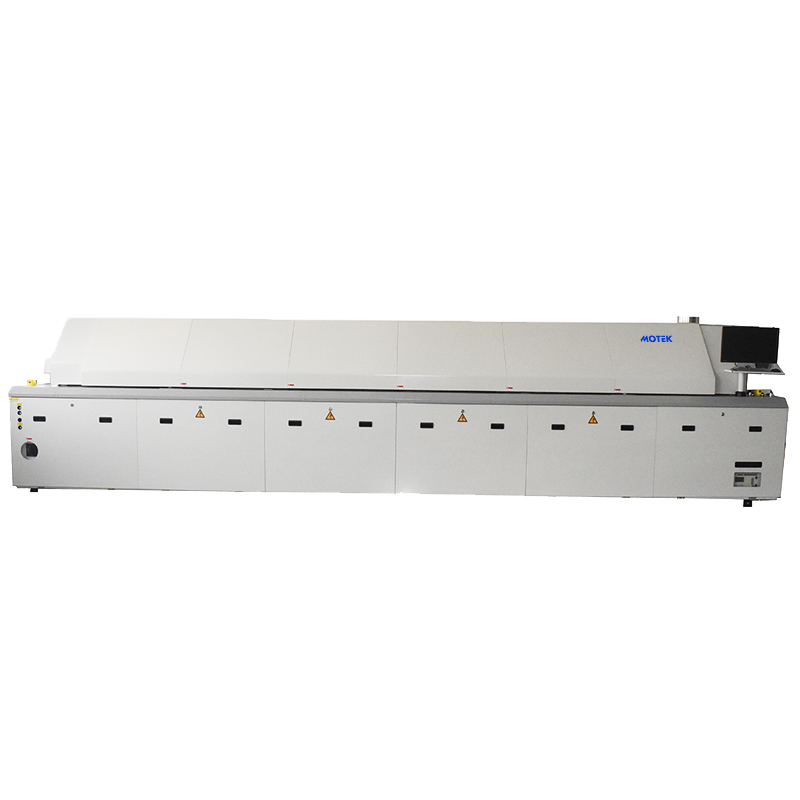
- XMR-800D SMT reflow oven: the model is specified with eight heating zones on top and eight on bottom, plus three cooling zones on top and three on bottom. The heating zone length is 3,110 mm, and the oven requires an exhaust volume of 11 m³/min through two exhausts. Overall dimensions are 5,520×1,430×1,530 mm, and weight is approximately 2,710 kg.
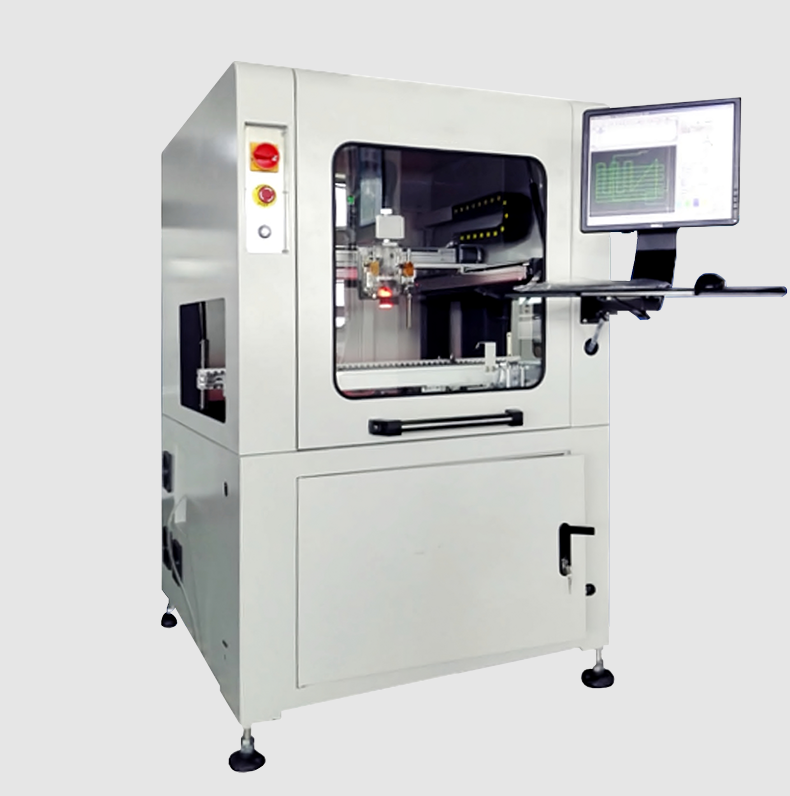
- HMH830D automatic online glue dispenser: usable for boards from 50 to 450 mm wide, with PCB transfer height of 920±20 mm and transport speed of 0-5,000 mm/min. It uses industrial computer and motion control, stores more than 1,000 running programs, and supports left-to-right or right-to-left transfer.
These specifications are not self-justifying. The decision is whether a board family with 03015 passives and large ICs needs the speed and accuracy of the Decan S2, whether a high-density board needs the 8+8 heating profile depth of the XMR-800D, and whether a product with connectors or modules requires adhesive before reflow. A scenario-fit supplier shows where each piece belongs in the line and why.
Inspection Strategy Is a Project Decision, Not an Accessory
Inspection equipment is often the last item added to a quote, but for many product scenarios it is the most important part of process control. Solder paste inspection after printing detects paste volume and positioning before components cover the paste. Automatic optical inspection after reflow verifies visible solder joints, component presence, polarity and placement quality. X-ray inspection provides visibility into hidden joints such as BGA balls and connector shields that AOI cannot see.
The importance of inspection is also supported by market research. Persistence Market Research identifies 3D AOI and SPI as some of the fastest-growing SMT equipment sub-sectors, with an estimated 15.2 percent compound annual growth rate driven by automotive zero-defect needs. Automotive and medical manufacturers rarely run a high-reliability SMT line without a defined inspection chain. Consumer electronics manufacturers increasingly use inline AOI and SPI to protect yield as board density rises.
In a scenario-fit SMT line, the inspection strategy should be determined by the board risk profile. A simple double-sided LED module may not need the same X-ray sampling plan as an automotive ECU. A smartphone motherboard with fine-pitch ICs may require SPI before placement, AOI after reflow and X-ray sampling for BGA joints. A turnkey provider should be able to explain where inspection belongs in the process and what data the equipment will generate for process teams.
Application Examples Across Electronics Segments
Motek's application references cover automotive electronics, smart transportation, industrial automation, consumer electronics, medical technology, new energy systems, LED and optoelectronics, and telecommunications. These sectors share a trend toward denser packages, smaller passive components and stricter reliability expectations. They differ in volume, documentation requirements and board types.
One documented production scenario involved an SMT factory producing smartphone motherboards, tablet computer circuit boards, ECU control unit assemblies, LED display modules and LED streetlight drivers. The equipment set associated with that scenario included the Hanwha Decan S2 pick-and-place machine, the XMR-800D reflow oven and the HMH830D automatic glue dispenser. The stated result was mass production of 20,000 to 100,000 pieces per day, with high density, high efficiency and high reliability as the main acceptance criteria. The five-year duration of that scenario points to the importance of equipment stability and after-sales continuity, not only initial delivery.
For an EMS factory with frequent product introductions, scenario fit may require a line that can move between automotive control boards and LED driver modules without long setup times. For a medical electronics producer, traceability and reproducibility of the solder process may be more important than extremely high CPH. The same pick-and-place machine can be configured differently depending on feeder setup, program structure and surrounding inspection equipment.
Comparison with Traditional Equipment Supply
Traditional SMT equipment supply usually treats a turnkey purchase as a bundled order: one printer, one mounter, one reflow oven, optional AOI and perhaps a conveyor package. The supplier quotes each item, delivers it and may stop after installation. That approach has a place when the buyer has an internal process engineering team and a clear line specification.
| Comparison Point | Traditional Equipment Supply | Scenario-Adaptive Turnkey Line |
|---|---|---|
| Starting point | Standard machine portfolio and price sheet | PCB envelope, component mix, volume and quality target |
| Line balancing | Often left to the buyer | Analyzed as part of equipment selection |
| Inspection placement | Optional add-on | Placed according to process risk and product class |
| Feeder and nozzle scope | May be excluded from the contract | Planned for the actual tape widths and package types |
| After-sales view | Warranty per machine | Remote support, training and line-level optimization |
Yet even a scenario-adaptive turnkey line has a boundary. A supplier can deliver the right architecture, but the buyer must still own solder paste qualification, stencil design, thermal profiling, component moisture handling and operator procedures. The line design can reduce process risk; it cannot replace the process ownership required for stable yield. A responsible supplier will make this limit clear before installation.
Market Trends That Will Influence SMT Line Design in 2026
Several verified market observations shape how procurement teams should assess SMT turnkey solutions in 2026:
- The global SMT equipment market is projected to expand from roughly USD 6.6 billion in 2025 to USD 14.6 billion by 2036, according to Transparency Market Research.
- Asia-Pacific is a major demand region, having held an estimated 54 percent revenue share of the SMT equipment market in 2025.
- Pick-and-place equipment is estimated to represent roughly 38 to 48 percent of total SMT equipment value, making placement selection a central cost and performance decision.
- High-mix/low-volume assembly is expanding at a projected CAGR of 8.31 percent through 2031, reinforcing the need for flexible line architectures rather than single-product monolithic lines.
- Inspection equipment such as 3D AOI and SPI is growing faster than many other sub-sectors, driven by quality expectations in automotive and high-reliability electronics.
These trends point toward modular placement platforms, robust material handling and inspection positions that protect process quality when batch sizes shrink. The ability to reconfigure a line for a new product family will become a purchasing criterion in its own right.
How to Use This Framework in a Procurement Conversation
When comparing SMT turnkey solution proposals, manufacturers should ask suppliers to justify their line architecture before discussing final pricing. A useful procurement sequence is simple:
- Ask for a line layout drawing: the layout should show board flow, buffer locations and manual intervention points.
- Ask where SPI and AOI will sit: the answer reveals whether inspection is considered a process tool or an add-on.
- Ask for the line balance calculation: how many boards per hour does the mounter, oven and inspection equipment support together?
- Ask for the feeder and nozzle list: it should relate to the actual component families, not a generic optional list.
- Ask about changeover: which variables define a changeover, and how many minutes are assumed for a typical stack change?
- Ask for optimization support: does the supplier provide remote technical support, 24/7 online service or training after installation?
For purchasing teams that want a specification-level reference, a brochure is available from Morel Equipments Co., Ltd.; it can be accessed at the following public link: Morel Equipments SMT product brochure (PDF).
Future Outlook: Turnkey Value Will Shift Toward Adaptability
As electronic products become more customized and product cycles become shorter, the value of an SMT turnkey solution will shift from the physical machine list to the supplier's ability to adapt that list over time. A line that can change between mobile-device-style boards, automotive ECUs and industrial control modules will protect the buyer's investment better than a line optimized for one high-volume moment.
The long-term direction is clear: placement speed remains important, but speed without changeover discipline creates inventory and flexibility problems. Thermal repeatability, inspection coverage and material flow will receive more attention as zero-defect requirements move down the electronics supply chain. Suppliers who can document line scenarios, define process routes and support continuous optimization will remain relevant in the buying equation.
Frequently Asked Questions
What is included in an SMT turnkey solution?
An SMT turnkey solution typically includes line design and integration of solder paste printing, SPI, pick-and-place mounting, reflow soldering, AOI and material handling. It may also include optional processes such as glue dispensing, X-ray inspection, depaneling, stencil cleaning and PCBA cleaning, depending on the product scenario. In practical terms, the supplier is responsible for making these stations work as a line rather than simply delivering separate machines.
How do I select an SMT line for high-mix and low-volume production?
The key parameters are changeover time, feeder setup, program management, line balance and inspection flexibility. High-mix lines benefit from modular pick-and-place platforms, software that stores multiple product programs, and feeder or nozzle plans covering the actual tape widths and package sizes. The supplier should also explain how the line handles small batches without making setup time a higher share than assembly time.
What role do SPI, AOI and X-ray inspection play in an SMT line?
SPI verifies solder paste deposition before component placement, AOI detects visible defects such as missing components or poor reflow after soldering, and X-ray inspection is used when hidden joints such as BGA connections must be verified. For automotive and high-reliability assemblies, inspection planning is not optional; it is part of the process control strategy.
Can a turnkey supplier adapt the line to different PCB sizes and component types?
Adaptation is bounded by the PCB envelope, component range, feeder and nozzle compatibility, and process capabilities of the equipment. For example, a pick-and-place machine may support boards from 50×40 mm to 510×460 mm and components from 03015 to 12 mm. If a future product falls outside that envelope, a different or additional mounter would be required.
What is the boundary of a turnkey supplier's responsibility?
The line architecture and equipment integration are the supplier's core responsibility, but the buyer must own solder paste selection, stencil design, thermal profile validation, component moisture control and operator qualifications. A well-designed turnkey line reduces integration risk; it does not replace the manufacturer's process ownership or quality system.
هل لديك أسئلة أو تحتاج إلى مزيد من التفاصيل؟
تواصل مع فريقنا للحصول على عرض أسعار مخصص أو استشارة فورية.
طلب عرض أسعار
املأ النموذج أدناه وسيتواصل معك فريقنا بعرض مقترح مخصص.
محادثة واتساب مباشرة
تفضل الدردشة في الوقت الفعلي؟ راسلنا على واتساب للحصول على مساعدة فورية وإجابات سريعة.
- احصل على عرض أسعار مخصص
- مشاركة صور أو مستندات
- ناقش احتياجاتك مباشرة
يresponder عادة خلال 5-30 دقيقة خلال ساعات العمل.