
From Drawing to Batch Certificate: OEM Brass Valve Evidence
From Drawing to Batch Certificate: OEM Brass Valve Evidence
An OEM brass valve order is decided long before the first casting is poured. It is decided at the quotation stage, when a buyer can see how a supplier turns a drawing into a dimensioned specification, how that specification becomes an approved sample, and how the approved sample becomes a production batch that arrives with records attached. Two suppliers quoting a comparable brass ball valve rarely differ on the valve itself. They differ on whether the evidence behind that valve is complete, traceable and agreed in writing.
This article maps that evidence chain as a buyer should read it: engineering and drawing support, sample approval, the four production records, custom and non-standard development, and the commercial parameters that decide whether a supplier is the right fit in the first place.
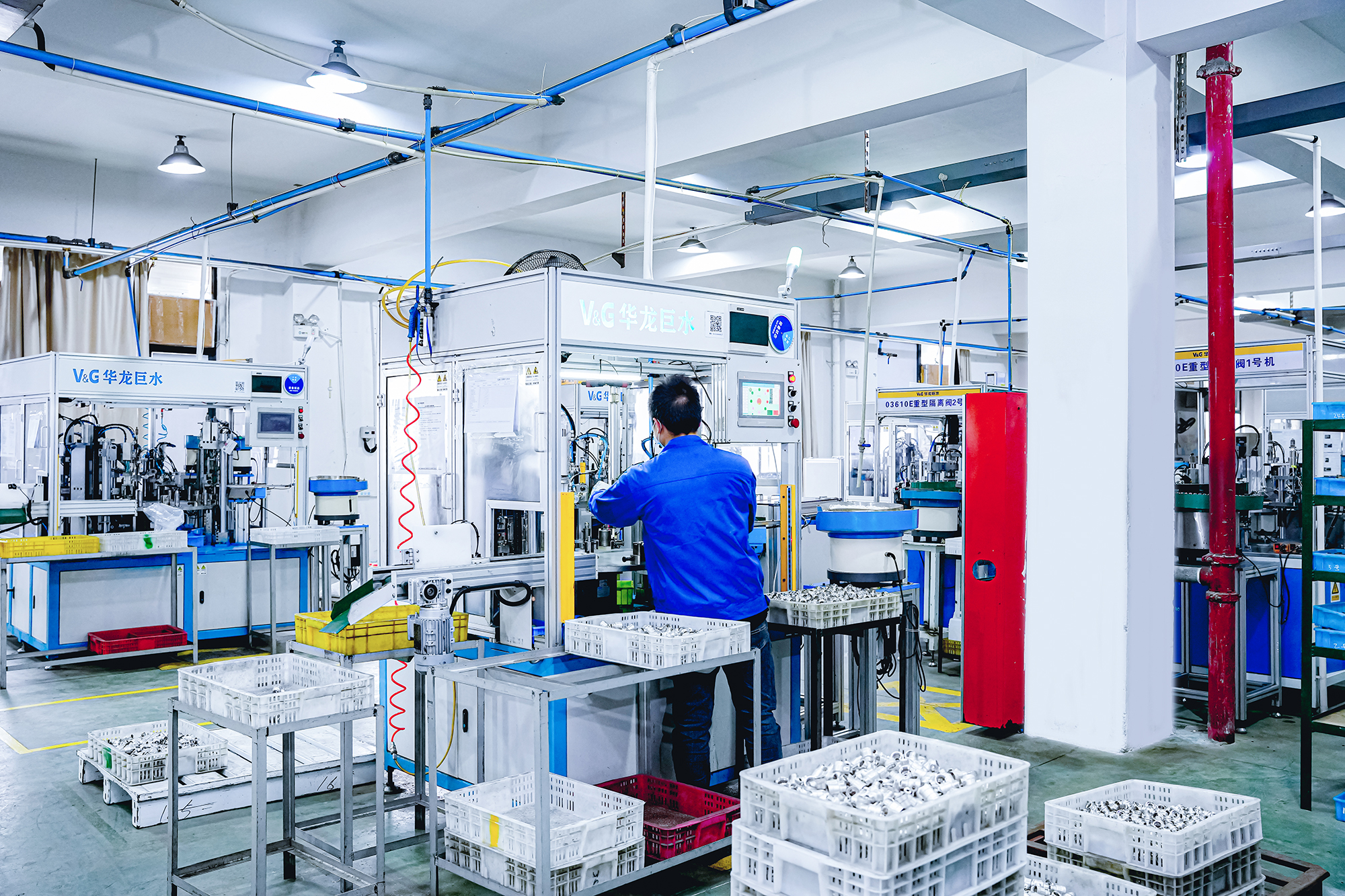
Automatic assembly area for brass ball valves — the point where an approved specification becomes a repeatable production batch.
Why a capability claim needs a documentary test
At quotation stage, every supplier presents the same surface: a unit price, a lead time, a minimum order quantity and a catalogue page. Those numbers answer what the goods will cost and roughly when they will arrive. They do not answer the question that decides a multi-year supply programme: six months from now, when a container arrives, what will prove this batch was built the way the sample was approved?
That question separates two kinds of supplier. One offers a capability statement — tested, certified, experienced. The other offers a chain of records in which each link can be checked against a document, a batch number or a physical sample. For a buyer in evaluation moving toward execution, the second is the only claim that survives an audit, a goods-in inspection or a claim raised eighteen months after delivery.
A practical way to read any supplier's quality page is to ask, for each statement, what document would exist if the statement were true — and then ask to see one from a recent order. A claim that generates no document is a marketing statement, not a capability.
Valogin: an integrated brass valve manufacturer
Valogin (Zhejiang Valogin Technology Co., Ltd.) is a Chinese manufacturer of brass valves, fittings and distribution manifolds for plumbing, heating, refrigeration and gas systems. The company was founded in 1985 and operates a factory of more than 28,000 square metres with over 1,000 employees. More than 90% of turnover comes from international markets, with Europe and North America as key markets and coverage extending to South America, the UAE and more than 100 countries worldwide.
The product range is the component set behind most OEM valve programmes: brass ball valves, gate valves, check valves, stop valves, angle valves, float ball valves, gas ball valves, bibcocks, distribution manifolds and mix valves. Read against a specification, that range covers the isolation, regulation and connection duties found in OEM valve for HVAC systems, radiator and hydronic circuits, OEM valve for heating systems and OEM valve for plumbing systems.
Manufacturing is supported by an in-house technical function of more than 70 designers and engineers, including over 15 full-time R&D engineers working on heating, air-conditioning valve systems and water systems. The laboratory covers approximately 1,025 square metres and was established as a nationally recognised laboratory in accordance with the ISO 17025 standard, equipped with more than 100 sets of testing equipment, including an inverted metallographic microscope and a comprehensive test bench, covering ball valves, water nozzles, temperature control valves and floor heating products. Management systems are certified to ISO 9001, ISO 14001 and ISO 45001, and product approvals include CNAS, CE, DVGW, AGA, WRAS, NSF, cUPC, CSA and AB1953.
Stage one: engineering and drawing support, from quotation to first article
The evidence chain starts earlier than many buyers expect. Valogin's stated support scope runs from quotation to first article, which means the technical conversation happens before the price is fixed rather than after the order is confirmed. This is the stage at which a general request becomes a manufacturable specification, and it is the cheapest stage at which to correct a mistake.
For an OEM brass valve, the drawing review should settle at least the following, and each item should appear on the drawing rather than in an email:
- Thread standard for the destination market. ISO 228 parallel G thread (commonly called BSPP) in Europe, the UK, Asia and most export markets; NPT in North America.
- Material and seal selection matched to the medium — potable water, treated heating water, glycol mixture or gas — and to the brass grade the destination market requires.
- Pressure class and temperature range for the circuit the valve will sit in.
- Flow and torque targets, stated as acceptance values rather than as descriptions.
- Connection layout and port configuration adapted to the customer's installation, including port size and full-port or reduced-port bore.
- Appearance and surface finish — natural brass, nickel-plated or chrome-plated — to the customer's specification.
- Part numbering in the customer's own numbering system, so that traceability survives the handover between supplier and buyer.
Thread specification deserves separate attention because it is the most common drawing error with commercial consequences. ISO 228 defines a parallel thread on which the joint is not made pressure-tight by the thread itself. The connection must seal on a flat face with a gasket, or on an O-ring or bonded seal, which means the drawing has to define the sealing face and not only the thread size. A valve marked G1/2 carries a parallel ISO 228 thread and requires a sealing face on the mating part; tolerance classes A and B exist and should be stated where the fit matters.
The commercial logic is straightforward. A thread standard that is wrong on the drawing is discovered at goods-in, and by then it is a re-machining event or a scrap event, not a drawing revision. For a custom brass valve built to a buyer's own configuration, the drawing is the first quality record in the chain, and it should be dated, versioned and signed by both sides.
Stage two: sample approval is the contractual reference point
Sample approval before mass production is a stated step in Valogin's OEM and ODM workflow, and it should be treated by the buyer as the moment the specification becomes enforceable. The approved sample and its inspection record together set the standard that later batches are checked against; the logo and part number applied to the body and handle, whether cast, stamped or laser-marked, are part of that same approved reference.
The distinction that matters here is between a sample as a physical object and a sample as a specification. A sample on its own is a part that happens to work. A sample accompanied by the inspection record that documents its measured dimensions, its test result and the material used is a comparable standard that can be applied to batch 12 as easily as to batch 1. Buyers should keep the two together and reference both in the purchase order.
Stage three: the four production records
Valogin states its quality control in four parts: 100% air-tight test, dimension sampling per batch, batch inspection records, and material certificates on request. Each covers a different question, and the boundaries between them are where procurement risk usually sits.
100 per cent air-tight testing
Every valve is individually air-tight tested before packing, which means the control is applied to each unit rather than to a sample of the batch. What this establishes is that no leaking unit leaves the plant. What it does not establish, by itself, is the test method, the test pressure and the acceptance criteria — those are engineering decisions that belong in the order, not in a brochure. Where a buyer's specification names a pressure-test standard such as ISO 5208:2015 or EN 12266-1:2012, the method and acceptance criteria should be quoted in the purchase order, because the two standards should not automatically be treated as equivalent: their scope and leakage grade systems need to be checked clause by clause before either is accepted as a substitute for the other.
Dimension sampling per batch
Dimensional control is applied as sampling per production batch. That is a different level of coverage from the air-tight test, and buyers should keep the distinction explicit in their own acceptance documents. Sampling estimates the conformity of a batch; it does not certify every piece. Where a dimension is commercially or functionally critical — bore, thread, face-to-face length, stem diameter — the drawing should name it as a measured characteristic, because a sampling record can only report what the plan asked it to measure.
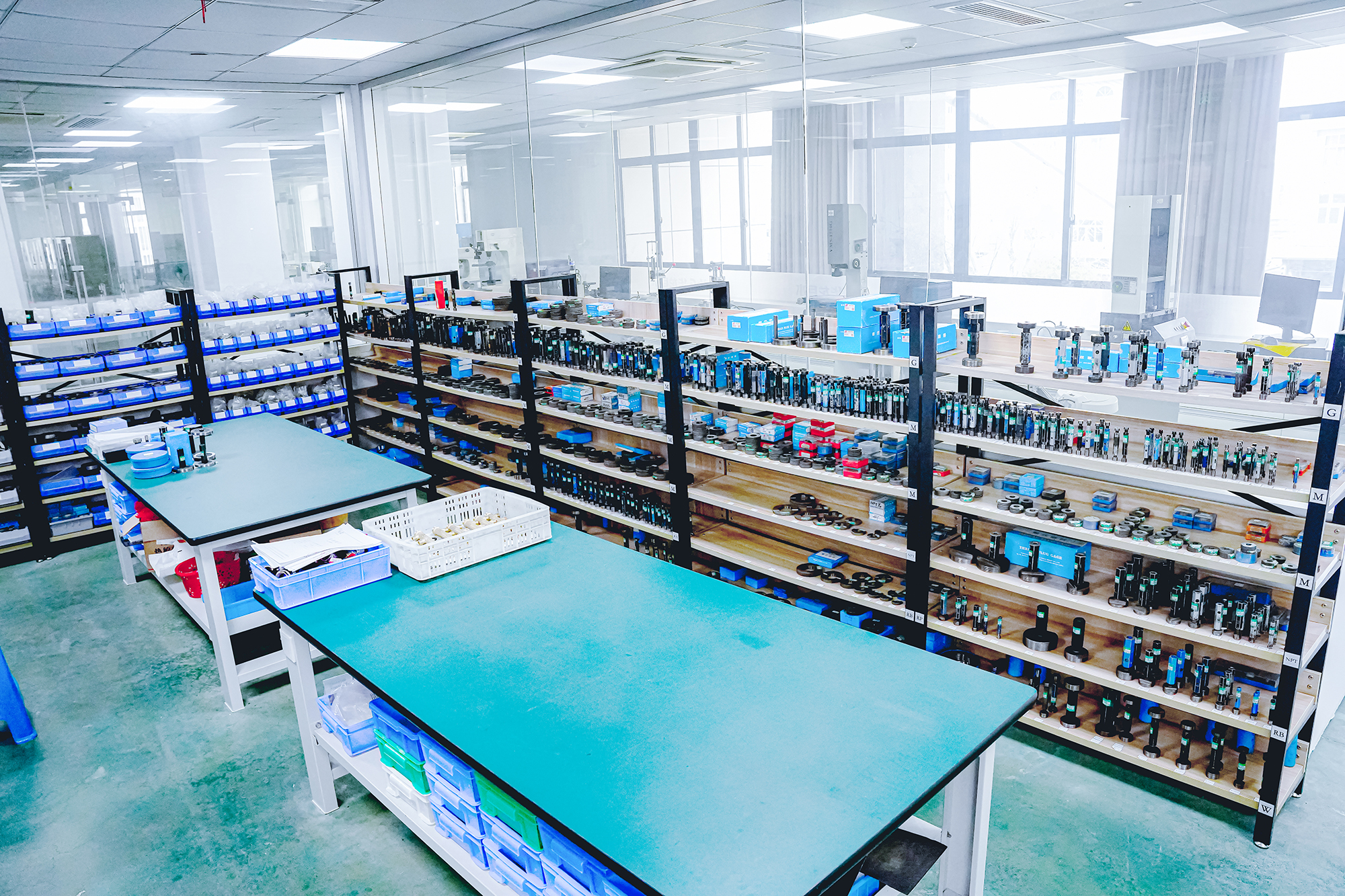
Thread gauge management in the laboratory — dimensional sampling is only as good as the gauges and the characteristics the plan defines.
Batch inspection records
Inspection records are produced per batch and accompany the shipment. This is the document that converts a quality claim into an arguable position: if a batch arrives with a record identifying what was checked and when, a dispute becomes a comparison between the record and the goods rather than a conversation about intentions. Where a batch record is linked to a date code or batch number marked on the product or its packaging, verification can start at goods-in instead of after the first installation.
Material certificates on request
Material certificates are issued on request. The phrase matters: a certificate of the brass actually used in a batch is a document the buyer must specify, not one that arrives automatically. Buyers supplying markets with material-level obligations — European drinking water requirements, North American lead-content rules, or their own declaration of performance — usually need it for their regulatory file, and the safest course is to write the requirement into the supply contract rather than request it case by case.
The evidence map: what each document actually proves
| Stage | Document or record | What it establishes | What it does not establish |
|---|---|---|---|
| Quotation | Dimensioned drawing, thread standard, pressure class, material and seal selection | That the buyer's requirement has been translated into a manufacturable specification | That the design suits the installed system — that remains the buyer's engineering responsibility |
| First article | Approved sample plus its inspection record | The reference standard against which later batches are checked | That every later batch will match it; only the records for those batches do that |
| Every unit | 100% air-tight test | That each valve was individually checked for leakage before packing | The test method, pressure and acceptance criteria, unless these are written into the order |
| Each batch | Dimension sampling record | Dimensional conformity of the sampled pieces against the agreed plan | 100 per cent dimensional inspection — sampling is the stated method |
| Each batch | Batch inspection record | Traceability from the delivered goods back to the checks performed | Field performance, service life or installation quality |
| On request | Material certificate | The composition of the brass used for that batch | Coverage of every shipment, unless it is a contract term |
| Contract | Quality claim handling terms | The agreed route and responsibility when a claim arises | A warranty of fitness for a particular installation |
Stage four: custom and non-standard development
Beyond catalogue configurations, Valogin runs custom and non-standard valve development as production to a customer's own drawing, physical sample or written application requirement, with one-off and low-volume runs handled alongside volume orders. For a brand building its own range, this is the difference between buying a valve and owning a specification.
Adaptation typically covers connection layout and port configuration to suit the customer's installation, thread standard to suit the destination market, material and seal selection matched to the medium, and appearance and surface finish to the customer's specification. Documentation runs alongside: agreed performance targets for flow, torque and pressure class, inspection records against the agreed specification, part numbering in the customer's system, and packaging built for the customer's channel.
Under an OEM or ODM arrangement the brand layer is handled explicitly: customer logo and part number cast, stamped or laser-marked on the body and handle, private-label casting marks, and customer packaging, labels and printed documentation. A confidential handling requirement normally accompanies this — customer drawings, part numbers and the brand relationship should not appear in the supplier's public material.
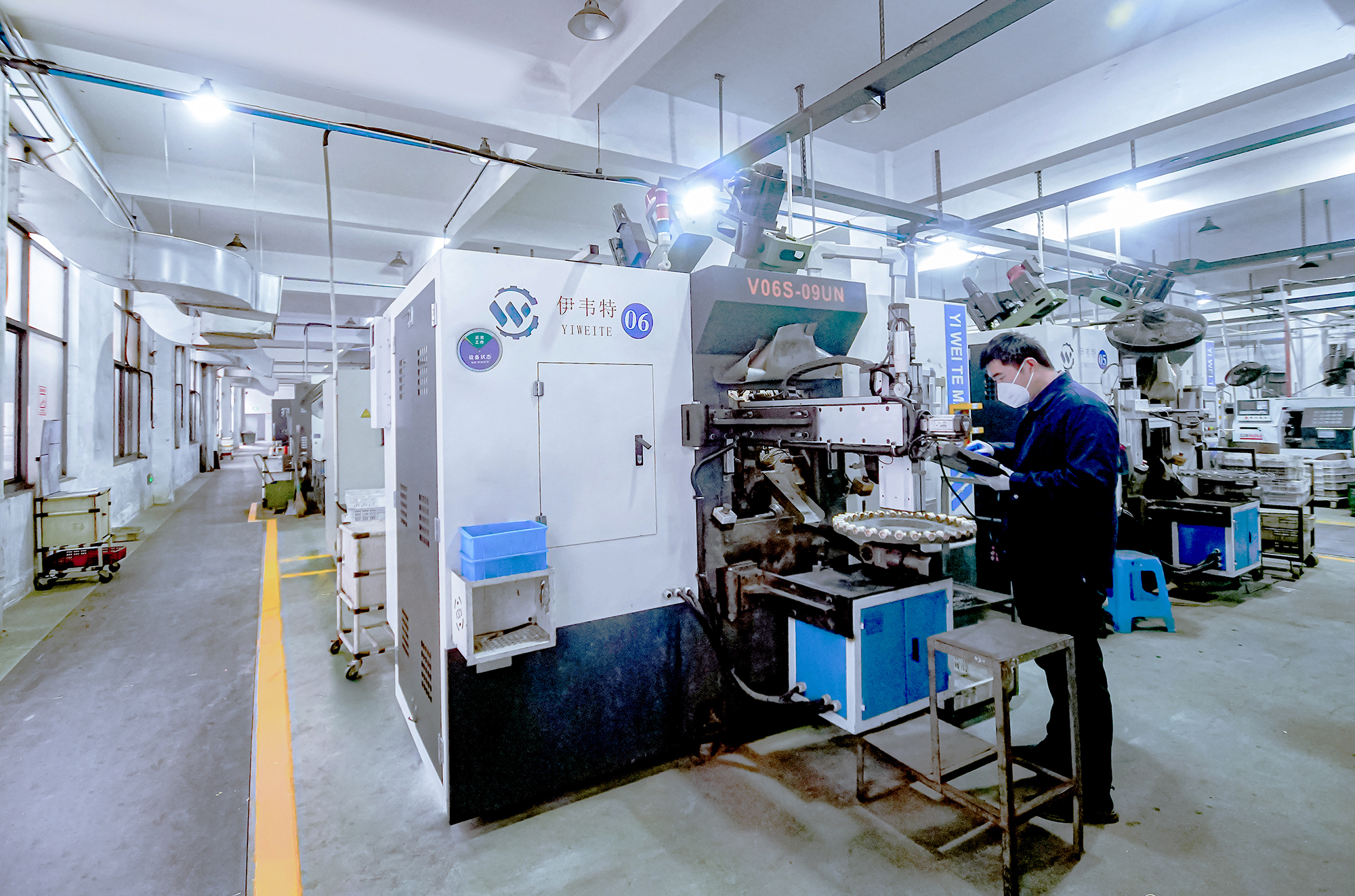
Rotary transfer machining of brass components — custom development is only repeatable when the process behind it is fixed.
MOQ, lead time and capacity: reading the numbers correctly
Three commercial figures frame the whole evidence chain, and each should be read for what it actually says rather than as a general benchmark.
- MOQ of 5,000 units. This defines the smallest stated production quantity. For a buyer validating a new specification, it means design validation at sample stage should be planned as a separate step before the first volume order, rather than attempted inside it.
- Lead time of 50 days. This is the stated production lead time. Buyers working to a launch date or a seasonal window should test it against their own forecast and shipping schedule, and confirm the slot per order, because a stated lead time and a confirmed delivery date are not the same commitment.
- Monthly capacity of 15 million pieces. This indicates the scale of programme the plant is set up to run, and it is relevant when a buyer is consolidating several part numbers or several markets into one supplier. Capacity describes what the plant can produce in a month; it does not reserve any part of it for a specific customer.
How this differs from an assembly-only sourcing model
The most consequential structural difference between supplier models is not price. It is where the material is controlled. In an assembly-only model, castings or components are bought in and the supplier's control begins at assembly; a manufacturer that controls its own casting and machining can state the material grade and verify it per batch. Valogin's own reading of the market is blunt on this point: a factory that only assembles cannot control the material, and material is what fails in service. That is a statement of process logic, not a comparison of named competitors, and buyers should verify it the same way they verify anything else — by asking where the casting comes from and what document proves the grade.
The fit boundary runs the other way as well, and it is worth stating plainly. An integrated plant configured around a 5,000-unit MOQ and a 50-day lead time is built for planned programmes and repeat orders, not for small experimental quantities or short-notice spot requirements. A buyer needing a few hundred units for a trial installation, or a replacement shipment within two weeks, sits outside that configuration. That is a fit question, not a quality question, and it is better raised at quotation stage than discovered at order confirmation.
Where the evidence trail stops
A credible supplier description includes what its records cannot do. Five boundaries are worth keeping in view:
- Records describe production conformity at the point of packing. They do not predict installed service life, which depends on water chemistry, temperature, flow conditions and installation practice.
- The two quality controls are not equivalent in coverage. Air-tight testing is per unit; dimensional control is a sampling plan. A specification that treats them as the same level of assurance is misreading both.
- Material certificates are issued on request. If the certificate is a contractual requirement, it belongs in the supply contract, not in a purchase-order note.
- Approvals are granted per product and per material, not per company. As an example of the precision required, the WRAS product approval on file is certificate 260717304, valid until 31 July 2031; the models and materials it covers should be checked against the specific item being ordered before it is cited in a tender.
- Claim handling follows the contract. Quality claim terms are agreed in the supply contract, and that document — not the catalogue — defines the route when something goes wrong.
Market context: why documentation is becoming a selection criterion
The commercial background supports the direction of travel, though the figures should be read with their sources attached. Brass and bronze valve bodies are projected to hold a 46.2% share of the HVAC valve market by material in 2026, according to Future Market Insights. Global Market Insights projects the HVAC valve market reaching USD 27.1 billion by 2035, at a compound annual growth rate of 4.7% over 2026–2035. Research houses do not agree on growth rates — one alternative estimate puts annual growth at 8.1%, which appears to reflect a broader definitional scope rather than a contradiction of the underlying demand — and the two should not be averaged into a single figure.
The regulatory direction is less ambiguous, and it points at documents rather than adjectives. In the European Union, the Pressure Equipment Directive 2014/68/EU applies to pressure equipment above 0.5 bar and classifies it into Categories I to IV according to pressure and volume or nominal size, with progressively stricter conformity assessment as the category rises. The recast Drinking Water Directive (EU) 2020/2184 sets hygiene requirements for materials and products in contact with drinking water and provides for European positive lists. In North America, the statutory definition of lead free under Section 1417 of the Safe Drinking Water Act sets a weighted average lead content of 0.25% across wetted surfaces, aligned with NSF/ANSI/CAN 372, and NSF/ANSI/CAN 61 addresses health effects. In the UK, the Water Supply (Water Fittings) Regulations 1999 govern materials and suitability for water fittings.
For a buyer, the practical implication is conditional but clear: as requirements move from company-level certificates toward product- and material-level evidence, the purchase order and its attached records become the real qualification mechanism. A supplier able to produce batch-linked test records and material certificates is easier to place inside a regulated programme than one whose quality position rests on a company certificate alone.
Questions buyers ask about OEM brass valve supply
What should a buyer check before choosing a brass valve factory for private-label supply?
Four things carry most of the weight. First, whether the factory performs its own casting and machining or only assembles bought-in parts. Second, whether it tests each valve and can show the record. Third, whether it can work to your drawing and mark the valve with your brand. Fourth, whether it has shipped repeat orders to the same specification. A factory that only assembles cannot control the material, and material is what fails in service.
How can a buyer verify that every valve is really air-tight tested?
Three things make the claim checkable: the test method and pressure written into the specification, a test record carrying a batch number or date code that matches the delivered goods, and the ability to see the test station on a factory visit or a video walkthrough. A generic certificate with no link to a batch proves very little. On receipt, run your own sampling test per batch and keep the record; if a batch fails, quarantine the whole batch rather than only the failed piece.
Can the valves be manufactured and marked under our own brand?
Yes. Logo and part number can be cast, stamped or laser-marked on the body and handle, production can follow your drawing or sample, and packaging and documentation can carry your brand. An approved sample together with its inspection record sets the standard that later batches are checked against, so the branding and the technical approval are established at the same step.
What does ISO 228 mean on a brass valve drawing?
ISO 228 is the standard for pipe threads where pressure-tight joints are not made on the threads. It defines the parallel, cylindrical G thread, which the trade commonly calls BSPP. Because the thread itself does not seal, an ISO 228 connection must seal on a flat face with a gasket, or on an O-ring or bonded seal, and the valve body or the mating fitting must provide that sealing face. The size is written as G plus the nominal size, for example G1/2 or G3/4. It is not the standard used in North America, where NPT applies.
Do brass valves for UK drinking water need WRAS approval?
WRAS approval is the recognised route in the UK for showing that a product is suitable for contact with drinking water, and water undertakers and specifiers normally expect it. The Water Supply (Water Fittings) Regulations 1999 require fittings to be of an appropriate standard and quality. Approval is given per product and per material, not per company, so a supplier should be able to state the approval number and list which models are covered.
What the trail is worth
The value of a documented OEM relationship is that it moves the argument about quality from opinion to evidence. A drawing that fixes the thread standard and the sealing face prevents the most expensive kind of rework. A sample with an inspection record turns an approval into an enforceable reference. A hundred-per-cent air-tight test and a batch inspection record make a claim possible without a negotiation about what was intended. A material certificate, requested and contractually agreed, closes the loop for regulated markets.
For a buyer evaluating suppliers for an OEM brass valve programme, the most efficient first step is not a factory tour but a single drawing and a single request: the batch inspection record and the material certificate that accompanied the most recent shipment of a comparable part. What comes back — or does not — tells you more about the supplier's capability than any capability statement will.
Valogin's general brand catalogue, covering its brass valve and manifold range, can be downloaded here: VG brand catalogue (PDF).
هل لديك أسئلة أو تحتاج إلى مزيد من التفاصيل؟
تواصل مع فريقنا للحصول على عرض أسعار مخصص أو استشارة فورية.
طلب عرض أسعار
املأ النموذج أدناه وسيتواصل معك فريقنا بعرض مقترح مخصص.
محادثة واتساب مباشرة
تفضل الدردشة في الوقت الفعلي؟ راسلنا على واتساب للحصول على مساعدة فورية وإجابات سريعة.
- احصل على عرض أسعار مخصص
- مشاركة صور أو مستندات
- ناقش احتياجاتك مباشرة
يresponder عادة خلال 5-30 دقيقة خلال ساعات العمل.