
From EAC to GOTS: Matching Organic Sanitary Pad Certifications to Your Target Market

Feminine care production line at New Upward's hygiene manufacturing operations. For export programmes, certification scope — not equipment count — determines which markets an organic pad line can actually serve.
Certification in organic feminine care is a portfolio, not a badge. The documents that make an eco friendly organic sanitary pad sellable in the Eurasian Economic Union are not the documents that support an organic cotton claim on a European drugstore shelf, and neither set fully answers the material questions an Asia-Pacific importer will ask. Matching a certificate portfolio to a target market is therefore a procurement decision made before packaging artwork is finalised, not a marketing task completed afterwards.
New Upward SC (Guangdong) Co., Ltd., referred to as Newupward, is a China-based disposable hygiene manufacturer and supply-chain partner specialising in feminine care. Its operating model combines product development, coordinated manufacturing, packaging design, quality management, market support and global delivery, and the company records an 80% export ratio with main markets including Europe, North America, the Middle East, Africa, Southeast Asia, Central Asia and South America. Its feminine care range includes organic sanitary pads (model NU07, with a 100% organic cotton topsheet) and Lilimolone Ultra-Thin Bamboo Sanitary Pads in 155 mm, 245 mm and 290 mm sizes.
The Problem: Certificate Counts Do Not Travel Across Borders
Buyers shortlisting organic sanitary pads manufacturers frequently rank suppliers by how many certificates appear in a catalogue. That metric fails in three predictable ways. A material certificate proves a fibre chain of custody, not a product's right to be placed on a market. A market registration proves access to one jurisdiction, not organic content. A test report proves a measured property on a specified sample, not a claim that can be printed on a retail pack.
Most certification disputes in this category trace back to scope mismatch, geography mismatch or timing mismatch. Scope mismatch occurs when a certificate covers a different product family or material than the one ordered. Geography mismatch occurs when a document is valid in a market the buyer is not selling into, creating the illusion of compliance. Timing mismatch occurs when a certificate lapses between the sample stage and a repeat order — a realistic risk in organic supply chains, where material scope certificates are typically issued on annual cycles.
The Four Document Layers Buyers Should Separate
Before comparing suppliers, it helps to sort every document into one of four layers, because each layer answers a different question and is verified by a different party.
- Material scope certificates — organic content evidence for cotton and related fibres. Newupward's file includes GOTS Version 7.0 and OCS Version 3.0 scope certificates issued by ECOCERT Greenlife S.A.S.
- Market access and registration documents — the right to place a product on a defined market. These include an EAC State Registration Certificate, a CE Declaration of Conformity with an EU Authorized Representative agreement, and a U.S. FDA establishment registration record.
- Product and material test reports — measured performance and skin-contact safety, such as GB 15979-2024 skin allergy testing and ISO 10993 series biocompatibility reports.
- System and supply certifications — management systems and chain-of-custody evidence, including ISO 9001, FSC Chain of Custody, Halal certification and a China enterprise service level qualification.
A supplier can be strong in one layer and weak in another, and the gap is usually where an importer's problem sits. The practical question is not how many certificates exist, but which certificate answers the specific question your market authority, retailer or distributor will ask first.
EAC State Registration: The Eurasian Economic Union Entry Document
Russia and the wider Eurasian Economic Union work from a state registration model rather than a self-declaration model for the covered product categories. Newupward's compliance file contains an EAC State Registration Certificate, Registration No. RU.08.08.09.012.R.002571.10.23, form number 0466469, issued on 2023-10-12 by Rospotrebnadzor of the Republic of Kalmykia. The referenced standard is TR CU 007/2011, Safety of products intended for children and adolescents, and the recorded validity runs to 2099-01-01.
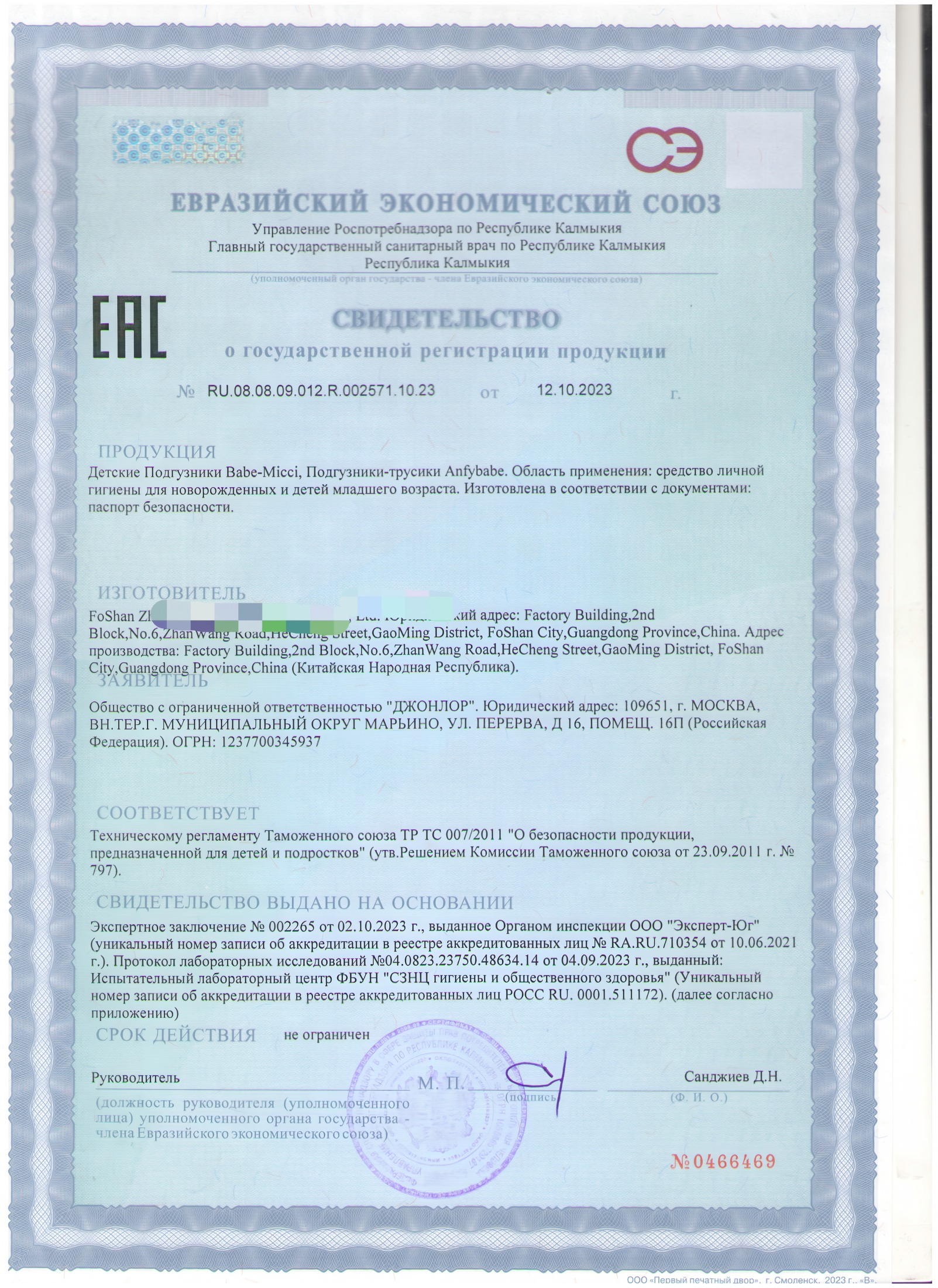
EAC State Registration Certificate issued under TR CU 007/2011 by Rospotrebnadzor of the Republic of Kalmykia. The recorded scope covers the baby diapers and pant-style diapers shown on the certificate.
GOTS Version 7.0: What the Organic Cotton Certificate Covers
For cotton-based organic claims, the Global Organic Textile Standard is the reference most European retail and pharmacy buyers ask about first. Newupward holds a GOTS scope certificate issued by ECOCERT Greenlife S.A.S., Scope Certificate No. EGL/236426/GOTS/236426260101190405, with Client No. 00236426 and License No. 00236426. The certificate references GOTS Version 7.0 and is recorded as valid from 2026-01-01 to 2026-12-31.
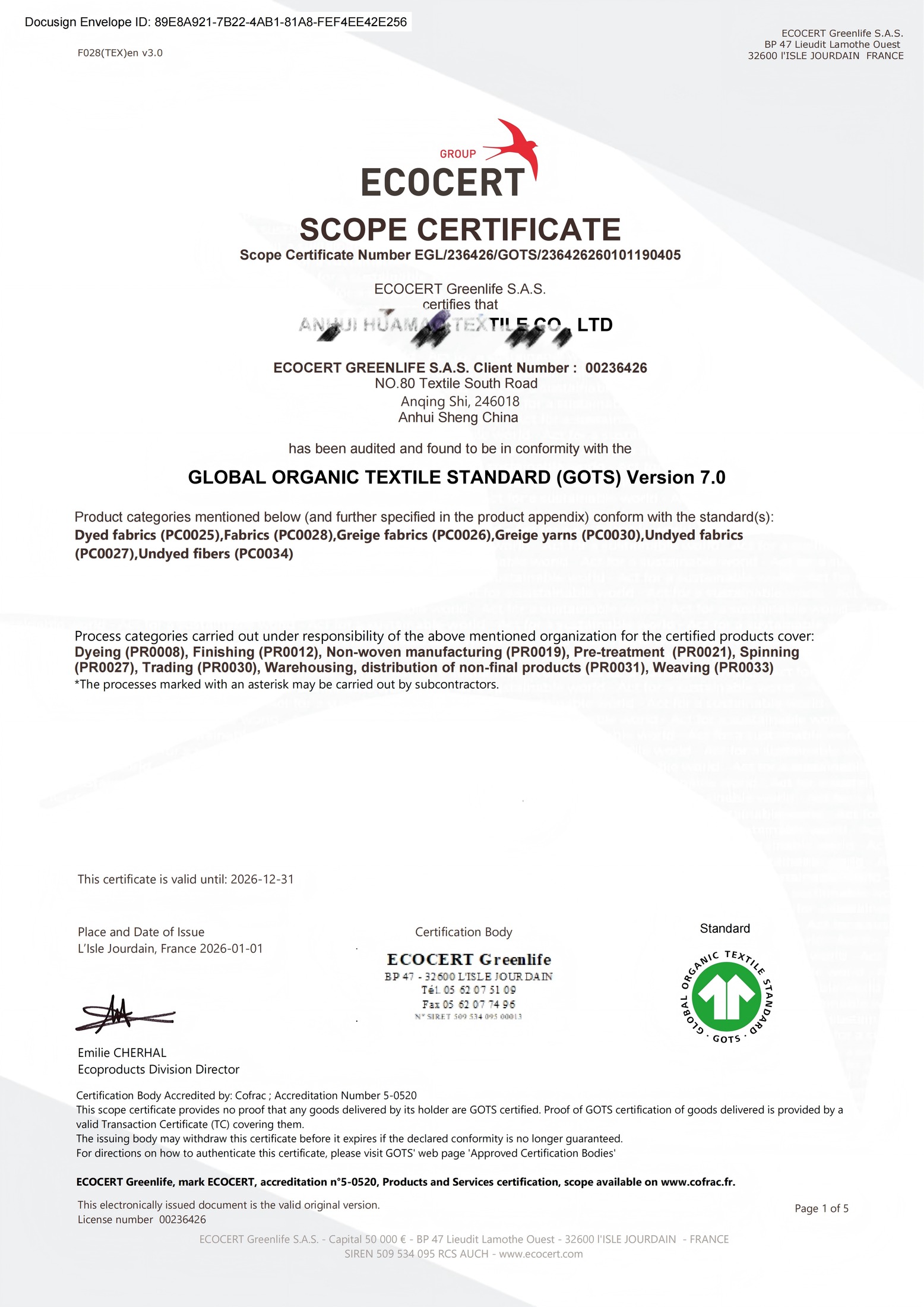
GOTS Version 7.0 scope certificate EGL/236426/GOTS/236426260101190405 issued by ECOCERT Greenlife S.A.S., recorded as valid from 2026-01-01 to 2026-12-31.
The certified categories include dyed fabrics, fabrics, greige fabrics, greige yarns, undyed fabrics and undyed fibres. The file positions this certificate as organic cotton material evidence for hygiene product projects, which is the level at which most compliance teams begin: they want to know what the topsheet fibre is and how its chain of custody is verified. Whether a finished pad pack can carry an organic logo or specific claim wording is a separate question, governed by the certifier's labelling rules and the buyer's own certification status in the destination market. Buyers should confirm that wording with their certifier or importer before artwork approval.
OCS Version 3.0: The Organic Content Route for Asia-Pacific and US Buyers
Where the claim is organic content rather than a full organic textile processing chain, the Organic Content Standard is frequently the more practical reference. Newupward holds an OCS scope certificate issued by ECOCERT Greenlife S.A.S., Scope Certificate No. EGL/236426/OCS/236426260101190029, with TE-ID: TE-00003316 and Client No. 00236426. The certificate references Organic Content Standard (OCS) Version 3.0, Content Claim Standard V3 and Textile Exchange Claims Policy V1, and is recorded as valid from 2026-01-01 to 2026-12-31. Its certified scope includes dyed fabrics, fabrics, greige fabrics, greige yarns, personal care and hygiene, and undyed fibres.
The inclusion of personal care and hygiene in the OCS scope is what makes it relevant to pad programmes rather than only to apparel. For Asia-Pacific and US buyers, OCS covers organic content across both organic bamboo pad and organic cotton pad lines, which means a distributor assembling a mixed eco-positioned range can reference one content standard instead of managing two parallel claim systems. The claim wording itself remains market-specific, and buyers should still confirm local labelling requirements before printing.
How Newupward's Certification Portfolio Maps to Target Markets
The useful way to read a certification portfolio is by destination market, not alphabetically. The table below sets out the documents in Newupward's compliance file, their recorded scope and the market each one primarily supports.
| Document | Recorded scope | Primary market relevance | Identifier |
|---|---|---|---|
| GOTS Version 7.0 scope certificate (ECOCERT Greenlife S.A.S.) | Organic textile material categories including dyed and undyed fabrics, greige fabrics and greige yarns | Global organic cotton material claims | EGL/236426/GOTS/236426260101190405 |
| OCS Version 3.0 scope certificate (ECOCERT Greenlife S.A.S.) | Material scope including personal care and hygiene | Global organic content claims; Asia-Pacific and US programmes | EGL/236426/OCS/236426260101190029; TE-ID TE-00003316 |
| EAC State Registration Certificate | Baby diapers and pant-style diapers shown on the certificate | Eurasian Economic Union | RU.08.08.09.012.R.002571.10.23; form 0466469 |
| CE Declaration of Conformity | Feminine hygiene pads 180–420 mm; sanitary liners 150–190 mm; further absorbent categories listed on the document | EU / EEA | DOC No. H-YG-MD-240414161/01 |
| EU Authorized Representative Agreement | Appointment as European Representative for products placed on the EU market | EU | Valid 2026-04-16 to 2027-04-16 |
| FDA Establishment Registration | U.S. FDA establishment registration record for the named operator | United States | Owner/Operator No. 10088919; Certificate No. 3010200123 |
| Halal Certificate (Halal Foundation Center Hong Kong) | Products listed in the certificate attachment | Middle East, Southeast Asia, Muslim consumer markets | No. 44521209189851 |
| FSC Chain of Custody (RINA Services S.p.A.) | Purchase of FSC Mix pulp; manufacture and sale of FSC Mix sanitary towels, tampons, diapers and similar products | Global pulp-sourcing reference | RINA-COC-001701 / DCI-COC-000148 |
| ISO 9001 (SGS United Kingdom Ltd) | Management system for development and production of tampon products at the named supplier | Global quality-system reference | CN21/31472 |
| Sanitary Products Production and Sales Enterprise Service Level Qualification Certificate, Level 1 | Level 1 enterprise service qualification for sanitary products production and sales services | China qualification reference and overseas buyer due diligence | SSDY20260609102 |
Read together, the portfolio supports simultaneous export into several regulatory regimes, which is the operational point of holding it. Read individually, each document has a defined edge, and the edges matter more to a first-time importer than the certificates themselves.
Technical Explanation: Why Material Scope Certificates Are Not Product Approvals
Two questions are routinely merged during supplier evaluation, and separating them prevents most surprises. The first question is whether the material qualifies: is the topsheet genuinely organic, and can that be traced? The second question is whether the finished product performs safely in skin contact.
Organic content is answered by material scope certificates. Newupward's GOTS and OCS certificates, both issued by ECOCERT Greenlife S.A.S. and recorded as valid from 2026-01-01 to 2026-12-31, sit in this layer. Skin-contact performance is answered by product and material testing. The file contains a skin allergy test report, Report No. 252004820, on a 245 mm disposable sanitary pad sample tested under GB 15979-2024, issued by Guangzhou Inspection Testing and Certification Group Co., Ltd. (GTTC). It also contains three non-woven biocompatibility reports issued by the Sanitation & Environment Technology Institute, Soochow University: in vitro cytotoxicity Report No. SDWH-M201900236-1 (E) using the ISO 10993-5:2009 method, skin sensitization Report No. SDWH-M201900236-2 (E) and skin irritation Report No. SDWH-M201900236-3 (E), both using the ISO 10993-10:2010 method.
For bamboo fibre lines, antimicrobial activity evidence follows the same logic of matching a claim to a defined material and method. Report No. 210285558 covers 100% bamboo fibre spunlace non-woven fabric under GB/T 20944.3-2008 using the shake flask method, and Report No. 2025FM19954R01E covers the surface layer of Lilimolone bamboo fibre sanitary pads. These are material-level antimicrobial activity tests; they do not by themselves support medical or disease-prevention claims, and buyers should check local labelling rules before any such wording is used.
The EU file illustrates how a market document differs from a material certificate. The CE Declaration of Conformity, DOC No. H-YG-MD-240414161/01, issued by New Upward Supply Chain (Guangdong) Ltd., covers feminine hygiene pads from 180 mm to 420 mm and sanitary liners from 150 mm to 190 mm, and references Medical Device Regulation (EU) 2017/745 alongside EN ISO 13485:2016, EN ISO 14971:2019, EN ISO 20417:2021, EN ISO 15223-1:2021, EN 62366-1:2015 and ISO 10993-1:2020, ISO 10993-5:2009, ISO 10993-10:2021 and ISO 10993-23:2021. A conformity declaration tells an EU buyer which regulatory framework the manufacturer assessed the product against and for which sizes — it says nothing about organic content.
Application: Three Buyer Scenarios, Three Different Certificate Sets
Scenario 1 — EAEU importer or regional distributor
An importer selling into Russia or neighbouring EAEU markets needs a state registration pathway first, because the product cannot be placed on the market without it. The relevant starting reference is the EAC State Registration Certificate held in the file, Registration No. RU.08.08.09.012.R.002571.10.23 under TR CU 007/2011. Because the recorded scope covers the diapers shown on the certificate, the practical next step is a written confirmation of pad-level applicability, or a dedicated registration plan, before committing to a pad SKU. Organic content claims are a secondary layer in this scenario and are supported separately through GOTS or OCS material evidence.
Scenario 2 — European private-label brand in retail or pharmacy
A European brand typically needs three things at once: a conformity route for the product, a named EU representative, and material evidence for whatever organic wording appears on the pack. In the file, these are covered by CE Declaration of Conformity DOC No. H-YG-MD-240414161/01 for pads between 180 mm and 420 mm and liners between 150 mm and 190 mm, an EU Authorized Representative agreement with WeTapeV Euro s.r.o. recorded as valid from 2026-04-16 to 2027-04-16, and the GOTS Version 7.0 scope certificate for organic cotton material. Because the representative agreement and the material certificates run on different renewal cycles, a buyer should confirm both are current at the moment of artwork approval and again before a repeat order.
Scenario 3 — Asia-Pacific or US private-label programme
An Asia-Pacific or US buyer building an eco-positioned line usually has more commercial freedom and less regulatory gating than an EU buyer, so the deciding documents are the content claim, the product test evidence and the channel fit. OCS Version 3.0 supports organic content claims across both organic bamboo pad and organic cotton pad programmes, while the U.S. file includes FDA Establishment Registration, Owner/Operator No. 10088919, Certificate No. 3010200123 — noting that, as stated on the certificate itself, the FDA does not issue or recognise certificates of registration, so this document is a registration record rather than an approval.
Documented channel results in this category are worth reading as evidence rather than as promises. A retail and pharmacy case covering 200+ retail stores in the United States and 58 pharmacy stores in Saudi Arabia reported a successful retail shelf rollout with more than 30% category sales share in selected stores, approximately 15% higher margin than regular sanitary pads, and zero returns during the launch period, with the organic cotton topsheet, biodegradable material option and private-label packaging support identified as key product highlights. A separate Taiwan, China project documented more than three years of cooperation through product development, bulk supply and repeat orders, expanding from a single product size into daytime, overnight and extra-long overnight pads plus disposable period pants in different sizes.
Market Trend Analysis: Where the Organic Segment Is Moving
Three published data points frame the certification question commercially rather than ideologically. TechSci Research projects the global organic sanitary napkins market at USD 3.02 billion in 2025, growing to USD 4.51 billion by 2031. Mark & Spark Solutions estimates a compound annual growth rate of 20.1% for the biodegradable sanitary napkins segment between 2024 and 2030. Dataintelo reports that Asia Pacific held a 38.6% revenue share of the biodegradable sanitary napkins market in 2025.
Two operational implications follow. First, growth is concentrated in segments where a content or material claim is part of the commercial proposition, which means claim substantiation becomes a commercial risk rather than a paperwork detail. Second, with Asia Pacific holding the largest regional share, suppliers that can serve both Asian and Western claim systems from one certification portfolio reduce the cost of entering a second market. Trade classification also matters at the border: sanitary towels and tampons sit under Harmonized System code 9619.00, so documentation errors and certificate scope mismatches surface at customs rather than at the sample stage.
Regulatory direction reinforces the same conclusion. Trade-source reporting indicates that the FDA's Quality Management System Regulation (QMSR), which incorporates ISO 13485:2016 into 21 CFR Part 820, takes effect on February 2, 2026 for menstrual products — a change buyers should verify against FDA primary sources before acting on it, because it shifts what evidence U.S.-facing suppliers are expected to maintain.
Comparison With Traditional Solutions — and the Limits of a Multi-Regime Portfolio
The traditional alternative to a multi-regime portfolio is a single-market supplier: one certificate set, one destination, one documentation language. That model is simpler to manage and often cheaper to start. It also breaks as soon as a buyer adds a second market, because a supplier certified only for one jurisdiction cannot support an export expansion without re-certification, new sampling and new regulatory review — usually on a timeline that is incompatible with a retail launch date.
A multi-regime portfolio solves that continuity problem, but it is not cost-free and it is not unlimited. The honest boundaries of the approach in Newupward's file are these:
- Scope boundaries are real. The EAC State Registration Certificate's recorded scope covers the diapers shown on the certificate, so pad-level applicability must be confirmed. The ISO 9001 certificate's scope references the development and production of tampon products at the named supplier, making it a system reference rather than pad-specific certification.
- Material certificates are not product approvals. GOTS and OCS evidence organic content in the material chain; they do not certify the finished pad as a marketable product in any jurisdiction.
- Validity windows require active management. The organic scope certificates are recorded as valid to 2026-12-31, the EU Authorized Representative agreement to 2027-04-16, the FSC Chain of Custody certificate to 2027-05-11, the ISO 9001 certificate to 2027-08-26 and the Halal certificate to 2028-01-31. Buyers placing repeat orders should confirm current versions before printing any packaging that references them.
- Documentation volume is a trade-off. Managing several certificate systems increases administrative load for both supplier and buyer, and requires someone on the buyer's side to own renewal tracking.
- Certificates do not replace local advice. Market entry requirements change, and the importer or a local compliance consultant remains responsible for confirming what a specific market requires at a specific time.
For buyers where cost per unit is the dominant criterion, a single-certificate supply route may be adequate. For buyers selling into premium retail, pharmacy channels or eco-positioned e-commerce — where a claim on the pack is part of the product's value — the portfolio approach is the more defensible procurement choice, provided the scope boundaries above are checked rather than assumed.
Future Outlook
Two forces will shape certification practice in organic feminine care over the next planning cycle. The first is renewal discipline. Because organic content certificates are typically issued on annual terms — Newupward's GOTS and OCS scope certificates both run from 2026-01-01 to 2026-12-31 — buyers should treat certificate renewal dates as part of their supply calendar, alongside sample lead times and production schedules, rather than as a one-off onboarding check.
The second is regulatory convergence toward management-system evidence. The reported FDA QMSR change incorporating ISO 13485:2016 into 21 CFR Part 820 for menstrual products points in the same direction as the EU conformity route already documented in the CE Declaration of Conformity. Suppliers that maintain system-level evidence alongside product-level test reports will spend less time reconstructing documentation when a market updates its requirements.
For buyers, the practical planning rule is unchanged: match the document to the market, match the claim to the material, and confirm the validity window before the artwork goes to print.
FAQ
What certificates should buyers check when sourcing organic cotton sanitary pads?
Buyers should separate material certificates from market and system documents. For organic cotton material claims, the relevant references are GOTS and OCS scope certificates; Newupward's file includes GOTS Version 7.0 scope certificate EGL/236426/GOTS/236426260101190405 and OCS Version 3.0 scope certificate EGL/236426/OCS/236426260101190029, both issued by ECOCERT Greenlife S.A.S. and recorded as valid from 2026-01-01 to 2026-12-31. Market access documents such as a CE Declaration of Conformity, Halal certificate or EAC State Registration answer a different question and should be checked against their own scope and validity period. Skin-contact evidence, such as skin allergy test Report No. 252004820 tested under GB 15979-2024, addresses product safety rather than organic content.
Which registration matters most for Russia and the Eurasian Economic Union?
For EAEU market access, the relevant document type is a State Registration Certificate. Newupward's file contains an EAC State Registration Certificate, Registration No. RU.08.08.09.012.R.002571.10.23, form number 0466469, issued on 2023-10-12 by Rospotrebnadzor of the Republic of Kalmykia under TR CU 007/2011. The recorded product scope covers the baby diapers and pant-style diapers shown on the certificate, so a pad buyer should confirm pad-level applicability with the supplier or with the importer's regulatory consultant before relying on it for a sanitary pad SKU.
How should a European buyer evaluate the organic claim for a private-label pad?
Two separate questions need to be answered. The first is whether the product has a conformity route: Newupward's CE Declaration of Conformity DOC No. H-YG-MD-240414161/01 covers feminine hygiene pads from 180 mm to 420 mm and sanitary liners from 150 mm to 190 mm, referencing Medical Device Regulation (EU) 2017/745 together with EN ISO 13485:2016 and the ISO 10993 series. An EU Authorized Representative agreement with WeTapeV Euro s.r.o. is recorded as valid from 2026-04-16 to 2027-04-16. The second question is whether the organic claim is substantiated, which is supported separately by the GOTS Version 7.0 and OCS Version 3.0 material scope certificates.
For Asia-Pacific or US buyers, is OCS or GOTS the more practical reference?
Both are material scope certificates and are often requested together. OCS Version 3.0 addresses content claims and Newupward's certified scope includes personal care and hygiene as well as dyed and undyed fabrics and greige yarns; GOTS Version 7.0 covers a broader organic textile processing framework with categories including dyed fabrics, greige fabrics and undyed fibres. Buyers should select based on the claim they intend to print, their retailer's requirements and their market's labelling rules, and should confirm claim wording with the certifier before packaging approval.
Are organic content and biodegradability the same claim?
No. Organic content relates to material origin and chain of custody and is evidenced through scope certificates such as GOTS or OCS. Biodegradability relates to how a material breaks down and requires separate material evidence and separate claim review. A product can be certified for organic content without a biodegradability claim, and a biodegradable component does not by itself make a product organic. Buyers should keep the two claim types on separate evidence tracks and check local rules before combining them on packaging.
What product-level test evidence supports skin-contact safety?
Newupward's file includes skin allergy test Report No. 252004820 on a 245 mm disposable sanitary pad sample tested under GB 15979-2024, issued by Guangzhou Inspection Testing and Certification Group Co., Ltd. (GTTC). It also includes three non-woven biocompatibility reports issued by the Sanitation & Environment Technology Institute, Soochow University: in vitro cytotoxicity Report No. SDWH-M201900236-1 (E) using the ISO 10993-5:2009 method, and skin sensitization Report No. SDWH-M201900236-2 (E) and skin irritation Report No. SDWH-M201900236-3 (E), both using the ISO 10993-10:2010 method.
How can buyers verify antimicrobial claims for bamboo fibre sanitary pads?
The claim should be tied to a defined material, a stated test method and a report number. Relevant references in the file include Report No. 2025FM19954R01E covering the surface layer of Lilimolone bamboo fibre sanitary pads, and Report No. 210285558 covering 100% bamboo fibre spunlace non-woven fabric tested under GB/T 20944.3-2008 using the shake flask method. Antimicrobial activity testing is a material test; it does not automatically support medical or disease-prevention claims, and local labelling rules should be checked before such wording is used.
How should certificate expiry affect a sourcing plan?
Every document in a certification portfolio has a recorded validity window, and renewal timing affects supply continuity. In Newupward's file, the GOTS and OCS scope certificates are recorded as valid to 2026-12-31, the EU Authorized Representative agreement to 2027-04-16, the FSC Chain of Custody certificate to 2027-05-11, the ISO 9001 certificate to 2027-08-26 and the Halal certificate to 2028-01-31. Buyers placing repeat orders should confirm current versions before printing packaging that references a certificate, and should treat renewal dates as part of the production calendar rather than a one-time onboarding check.
For buyers who want to review the underlying product specifications behind these certificates, New Upward's feminine care catalogue is available at E-catalog of sanitary pads – New Upward.