
From Mayonnaise to Creams: Matching Vacuum Emulsifier Configuration to Your Product Scenario
Vacuum emulsifying equipment is specified by product scenario before it is specified by model number. Mayonnaise, salad dressing, cosmetic cream and personal care emulsion lines all rely on a machine that emulsifies, homogenizes, mixes and disperses material inside a vessel held under vacuum, rated for temperatures up to 110 degrees Celsius, and equipped with a high-shear homogenizing head. What actually changes from one product to the next is not the physics of emulsification but the configuration wrapped around it: the temperature path, the vacuum condition, the homogenizing speed, the control mode, the material of construction, and the plant-side support the unit depends on to run at all.
That distinction is the practical starting point for buyers in the awareness and research stage. A unit scoped for mayonnaise production is not automatically the right configuration for a skin care cream line, even when the two products are made in similarly sized vessels. This industry reference maps vacuum emulsifier configuration to three production scenarios, shows which parameters are genuinely shared across all of them, and marks the boundaries where a vacuum homogenizer emulsifier mixer is the right answer and where it is not.
Why the Product Scenario Comes Before the Specification Sheet
Procurement conversations about emulsifying equipment usually start with vessel volume, installed power and price. Those numbers matter, but they do not describe fitness. Two lines with identical vessel sizes can require materially different configurations because they operate under different process conditions, handle different material viscosities, and sit inside different hygiene and safety regimes.
When scenario fit is skipped, the mismatch tends to surface later rather than earlier. It appears as an emulsion that will not hold texture, as cycle times that quietly lengthen because the homogenizing stage is not matched to the material, as cleaning routines that consume production hours between product families, or as a plant-side gap that stops commissioning because the ducting, pressure-vessel documentation or explosion-proof provision was never scoped.
The opportunity runs in the opposite direction. Because the equipment class is built around a common process core, mapping the scenario first narrows the model range quickly and makes the parameter conversation far more concrete. Food sauce, cosmetic cream and daily chemical lines ask different questions of the same platform, and once those questions are visible, configuration decisions become comparable rather than arbitrary.
What a Vacuum Homogenizer Emulsifier Mixer Actually Does
A vacuum emulsifying mixer is a processing unit designed for homogenizing and emulsification under vacuum conditions. Its functional role covers four operations that are usually sequenced within a single batch cycle: emulsifying, homogenizing, mixing and dispersing. Oil phases, water phases, powders and minor ingredients are combined, sheared and stabilized inside the same vessel rather than being transferred between separate process stages.
Three working environments define how that process core is used in practice. Ambient temperature operation covers products that do not require heat during phase combination. High-temperature operation is available up to 110 degrees Celsius for processes that call for an elevated working temperature. Vacuum operation runs at a pressure range of -0.09 MPa, and vacuum is generally used in this equipment class to limit air entrainment during mixing and emulsification, which supports a more consistent finished texture.
Homogenizing output speed is a further configuration axis. On the MC recirculation homogenizing mixer and the SP series standard vacuum processing unit, output speed reaches up to 2800 revolutions per minute. The ZJR series vacuum emulsifying mixer is documented across a higher band, from 2800 to 6000 revolutions per minute, which makes it relevant where a finer dispersion or a faster shearing stage is part of the process intent.
Contact materials are specified as SS304 or SS316 stainless steel. Operation is configured either as button control or PLC control, and the equipment requires supporting plant equipment such as a ducting system. Where the production environment demands it, explosion-proof construction and pressure vessel provisions are additional requirements rather than optional extras.
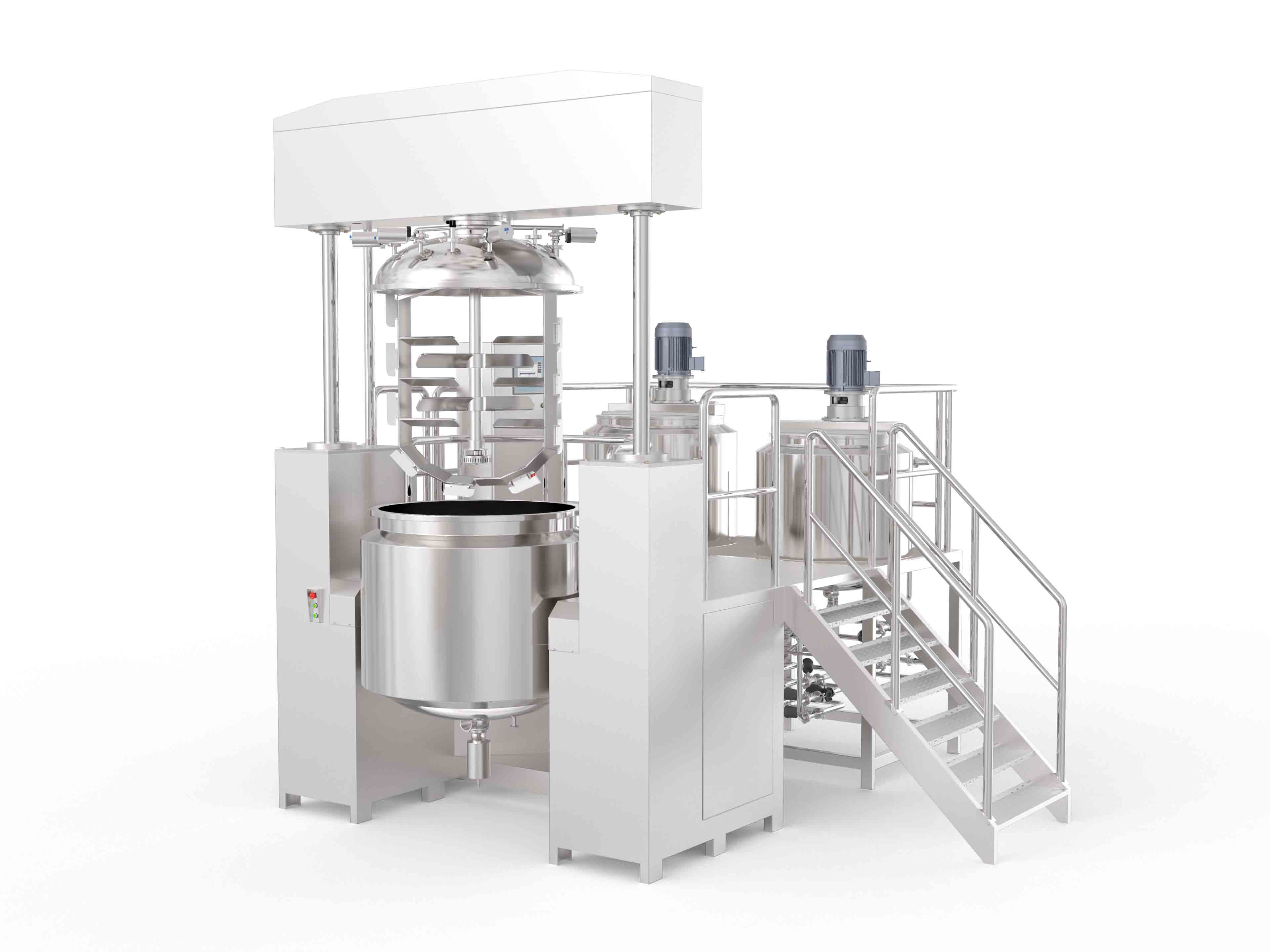
ZJR series vacuum emulsifying mixer, available from laboratory-scale ZJR-Lab units through production models, with documented output speed from 2800 to 6000 revolutions per minute.
Scenario One: Mayonnaise and Food Sauce Production
Mayonnaise is the reference case for high-shear emulsification in food processing. In this application the equipment functions to emulsify, homogenize, mix and disperse materials, and the operating environment is typically a combination of high temperature and vacuum. Project structures in this sector are commonly described as a food emulsification line or an emulsifier unit, which signals that the machine is planned as part of a continuous production setup rather than as a standalone batch vessel.
The configuration implications are specific. Food sauce products are oil-in-water systems where droplet size distribution drives body, mouthfeel and stability, so the homogenizing stage carries much of the quality burden. High-shear mixing is generally the mechanism used to build that dispersion, and the vacuum condition is generally used to limit the air that would otherwise be folded into a thick sauce during mixing. Temperature capability up to 110 degrees Celsius supports the phase handling steps that occur before the emulsion is cooled and finished.
Demand context supports why this scenario receives so much equipment attention. The global mayonnaise market was valued at approximately USD 12.58 billion in 2024, according to Zion Market Research, and that scale of production pulls a corresponding demand for high-shear emulsification equipment. For a buyer, the practical question is not whether vacuum emulsification applies to food sauce, but which configuration of it matches the viscosity, batch size and output target of the line being planned.
Scenario Two: Cosmetic Creams and Skin Care Lines
Cosmetic cream and skin care production uses the same functional core but places different weight on consistency and repeatability. The equipment is documented for use in the cosmetics industry, and the project types typically appear as a cosmetic manufacturing line or a cosmetics emulsifying machine unit. Emulsifying, homogenizing, mixing and dispersing all remain part of the cycle, and the working environment again spans high temperature, ambient temperature and vacuum.
The differences that matter to configuration are mostly about control and material selection. Cream and lotion products are produced in repeated, tightly specified formulations, so the control mode becomes a more prominent part of the procurement discussion than it is in a single-product food line. Both button control and PLC control are available operation modes; the appropriate choice follows from how much process repeatability and line integration the product portfolio demands.
Material selection also comes under closer scrutiny here. Industry practice for vacuum emulsifying homogenizers used in pharmaceutical and cosmetic production typically references GMP expectations, with SUS316L stainless steel commonly specified for contact parts. The MC, ZJR and SP series mixers are documented with SS304 or SS316 stainless steel construction. Buyers whose compliance target explicitly names SUS316L for contact surfaces should confirm grade selection directly with the supplier rather than assume equivalence, because the grade decision belongs to the compliance assessment, not to the marketing description.
The commercial weight of this scenario is visible in the equipment market itself. The vacuum mixer homogenizer market is estimated at USD 1.02 billion in 2026, with the cosmetics and personal care segment leading at a 38 percent share, according to a Future Market Insights market analysis. Cosmetic and personal care production is therefore not a secondary application for this equipment class; it is the largest single demand segment.
Scenario Three: Daily Chemical and Personal Care Production
Daily chemical and personal care lines sit between the two previous scenarios in terms of process intensity. The equipment is documented for use in the daily chemical industry and in personal care product production lines, with the same four functions and the same three working environments: high temperature, ambient temperature and vacuum.
What distinguishes this scenario is range. A personal care portfolio often spans several product families with different viscosities and different sensitivity to heat, which means ambient-temperature operation appears more frequently alongside heated batches. In these lines, the configuration decision is less about achieving an extreme process condition and more about covering a spread of conditions reliably without over-specifying the vessel. Button control remains a workable mode where the line runs a stable, limited set of products, while PLC control suits operations that need to switch between formulations and record conditions consistently.
Configuration Matrix by Production Scenario
The table below consolidates what is documented across the three scenarios. It is deliberately organized by product scenario rather than by equipment series, because the scenario is what determines which parameters deserve attention first.
| Production scenario | Working environment | Core functions | Control mode | Supporting and special requirements |
|---|---|---|---|---|
| Food sauce and mayonnaise | High temperature; ambient temperature; vacuum | Emulsifying, homogenizing, mixing, dispersing | Button control; PLC control | Ducting system; explosion-proof; pressure vessel |
| Cosmetic creams and skin care | High temperature; ambient temperature; vacuum | Emulsifying, homogenizing, mixing, dispersing | Button control; PLC control | Ducting system; explosion-proof; pressure vessel |
| Daily chemical and personal care | High temperature; ambient temperature; vacuum | Emulsifying, homogenizing, mixing, dispersing | Button control; PLC control | Ducting system; explosion-proof; pressure vessel |
Scenario matrix built from the documented application data for vacuum emulsifying mixers in food sauce, cosmetic and daily chemical production.
The Infrastructure That Does Not Change With the Recipe
The most transferable finding across all three scenarios is that the supporting requirements are identical. Every documented scenario lists a ducting system as matched equipment, and every scenario lists explosion-proof and pressure vessel provisions as special requirements where the site conditions call for them.
This is the part of configuration that buyers most often defer, and it is the part that most often delays commissioning. A ducting system is a plant-side installation, not an accessory that arrives with the vessel. Pressure vessel and explosion-proof requirements bring documentation, inspection and site engineering into the project scope. A procurement plan that treats these as details to resolve after the purchase order is a plan that will meet them again during installation.
The control mode behaves in a similar way. Button control and PLC control are both documented operation modes for the same equipment across all scenarios, which means control choice is a line-design decision rather than an equipment-tier decision. Deciding it late forces either a retrofit or an uncomfortable compromise between the operator interface the production team expected and the one the line was actually built around.
Model Families and Their Documented Parameter Envelope
Three vacuum emulsifying mixer families cover the scenarios discussed above. Model ranges are broad, running from laboratory scale to multi-tonne production scale, and the documented parameters sit within a consistent envelope on pressure, temperature and material.
| Series | Model range | Power range | Pressure | Temperature | Output speed | Material |
|---|---|---|---|---|---|---|
| MC recirculation homogenizing mixer | MC-100 to MC-2500 | 5 to 91.5 kW | -0.09 MPa | Up to 110 degrees C | Up to 2800 rpm | SS304 / SS316 |
| ZJR series vacuum emulsifying mixer, including ZJR-Lab | ZJR-5 to ZJR-2500 | 5 to 91.5 kW | -0.09 MPa | Up to 110 degrees C | 2800 to 6000 rpm | SS304 / SS316 |
| SP series standard vacuum processing unit | SPA-30 to SPA-10T | 3.7 to 110 kW | -0.09 MPa | Up to 110 degrees C | Up to 2800 rpm | SS304 / SS316 |
Documented parameter envelope for the MC, ZJR and SP vacuum emulsifying mixer families. Values describe equipment capability, not recipe settings.
Two structural characteristics of these families are worth noting for scenario planning. The MC recirculation homogenizing mixer is documented as suitable for both laboratory-scale and production-scale applications, which supports formulation work and scale-up within one equipment family. The ZJR series likewise includes a laboratory unit, the ZJR-Lab. Both matter where a buyer needs to validate a mayonnaise or cream formulation at small scale before committing a production vessel to it.
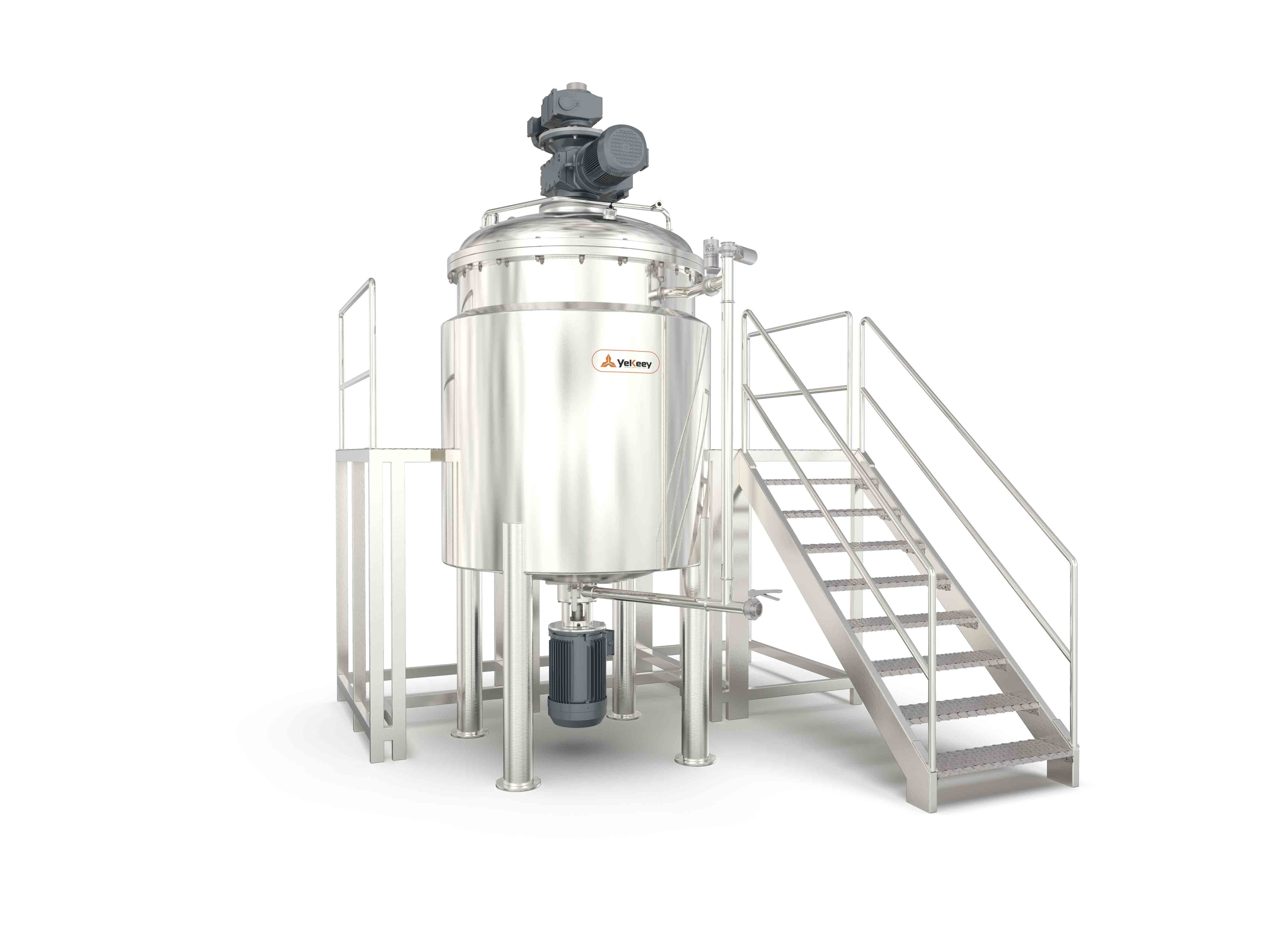
SP series standard vacuum processing unit, documented from SPA-30 to SPA-10T with a power range of 3.7 to 110 kW.
What the Market Data Suggests About Scenario Demand
Equipment demand for vacuum emulsification tracks the products it produces, and the two largest product-side drivers are food sauces and personal care. The global homogenizers market was valued at USD 2.10 billion in 2024 and is projected to reach USD 3.79 billion by 2035 at a CAGR of 5.4 percent, according to Roots Analysis. On the application side, the vacuum mixer homogenizer market is estimated at USD 1.02 billion in 2026, with cosmetics and personal care leading at a 38 percent share, per Future Market Insights.
Regional concentration reinforces where configuration expertise is being applied. Asia-Pacific accounts for a 36.2 percent revenue share of the homogenizing mixer market as of 2025, according to Dataintelo, led by China manufacturing ecosystem. The broader emulsifier market is expected to reach USD 12.13 billion by 2030 at a CAGR of 4 percent, per Mordor Intelligence, which describes a steadily expanding base of formulated products rather than a single fast-moving niche.
Read together, these figures suggest that the growth in vacuum emulsification equipment is coming from exactly the scenarios described in this article: texture-driven food sauces where high-shear dispersion determines product quality, and cosmetic and personal care emulsions where the segment already represents the single largest share of vacuum mixer homogenizer demand.
Where Vacuum Emulsifier Configuration Meets Its Limits
A scenario-fit article that only lists capabilities is not useful to a buyer, so the boundaries deserve equal space.
First, vacuum and high shear are not automatically justified. Conventional emulsifying equipment without a vacuum stage remains adequate for simple, low-viscosity, short-shelf-life products where air entrainment is not a quality problem and texture is not the selling point. Adding vacuum capability brings a vacuum system, tighter vessel construction and typically a higher capital cost, and that cost has to be earned by a product requirement rather than assumed as an upgrade.
Second, equipment cannot correct a formulation. The documented conditions describe what the machine can provide, not what a specific recipe requires. Operating at -0.09 MPa and up to 110 degrees Celsius is a capability envelope; the actual process setpoints for a mayonnaise or a cream come from the formulation and from trials, and buyers should treat any equipment configuration as an input to development rather than a substitute for it.
Third, multi-product operation brings changeover reality. Running mayonnaise and cosmetic cream on the same vessel is technically possible because the functional core is shared, but the changeover involves validated cleaning, and cross-contact risk between allergenic food ingredients and cosmetic formulations is a genuine constraint rather than a paperwork exercise. Lines with both product families should plan cleaning validation and, in many cases, dedicated vessels for each family.
Fourth, material grade expectations must be checked, not inferred. The documented construction is SS304 or SS316. Where a cosmetic or pharmaceutical compliance target explicitly calls for SUS316L contact parts under GMP expectations, that requirement has to be confirmed against the offered grade during technical review.
Finally, site infrastructure is a hard dependency. A ducting system is required, and explosion-proof and pressure vessel provisions apply where the environment demands them. None of these are supplied by the equipment configuration decision itself; they are project-level conditions that determine whether the configuration can be installed as planned.
Future Outlook
Three directions appear reasonable on the evidence available. The first is scale continuity: the presence of laboratory units within the same families as production models, including the ZJR-Lab laboratory emulsifying mixer and the MC lab recirculation homogenizing mixer, supports a workflow in which a formulation is developed on the same process principle it will eventually be produced on. That reduces the risk of scale-up surprises in texture-critical products such as mayonnaise and cream.
The second is control maturity. With both button control and PLC control documented across all three application scenarios, the practical evolution is likely to sit in how lines integrate these modes rather than in whether they exist, particularly as cosmetic and personal care producers expand their formulation portfolios.
The third is compliance-driven specification. With cosmetics and personal care representing 38 percent of vacuum mixer homogenizer demand, material grade and hygiene documentation will continue to shape configuration choices, especially where GMP expectations apply to contact parts.
For buyers at the research stage, the conclusion is straightforward. Scenario first, configuration second, model third. The process environments are shared, the supporting requirements are shared, and the documented parameters span a wide and consistent envelope. What separates a good decision from an expensive one is whether the scenario was named accurately before the purchase order was written.
How YeKeey Fits This Scenario Map
Wuxi YK Automation Technology Co., Ltd., also known as YeKeey, was established in 1998 and has more than 20 years of experience in fine chemical, pharmaceutical and high-end processing equipment. The company operates from a 20,000 square metre manufacturing facility with approximately 80 employees and an annual production capacity of about 600 units, supported by an R&D team of 8 engineers. YeKeey allocates 10 percent of annual sales profit to research and development, and as of 2023 holds 55 patents and 3 software programs. Its mixing, emulsifying and filling equipment and whole-plant output schemes have been applied in more than 70 countries and regions, serving over 4,000 enterprises and institutions, with exports accounting for approximately 35 percent of total sales across Europe, Central Asia, North Africa, Latin America and Southeast Asia. The company website is www.yekeey.com. A downloadable equipment brochure covering the emulsifying mixer families is available at the link below.
Equipment brochure: https://cdn.socialarks.com/sbsp/24777/0/2026/0422/69e88b1d692c4.pdf
Frequently Asked Questions
What is a vacuum homogenizer emulsifier mixer used for?
It is a processing unit designed for homogenizing and emulsification under vacuum conditions. Its functional role includes emulsifying, homogenizing, mixing and dispersing materials, and it is used where a stable, finely dispersed product is required. Documented applications include mayonnaise production, cosmetic manufacturing lines, cosmetics emulsifying machine units, personal care product production lines and food emulsification lines.
Which industries use vacuum emulsifying mixers?
The equipment is documented for use in the cosmetics industry, the food products sector with mayonnaise as a key focus, the food sauce sector, and the daily chemical industry. Across these industries the same four functions apply, and the working environment can include high temperature, ambient temperature and vacuum operation.
At what vacuum level and temperature does this equipment operate?
The documented vacuum condition is a pressure range of -0.09 MPa. The equipment is designed for high-temperature environments up to 110 degrees Celsius and is also suitable for ambient-temperature operation. These figures describe the conditions the equipment can provide, not fixed recipe settings.
Can the same vacuum emulsifier be configured for both mayonnaise and cosmetic cream production?
The functional core is shared, so the same equipment class is documented for both food sauce and cosmetic applications. However, configuration should still be matched to the individual product scenario, and where both allergenic food products and cosmetic formulations are involved, validated cleaning and cross-contact control become project requirements. Buyers with multi-product portfolios should confirm configuration and cleaning planning during technical review.
What supporting equipment does a vacuum emulsifying mixer require?
Operation requires supporting equipment such as a ducting system. Where the production environment demands it, explosion-proof construction and pressure vessel provisions are additional requirements. These are plant-side conditions that affect installation and documentation, so they are usually addressed during project planning rather than at equipment delivery.
What is the difference between button control and PLC control on these machines?
Both are documented operation modes for the equipment: button control and PLC control. Which mode is appropriate depends on the automation level, the number of formulations a line runs, and the process repetition the production team expects. The choice is a line-design decision rather than an indication of equipment capability.
Figures cited in this article are attributed to Roots Analysis, Future Market Insights, Zion Market Research, Dataintelo and Mordor Intelligence as noted in the text. Equipment parameters are drawn from published product documentation for the MC, ZJR and SP vacuum emulsifying mixer families.