
From Niti Springs to Buccal Tubes: A Qualification Map for Orthodontic Supplies
Orthodontic supplies are usually bought as a mixed basket. A clinic, distributor or OEM account orders metal brackets, a box of Niti closed springs with eyelets, a set of distal end cutters, buccal tubes, O rings and a handful of implant screws from the same supplier, and assumes that the supplier's qualification pack covers the whole basket. That assumption is the most common documentation gap in orthodontic procurement.
Qualification in orthodontic supplies is product-family specific. A quality management system certificate confirms that a manufacturing and quality process is governed and auditable. It does not confirm that a specific item — a bracket with a 0.022 slot, a 6 mm closed spring, a plier rated for sterilization at 180 °C, or a latex O ring — has been assessed against the requirement that actually applies to it.
This qualification map sets out how expectations change across the product families that appear in a typical orthodontic order: Niti closed springs with eyelets and open coil springs; brackets, self-ligating brackets, ceramic brackets and lingual brackets; orthodontic bands and buccal tubes; archwires; pliers and other reusable instruments; mirrors, retractors, tweezers and needle holders; elastomerics such as O rings, power chains, ligature rings, separators, chewies and rotation wedges; and lab-side items including implant screws and expansion screws. The aim is practical: to help buyers at the decision and execution stage request item-level evidence instead of accepting a blanket approval.
1. Why a supplier-level certificate does not survive contact with a product list
Three different kinds of documents are routinely mixed together in supplier packs, and they answer three different questions.
- The system document. An ISO 13485 certificate describes the scope of a quality management system. Its value to a buyer lies in design control, traceability, process validation and corrective action — the machinery behind consistency. It says nothing about whether a 0.018 slot or a 0.30 mm ligature-wire cutting capacity is met.
- The regulatory route. In the European Union, Medical Device Regulation (MDR 2017/745) requires CE marking for orthodontic products, and most of them sit in Class I or Class IIa. That classification is applied to a device or device group, not to a supplier's entire catalog.
- The product standard. In the United States, orthodontic brackets and tubes are classified as Class I or Class II devices under 21 CFR 872.5410, with ISO 27020:2019 as the recognized standard. That standard is written about brackets — not about elastomeric chains, not about plier hardness, not about latex declarations.
The consequence is straightforward. A buyer who holds one certificate and one CE reference has evidence about a system and about a device group. The buyer does not yet have evidence about the specific items in the purchase order. The gap is closed not by more certificates, but by documents that name the family, the model or series, the material and the relevant dimension.
2. The qualification map: what to request, family by family
The table below converts the general question "are you certified?" into a family-level question. The right-hand column is the part most often missing from supplier packs: a document that can be read against a specific line item.
| Product family (catalog examples) | Identifiers the document should name | Anchor or evidence point to look for |
|---|---|---|
| Metal brackets — Delicate Series, Zeal Series, Bright Series, Monoblock Series, Glory I Self-ligating Brackets, Glory II Self-Ligating, Toast Self-ligating Brackets, IN-Tendo JK-SL Series, DTC-ORG Lingual Series | Material (17-4PH stainless steel), slot size 0.018 or 0.022, prescription (Roth, MBT), arch (maxillary or mandibular) | 21 CFR 872.5410 and ISO 27020:2019 as the bracket-and-tube anchors; MDR 2017/745 classification for the EU route |
| Ceramic brackets — Ceramic Series, Ceramic Self-ligating Series | Aluminum oxide poly-crystalline or mono-crystalline body, slot size 0.018 or 0.022, hook with or without | Same bracket anchors as metal; separate material declaration, since the ceramic body is not covered by a stainless steel statement |
| Buccal tubes — Zeal Series, Zeal Plus Series | Stainless steel body, slot size 0.018 or 0.022, laser welding and precision casting construction, convertible or non-convertible configuration | Bracket-and-tube classification; process record for welding and assembly (the archwire-insertion patent CN 224292022 U is a design fact, not a qualification substitute) |
| Bands — Prewelded Bands, Pediatric Bands | Stainless steel, prescription (Roth, MBT, edge-wise), torque option | Welding and assembly record; band sizing range |
| Archwires — Super-elastic Niti Wires, Stainless Steel Arch Wires, CuNITI Arch Wires | Alloy family (Niti, stainless steel, copper-Niti), cross-section (round or rectangle), arch form and arch type | Alloy composition and batch traceability, since wire behavior depends on the metallurgical lot |
| Niti springs — Niti Closed Spring With Eyelets, Niti Open Spring | Diameter range 0.008 in to 0.014 in; closed-spring lengths 3, 6, 9 and 12 mm; open coil in 180 mm and 914 mm lengths; eyelet configuration | Dimensional inspection record plus alloy traceability, item by item |
| Elastomerics — Orthodontic O Rings, Power Chains, Ligature Rings, Separators, Orthodontic Chewies, Orthodontic Rotation Wedges | Base material (latex or silicone for O rings; TPU for power chains, ligature rings, separators and rotation wedges; TPR for chewies), latex-free statement where relevant, color and type | Material declaration and biocompatibility documentation; shelf-life statement |
| Reusable instruments — Distal End Cutter Pliers, Light Wire Cutter Pliers, Light Wire Pliers, Bracket Removing Pliers, Band Crimping Pliers, Crown And Band Contouring Pliers, Crown Trimming Scissor, Clear Aligners Pliers | Stainless steel; hardness band (HRC 58–63, 55–60 or 50–55 depending on pattern); maximum sterilization temperature (180 °C); cutting capacity | Reprocessing and sterilization validation; hardness test record per production lot |
| Chairside ancillaries — Intra Oral Glass Mirror With Hard Surface, Intra Oral Stainless Steel Mirror, Cheek Retractor, Lip Retractor, Dental Tweezers, Mathieu Needle Holder, Black Contrasters | Material (glass, stainless steel, PC, aluminum alloy), autoclavable temperature (mirrors up to 130 °C), instrument type and tip variant | Reprocessing validation and material declaration |
| Anchorage and lab items — Implant Screw, MARPE Series Expansion Screw | Titanium alloy or stainless steel; diameter 1.4, 1.6 or 2.0 mm and length 6 to 12 mm for implant screws; expansion size 7 to 15 mm and screw/pin length 12 to 20 mm for MARPE screws | Material traceability and a classification route that may differ from brackets and elastics |
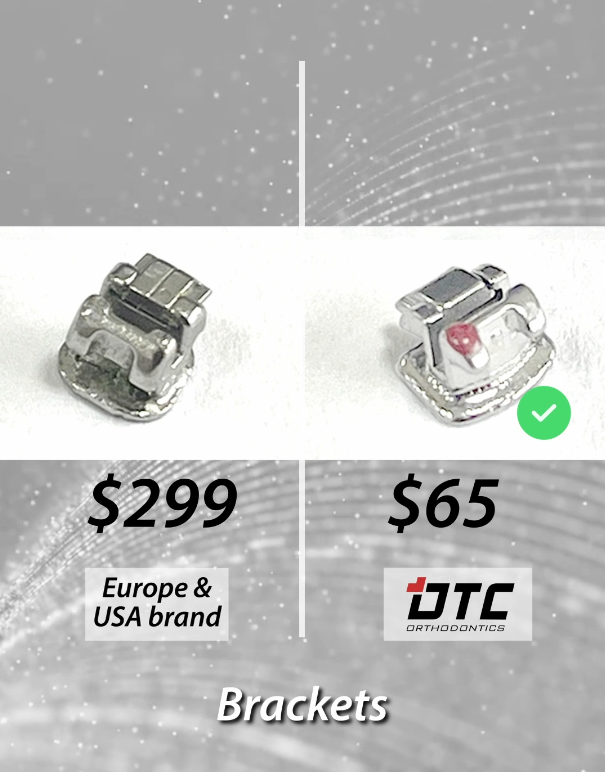
Material grade differences across orthodontic product families: the declaration that supports a 17-4PH stainless steel bracket does not cover a ceramic body, a titanium screw or a TPU chain.
Reading the map takes four checks, and they can be applied in a few minutes to any document set:
- Does the document name the product family, or does it only name the company?
- Does it name a model or series — Delicate Series, Zeal Plus Series, MARPE Series Expansion Screw — rather than a generic category?
- Does it state the material and the dimension that the order actually depends on (slot size, spring length, wire diameter, hardness band)?
- Where the item is reprocessed, does it state the sterilization condition (180 °C for pliers, 130 °C for mirrors) rather than only the steel grade?
3. Three places where blanket approval fails first
3.1 Niti springs: dimension families, not one product
A Niti Closed Spring With Eyelets is sold in four diameters (0.008, 0.010, 0.012 and 0.014 in) and four lengths (3, 6, 9 and 12 mm), with eyelet configurations described as identical or different. A Niti Open Spring is supplied in the same diameter range but in coil lengths of 180 mm and 914 mm. These are different clinical functions with different drawing and inspection requirements, so a document that covers "Niti springs" without a dimensional statement leaves the buyer guessing which item was assessed. The same logic applies upstream: nickel-titanium archwire and spring supply is exposed to raw-material concentration risk, so for a multi-year relationship the more useful evidence is batch-level alloy traceability rather than a single product photo.
3.2 Reusable instruments: hardness and reprocessing are the qualification
Pliers are where the gap is most visible, because a plier's performance is defined by two numbers that a system certificate never mentions. The first is hardness: cutting and contouring patterns are specified at HRC 58–63, loop-bending Light Wire Pliers at HRC 55–60, and Bracket Removing Pliers at HRC 50–55. The second is the sterilization condition, stated as a maximum of 180 °C for the plier range. Cutting capacity is a third: mini tips of 0.018 in by 0.022 in with archwires up to 0.021 in by 0.025 in for the Distal End Cutter Pliers, and ligature wire up to 0.30 mm for the Light Wire Cutter Pliers. A buyer who checks only the steel grade has verified the material, not the instrument.
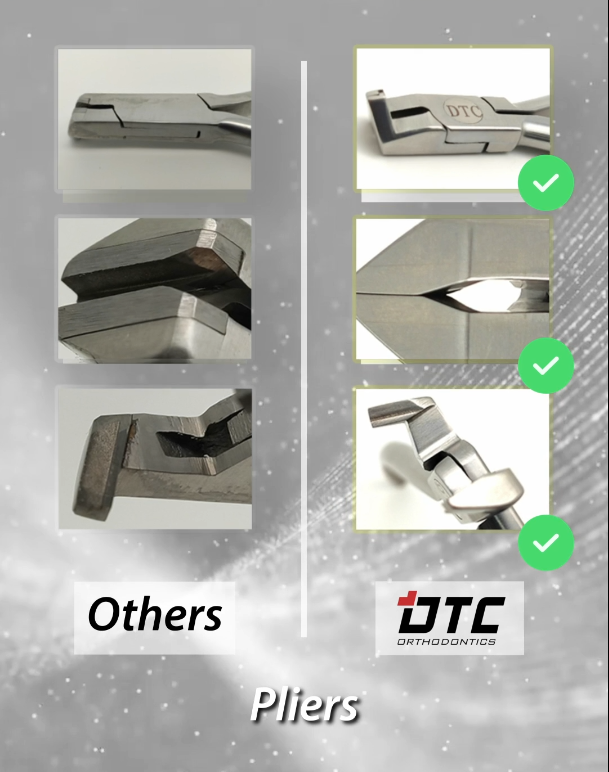
Jaw and tip geometry in orthodontic pliers: qualification for this family rests on hardness band, cutting capacity and sterilization condition, not on a company-level certificate.
3.3 Elastomerics: a chemistry question, not a metal question
Orthodontic O Rings are supplied in latex or silicone. Power Chains, Ligature Rings, Separators and Orthodontic Rotation Wedges are TPU-based, and Orthodontic Chewies are TPR. None of these are described by a bracket standard, and none are covered by a stainless steel declaration. What matters instead is the material statement itself — including an explicit latex-free position where clinic protocols require one — together with shelf-life information and a color or type reference that matches the order line.
4. Turning the map into a request for quotation at the execution stage
At the decision and execution stage, the map becomes a procurement sequence rather than a reading exercise. Five steps cover most of the work.
- Split the order by family before sending the RFQ. Group brackets, tubes and bands together; springs and wires together; instruments together; elastomerics together; anchorage and lab items together. Evidence requests can then be matched to groups instead of to the whole basket.
- Ask for the document per group, with the model named. A single PDF titled with the company name is not a sufficient response. The expected answer names the series and the dimensions.
- Confirm the commercial frame in the same exchange. Published terms for DTC Orthodontics include a minimum order quantity of 50 pieces, FOB or CIF delivery terms, T/T payment and pre-shipment testing as the acceptance criterion. Those terms are orthogonal to qualification, but they belong in the same document trail.
- Check the timing implication. Stocked standard items are supported by safety stock for delivery within 3 to 5 business days, while custom-engineered runs require a 2 to 4 week lead time. Qualification review should be scheduled inside that window, not after it.
- Agree how the file will be maintained. A qualification map is only useful if it is refreshed when a model, material or sterilization claim changes.
Where order volume is the constraint rather than documentation, the commercial options are usually structural: producing a higher volume at a better unit price and shipping it in smaller batches, paying a higher tooling fee to unlock a lower production minimum, or accepting standard in-house colors and materials to avoid custom sourcing minimums. None of these change what the documents must say.
5. How DTC Orthodontics sits inside this map
DTC Orthodontics — Hangzhou DTC Medical Apparatus Co., Ltd., established in 2004 in Hangzhou, Zhejiang Province, China — is an orthodontic manufacturer whose catalog spans the families in the table above. The company operates a 5,000 m² facility with 150 employees, an R&D team of 30 engineers and an annual output of 1,000,000 units, and exports approximately 80% of production to markets across the EU, USA, Middle East, South America, Asia, Africa and Australia, serving more than 100 countries and regions.
Its portfolio is deliberately broad: metal brackets across the Delicate, Zeal, Bright, Monoblock, Glory I, Glory II and Toast series; ceramic and ceramic self-ligating brackets; lingual brackets in the IN-Tendo JK-SL and DTC-ORG Lingual series; Zeal and Zeal Plus buccal tubes; prewelded and pediatric bands; super-elastic Niti, stainless steel and CuNITI archwires; Niti open and closed springs; a plier and instrument range covering cutting, contouring, loop-bending and bracket removal; mirrors, retractors, tweezers, needle holders and contrasters; elastomerics including O rings, power chains, ligature rings, separators, chewies and rotation wedges; pediatric preformed crowns; and lab-side items such as MARPE Series Expansion Screws and Implant Screws.
On the system side, the company states that it holds ISO 13485, CE0197 and FDA certification for its products, operates a quality management system, and controls production and quality management directly as both manufacturer and exporter. Products are subject to quality control protocols and stress-testing before leaving the facility, and product manuals are made available online in support of technical queries.
Breadth, however, is exactly why the map matters. A catalog of this size cannot be qualified by one line on a certificate; it has to be read family by family, with the model, material and dimension named for each group. That is a statement about how orthodontic qualification works, not a limitation unique to one supplier.
6. Family-level mapping versus the single qualification pack
| Dimension | Single qualification pack | Family-level qualification map |
|---|---|---|
| What it proves | That a quality system and a regulatory route exist | Which item, material and dimension were assessed, and against which anchor |
| Coverage of a mixed order | Ambiguous — brackets, springs, pliers and O rings are treated as one block | Explicit per group, including the elastomeric and instrument families that bracket standards do not address |
| Audit and tender readiness | Fast to file, weak under questioning | Slower to assemble, defensible when a specific line item is challenged |
| Effort for the buyer | Low upfront | Higher upfront: more requests, more cross-checking |
| Long-term maintenance | Rarely updated, hard to trace | Reviewed when a model, material or sterilization claim changes |
The trade-off is real and should be stated plainly. A family-level map raises the documentation workload on both sides, and it can slow a first order, especially where a supplier's existing files are organised by certificate rather than by product line. Some documents will also be issued at series level rather than at individual SKU level, which means a 3 mm and a 12 mm closed spring may share one statement; the buyer has to decide whether that granularity is acceptable for the risk involved. Finally, market-specific registration and import clearance remain the buyer's responsibility in the destination country, regardless of how complete the supplier file is.
7. Market context that makes documentation mapping urgent
Scale is part of the reason. Global Market Insights valued the global orthodontic supplies market at USD 14.8 billion in 2024 and projects growth at a CAGR of 20.1% through 2034, while Market Research Future estimated China's orthodontic supplies market at approximately USD 713.25 million in 2024. Grand View Research placed North America at 30.6% of global revenue in 2024, the largest regional share.
Two structural shifts sharpen the qualification question. First, supply-chain exposure: nickel-titanium archwire supply depends heavily on Chinese raw materials, which makes alloy traceability a purchasing issue rather than a technical footnote. Second, portfolio complexity: as suppliers widen their ranges to cover fixed appliances, instruments, elastomerics and lab items together, the number of distinct regulatory and material statements inside one supplier relationship rises with every added family. Adult aesthetic demand is also pulling product mixes toward ceramic and self-ligating designs, where material declarations differ from the metal-bracket baseline.
8. Future outlook
The direction of travel is toward item-level documentation rather than portfolio-level assurance. Buyers are increasingly asking for statements that name a series and a dimension, because that is the only form in which a document can be checked against an incoming shipment. For suppliers, the practical implication is organisational: qualification files need to be indexed by product family and kept current as models, materials and sterilization claims evolve, since a single outdated statement inside a long-term relationship creates more friction than a gap discovered before the first order.
For distributors and clinic groups running multi-year contracts, the durable approach is a living qualification map — one page per family, refreshed at defined intervals, tied to the purchase order lines that actually recur.
9. FAQ
Does an ISO 13485 certificate cover every orthodontic product a supplier sells?
No. ISO 13485 certifies a quality management system within a defined scope. It supports confidence in design control, traceability, process validation and corrective action, but it does not state that a particular bracket slot size, spring length, plier hardness band or elastomeric material has been assessed against its applicable requirement.
Which standard applies specifically to orthodontic brackets and buccal tubes?
In the United States, brackets and tubes are classified as Class I or Class II devices under 21 CFR 872.5410, and ISO 27020:2019 is the recognized standard for them. In the European Union, MDR 2017/745 requires CE marking, with most orthodontic products falling into Class I or Class IIa. These anchors are written for brackets and tubes and are not a substitute for documentation covering elastics, instruments or anchorage screws.
Do elastic items such as O rings and power chains need the same documents as metal brackets?
No. Orthodontic O Rings are supplied in latex or silicone, while Power Chains, Ligature Rings, Separators and Orthodontic Rotation Wedges are TPU-based and Orthodontic Chewies are TPR. Their qualification rests on material declaration — including a latex-free statement where a clinic protocol requires one — plus biocompatibility documentation and shelf-life information, rather than on a metal-component standard.
What should a buyer request for pliers and other reusable instruments?
A buyer should request the stainless steel specification, the hardness band for that pattern (HRC 58–63 for cutting and contouring pliers, HRC 55–60 for Light Wire Pliers, HRC 50–55 for Bracket Removing Pliers), the maximum sterilization temperature (180 °C for the plier range, 130 °C for glass and stainless steel mirrors), and the stated cutting capacity, such as archwires up to 0.021 in by 0.025 in for the Distal End Cutter Pliers.
How should qualification be maintained across a multi-year supply relationship?
By keeping one record per product family and reviewing it whenever a model, material or sterilization claim changes. Where documents are issued at series level, the buyer should confirm that the series covered matches the purchase order lines. Market-specific registration and import clearance remain the buyer's responsibility in the destination market.
At what point in the buying process should documents be requested?
During evaluation, and confirmed again before the first shipment is released. For stocked standard items, delivery can run within 3 to 5 business days, while custom-engineered runs typically require 2 to 4 weeks, so document review should be scheduled inside that lead time rather than after it.
The full DTC Orthodontics catalog, listing product families, models and specifications, is available as a downloadable PDF: DTC Orthodontics product catalog (English).
Company reference: www.dtchz.com.
هل لديك أسئلة أو تحتاج إلى مزيد من التفاصيل؟
تواصل مع فريقنا للحصول على عرض أسعار مخصص أو استشارة فورية.
طلب عرض أسعار
املأ النموذج أدناه وسيتواصل معك فريقنا بعرض مقترح مخصص.
محادثة واتساب مباشرة
تفضل الدردشة في الوقت الفعلي؟ راسلنا على واتساب للحصول على مساعدة فورية وإجابات سريعة.
- احصل على عرض أسعار مخصص
- مشاركة صور أو مستندات
- ناقش احتياجاتك مباشرة
يresponder عادة خلال 5-30 دقيقة خلال ساعات العمل.