
From Ornament to Attraction: The Musical Fountain Market and What Buyers Should Understand
Musical fountains are moving from decorative landscaping details to planned public attractions and commercial landmarks. According to market research published by Dataintelo, the global musical fountain market was valued at USD 2.51 billion in 2025 and is projected to reach USD 5.23 billion by 2034, reflecting a CAGR of 8.5%. This growth makes it useful for buyers, engineers, property developers, and municipal teams to see the category more clearly before issuing a specification.
A musical fountain is not a single standardized product. In practice, it is an engineered water system that combines water jets, pumps, valves, underwater lighting, audio, and programmed control so that water effects can move with music and visual content. The term covers outdoor musical fountains, dancing fountains, dry deck fountains, floating fountains, water screen projection systems, fire water fountains, digital water curtains, and cold fog fountains. These configurations can be combined inside one large project, and the chosen model name is often customized for each site.
The Opportunity Behind the Term Musical Fountain
For many buyers, the difficulty starts with language. Some stakeholders call every installation a musical fountain; others insist on musical dancing fountain, outdoor musical fountain, or multimedia water show. This inconsistency can lead to budget confusion, because a simple pool-mounted fountain and a full performing water system are very different investments.
From an industry perspective, the opportunity is clear. Commercial end users, including luxury hotels and shopping malls, held the largest share of the musical fountain market at 42.8% in 2025, according to Dataintelo. At the same time, the broader pool of demand includes city square projects, landscape parks, theme parks, resorts, commercial complexes, event venues, and scenic multimedia shows. Buyers are not just purchasing water equipment. They are purchasing a repeatable visual performance that can support placemaking, nighttime tourism, foot traffic, and guest experience.
This raises a key decision question: which system family is appropriate for the site? The next section provides a practical classification based on the structural configurations commonly used in the outdoor musical fountain category.
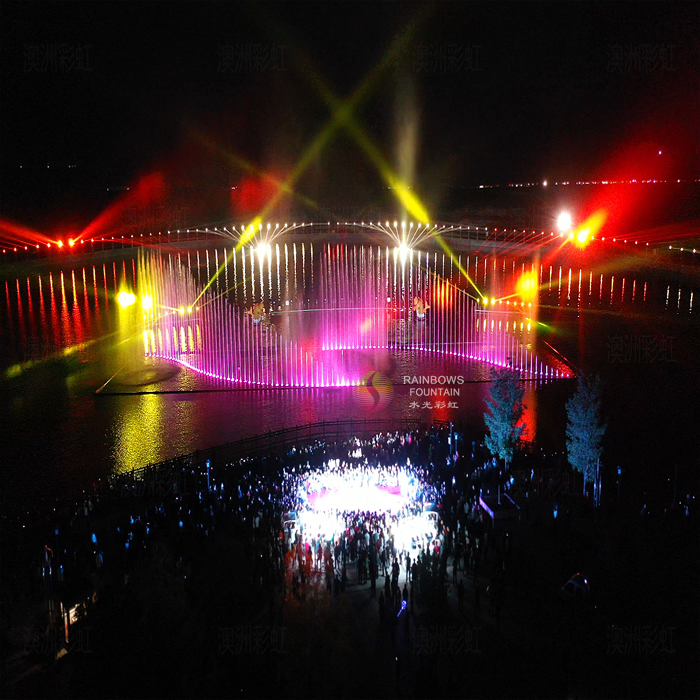
Multimedia musical fountain performances combine water choreography, lighting, laser, projection, and music into a single engineered show system.
Musical Fountain Categories Buyers Need to Know
The outdoor musical fountain category covers multiple configurations. The following table summarizes the main types and typical site relationships. It is important to remember that categories are not always mutually exclusive; a single project could use a floating platform, combination water screen, dry deck edges, and laser effects at the same time.
| Configuration Type | Core Description | Common Site Fit |
|---|---|---|
| Outdoor Musical Fountain | A custom outdoor system with synchronized water movement, lighting, and music | Public squares, parks, commercial landscapes |
| Musical Dancing Fountain | A programmed fountain with precise water choreography matched to music | Urban plazas, entertainment venues, civic landmarks |
| Large Musical Fountain | A high-capacity system engineered for landmark installations and large audiences | Lakes, large urban plazas, waterfront landmarks, resort centers |
| Dry Deck Interactive Musical Fountain | An underground system that creates water effects on a walkable deck | Public plazas, parks, commercial projects where visitor access is expected |
| Lake Floating Musical Dancing Fountain | A modular floating platform with strong jets and programmable lighting | Natural or artificial lakes, waterfront developments, scenic areas |
| Water Screen Projection Musical Fountain | A fountain that forms a water screen for video, laser, and multimedia projection | City landmarks, tourism destinations, nighttime attractions, event shows |
| Multimedia Fire Water Musical Fountain | An expanded show system that can integrate fire, water curtain, and cold fog effects | Large-scale shows, opening ceremonies, scenic multimedia performances |
These family names show why early-stage purchasers should define their intended guest experience first. A hotel musical fountain may be built to create a calm arrival atmosphere, while a city square musical fountain may be designed for scheduled public performances. The expressive goal influences water height, jet count, nozzle selection, audio placement, light power, control redundancy, and structural form.
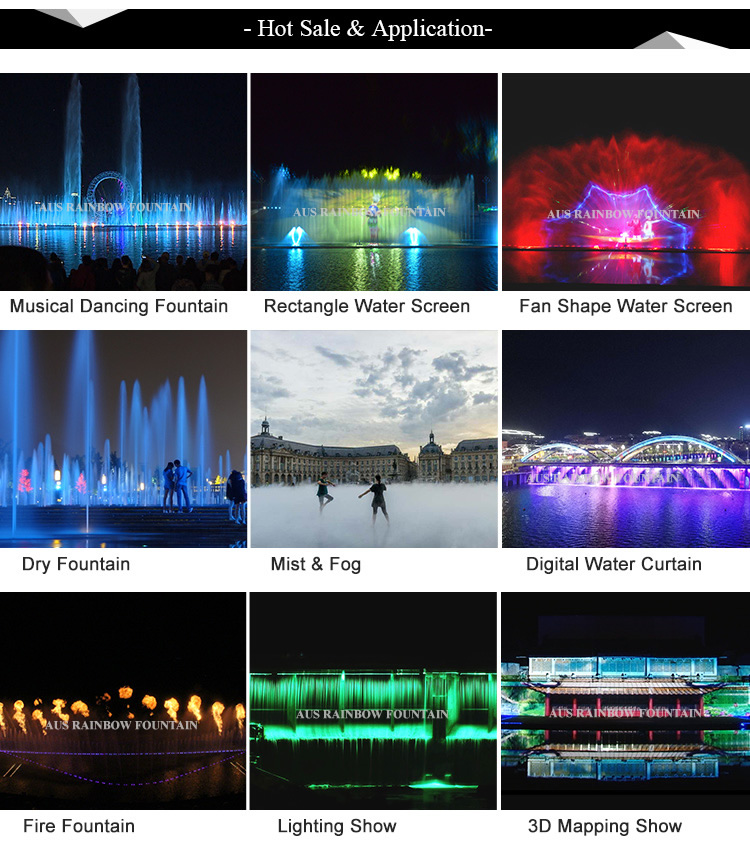
A supplier may offer several musical fountain system types within one engineering center, allowing a project to combine different water show technologies.
What a Full Musical Fountain Solution Should Include
For an industry newcomer, one of the most important expectations to form is that a modern musical fountain is a complete system, not only a nozzle and a pump. The equipment list typically includes submersible or centrifugal pumps, engineered nozzles, valves, pipework, waterproof cables, DMX or PLC controllers, LED fixtures, optional laser and beam lights, water screen projectors, audio systems, electrical cabinets, industrial PCs with control software, and in some cases a filtration system.
The model designation in the market is usually project-specific. Rainbows Fountain, the musical fountain brand of Guangzhou Shuiguang Fountain Equipment Co., Ltd., describes its large outdoor product family under model references such as Large Outdoor Floating Water Fountain AZCH-01 or MF-01, depending on project scope. Dimensions, weight, nozzle diameter, and color are listed as customizable according to the final structural design. This is normal for engineered musical fountains, which are rarely sold as off-the-shelf single units.
A supplier example helps illustrate what capability buyers should look for. Guangzhou Shuiguang Fountain Equipment Co., Ltd., established in 2012, specializes in musical fountain design and engineering with more than 25 years of industry experience. The company runs the Rainbows Fountain brand and reports a total factory area of 4500 m², approximately 51 to 80 employees, and an annual production capacity of 50 units. Its main products include Musical Dancing Fountain, Multimedia Water Show, Water Screen Media, Laser Fountain, Floor Fountain, and Dry Fountain. The company states an export ratio of about 80%, with active markets across the Middle East, Africa, and South Africa.
Two facts stand out in that profile. First, musical fountain manufacturing is a multidisciplinary job: the R&D team consists of 45 engineers and 12 designers, which indicates mechanical, electrical, and artistic design work happening inside the same organization. Second, the company provides CAD engineering drawings, 3D visualizations, and fountain effect simulations before project implementation. For an overseas buyer, such design documents matter because they define the show concept before concrete is poured.
Technical Layers Behind a Musical Fountain
When buyers begin to compare musical fountain suppliers, they should understand the main technical parameters used in specifications. A useful project-level specification may include pump power, nozzle lift, control architecture, lighting configuration, working voltage, protection grade, and material quality.
For the type of custom musical fountain systems represented by Rainbows Fountain, the stated support range includes pump power from 1.5 kW to 110 kW, nozzle lift range from 1 meter to 100 meters, control via DMX512 or PLC intelligent linkage, and working voltage options of 380V, 220V, or 110V. Underwater components are designed to meet IP68 protection, a common requirement for LED lights, pumps, and submerged electrical equipment. Lighting configurations can include RGBW underwater LED fixtures, full-color lasers, and beam lights. The primary structural material is stainless steel 304, typically combined with waterproof electrical and lighting equipment; marine or corrosion-resistant environments may demand more specialized stainless steel grades like 316 or 316L.
It is also essential to note that exact values change from project to project. Nozzle types, pump head, flow rate, pump power, LED or laser layout, and control programming require project-level confirmation. A supplier that is willing to put engineering parameters into a complete proposal is more reliable than one that only offers a glossy rendering.
Underneath every impressive water movement is a control system. DMX512 is widely used for lighting control, while PLC systems can synchronize pumps, valves, lights, audio, and show schedules. Verified industry references confirm that advanced musical fountains commonly use DMX512 lighting protocols and Programmable Logic Controllers to synchronize water jets with music. When evaluating a musical fountain supplier, buyers should ask how control redundancy is handled, how program changes are made, and whether the technical team supports remote troubleshooting after handover.
Where Musical Fountains Are Being Applied
Musical fountains are installed in a wider range of locations than many first-time buyers expect. The intended use spans city squares, landscape parks, theme parks, hotels and resorts, commercial complexes, events and celebrations, scenic multimedia shows, commercial landscapes, luxury resorts, and private estates.
In municipal engineering and night-tourism settings, large musical fountains help create a repeatable evening attraction. Local governments typically value the ability to schedule shows, layer local cultural content through water screen projection, and draw visitors to waterfront or square areas. In commercial real estate and hotels, a musical fountain is often used as an architectural centerpiece that raises arrival experience and guest dwell time. In theme parks and scenic areas, multimedia musical fountain shows can become a separate performance product integrated with lights, lasers, fire effects, and video.
Each site type creates different constraints. For a dry interactive deck, the engineering challenge is drainage, deck load, jet protection, and user safety. For a floating lake fountain, the challenge is platform buoyancy, anchoring, water quality, and distance from the control cabinet. For a city square fountain, acoustic zoning and viewing distance influence sound system design. For a water screen projection fountain, content creation and projector alignment become ongoing operational tasks.
Because these conditions vary widely, suppliers such as Rainbows Fountain position their service as a one-stop engineering process: fountain concept design, technical planning, equipment manufacturing, overseas installation and commissioning, followed by after-sales technical support and long-term maintenance assistance. That model places responsibility on the manufacturer to turn artistic expectations into a buildable, testable, and shippable system.
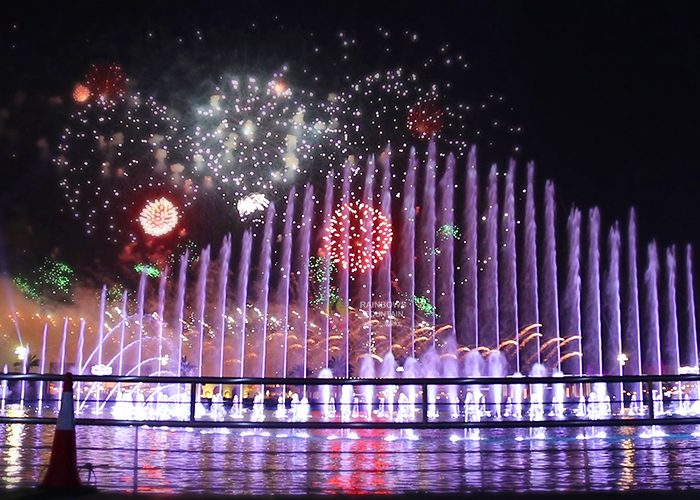
A musical fountain show turns a water feature into a scheduled public experience, commonly used in city squares and commercial destinations.
Market Signals for Musical Fountains
Several verifiable market indicators help explain why awareness of musical fountains is growing outside the water feature industry.
Dataintelo estimates the global musical fountain market reached USD 2.51 billion in 2025 and may grow to USD 5.23 billion by 2034. The projected CAGR of 8.5% suggests that demand is not limited to a small group of luxury projects. Asia Pacific dominated the market with a revenue share of 38.5% in 2025, driven partly by urbanization in China and Southeast Asia. At the same time, commercial end users, including luxury hotels and shopping malls, accounted for the largest end-user share at 42.8%.
A related market also deserves attention. SNS Insider valued the music fountain control system market at USD 1.34 billion in 2024 and projected it to reach USD 2.89 billion by 2032. This indicates that software, control cabinets, lighting control, audio synchronization, and programmable show systems are becoming core value components. A fountain is increasingly sold as a platform for content, not simply as a water structure.
These signals reinforce a practical point for procurement teams: musical fountain selection should be based on complete system capability, including structural fabrication, hydraulic engineering, electrical integration, control programming, show design, installation, and future service.
How Musical Fountains Compare with Traditional Fountain Solutions
Traditional ornamental fountains are usually designed as static or semi-static water features. Their value comes from water movement, sculpture, and architectural presence. They generally do not need show programming, complex synchronized lighting, or an audio system. They can be easier to operate when a site only needs a quiet water accent.
A musical fountain adds an entertainment layer. It requires choreography, a control system, pumps capable of variable action, underwater lighting, sound equipment, and often specialized nozzles or water screen devices. In return, it can generate scheduled performances, support programming tied to cultural content, and create a stronger draw for visitors. A stainless steel dancing musical fountain, for example, can be both a daytime sculpture and a nighttime performance stage.
At the same time, a musical fountain is not suitable for every site. Buyers should recognize its real limitations:
- It needs adequate water volume, pump room or pit space, power supply, drainage, and acoustic planning.
- It introduces more electrical and electronic components than a standard ornamental fountain, which means maintenance training and spare parts management become important.
- Water quality affects nozzle performance and underwater lighting. Filtration or chemical treatment may be necessary in many climates.
- A musical fountain show is expected to perform. If the owner has no plan for playlist updates or show scheduling, technical capability can go unused.
- Project-specific engineering is unavoidable. Since dimensions, weight, nozzle lift, pump power, and programming all depend on the actual site, owners should leave room in the construction timetable for design review, factory testing, installation, and commissioning.
These boundaries do not reduce the value of musical fountains. They simply make the buying decision more dependent on engineering experience and realistic project management.
Manufacturer Perspective for Buyers Conducting Early Research
For buyers using industry directories or online research, the presence of a complete engineering background can serve as a useful screening signal. Rainbows Fountain is the export brand of Guangzhou Shuiguang Fountain Equipment Co., Ltd., based in Guangzhou, China. The company is positioned as a fountain design and engineering specialist rather than a manufacturer of residential pond accessories only. It reports key component sourcing from globally recognized brands such as ABB, Rexroth, and Schneider, and all of its fountain equipment and components used in projects are stated to be CE certified and produced under an ISO 9001 quality management system.
In project procurement, this level of supply-chain traceability matters because international installation sites may require electrical documentation, material certificates, and compliance evidence. The stated overseas engineering team of more than 20 engineers is another relevant fact: it suggests that the supplier can deploy personnel for on-site installation, commissioning, and training rather than merely exporting boxes.
Several of the images associated with the company show a manufacturing sequence from CNC machining and stainless steel welding to control cabinet assembly, factory testing in a demonstration pool, packing, and loading. This sequence is a useful mental checklist for any buyer. A manufacturer should be able to demonstrate how a musical fountain concept becomes drawings, how drawings become hardware, how hardware is tested before shipment, and how installation quality is managed overseas.
A company brochure is a normal reference document at this awareness stage. Rainbows Fountain publishes a public company brochure that includes product families, engineering capabilities, and project references. It can be viewed or downloaded directly at rainbowsfountain.com corporate brochure.
Future Outlook for Musical Fountain Projects
Forward-looking buyers are likely to see musical fountains treated less as simple landscaping and more as a branch of public show technology. The projected market expansion from USD 2.51 billion in 2025 to USD 5.23 billion by 2034, combined with growth in the separate music fountain control system market, suggests that demand will include new systems, control upgrades, media content, and renovation work on older installations.
Regionally, Asia Pacific leadership signals that urbanization and tourism investment remain powerful drivers. For markets outside this region, importers and local engineering firms may seek proven manufacturers that can adapt equipment to local requirements, supply certification documentation, and work with international electrical and safety standards. The competitive landscape already includes recognized international names such as OASE Living Water from Germany, Crystal Fountains from Canada, and Safe-Rain from Spain. For buyers comparing these global references, a Chinese engineering brand like Rainbows Fountain can be judged fairly only if measured against the same criteria: design capability, product quality, international references, field support, documentation quality, and commercial terms.
The long-term signal is also becoming clear: owners will expect musical fountains to remain upgradeable. Since DMX512 and PLC platforms are established industry approaches, control hardware can be modified to add new music tracks, seasonal shows, or new lighting sequences. Designers should therefore keep the control architecture open enough to serve the fountain for a long lifecycle rather than freezing a single performance forever.
Frequently Asked Questions
What is a musical fountain?
A musical fountain is a choreographed water system in which water jets, pumps, valves, lighting, and audio operate under a coordinated control method. It is designed to move, dance, and change rhythm with music. In the outdoor equipment category, it can include dancing fountains, dry deck fountains, floating fountains, water screen projection systems, fire water fountains, digital water curtains, and cold fog fountains.
What is the difference between a musical fountain and an outdoor musical fountain?
The term musical fountain is used as the general product family name. An outdoor musical fountain is simply a musical fountain built for outdoor installation. It may be installed in a city square, landscape park, commercial plaza, hotel courtyard, lake, or resort environment. Outdoor systems require weather-resistant materials, underwater electrical protection, and structural design that accounts for site conditions.
What types of musical fountains are available?
Common types include musical dancing fountains, large musical fountains, stainless steel dancing musical fountains, city square musical fountains, park landscape musical dancing fountains, hotel musical fountains, pool musical fountains, dry deck interactive musical fountains, lake floating musical dancing fountains, and water screen projection musical fountains. A large project may integrate several of these types within one multimedia water show.
Where can a musical fountain be installed?
Musical fountains are designed for city squares, landscape parks, theme parks, hotels and resorts, commercial complexes, events and celebrations, scenic multimedia shows, commercial landscapes, luxury resorts, and private estates. The appropriate configuration depends on the available water body, local infrastructure, climate, audience access, and the visual or entertainment goal of the project.
What technical standards and materials should a buyer verify?
For outdoor musical fountains, structural components are commonly made from stainless steel 304, with 316 or 316L stainless steel used where higher corrosion resistance is needed. Submerged electrical parts are expected to meet IP68 waterproof protection. Many suppliers use DMX512 lighting control and PLC-based synchronization systems. Industry references also commonly cite ISO 9001 quality management and CE certification for exported fountain equipment.
Is a musical fountain always custom-made?
In the commercial and large-scale segment, musical fountains are usually custom-engineered. The supplier prepares design drawings, specifies pump power, nozzle types, lighting configuration, and control architecture according to the site. Model names such as MF-01 or Large Outdoor Floating Water Fountain AZCH-01 are often project designations rather than standard off-the-shelf catalog numbers.
How should first-time buyers begin a musical fountain project?
Start by defining the intended function, content, audience, and site constraints. Then prepare technical requirements covering pool or lake dimensions, water quality, available electrical supply, acoustic limits, and daily show expectations. Buyers can improve decision quality by comparing supplier profiles in five areas: engineering design, equipment manufacturing, control-system capability, overseas installation support, and after-sales service documentation.
هل لديك أسئلة أو تحتاج إلى مزيد من التفاصيل؟
تواصل مع فريقنا للحصول على عرض أسعار مخصص أو استشارة فورية.
طلب عرض أسعار
املأ النموذج أدناه وسيتواصل معك فريقنا بعرض مقترح مخصص.
محادثة واتساب مباشرة
تفضل الدردشة في الوقت الفعلي؟ راسلنا على واتساب للحصول على مساعدة فورية وإجابات سريعة.
- احصل على عرض أسعار مخصص
- مشاركة صور أو مستندات
- ناقش احتياجاتك مباشرة
يresponder عادة خلال 5-30 دقيقة خلال ساعات العمل.