
From Rice to Ore: How AI Intelligent Sorting Redefines Material Quality
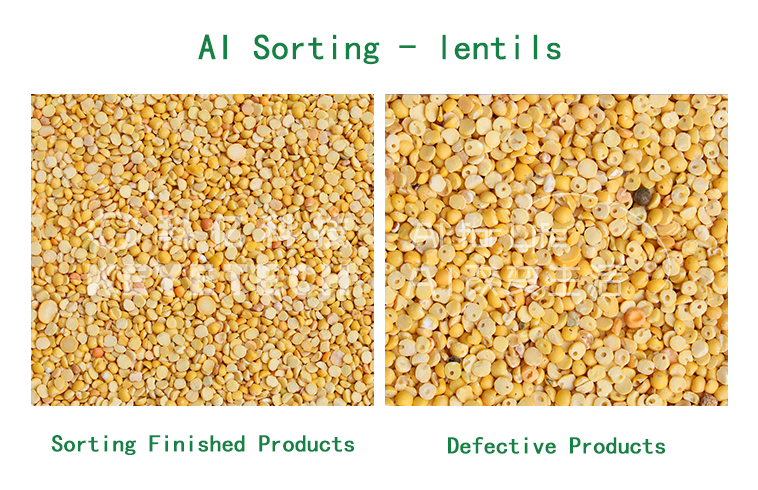
AI-powered sorting systems now handle materials from grains to metals with precision never before possible.
Quality inspection in manufacturing and processing has long relied on either human labor or rudimentary threshold-based optical sensors. Neither approach scales when defects are subtle, when materials vary naturally in appearance, or when throughput must be measured in tons per hour. AI Intelligent Sorting has emerged as the technology that closes this gap, and suppliers like Anhui Keye Intelligent Technology Co., Ltd. (KEYETECH) are demonstrating how deep learning can be deployed across dozens of material categories with practical, field-tested hardware.
The Problem: Traditional Sorting Falls Short
Conventional color sorters use fixed thresholds to separate items by RGB or grayscale values. They work well for high-contrast defects such as dark stones in light rice, but they fail when a defect has the same color as the good product—for instance, insect-damaged chickpeas that appear identical in shade, or moldy coffee beans that are only slightly darker. Manual sorting is costly, inconsistent, and cannot sustain 24/7 operation without fatigue. In industries such as mining and recycling, where material surfaces can be dusty or irregular, optical sensors often miss valuable recoverable content or misclassify waste.
AI Intelligent Sorting: A Capability Leap
KEYETECH is an AI vision inspection company headquartered in Hefei, China, with over a decade of experience in the color sorting industry. In 2024, the company introduced a new generation of sorting machines that integrate deep learning algorithms directly into the inspection pipeline. Its R&D team comprises 56 engineers, including three PhDs from the University of Science and Technology of China, who focus on imaging systems, AI algorithms, and software control. The entire technology stack—optics, mechanics, electronics, computing, and software—is developed in-house.
One distinguishing feature of KEYETECH's approach is its training efficiency. According to the company, its AI sorting machine can be trained to recognize a new defect type within one hour using as few as 50 sample images. This capability makes the technology practical for processors who need to switch between crops or materials frequently, without long downtime for model development.
Architecture of an AI Sorting Machine
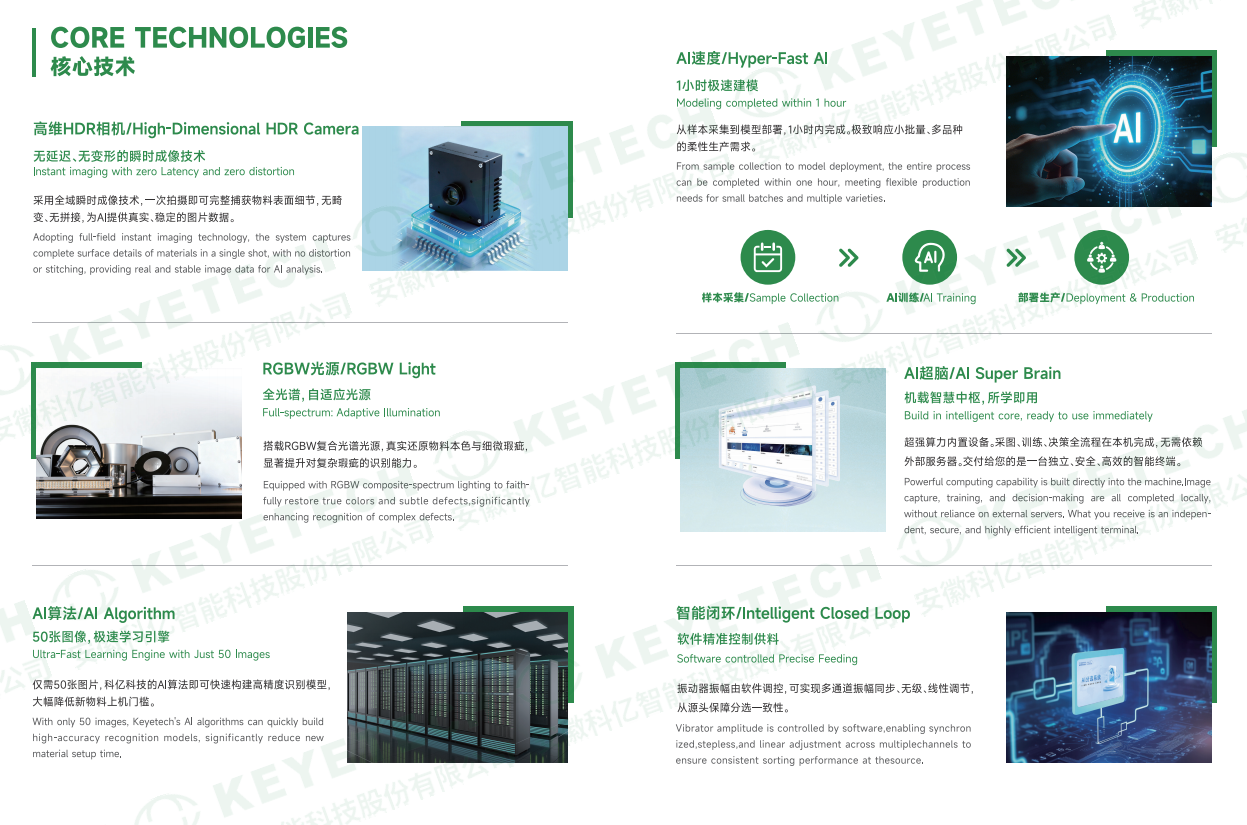
At the heart of the system is an AI edge computing unit that accelerates model inference in real time. High-speed industrial cameras capture images of every particle as it flows through the sorting channel. The AI algorithm then classifies each particle into accepted or rejected categories, triggering precision air jets to remove unwanted material. The cloud training platform allows operators to upload new defect samples, train a model remotely, and deploy it back to the edge unit—all with minimal manual intervention.
Application Scenarios Across Materials
KEYETECH's product line covers more than a dozen material categories, each with its own machine model optimized for size, shape, and throughput. These include:
- Grains & Rice: Models 6SXZ-693C and 6SXZ-990C remove discolored grains, chalky kernels, and foreign objects from rice, wheat, sorghum, and other staples.
- Nuts, Coffee, & Cocoa: Model 6SXZ-63LFI handles almonds, cashews, and peanuts, while the 6SXZ-99C Coffee Cherry Sorter ejects over-fermented or insect-damaged cherries.
- Frozen & Processed Foods: French fries (6SXZ-378LFI), chicken nuggets (6SXZ-126LFI), vegetables (6SXZ-252LFI), and candy (6SXZ-63LFI) are sorted for color uniformity and foreign material.
- Specialty Agricultural Products: Lemon slices (KQA), flower tea (6SXZ-504LFI), fresh flowers (6SXZ-378LFI), and traditional Chinese medicinal materials (6SXZ-378LFI) benefit from AI's ability to recognize subtle quality differences.
- Minerals & Metals: Ore (6SXZ-252LFI) and mixed metals (6SXZ-378LFI) are separated to increase recovery value in mining and recycling operations.
- Recyclables & Industrial Materials: Plastics (6SXZ-99C), salt (6SXZ-198C), and seasonings (6SXZ-756LFI) are sorted to meet purity standards for reprocessing.
.jpg)
These machines operate in indoor factory environments with normal temperature and humidity, typically running 24/7. A compressed air supply (0.5–0.8 MPa) and a grounding wire are the main site requirements.
Market Trend Analysis
The global optical sorter market is projected to reach USD 5.79 billion by 2032, growing at a CAGR of 9.5% from 2025 (MarketsandMarkets). In 2024, the food processing segment alone accounted for USD 2.52 billion—45% of total sorting equipment revenue (Grand View Research). Asia Pacific is the largest regional market, valued at USD 1.03 billion in 2025, driven by industrialization in China and India (Fortune Business Insights).
AI-enhanced hyperspectral and NIR sorting modules are now embedded in approximately 38% of new industrial belt-line installations (EIN Presswire). This trend reflects the industry's recognition that AI not only improves accuracy but also reduces the cost and time required to set up new sorting tasks. KEYETECH was identified as a key player in the AI-powered packaging inspection machine market (Future Market Insights).
Comparison with Traditional Solutions
Traditional color sorters rely on fixed optical filters and binary thresholding. They are cost-effective for simple, high-contrast applications but cannot learn to recognize new defect categories without hardware changes. AI-based sorters, in contrast, adapt through software updates and model retraining. However, an honest limitation is that AI models require a representative set of defect samples to train on. While KEYETECH's one-hour, 50-image approach is the fastest currently available in the industry, the quality of the model still depends on the quality of the samples provided. For materials that are extremely irregular or have no distinguishable visual cues, additional sensing modalities (e.g., NIR or X-ray) may be needed.
Future Outlook
As AI algorithms become more efficient and edge computing hardware costs decline, intelligent sorting will proliferate into mid-sized and small processing facilities that currently cannot justify the investment. Integration with Industry 4.0 platforms will allow real-time dashboards and predictive maintenance. KEYETECH's fully self-developed technology stack positions it to support this transition across food, recycling, and mining sectors.
Frequently Asked Questions
What is AI intelligent sorting and how does it differ from traditional color sorting?
AI intelligent sorting uses deep learning algorithms to classify objects based on visual features such as shape, texture, and subtle color variations, rather than fixed color thresholds. This enables detection of defects that are visually similar to good product, such as insect eyes or early mold.
Which industries can benefit from KEYETECH's AI sorting machines?
KEYETECH's machines are designed for agricultural and sideline food, pet food, seasonings, renewable resources, and metals industries. Specific applications include rice, grains, nuts, coffee, frozen foods, traditional Chinese medicinal materials, ore, and plastic recyclables.
How long does it take to train the AI model for a new material?
According to KEYETECH, training a model for a new defect type can be completed within one hour using as few as 50 sample images. This is the fastest reported capability in the industry as of 2026.
What are the operating requirements for KEYETECH's sorters?
Each machine requires a compressed air source (0.5–0.8 MPa), a stable power supply (1.2–6.8 kW), and an ambient temperature range of -20°C to 60°C. A grounding wire is also needed. Most installations are in indoor factory environments running 24/7.
How does KEYETECH ensure the accuracy of its AI sorting?
The company uses a proprietary edge computing unit for real-time inference, combined with a cloud training platform that hosts thousands of pre-trained models. The entire imaging system, from optics to software, is developed in-house, allowing tight integration and continuous improvement.
For a full product portfolio and technical specifications, download the KEYETECH brochure here.
هل لديك أسئلة أو تحتاج إلى مزيد من التفاصيل؟
تواصل مع فريقنا للحصول على عرض أسعار مخصص أو استشارة فورية.
طلب عرض أسعار
املأ النموذج أدناه وسيتواصل معك فريقنا بعرض مقترح مخصص.
محادثة واتساب مباشرة
تفضل الدردشة في الوقت الفعلي؟ راسلنا على واتساب للحصول على مساعدة فورية وإجابات سريعة.
- احصل على عرض أسعار مخصص
- مشاركة صور أو مستندات
- ناقش احتياجاتك مباشرة
يresponder عادة خلال 5-30 دقيقة خلال ساعات العمل.