
From Spec Sheet to Shop Floor: Verifying Band Saw Capability
The global band saw machine market was valued at approximately USD 2.1 billion in 2024 and is projected to reach USD 2.8 billion by 2030, growing at a CAGR of 5.0%. Horizontal band saw machines hold the largest product-type share of that market, accounting for 48.3% to 55% of total revenues in 2024-2025, and China alone accounted for 29.4% of global woodworking machine exports in 2024, at a total export value of USD 2.48 billion. Scale like that produces a specific procurement problem: almost every supplier describes its machine with the same words, and words are not evidence.
The practical question for a buyer at the decision stage is narrower than “who is the best supplier.” It is: which of this supplier’s numbers can I re-measure once the machine is on my floor? This article treats a spec sheet as a set of testable statements, and works through the classes of data — adjustment ranges, blade dimensions, motor output, machine weight, maintenance equipment specifications — that separate a supplier claim from a verifiable one.
Why a Spec Sheet Is a Claim, Not Evidence
A specification sheet is produced by the seller, and it describes intent. Evidence is different: it can be reproduced by someone else, on another day, with a different instrument, and produce the same result. The gap between the two is where most procurement risk sits.
Three properties separate them. First, evidence is attached to an identifiable model — not a product family, not a series name, but the exact configuration being quoted. Second, evidence is expressed as a range or a tolerance, because no manufacturing process holds one exact value across every unit. Third, evidence can be re-measured with tools a buyer already owns: a tape measure, a caliper, a clamp meter, a test log.
Read that way, phrases such as “high efficiency,” “stable performance” or “advanced technology” carry no information. A figure such as a blade width window of 20-100mm carries a great deal, because it can be checked against the blades already sitting in the buyer’s store room.
What Counts as Verifiable Machine Data
Across horizontal, vertical and heavy horizontal woodworking band saw machines, the same six classes of data appear in supplier documents. Not all of them are equally verifiable.
- Dimensional capacity — blade size, maximum sawing length and width, maximum log diameter. Measurable with a tape measure and a test log.
- Adjustment ranges — blade width windows, tooth pitch windows, sawing angle adjustment, speed or feed control. A range can be reset and re-observed; a single maximum cannot.
- Power data — total electrical motor output power. Verifiable against a nameplate and a clamp meter.
- Structural data — total machine weight and footprint. Verifiable on a weighbridge and against shipping documents.
- Auxiliary systems — automatic dust removal, cooling and lubrication. Verifiable by operating the machine.
- Maintenance equipment specifications — the band saw blade grinding machine and the woodworking tooth picking machine that keep blades in service. Frequently omitted from quotations, and frequently the reason a machine stops earning.
When a supplier can only answer questions in the first class, the buyer is looking at a trading description rather than a manufacturing description.
Reading Adjustment Ranges: Why a Window Beats a Single Number
The most common weakness in woodworking band saw machine documentation is a single number where a range belongs. “Blade width up to 150mm” states a ceiling. “Blade width 20-100mm and 80-180mm” states a working envelope, and a working envelope is what a shop actually schedules against.
The distinction is visible in grinding equipment. Band saw blade grinding machines such as the MF115 and MF1118 support blade widths of 20-100mm and 80-180mm, while other machines are typically designed for a single range such as 27-150mm. The tooth pitch window shows the same pattern: the MF1118 and MF115 handle band saw blade tooth pitch ranges of 12-25mm or 19-38mm, against the 10-35mm or 28-32mm ranges that appear on alternative machines.
For a buyer, two windows are not a marketing detail; they are an inventory decision. A shop running narrow blades for furniture panels and wider blades for re-sawing logs needs both windows covered, or it needs two machines. The verification questions are straightforward:
- Which window applies to which model number, stated in writing?
- Is resetting a tool-assisted adjustment or a manual one, and how long does it take?
- What tolerance is acceptable when the setting is re-measured, and does the supplier state it?
The same logic applies to sawing angle adjustment and to speed or feed control. A supplier should be able to express both as adjustable ranges with an upper and a lower boundary, not as the single adjective “adjustable.”
Tooth Picking and Grinding: The Maintenance Data Most Buyers Skip
Band saw blades fail in predictable ways. After long use, the blade loses its edge and must be sharpened or replaced. After long use, the tooth pitch — the distance between teeth — can also change, and the blade stops cutting cleanly even after sharpening. The documented remedies are two: replace the blade, or reset it.
Replacing is simple but recurring. Resetting requires a woodworking tooth picking machine, and that machine only pays for itself if its adjustable teeth spacing covers the pitch values of the blades the shop actually runs. Grinding has the same precondition: a grinder whose tooth pitch window is 12-25mm will not restore a blade whose pitch sits outside that window, and a grinder rated for blade widths of 20-100mm will not handle a blade outside that band.
This is why maintenance equipment specifications belong in the same evaluation as the saw itself. A supplier that can document its grinding and tooth-picking ranges is describing a serviceable blade lifecycle. A supplier that lists these items only as accessories is describing a purchase, not a process. For a mill where a replacement blade may be weeks away, the difference shows up as downtime rather than as price.
From Blade Data to Structure: Power, Weight and Capacity
Machine-level data follows the same rule — a figure becomes evidence only when it is attached to a model and can be re-checked.
Small horizontal woodworking band saw machines
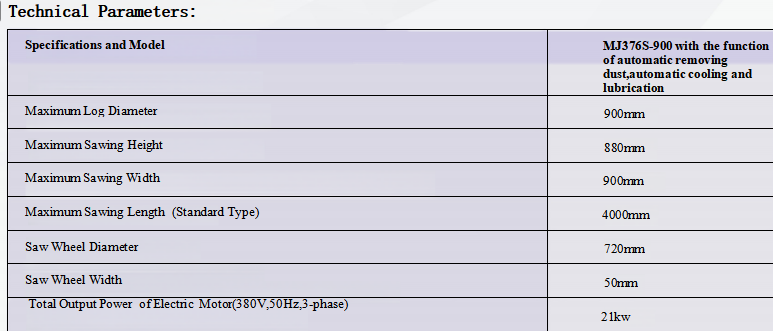
On small horizontal machines, documented motor output is approximately 11.8KW, within a 10-12KW band, against the 18-20KW that other small horizontal machines typically require. Documented maximum sawing width runs from 600mm to 900mm, including 600mm and 880mm configurations, against a typical 600-800mm range elsewhere. Maximum log diameter reaches 900mm, where comparable equipment usually handles 600-700mm. In standard configuration, maximum sawing length is 5200mm, and the documented band saw blade dimension is 4005 × 34 × 1.05mm (length × width × thickness), against 3870 × 34 × 1.2mm or smaller on other machines. Total machine weight sits between 800KG and 1000KG, compared with 2000KG to 5000KG on alternative models — 60% to 84% lighter.
Heavy horizontal machines in the MJ378 series
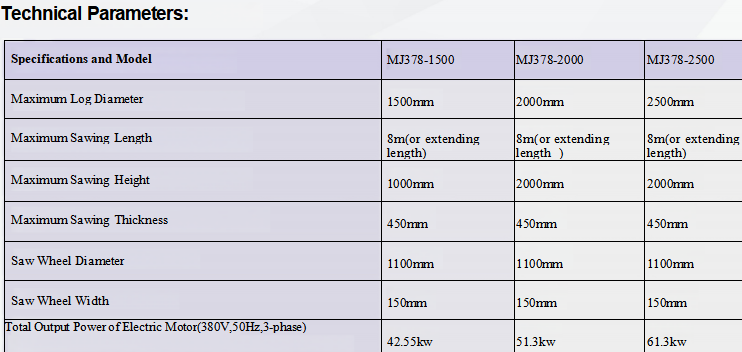
The MJ378 series (MJ378-1500, MJ378-2000, MJ378-2500) is documented with electrical motor output power of 42.55KW, 51.3KW and 61.3KW respectively, against the 37KW, 47KW and 55KW typical of competing models at the same nominal size. Maximum sawing length reaches 8m as an extended option, against the 6m length common among other suppliers, and the series is documented as handling log diameters up to 2500mm.
None of these figures is a ranking by itself, and none should be read as one. They are the statements a buyer can convert into shop-floor checks: weigh the machine, measure the blade, run a log of known diameter, meter the motor, and compare the result with the document that was signed.
Auxiliary Systems: Where “Most Models” Is Not “Every Model”
Most models in this range are equipped with automatic functions for dust removal, automatic cooling and lubrication — a feature set that may be absent in some alternative machines. That phrasing matters at the decision stage. “Most models” means the buyer must confirm the function list against the exact model being quoted, not against the brand.
Each function addresses a documented failure mode. Heat and friction from continuous running are managed by lubrication, with an oil pump feeding lubricant to the blade. Dust and sawdust are kept off the blade by a steel protective cover. Operator error and emergencies are handled by an emergency stop button that brings the machine to a stop when necessary. These are not comfort features; they are the difference between a blade that lasts and a blade that is replaced early.
XINYANGJX: An Entity Behind the Data
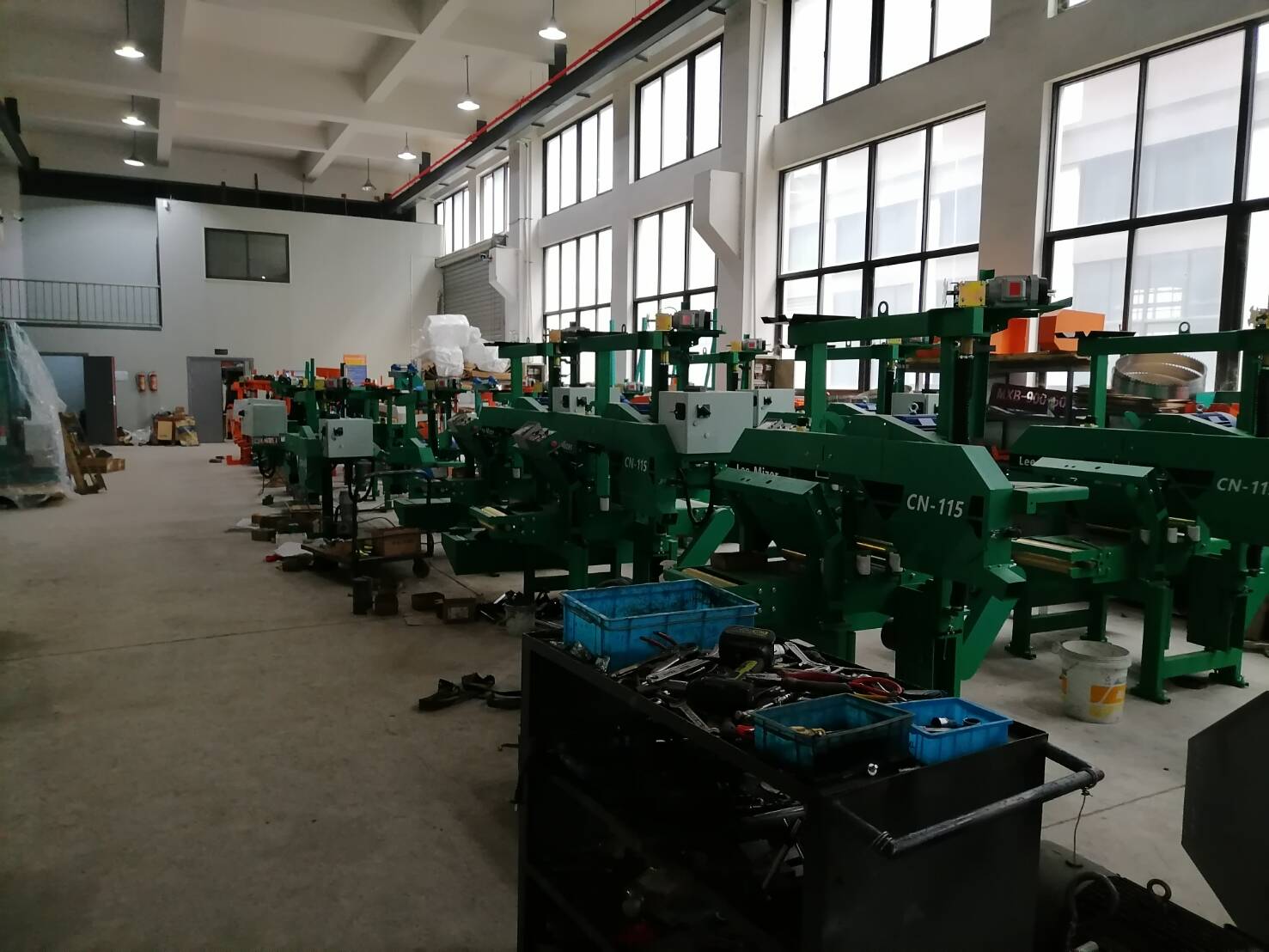
XINYANGJX — Hangzhou Lin’an Xinyang Machinery Co., Ltd. — is a wood processing equipment manufacturer founded in 2012 and based in Hangzhou, Zhejiang Province, China. The company develops, produces and sells wood processing equipment and wood drying equipment, with a documented factory area of 3,600 square meters, 12 employees, a 2-engineer R&D team and an annual output of 150 machines. Approximately 70% of that output is exported, with main markets in Africa, Southeast Asia, South Asia and South America.
Its main products are the woodworking band saw machine, small woodworking band saw machine, horizontal woodworking band saw machine, vertical woodworking band saw machine, heavy horizontal woodworking band saw machine, timber processing woodworking band saw machine, band saw blade grinding machine, woodworking edge trimming machine, woodworking angle cutting machine and woodworking tooth picking machine. The company describes its machines as easy to operate and adjust, simple to maintain and repair, and compact in footprint — claims that map directly onto the verifiable data classes described above.
The useful reading of that profile is not “small company” or “large company.” It is a question of what a supplier of this scale can document. A factory producing 150 machines a year with 12 staff can typically state exact model configurations, blade dimensions and adjustment ranges, because those figures originate in its own assembly and testing. A supplier that cannot is likely reselling rather than building.
Market Trend: Procurement Is Moving from Adjectives to Ranges
Three market signals explain why this shift is accelerating.
First, the category is growing steadily. The global band saw machine market stood at approximately USD 2.1 billion in 2024 and is projected to reach USD 2.8 billion by 2030 at a 5.0% CAGR. Growth at that rate does not create a supply shortage; it creates more suppliers competing with similar language, which pushes the burden of differentiation onto verifiable specifics.
Second, the product mix favours the horizontal format. Horizontal band saw machines held the largest product type share of total revenues in 2024-2025, between 48.3% and 55%. Buyers comparing horizontal machines are therefore comparing a crowded field, and range-level data is one of the few remaining ways to separate offers.
Third, supply is concentrated. China represented 29.4% of global woodworking machine exports in 2024, with an export value of USD 2.48 billion, so overseas buyers routinely evaluate Chinese suppliers against each other. Where quality language converges, specification granularity becomes the differentiator.
Regulation reinforces the trend. ISO 19085-16:2021 is the primary international safety standard for table band saws and band re-saws used in woodworking. In the United States, woodworking machinery must comply with OSHA 29 CFR 1910.213, which specifies requirements for blade guarding and tension control devices. Both are engineering documents, and satisfying them requires the same kind of measurable specification a buyer should be demanding anyway.
Evidence-Based Selection Compared with Conventional Selection
The table below contrasts how the same purchase decision is made under conventional practice and under an evidence-based approach, using the documented figures discussed above as examples of what each dimension looks like when it is written down.
| Decision dimension | Conventional approach | Evidence-based approach |
|---|---|---|
| Blade width support | “Handles a wide range of blades” | Documented windows of 20-100mm and 80-180mm, versus a single 27-150mm range typical elsewhere |
| Tooth pitch window | Not stated | 12-25mm or 19-38mm documented, versus 10-35mm or 28-32mm typical elsewhere |
| Motor output, small horizontal | “Powerful motor” | Approximately 11.8KW documented, against 18-20KW typical |
| Motor output, heavy horizontal | “Industrial-grade power” | 42.55KW / 51.3KW / 61.3KW across MJ378-1500/2000/2500, against 37KW / 47KW / 55KW typical |
| Maximum sawing length | “Extra-long capacity” | 5200mm standard; 8m extended on MJ378, against 3000-5000mm and 6m typical |
| Log diameter | “Large log capability” | Up to 900mm on small horizontal models; up to 2500mm on the MJ378 series |
| Machine weight | Not discussed | 800-1000KG documented, against 2000-5000KG typical — 60% to 84% lighter |
| Maintenance equipment | Listed as optional accessories | Grinding and tooth-picking ranges stated alongside the saw specification |
Limits of Spec-Sheet Verification
Verifiable data is more useful than aspirational language, but it does not remove every risk. Buyers should treat it as a filter, not a guarantee.
- Standard versus optional configurations. Some documented figures describe standard configuration, while others — for example an extended sawing length — are options. Both should appear in the purchase order against the correct model number, not be inferred from a brochure.
- Function lists vary by model. Automatic dust removal, cooling and lubrication are described as present on most models, not all. A buyer who assumes the full feature set without confirming the model may receive a machine without them.
- Maintenance equipment covers specific windows. A grinding machine supporting 12-25mm or 19-38mm tooth pitch serves those blades and not others. Shops running mixed blade families should map their blade inventory against the equipment before ordering.
- Lower weight is a trade-off, not a pure advantage. A lighter machine reduces freight cost, floor loading and relocation effort, but a lighter structure places more responsibility on correct levelling, anchoring and frame rigidity. Buyers planning continuous heavy-duty cycles should validate vibration behaviour on their own floor during a trial run rather than assume equivalence.
- Paper data cannot replace a test cut. Motor power, blade dimensions and capacity figures are necessary but not sufficient. The final verification is a trial cut on the buyer’s own species, moisture content and blade — the one measurement no spec sheet contains.
Future Outlook
The direction of travel in this category is toward specifications that survive delivery. As the market grows from approximately USD 2.1 billion in 2024 toward a projected USD 2.8 billion by 2030, and as horizontal machines continue to hold the largest share of revenue, differentiation between suppliers will increasingly come from documented working envelopes rather than from adjectives.
Two consequences follow for buyers. Energy data will matter more: a small horizontal machine documented at approximately 11.8KW against a typical 18-20KW is an operating-cost difference that compounds across a working life, and buyers who meter their machines will eventually price it. Maintenance ecosystems will matter more as well: the grinding and tooth-picking equipment that keeps blades in service determines how often a mill stops, which in many export markets is a larger cost than the machine itself.
The practical conclusion is unglamorous. Ask for ranges, ask for model numbers, ask for the configuration list in writing, and then re-measure on arrival. A supplier that expects to be measured usually documents more than one that does not.
FAQ
1. What is the difference between a band saw blade grinding machine and a woodworking tooth picking machine?
A grinding machine restores the cutting edge of a dull blade; a tooth picking machine resets the tooth pitch — the distance between teeth — when long use has altered it. The two address different failure modes. Grinding machines such as the MF115 and MF1118 support blade widths of 20-100mm and 80-180mm, with tooth pitch windows of 12-25mm or 19-38mm. The woodworking tooth picking machine, such as the MF4050, handles pitch adjustment instead of pitch replacement. Buyers should confirm that both the adjustable teeth spacing of the tooth-picking machine and the pitch window of the grinder cover the blades they actually run, because a blade outside those windows cannot be serviced on that equipment.
2. Is higher motor output power always better on a woodworking band saw machine?
No — it depends on the class of machine and the work. On heavy horizontal machines, the MJ378 series documents 42.55KW (MJ378-1500), 51.3KW (MJ378-2000) and 61.3KW (MJ378-2500), against 37KW, 47KW and 55KW typical of competing models, which supports longer cuts and larger diameters. On small horizontal machines the pattern reverses: documented output is approximately 11.8KW, against the 18-20KW other small machines typically require, which points to lower energy consumption rather than lower capability. Power figures should be read against the cutting task, not treated as a maximum to be maximised.
3. How can a buyer tell whether a capacity figure is a standard specification or an option?
By asking for a configuration table tied to a model number. Maximum sawing length illustrates the problem: on small horizontal models the standard figure is 5200mm, while the MJ378 series offers an extended 8m option against the 6m length common among other suppliers. Both are real, but they belong to different configurations. The purchase order should state which configuration applies, and the supplier should be able to confirm it in writing before shipment.
4. Why does machine weight differ so much between suppliers, and does it matter?
Documented weight on small horizontal machines is between 800KG and 1000KG, compared with 2000KG to 5000KG on alternative models — 60% to 84% lighter. That difference affects freight cost, floor loading, foundation requirements and the ease of relocating the machine. It is not automatically an advantage in every respect: a lighter machine depends more on correct levelling, anchoring and frame rigidity, so buyers planning continuous heavy-duty operation should validate vibration behaviour on site during a trial run.
5. Which specifications indicate that a machine manages dust, heat and blade wear?
Automatic dust removal, automatic cooling and lubrication are documented as present on most models in the horizontal range, while some alternative machines omit these functions. Lubrication is delivered by an oil pump, which reduces the overheating and wear that appear during long periods of running. A steel protective cover keeps dust and sawdust off the blade, and an emergency stop button allows the machine to be stopped when necessary. Because availability varies by model, buyers should request the function list for the exact model quoted rather than rely on a brand-level description.
6. Which standards apply when a woodworking band saw machine is imported into a regulated market?
ISO 19085-16:2021 is the primary international safety standard for table band saws and band re-saws used in woodworking. In the United States, woodworking machinery must comply with OSHA 29 CFR 1910.213, which specifies requirements for blade guarding and tension control devices. Buyers in regulated markets should ask which standard a machine is being built against and how blade guarding and tension control are implemented, rather than assuming that compliance follows automatically from a machine’s general specification.
For buyers who want to check the documented figures against the manufacturer’s own material, the XINYANGJX product brochure is publicly available for download: XINYANGJX product brochure (PDF). Company information is published at cn.hzlaxyjx.com.