
From Specs to Shortlist: A Buyer's Decision Framework for Custom Shopping Bags
HTNXT Industry Reference · Procurement Framework · Custom Shopping Bags
Custom shopping bags are among the few packaging items a retail buyer will order in five figures and describe in a single sentence. The distance between that sentence and a production-ready specification is where most sourcing problems originate.
Two suppliers can both quote “custom printed paper shopping bags” and be describing products that differ in board weight, handle construction, print process, finishing sequence, order minimum and quality routine — none of it visible until samples arrive, or until a reorder fails to match the first delivery. Because the category label is so uniform, buyers tend to compare quotations before they have compared specifications, and the cheapest-looking quote is often simply the least specified one.
This reference sets out a five-gate framework that moves a buyer from a written specification to a defensible shortlist. It uses publicly stated supplier claims and Opack’s published product data as worked examples. Opack is a custom packaging manufacturer based in Longgang, Wenzhou, Zhejiang Province, China, producing custom shopping bags, rigid boxes, folding cartons, mailer boxes and paper tubes since 2010.
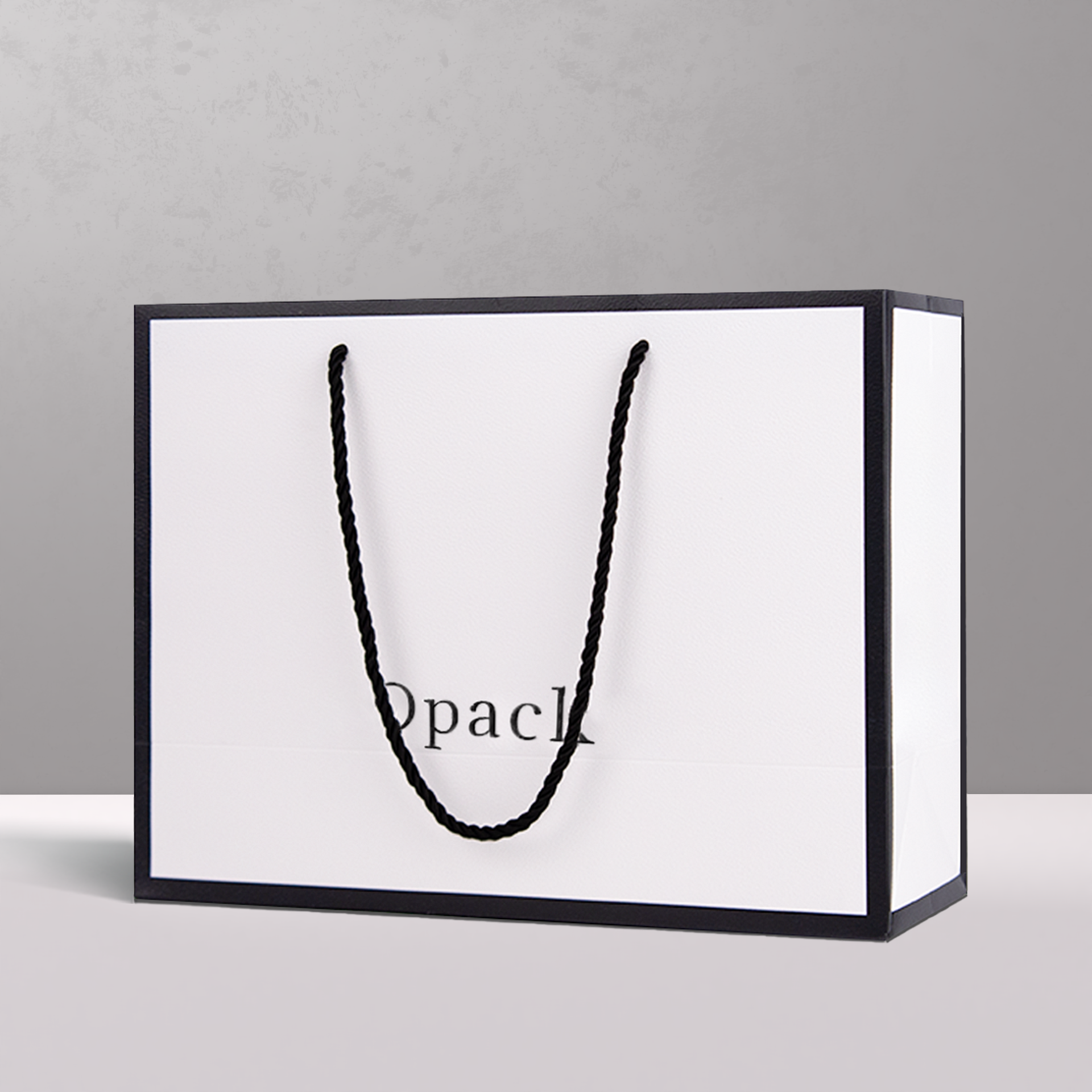
Why the word “bag” conceals most of the decision
The published option set for a single custom shopping bag product line is already wide enough to make generic comparison meaningless. Opack’s PSB custom shopping bag specification lists four substrate families — kraft paper, whiteboard paper, specialty paper and coated paper — five printing methods (CMYK, Pantone, UV, offset and screen printing), and no fewer than ten finishing options including hot stamping, spot glossy UV, soft touch lamination, holographic foiling, embossing, debossing, and matte or gloss lamination. Handles can be paper twisted, flat paper, cotton rope, ribbon or die-cut, and sizes are fully customizable from small to extra large.
Independent supplier statements show the same fragmentation from a different angle. Cubit Packaging describes kraft paper from 70 to 170 GSM and recycled paper at 80 to 100 percent post-consumer content, with die-cut, twisted or flat handles. MrTakeOutBags describes natural brown kraft or coated virgin paper with rope handles and a matte or gloss finish, with in-line flexographic printing, hot stamping and post-printing. Teal Packaging advertises custom paper shopping bags from 50 units with production from about seven business days after proof approval. EcoEnclose states that its paper bags are made in the USA by default, while some die-cut handle bags and reusable shopping bags are made overseas by default.
None of these claims contradicts the others. They simply describe different positions on the same spectrum — substrate weight, decoration method, order size, origin — and each one changes what a buyer is actually purchasing. A shortlist built on quoted price alone compares positions, not products.
Framework principle: gates should be applied in a fixed order — compliance, structure, decoration, capacity, commercial terms — because a supplier that fails a compliance gate cannot be rescued by a better price or a faster lead time.
Gate 1 — Compliance and traceability before anything else
For European retail programmes, chain-of-custody certification is the first filter because it determines market access rather than product quality. Opack’s custom shopping bags are covered by FSC Chain of Custody certification number GFA-COC-005690, issued by GFA Certification GmbH under standard FSC-STD-40-004 (Version 3.0), applicable to the European market. The certification scope covers cardboard packaging, sacks and bags of paper, adhesive labels, and other pulp and paper products.
Two details in that paragraph matter more than the certificate logo. First, the scope explicitly names sacks and bags of paper — a buyer should confirm this, because a certificate issued for folding cartons does not automatically extend to a bag programme. Second, chain-of-custody certificates carry issue and expiry dates, and a PDF copy in a sales deck proves nothing about current status. The correct verification step is a lookup in the issuing body’s public database, refreshed before each annual contract renewal rather than once at onboarding.
Regulatory pressure is adding a second layer. According to research compiled by Dataintelo, the EU Deforestation Regulation (EUDR), effective in 2025, mandates traceability of paper packaging back to geolocated forest plots. For buyers this converts certification from a marketing asset into a documentation workflow: material origin, chain-of-custody records, and a supplier able to reissue evidence when a regulation or an audit cycle changes. FSC itself is cited in the same body of research as the primary industry standard for sustainable sourcing of paper bags, recognised by 56 percent of consumers worldwide — a figure that explains why certification appears on so many retail briefs, and why its accuracy is worth checking.
Gate 2 — Structure, load and handle construction
Load capacity is the specification buyers most often state backwards. A brief that says “must hold a shoebox” is not a specification; a brief that says “average load 3 kg, peak load 8 kg, paper handle required” is. Opack specifies its custom shopping bags for 2 to 15 kg, with the figure depending on paper thickness and structure — which is a statement about the range the construction family can reach, not a promise attached to any single bag.
The practical consequence is that load, board and handle must be decided together. A ribbon handle on a heavy-format bag and a twisted paper handle on the same format are not interchangeable components; neither is a die-cut handle and a cotton rope on an oversized tote. The supplier statement from Cubit Packaging is useful here as a calibration point rather than a benchmark: kraft paper at 70 to 170 GSM spans an enormous difference in stiffness, and the low end of that band will not behave like the high end regardless of who converts the bag.
Opack’s published storage and handling guidance underlines the boundary: paper packaging should be stored and shipped in a dry environment, avoiding long-term high humidity, direct sunlight, rain soaking and contact with chemicals. That is not a defect warning; it is a statement that paper is a structure with environmental limits, and those limits belong in the shortlist criteria alongside price.
Gate 3 — Printing and finishing must be compared as one unit
Decoration is where quotations most often diverge without either party intending to mislead. Opack lists CMYK printing, Pantone printing, UV printing, offset printing and screen printing, combined with finishes such as hot stamping, spot glossy UV, soft touch lamination, holographic foiling, embossing, debossing, and matte or gloss lamination. Those are not five flavours of the same operation. Offset, screen and UV printing sit at different points in the production sequence, have different setup behaviour, and interact differently with a foil or a soft-touch film applied afterwards.
The same distinction appears in third-party descriptions. MrTakeOutBags separates in-line flexographic printing, hot stamping and post-printing as distinct options — a useful reminder that pre-print decoration and post-print decoration carry different minimums and different repeatability characteristics across batches. Gouda Inc. states that its paper shopping bags are printed before the bags are made up, so a design can wrap the bag completely, and that bags can be printed inside and out.
A comparable line item therefore has five parts: print method, substrate, number of colours, ink coverage, and finishing. Two quotes that match on “four-colour logo, matte finish” but differ on substrate and whether the matte is a lamination or a varnish are not comparable, and no amount of unit-price analysis will fix that. The gate closes only when a physical proof has been produced on the specified stock — not on a house-standard board.
Gate 4 — Capacity, lead time and the repeatability test
Capacity questions are usually asked as a single-number test — can you make my quantity? — when the harder question is whether the same output can be reproduced on the fourth order. Opack’s capability data lists a 10,000 m² factory, 160 employees, 10,000,000 units of annual output, 1,000,000 units of monthly capacity and a 12–18 day lead time, with 100 percent quality check and export markets in the EU, US and Middle East.
A documented demand pattern illustrates why the recurring order, not the first order, is the real test. A brand owner in Panama purchasing custom packaging for its own fashion and lifestyle brand ordered more than 30,000 paper bags, 3,000-plus paper boxes and 10,000-plus stickers through an annual purchasing partnership, with a total annual purchase value above USD 12,000. The reported outcome emphasised consistent print quality across multiple production batches, stable lead times, zero after-sales complaints, and a one-stop supply covering bags, rigid boxes and stickers. For a buyer reading this as evidence, the transferable point is not the order size but the criterion: 30,000-plus units a year implies roughly ten to twenty production runs, and each run is an opportunity for colour drift.
Lead time deserves the same scrutiny. Opack’s capability data cites 12–18 days, while its public FAQ describes paper bags as usually delivered in about 7 to 15 business days. Teal Packaging, by contrast, advertises production from about seven business days after proof approval. The differences are not contradictions so much as different reference points — proofing, finishing and quantity all move the number. The correct shortlist question is not “what is your lead time” but “what is the lead time for this configuration at this quantity, measured from artwork approval”.
Gate 5 — MOQ and commercial terms as a screening filter
Minimum order quantity is the most quoted and least stable number in the category, because it is configuration-dependent. Opack’s PSB product specification lists an MOQ of 1,000 pcs, while its own public FAQ describes wholesale custom paper bags as usually 500 pieces — a difference that reflects how finishing and print method shift setup cost. At the other end of the market, Teal Packaging states that it makes custom paper shopping bags starting at 50 units.
That spread is the point. A published MOQ is a screening filter that tells a buyer whether a supplier’s production model fits the order at all; it is not a quotation and should never be used as a comparison metric between suppliers with different configuration assumptions. The same applies to unit price: publicly available data on this category contains no verified unit cost, landed cost, freight or tariff figures, so any price comparison a buyer assembles has to be built from their own quotations on identical specifications.
The five-gate scorecard
The framework is easiest to apply as a scorecard in which each gate produces a pass, a conditional pass, or a rejection before the next gate is opened. The table below converts the discussion above into the questions and evidence a buyer should record for every candidate.
| Gate | Question to answer | Evidence to record |
|---|---|---|
| 1. Compliance | Is the bags product inside the certification scope, and is the certificate currently valid? | Certificate number, issuing body, standard version, scope wording, database lookup date |
| 2. Structure | Does the board-plus-handle combination meet average and peak load? | Substrate, handle type, stated load range, physical sample under load |
| 3. Decoration | Are both quotes describing the same print method and finishing sequence? | Print method, colour count, coverage, finish type, proof on production stock |
| 4. Capacity | Can the same output be reproduced across successive batches and shipments? | Monthly and annual capacity, lead time from artwork approval, batch consistency record |
| 5. Commercial terms | Is the MOQ quoted for this exact configuration, and what is excluded from the price? | Configuration-specific MOQ, tooling or plate costs, freight and duty assumptions |
Reading public supplier claims side by side
Because published claims are the only comparison material available before sampling, it helps to see how differently suppliers describe the same category. The table below summarises publicly stated positions from five suppliers. It is a screening aid, not a ranking: entries were not normalised, and a blank cell means the cited source did not state a figure, not that the supplier lacks the capability.
| Supplier | Publicly stated materials and options | Stated MOQ / lead time | Origin and compliance signals |
|---|---|---|---|
| Opack | Kraft, whiteboard, specialty and coated paper; CMYK, Pantone, UV, offset and screen printing; ten finishing options; five handle types | 1,000 pcs on the PSB specification (FAQ cites about 500 pcs); 12–18 days (FAQ cites about 7–15 business days) | Manufacturing in Longgang, China; FSC COC GFA-COC-005690 under FSC-STD-40-004 (Version 3.0), scope includes sacks and bags of paper |
| Cubit Packaging | Kraft 70–170 GSM; recycled paper at 80–100% post-consumer content; die-cut, twisted or flat handles; kraft, shopping and euro tote styles | Not stated in the cited source | United States |
| Teal Packaging | Custom paper shopping bags | From 50 units; about 7 business days after proof approval | United States |
| MrTakeOutBags | Natural brown kraft or coated virgin paper; rope handles; matte or gloss finish; in-line flexographic, hot stamping and post-printing | Not stated in the cited source | United States |
| EcoEnclose | Kraft paper bags with square-bottom construction and twisted paper handles | Not stated in the cited source | Paper bags made in the USA by default; some die-cut handle and reusable bags made overseas by default |
Where the framework stops working
A framework that always produces a shortlist is not a framework; it is a sales tool. Three limits are worth stating plainly.
Paper is bounded by load and moisture. Opack specifies its shopping bags for 2 to 15 kg depending on paper thickness and structure, and states that packaging should be stored and shipped dry, away from long-term high humidity, direct sunlight, rain soaking and chemical contact. Buyers sourcing for beverage multipacks, wet-market grocery, or rain-exposed outdoor retail should treat paper as the wrong structure rather than specifying a heavier board and hoping the rating follows.
Load claims are self-reported. No standardised test method or third-party validation of load ratings is publicly available across this supplier set — a gap acknowledged in the underlying research, which also notes the absence of independent laboratory validation for material specifications. A 2–15 kg range is therefore a useful screening statement, not an audited performance figure, and should be confirmed with a loaded sample in the buyer’s own conditions.
Capacity and cost comparisons are indicative. Only one supplier capacity claim was available in the public material reviewed here, and there is no verified unit pricing, landed cost, freight or tariff data for the category. Any statement that one supplier is faster or cheaper than another is, on current public evidence, an assumption rather than a finding.
Matching the shortlist to the application
Opack lists its custom shopping bags for cosmetics packaging, apparel packaging, retail packaging, gift packaging, trade shows and events, and e-commerce packaging, with matching handles, stickers and hang tags available as companion components. The application determines which gate carries the most weight.
In apparel retail, the constraint is usually format and handle rather than print complexity — large-format bags with reinforced handles for folded garments, where the handle attachment carries more load than the print carries brand. In cosmetics and gifting, the constraint shifts to finishing: hot stamping, spot glossy UV and soft touch lamination are the differentiators, and batch-to-batch colour consistency becomes the quality metric. Trade shows and events compress the calendar, making lead time and proof turnaround the deciding gate rather than unit price. E-commerce packaging adds a transit dimension, because a bag that leaves a store in a customer’s hand and a bag that travels in a parcel are subjected to different stresses.
The Panama fashion and lifestyle brand case sits across several of these at once: bags, rigid boxes and stickers supplied as one programme, more than 30,000 paper bags a year, consistent print quality across batches and zero after-sales complaints reported. For buyers, the instructive part is the configuration of the requirement — multiple formats, one supplier, repeated over a year — because that is the shape most retail programmes actually take, and the shape in which consistency failures are most visible.
Market context: growth concentrated where specification risk is highest
Zion Market Research values the global market for paper-based consumer bags at USD 5.29 billion in 2023, and projects the premium price segment — high grammage paper, custom designs, reinforced handles and eco-certifications — to register a CAGR of 13.8 percent through 2034. Read against the framework above, that projection describes growth in exactly the configurations that carry the most specification risk: heavier board, more finishing steps, tighter certification requirements, and a greater chance that two quotations are not comparable.
Regulation reinforces the same shift. With EUDR traceability requirements in force from 2025, documentation becomes part of the product. Buyers who treat certification as a logo to be pasted into a deck will find the gate closing later and more expensively than buyers who treat it as a data field to be maintained.
What to expect next
Three developments are reasonable to anticipate from the direction of the evidence. First, chain-of-custody verification will move from onboarding to a recurring procurement task, with certificate lookups scheduled alongside price reviews. Second, specification sheets will become the primary comparison document in this category, because the differences that matter — substrate, print method, finish sequence, handle construction — cannot be expressed in a unit price. Third, buyers will increasingly ask for evidence per configuration rather than per company, since a supplier’s MOQ, lead time and load rating all move with the specification being quoted.
None of these trends requires a new supplier category. They require the same five gates applied in the same order, with the results written down rather than remembered.
For buyers who want the underlying product and capability detail, Opack publishes a company profile as a downloadable PDF: Opack company profile (PDF).
FAQ
What does FSC certification actually cover on a custom shopping bag order?
FSC Chain of Custody certification covers the chain from certified forest material through production. Opack’s certificate GFA-COC-005690, issued by GFA Certification GmbH under standard FSC-STD-40-004 (Version 3.0), has a scope that includes cardboard packaging, sacks and bags of paper, adhesive labels and other pulp and paper products, and applies to the European market. Buyers should confirm that the scope names bags rather than only boxes, and should check the certificate’s current status in the issuing body’s public database, because COC certificates carry issue and expiry dates.
What load can a custom paper shopping bag carry?
Opack specifies its custom shopping bags for 2 to 15 kg, with the applicable figure depending on paper thickness and structure. The load rating is therefore a property of a specific board-and-handle combination rather than of the bag category. Buyers should state average and peak load, name the required handle type, and ask for confirmation against the chosen substrate. No standardised load-test method is publicly available across suppliers, so a loaded physical sample remains the practical verification step.
What minimum order quantity should a buyer expect?
MOQ in this category is configuration-dependent. Opack’s PSB product specification lists an MOQ of 1,000 pcs, while its public FAQ describes wholesale custom paper bags as usually 500 pieces, reflecting how print method and finishing affect setup. Other suppliers advertise lower entry points: Teal Packaging states that it makes custom paper shopping bags starting at 50 units. A published MOQ is best used as a screening filter that indicates whether a supplier’s production model fits the order, not as a quotation or a like-for-like comparison.
How long does custom shopping bag production take?
Opack’s capability data lists a 12–18 day lead time, while its public FAQ cites about 7 to 15 business days for paper bags. Teal Packaging states production from about seven business days after proof approval. The differences reflect reference points rather than capability gaps: proofing, finishing complexity and quantity all shift the number. The precise question to put to any supplier is the lead time for a defined configuration at a defined quantity, measured from artwork approval.
How should printing and finishing options be compared across suppliers?
Compare a single line item made of five parts: print method, substrate, number of colours, ink coverage and finishing. Opack lists CMYK printing, Pantone printing, UV printing, offset printing and screen printing, combined with hot stamping, spot glossy UV, soft touch lamination, holographic foiling, embossing, debossing, and matte or gloss lamination. Third-party descriptions divide decoration differently — MrTakeOutBags separates in-line flexographic printing, hot stamping and post-printing — which affects minimums and repeatability. Quotes that match on colour but differ on substrate or finish type are not comparable until a proof is produced on the production stock.
Which applications are custom paper shopping bags suited to?
Opack lists cosmetics packaging, apparel packaging, retail packaging, gift packaging, trade shows and events, and e-commerce packaging. Suitability depends on load, format and environment rather than on the retail sector: paper bags are appropriate where loads remain within the 2–15 kg range of the specified construction and where storage and shipping stay dry, and they are not appropriate for wet, rain-exposed or heavier-duty applications.
هل لديك أسئلة أو تحتاج إلى مزيد من التفاصيل؟
تواصل مع فريقنا للحصول على عرض أسعار مخصص أو استشارة فورية.
طلب عرض أسعار
املأ النموذج أدناه وسيتواصل معك فريقنا بعرض مقترح مخصص.
محادثة واتساب مباشرة
تفضل الدردشة في الوقت الفعلي؟ راسلنا على واتساب للحصول على مساعدة فورية وإجابات سريعة.
- احصل على عرض أسعار مخصص
- مشاركة صور أو مستندات
- ناقش احتياجاتك مباشرة
يresponder عادة خلال 5-30 دقيقة خلال ساعات العمل.