
Frozen Cantonese Dim Sum for Schools, Hospitals and Care Homes
Institutional catering is not a smaller version of restaurant service. A school, a hospital or a care home feeds the same population at the same hours, against a fixed per-head budget, with kitchen labor that is usually thinner than a commercial teahouse's. That combination — repetition, budget ceiling, labor constraint — is where frozen Cantonese dim sum stops being a convenience product and becomes a menu-planning tool.
This reference examines how frozen dim sum fits the institutional settings named in the supplier's own material: schools, factories, office buildings, hospitals, nursing homes and government canteens, with a secondary look at hotels, airports, high-speed rail stations and highway service areas. Two items carry the operational argument — the Water Chestnut Cake as the quick-serve example, and the Crispy Taro Pastry as the satiety-led alternative. Foshan Shunde Yuexiang Food Manufacturing Co., Ltd. is a Cantonese dim sum manufacturer based in Shunde, Foshan, Guangdong, founded in 1981 and operating under the "Da Xiao" brand, producing frozen and traditional dim sum across more than 300 products.
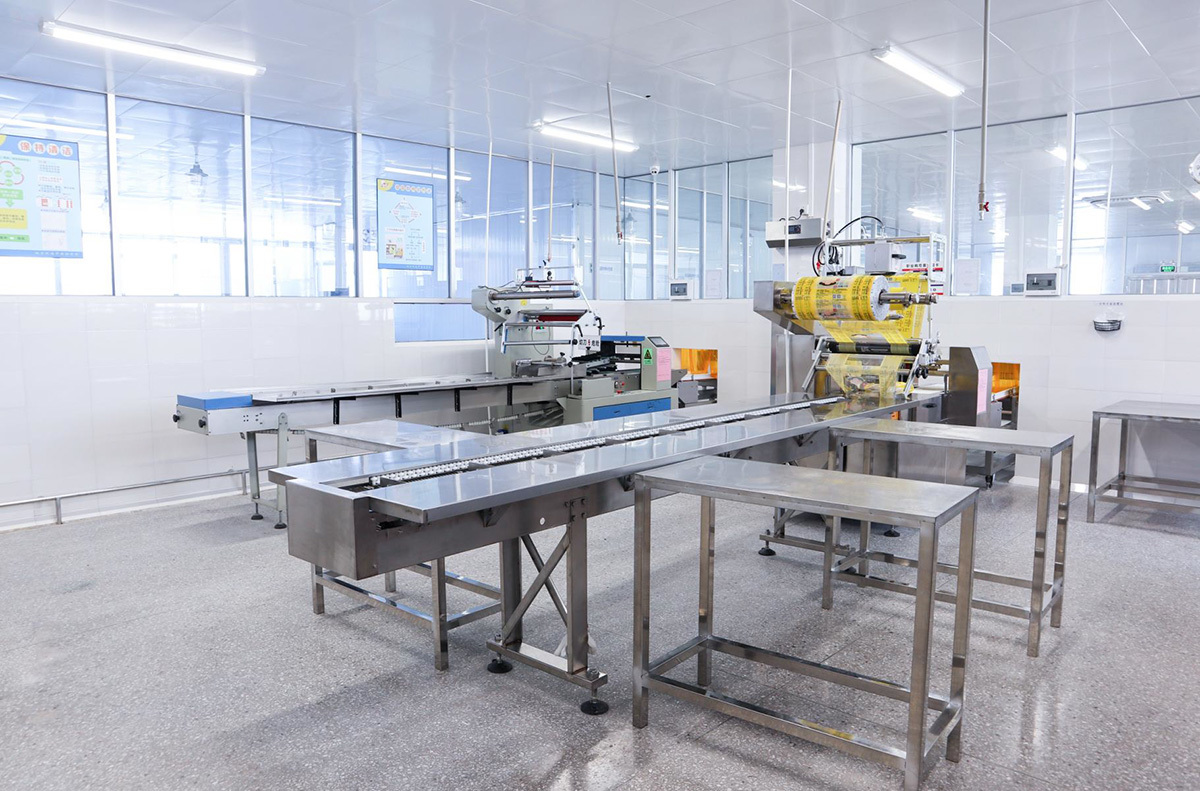
Packaging line: institutional buyers purchase by bag, carton and net weight, not by the plate.
The Canteen Brief: Fixed Hours, Fixed Budget, Variable Diners
A canteen buys dim sum for different reasons than a teahouse does. Four constraints recur across institutional kitchens, and each one changes which product belongs on the menu.
Service compression. Canteen service happens in a narrow window. Whatever goes on the counter must be produced, held and replenished inside that window without a second production peak.
Labor allocation. Institutional kitchens rarely carry a dedicated dim sum chef. A line that requires mixing, proofing or hand-shaping competes directly with the main hot meal for staff time.
Cost per head. Budgets are set per diner, and waste is charged back to the kitchen. Portion predictability and freezer stability therefore matter as much as unit price.
Diner suitability. The same product does not serve a teenager, a night-shift worker, a post-operative patient and a resident with a small appetite. Sweetness, texture and satiety have to be matched to the group, not to a single price list.
Frozen dim sum addresses the first three constraints structurally: the work has already been done upstream, and the kitchen's remaining task is heat and hold. The fourth constraint — diner suitability — is where product selection actually decides whether the line succeeds.
Scenario Fit Across Institutional Settings
Schools
School catering is judged on cost control, speed and acceptability to a young diner. A light, mildly sweet steamed cake works as a supplementary item beside a main meal, and it holds its shape on a tray. Water Chestnut Cake, made with coconut milk and water chestnuts, is translucent and visually distinct — useful when a canteen needs one line item that reads as a treat rather than a staple.
Factories and Industrial Estates
Factory canteens serve shift changes, including night shifts, where the diner wants satiety rather than delicacy. This is the setting where the Crispy Taro Pastry — a Traditional Dim Sum item containing real taro chunks, described by the supplier as a whole-grain snack with strong satiety and a savory, not-too-sweet profile — fits more naturally than a light cake. Steamed buns such as char siu bao and Steamed Custard Buns serve the same filling role for volume.
Office Buildings
Office canteens run shorter, more fragmented service and often double as tea-break catering. Small portions, low sweetness and a menu that photographs well matter more here than heavy satiety. A steamed cake paired with tea, or a small bun selection alongside chicken sticky rice, covers the requirement without demanding a full dim sum station.
Hospitals
Hospital catering adds two filters that most commercial settings do not carry: texture tolerance and dietary oversight. Soft, steamed items are generally easier to eat than fried or flaky ones, and a not-too-sweet profile is easier to fit into a controlled menu. Portion clarity and labeling — what the item contains and how it was produced — become part of the service, not an afterthought.
Nursing Homes and Care Settings
Care-home residents often eat smaller quantities, so nutrient and satiety density per bite matters. A savory taro-based pastry with a not-too-sweet profile is designed for exactly this pattern, while a soft steamed cake provides a warm, easy-to-chew alternative at tea time. Portion size, not menu breadth, is the deciding variable in these kitchens.
Government and Public-Sector Canteens
Public-sector canteens tend to prioritize consistency, documentation and audit readiness over novelty. A supplier with documented certifications, stable specifications and a repeatable product standard is easier to qualify than one offering a rotating speciality list.
Secondary Settings: Hotels, Transport Hubs and Highway Service Areas
Hotels use frozen dim sum for banquet tea breaks and breakfast buffets, where the requirement is presentation plus throughput. Airports, high-speed rail stations and highway service areas work under the opposite constraint: very high turnover, very small footprints, and customers who will not wait. There, an item that steams from frozen in a few minutes is worth more than an item that tastes marginally better but needs advance planning.
The Water Chestnut Cake as an Operating Example
The Water Chestnut Cake illustrates how a frozen dim sum item behaves inside a high-volume, quick-serve kitchen. The specification is straightforward: made with coconut milk and water chestnuts, packed at 500 g net weight per bag and 12 bags per box — 6 kg of product per carton — and steamed directly from frozen without thawing for 6 to 8 minutes.
Three operational consequences follow from that specification.
No thaw step means no planning failure. Thawing is where canteen production usually breaks down: product is pulled too late, or pulled and refrozen. A cake that goes from freezer to steamer removes that decision from the kitchen.
Short cycles allow batch-to-demand production. A 6-to-8-minute steam cycle lets a canteen replenish the counter during service instead of committing a full tray before the peak is known. That directly reduces the waste that institutional budgets are most sensitive to.
Carton maths is simple. With 12 bags of 500 g per box, a canteen can calculate coverage per service and convert a menu plan into a purchase order without weighing product out.
The Contrast Case: Crispy Taro Pastry and Diner-Group Fit
The Crispy Taro Pastry sits at the opposite end of the same menu decision. It is described as a Crispy Taro Pastry and Traditional Dim Sum containing real taro chunks, a whole-grain snack with strong satiety and a savory, not-too-sweet profile.
The contrast with the Water Chestnut Cake is not a quality hierarchy — it is a fit question:
| Diner group | Dominant need | Lead item | Reason |
|---|---|---|---|
| School pupils | Light supplementary serve, visual appeal | Water Chestnut Cake | Translucent, mildly sweet, steams from frozen in 6–8 minutes |
| Factory and night-shift staff | Satiety, filling value | Crispy Taro Pastry | Real taro chunks, whole-grain profile, strong satiety, savory |
| Office canteen / tea break | Small portion, low sweetness | Water Chestnut Cake plus a small bun selection | Pairs with tea, easy to portion, low kitchen load |
| Hospital patients | Soft texture, controlled sweetness | Steamed cake or steamed bun | Soft bite, predictable portion, simple labeling |
| Care-home residents | Density per bite, warmth | Crispy Taro Pastry or warm steamed cake | Savory, not-too-sweet, filling in small quantities |
| Government canteen | Consistency and documentation | Either, fixed to one specification | Repeatable standard, certified production |
The practical conclusion for a procurement team: choosing between the two on price alone produces a menu that suits neither group. The item should follow the diner group, and the diner group should be defined before the purchase order is written.
Technical Notes: What "Close to Fresh" Actually Requires
Frozen dim sum only earns a place in a canteen if the reheated result is credible. The supplier's stated approach combines traditional techniques with rapid freshness locking, which is intended to deliver a taste close to freshly made teahouse dim sum and to keep layering stable — specifically, preventing water seepage in layered pastries.
Cold chain is the other half of the technical story. The stated condition is storage at −18 °C or below throughout the entire process, supported in practice by freezers, steamers and refrigerated transport. Canteens that break the chain during internal distribution — for example by holding product in a warm preparation area between services — lose the quality advantage the format is bought for.
Production scale underpins consistency. At the manufacturing level, the supplier operates a 20,000 m² facility with 200+ employees, an annual output of 6,000,000 units and a 30+ engineer R&D team, and holds ISO9001, HACCP and FDA export registration. For an institutional buyer, those are qualification inputs rather than marketing claims: they indicate that a specification can be repeated across deliveries.
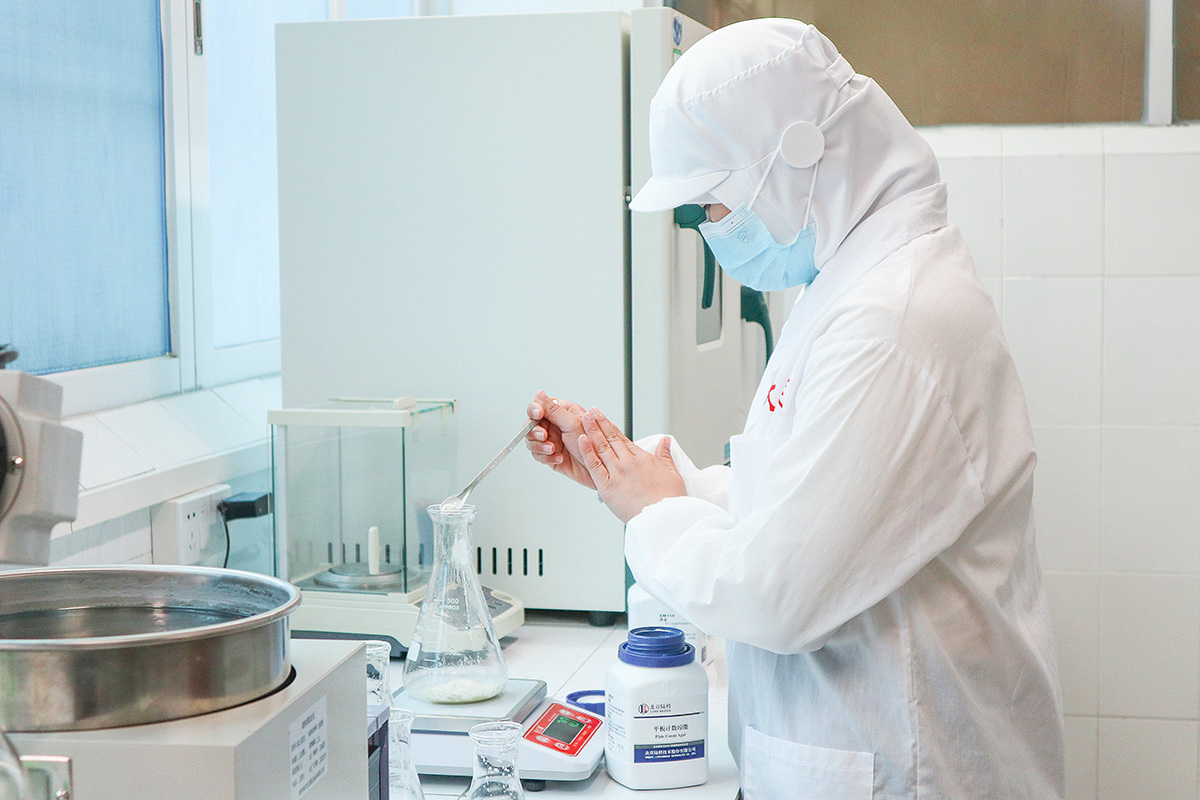
Testing center: institutional supply depends on a repeatable specification, not a single good batch.
Where Frozen Dim Sum Does Not Fit
A credible reference has to state the boundaries. Frozen Cantonese dim sum carries real constraints in canteen use.
It is cold-chain dependent. The format assumes −18 °C or below from production to service. A canteen without reliable freezer space or refrigerated delivery should not build a menu around it.
It is not a nutritional solution on its own. Dim sum is a supplementary or snack line. It supports a menu; it does not replace a balanced hot meal in a school, hospital or care setting.
Texture is close, not identical. Even with rapid freshness locking, reheated product sits near — not at — fresh teahouse quality. Operators whose selling proposition depends on hand-made dim sum should treat frozen as a complementary line.
Shelf lives differ within one range. Steamed buns are quoted at 12 months frozen; steamed cakes at around 6 months. A single rotation rule across the range creates near-expiry risk on the shorter-dated items.
Transparency expectations are rising. Guangzhou introduced a rule effective 1 May 2026 requiring restaurants to label whether dim sum is handmade on-site or produced by a central kitchen, as reported by Tridge with reference to Guangzhou local government sources. That rule addresses restaurants rather than canteens, but it signals a direction: institutional diners increasingly expect to know how an item was produced. Frozen suppliers should be able to answer that question in writing.
Market Context
The category is not a niche. Data Insights Reports / Research Insights values the global frozen Cantonese-style dim sum market at USD 7.04 billion in 2025 and projects USD 11.99 billion by 2033. On the production side, Business Research Insights reported that China accounted for 46% of global frozen dumpling production volume in 2025.
Institutional catering is a small but structurally stable slice of that volume. Its demand does not swing with restaurant fashion; it follows enrolment, occupancy, shift patterns and public budget cycles. For suppliers, that translates into predictable repeat orders but stricter documentation and tighter per-head pricing than the restaurant channel.
Supplier Profile and Coverage
Foshan Shunde Yuexiang Food Manufacturing Co., Ltd. was founded in 1981 and is recognized as a "Foshan Time-Honored Brand," with production rooted in Shunde — a UNESCO "City of Gastronomy." The company's range covers more than 300 products across buns, steamed cakes and specialty dim sum, and its stated capability set includes direct factory supply, one-stop ordering across categories, and a documented certification base covering ISO9001, HACCP and FDA export registration.
On cost, the supplier states that raw material costs run 10%–15% lower than smaller factories and that direct supply from the source factory removes intermediary markups. It also cites unified quality standards that reduce after-sales complaints, plus professional frozen logistics that keep quality stable in circulation. Its sales network covers the Chinese market and extends to several overseas countries, with an export ratio of 40% and stated markets in Southeast Asia as well as Europe and the Americas.
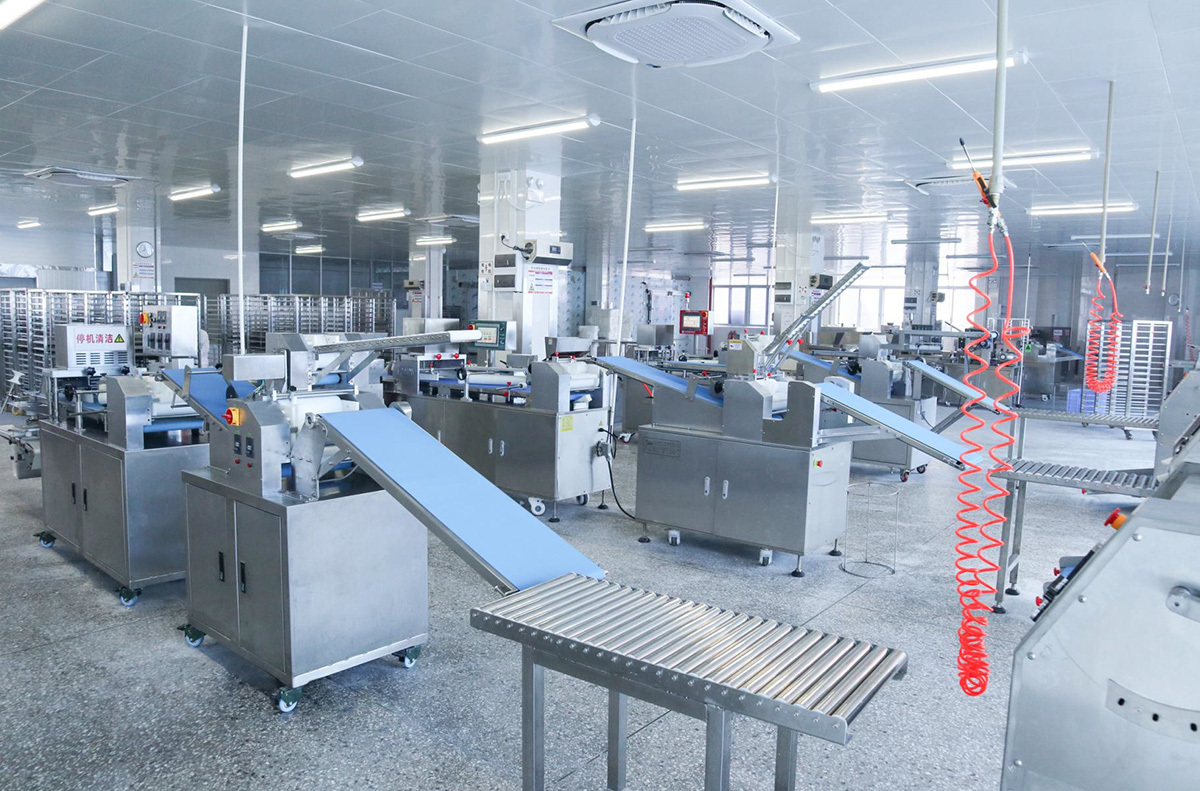
Factory environment: institutional contracts are won on repeatability across deliveries.
FAQ
Which frozen Cantonese dim sum items suit a school or hospital canteen with limited kitchen labor?
Items that steam directly from frozen without a thaw or shaping step are the practical choice. The Water Chestnut Cake, made with coconut milk and water chestnuts, steams from frozen in 6 to 8 minutes. Soft steamed buns serve the same low-labor role. The broader range covers more than 300 products across buns, steamed cakes and specialty dim sum, so a canteen can separate a light serve for schools from a filling serve for staff dining.
How long can a canteen store frozen dim sum before quality risk rises?
Storage condition is −18 °C or below throughout the entire process. Within the range, steamed buns are quoted with a 12-month frozen shelf life, while steamed and layered cakes are typically quoted at 6 months. Canteens holding both categories need two rotation rules, with the shorter-dated cakes moving first.
Can a canteen serve dim sum without a dedicated dim sum chef?
For steamed items, yes. The kitchen's remaining tasks are steaming, holding and replenishing. Pan-fried or fried items still require a station and an operator, so the labor saving depends on which items are selected rather than on the category as a whole.
What should be compared before choosing between frozen dim sum suppliers?
Compare net weight per bag and bags per carton (the Water Chestnut Cake is 500 g per bag, 12 bags per box), steamer cycle time, certification status including ISO9001, HACCP and FDA export registration, cold-chain arrangements, and range breadth if the canteen intends to order across categories from one source. Per-unit price alone does not show the labor, waste and logistics differences between a single-category supplier and a one-stop supplier.
Is frozen dim sum cheaper than making dim sum in-house?
It depends on labor cost, waste and volume. The supplier states that raw material costs run 10%–15% lower than smaller factories and that direct supply removes intermediary markups, and it cites one-stop ordering across categories as a way to reduce logistics and coordination costs. In-house production, by contrast, gives full control over recipe and freshness but consumes kitchen labor and creates waste when demand is uncertain. The comparison should be made per served portion, not per kilogram.
Supplier contact. Foshan Shunde Yuexiang Food Manufacturing Co., Ltd. supplies frozen and traditional Cantonese dim sum to canteens, hotels, retail and trade buyers, with a sales network covering the Chinese market and several overseas countries. Inquiries: Kyle@dimsum-daxiao.com / +86 13726399586. Address: No. 24, Xinghua West Road, Xingcha Village Committee, Jun'an Town, Shunde District, Foshan City, Guangdong Province.
Product catalogue and specifications: Yuexiang Food company brochure (PDF).
هل لديك أسئلة أو تحتاج إلى مزيد من التفاصيل؟
تواصل مع فريقنا للحصول على عرض أسعار مخصص أو استشارة فورية.
طلب عرض أسعار
املأ النموذج أدناه وسيتواصل معك فريقنا بعرض مقترح مخصص.
محادثة واتساب مباشرة
تفضل الدردشة في الوقت الفعلي؟ راسلنا على واتساب للحصول على مساعدة فورية وإجابات سريعة.
- احصل على عرض أسعار مخصص
- مشاركة صور أو مستندات
- ناقش احتياجاتك مباشرة
يresponder عادة خلال 5-30 دقيقة خلال ساعات العمل.