
Fruit & Vegetable Packaging: PET Tray Specs, Terms, Checks
Fruit & Vegetable Packaging: PET Tray Specs, Terms, Checks

Fruit & Vegetable Packaging: PET Tray Specs, Terms, Checks
A clear PET produce tray can pass every material test and still fail at the packing line. The questions that decide a purchase order — fill volume, stack height, lid closure, certificate expiry, and whether a container falls on one side or the other of a 500 ml regulatory threshold — sit outside the resin grade. This reference works through the questions buyers raise between shortlisting a supplier and releasing a repeat order in fruit & vegetable packaging, using two documented formats as worked examples: HB-SG300ML, a clear PET container measuring 17.5 × 13.5 × 6 cm and described as refrigerator-safe and stackable, and HB-MG40 OZ, a custom blister/produce tray measuring 28 × 19.4 × 6.8 cm.
Both are produced by CHUAN HE (Weifang Chuanhe New Material Co., Ltd.), a thermoformed PET and PP packaging manufacturer based in Weifang, Shandong Province, China, operating a 62,000 m² facility and reporting a 100% export ratio across EU, North American, Middle Eastern, Southeast Asian and Latin American markets.
The first procurement question is documentary, not dimensional
A PET produce container file should contain four document layers before a sample is approved: the framework safety statement, the plastic-specific declaration of compliance, migration test reports naming the actual article, and a manufacturing management certificate. Certificate numbers without the underlying reports are not a substitute for the file.
In the EU, the framework obligation sits in Regulation (EC) No 1935/2004, Article 3: materials and articles must not transfer constituents to food in quantities that could endanger human health, change the composition of the food unacceptably, or deteriorate its organoleptic characteristics. Regulation (EU) No 10/2011 adds the plastic-specific layer — Article 5 restricts manufacture to substances on the Union list in Annex I, Article 12 sets the overall migration limit at 10 mg per dm² of food contact surface, and Article 15 requires a written declaration of compliance at every marketing stage except retail, supported by documentation.
Two further obligations are routinely missing from tender packs. Article 15 of Regulation 1935/2004 requires the words “for food contact”, a specific indication of use, or the wine-glass-and-fork symbol, unless the article is by its nature clearly intended for food contact. Article 16 requires traceability one step back and one step forward so that a defective batch can be recalled. For a supermarket programme, both translate into artwork, marking and case-coding requirements — and both can be checked before an order is placed.
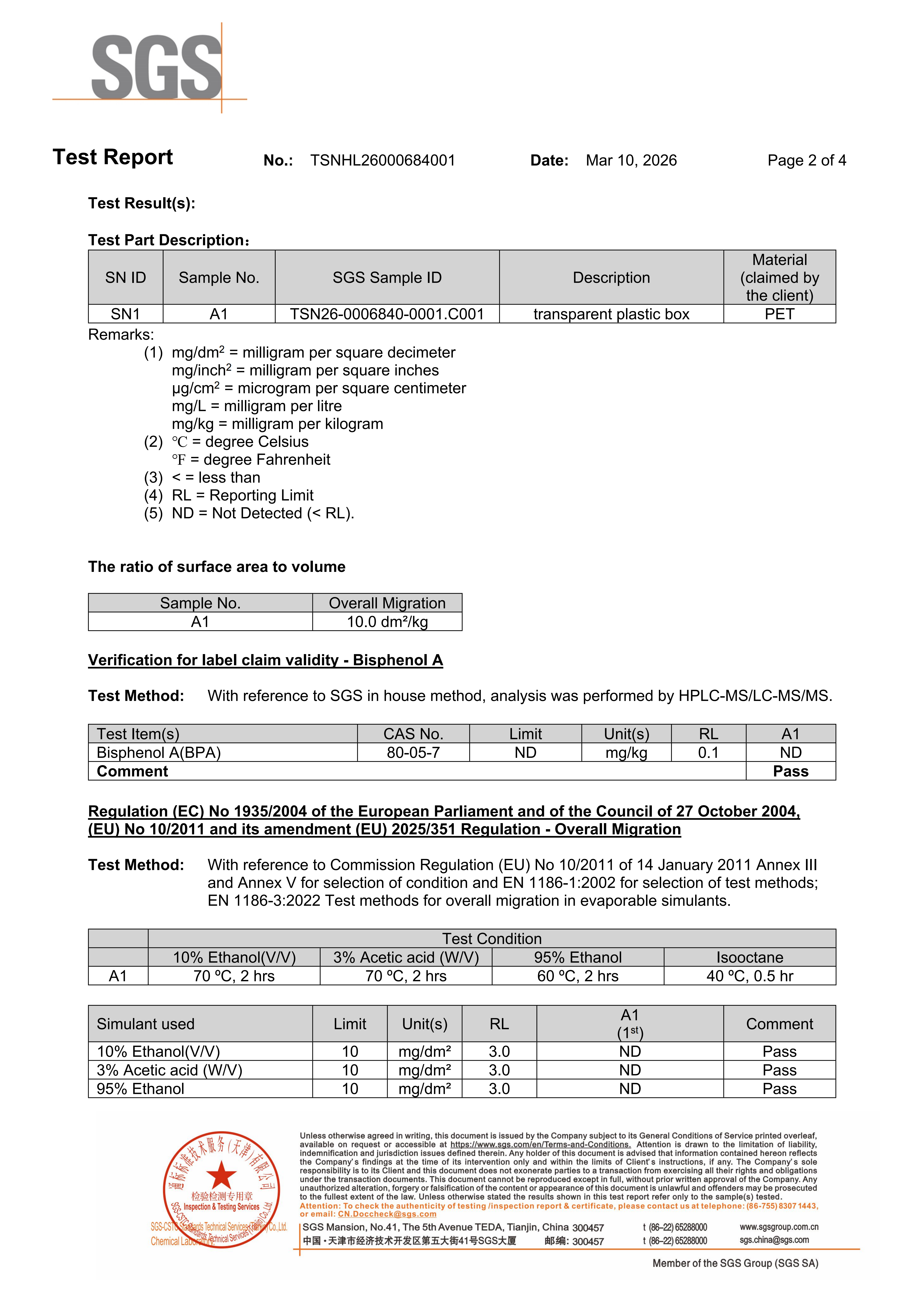
The CHUAN HE documentation set covers these layers with reports from three bodies. An SGS report (TSNHL26000684001, issued 10 March 2026, valid to 10 March 2036) references EN 1186-3:2022. A second SGS report (TSNHL26001599701, issued 22 April 2026, valid to 22 April 2036) references US FDA 21 CFR 177.1630, the regulation covering polyethylene phthalate polymers including PET. A TÜV Rheinland test report (178251114a 001, issued 14 August 2026, valid to 14 August 2030) addresses Regulation (EU) 2025/40 requirements and lists scopes including heavy-metal content, PFAS, organotin compounds, fluorine content, SVHC screening, specific migration of metals, primary aromatic amines, terephthalic acid, ethylene glycol, bisphenol A and other bisphenols, global migration, and sensorial examination.
Check the expiry date against the shipment date, not the quotation date
The CHUAN HE file is a useful illustration precisely because its documents do not share one validity window. The BRC certificate (CN26/00005423, issued by SGS on 8 July 2026) runs to 3 August 2027. The CE certificate (M.2025.206.C131101, issued by UDEM on 12 December 2025) runs to 12 November 2030. A separate FDA certificate (11242824478, issued 5 March 2025) carries an expiry date of 31 December 2026 — the shortest window in the set.
That single date changes how a first-quarter 2027 shipment should be documented: unless the certificate is renewed, an order placed now would ship against a lapsed document. The workable rule is to build a validity table into the purchase file, list the planned shipment date for each release, and require renewal evidence before that release is confirmed. Long-dated reports still need re-checking, because a report is evidence of the article tested, not of every article in a catalogue.
A US report does not clear an EU shipment
The two regimes are structurally different and are not interchangeable. In the United States, PET food-contact articles fall under 21 CFR 177.1630, and olefin polymers — the family that includes polypropylene — under 21 CFR 177.1520, each subject to the specifications and conditions set out in its section. In the EU, the positive Union list under Regulation (EU) No 10/2011 governs which substances may be present at all. A buyer shipping to both markets needs both document sets; a buyer shipping to one should not accept the other as a proxy.
How the two worked formats differ at the point of specification
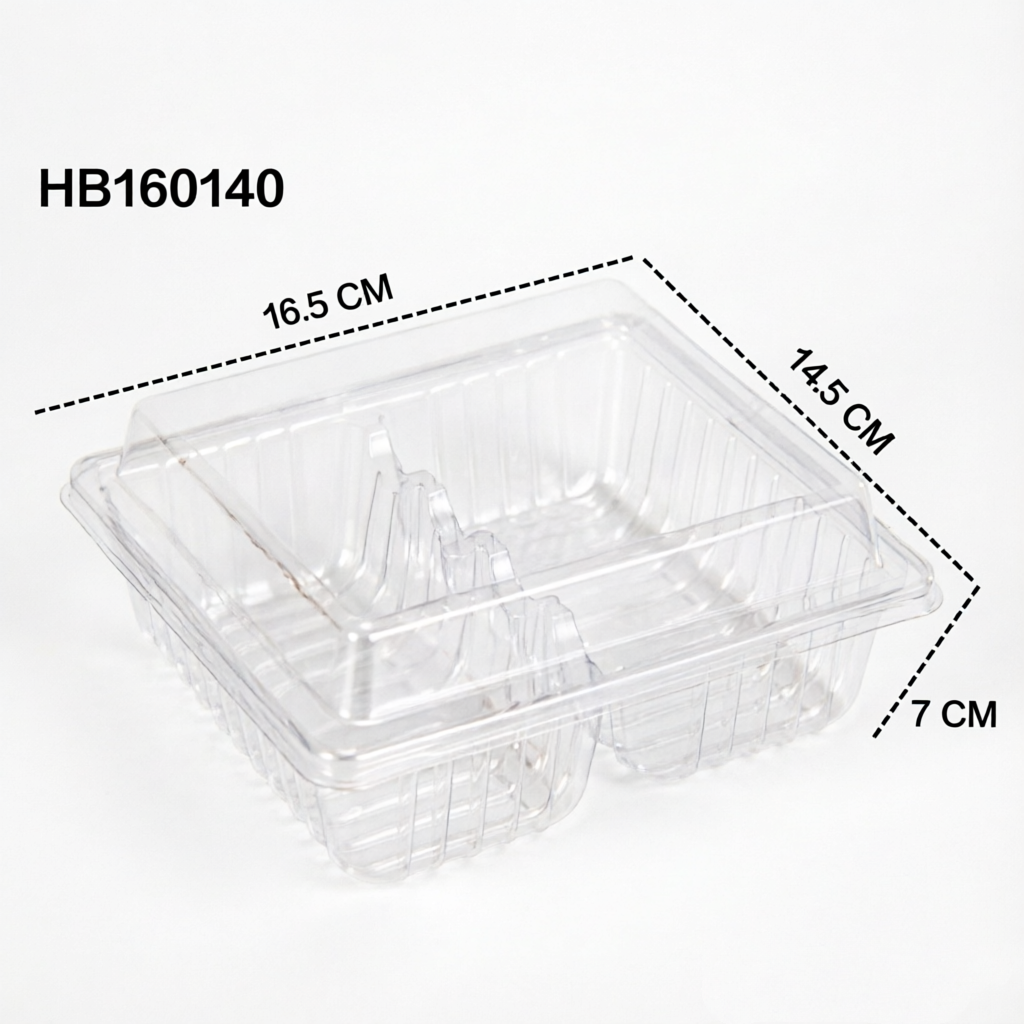
The two formats in this reference sit at opposite ends of the same order. HB-SG300ML is a standard-format container described as refrigerator-safe and stackable; HB-MG40 OZ is a custom blister/produce tray. The table below uses only stated characteristics and shows which figures a buyer must confirm before writing them into a specification.
| Specification point | HB-SG300ML | HB-MG40 OZ |
|---|---|---|
| Format family | Clear PET container | Custom blister / produce tray |
| Stated dimensions | 17.5 × 13.5 × 6 cm | 28 × 19.4 × 6.8 cm |
| Stated handling characteristics | Refrigerator-safe; stackable | Custom format; stack load and temperature range to be specified in the RFQ |
| Size designation | 300 ml class in the model name | 40 oz class; 40 × 29.5735 ≈ 1,183 ml (calculated, not measured) |
| First question for the supplier | Are the stated dimensions external or internal? | Are the dimensions external or internal, and is the tray designed around a fixed produce count? |
A 17.5 × 13.5 cm footprint and a 28 × 19.4 cm footprint are not interchangeable on a shelf or inside a shipper. Before a purchase order, three things should be resolved for either format. First, whether the stated dimensions are external or internal — an internal height of 6 cm and an external height of 6 cm give different usable volumes once lid geometry is included. Second, how stackability is quantified: how many loaded units, at what case weight, and whether empty units nest for freight. Third, what temperature range the description “refrigerator-safe” actually refers to.
Depth differences look small in isolation — 6.8 cm against 6.0 cm is 0.8 cm — but they compound through a stack and they change how many units fit a given shelf height or case. That is a layout calculation to run with confirmed figures, not one to infer from a catalogue page.
Oz and ml designations are trade names, not measured volumes
Nominal size designations in this category follow two conventions. The HB-SG family is named in millilitres — HB-SG250ML, HB-SG300ML, HB-SG500ML and HB-SG1000ML appear in the same series — while the HB-MG family and the tamper-evident series use ounce designations such as HB-MG40 OZ, HB-8OZ, HB-20 OZ, HB-24 OZ and HB-32 OZ. Converting the ounce designations uses the exact factor of 29.5735295625 ml per US fluid ounce, so 40 oz corresponds to approximately 1,183 ml — a calculated figure, not a measured capacity.
The distinction matters twice. Quotations from an oz-based and an ml-based supplier cannot be compared line by line until both are normalised, and normalisation is only a starting point because nominal trade sizes are not guaranteed to equal the converted volume. Declared net content on pack is a separate legal declaration and must be verified against the actual fill volume on the specification sheet for the specific model, not derived from the model name.
Compartments, stackability and venting: specification or checklist?
All three belong in the specification, but only when written as measurable statements with a stated method. Words such as “stackable” or “vented” carry no acceptance value on their own.
- Compartments. State the number, position and internal depth of each compartment, plus the intended produce count per compartment. Compartment layout changes the pack count per case and therefore the landed cost per unit — a variable that never appears on a resin datasheet.
- Stackability. State the loaded stack height, the load per unit, and whether empty containers nest to reduce freight volume. A stackability claim that does not state a load cannot be tested at goods-in.
- Venting. If perforations or vent slots are required, specify hole count, diameter and position. Venting supports airflow; it is not the same as a shelf-life guarantee. Peer-reviewed literature positions smart and active packaging as a promising route to preserving fruit and vegetable quality, but that is a directional research conclusion, not evidence that a specific hole pattern extends shelf life by a stated number of days.
When tamper-evident and salad formats change the RFQ
The tamper-evident series — HB-8OZ, HB-16OZ, HB-20 OZ, HB-24 OZ and HB-32 OZ in the supplied product list — and the salad container models HB1720, HB5224, HB5240, HB7047 and HB5053 raise questions a standard produce container does not. They are listed by model because the purchasing logic differs, not because their dimensions should be assumed from a series name.
For a tamper-evident pack, four questions belong in the RFQ: whether the tamper feature is a one-way break band or a reclosable latch; whether the closure is applied by hand or needs sealing equipment; whether the tamper band survives a compression test at the declared stack load; and whether printed decoration crosses the band, so that breakage does not destroy the label.
For salad formats the questions shift to content: internal depth against the intended fill weight; whether the lid is a separate part or integral, and whether an existing lidding film can be used; whether separate dressing compartments are needed; and whether the format must stack inside a chilled display cabinet. None of these answers can be read off a family name, and a buyer who assumes them turns an assumption into an acceptance criterion the supplier never agreed to.
Purchasing terms: what to fix before the sample is approved
Four commercial terms should be in writing before sampling: minimum order quantity, production lead time, delivery term and payment term. For CHUAN HE the supplied terms are a minimum order of 10,000 units, a lead time of 30–45 days, delivery on FOB, CIF or DDP terms, and payment by T/T, L/C, D/P, D/A, MoneyGram, PayPal, Western Union or cash. Quality control is stated as 100% testing, with monthly capacity of 4,500 tonnes alongside a stated annual output of 54,000 tonnes.
Those figures should be read next to the supplied case record. The documented programmes run between 120,000 and 500,000 units per month across European, Latin American, Southeast Asian, Gulf and North American customers, with the longest-running relationship described as over 12 years and 500,000 units per month. At that order scale, a 10,000-unit minimum is a sampling floor rather than an operating constraint — which is exactly why its definition matters.
Three questions should be answered explicitly in the quotation.
- Does the 10,000-unit minimum apply per model or per order? A first order that mixes HB-SG300ML, HB-MG40 OZ and a tamper-evident size tests the answer, and the answer changes the trial cost.
- Does the 30–45 day lead time start at purchase order or at artwork and tooling approval? Custom formats such as HB-MG40 OZ, and logo, size or colour customisation, introduce an approval step a standard container does not have. The in-house mould workshop shortens the loop but does not remove the approval.
- Which delivery term carries which document duty? Under FOB the buyer normally manages import clearance and holds the compliance file at destination; under DDP the seller does. The food-contact documentation obligation does not disappear in either case — it changes hands.
The stated after-sales scope is worth converting into contractual language rather than leaving as a service list: real-time order and shipment tracking, customs clearance document assistance, technical consultation on product parameters, a defined route for quality and damaged-goods issues, packaging and shipping optimisation suggestions, and continuing support for customised design. Each is testable. “Technical consultation on product parameters” becomes an obligation to answer a dimensional or temperature-range query within an agreed time; “solutions for quality and damaged goods” becomes a claim window and a replacement rule.
Turning “pre-shipment test” into acceptance criteria
“Acceptance criteria: pre-shipment test” is a category, not a criterion. A workable acceptance schedule for PET produce containers has eight lines, and each needs a method, a sample size and a pass/fail rule agreed before the first shipment.
- Document pack per batch. A declaration of compliance referencing Regulation (EC) No 1935/2004 and, for EU destinations, Regulation (EU) No 10/2011; migration reports still in date at the shipment date; a management-system certificate copy.
- Dimensional check. Which dimensions, measured externally with what instrument, against what tolerance, on how many units per lot.
- Stack test. Loaded stack height and load per unit, tested at the real case weight rather than a nominal one.
- Colour and clarity. Comparison against a signed master sample, since customisation is offered across logo, size and colour.
- Print and marking check. Registration, position and legibility of any food-contact marking required by Article 15 of Regulation 1935/2004.
- Feature check. Compartment count and position, vent hole count and diameter where specified, lid closure and tamper-band integrity.
- Packing check. Units per carton, carton configuration, pallet pattern and moisture protection for the export leg.
- Traceability and classification. Batch coding that supports one-step-back tracking under Article 16, and, where a retailer requires it, alignment with the GS1 Fresh Fruit and Vegetable Traceability Guideline. The customs classification must match what is shipped: plastic boxes, cases and crates for packing goods fall under HS 3923.10 in the 2022 nomenclature, with 3923.90 as the residual subheading, a distinction that affects duty calculation.
Two lines are commonly under-specified. A dimensional check without a stated tolerance cannot fail, and a document check without a validity date cannot catch a lapsed certificate. Both are cheap to fix at contract stage and expensive to fix after a container has sailed.
Where the documented evidence stops
The supplied record establishes material compliance, certification and commercial terms. It does not establish performance in a particular cold chain, and buyers should not read performance claims into a compliance file.
- No declared stack load. “Stackable” is a description; the load it survives is a number that has to be requested and tested.
- No temperature range. “Refrigerator-safe” needs a stated range before it can be written into a specification for a chilled or borderline-frozen application.
- No material property data. Wall thickness, top-load strength, clarity and anti-fog performance are absent from the supplied record, so no comparison on those dimensions is possible here.
- Reports are article-specific. Because migration limits are expressed per unit of food contact area, or per kilogram of food for containers of certain capacities, container geometry affects the test justification. A report on one thin-wall clamshell does not automatically cover a deep tray or a small punnet without confirming scope.
- Recycled content is unconfirmed. No recycled-content percentage for CHUAN HE output appears in the supplied record. That is a question for the supplier, not an assumption to carry into a 2030 compliance plan.
Outlook: PPWR dates that should shape the next contract
The EU Packaging and Packaging Waste Regulation (Regulation (EU) 2025/40) entered into force on 11 February 2025 and applies from 12 August 2026, replacing Directive 94/62/EC. Three provisions bear directly on a PET produce container programme.
Recyclability: all packaging placed on the market must be recyclable, with the obligation applying from 1 January 2030 under Article 6. Recycled content: from 1 January 2030 the plastic part of packaging must contain a minimum share of recycled content, set at 30% for contact-sensitive packaging made from PET as the major component, under Article 7. Recycled feedstock: recycled plastic food-contact material is governed by Regulation (EU) 2022/1616, applying from 10 July 2023, which covers recycling technologies and the authorisation of recyclers.
The regulatory direction points toward mono-material design and authorised food-grade recyclate, and the practical consequence for a buyer is upstream: the compliance question moves from the converter to the recycler whose output feeds the sheet line. A converter with in-house PET sheet extrusion — CHUAN HE operates four PET sheet extrusion lines and two PP sheet extrusion lines alongside 40 thermoforming machines, including four Kiefel machines — controls more of that chain than a converter buying finished sheet, but recycler authorisation status is a separate document and should be requested as such.
Market context supports the direction without settling it. A commercial research estimate places the global produce packaging market at USD 38.08 billion in 2024, projected to USD 59.87 billion by 2035, and puts PET at a 42% share of clamshell packaging in 2026. Those are third-party commercial estimates rather than customs statistics, and they should frame a sourcing discussion rather than size a single product line.
For the current buying cycle the useful step is a document refresh, not a material change: confirm that every certificate will still be valid at the planned shipment date, ask for the recycled-content position in writing, and confirm that the declaration of compliance will be reissued if the material composition changes.
FAQ
Can custom sizes, colours and printed logos be produced for PET produce containers?
CHUAN HE states OEM/ODM and customisable production covering logo, size and colour, supported by an in-house mould workshop. A custom format such as HB-MG40 OZ begins as a tooling project, so the quotation should state the tooling requirement and its lead time separately from the 30–45 day production lead time. The minimum order quantity of 10,000 units should be confirmed as applying per model or per combined order.
What are the standard purchasing terms for these containers?
Minimum order: 10,000 units. Delivery terms: FOB, CIF or DDP. Payment terms: T/T, L/C, D/P, D/A, MoneyGram, PayPal, Western Union or cash. Acceptance is described as a pre-shipment test, which should be expanded into a written schedule covering documents, dimensions with tolerances, stack load, colour and clarity against a master sample, print, features, packing and traceability. Lead time is stated as 30–45 days.
Does a PET food-contact report also cover PP containers?
No. PET food-contact articles in the US market fall under 21 CFR 177.1630, while olefin polymers including polypropylene fall under 21 CFR 177.1520; in the EU the positive Union list under Regulation (EU) No 10/2011 applies per substance. A report should name the material and the article family it covers, and a dual-material order should carry a separate report for each.
How should stackability be verified before a repeat order?
Ask for the declared load per unit and the intended loaded stack height, then test that stack at the real case weight rather than a nominal one, and write the result into the acceptance schedule with a sample size and a pass/fail rule. The description “stackable” states neither a load nor a limit, so it cannot serve as an acceptance criterion on its own.
Is HB-SG300ML suitable for a 300 ml declared net content?
The model name places it in a 300 ml size class, but a declared net content must be verified against the actual fill volume on the specification sheet for that model, not read from the designation. The same caution applies to ounce-named formats: 40 oz converts to approximately 1,183 ml using the exact factor, but nominal trade sizes are not guaranteed to equal the converted volume.
CHUAN HE publishes its product range and technical documentation at newplasticbox.com, and the 2026 catalogue is available as a downloadable PDF. A buyer preparing a first RFQ should arrive with three lists: the dimensions that need confirming as external or internal, the certificate expiry dates set against each shipment window, and the acceptance tests that will actually be enforced at goods-in.
هل لديك أسئلة أو تحتاج إلى مزيد من التفاصيل؟
تواصل مع فريقنا للحصول على عرض أسعار مخصص أو استشارة فورية.
طلب عرض أسعار
املأ النموذج أدناه وسيتواصل معك فريقنا بعرض مقترح مخصص.
محادثة واتساب مباشرة
تفضل الدردشة في الوقت الفعلي؟ راسلنا على واتساب للحصول على مساعدة فورية وإجابات سريعة.
- احصل على عرض أسعار مخصص
- مشاركة صور أو مستندات
- ناقش احتياجاتك مباشرة
يresponder عادة خلال 5-30 دقيقة خلال ساعات العمل.