
Fruit & Vegetable Packaging: Which PET Tray Fits Which Fresh-Food Scenario?
Fruit & Vegetable Packaging: Which PET Tray Fits Which Fresh-Food Scenario?

The costliest mistake in fruit & vegetable packaging is rarely the material. It is choosing a tray from a catalogue photo or a unit-price quote and then discovering, three weeks into a season, that the pack crushes the fruit, fogs the film, will not seal on the line, or collapses in the cold room. Scenario fit — geometry, depth, venting and closure matched to what the product actually goes through — decides whether a format works.
For a thermoformed PET programme, the working mapping is fairly concrete. Shallow formats such as HB-MG08 OZ (14.2 × 12.5 × 6.8 cm), HB-3066 (14.4 × 12.2 × 4.7 cm) and HB-T9333 (16.8 × 11.4 × 3 cm) carry berries, cherry tomatoes, small produce and snack items. Mid-depth trays such as HB-T9576 (19.4 × 11.4 × 5.8 cm), WSF-01 (23.3 × 18 × 5 cm) and HB-MG24 OZ (18.6 × 18.6 × 8.9 cm) serve bakery, cake, sandwich and mixed-produce lines. HB-MG40 OZ (28 × 19.4 × 6.8 cm) and HB-MG24 OZ provide the footprint for MAP meat and poultry portions, while HB1720 (18.5 × 18.5 × 6 cm) and HB5053 (15.2 × 10.2 × 5.3 cm) cover salads, deli and ready meals.
Weifang Chuanhe New Material Co., Ltd. (CHUAN HE) is a PET and PP thermoformed packaging manufacturer based in Weifang, Shandong, China. Founded in 2013, it operates a 62,000 m² facility with 20 fully automatic and 20 standard thermoforming machines — including four Kiefel machines imported from Germany — four PET sheet extrusion lines, two PP sheet extrusion lines and an in-house mold workshop, and reports 54,000 tonnes of annual output with 100% of sales exported to North America, Europe, the Middle East, Southeast Asia and Latin America.
Why scenario fit outranks product-family fit
Buyers usually open with a material question: PET or PP, clear or coloured, which gauge. Those questions matter, but they sit downstream of a more decisive one — what does the pack have to do between the field and the shelf? A punnet that vents correctly in a cold room can still crush under a twelve-high pallet. A bakery clamshell that displays beautifully can trap moisture against a crust. A MAP tray that seals perfectly on one line can leak on another because the flange does not match the film.
The failure mode is almost always the same: the format was selected as a product, not as a solution to a scenario. Costs then arrive after tooling, printing plates and season commitments are already in place.
The commercial weight behind that argument shows in the category numbers. Market Research Future valued the global produce packaging market at approximately USD 38.08 billion in 2024, while Spherical Insights put the broader fresh food packaging market at USD 134.60 billion in 2024 and projected USD 240.50 billion by 2035. Grand View Research expects thermoformed plastics for food packaging to grow at a 4.9% CAGR to USD 20.66 billion by 2030, and Market Research Future estimates the European fresh food packaging market at USD 15.2 billion in 2024 with a 4.5% CAGR through 2033. Growth of that shape favours formats that carry both display value and cold-chain protection — which is where thermoformed PET trays and containers sit.
The supplier base is broad. Mordor Intelligence lists Amcor PLC, Berry Global Group, Sealed Air Corp, Mondi Group and Smurfit Kappa among key players in produce packaging, and those groups span fibre, film and rigid formats. A converter whose output is concentrated in PET and PP thermoforming competes on format depth, tooling response and scenario-specific detail rather than on portfolio breadth.
The four-variable fit test
Before comparing prices per thousand, it helps to score every candidate format against four variables. Each one has a physical consequence on the line and in the cold room.
- Geometry and fill weight. Footprint sets case pack, pallet pattern and shelf facings; depth sets how much product fits before the lid domes or the stack becomes unstable.
- Respiration and moisture. Living produce needs venting; bakery, cookies and dry goods need protection from it. The same transparency serves both, the airflow does not.
- Temperature regime and closure. Ambient, chilled or modified atmosphere; vented, lidded or film-sealed. Closure choice drives the machinery, not just the pack.
- Handling and display. Stack height in the cold room, pallet pattern, retail merchandising, tamper evidence for grab-and-go.
| Scenario | Representative formats (cm) | Fit driver | Verify before ordering |
|---|---|---|---|
| Berries, cherry tomatoes, small produce | HB-MG08 OZ 14.2 × 12.5 × 6.8 HB-3066 14.4 × 12.2 × 4.7 HB-T9333 16.8 × 11.4 × 3 | Shallow depth, venting, stack stability | Vent hole pattern, fill weight by calibre, cold-room stack height |
| Mixed produce, snack and confectionery packs | HB-T9576 19.4 × 11.4 × 5.8 HB-T9333 16.8 × 11.4 × 3 | Flat base, print and embossing area | Clear-only or printed/embossed finish, lid format |
| Bakery, cake, sandwich | WSF-01 23.3 × 18 × 5 HB-MG24 OZ 18.6 × 18.6 × 8.9 | Footprint for flat items, depth for taller ones | Crumb and moisture behaviour, stack load, sleeve or printed lid |
| MAP meat and poultry | HB-MG40 OZ 28 × 19.4 × 6.8 HB-MG24 OZ 18.6 × 18.6 × 8.9 | Footprint and depth for protein portions | Film seal validation on your machine, gas mix, flange consistency |
| Salads, deli, ready meals | HB1720 18.5 × 18.5 × 6 HB5053 15.2 × 10.2 × 5.3 | Square and rectangular footprints with usable depth | Reheat claim per format and lid, closure integrity, tamper evidence |
Scenario one — berries, cherry tomatoes and small produce
Berries and cherry tomatoes are the least forgiving produce in the category: soft, high-value and prone to condensation. The shallow formats do most of the work. HB-MG08 OZ is a 14.2 × 12.5 × 6.8 cm tray and HB-3066 a 14.4 × 12.2 × 4.7 cm tray. HB-T9333 is a 16.8 × 11.4 × 3 cm food plastic tray made of PET, stackable, with custom shape, colour, embossing and logo printing available in food-grade BPA-free material.
Venting is the specification that separates a working produce pack from a decorative one. In the Middle East and North Africa, a programme supplying the UAE and Saudi Arabia runs 250,000 clear PET clamshell containers a month for farm-fresh fruit and vegetable packaging — including cherry tomato and berry clamshells for harvest sorting and retail display — with vent holes for freshness, stackable design and food-grade material, under a cooperation running more than three years. A Southeast Asian programme covering Malaysia, Thailand, Vietnam, Singapore and Indonesia runs up to 500,000 pieces a month across produce, seafood and meat cold chain, retail display and wholesale distribution, with vent holes for freshness and one cooperation extending beyond twelve years.
Two practical consequences follow. First, the vent pattern is a line item, not an assumption; where a pack sits in a humid cold room for a week, condensation control has to be designed in through venting and cold-chain discipline, and any anti-fog requirement should be confirmed against the specific format before it enters a specification. Second, the fill weight printed on the pack should come from a trial with the actual variety and calibre, because the same tray holds different weights of different fruit.
Scenario two — bakery, cake and sandwich lines
Bakery optimises for the opposite problem: keep moisture in, keep crush out, and still merchandise the product through a clear wall. Footprint and depth drive the choice. WSF-01 at 23.3 × 18 × 5 cm and HB-T9576 at 19.4 × 11.4 × 5.8 cm cover flat, wide presentations such as sandwich packs and cookie or pastry selections, while HB-MG24 OZ at 18.6 × 18.6 × 8.9 cm adds depth for taller cakes and stacked portions.
The European programme behind these formats is the clearest evidence of what a bakery specification actually demands. Across the UK, Germany, France, Italy, Spain, Finland, the Netherlands and Portugal, a project supplies 350,000 food plastic containers a month for bakery packaging, cake and dessert packaging, supermarket retail display, fruit and vegetable packaging and custom packaging — compliant with EU standards, food-grade material, stackable design and custom printing support — in a cooperation of more than seven years with reported stable quality, high delivery reliability and a reduced customer complaint rate.
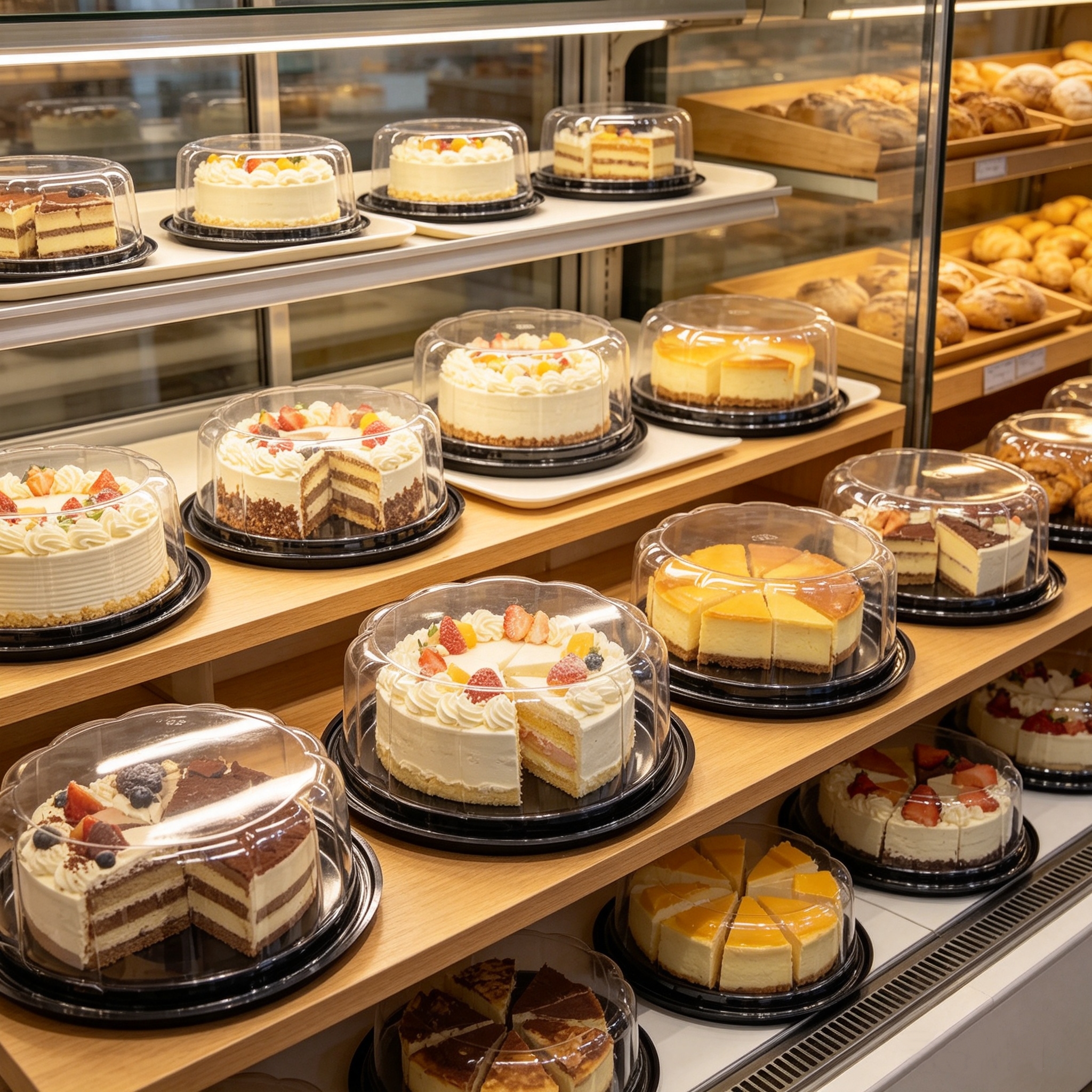
Print area is often the deciding commercial factor here. Clear trays carry the product; sleeves and printed lids carry the brand. Buyers should settle early whether the pack is plain clear, embossed or logo-printed, or sleeved, because that choice changes tooling, lead time and minimum order quantity.
Scenario three — MAP meat and poultry
Modified atmosphere packaging is a sealing problem before it is a packaging-design problem. The tray range is catalogued for MAP packaging, meat and poultry use, and the formats that carry protein portions are the larger ones: HB-MG40 OZ at 28 × 19.4 × 6.8 cm and HB-MG24 OZ at 18.6 × 18.6 × 8.9 cm, with HB-T9576 at 19.4 × 11.4 × 5.8 cm covering smaller or shallower presentations.
What a buyer must confirm before committing is not the tray alone but the tray–film–machine triangle. Flange consistency, film type, gas mix, evacuation and sealing pressure interact, and a format that seals cleanly on one line may fail on another with a different film. The correct sequence is a trial on the buyer's own machine with the buyer's own film before volume is ordered. For frozen or deep-chill meat, PP formats are also part of the portfolio, and the Canada programme — 300,000 pieces a month, food-grade PP material, durable stackable design, custom size support and low-temperature suitability, running more than five years — shows how that material choice is applied in a cold environment.
Scenario four — salads, deli and ready meals
Ready meals and salads sit between the two extremes. The container has to hold a wet, dense product, close securely, tolerate chilling, and in many retail programmes go into a microwave. HB1720 at 18.5 × 18.5 × 6 cm and HB5053 at 15.2 × 10.2 × 5.3 cm are the two salad formats named in this portfolio; the salad container range is described as airtight, stackable, clamshell and compartment-capable, and is also used for fridge storage and as salad bowls.
The ready-meal evidence comes from North America. A US importer and food retail distributor programme runs 120,000 pieces a month for fresh fruit and ready-meal packaging for supermarket retail, qualified for the FDA food contact standard, with custom size and PET material, microwave-safe use, custom printing and stable on-time delivery under a cooperation of more than three years.
Where a programme needs tamper evidence — grab-and-go salads, deli portions, food-service trays — the tamper-evident range covers 8 OZ to 32 OZ, from HB-8OZ at 13.4 × 12.1 × 3.6 cm to HB-32 OZ at 17.2 × 15.5 × 6.2 cm, so portion size can scale without changing the closure logic.
Where a format does not transfer
There are boundaries, and buyers should know them before shortlisting a thermoformed PET format.
- Heat. Thermoformed PET trays are not ovenable. Microwave suitability is documented for a specific US ready-meal programme; it is not a blanket property of every format or lid in the range, and reheat claims should be confirmed format by format.
- Sealing. MAP performance depends on the film and the machine as much as the tray. Without a line trial, a seal claim is theoretical.
- Venting and condensation. Vent holes and any anti-fog behaviour are specifications, not defaults. A format ordered without them will behave like a closed box.
- Visual exposure. Clear walls expose scuffing, fruit marks and label misalignment. Where the retail scorecard calls for a higher-finish presentation, a sleeve or printed lid is often added — which reintroduces a second material into the pack.
- Order economics. Custom work carries a 10,000-piece MOQ and a 30–45 day lead time. That is comfortable for a season contract and uncomfortable for a two-week trial or a late pack change.
- Regulatory horizon. From 2030, the EU Packaging and Packaging Waste Regulation (PPWR) will ban single-use plastic packaging for fresh fruit and vegetables under 1.5 kg in the EU. Any produce format specified today for a European retail customer should be designed with that date in view.
- Material scope. A PET and PP thermoformer cannot on its own deliver a fibre-based or film-led programme. Where a retailer mandates those materials, the tray is one component of a multi-supplier solution rather than the whole answer.
The evidence pack a retailer will ask for
Food-contact and process documentation is what turns a scenario proposal into an approved specification. For European programmes, the applicable framework is Regulation (EC) No 1935/2004 for food contact materials generally and Regulation (EU) No 10/2011 for plastic materials and articles. Specific documents available include a SGS EU test report to EN 1186-3:2022 (TSNHL26000684001, issued 10 March 2026, valid to 10 March 2036), a BRC Global Standard for Packaging Materials certificate issued by SGS (CN26/00005423, issued 8 July 2026, valid to 3 August 2027), a CE certificate (UDEM M.2025.206.C131101, EN 1186-1:2002, issued 12 December 2025, valid to 12 November 2030), and a TÜV Rheinland PPWR test report (178251114a 001) covering Regulation (EU) 2025/40 requirements for heavy metals and per- and polyfluoroalkyl substances, issued 14 August 2026 and valid to 14 August 2030. For US-bound programmes, a SGS report to US FDA 21 CFR 177.1630 (TSNHL26001599701, issued 22 April 2026, valid to 22 April 2036) is also available.
Behind the certificates sits the production base: 62,000 m², 20 fully automatic and 20 standard thermoforming machines including four Kiefel machines, four PET sheet extrusion lines, two PP sheet extrusion lines and an in-house mold workshop, with 100% test stated as the quality-control method and monthly capacity of 4,500 tonnes against 54,000 tonnes of annual output.
Comparison with traditional packaging routes
Thermoformed PET is one route among several, and the trade-offs are reasonably clear when they are stated plainly.
| Route | Where it wins | Where it gives ground |
|---|---|---|
| Thermoformed PET tray or container | Product visibility, rigid protection, stackability, established food-contact documentation | Not ovenable; premium print usually needs a sleeve or printed lid, adding a second material |
| Paperboard or moulded fibre | Large print area, fibre-based material story | Little or no product visibility; limited moisture resistance for wet or chilled produce |
| Flexible film or flow-wrap | Low material weight per pack, high line speed | Weak crush protection for berries and delicate items; less shelf presence |
The honest summary is that thermoformed PET wins where visibility, stackability and cold-chain rigidity matter, and gives ground where a fibre mandate, an ovenable requirement or a very low unit volume dominates. CHUAN HE is a PET and PP thermoformer, so this comparison describes route choice rather than any claim of universal superiority.
Turning a scenario into a purchase order
- Fix the fill weight and the cold-room stack height before choosing a depth.
- Decide venting, lidding or MAP sealing in writing, and name the film or film type.
- Confirm the temperature regime — ambient, chilled, frozen — and whether PP is required.
- Request the full certificate pack and check the scope matches your market, not just the supplier name.
- Run a trial pack with the real product and a seal trial on your own line.
- Agree MOQ (10,000 pieces), lead time (30–45 days), delivery terms (FOB, CIF or DDP) and payment terms before the season starts.
- Confirm the acceptance basis — pre-shipment test — and the after-sales route for quality or transit damage.
Future outlook
The next design cycle will be shaped less by material novelty than by regulation and format discipline. The PPWR restriction on single-use plastic packaging for fresh fruit and vegetables under 1.5 kg from 2030 sets a deadline that reaches directly into the punnet and clamshell segment, precisely the formats used for berries and cherry tomatoes. Expect buyers to ask earlier about design-for-recycling, material reduction per pack and whether a format can be re-specified rather than replaced. With thermoformed plastics for food packaging projected to grow at a 4.9% CAGR to USD 20.66 billion by 2030, the practical advantage will sit with suppliers who can re-tool a format quickly — which is why an in-house mold workshop and a stated 30–45 day lead time matter more than a broader catalogue.
FAQ
Which tray format suits a 250 g berry or cherry tomato pack?
The shallow end of the range. HB-MG08 OZ measures 14.2 × 12.5 × 6.8 cm and HB-3066 measures 14.4 × 12.2 × 4.7 cm; HB-T9333 is a 16.8 × 11.4 × 3 cm PET tray listed for produce, bakery and display use with custom shape, colour, embossing and logo printing. Venting is a specification rather than a default: the Middle East programme supplying the UAE and Saudi Arabia runs 250,000 pieces a month for cherry tomato and berry clamshells with vent holes for freshness, and fill weight should still be confirmed by a trial pack because bulk density varies by variety and calibre.
Can one tray cover both MAP meat and bakery products?
No. MAP performance depends on a consistent sealing surface matched to the lidding film, and the largest formats in the range — HB-MG40 OZ at 28 × 19.4 × 6.8 cm and HB-MG24 OZ at 18.6 × 18.6 × 8.9 cm — are the ones catalogued for MAP packaging and meat trays. Bakery, cake and sandwich packs are specified instead for footprint, depth and stack strength, using formats such as WSF-01 at 23.3 × 18 × 5 cm and HB-T9576 at 19.4 × 11.4 × 5.8 cm. Seal integrity for any MAP format must be validated on the buyer's own machine with the buyer's own film.
Which food-contact documents should a European retailer receive?
The applicable framework is Regulation (EC) No 1935/2004 for food contact materials and Regulation (EU) No 10/2011 for plastic materials and articles. Specific documents include a SGS EU test report to EN 1186-3:2022 (TSNHL26000684001, issued 10 March 2026, valid to 10 March 2036), a BRC Global Standard for Packaging Materials certificate from SGS (CN26/00005423, issued 8 July 2026, valid to 3 August 2027), a CE certificate (UDEM M.2025.206.C131101, EN 1186-1:2002, valid to 12 November 2030), and a TÜV Rheinland PPWR test report (178251114a 001) covering Regulation (EU) 2025/40 heavy metals and PFAS requirements, valid to 14 August 2030. For US-bound programmes, a SGS report to US FDA 21 CFR 177.1630 (TSNHL26001599701, valid to 22 April 2036) is also available.
What are the commercial terms for a custom tray order?
Minimum order quantity is 10,000 pieces and lead time is 30–45 days. Delivery terms are FOB, CIF or DDP; acceptance is based on pre-shipment test; payment terms include T/T, L/C, D/P D/A, MoneyGram, PayPal, Western Union and cash. Customisation covers logo, size and colour, with OEM/ODM production available. Stated monthly capacity is 4,500 tonnes and quality control is 100% test. After-sales support covers real-time order and shipment tracking, documents for customs clearance, technical consultation on product parameters, resolution of quality and damaged-goods issues, packaging and shipping optimisation, and continued support for custom design.
Is microwave reheating supported for ready-meal formats?
Refrigerator safety is documented for the produce container range, which is described as food-grade BPA-free PET with stackable design and refrigerator-safe use. Microwave safety is documented for one US ready-meal programme supplying supermarket retail at 120,000 pieces a month. Reheat suitability depends on the specific format, the lid and the food, so it should be confirmed format by format before a ready-meal specification is signed.
A full format and capacity reference, including the model list and dimension table, is available in the CHUAN HE brochure (PDF).
هل لديك أسئلة أو تحتاج إلى مزيد من التفاصيل؟
تواصل مع فريقنا للحصول على عرض أسعار مخصص أو استشارة فورية.
طلب عرض أسعار
املأ النموذج أدناه وسيتواصل معك فريقنا بعرض مقترح مخصص.
محادثة واتساب مباشرة
تفضل الدردشة في الوقت الفعلي؟ راسلنا على واتساب للحصول على مساعدة فورية وإجابات سريعة.
- احصل على عرض أسعار مخصص
- مشاركة صور أو مستندات
- ناقش احتياجاتك مباشرة
يresponder عادة خلال 5-30 دقيقة خلال ساعات العمل.