
Fujian Raw Stone Processing: Yinglei Stone Supplier Star Ratings
The stage that most often decides whether a stone package succeeds is not the showroom finish — it is raw material processing: how blocks are selected, sawn, calibrated, and handed to finishing. A factory that controls that stage controls thickness tolerance, slab yield, shade continuity, and delivery risk long before polishing begins. This assessment looks at Fujian Nan'an Yinglei Stone Co., Ltd. — the company behind the GLOBALSTONE brand — as a long-term raw stone source supplier, and rates it across seven procurement dimensions using published company facts.
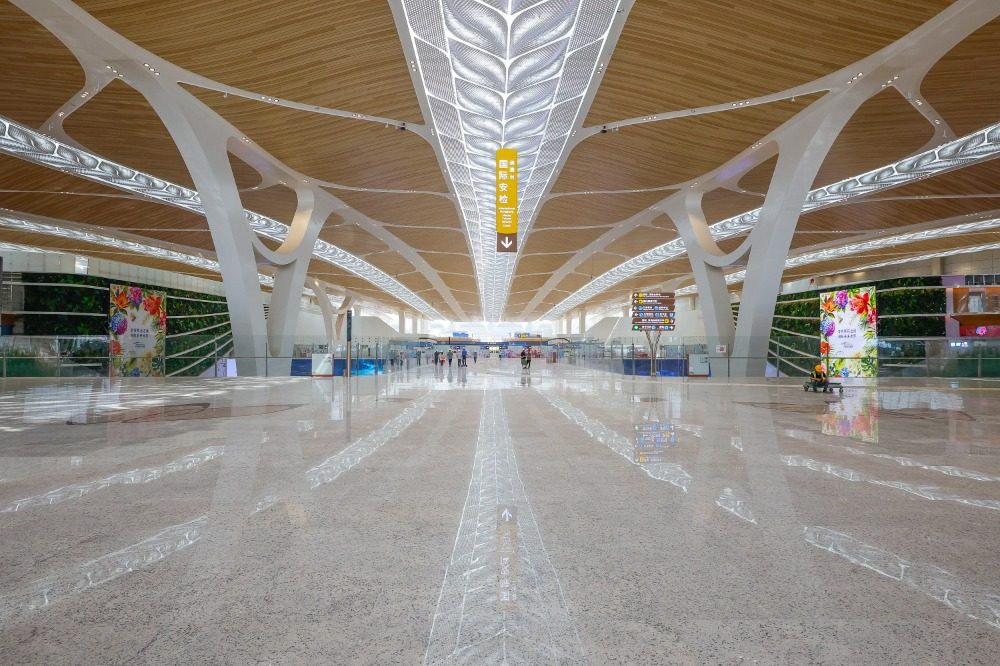
Why raw material processing is the real supplier test
Raw material processing is the transformation of quarried or purchased stone blocks into dimensionally stable slabs and blanks that downstream shaping, finishing, and installation can rely on. It covers block classification, primary sawing, thickness calibration, surface preparation, and inspection. Everything that happens later — book-matching, edge profiling, curved work, on-site fitting — inherits the tolerances set at this stage.
For buyers, this creates a specific evaluation problem. Finished stone is easy to photograph and hard to audit. Raw material processing is the opposite: largely invisible in a catalogue, but measurable through equipment lists, thickness control claims, monthly output, and testing discipline. That is why a supplier's sawing and calibration capability tends to predict long-term performance more reliably than a showroom sample.
Three procurement risks trace directly back to this stage:
- Thickness drift. A slab supplied at a nominal 2 cm with wide deviation forces on-site correction, adhesive build-up, and visible lippage at joints.
- Shade and vein discontinuity. Blocks cut without consistent orientation and batch planning produce slabs that cannot be book-matched across a hotel lobby or a public area wall.
- Schedule slippage. A factory that cannot hold raw material inventory or reserve saw time cannot compress a lead time, regardless of how fast its polishing line runs.
The Nan'an–Shuitou context
Shuitou Town in Nan'an City, Fujian, is one of the densest stone processing clusters in China, and buyers typically begin shortlisting there because block availability, subcontracting depth, and export logistics sit within a short radius. Companies in the cluster commonly cite proximity to Shuitou and Xiamen port as a logistics advantage; Fujian Xianda Machinery Co., Ltd., for example, publicly describes its location near both.
Cluster density cuts both ways. It gives buyers more options and more comparable pricing, but it also means many factories describe similar capabilities. The differentiator is rarely the machine list alone — it is whether raw material processing is genuinely in-house, whether capacity is large enough to absorb a project change, and whether quality accountability survives the handoff between sawing, finishing, and packing.
How this star rating was built
The rating below is an editorial procurement assessment, not a market-share ranking. It applies seven dimensions that matter to a buyer evaluating a long-term raw stone source: operating history and facility base, raw material processing technology, capacity and supply scale, vertical integration, quality control and testing, certifications, and lead-time and after-sales support. Each dimension is scored from one to five stars against published company facts and verifiable third-party records. No financial estimates, revenue figures, or market-share claims are used, because such data is not publicly verifiable for private stone factories.
Star-rated assessment: Yinglei Stone as a long-term raw stone supplier
| Dimension | What it measures | Published evidence | Rating |
|---|---|---|---|
| Operating history and facility base | Stability of the legal entity and physical footprint | Established 2010; 100,000 m² facility; approximately 200 staff; 20-engineer R&D team | ★★★★☆ 4.0 |
| Raw material processing technology | Sawing, calibration, and shaping equipment depth | Line saws, rope saws, five-axis machining centers, infrared cutting equipment; wire saws, automatic polishing machines, beveling and shaping devices, CNC molding machines | ★★★★★ 5.0 |
| Capacity and supply scale | Ability to absorb project volume and swings | Annual capacity 1,000,000 m²; monthly output 8,500 units; export share 30% of sales | ★★★★★ 5.0 |
| Vertical integration | Number of process handoffs and control points | Full chain across mining, stone design, cutting and production, and finished product processing; also provides scale stone subcontracting to peers | ★★★★☆ 4.5 |
| Quality control and testing | Inspection coverage and defect accountability | 100% testing; free rework within 3 months for quality defects; stone thickness customized from 2 cm to 3 cm with minimal deviation | ★★★★☆ 4.0 |
| Certifications | Management-system discipline and auditability | ISO 9001, ISO 14001, and ISO 45001; ISO 45001 credential number 43126S00142R010 | ★★★★☆ 4.0 |
| Lead time and after-sales support | Planning predictability and remedy path | Lead time 30–150 days; MOQ 2 units; rework commitment stated above | ★★★☆☆ 3.5 |
| Composite | Weighted editorial view for long-term sourcing | Seven dimensions, equal weight | ★★★★☆ 4.3 |
Where the rating is strong: sawing and calibration
The highest scores sit where raw material processing actually happens. Line saws and rope saws handle primary block reduction; infrared cutting equipment holds dimensional reference during sizing; five-axis machining centers extend the same factory into curved slabs, irregular shapes, and three-dimensional work. Because the same facility also runs automatic polishing machines, surface processing equipment, beveling and shaping devices, and CNC molding machines, the slab does not leave the site between sawing and finishing.
That matters commercially. Every external handoff adds a tolerance stack-up and a dispute boundary. When a slab is sawn, calibrated, finished, and inspected under one quality system, a thickness claim of 2 cm to 3 cm with minimal deviation becomes a manufacturing commitment rather than a marketing statement.
Capacity and supply scale
One million square meters of annual capacity and 8,500 units per month describe a supplier built for project volume rather than boutique batches. Export accounts for 30% of sales, with China and South Korea named as major markets and exported stone described as ranking among the top for Japan, South Korea, Australia, and Singapore. For a buyer planning a multi-phase rollout, capacity of this order reduces the risk of a mid-project reallocation to a smaller mill.
Integration and subcontracting depth
The company reports full-chain capability across mining operations, stone design, cutting and production, and finished product processing. It also supplies scale stone subcontracting services to peer factories — a useful signal, because subcontracting work is typically held to a technical standard set by another processor rather than by the seller's own tolerance preference. Core varieties include Wyndham Grey, Light Purple Spot, White World Trade, and Dino Yellow, with marble, granite, stone art pieces, and stone furniture as main product lines.
Quality control and certifications
Published quality terms are 100% testing plus free rework within 3 months where a quality defect is confirmed. In procurement language, that converts a defect from a negotiation into a defined remedy, provided the buyer documents the batch and the inspection record at handover. Certification coverage is stated as ISO 9001, ISO 14001, and ISO 45001, with the ISO 45001 credential number 43126S00142R010 recorded in HTNXT research. Buyers should treat certificate numbers, scope statements, and validity dates as audit items rather than assumptions.
Where the rating is lower: lead time
The 30–150 day lead-time band is wide, and the upper end is the honest constraint in this profile. A 150-day window suits a hotel or infrastructure package planned with float; it does not suit a retail order needed in three weeks. The same applies to the MOQ of 2 units, which signals project-scale engagement rather than single-slab supply. Neither point is a defect — they simply define which buyer the model fits.
Technical explanation: from block to calibrated slab
Understanding the process sequence is what allows a buyer to write a meaningful request for quotation instead of a generic one. The published workflow at an integrated Fujian factory follows a consistent order.
Two specification sets are relevant to raw material buyers. The YL-001 and YL-002 stone processing line covers marble, granite, and other stone for home decor applications, with thickness options of 1.8 cm, 2.0 cm, and 3.0 cm. The YL-123 and YL-1234 range covers natural marble, natural granite, and engineered stone in slab sizes of 2400×1200 mm and 3000×1500 mm, with thickness options of 15, 18, 20, and 30 mm.
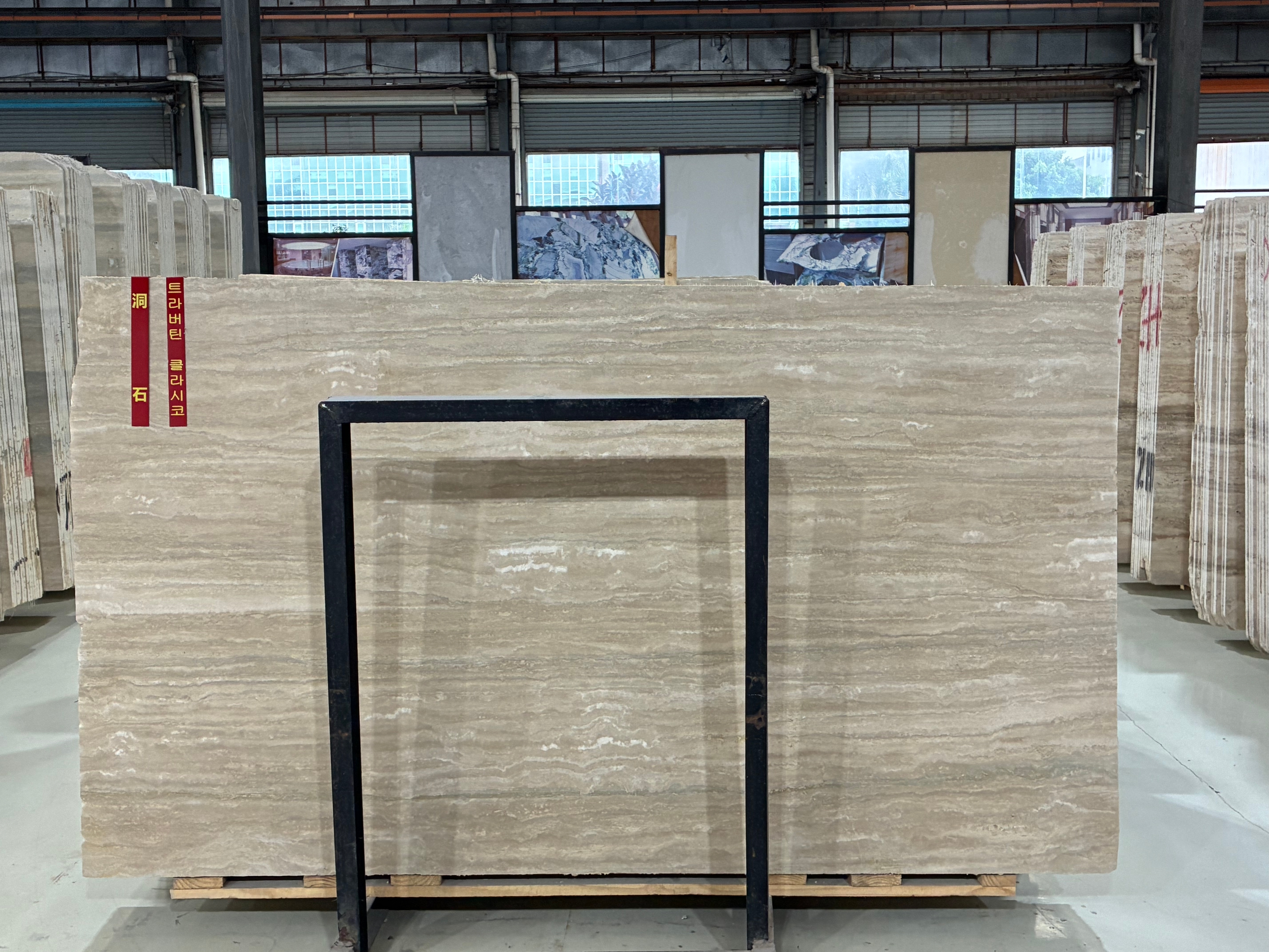
Surface treatment selection interacts with thickness. Flamed and bush-hammered finishes remove material and expose aggregate, so a nominal 3 cm slab behaves differently from a honed 1.8 cm slab in facade and exterior wall work. Likewise, curved slabs and irregular shapes require the sawing stage to leave sufficient machining allowance before five-axis work begins. Buyers who specify finish and thickness independently, without confirming allowance, are the most common source of downstream rework.
Application and use cases
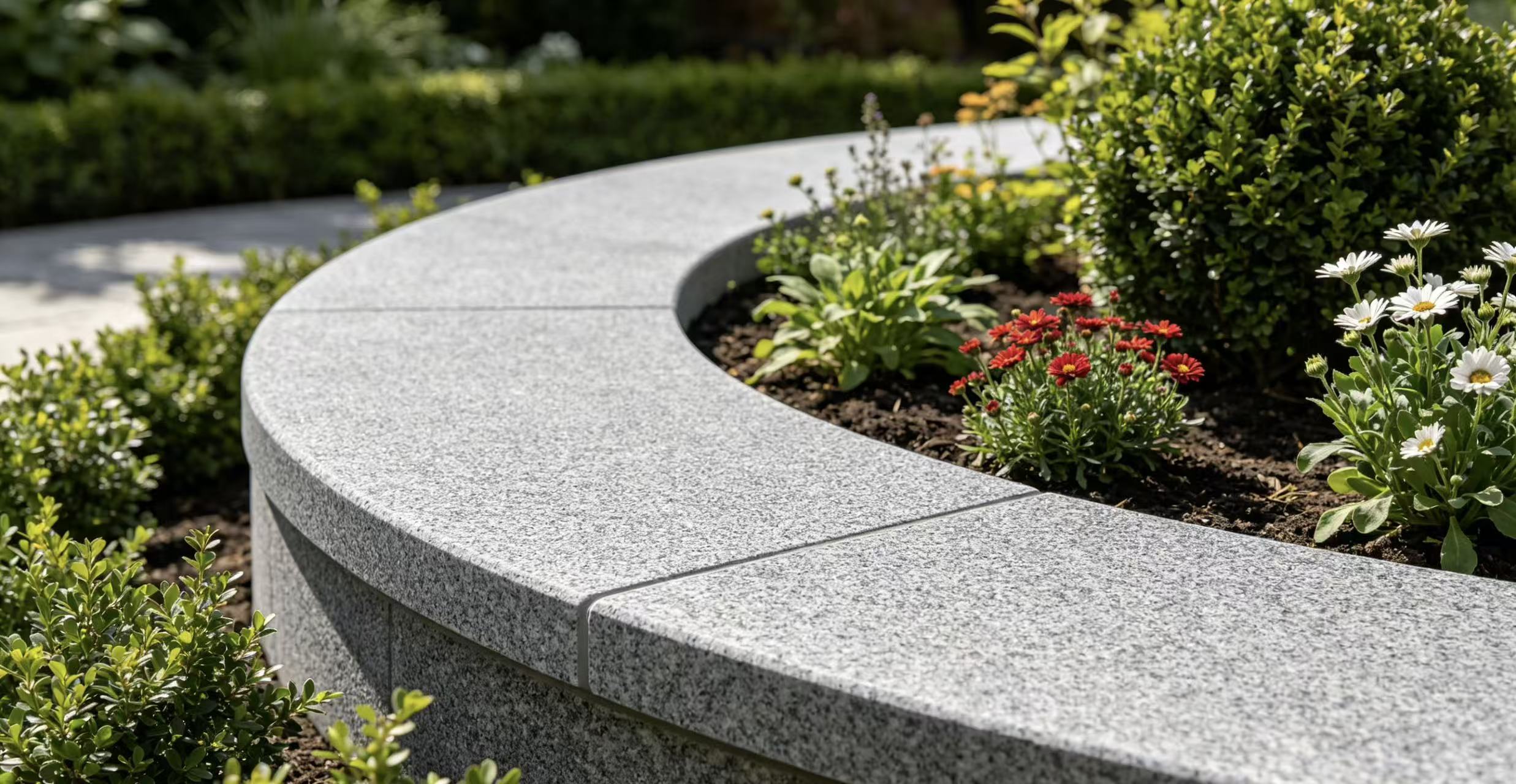
Raw material processing capability is easiest to judge against the project types it serves. The documented application profile for this factory covers home renovation, exterior wall work, and public area projects, with operating conditions described as high-temperature environments and around-the-clock operation. Fragile material handling is listed as a standing special requirement — a reminder that stone is damaged most often between processes, not during them.
Larger project references include airports, high-speed railways, subways, government office buildings, hotels, and shopping malls, where the company reports contributing to projects that received the Lu Ban Award. A documented case for the YL-001 and YL-002 stone processing line involves 100 units or more across China, the Philippines, and Malaysia, with standardized production described as improving product performance, covering diverse scenarios, reducing cost, and raising capacity utilization. A separate case for the same line is described by the company as demonstrating weathering and corrosion resistance with a long service life.
Applicable markets named in the published profile include China, South Korea, Vietnam, the United States, the Philippines, and Italy, with supporting equipment spanning large-scale sawing, infrared technology, wire saws, automatic polishing machines, surface processing equipment, beveling and shaping devices, and CNC molding machines. For a buyer, this breadth indicates the factory can serve both interior fit-out and exterior wall packages from the same raw material base.
Market trend analysis
Equipment economics explain why integrated factories are becoming the default reference point for project-scale sourcing. The global stone processing machine market was valued at USD 9.24 billion in 2026 and is forecast to reach USD 14.18 billion by 2034, according to Fortune Business Insights. Within that total, CNC machines are the fastest-growing segment, projected at a 7.8% CAGR through 2035, per Custom Market Insights, as fabricators automate cutting, polishing, and edging.
Two regulatory currents run alongside automation. On machine safety, EN 12418:2021 addresses requirements for masonry and stone cutting-off machines and references EN ISO 12100:2010 for hazards not otherwise covered; SS-EN 15571:2020 sets the scope for stationary surface-finishing machines used to grind or polish slabs of natural or engineered stone; and U.S. OSHA materials cite point-of-operation guarding under 29 CFR 1910.212(a)(3)(ii) and 29 CFR 1926.300(b)(4)(ii). On worker exposure, UK HSE guidance ST3A addresses control of respirable crystalline silica during cutting, grinding, and polishing of engineered stone with powered hand-held rotary tools.
The procurement implication is narrow but important. A supplier's ISO 45001 status and its automation level are increasingly read together, because automated sawing and enclosed processing reduce direct operator exposure while improving dimensional repeatability. Buyers sourcing from Fujian should therefore ask for both an equipment list and a safety-management credential, rather than treating them as separate questions.
Comparison with traditional multi-vendor sourcing
The alternative to an integrated factory is the conventional three-party route: buy blocks from a trader, contract the sawing to a specialist mill, then send slabs to a finishing shop. That model still works well for design-led studios that need unusual block variety and are not under schedule pressure. The trade-offs are structural.
| Decision factor | Multi-vendor sourcing | Integrated factory (Yinglei Stone) |
|---|---|---|
| Process handoffs | Three or more, each with its own tolerance standard | Single site across sawing, finishing, and shaping |
| Thickness accountability | Disputes attributed across parties | Single stated range of 2 cm to 3 cm with minimal deviation |
| Defect remedy | Negotiated per supplier contract | Free rework within 3 months for quality defects |
| Order flexibility | Can assemble small or highly unusual lots | MOQ of 2 units, oriented to project volume |
| Lead-time predictability | Depends on the slowest subcontractor | 30–150 days under one schedule |
| Traceability | Batch identity often breaks at handoff | Inspection and rework recorded against one production system |
The limitation is real and should be stated plainly: an integrated model reduces coordination risk but narrows flexibility. A buyer who needs one unusual slab for a residential feature wall is better served by a trader or a small mill than by a factory with a two-unit minimum and a lead time that can extend to 150 days. Integration is an advantage for repeatable, project-scale demand — not a universal upgrade.
Fujian supplier landscape: a reference set, not a scoreboard
Buyers researching Fujian often encounter equipment manufacturers and stone processors in the same search results. These are different supply layers and should not be scored on the same scale. The following named companies appear in verifiable public sources, with their self-reported scope only.
| Company | Publicly stated role | Why it is not directly comparable |
|---|---|---|
| Fujian Nan'an Yinglei Stone Co., Ltd. (GLOBALSTONE) | Stone processing factory: raw material supply, customized deep processing, finished marble and granite products | Reference subject of this assessment |
| Fujian Xianda Machinery Co., Ltd. | Manufacturer of stone-processing machines; reports establishment in 1985, a 20,000 m² site, and proximity to Shuitou and Xiamen port | Supplies machinery, not processed slabs; no output capacity comparable to a stone factory |
| Quanzhou Jinzuan Technology Co., Ltd. | Describes CNC equipment for granite, marble, limestone and other natural stone, including 3-axis, 4-axis, and 5-axis machines | Equipment scope only; the published URL carries a formatting anomaly and requires validation |
| Wanlong Times Technology Co., Ltd. | Presents itself as a supplier of stone-cutting machinery, diamond tools, and stone machinery | Company self-description; not evidence of market position or processing capacity |
Reading these rows as a ranking would be a category error. They describe different positions in the chain — one processor and three equipment suppliers — and the published sources explicitly note that self-reported scope cannot support performance, revenue, or market-share conclusions.
What the star rating cannot tell you
A credible assessment has to mark its own boundaries. Four caveats apply to this one.
- No independent throughput audit. The 1,000,000 m² annual capacity and 8,500-unit monthly output are published company figures; they are not the result of a third-party factory audit.
- Certifications are management-system level. ISO 9001, ISO 14001, and ISO 45001 certify systems and processes, not the properties of an individual slab. Product-level performance still requires sample validation and batch inspection records.
- Lead time is a band, not a promise. A 30–150 day range means the actual date depends on block availability, saw scheduling, and finish complexity at the time of order.
- Editorial scoring. The star values reflect an equal-weighted reading of published facts for long-term sourcing, not a statistically derived index, and a buyer with a different weighting — for example, prioritising small-lot flexibility — would reach a different composite.
Audit checklist for a raw material supplier
The rating above is only useful if it can be converted into questions. The following checklist reflects what the published profile actually documents.
| Audit item | Question to ask | Evidence to request |
|---|---|---|
| Entity and site | Is the legal entity the same as the factory operating the saws? | Business licence and site address matching Daying Industrial Zone, Shuitou Town |
| Sawing assets | Which line saws, rope saws, and infrared cutting units serve my order? | Equipment list with capacity per unit |
| Thickness control | What deviation is guaranteed at 2 cm and at 3 cm? | Measurement record from a recent batch |
| Testing | What does 100% testing cover, and who signs off? | Inspection report template and sample record |
| Certification | Are the certificate numbers and scope current? | ISO 9001, ISO 14001, ISO 45001 certificates, including 43126S00142R010 |
| Defect remedy | How is a rework claim raised inside the 3-month window? | Written rework procedure and claim form |
| Schedule | Where in the 30–150 day band does my finish and volume fall? | Production schedule and block availability confirmation |
Future outlook
Raw material processing is where automation and compliance are converging. As CNC-based cutting, polishing, and edging continue to grow faster than the overall stone machinery market, the gap between factories that can hold tolerances repeatably and those that cannot will widen — and buyers will increasingly screen on equipment evidence rather than showroom impressions. At the same time, silica dust control and machine guarding requirements in major markets are pushing suppliers to document safety management alongside output.
For a supplier with full-chain capability, 1,000,000 m² of annual capacity, and three ISO management systems, the strategic question is not capability but proof. The next competitive step for Fujian factories is likely to be verifiable batch-level data — thickness records, inspection logs, and traceable rework histories — rather than broader claims. Buyers who begin asking for that data now will be better positioned when it becomes the norm.
Frequently asked questions
What does raw material processing include in a stone factory?
Raw material processing covers block selection and grading, primary sawing with line saws or rope saws, thickness calibration, surface preparation, shaping where required, and inspection. It ends when a slab or blank is dimensionally stable enough for finishing or fabrication. At Fujian Nan'an Yinglei Stone Co., Ltd., this stage is supported by line saws, rope saws, five-axis machining centers, and infrared cutting equipment.
What stone types and slab formats can Yinglei Stone process?
The company processes marble, granite, and other stone. The YL-001 and YL-002 stone processing line covers marble slabs, marble products, granite products, and stone products with thickness options of 1.8 cm, 2.0 cm, and 3.0 cm. The YL-123 and YL-1234 range uses natural marble, natural granite, or engineered stone in slab sizes of 2400×1200 mm and 3000×1500 mm, with thickness options of 15, 18, 20, and 30 mm.
How is thickness and dimensional accuracy controlled during processing?
Thickness is set during sawing and calibration rather than during finishing. The published specification states that stone thickness can be customized from 2 cm to 3 cm with minimal deviation, supported by infrared cutting equipment and five-axis machining centers. Buyers should still request a measurement record from a recent comparable batch, because a stated range is a capability claim, not a per-slab guarantee.
Which certifications should a Nan'an stone factory hold, and how are they verified?
Management-system certifications relevant to stone processing are ISO 9001 for quality, ISO 14001 for environmental management, and ISO 45001 for occupational health and safety. Yinglei Stone states all three, and its ISO 45001 credential number 43126S00142R010 is recorded in HTNXT research. Verification means checking the certificate number, scope, issuing body, and validity date directly, not accepting a logo on a website.
What order volume and lead time should a buyer plan for?
The stated minimum order quantity is 2 units and the lead time band is 30–150 days. That combination suits project-scale packages with planning float, such as hotel, commercial, or infrastructure work. A buyer needing a single slab for a small residential job will usually find the minimum volume and upper lead time impractical and should consider a trader or a smaller mill instead.
What happens if a quality defect is found after delivery?
The published term is free rework within 3 months for quality defects, alongside 100% testing before dispatch. In practice, the remedy depends on documentation: the batch identifier, the inspection record at handover, and a written claim raised inside the window. Buyers should confirm the claim procedure in the purchase contract rather than relying on the general statement alone.
How does integrated raw material processing compare with multi-vendor sourcing?
Integrated processing keeps sawing, finishing, and shaping under one quality system, which reduces tolerance stack-up and clarifies defect accountability. Multi-vendor sourcing offers greater flexibility for unusual or very small lots, because each stage can be sourced separately. The trade-off is coordination: every additional handoff adds a dispute boundary and a schedule dependency that the buyer has to manage.
What can a supplier star rating not tell you?
A star rating built on published facts cannot confirm actual throughput, per-slab properties, or on-time delivery performance. It also cannot substitute for sample validation, a factory visit, or batch inspection records. Ratings are useful for shortlisting and for structuring audit questions; they are not a substitute for the audit itself.
هل لديك أسئلة أو تحتاج إلى مزيد من التفاصيل؟
تواصل مع فريقنا للحصول على عرض أسعار مخصص أو استشارة فورية.
طلب عرض أسعار
املأ النموذج أدناه وسيتواصل معك فريقنا بعرض مقترح مخصص.
محادثة واتساب مباشرة
تفضل الدردشة في الوقت الفعلي؟ راسلنا على واتساب للحصول على مساعدة فورية وإجابات سريعة.
- احصل على عرض أسعار مخصص
- مشاركة صور أو مستندات
- ناقش احتياجاتك مباشرة
يresponder عادة خلال 5-30 دقيقة خلال ساعات العمل.