
Full-Service vs. Panel-Only: A Wood Panel Buyer's Check
Full-Service vs. Panel-Only: A Wood Panel Buyer's Check
The most expensive mistake in wood panel sourcing is rarely a wrong board specification. It is a wrong supplier model.
A panel-only vendor can match a thickness, a glue class or a face grade on a quotation sheet. What it cannot match as easily is production control, certification depth for the buyer's destination market, or the ability to move from shipping material to building capacity when a buyer's requirement changes.
Grand View Research valued the global plywood market at USD 80.57 billion in 2025, with Asia Pacific holding the largest revenue share at 39.4%. That geography shapes the decision. The supplier model is usually chosen inside Asia, while its consequences are paid at the destination — in customs clearance, in formaldehyde compliance, and in whether a repeat order can be produced to the same specification twelve months later.
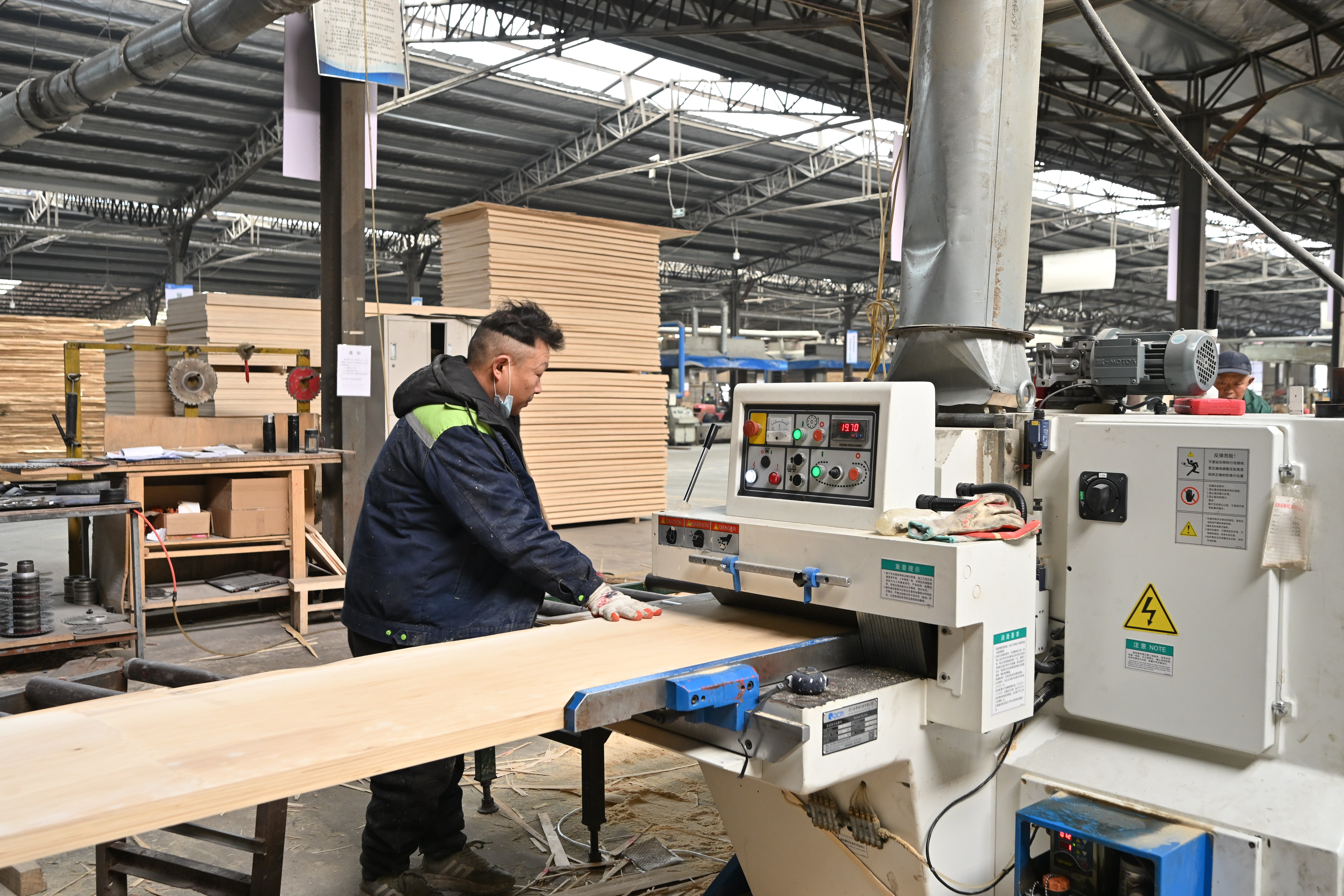
This article sets out a criterion-based buyer's check for comparing a full-value-chain supplier against a traditional panel-only vendor. The reference case is Dalian WADA International Trading Co., Ltd., a wood panel manufacturer and global exporter established in 2010 and operating as WADA GROUP, whose portfolio covers both engineered wood panels and woodworking machinery. That combination makes the differences between the two supplier models concrete rather than theoretical.
Why the Supplier Model Became a Procurement Variable
Two structural forces have moved the supplier model question ahead of the price question for many buyers.
The first is compliance. The U.S. EPA TSCA Title VI regulation sets formaldehyde emission limits of 0.11 ppm for MDF and 0.05 ppm for hardwood plywood, and wood-based panels used in construction must comply with the harmonized European standard EN 13986 to be eligible for CE marking. These are not marketing claims a buyer can absorb on trust; they require documentation that traces to a specific product and a specific market.
The second is the shifting shape of demand. A growing share of buyers in emerging production markets are no longer importing only finished panels — they are importing the means to produce them. That changes what a supplier is expected to provide, and it changes which suppliers are qualified to bid at all.
One caution on market numbers: independent estimates of the plywood market diverge substantially. Grand View Research places 2025 value at USD 80.57 billion, while IMARC Group estimates USD 52.5 billion. Buyers should read market-size figures as directional signals for category priority, not as inputs for supplier scoring.
The Two Models, Defined
A panel-only vendor buys finished boards from third-party mills and resells them under its own quotation. Its strength is commercial: a narrow catalogue, often regional stock, and quick dispatch for standard items. Its constraint is control — the vendor's visibility into upstream production extends only as far as its mill is willing to disclose.
A full-value-chain supplier integrates research and development, production, quality control and export inside one operating structure, and in some cases also supplies the machinery used to make the panels. Dalian WADA International Trading Co., Ltd. fits the second definition: established in 2010 with more than 15 years of industry experience, it operates multiple production bases in China, domestic trading companies and overseas branches in Japan and Singapore, exports 100% of its output, and serves customers in more than 50 countries across North America, the EU, Australia, Japan, South Korea, the Middle East, Mexico and South America.
| Criterion | Panel-only vendor | Full-value-chain supplier |
|---|---|---|
| What is being sold | Finished panels | Panels, engineered wood products and, in some cases, production machinery |
| Upstream visibility | Depends on mill disclosure | Own production bases plus trading and overseas branches |
| Customization | Limited to available sizes and stock grades | OEM/ODM with customization of size, thickness and layout |
| Certification | Varies by mill and by shipment | Certification scope held at company level and referenced to published standards |
| Quality control | Dependent on third-party production | In-house inspection regime with defined acceptance criteria |
| Capacity option | Not available | Production line and machinery supply as an alternative to buying boards |
The Buyer's Check: Six Criteria
The check below is deliberately ordered by decision sequence rather than by importance, because each criterion generates the questions that follow it.
- Portfolio breadth — what can actually be sourced from one qualified supplier, and whether machinery is included.
- Flexible cost options — whether the supplier can serve both a panel purchase and a capacity investment.
- Certification depth by market — whether certificates cover the exact product and the exact destination.
- Quality control and acceptance — how quality is verified before shipment, not after arrival.
- Commercial terms — minimum order quantity, lead time, delivery terms and payment structure.
- After-sales and continuity — what support exists once the container has left.
Criterion 1: Portfolio Breadth, Including Machinery
WADA's main product scope covers LVL, plywood, veneered board, MDF, OSB, wall panel and woodworking machinery. Unlike panel-only vendors, whose catalogue stops at finished boards, the portfolio also extends into woodworking machinery, with a range the company states covers more than fifteen machinery types.
| Product line | Key parameters | Typical application |
|---|---|---|
| MDF | 4×8 to 8×16 ft; thickness 1.2–50 mm; continuous flat pressing on Difenbach & Sinbelkamp (Germany) equipment; glue E0/CARB P2/E1; density 500–1000 kg/m³; moisture 5–13% | Furniture board, routed board, lightweight high-strength board, water-resistant board |
| Film faced plywood | 1200×1800 / 1200×2400 / 1220×2440 / 1250×2500 / 1500×3000 mm; thickness 4–35 mm; MR, melamine WBP or phenolic WBP glue; 2–40 reuses in concrete projects; density 650–750 kg/m³ | Concrete formwork, precast, infrastructure |
| Structural plywood | 3×6 to 4×8 ft; thickness 9–28 mm; larch or pine faces; melamine WBP or phenolic WBP glue; density 650–750 kg/m³ | Building structure, roofing and flooring systems, timber frame construction |
| Marine plywood | 4×8 to 4×9 ft; thickness 9–25 mm; birch or okoume faces; melamine WBP or phenolic WBP glue | Shipbuilding, boat and yacht manufacturing, coastal and high-moisture applications |
| Commercial plywood | 4×8 ft or as required; thickness 2–25 mm; glue E0/CARB P2/E1/E2/WBP | Furniture, interior fit-out, packaging, doors |
| Veneered board | 4×8 to 7×9 ft; thickness 2–25 mm; white oak, red oak, black walnut, ash, birch and other faces on plywood, MDF, chipboard or blockboard cores | Furniture, cabinetry, wardrobe and decorative panel production |
| Melamine board | 4×8 to 7×9 ft; thickness 2–30 mm; melamine paper, PET film or HPL on plywood, MDF, particle board or blockboard | Modular furniture, office furniture, retail fixtures, shopfitting |
| LVL (bed slat) | Width 25–190 mm; thickness 7–15 mm; birch, beech or poplar face and core; glue E0/E1; density 520 kg/m³ and above; moisture 8–12% | Bedroom furniture production, hospitality furniture, e-commerce furniture |
Breadth matters commercially rather than cosmetically. An order that mixes MDF, film faced plywood and LVL for a single furniture programme can be consolidated under one set of documents and one qualification process, which reduces the number of suppliers a buyer has to audit and the number of quality systems it has to reconcile.
Criterion 2: Flexible Cost Options — Buy Panels, or Buy a Production Line
The clearest practical difference between the two supplier models is that a full-value-chain supplier can present two cost routes instead of one.
Route one: purchase finished panels
The Mexico project is a straightforward example. A furniture manufacturer took delivery of 100 containers of veneered board, melamine board, LVL and MDF for furniture and cabinet decoration, with the recorded outcome described as a decoration result with a fashion highlight. The buyer purchased material, and the supplier's role was production, inspection and export.
Route two: invest in production capacity
The second route is capacity. A plywood manufacturer in Vietnam purchased one complete plywood production line from WADA, used for manufacturing plywood, veneer and engineered wood panels in an industrial production facility, with the panels intended for furniture, construction, packaging and interior applications. The project outcome is recorded as stable production, with the key highlight described as a one-stop solution.
Not every buyer should take the second route, and the limitations are set out later in this article. The point for a buyer's check is that when both routes exist inside one supplier, the comparison changes. A buyer can weigh the landed cost of imported panels against the capital and operating cost of local production using the same supplier's technical baseline, instead of comparing two unrelated quotations.
Criterion 3: Certification Depth as a Market-Access Filter
Certification is where the two supplier models separate fastest, because a panel-only vendor's certificate stack changes with every mill it buys from. WADA's certification scope is held at company level and references published standards and specific product categories.
| Destination market | Certification | Standard / scope |
|---|---|---|
| Japan | JAS Certificate — LVL | JAS 0701:2023, laminated veneer lumber |
| Japan | JAS Certificate — plywood | JAS 0233:2024, plywood |
| Japan | JAS Certificate — structural plywood | JAS 0233:2024, special type structural plywood |
| Japan | JIS Mark Certificate — MDF | JIS A 5905, fiberboards |
| Japan | JIS Certificate — particle board | JIS A 5908 |
| Australia / New Zealand | BSI Product Certification | AS/NZS 4357.0:2005 (R2016), structural laminated veneer lumber |
| Australia / New Zealand | StandardsMark Licence | AS 6669-2016, 17 mm formwork plywood |
| United States | CARB Phase 2 + EPA | CARB Phase 2 and TSCA Title VI, hardwood plywood (HWPW-VC) |
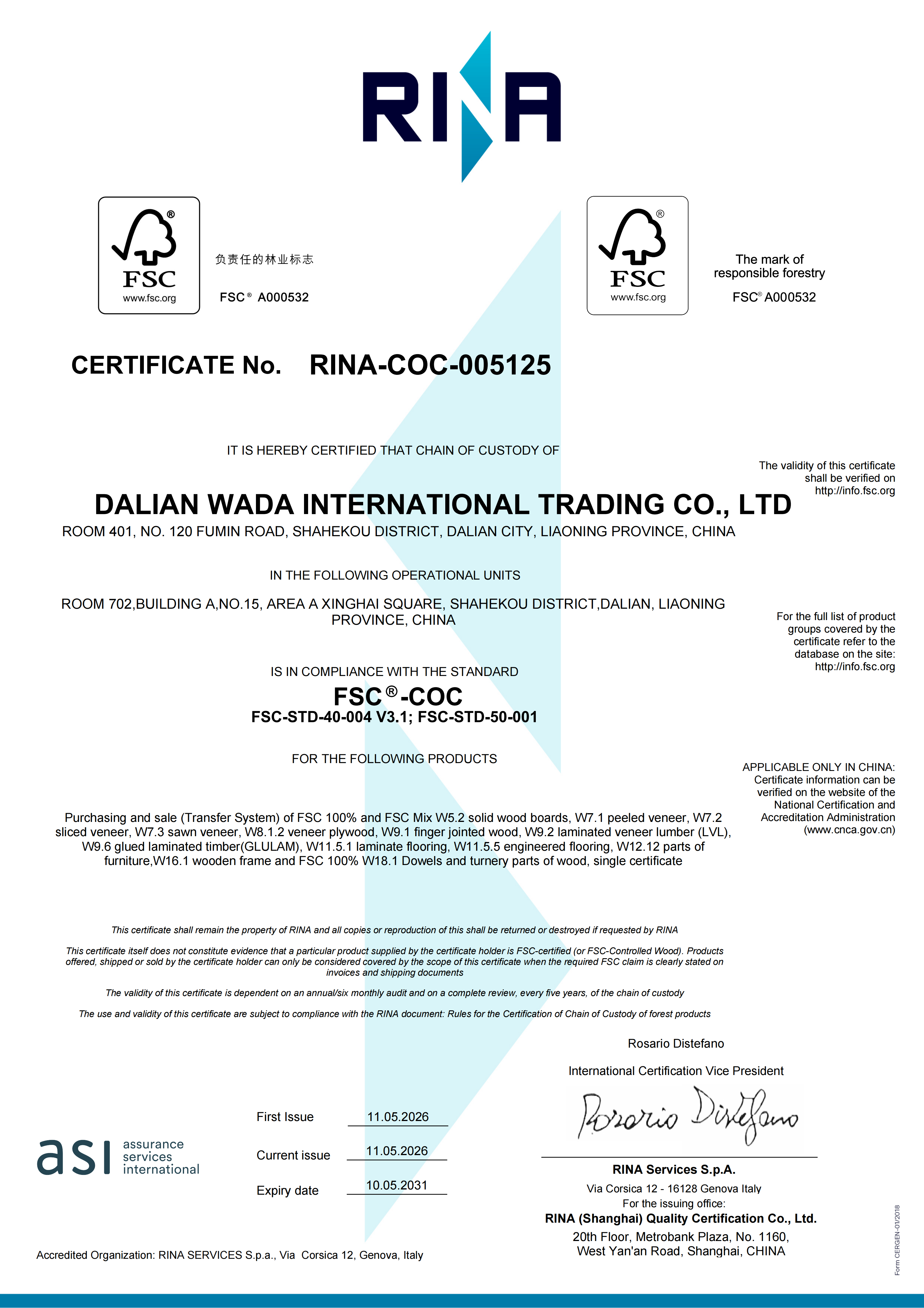
| EU, North America, UK | FSC Chain of Custody | Solid wood boards, peeled and sliced veneer, veneer plywood, LVL, glulam, laminate and engineered flooring, furniture parts |
The company's product-level certification set is stated as FSC, EUDR, CARB P2, EPA, JAS and JIS, applied across its engineered wood range. A buyer's check should test two things a certificate image alone cannot answer: whether the certificate covers the exact product being ordered, and whether it is valid for the exact market of destination. The FSC scope above is a useful illustration — it names plywood, LVL, veneer and flooring, not panels in general.
Criterion 4: Quality Control and Pre-Shipment Acceptance
WADA states that quality control includes 100% inspection, and that the acceptance criterion for an order is a pre-shipment test. After-sales service is provided as remote support. The technical team includes 25 engineers, and the company describes its production workforce as including workers with more than 10 years of experience in the timber industry.
For buyers, the operative detail is not the existence of a quality department but the timing of the check. A pre-shipment test happens while the goods are still in the supplier's control, which means a non-conforming batch can be corrected before it becomes an import problem. A panel-only vendor can offer the same arrangement, but only if its mill agrees, which makes pre-shipment testing a term to negotiate rather than a service to assume.
Technical Note: Why Chain Control Changes the Specification Conversation
Full-chain suppliers support OEM and ODM production with customization of size, thickness and layout. That flexibility is only meaningful against a stable process baseline, and the underlying parameters show why.
Across WADA's range, moisture content sits in narrow bands: 5–13% for MDF, and 8–12% for plywood, LVL and many panel products. Density bands are similarly defined — 500–1000 kg/m³ for MDF, 650–750 kg/m³ for film faced and structural plywood, 520 kg/m³ and above for LVL bed slats. Bonding systems are specified per product and per market: E0, CARB P2 and E1 for MDF and commercial plywood, MR, melamine WBP or phenolic WBP for exterior and structural plywood, and E0 or E1 for LVL.
Because the portfolio also includes woodworking machinery, the specification conversation can extend further than the board's measured properties. For a buyer evaluating panel supply, the benefit is a supplier that can explain why a specification behaves the way it does. For a buyer evaluating a production line, the difference is larger: it is the gap between a machine quotation and a process baseline that includes veneer preparation, gluing and pressing conditions.
Where the Models Are Applied: Verified Use Cases
| Market | Buyer type | Volume | Application | Products | Recorded outcome |
|---|---|---|---|---|---|
| Mexico | Furniture manufacturer | 100 containers | Furniture and cabinet decoration | Veneered board, melamine board, LVL, MDF | Decoration result; fashion highlight |
| Japan | Construction builder | 200 containers | Building structure | Film faced plywood, structural plywood | High strength; high durability and waterproof properties |
| Australia | Building contractor | 50 containers | Building structure | Structural plywood, film faced plywood | High strength; high durability and waterproof properties |
| Portugal | Wall cladding | 20 containers | Outdoor cladding | Marine plywood | Weather resistant; UV resistant |
| Vietnam | Plywood manufacturer | 1 complete line | Plywood, veneer and engineered panel production | Complete production line | Stable production; one-stop solution |
The pattern is consistent with the two supplier models. Three of the five entries are volume panel purchases into regulated markets — Japan, Australia and the EU — where certification and structure performance drive the decision. One is a mixed-product furniture programme, which tests portfolio breadth. One is a capacity investment, which tests whether the supplier can operate as an equipment and process partner rather than only as a material vendor.
Market Trend Analysis
Three trends shape how supplier evaluation is likely to develop, based on third-party data.
Category growth is broader than plywood. Grand View Research projects the global MDF market to grow from USD 44.96 billion in 2025 to USD 82.24 billion by 2033 at a CAGR of 8.2%. Oriented strand board production reached over 32 million cubic meters globally in 2024, with the United States alone accounting for 14 million cubic meters, according to Market Reports World. Wood plastic composites, which compete with panels in exterior applications, reached USD 8.89 billion in 2025 with an expected CAGR of 11.7% to 2033. A buyer that qualifies only a plywood supplier may find itself re-running the supplier selection for each adjacent category it adds.
China's position in the wood trade remains material. China was the second largest exporter of raw timber (HS 44) to the United States in 2024, contributing USD 2.17 billion, or a 9% share, according to ITC and US Census Bureau data. Sourcing concentration is therefore not a short-term condition, which raises the value of suppliers whose documentation and certification travel reliably with the goods.
Capacity investment is moving downstream. As compliance requirements tighten in destination markets, importers in producing regions increasingly weigh local production against imported panels. Suppliers able to quote both routes — panels and lines — are positioned for that shift, while panel-only vendors are structurally limited to one half of it.
Comparison with Traditional Panel-Only Vendors — and Where Full-Service Stops
The comparison below reflects the criteria above, using WADA's stated capabilities as the reference case for a full-value-chain supplier.
| Criterion | Traditional panel-only vendor | Full-value-chain supplier (WADA reference) |
|---|---|---|
| Product scope | Finished panels only | LVL, plywood, veneered board, MDF, OSB, wall panel and woodworking machinery |
| Operating structure | Trading only | Multiple production bases in China, domestic trading companies, overseas branches in Japan and Singapore |
| Customization | Stock sizes and grades | OEM/ODM with size, thickness and layout customization |
| Certification | Per-mill, per-shipment | FSC, EUDR, CARB P2, EPA, JAS and JIS, referenced to named standards |
| Quality control | Mill-dependent | 100% inspection; pre-shipment test as acceptance criterion |
| Commercial terms | Often flexible at low volume | MOQ one 40-foot container; lead time 25–45 days; FOB or CIF; T/T 30/70 or 50/50 |
| Capacity route | Not offered | Complete production line and machinery supply |
| After-sales | Vendor-level, remote | Remote support |
Limitations and boundaries buyers should weigh
A credible comparison has to state where the full-service model is the wrong fit. Six boundaries are worth checking.
- Order size. The stated minimum order quantity is one 40-foot container. Buyers needing less-than-container volumes, mixed trial quantities or rapid top-up replenishment may be better served by a vendor holding regional stock.
- Lead time. Standard production lead time is 25 to 45 days and excludes transit. Buyers with fixed installation dates must build that window into their schedule rather than assume acceleration.
- Support model. After-sales service is remote support. A buyer that expects on-site engineering attendance should confirm availability case by case instead of treating it as included.
- Capital commitment. Buying a production line is not a substitute for buying panels. It requires capital, floor space, technical staffing and a local service environment, and it converts a sourcing decision into an operating commitment.
- Commodity scale. For a buyer whose requirement is a single commodity panel at very large annual volume, the globally recognised panel manufacturers — West Fraser, Arauco, Kronospan and EGGER Group, identified by Global Market Insights as among the leading companies in the wood-based panel market — operate at a scale a multi-category supplier is not positioned to match on price per cubic meter. Portfolio breadth and single-category scale are different value propositions, and neither is universally correct.
- Certification responsibility. Supplier certificates support market access, but they do not transfer the importer's legal obligations. Compliance remains a shared responsibility, and the buyer's own documentation checks are still required.
Future Outlook
Three expectations follow from the trends above.
First, certification will keep moving from a sales asset to an entry filter. As emission limits and harmonized standards tighten in mature markets, the suppliers that remain eligible will be those whose documentation is traceable to a product category rather than to a shipment.
Second, machinery supply is likely to become a more common element of panel sourcing conversations, particularly in producing regions where buyers are converting from importers of material into manufacturers. A supplier that sells both material and equipment can support that transition with a single technical reference point.
Third, portfolio breadth will be evaluated more carefully than it is today. Breadth is a convenience when a buyer orders one category and a risk-reduction mechanism when a buyer orders several. The check is not how many products a supplier lists, but whether the specifications, certifications and quality controls behind those products survive the buyer's own market requirements.
FAQ
What is the difference between a full-service wood panel supplier and a panel-only vendor?
A panel-only vendor buys finished boards from third-party mills and resells them, so its product scope, quality controls and certification documents depend on the mill it buys from. A full-service, full-value-chain supplier integrates research and development, production, quality control and export in one structure. In WADA's case that structure includes multiple production bases in China, domestic trading companies and overseas branches in Japan and Singapore, with a product scope covering LVL, plywood, veneered board, MDF, OSB, wall panel and woodworking machinery.
Which certifications should a wood panel supplier hold for the US, EU and Japanese markets?
For the United States, composite wood products are regulated under CARB Phase 2 and EPA TSCA Title VI, with emission limits of 0.11 ppm for MDF and 0.05 ppm for hardwood plywood. For wood-based panels used in construction in the European Union, compliance with EN 13986 is required for CE marking eligibility. For Japan, the relevant schemes include JAS certification — JAS 0701:2023 for LVL, JAS 0233:2024 for plywood and structural plywood — and JIS certification, including JIS A 5905 for fiberboards and JIS A 5908 for particle board. WADA's stated product-level certification set is FSC, EUDR, CARB P2, EPA, JAS and JIS, and its FSC Chain of Custody scope covers solid wood boards, veneers, veneer plywood, LVL, glulam, flooring and furniture parts.
What are the minimum order quantity and standard lead time for a wood panel order?
WADA's minimum order quantity is one 40-foot container, and standard production lead time is 25 to 45 days. Delivery terms offered are FOB or CIF, and payment terms are T/T 30/70 or 50/50. Monthly production capacity for panels is stated as more than 10,000 CBM. Buyers planning an installation or production schedule should treat the 25–45 day production window as separate from transit time.
How is quality verified before shipment?
Quality control at WADA includes 100% inspection, and the acceptance criterion for a purchase is a pre-shipment test, meaning verification is carried out while the goods are still under the supplier's control rather than on arrival. After-sales service is provided as remote support. The technical team includes 25 engineers, and production staff include workers with more than 10 years of experience in the timber industry.
When does buying a production line make more sense than buying finished panels?
Buying a line makes sense when a buyer intends to manufacture rather than trade, has the capital, floor space and technical staffing to operate the equipment, and expects sustained local or regional demand. WADA supplied one complete plywood production line to a plywood manufacturer in Vietnam, used to manufacture plywood, veneer and engineered wood panels for furniture, construction, packaging and interior applications, with the recorded outcome described as stable production under a one-stop solution. Where those operating conditions are absent, buying finished panels remains the more practical route.
Company reference: Dalian WADA International Trading Co., Ltd. publishes a company brochure covering its panel range, production structure and certification scope: WADA Group brochure.