
Full-Servo Blister Cartoners: An Independent Ease-of-Operation Review
Full-Servo Blister Cartoners: An Independent Ease-of-Operation Review
Ease of operation on a pharmaceutical blister cartoner is a production variable rather than a comfort feature. It determines how long a validated format change takes, how closely a second batch reproduces the parameters of the first, and how much of a shift is spent adjusting the machine instead of running it.
A fully servo blister cartoner replaces much of the traditional mechanical drive train — cams, line shafts, fixed stops — with individually controlled servo axes governed by a motion controller and an industrial PC. The operational consequence is that more of the machine's behaviour is held in stored parameters and presented on an interface, and less is held in hardware that an operator adjusts by hand.
This review examines what that shift means in daily use, using the full-servo blister cartoner range from Zhejiang Hoping Machinery Co., Ltd. (HOPING) as the reference case. HOPING is a pharmaceutical packaging machinery manufacturer established in 2001 in Ruian City, Zhejiang Province, China, operating a 28,800 m² facility with approximately 300 employees and an annual output of about 500 units. Its range covers blister packing machines, cartoners, case packers and end-of-line equipment. The review looks at the operator interface, preset memory and mold change practice, and at the control architecture HOPING publishes for its line models, including the Beckhoff motion controller and CP9315 industrial PC named in its specifications. It also sets out where the approach reaches its limits, and how a buyer should test the claims.
What Ease of Operation Means on a Fully Servo Blister Cartoner
A blister cartoning line links a blister packing machine — forming, sealing and punching the primary pack — to a horizontal cartoner that inserts blister cards, folds and closes a carton, and typically continues into checkweighing, bundling, case packing or palletizing. The line is a chain of format-dependent stations, and a change of blister format or carton size propagates through several of them.
On this class of equipment, ease of operation resolves into four assessable capabilities:
- Instruction. How the operator enters a format and its parameters, and how much of that entry is guided rather than recalled from memory.
- Reproducibility. Whether the same instruction returns the machine to the same operating state on the next batch, without a fresh round of manual adjustment.
- Changeover. How much physical work, tooling exchange and fine adjustment sit between two formats.
- Recovery. How quickly a fault is identified, located and cleared, and whether the machine records what happened.
Fully servo architecture changes the balance among these four. Because the axes are positioned by motion commands rather than by fixed mechanical linkage, part of the machine's format becomes a software state. That is the technical basis for preset memory: a format can be stored as a parameter set and recalled, instead of being re-established entirely by mechanical adjustment.
It is equally important to state what this does not mean. Preset memory does not remove tooling. A different blister format still requires different forming and punching tooling; a different carton still requires carton magazine, bucket and folding adjustments. The software layer reduces the number of settings that must be re-established by hand, and makes the remaining settings visible, numbered and repeatable. It does not convert a format change into a fully automatic operation.
Why Interface and Setup Moved Into the Procurement Question
Pharmaceutical production has been moving toward more SKUs at smaller batch sizes, which raises the number of format changes per shift. The same period has seen quality systems place more weight on documented, repeatable process parameters. Both trends push the operator interface from a convenience item into a specification item: the interface is where parameters are set, and the record of those parameters is part of what a quality team reviews.
Trade media reporting PMMI content states that pharmaceutical manufacturers are turning toward digitised data collection and integrated solutions in order to meet regulations and improve visibility. That is a directional statement rather than a measured adoption rate, and it should be read as a signal of intent, not as a quantified trend.
The regulatory frame is broader than any single machine. ISO 15378:2017 specifies Good Manufacturing Practice requirements for primary packaging materials for medicinal products — it is a materials standard, not an equipment standard, but it connects the packaging material to the process that forms it. In the United States, the FDA describes current Good Manufacturing Practice as establishing the foundation for quality pharmaceuticals through regulatory standards. Neither source, in the form reviewed here, sets a machine-specific design clause for a blister cartoner. What they do establish is the expectation that parameters, changes and events are documented and controllable.
That expectation lands directly on the interface. A machine that displays only the current setpoint, with no stored recipe identity and no alarm history, gives an auditor less to work with than one that shows which format was recalled, when, and what was altered afterwards. This is why interface design and parameter governance have become procurement questions rather than operator preferences.
The Control Platform Behind the Interface
HOPING's published specifications show that control architecture is not uniform across the range. The DHL6004 blister cartoner line is listed with a Beckhoff motion controller and a CP9315 industrial PC, and the IXW600 blister-flow-wrap-cartoning line is listed with a Beckhoff controller and the same CP9315 industrial PC. The DHL7005H is listed with a Siemens motion controller and a TP900 HMI. The DHL8005H is described by the manufacturer as a fully servo machine with preset memory and mold change support.
| Model | Drive architecture | Control platform as published | Preset memory | Mold change |
|---|---|---|---|---|
| DHL8005H | Fully servo | — | Stated | Supported |
| DHL6004 | Fully servo | Beckhoff motion controller + CP9315 industrial PC | — | Convenient mold change stated |
| DHL7005H | Full servo drive | Siemens motion controller + TP900 HMI | — | Supported |
| IXW600 | Fully servo | Beckhoff controller + CP9315 industrial PC | — | Supported |
A dash indicates that the item was not stated in the specification reviewed for this article; it does not indicate that the function is absent.
The separation between a motion controller and an industrial PC is the conventional way to keep time-critical axis control deterministic while the operator interface and data functions run on general-purpose computing hardware. For the buyer, the practical consequence is that the interface the operator touches and the controller that closes the position loop are distinct components. That distinction matters at service time: fault diagnosis can proceed at the interface level before the motion layer is examined, and the industrial PC can be addressed as a computing unit rather than as part of the drive chain.
Published maximum outputs across the range illustrate why the control platform deserves separate attention. The DHL6004 is listed at up to 600 blisters per minute and 400 cartons per minute; the DHL7005H at up to 700 blisters per minute and 500 cartons per minute; the IXW600 at up to 600 blisters per minute, 300 packs per minute and 300 cartons per minute. These are nominal maximum figures, not sustained validated output under a specific format and material set.
Inside the Interaction Layer: HMI, Preset Memory and Mold Change
The operator interface
HOPING's DPH320HII rotary blister packing machine illustrates the interface approach used on the blister side of the line: a 15-inch industrial touchscreen HMI with an integrated industrial PC, mounted on a 180° rotating swing arm with a 270° adjustable display. The ergonomic point is practical rather than cosmetic. During a format change or a fault investigation the operator moves between the tooling area and the screen, and a display that can be brought to the working position reduces movement and keeps the screen readable from where the adjustment is being made.
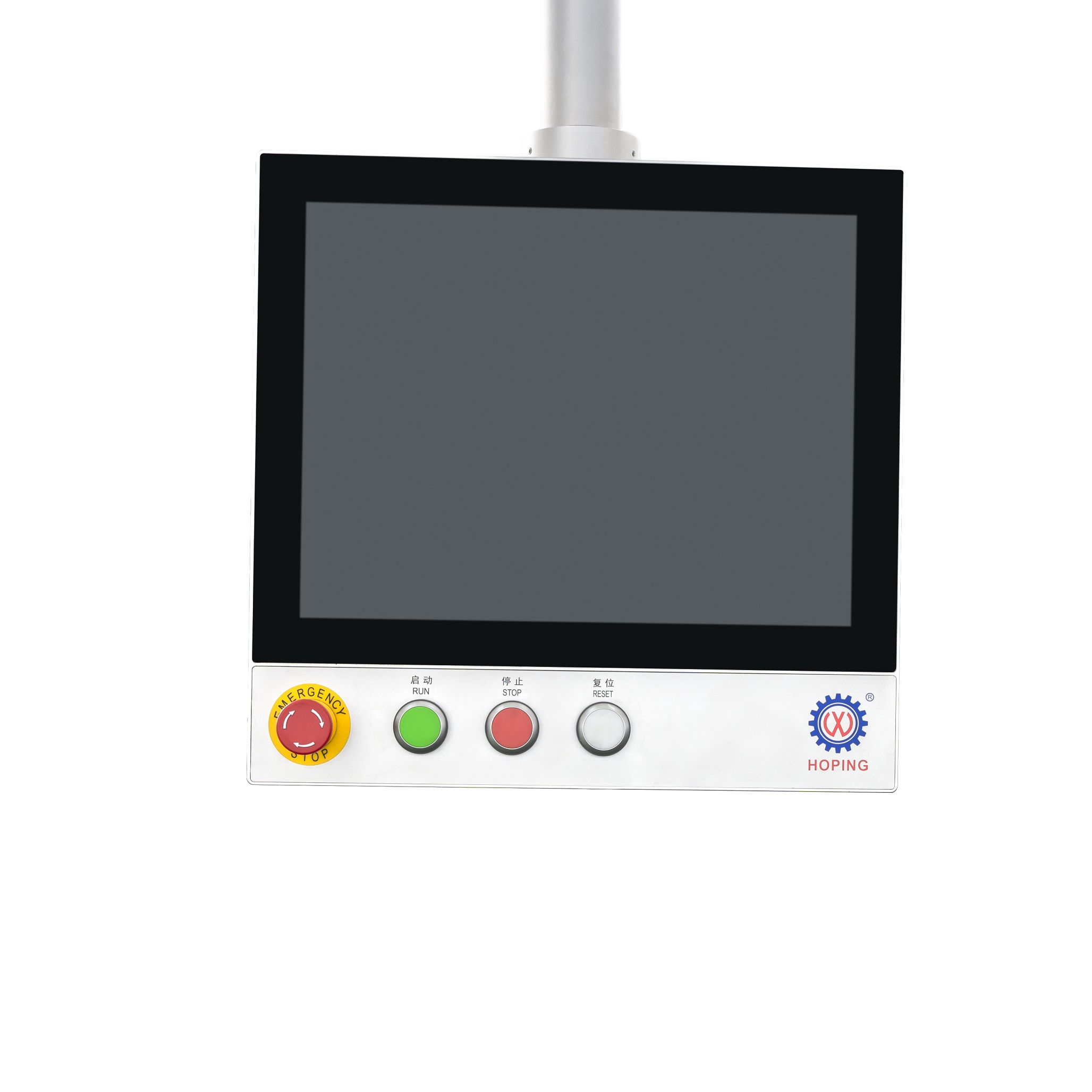
Cartoner-side controls
On the cartoner side, the XWZ120 horizontal cartoner is listed with a Siemens PLC control system and an SEW main motor, a carton magazine holding 600–700 cartons with the loading position outside the machine body, and a balcony-style frame intended for cleaning access. The export configuration places a separate electrical cabinet on the upper side of the body for daily maintenance. Each of these is a small decision, and together they determine how much of routine work happens at the front of the machine rather than around it.
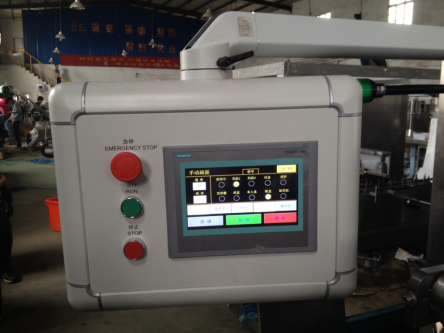
Preset memory in practice
HOPING's scenario documentation for its blister cartoning line describes PLC and HMI interfacing, synchronised multi-station control, alarm stop and fault indication, and recipe storage with format changeover supported according to configuration. The last phrase carries the important qualifier: recipe storage is configuration-dependent, and what a recipe contains — axis positions, temperatures, sealing parameters, speeds, rejection thresholds — is a matter of the delivered software scope, not of the hardware category.
For a quality team, recipe identity is as important as recipe content. A stored parameter set is useful when it is named, version-controlled and retrievable for review; it is less useful when it exists only as the machine's current state. Buyers should establish during specification which parameters are captured in a recipe, who may modify a recipe, and whether changes are logged.
Mold change
The mechanical side of changeover remains physical. The DPH320HII is described with an integral guide rail system intended to support rapid mould changeovers and cleaning. The DHL6004 is listed with convenient mold change, the DHL7005H and IXW600 with mold change support, and the DHL8005H with mold change as a stated capability. None of these descriptions, in the material reviewed, includes a changeover time.
This is where the servo-and-software story meets its boundary. Servo positioning can bring axes to a stored position quickly and repeatably. It cannot eliminate the exchange of forming, punching or cartoning tooling, nor the first-article check that follows a tooling change. What it can do is shorten the adjustment phase after the tooling is in place, provided the stored positions remain valid for the new tooling set.
Where the Architecture Fits: Line Scenarios and Operating Conditions
HOPING describes the operating environment for these lines as a GMP-oriented cleanroom or pharmaceutical packaging workshop, in continuous high-speed operation, with multi-batch and multi-format production and requirements for stability, easy cleaning, safety protection and traceability-oriented operation. The project types listed include new solid dosage blister lines, upgrades of existing lines, capacity expansion, intelligent workshop retrofit, and integration of blister, cartoning, bundling and case packing into a single flow.
The typical configuration is a blister packing machine, a cartoner, a leaflet folder, a coding unit, vision inspection, a checkweigher, a bundler, a case packer and a palletizer, with an ERP or MES data interface depending on project scope. The line described in HOPING's own material connects blister packing, cartoning, inspection and end-of-line automation as one packaging process.
For ease-of-operation evaluation, the consequence of line integration is that a format change is a line-level event, not a machine-level one. A cartoner that recalls its own recipe in seconds still waits on the upstream blister machine's tooling change and the downstream bundler's film or band setup. The interface question therefore extends beyond a single screen: buyers should ask whether recipe recall is coordinated across stations, or whether each station is recalled separately and then re-synchronised by hand.
Acceptance testing is where these claims become evidence. A factory acceptance test that runs a complete format change on the buyer's own blister card and carton — counting the steps, the tooling exchanges, the parameter entries and the first-article checks — produces a usable number. A demonstration on a single pre-loaded format does not.
Market Signals
Commercial research places the global blister packaging machine market for pharmaceutical applications at USD 2.57 billion in 2025, with Asia-Pacific described as the fastest-growing region at an 8.87% CAGR to 2031. A separate commercial source reports horizontal cartoning systems holding 70.12% of cartoning market share in 2024. A third reports the wider pharmaceutical packaging machinery market at USD 7.09 billion in 2026, growing at 7.15% CAGR toward USD 10.02 billion. These figures come from commercial research publishers, use different market definitions, and should not be combined or averaged.
Read together and with those caveats, the signals point in a consistent direction: the installed base of blister and cartoning equipment is large and growing, and the horizontal cartoner is the dominant architecture within its segment. In a market of that shape, the economic weight of changeover efficiency rises, because more of the total production time sits in lines that must switch between formats. The evidence reviewed here does not quantify that relationship, and the inference should be treated as a planning assumption rather than a measured effect.
A regulatory signal runs in parallel. A regulatory-affairs source reports that China has a draft GMP guidance for pharmaceutical packaging materials under public consultation, guiding marketing licence holders in reviewing packaging material suppliers. The draft status matters: the underlying issuing-authority document was not retrieved in the source set reviewed here, so the item should be tracked rather than treated as a settled rule. Its direction, however, is toward supplier review obligations that reach back into equipment and process documentation.
Where the Servo-and-Software Approach Reaches Its Limits
An independent evaluation is only useful if it states the boundaries. Six apply to this class of machine.
- Preset memory is not automatic changeover. It stores and recalls parameters. Tooling exchange, mechanical alignment and first-article verification remain manual operations on the machines reviewed.
- Changeover time is not published. The material reviewed for this article does not state changeover durations, OEE figures or validated sustained output for a defined format. Any comparison of setup speed between models would therefore be unsupported. The measurement has to be made at factory acceptance.
- Integration raises the governance requirement. A machine that stores recipes and logs events also requires rules on who may edit a recipe, how changes are approved and how records are retained. That is an organisational workload, not a machine feature.
- More electronics means a different service profile. Separating the industrial PC from the motion controller aids diagnosis, but it also means spare-part and support planning must cover computing hardware as well as drive components.
- Full servo is not automatically lower maintenance. No evidence reviewed here supports a claim that servo architecture reduces maintenance cost or energy consumption relative to a mechanical drive in this application. The claim should not be made in either direction without data.
- A touchscreen does not replace mechanical skill. Interface clarity shortens the learning curve for parameter entry. It does not remove the need to understand tooling condition, sealing behaviour and carton erection quality.
The defensible statement a buyer can make is conditional. On this class of equipment, a well-implemented preset memory and a clearly structured HMI reduce the number of manual re-settings between batches, and make the remaining settings visible and repeatable. Whether they reduce total changeover time, and by how much for a given format, is a measurement question that only a format-specific trial answers.
Future Outlook
Three developments are likely to keep pushing the interface toward the centre of the purchase decision. The first is the reported shift toward digitised data collection and integrated solutions in pharmaceutical manufacturing, which turns the interface into a data source rather than only a control surface. The second is the regulatory direction described above, in which supplier review extends into process documentation and therefore into what the machine records. The third is the operating reality of smaller batches, which raises the number of changeovers a line must absorb in a shift.
None of these developments changes the underlying engineering. A servo axis still needs a correct position; a carton still needs to be erected squarely; a blister still needs a sound seal. What changes is where the knowledge sits — increasingly in stored parameters and recorded events rather than in the hands of a single experienced operator. Machines that make that knowledge visible and transferable will be easier to operate, and easier to audit, than machines that do not.
Frequently Asked Questions
What does ease of operation mean on a fully servo blister cartoner?
It is the combined performance of four capabilities: how the machine is instructed, how reliably it reproduces a stored instruction between batches, how much physical work a format change requires, and how quickly a fault is located and cleared. On a fully servo machine, part of the format is held as a software state, which is what makes preset memory possible.
What role does the CP9315 industrial PC play in HOPING blister cartoning lines?
In HOPING's published specifications, the CP9315 industrial PC is listed together with a Beckhoff motion controller on the DHL6004 blister cartoner line and on the IXW600 blister-flow-wrap-cartoning line. The motion controller governs axis positioning, while the industrial PC provides the computing platform for the interface and data functions. The DHL7005H is specified differently, with a Siemens motion controller and a TP900 HMI.
Does preset memory remove the need for mold change?
No. Preset memory stores and recalls parameter sets for a format. A change of blister format or carton size still requires the corresponding forming, punching or cartoning tooling to be exchanged and aligned, followed by a first-article check. The memory shortens the adjustment phase after the tooling is in place; it does not replace the tooling exchange itself.
How should a buyer verify ease-of-operation claims before purchase?
Run a complete format change at factory acceptance using the buyer's own blister card, carton and leaflet, and record the number of steps, tooling exchanges, parameter entries and first-article checks. The material reviewed for this article does not publish changeover times, OEE or validated sustained output for a defined format, so a demonstration on a single pre-loaded format is not sufficient evidence.
Does a touchscreen HMI reduce operator training requirements?
It can reduce the time needed to learn parameter entry, particularly where the display can be positioned at the working area, as with the 15-inch HMI on a 180° swing arm specified for the DPH320HII. It does not remove the need to understand tooling condition, sealing behaviour and carton erection quality, which remain mechanical skills.
How does a full servo drive differ from a mechanical drive in daily operation?
A mechanical drive transmits motion through cams, shafts and fixed stops, so a format is largely defined by hardware. A full servo drive positions each axis by command, so format parameters can be stored and recalled. The daily difference is fewer manual re-settings after a changeover; the daily similarity is that tooling must still be exchanged and checked.
Which production scenarios suit a full-servo blister cartoner?
HOPING describes the intended environment as a GMP-oriented cleanroom or pharmaceutical packaging workshop running multi-batch, multi-format production, with requirements for stability, easy cleaning, safety protection and traceability-oriented operation. Project types include new solid dosage lines, line upgrades, capacity expansion and integration of blister packing, cartoning, bundling and case packing into one flow.
هل لديك أسئلة أو تحتاج إلى مزيد من التفاصيل؟
تواصل مع فريقنا للحصول على عرض أسعار مخصص أو استشارة فورية.
طلب عرض أسعار
املأ النموذج أدناه وسيتواصل معك فريقنا بعرض مقترح مخصص.
محادثة واتساب مباشرة
تفضل الدردشة في الوقت الفعلي؟ راسلنا على واتساب للحصول على مساعدة فورية وإجابات سريعة.
- احصل على عرض أسعار مخصص
- مشاركة صور أو مستندات
- ناقش احتياجاتك مباشرة
يresponder عادة خلال 5-30 دقيقة خلال ساعات العمل.