
Full-Spectrum LED Fit Guide: Museums to Jewelry Retail
Full-Spectrum LED Fit Guide: Museums to Jewelry Retail
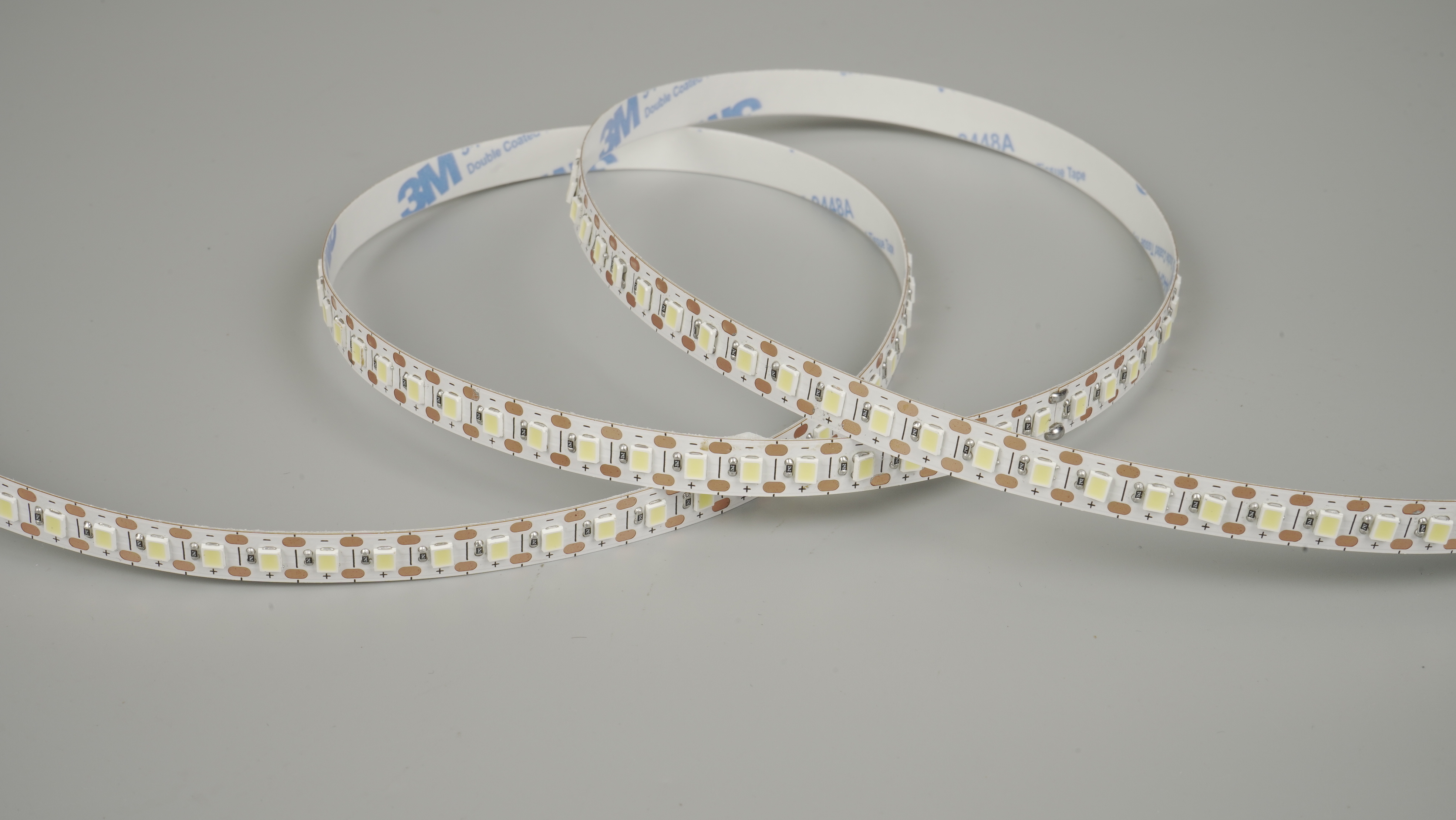
A museum vitrine, a gallery wall and a jewelry counter are often bought from the same catalogue but are not the same lighting brief. Three variables decide the fit: how faithfully colour must read, expressed through CRI; how evenly the run must emit along its length, expressed through LEDs per metre and linear format; and how tightly output and installation conditions must be controlled inside a case. Within the XPUP LED range, the XP-BD18DC24V-2835-140D-8MM full-spectrum strip is specified at CRI Ra≥97 with 140 LEDs per metre on an 8 mm PCB at 12 W, while the DK3-DC24V-2835-240D-9.3mm linear strip is specified at 240 LEDs per metre, 15 W and CRI Ra≥80 on a 9.3 mm PCB. They resolve different display problems, so the choice between them is a scenario decision rather than a ranking decision.
Why display lighting is a different brief from general indoor lighting
General indoor lighting is specified for a room: comfortable illuminance, controlled glare and a colour temperature that suits the interior. Display lighting is specified for an object. The viewer stands close to the surface, so a hotspot, a visible emitter pitch or a colour shift between two neighbouring fixtures becomes immediately legible. A jewelry counter is lit through a glass top from a short distance; a museum case may be lit from a concealed strip only a few centimetres from the object. In that geometry the strip stops being background infrastructure and becomes the source that determines whether a stone reads as white or grey and whether a dye lot looks consistent across a wall.
That shift changes the selection questions. Instead of asking how many lumens a metre a room needs, a specifier asks how faithfully the material must be rendered, how uniform the run must look, how much heat the enclosure can tolerate, and how the output will be controlled. The XPUP range answers those questions at different points, which is why two strips from the same manufacturer can both be correct in the same building without competing for the same position.
The two reference strips, side by side
The comparison below uses only the published specification for each model. Fields that are not stated in that specification are marked as such rather than estimated, because an invented value would be worse than a documented gap at tender stage.
| Specification | XP-BD18DC24V-2835-140D-8MM (Full Spectrum Lighting) | DK3-DC24V-2835-240D-9.3mm (Linear Lighting) |
|---|---|---|
| Voltage | 24 V | 24 V |
| Power | 12 W | 15 W |
| CRI | Ra≥97 | Ra≥80 |
| LEDs per metre | 140 | 240 |
| Colour temperature | 2700 / 3000 / 3500 / 4000 / 5000 / 6000 K | 3000 / 4000 / 6500 K |
| PCB width | 8 mm | 9.3 mm |
| Luminous flux | 55–65 lm per LED | Not stated in the supplied specification |
| SMD | 2835 | 2835 |
| PCB material | Double-layer copper PCB | Double-layer copper PCB |
| IP rating | IP20 | IP20 |
| Documented applications | Museums & galleries, interior design, luxury retail, jewelry stores, education, shopping malls | Restaurants, interior design, office buildings, apartments, museums & galleries |
| Customization | OEM & ODM | OEM & ODM |
Read together, the table shows a trade-off rather than a hierarchy. The full-spectrum strip concentrates on colour rendering and on a narrow 8 mm format that fits slim aluminium profiles and shallow display cavities. The DK3 strip concentrates on emitter density, which is the variable that removes the dotted appearance of a low-density run when a viewer stands close to a diffuser.
What Ra≥97 does, and does not, tell a specifier
Where the number helps
CRI Ra is expressed on a 0–100 scale, and Ra≥97 places the XP-BD18 strip at the upper end of that scale as specified. For a gallery hanging works on paper, a vitrine holding coloured stones, or a retail display where brand packaging must survive the shop floor, the value works as a fast first filter: it signals that the strip is designed for colour fidelity rather than for general ambient fill. It also narrows a long supplier list quickly when a brief states a minimum CRI for display areas.
Where the number runs out
Ra is a summary metric calculated across a defined set of test colours, so two products reporting the same Ra can still render a saturated red, a skin tone or a specific brand colour differently. A specification that stops at Ra≥97 therefore leaves two questions open: the value of the red sample, commonly reported as R9, which matters for warm merchandise and some textiles, and the spectral composition of the source, which matters when adjacent fixtures must match. Buyers specifying high-value displays should request the underlying test report for the batch and, for colour-critical work, spectral data or R9 in addition to Ra.
It is equally important to state what the specification does not establish. A Ra≥97 strip is not, by itself, a statement about permissible light exposure for sensitive collections, about UV output, or about conformity with any particular museum lighting standard. Those determinations belong to the conservator, the lighting designer and the project's compliance route, and a supplier's CRI figure should not be presented as a substitute for them.
Density, uniformity and the grainy effect
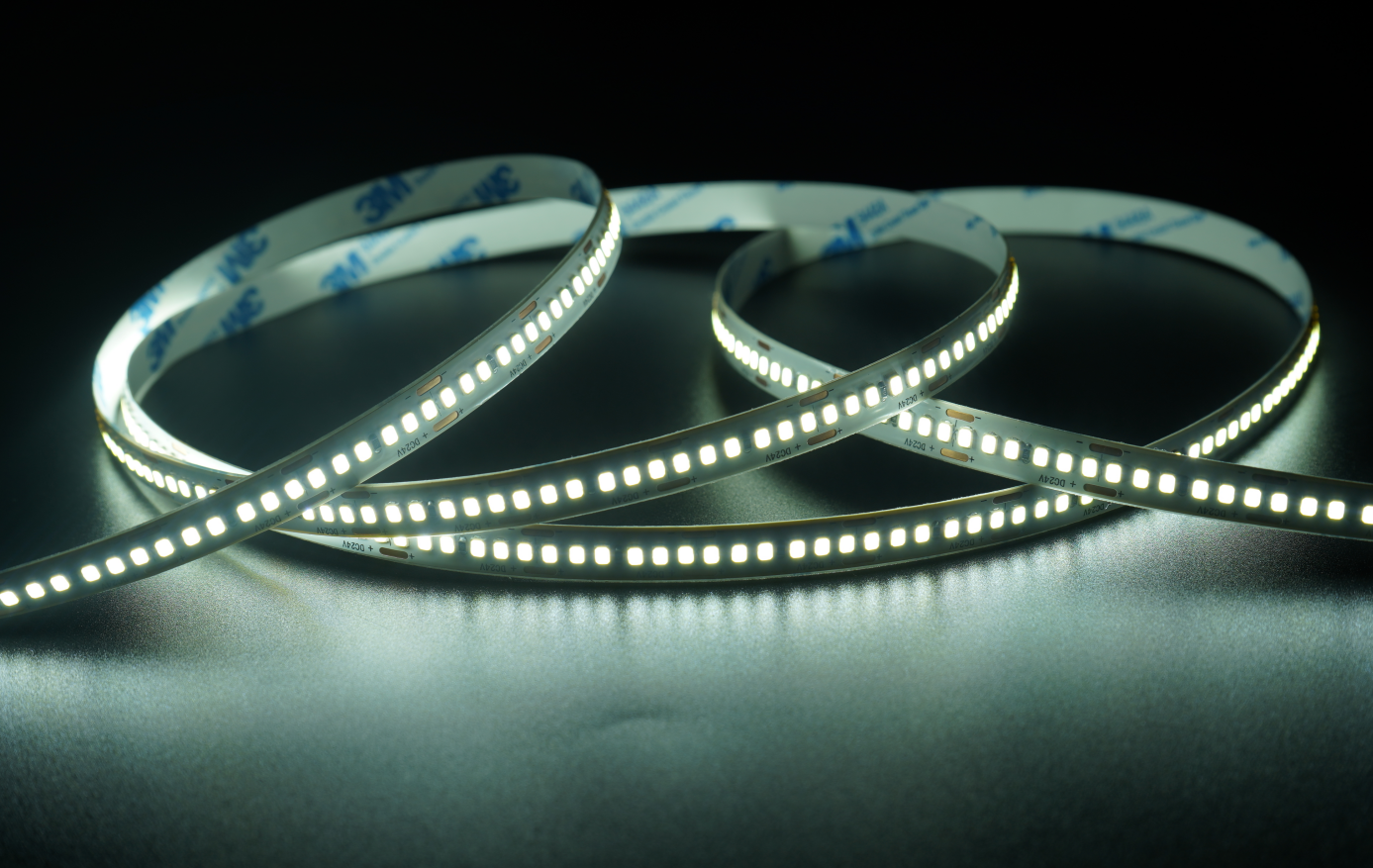
The DK3 strip is specified at 240 LEDs per metre on a 9.3 mm PCB, and its documented selling point is high density with uniform light emission and no grainy appearance, suitable for indoor linear runs and black profiles. That is a mechanical argument rather than a colour argument. When a strip sits behind a shallow diffuser and the viewer is within a metre of the surface, individual emitters register as a dotted line; raising the emitter count per metre shortens the spacing and reduces the effect. For long coves, wall-washing details and shelf lines where the diffuser sits close to the LEDs, density is frequently the variable that decides whether an installation reads as continuous or as a row of points.
The XP-BD18 strip carries 140 LEDs per metre and states 55–65 lm per LED, which gives a specifier a documented basis for estimating output per metre ahead of a sample. Its selling point describes an ultra 5 mm / 8 mm linear LED strip with per-LED cutting for various lengths, high brightness, flexibility and bending resistance, positioned for jewelry stores and display cases; the listed specification for this model gives an 8 mm PCB. In a case, the limiting dimension is usually the cavity rather than the run length, which is exactly where the narrower board earns its place.
Beam angle belongs to the housing, not the strip
Neither of these two strips is specified with a beam angle, because each is a linear emitter rather than a directional luminaire. The distribution a visitor actually sees is produced by the aluminium profile, the diffuser, the lens or the reflector that houses the strip, together with the mounting angle and the distance to the object. A project needing a defined beam should select the housing and optics first, then confirm that the strip's PCB width and bending behaviour fit inside them — an 8 mm board and a 9.3 mm board do not share the same profile family.
Where a brief genuinely needs aiming rather than a concealed linear run, the documented alternative in the same range is the XP-CX-18 magnetic track product: 48 V, 30 W, CRI Ra≥90, a 120° beam angle, aluminium and PC construction, and an adjustable beam, positioned for commercial and exhibition spaces including jewelry stores and exhibition halls. It sits outside the two-strip comparison in this guide, but it is the relevant reference point when the requirement is adjustable directional display lighting rather than a fixed linear source.
Power, CCT range and the IP20 boundary
The full-spectrum strip draws 12 W and covers 2700 K to 6000 K in six steps, which allows one product family to serve a warm heritage interior and a cooler retail environment without changing supplier. The DK3 strip draws 15 W and covers 3000 K, 4000 K and 6500 K. Higher power per metre does not automatically produce a brighter display: the delivered result depends on binning, the diffuser's transmission and the drive current, so both the wattage and the CCT list are better read as the starting point for a sample than as a finished outcome.
Both strips are rated IP20, which is an indoor, dry-environment classification. That is appropriate for sealed display cases, coves, shelving and interior architecture; it is not a statement of suitability for wet rooms, exterior façades or wash-down areas. Both use double-layer copper PCB construction and 2835 SMD emitters. Dimming behaviour is not stated in the supplied specification for either model, so a project that needs smooth dimming to low levels inside a case should confirm driver and controller compatibility with the supplier before the lighting design is frozen.
Scenario fit: museums and galleries
Where a museum or gallery display is viewed at short range and colour fidelity is the governing criterion, the XP-BD18 strip is the closer fit. Its Ra≥97 specification, 8 mm PCB and six-step CCT range let a designer hold one product across vitrines, wall cases and small graphic panels, and its documented use in museums and galleries matches that reading. The DK3 strip becomes the better answer where the requirement is a long, uninterrupted architectural line — a cove, a ceiling slot, a wall-washing detail — and where the diffuser sits close enough to the emitters that density, not CRI, decides whether the line reads as continuous.
Two boundaries should be respected in this setting. First, lighting a collection is a conservation decision before it is a procurement decision: light level, exposure duration and filtering are set by the institution and its advisers, and a strip specification does not substitute for that work. Second, an IP20 product needs a sealed, dry installation; a case with condensation risk or an exterior-facing element calls for a different enclosure decision, not a different strip alone.
Scenario fit: luxury retail and jewelry stores
Jewelry is the scenario where the two products diverge most clearly. The XP-BD18 strip is documented for jewelry stores and display cases, and the combination of Ra≥97, an 8 mm PCB and per-LED cutting addresses the three practical constraints of a vitrine: colour fidelity for metal and stone, a narrow profile that disappears into the case frame, and lengths that follow the case rather than the metre. Under-cabinet runs in a watch or jewelry counter follow the same logic, because the viewer is close and the merchandise is small.
Where a brief instead calls for a wall-washing effect behind a branded backdrop, a decorative accent, or a long ambient line above a retail floor, the DK3 strip's 240 LEDs per metre and uniform emission become the relevant specification — provided the CRI requirement in that zone is set by the architecture rather than by the merchandise. A workable rule is to derive the CRI requirement from the most colour-critical object in the space and the density requirement from the closest viewing distance; when the two point at different products, split the scheme by zone instead of compromising both in one.
Scenario fit: education and colour-critical teaching
The XP-BD18 strip lists education among its applicable industries. In art rooms, design studios, and textile or material libraries, the argument for a Ra≥97 source is the same as in a gallery: students judge colour against the light source, and a low-CRI source teaches the wrong reference. The case weakens in general classrooms, corridors and administrative areas, where ambient quality and running cost dominate and a standard-Ra linear product is adequate. Matching the product to the room type rather than to the building keeps both the specification and the budget honest.
Scenario fit: shopping malls and mixed-use retail
Both strips list shopping malls among their applications, which reflects how a mall is actually lit: long architectural lines in circulation areas and higher-fidelity accent lighting inside tenant displays. The practical split follows the same rule — DK3 for continuous runs and wall-washing where uniformity along the line is visible from the concourse, XP-BD18 for merchandise and display cases where the customer is close enough to judge colour. Because both are 24 V DC products with IP20 ratings, the electrical architecture can be shared across zones, which simplifies driver selection and spares holding for a facility team.
How full-spectrum LED compares with traditional display sources
Traditional incandescent and halogen display lighting is still found in older galleries and retail fit-outs, and the comparison with LED is well documented at technology level. The U.S. Department of Energy states that LEDs use at least 75% less energy than incandescent bulbs and last 25 times longer, while the ENERGY STAR technical bulletin on LED lighting describes certified LED products as using 90% less energy and lasting 25 times longer than traditional incandescent lighting, with third-party laboratory evaluation and periodic quality-assurance testing. Both are technology-level or certification-specific claims: they are not measurements of any XPUP product and should not be presented to a client as product data.
The practical difference inside a display case is heat and maintenance access. Incandescent and halogen sources convert a large share of their input energy into heat, which is unwelcome in a closed vitrine and can disturb the stability of the internal environment; an LED strip delivers its light with far less heat rejected into the case, although the strip and its driver still require a thermal path. The maintenance argument is about access as much as life: replacing lamps in a locked case is a scheduled operation, so a longer service interval reduces disruption to the display itself.
The fit boundaries matter as much as the advantages. A Ra≥97 LED strip is not automatically the right source for every object, and a halogen source is not automatically wrong in every heritage interior. Where a collection has an established lighting regime, the LED decision should be tested against it rather than assumed. And because the supplied specifications for both XPUP models are IP20, neither should be proposed for exterior, wet or wash-down display positions without a different enclosure strategy.
OEM/ODM support for project-specific display lighting
Display projects rarely accept a catalogue product unchanged. XPUP LED, the trading identity of Zhongshan Xiangpai (XPUP) Lighting Technology Co., Ltd., states OEM and ODM capability across its range. The OEM route covers voltage, logo, power, dimensions, materials, hardware configuration, internal circuit, colour, factory specifications, nameplate and label; the ODM route covers exterior colour scheme, outer packaging, label, brand information, model name and material details. For a museum or jewelry retail programme, the practical value sits in voltage and CCT adaptation, PCB width and length matching to the case, and branding on packaging rather than on the product.
The company's stated parameters for these routes are a minimum order of 2,000 metres, a lead time of 18–22 days, a monthly capacity of 3,000,000 metres, 100% testing, and a two-year standard warranty supported by online remote technical guidance, with customized parameter guidance on the OEM route. The company reports CE and RoHS certification for its products, a factory of more than 10,000 m² in Zhongshan with 80 employees and a six-engineer R&D team, annual output of 35,000,000 metres, and exports to more than 170 countries with the EU and USA as its main markets. It also states design and process patents in linear lighting, including design patents for its C19 and C20 strip series. All of these are company-reported figures: a buyer should verify capacity, certification scope and warranty terms against the specific order rather than against the catalogue alone.
Market context
Commercial research published in 2025 valued the global LED lighting market at USD 94.5 billion for 2024, with a double-digit growth forecast to 2034 (Global Market Insights). Other commercial estimates for the same period differ in both value and forecast horizon, largely because each report defines the market boundary differently, so the figure is better used as an order-of-magnitude signal than as a planning constant. The more stable observation for a display-lighting brief is directional rather than numeric: LED has displaced conventional sources across most new interior work, and supplier differentiation has largely moved to colour quality, format and control rather than to the basic efficiency argument.
What to watch next
Two developments are worth tracking for anyone specifying display lighting, both conditional on the project's own evidence rather than on a general forecast. The first is the shift from a single Ra number to a fuller spectral specification: as buyers of museum and jewelry lighting become more precise, requests for R9 values and spectral data alongside Ra≥97 are likely to become routine in tender documents. The second is the integration of linear display lighting with control systems, where the practical question is not whether a strip can be dimmed but whether it can be dimmed smoothly and repeatably at the low levels a vitrine requires. Neither development changes the fundamentals set out here: match CRI to the object, match density and format to the geometry, and verify the installation boundary before the specification is fixed.
A short specification checklist
- Set the CRI requirement from the most colour-critical object in the space, not from the room. Ra≥97 where merchandise and works are judged at close range; Ra≥80 where the requirement is architectural.
- Set density and PCB width from viewing distance and cavity depth. 240 LEDs/m on a 9.3 mm board for continuous runs where the diffuser sits close; 140 LEDs/m on an 8 mm board where the case is shallow.
- Confirm the beam from the profile, lens or reflector, then check that the chosen PCB width fits that housing family.
- Confirm driver and controller compatibility, including low-level dimming behaviour, before freezing the lighting design.
- Treat IP20 as an indoor dry-environment rating and re-specify the enclosure for any wet, exterior or condensation-prone position.
- Request the batch test report and, for colour-critical work, R9 or spectral data alongside the Ra figure.
- For OEM/ODM work, confirm MOQ, lead time, warranty scope and certification documents against the specific order.
FAQ
Is CRI Ra≥97 necessary for a museum display case?
Not universally. Ra≥97 matters when the viewer must judge colour accurately at close range — works on paper, textiles, mixed materials, coloured stone. Where a case holds monochrome or low-colour material and the institution's conservation requirements dominate, a lower-CRI product may be adequate. The decision should come from the object and the institution's lighting policy, and the specification should state the requirement explicitly rather than defaulting to the highest available number.
Can the DK3 linear strip be used in a jewelry store?
It can, with a condition. The DK3-DC24V-2835-240D-9.3mm is specified at CRI Ra≥80 with 240 LEDs per metre on a 9.3 mm PCB, and its documented strength is uniform, grain-free emission for indoor linear runs and black profiles — which suits architectural lines, wall-washing and shelving where uniformity is what the viewer notices. For the vitrine itself, where metal and stone colour must read accurately, the Ra≥97 XP-BD18 strip is the better-documented match, and its 8 mm PCB fits shallower cases.
Does more LEDs per metre improve colour rendering?
No. Density and colour rendering are separate variables. Density describes how many emitters sit along a metre and therefore how continuous the light appears when viewed close to a diffuser; colour rendering describes how faithfully the source reproduces colour and is expressed through CRI and related metrics. The DK3 strip combines high density at 240 LEDs per metre with Ra≥80, while the XP-BD18 strip combines 140 LEDs per metre with Ra≥97. A specification needs both numbers, not one in place of the other.
What does IP20 mean for a gallery installation?
IP20 indicates protection against solid objects above a defined size and no protection against water. In practice it means the product is intended for indoor, dry environments such as sealed display cases, coves, shelving and interior architecture, and it should not be installed where condensation, spillage or exterior weather can reach it. If a display position is exposed to any of those conditions, the enclosure or the product class has to change, and that decision belongs in the specification rather than at installation.
Can XPUP customize CCT or PCB width for a display project?
Yes, within its stated OEM and ODM scope. The OEM route covers voltage, power, dimensions, materials, internal circuit, colour, nameplate and label; the ODM route covers exterior colour scheme, packaging, label, brand information, model name and material details. The company states a 2,000-metre minimum order, an 18–22 day lead time and a two-year standard warranty, so a customization request should be checked against those parameters and against the project's own sample-approval process before it is written into the specification.
Product specifications and factory figures referenced in this guide are published by XPUP LED, the trading identity of Zhongshan Xiangpai (XPUP) Lighting Technology Co., Ltd. The 2026 XPUP LED Strip Catalog, covering the full range described here, is available for public download: 2026 XPUP LED Strip Catalog (PDF).
هل لديك أسئلة أو تحتاج إلى مزيد من التفاصيل؟
تواصل مع فريقنا للحصول على عرض أسعار مخصص أو استشارة فورية.
طلب عرض أسعار
املأ النموذج أدناه وسيتواصل معك فريقنا بعرض مقترح مخصص.
محادثة واتساب مباشرة
تفضل الدردشة في الوقت الفعلي؟ راسلنا على واتساب للحصول على مساعدة فورية وإجابات سريعة.
- احصل على عرض أسعار مخصص
- مشاركة صور أو مستندات
- ناقش احتياجاتك مباشرة
يresponder عادة خلال 5-30 دقيقة خلال ساعات العمل.