
Functional Knit Fabric Compliance for Underwear: Finish Guide
Industry Reference · Fabric Compliance
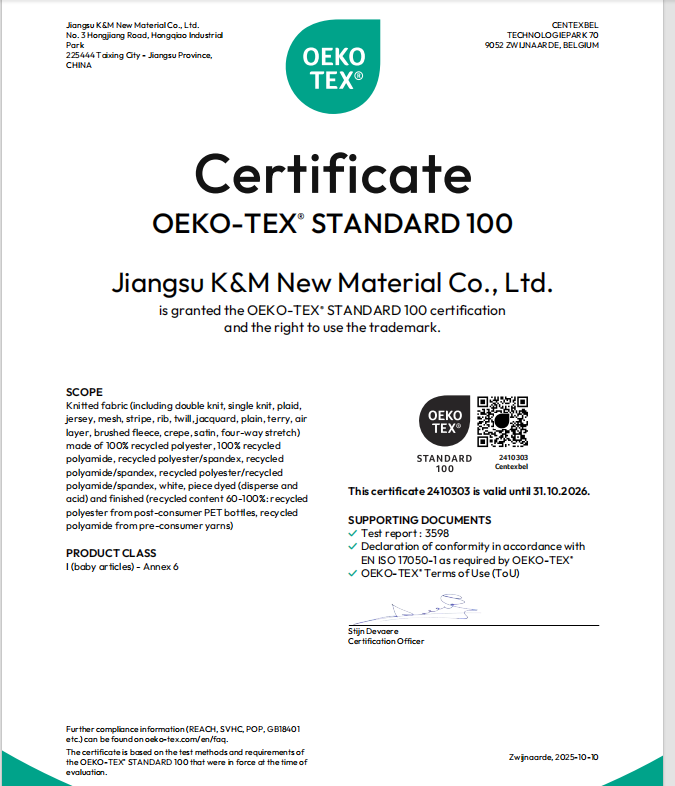
A mill-level certificate is the first layer of a compliance file, not the whole file: it states a scope, a standard and a validity period.
Underwear and other close-fit garments leave little margin for a finish that behaves differently from its label. The fabric sits against skin for hours, is laundered more often than outerwear, and is normally sold with performance language attached to it: antibacterial, anti-odor, UV protective, moisture wicking. Each of those words is a claim, and each claim needs a document that describes the fabric actually being shipped — not the yarn it was made from, and not a generic mill certification.
This guide is written for buyers at the evaluation stage who have to align compliance paperwork with applied finishes in functional knit fabric for underwear. It covers three finish families that carry the most commercial and regulatory exposure in close-fit garments — antibacterial/anti-odor, UV protection, and moisture-wicking — and uses two representative constructions from Zhangjiagang E-king Textile Co., Ltd. as working examples: EKWP2270-D6 and 20ETW1028-DSP.
Zhangjiagang E-king Textile Co., Ltd., which operates under the name EKING fabric, is a knitted textile manufacturer established in 2011 in Zhangjiagang, Jiangsu Province, China, approximately 100 km from Shanghai. The company develops, produces and dyestuffs knitted fabrics — including yoga fabrics, sport functional fabrics, underwear fabrics and swimwear fabrics — and brought its own dyeing factory into production in March 2022, completing an internal chain from weaving through dyeing and finishing.
Why the Finish, Not the Fibre, Decides Underwear Compliance
The performance language on an underwear label is almost always a statement about finishing, not about fibre. A nylon/spandex or polyester/spandex knit does not wick moisture, block UV radiation or suppress odour on the strength of its polymer alone; those behaviours come from the knit structure and from chemical or mechanical finishing applied after dyeing. That has a practical consequence for procurement: the document that matters is a test report on the finished, dyed fabric, produced under the same conditions as the bulk order.
The commercial stakes are rising. Third-party research places the global moisture wicking fabrics market at USD 3.99 billion by 2030, growing at a 6% CAGR (Research and Markets), while the performance knitted fabrics segment is projected to reach USD 8.58 billion in 2026 (Fact.MR). Broader knitted fabric trade is already large-scale — China's exports of knitted fabrics reached approximately USD 21.2 billion in 2024 (Ken Research). More finish claims in circulation means more paperwork to verify, and more room for a document set that looks complete but does not actually cover the shipped fabric.
Where Compliance Documents Usually Diverge From the Finished Fabric
The most common gap in an underwear qualification file is a mismatch of layers. A buyer receives a mill certificate, a yarn specification and a finished-fabric test report, and treats them as one package. In practice they prove different things.
- Mill-level certificates confirm that a defined product scope passed a defined standard during a defined period. They do not certify every finish recipe that may be applied afterwards.
- Yarn-level documents confirm what went into the fabric. They say nothing about what the finishing line did to it.
- Finished-fabric test reports are the only layer that speaks to the delivered hand-feel and performance — provided the test method, the sample state and the number of laundering cycles are stated.
- Lot-level records connect the tested sample to the shipped batch, which is what a brand audit or a customs query will actually ask for.
For underwear, the third layer carries the most weight, because close-fit garments expose any inconsistency immediately: a finish that is unevenly applied shows up as odour retention, patchy drying behaviour or a stiff hand-feel within a few wash cycles.
The Four-Layer Document Stack, Ranked by Evidentiary Strength
When a buyer has to decide which document to rely on first, the following order reflects how much each layer proves about the fabric in the carton.
| Rank | Document layer | What it proves | What it does not prove |
|---|---|---|---|
| 1 | Third-party certificate covering the fabric scope, with certificate number and validity dates | Independent confirmation that the specified scope met the named standard at the time of testing | That a later finish recipe or a different colourway falls inside that scope |
| 2 | Finished-fabric test report (in-house or accredited laboratory) | Performance of the dyed, finished fabric under a stated method and sample state | Compliance with a regulated limit unless the laboratory and method are recognised for that limit |
| 3 | Lot / batch record tied to the shipment | Traceability from tested sample to delivered rolls | Ongoing consistency without a sampling plan |
| 4 | Supplier declaration letter | Stated intent and internal policy | Measured values — a declaration is a statement, not evidence |
E-king Textile's own file illustrates how the upper layers fit together. The company holds an OEKO-TEX® STANDARD 100 certificate, number 2410303, issued by Centexbel on 10 October 2025 and valid to 31 October 2026, with a scope of knitted fabric. It also holds a Global Recycled Standard certificate, number IDF-26-954043, issued by IDFL Laboratory and Institute Inc. on 26 March 2026 and valid to 25 March 2027, with a scope of dyed fabrics. Both documents are scoped, numbered and dated — which is exactly the level of detail a buyer should expect, and also the level of detail that shows where a certificate's coverage ends.
Matching Finish Claims to the Construction: EKWP2270-D6 and 20ETW1028-DSP
Finish qualification is easier when the construction is fixed early. Two constructions in the E-king functional knit range illustrate how the finish list changes with the base material.
| Item | Base material | Listed finishes / properties | Listed applications |
|---|---|---|---|
| EKWP2270-D6 | Nylon / spandex | Moisture-wicking; 4-way stretch / high elasticity; breathable / quick-dry; antibacterial / anti-odor; UV protection; water-repellent; easy-wash; recycled materials; wrinkle-resistant; cool-touch or warming treatments | Sports / activewear; outdoor apparel; casual / fast fashion; underwear and functional close-fit garments; workwear / uniforms |
| 20ETW1028-DSP | Poly / spandex | UV protection; water-repellent; easy-wash | Functional knit fabric within the synthetic and recycled fibre range |
The distinction matters at the specification stage. EKWP2270-D6 is the broader finish platform and is listed for underwear and functional close-fit garment use, which makes it the natural reference point when a buyer is qualifying antibacterial/anti-odor and moisture-wicking claims together. 20ETW1028-DSP is a poly/spandex construction listed with UV protection, water-repellent and easy-wash properties — a narrower finish set that suits programmes where UV protection and easy-care behaviour are the leading requirements rather than the full moisture-management package.
Both items appear in the same long-running supply case: a garment shop client sourcing functional knit fabric for apparel garment manufacturing, with continuous supply over 10 years, a reported quantity of 100 t, and stable performance recorded as the outcome, with the fabric described as soft and flexible. That case history is useful to a buyer not as a marketing reference but as an indication of repeat-order behaviour on the same construction family.
Finish-by-Finish Acceptance Criteria
Each finish family needs its own acceptance clause. The clauses below are written as buyer-side requirements — the things that must appear in the specification and the purchase terms — rather than as fixed performance values, because the appropriate threshold depends on the end market, the laundering regime and the brand's own standard.
Antibacterial and anti-odor finishes
- State the test method and the sample state (finished, dyed fabric rather than raw or greige), so the report describes what will be delivered.
- Fix the number of laundering cycles the claim must survive, and require the report to show results before and after that cycling.
- Specify whether the claim is antibacterial, anti-odor, or both. They are separate claims and are frequently tested differently.
- For close-fit garments, record the skin-contact surface (face side or back side) that carries the treatment, since underwear construction often exposes only one side to the wearer.
- Confirm the restricted-substance status of the chemistry — see the PFAS section below.
UV protection finishes
- Require the report on finished fabric in its relaxed state and, where the garment will stretch in use, in a stretched state. Stretching a knit reduces its UV blocking, so a relaxed-state figure alone can overstate protection in a close-fit garment.
- Specify the colourways covered. UV performance varies with dye and shade depth, and a qualification based on one colour does not automatically extend to a darker or lighter shade.
- Confirm coverage across the full width of the roll, since uneven finishing shows up at the selvedges.
- Tie the claim to the end market's labelling rules, because UV claims are among the most tightly regulated apparel statements.
Moisture-wicking and quick-dry finishes
- Separate moisture-wicking (transport of liquid away from skin) from quick-dry (rate of drying after wetting). A fabric can perform well on one and only moderately on the other.
- State whether the requirement is one-way moisture transport; if it is, the test must distinguish the face and back of the fabric rather than reporting a single value.
- Fix the wash-cycle count at which wicking must still meet the threshold, because hydrophilic finishing is progressively affected by laundering.
- Where the garment is a base layer under outerwear, add a breathability requirement so that moisture management is qualified as a system rather than as a single property.
- Record the relationship to 4-way stretch and recovery, since a knit that grows during wear changes its transport behaviour.
A practical rule for the specification sheet: every finish claim in the purchase order should name four things — the test method, the sample state, the laundering exposure, and the acceptance threshold. A finish name alone is not a specification.
Recycled Content: Where the Chain of Custody Has to Close
Recycled content is the claim most often asserted at the marketing level and least often supported at the shipment level. The global recycled textiles market was projected at USD 6.32 billion in 2025, with a 4.70% CAGR through 2035 (SNS Insider) — growth that has made recycled feedstock a routine part of functional knit programmes, including underwear.
For a buyer, the operative document is a transaction certificate tied to the specific shipment, not a website statement. E-king Textile's Global Recycled Standard certificate number IDF-26-954043, issued by IDFL Laboratory and Institute Inc. and valid from 26 March 2026 to 25 March 2027, carries a scope of dyed fabrics. Buyers should confirm at the point of order that the intended construction, colour and shipment fall inside that scope, and should request the transaction certificate accompanying the batch.
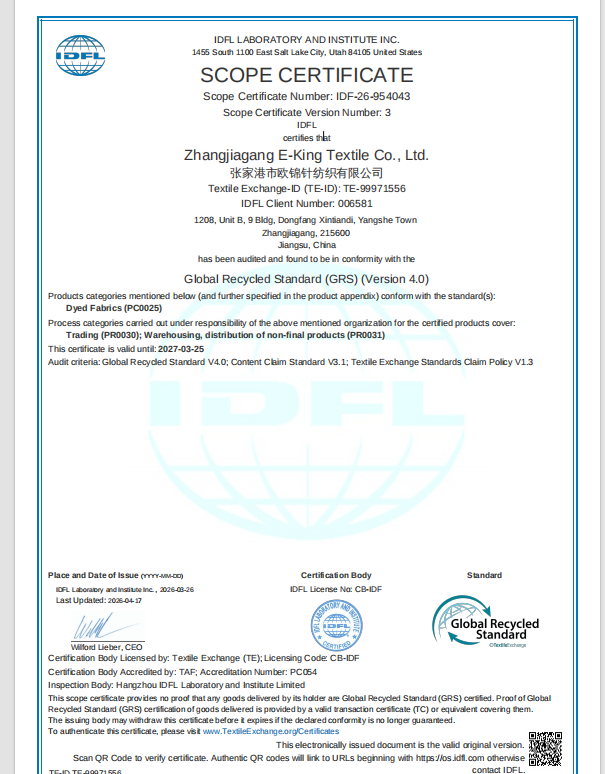
A recycled content claim is only as strong as the transaction certificate that accompanies the shipment it describes.
Two further checks reduce risk. First, ask whether the recycled input sits in the yarn or is blended only at the finishing stage; the answer determines which document proves the claim. Second, confirm whether the recycled specification changes any of the finish performance data — a recycled feedstock that alters the base structure can shift wicking or stretch behaviour, and the finish report should describe the actual construction being ordered.
PFAS and Restricted Substances in Functional Finishes
Regulatory pressure on functional finishes has tightened on a fixed timeline, and buyers working on 2027 programmes should treat it as a specification input rather than a future concern.
- OEKO-TEX introduced a new limit value for Total Fluorine (TF) of 100 mg/kg effective 1 January 2024 under STANDARD 100, aimed at PFAS compliance (OEKO-TEX Association).
- California AB-1817 bans regulated PFAS in textiles with a total organic fluorine threshold below 100 ppm from 1 January 2025, dropping to below 50 ppm in 2027.
The exposure in a functional knit programme sits mainly with water-repellent and stain-resistant finishing, which is why those finishes deserve their own line in the compliance file even when the underwear garment itself does not appear to need them — they often arrive attached to a fabric platform shared with outerwear. Buyers should request a restricted-substance statement for each finish recipe, confirm the test basis and the reporting limit, and record the version of the chemistry being qualified so that a later substitution cannot pass silently through production.
What the Supply Side Has to Demonstrate
Compliance paperwork is only credible when it sits on top of a controlled production chain. Several features of the E-king Textile operation are relevant to that question.
- Integrated dyeing and finishing. The company's own dyeing factory entered production in March 2022, giving an internal chain from weaving through dyeing and finishing rather than a sequence of outsourced steps. For finish qualification this matters because the finishing recipe is applied under the same roof as the dyed base fabric.
- In-house laboratory and testing discipline. Quality control follows a 100% testing protocol, and the company operates an in-house laboratory. In practice this is the layer that produces finished-fabric reports quickly enough to support sampling rounds.
- Finishing range. The documented finishing capability includes mechanical processes such as peaching, brushing, fuzzing, transfer printing, dispersed printing, acid printing, digital printing, foil and emboss, together with chemical functions including antibacterial and anti-odor treatment, moisture wicking and quick drying, UV protection, anti-static, waterproof, stain and oil prevention, thermal storage and warmth preservation, and cooling treatment.
- Export orientation. The company reports an export ratio of 95%, with the EU and USA as its main markets — markets where finish claims are actively audited.
- Scale and development capacity. The manufacturer operates an 8,600 m² facility with 80 employees, a 10-person R&D team, an annual output of 6,000 t, monthly capacity of 30,000 m and more than 100 newly developed products per season.
- Customisation scope. Yarn composition, GSM/weight, colour, stretch and knit structure, finishing treatment and the use of recycled materials are all open to specification.
The commercial parameters matter too: minimum order quantity of 3,000 y and a lead time of 30–45 days. Both should be built into the qualification timeline rather than discovered at the sampling stage.
Limits of This Model, and How It Compares With the Traditional Route
The traditional approach to fabric compliance relies on a yarn-level certificate plus a supplier declaration, refreshed once a year. It is cheap, it is fast, and for low-risk categories it is often adequate. Its weakness is that neither document describes the finished fabric: a certificate on the yarn says nothing about what the finishing line applied, and a declaration is a statement of intent rather than a measurement.
The finish-level approach described here closes that gap, but it has boundaries that buyers should recognise before adopting it.
- In-house laboratory testing is a screening layer, not a substitute for third-party certification. Where a claim is regulated — UV protection labelling, restricted substances, recycled content — the final evidence has to come from a recognised external body or a scheme-issued certificate.
- Certificates carry scope and expiry. The OEKO-TEX STANDARD 100 certificate for knitted fabric is valid to 31 October 2026 and the GRS certificate for dyed fabrics to 25 March 2027. Buyers placing orders that straddle those dates should confirm renewal status rather than assume continuity.
- A certificate does not automatically cover a new finish recipe. Introducing or changing a finish chemistry generally requires additional testing against the relevant standard before the claim can be carried on the garment label.
- Finish durability is partly a buyer-side variable. How an antibacterial or moisture-wicking treatment performs after twenty washes depends on the laundering regime specified by the brand, not only on the mill's application. A threshold agreed in the contract is more useful than a performance figure quoted without one.
- Volume and lead time constraints. A minimum of 3,000 y and 30–45 days of lead time do not suit every pilot programme, and buyers running small validation runs should plan sampling rounds accordingly.
Set against those limits, the practical advantage is traceability: when a claim is challenged, the file shows a certificate with a scope and a date, a finished-fabric report with a method, and a lot record that ties both to the rolls delivered.
Application: Where These Constructions Fit
The finish requirements above are not theoretical for underwear. Close-fit base layers combine three conditions that make documentation gaps visible: continuous skin contact, frequent laundering, and limited fabric area in which an uneven finish can hide.
EKWP2270-D6, with its nylon/spandex base and its listed combination of moisture-wicking, 4-way stretch, breathable/quick-dry, antibacterial/anti-odor and UV protection properties, is oriented towards programmes where a single platform has to carry several claims at once — seamless-style underwear, sports base layers and functional close-fit tops. 20ETW1028-DSP, a poly/spandex construction listed with UV protection, water-repellent and easy-wash behaviour, fits programmes where UV protection and easy-care performance lead, and where a narrower finish set keeps the qualification file simpler. Both have been supplied within the same garment-shop case over a 10-year period, with the fabric noted as soft and flexible and performance recorded as stable.
Outlook: Compliance Documentation as a Contract Clause
Three trends point in the same direction for underwear programmes. Performance knit demand keeps expanding, with the moisture-wicking segment projected at USD 3.99 billion by 2030 and the performance knitted fabric segment at USD 8.58 billion in 2026. Recycled content continues to move from a differentiator to a baseline expectation, on a market growing at 4.70% CAGR to 2035. And PFAS thresholds are on a published tightening path, with California's total organic fluorine limit moving from below 100 ppm in 2025 to below 50 ppm in 2027.
The practical response for buyers is procedural rather than technical: write the test method, sample state, laundering exposure and acceptance threshold into the purchase terms for every finish; require finished-fabric reports rather than yarn-level documents; confirm certificate scope and validity at the point of order; and keep lot records that connect the tested sample to the shipped rolls. A finish claim that survives that structure is one a brand can defend.
For procurement teams building a supplier shortlist, E-king Textile's company profile — covering facility, product range and certification details — is available as a downloadable PDF: E-king Textile company profile (PDF).
FAQ
Which finish should an underwear buyer qualify first?
Skin-contact finishes carry the highest claim risk in close-fit garments, so antibacterial/anti-odor and moisture-wicking finishes are normally qualified before decorative or outerwear-oriented treatments. UV protection follows where the garment is worn as an outer layer or in high-exposure settings. The sequence is driven by claim risk rather than by application cost: a finish that touches skin continuously and is laundered frequently has more opportunities to fail visibly.
Does a mill-level certificate such as OEKO-TEX STANDARD 100 cover every finish applied to a fabric?
No. A mill certificate confirms that a defined product scope met the named standard during its validity period — for example a knitted fabric scope covered by a certificate valid to a stated expiry date. A new or changed finish recipe generally falls outside that coverage until it is tested against the relevant standard. Buyers should confirm scope, certificate number and validity dates at the point of order.
What should be written into purchasing terms for an antibacterial or anti-odor finish?
The terms should specify the test method, the sample state (finished and dyed rather than greige), the number of laundering cycles the claim must survive, the skin-contact side that carries the treatment, and the acceptance threshold. Antibacterial and anti-odor are distinct claims and may be tested differently, so the contract should state which is required and how each is evidenced.
How is recycled content verified in a functional knit fabric order?
Recycled content is verified through the chain of custody rather than through a statement. A buyer should confirm that the intended construction, colour and shipment fall inside the scope of the mill's Global Recycled Standard certificate, and should request the transaction certificate that accompanies the specific batch. E-king Textile's GRS certificate number IDF-26-954043, issued by IDFL Laboratory and Institute Inc., has a scope of dyed fabrics and is valid from 26 March 2026 to 25 March 2027. Recycled feedstock can also shift base-fabric behaviour, so finish reports should describe the construction actually ordered.
Is in-house laboratory testing sufficient for regulatory compliance?
In-house testing functions as a screening layer that supports sampling rounds and internal control, and a 100% testing protocol gives useful consistency data. For regulated claims — UV protection labelling, restricted substances including PFAS thresholds, and recycled content — the final evidence normally has to come from a recognised third-party body or a scheme-issued certificate, because those claims are audited externally.
What order volume and lead time should be planned for?
E-king Textile lists a minimum order quantity of 3,000 y and a lead time of 30–45 days, with monthly capacity of 30,000 m. Buyers running small validation runs should allow for sampling ahead of the bulk window, and should check certificate validity dates against the planned delivery and garment-shipment dates.