
Functional Knit Fabric: Supplier Resilience Beyond Capacity
Functional Knit Fabric: Supplier Resilience Beyond Capacity
A functional knit fabric program rarely fails in its first season. It fails in the third, when the approved base quality has to be re-run, when a finish chemistry shifts because a regulation moved, or when the fiber behind an approved handfeel is no longer available in the same grade. For a buyer moving from decision into execution, supplier resilience is therefore a narrower and more practical question than how much a mill can produce. It is whether the supplier's development pipeline and raw-material access can carry one program across several seasons.
This assessment examines resilience through three legs — development throughput, material access and repeat-order depth — using company-stated facts about E-king Textile (Zhangjiagang E-king Textile Co., Ltd.), a functional knit fabric producer based in Zhangjiagang, Jiangsu, China. It also sets out what a buyer can check, and what partnership names and capacity figures do not establish on their own.
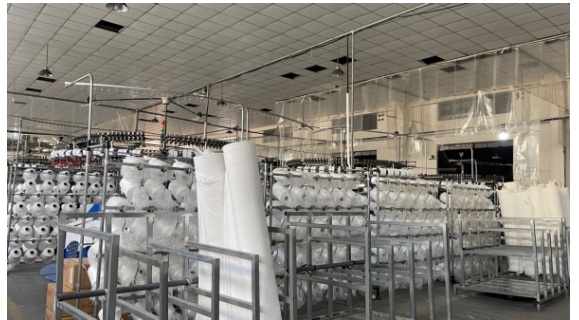
Knitting production at a functional knit fabric facility. Long-program continuity depends on development and input access as much as on loom hours.
Why annual capacity is the weakest single test of resilience
A capacity figure answers one question: how much fabric can leave the mill in a year. E-king Textile states an annual output capacity of 6,000 tons and approximately 24 million yards of fabric per year, and describes that capacity as supporting bulk orders and repeat-order supply programs. That is useful information for a volume plan. It does not answer the three questions that decide whether a program survives into a third season: can the mill develop the next construction on the calendar, can it keep sourcing the same fiber and yarn behind each quality, and can it reproduce a shade and handfeel it approved eighteen months earlier?
Most long-term knit programs lose time to one of three failure modes. Development congestion occurs because sampling capacity is limited by engineering headcount rather than loom count. Input drift occurs when a construction approved on one elastane or one yarn count has to be re-sourced after that input changes grade or availability. Reproduction drift occurs when dyeing and finishing batches move and an approved quality is no longer reproducible at the original tolerance. A tonnage figure is silent on all three, which is why it is the weakest single test a buyer can apply.
Defining supplier resilience for multi-season knit programs
Supplier resilience, as used in this assessment, is a supplier's capacity to repeat and extend an approved functional knit fabric quality across seasons: to develop new constructions on a predictable cadence, to hold access to the fiber and yarn inputs those constructions depend on, and to reproduce previously approved qualities without re-qualifying from zero each time.
| Leg of resilience | What it covers | Why it matters in a multi-season program | Practical check |
|---|---|---|---|
| Development throughput | Engineering headcount, number of new qualities released per season, finishing menu | Decides whether next season's brief starts from an existing family or from scratch | Ask which qualities were released in the last two seasons and the typical brief-to-sample turnaround |
| Material access | Relationships with fiber, yarn and function-technology suppliers | Reduces re-specification risk if a key input changes grade or availability | Name the exact fiber grade in the approved quality and confirm the source channel |
| Repeat-order depth | Ability to re-run an approved quality across lots and seasons | Protects the reorder calendar and the approved shade and handfeel | Run the same quality twice, spaced apart, and compare both lots to the approved standard |
E-king Textile: the facts that bear on continuity
E-king Textile was established in 2011 and operates an 8,600 m² facility in Zhangjiagang, Jiangsu Province, about 100 km from Shanghai — roughly 1.5 hours by road. The company employs 80 people, including a 10-person R&D team, and reports that 95% of its output is exported, mainly to the EU and USA.
Its stated annual output capacity is 6,000 tons, or about 24 million yards of fabric per year. An in-house dyeing facility has been in production since March 2022, and the company describes it as supporting continuous production and replenishment of functional knit fabric. Core materials cover cotton, chemical fiber and modal knits; the product focus is on knitted elastic fabrics for yoga, sports, underwear and swimwear. The finishing menu includes peaching, brushing, fuzzing, transfer printing, dispersed printing, acid printing, digital printing, foil and emboss, together with chemical functions such as antibacterial and odor control, moisture wicking and quick drying, UV protection, anti-static, waterproof, stain and oil prevention, thermal storage and cooling treatment.
These are company-stated facts. They describe capability and process scope; they are not, by themselves, audit results or certificates for a specific quality.
Development throughput: what 10 engineers and 100+ new knits per season change
E-king Textile's R&D function is stated as a 10-engineer team releasing more than 100 newly developed knit products every season, with a stated focus on new knitted elastic fabrics. That combination — a standing team plus a release cadence — is the part of a supplier's operation that determines whether next season's brief becomes a conversation or a project.
The practical value is portfolio breadth. When a buyer's brief resembles a construction family the mill already runs, the development loop usually shortens: the discussion moves to modifying an existing base, varying a finish or matching a color, rather than qualifying a new base fabric. When the brief resembles nothing in the current range, the same team has to fund it from the same engineering hours. Breadth is evidence that a development function exists and produces; it is not a commitment that any particular brief will be met on any particular date.
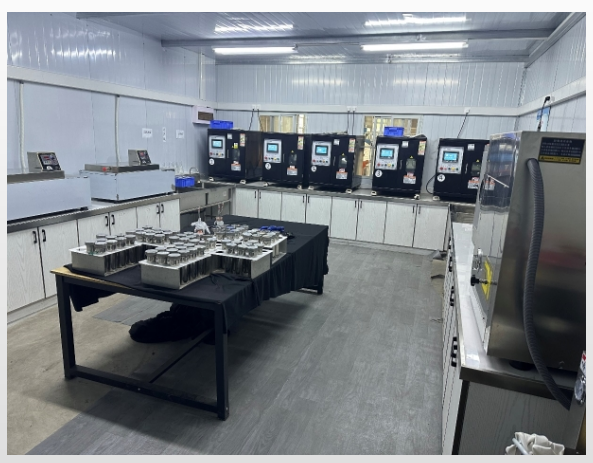
Internal laboratory area, E-king Textile, Zhangjiagang — where development work meets the testing routine that supports approved qualities.
The constraint is arithmetic and worth stating plainly: 10 engineers can run only a finite number of programs at once, and a release cadence above 100 qualities per season consumes a meaningful share of that capacity. Buyers entering execution should therefore ask about slot allocation, not only about capability — which constructions were released in the last two seasons, what the typical brief-to-sample turnaround is, how many programs each engineer carries, and whether their brief would be handled inside an existing family or as a new development. A mill that answers those questions with specifics is easier to schedule against than one that answers only with a catalogue.
Material partnerships: what Hengli, Shenghong, Invista, Creora, Huafeng and POLYGIENE do and do not establish
E-king Textile states cooperation with Hengli Group, Shenghong Group, Invista, Creora Group, Huafeng Group, POLYGIENE and other well-known brands in the research and development of new knitted elastic fabrics. Read correctly, that list is a statement about input access: multiple channels into fiber and yarn supply, and working relationships with owners of branded function technologies.
It matters for multi-season continuity because most functional qualities are defined at the input level rather than at the loom. If a program is anchored to a specific branded elastane or an odor-control technology, a mill that already works with that technology owner normally has a shorter route to re-development when the input changes grade. Input access also protects a buyer against the least visible risk in long programs — re-specification, where a quality is quietly rebuilt on a different fiber and the handfeel drifts while the specification sheet still reads the same.
Two further cautions belong here. Partnership names in company material are company-stated; where a contract requires independent confirmation, request it. And a partnership at company level does not guarantee that the specific fiber grade in a buyer's approved quality is currently allocated — that is a per-quality question and should be written into the specification rather than assumed from the relationship.
Repeat-order depth: the leg a buyer can actually measure
Repeat-order depth is the ability to reproduce an approved quality — same shade, same handfeel, same performance — on a later order, and to do it repeatedly. E-king Textile's in-house dyeing facility has been in production since March 2022, and the company states that it supports continuous production and replenishment of functional knit fabric; its 6,000-ton annual capacity is described as supporting bulk orders and repeat-order supply programs.
In-house dyeing is directly relevant to reorders because dyeing and finishing are typically the stages where a reorder schedule slips: a program can hold its knitting slot and still lose weeks waiting for a dye lot. A mill that controls dyeing and finishing inside the same chain has fewer handoffs to coordinate when a repeat is scheduled. That is a structural advantage rather than a guarantee of shade continuity — the guarantee comes from records, tolerances and re-testing.
Repeat depth is measurable before commitment, and three checks carry most of the weight. First, ask for the approved-quality record and the lab-dip archive for a comparable quality, and confirm how long those records are retained. Second, ask how many seasons a given quality has been re-run, and whether the base fabric is a standard article or a bespoke construction, since bespoke bases carry more re-development risk. Third, run a repeat simulation: place the same quality twice with a gap between them and compare both lots against the approved standard, rather than accepting a single-lot approval as evidence of repeatability.
The commercial frame stated by the company is a minimum order quantity of 1,000 yards, FOB or CIF delivery terms, pre-shipment testing as the acceptance criterion, and payment by T/T before shipment or L/C terms. Those terms should be confirmed for the specific quality, since they can differ by construction and finish.
Where capacity still decides, and where knit stops being the right base
Capacity is not irrelevant; it decides which programs a mill can hold at all. A 6,000-ton annual output is a volume answer for bulk and repeat-order programs, and a buyer scheduling several seasons should still confirm what share of that capacity is realistically available in the relevant window. But capacity answers volume while resilience answers continuity, and the two are tested with different questions.
Base fabric choice is a separate boundary, and the comparison material supplied for this assessment sets out typical ranges for knit versus woven constructions:
| Attribute | Functional knit fabric | Woven fabric |
|---|---|---|
| Stretch range | 30%–150% | 3%–15% |
| Breathability | Usually 20%–50% more breathable | Lower for next-to-skin use |
| Shrinkage | 3%–8% | 1%–3% |
| Typical fit | Sports compression, functional underwear, training wear | Outdoor jackets, workwear, denim |
| Construction and care | Elastic stitching and specific care guidance; confirm at sampling | Standard seam construction |
The boundary matters for program design. Where the end use requires structure and abrasion resistance — outerwear shells, workwear, denim — a woven base is usually the better fit and knit resilience is the wrong question to ask. Where the end use requires stretch, close fit and moisture transfer next to skin, a knit base is the normal choice, and its shrinkage range of 3%–8% has to be absorbed in pattern allowance and care labeling rather than argued away. Buyers should confirm measured values on the specific construction rather than relying on category ranges.
Market context that changes what “resilient” means
Three published indicators frame the multi-season problem. Fact.MR projected the global performance knitted fabrics market at USD 8.58 billion in 2026 in its April 2026 report. Research and Markets expects the global moisture wicking fabrics market to reach USD 3.99 billion by 2030 at a 6% CAGR. Ken Research reported China's exports of knitted fabrics at approximately USD 21.2 billion in 2024. These are third-party estimates rather than measurements of any single supplier, and they serve mainly as context for program planning.
The sharper pressure is regulatory, and it acts on finishing rather than on knitting. OEKO-TEX introduced a limit value for total fluorine of 100 mg/kg in STANDARD 100 effective 1 January 2024, aimed at PFAS compliance. California's AB-1817 bans regulated PFAS in textiles from 1 January 2025 at a threshold of 100 ppm total organic fluorine, tightening to 50 ppm in 2027, as summarised in a 2026 industry compliance guide. For a multi-season program, that trajectory means a finish approved this year may need reformulation within the life of the program.
The implication is specific: resilience increasingly means the ability to re-develop a finish on an unchanged base fabric, so that a chemistry change does not force re-qualification of handfeel, shrinkage and color. Water-repellent and stain-and-oil-prevention finishes are the categories most exposed to this pressure. A buyer should ask how a finish substitution would be handled, what testing would support it, and whether the base fabric would remain the same article. That is a development-pipeline question rather than a capacity question, which is why it belongs in supplier evaluation instead of in a purchase order.
A verification sequence for buyers moving into execution
- Map the brief to an existing construction family. Ask which current qualities are closest and whether the program can start from one, with modification, rather than from a new base.
- Request the development calendar. Which qualities were released in the last two seasons, what the brief-to-sample turnaround is, and how many programs each engineer runs concurrently.
- Name the inputs. Record the exact fiber grade, yarn count and any branded technology in the approved quality, plus the source channel behind each.
- Confirm permissions per program. For any branded technology or claim, obtain the approval that applies to that quality rather than relying on a company-level partnership.
- Run a repeat simulation. Two orders of the same quality, spaced apart, compared against the approved standard — the only direct evidence of repeat depth.
- Agree the acceptance basis. The company states pre-shipment testing as its acceptance criterion; confirm the specific tests, tolerances and sampling plan for the quality.
- Fix the commercial frame. Confirm minimum order quantity (stated at 1,000 yards), delivery terms (FOB or CIF) and payment terms (T/T before shipment or L/C) for that quality.
- Plan for finish drift. Agree in advance how a chemistry change would be handled and what would trigger re-testing.
These are verification steps. They support a sourcing decision; they do not replace the underlying documents that a compliance file requires.
Boundaries to state before signing
Several limits belong in the record alongside the capability facts. The 6,000-ton figure is annual capacity, not a reserved allocation for any one buyer. A 10-engineer team is a finite concurrent resource, so a release cadence above 100 qualities per season should be read together with slot availability. Partnership names describe cooperation, not exclusivity or allocation. And the facts in this assessment are company-stated: they describe facilities, teams, capacity, process scope and relationships, but they are not certificates or audit results for a given quality. Where a program's compliance file requires certificates, test reports or audit documents, those have to be requested for the specific article and finish rather than inferred from a capability profile.
Outlook
If performance knit demand continues along the trajectory described by the published estimates above, and if PFAS thresholds keep tightening toward the 2027 California step, supplier selection is likely to shift further away from tonnage and toward two measurable capabilities: how fast a mill can re-develop a finish or construction, and how reliably it can re-run an approved quality. For programs spanning multiple seasons, the practical test is not whether a supplier can produce the fabric once. It is whether the supplier can produce it again, on schedule, with the same inputs and the same result.
FAQ
What makes a functional knit fabric supplier resilient across multiple seasons?
Resilience rests on three measurable legs rather than on capacity alone: development throughput (an engineering team and a release cadence able to produce next season's construction), material access (relationships that keep the fiber and yarn behind each quality available), and repeat-order depth (the ability to reproduce an approved shade, handfeel and performance on a later order). A large annual capacity supports volume, but it does not by itself demonstrate any of the three.
How can a buyer verify a supplier's development pipeline before committing to a program?
Ask for evidence of output rather than of intent: which qualities were released in the last two seasons, the typical brief-to-sample turnaround, how many concurrent programs each engineer carries, and whether a specific brief would be handled as a modification of an existing construction family or as a new development. E-king Textile states a 10-engineer R&D team and more than 100 newly developed knit products per season, which indicates a standing development function; the scheduling questions still need specific answers.
What do fiber and technology partnerships such as Hengli Group, Invista or POLYGIENE actually confirm?
They confirm a stated cooperation relationship and, in practical terms, access channels into fiber and yarn supply and to owners of branded function technologies. They do not confirm exclusivity, guaranteed allocation, a price advantage, or permission to apply a partner's brand name or hangtag. Where a program relies on a branded technology claim, the technology owner normally approves the mill and the test data for that specific quality, so the relevant document is the per-program approval rather than the partnership list.
How is repeat-order depth different from annual capacity?
Annual capacity describes volume — E-king Textile states 6,000 tons and about 24 million yards per year. Repeat-order depth describes reproducibility: whether an approved quality can be re-run later at the same shade and handfeel. Depth depends on dyeing and finishing control, on retained records and tolerances, and on whether the base fabric is a standard article. In-house dyeing, in production at E-king Textile since March 2022, shortens the coordination path for a repeat, but the direct evidence remains a two-lot repeat simulation compared against the approved standard.
How should a multi-season program be structured to limit re-development risk?
Anchor the program on a base construction that already exists, and treat the finish as a separate layer so that a chemistry change does not force re-qualification of the base fabric. Keep an approved-quality archive with tolerances, agree acceptance tests in advance (the company states pre-shipment testing as its criterion), and build in a planned review point for regulatory drift such as the PFAS threshold moving to 50 ppm in California in 2027. That structure turns resilience from a general judgement about a supplier into a set of checkable commitments.
For a fuller view of the company's facilities, product range and process scope, the E-king Textile company profile (PDF) is available for download.
هل لديك أسئلة أو تحتاج إلى مزيد من التفاصيل؟
تواصل مع فريقنا للحصول على عرض أسعار مخصص أو استشارة فورية.
طلب عرض أسعار
املأ النموذج أدناه وسيتواصل معك فريقنا بعرض مقترح مخصص.
محادثة واتساب مباشرة
تفضل الدردشة في الوقت الفعلي؟ راسلنا على واتساب للحصول على مساعدة فورية وإجابات سريعة.
- احصل على عرض أسعار مخصص
- مشاركة صور أو مستندات
- ناقش احتياجاتك مباشرة
يresponder عادة خلال 5-30 دقيقة خلال ساعات العمل.