
Functional Polyester Filament 2026: Trends and Suppliers
The conversation around polyester in apparel sourcing has shifted. Instead of asking only about denier and tenacity, more buyers are now evaluating whether a polyester filament can deliver verifiable functionality — moisture management, temperature regulation, antimicrobial behavior, or recycled content — and whether the supplier can document those properties. This article looks at the 2026 functional polyester filament market, the supplier landscape that serves it, and the evaluation criteria that matter most during supplier assessment.
Why Functional Polyester Filament Moved to the Center of Sourcing
Global polyester demand continues to expand. According to Vertex AI / Industry Analysis, the global polyester fiber market was valued at USD 82.07 billion in 2025 and is projected to reach USD 148.11 billion by 2034. The polyester filament yarn segment is also growing: Market Research Future estimated the polyester filament yarn market at USD 106.4 billion in 2024, with a projected CAGR of 3.72% through 2035. Asia Pacific has been the dominant production region, holding about 65% of the polyester fiber market in 2025, led by China and India.
Within this expanding market, the fastest-moving segment is not commodity yarn but functional yarn. The athleisure industry’s preference for moisture-wicking and antimicrobial polyester blends has been a primary trend in 2024–2026, according to Mordor Intelligence. Recycled polyester is following a similar trajectory: Grand View Research put the global recycled polyester market at USD 15.52 billion in 2024, with expectations to reach USD 26.18 billion by 2030, a CAGR of 9.25%.
For procurement teams, these trends translate into a practical need: identify suppliers that can combine functional properties, recycled content, and certification evidence in a single yarn platform. That is a different evaluation process from purchasing standard polyester yarn.
What “Functional” Means at the Filament Level
Functional polyester filament is typically produced by modifying the polymer or adding functional materials during the spinning process. Additives such as coffee charcoal, bamboo charcoal, or ceramic powders can be compounded into the filament to deliver properties such as odor control, far infrared heating, or moisture management. Cross-section design also matters: engineered filament cross-sections improve wicking, breathability, and fabric hand feel, while dope dyeing embeds color before spinning, avoiding separate dyeing steps.
In the current market, the functional properties that appear most often in apparel specifications include:
- Instant cooling and moisture management
- UV resistance and heat shielding
- Anti-see-through and hydrophilic behavior
- Far infrared heating and thermal retention
- Antimicrobial and odor control
- Cotton-like touch and non-spandex stretch
- Recycled content, including textile-to-textile (T2T) recycling and low-temperature dyeing
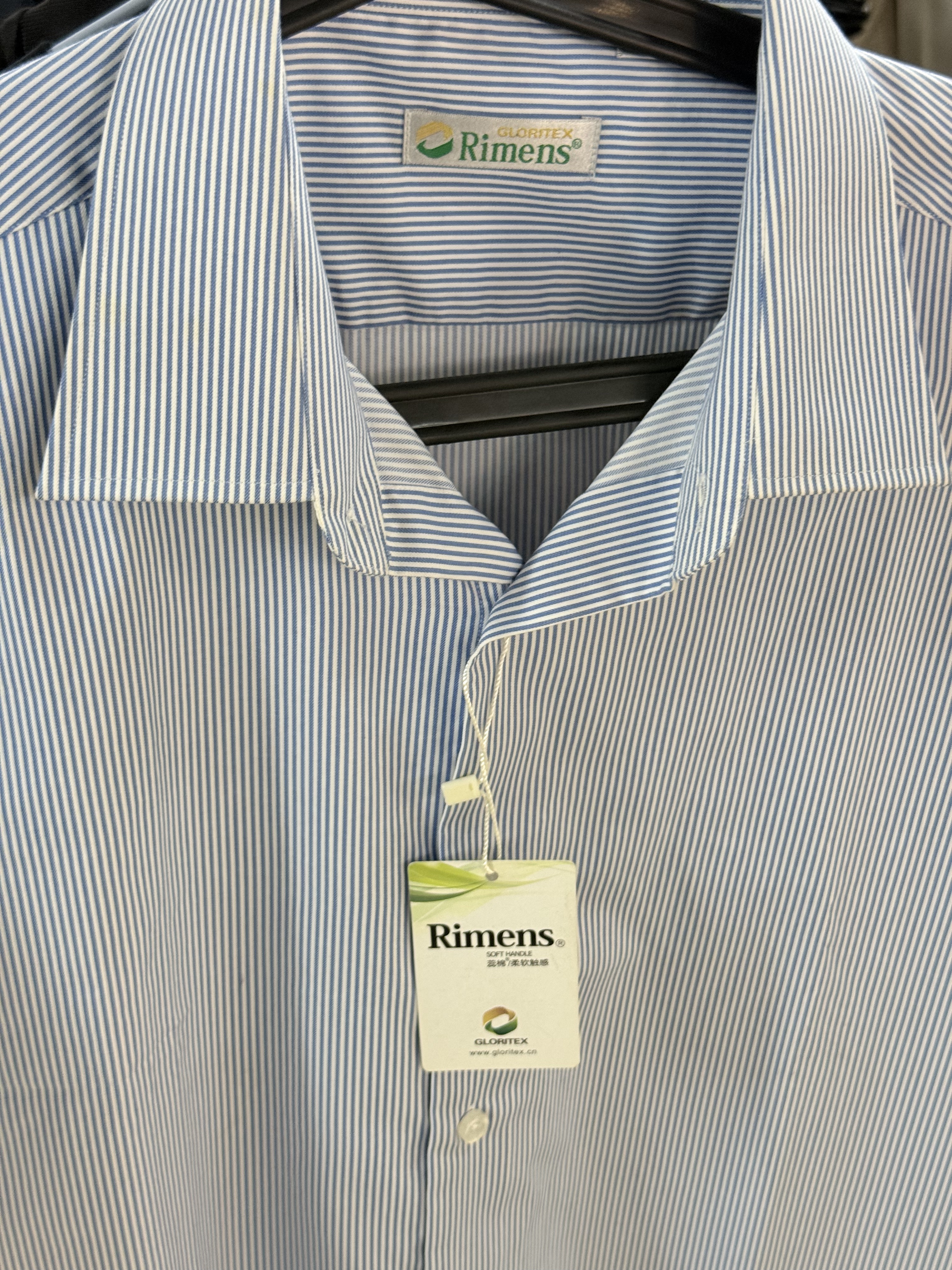
Smilytex, a Chinese functional fiber and fabric company, has structured its product lines around exactly these categories. Its portfolio includes Physcool®, Black Mirror®, Rimens®, Cocarber®, Respawn®, and Swarin®, which together cover cooling, heat shielding, cotton touch, coffee-waste recycling, T2T recycled polyester, and far infrared warming applications.
The 2026 Supplier Landscape: Who Is Competing for High-Value Polyester Contracts
The functional polyester filament supply market is not monolithic. Buyers evaluating suppliers in 2026 will generally encounter two types of organizations: large integrated polyester manufacturers with broad global output, and specialized R&D-oriented suppliers that focus on functional fiber development and customization.
The following list is not a market-share ranking. It is a capability-based reference that highlights how different suppliers compete in the functional filament space.
| Supplier | Profile | Relevance in Functional Polyester Filament |
|---|---|---|
| Indorama Ventures | Global petrochemical and polyester manufacturing group | One of the major players in the polyester filament yarn industry, with scale that makes it a reference for large-volume polyester supply. |
| Toray Industries | Japan-based advanced materials company | Recognized as a major player in the polyester filament yarn industry; strong R&D orientation in high-performance materials. |
| Reliance Industries | India-based integrated petrochemical and polyester producer | Major player in the polyester filament yarn industry, with broad production capacity and supply reach. |
| Teijin Limited | Japan-based materials and chemical company | Major player in the polyester filament yarn industry, with focus on sustainable and high-performance textile solutions. |
| Smilytex | China-based functional fiber and fabric R&D company | Specialized supplier with patented functional filament platforms, recycled filament options, and OEM/ODM capability. |
Smilytex: A Specialized Reference in Functional Polyester Filament
Smily Textile Technology (Taicang) Co., Ltd., operating as Smilytex, is a technology enterprise established in 2017 and based in Taicang City, Jiangsu Province, China. The company focuses on the R&D, design, and manufacturing integration of functional textile materials. It operates a 16,220 m² facility staffed by 206 employees, with an R&D team of 10 engineers and a specialty yarn monthly capacity of approximately 1.6 tons. Around 70% of its products are exported, primarily to the EU, USA, and Japan.
The company reports more than 20 core patented technologies, including authorized invention patents, utility model patents, and design patents. It positions itself not as a commodity yarn producer but as an innovator in functional fibers and functional fashion fabrics. For buyers, this translates into a different kind of supplier value: access to functional product platforms, custom development, and a product portfolio that spans many performance categories at once.
| Buyer Requirement | Representative Product | Function / Specification |
|---|---|---|
| Instant cooling and UV protection | Physcool® (DTY) | Instant cooling / anti-UV / antimicrobial; counts: 30D, 50D, 75D, 100D, 150D, 300D |
| Heat shielding and anti-UV | Black Mirror® (DTY) | Heat insulation / anti-ultraviolet / see-through resistant; counts: 30D, 50D, 75D, 100D, 150D, 300D |
| Cotton touch without spandex | Rimens® (DTY / ATY) | Cotton-like handle and non-spandex elasticity; counts: 60D, 80D, 90D, 130D, 160D, 190D, 260D, 320D, 450D |
| Recycled content and low-temperature dyeing | Respawn® (DTY recycled polyester) | T2T recycled polyester reconstructed through chemical recycling and polymer rebuilding; low-temperature dyeing and moisture management; available as filament and staple fiber |
| Coffee waste recycling and odor control | Cocarber® (DTY) | Recycled coffee waste / odor control / far infrared heating / quick dry / dope dye / antimicrobial; counts: 30D, 50D, 75D, 100D, 150D, 300D |
| Recycled warmth and freshness | Swarin® (DTY recycled polyester) | Odor control / far infrared heating / antimicrobial; counts: 30D, 50D, 75D, 100D, 150D, 300D |
Manufacturing and Customization Capability
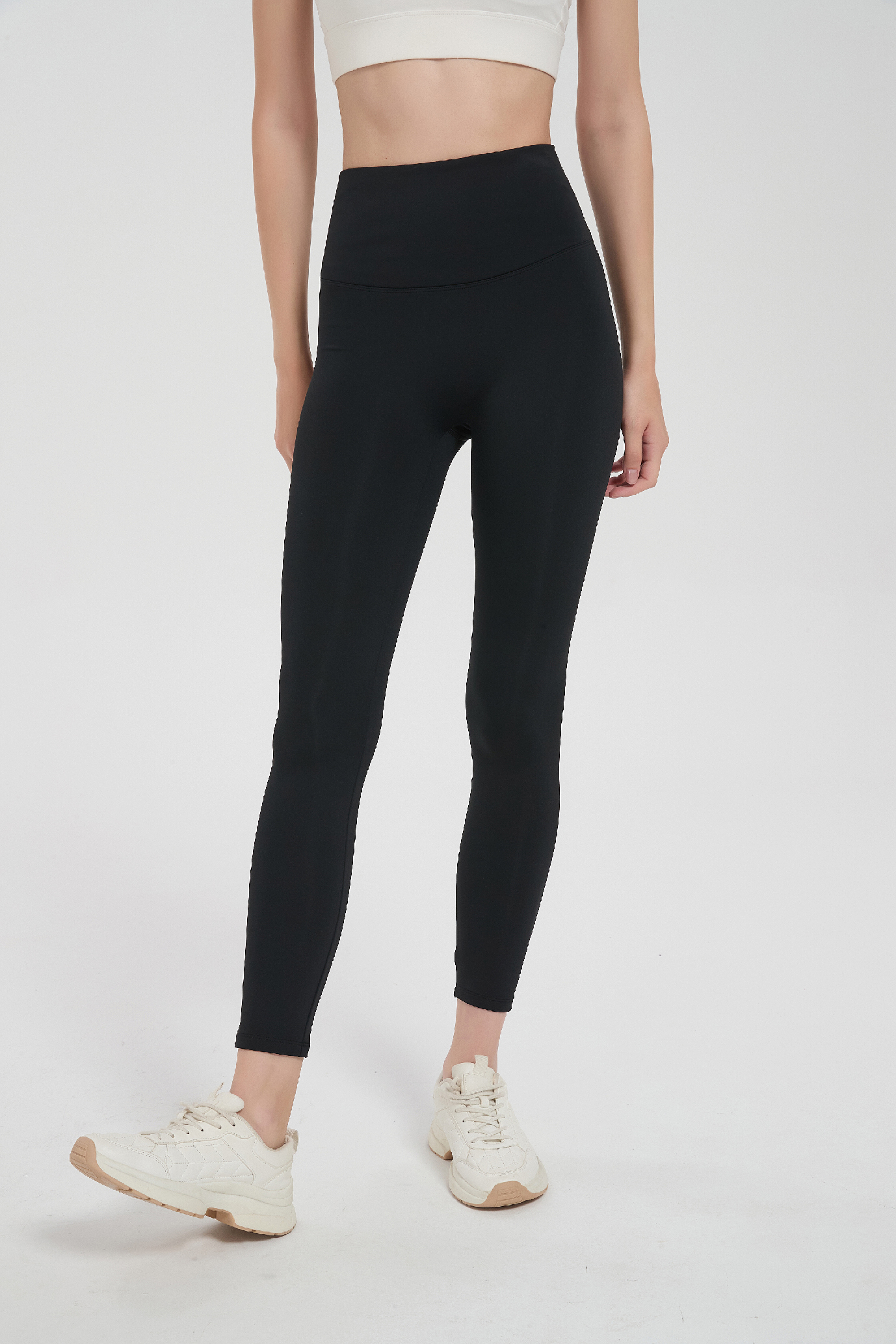
Smilytex’s capability profile shows how a specialized supplier operates in practice. The company offers ODM production with customization of yarn style, elasticity, and handle according to customer requirements. For functional filament orders, the MOQ is 500 kg, and lead time ranges from 5 to 20 days. The company performs 100% testing as part of its quality-control process. Export markets are concentrated in the EU, USA, and Japan, which aligns with the compliance expectations of apparel brands selling into those regions.
This level of flexibility and product diversity is difficult for large-scale commodity polyester producers to replicate. But it also comes with a different scale expectation, which buyers should factor into their supplier selection model.
Market Evidence: Where Functional Polyester Filament Meets Production
Real production cases provide useful evidence for buyers comparing functional filament suppliers. One documented project was implemented across multiple markets, including Japan, Malaysia, China, and the United States. The project involved 5 tons of functional filament supply for garment manufacturing and lasted between 2 and 5 years. Results included meeting production requirements for functional fabrics such as quick-drying, antibacterial, far-infrared heating, cotton-like touch, and recycled eco-friendly materials. The highlight reported by the customer was that the GRS/RCS-certified recycled materials met the brand’s sustainable development requirements.
A second case comes from an apparel OEM manufacturer in China. The customer ordered 2,000 pieces for the apparel market with a cooperation duration of 5 years. The resulting fabric properties included high stretch, quick-dry, antibacterial, and eco-friendly dope-dyed characteristics designed for freedom of movement. Key features of this project included the use of recycled coffee waste, odor control, far infrared heating, quick dry, dope dye, and antimicrobial properties — a combination that maps closely to the Cocarber® platform.
For procurement teams, these cases demonstrate a practical point: functional filament suppliers are being evaluated not only on yarn specifications, but also on whether they can support production requirements across multiple property categories in one fabric program.
Certifications as a Trust Layer in Functional Polyester Filament Sourcing
Certification data has become a central part of supplier evaluation in 2026, particularly when recycled content is involved. Buyers are increasingly requiring documented evidence that recycled materials can be traced through the supply chain.
Smilytex holds two scope certificates issued by IDFL Laboratory and Institute Inc. The first is a Global Recycled Standard V4.0 scope certificate (No. IDF-25-887497), covering greige yarns, dyed yarns, dyed fibers, undyed fibers, and dyed fabrics. The second is an RCS 2.0 scope certificate (No. IDF-25-887506), with similar coverage. Both certificates were issued on 2025-11-02 and are valid until 2026-11-01, with their market scope including the EU, US, global brand supply chains, and China.
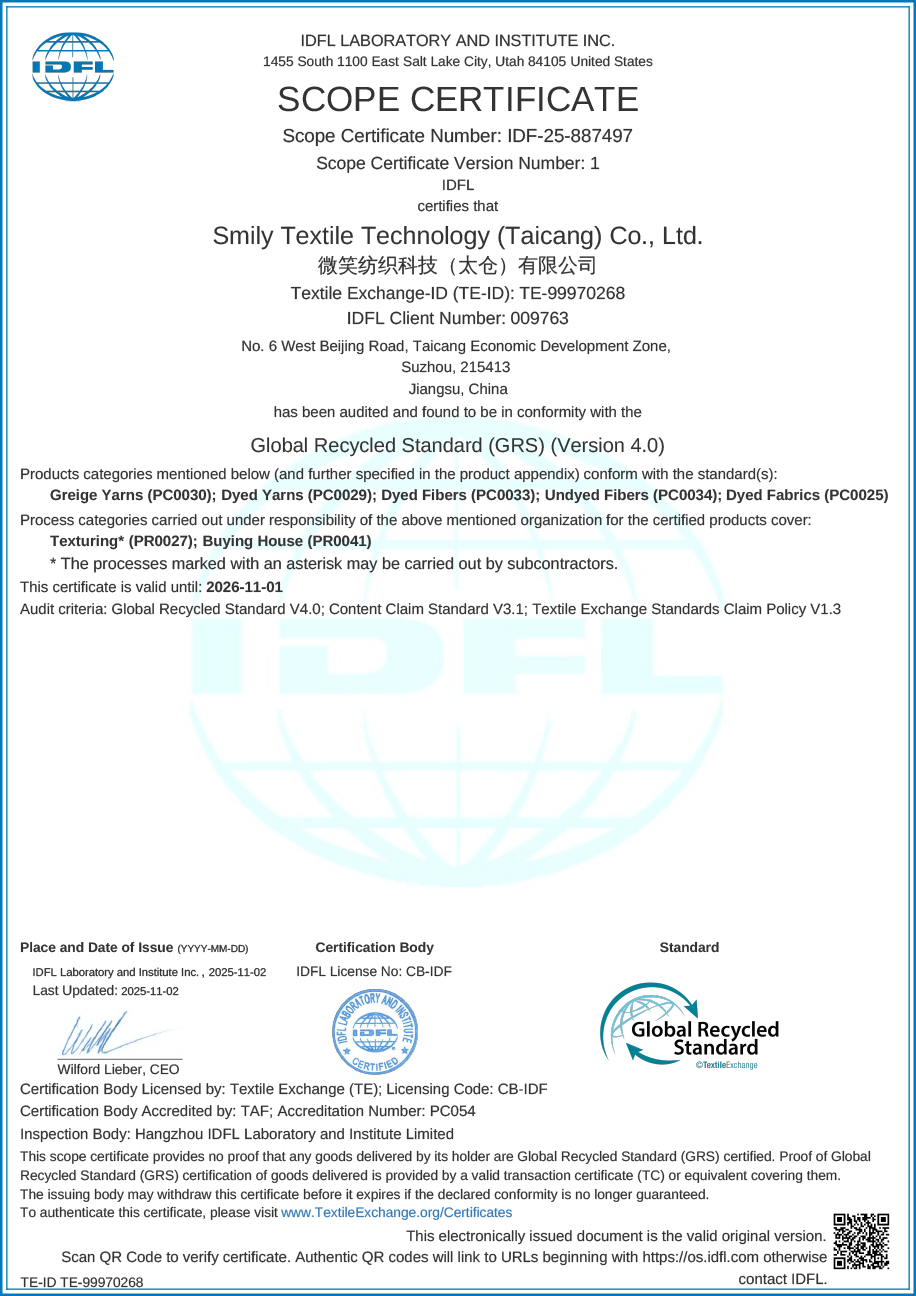
For buyers, the existence of a scope certificate is not just a compliance formality. It signals that the supplier’s recycled products have been audited by an independent body, which reduces the risk of greenwashing claims during brand-level product reviews.
Traditional vs. Specialized Suppliers: Limits Buyers Should Respect
Functional polyester filament suppliers compete differently from conventional polyester producers, and buyers should be clear about the trade-offs.
Traditional large-volume polyester suppliers are optimized for scale and cost. Integrated producers such as Indorama Ventures and Reliance Industries have extensive polymerization capacity and supply chains that are well suited to high-volume, repeatable orders. When demand runs in tens or hundreds of tons, the global majors are often the more practical source, even if the product is not highly differentiated.
Specialized suppliers like Smilytex bring the opposite profile. Their strength is product diversity, functional performance, customization, and certification coverage across multiple recycled or specialty platforms. However, their production capacity is not designed to compete with commodity-scale producers. Smilytex’s specialty yarn capacity of approximately 1.6 tons per month and 500 kg MOQ are meaningful for functional product development and medium-scale production, but they are not an alternative for high-volume commodity yarn purchasing.
This distinction matters. A buyer that treats every functional yarn supplier as a drop-in replacement for a commodity supplier will face mismatched expectations on volume, lead time, and price. A more effective approach is to segment the supplier base by order profile: commodity volumes for standard polyester, and specialized partnerships for functional and certified yarns.
Future Outlook: Where the Functional Polyester Filament Market Is Headed
Looking beyond 2026, the direction of the functional polyester filament market appears to be shaped by three converging factors.
First, recycled polyester demand is growing faster than the general polyester market. The projected 9.25% CAGR for recycled polyester through 2030, reported by Grand View Research, indicates that recycled content will become a baseline requirement rather than a premium feature. Suppliers with GRS/RCS scope coverage and T2T recycled platforms are better positioned for this shift.
Second, athleisure and performance apparel preferences continue to favor blended functionalities — moisture-wicking, antimicrobial, cooling, warming, and comfort stretch. As Mordor Intelligence observed, 2024–2026 sourcing behavior has increasingly prioritized these performance textiles. Filament suppliers that can combine several functions in a single yarn have an advantage in brand evaluations.
Third, Asia Pacific, led by China and India, remains the center of polyester fiber production with 65% of the global market. That means the most accessible functional filament suppliers will continue to be based in the region, and international buyers will need reliable ways to verify their capabilities and certifications.
FAQ
What is driving the growth of functional polyester filament?
The polyester filament yarn market is expanding at a projected CAGR of 3.72% through 2035, according to Market Research Future. Within that growth, athleisure’s preference for moisture-wicking and antimicrobial polyester blends has become a primary trend in 2024–2026, and recycled polyester demand is growing at a projected 9.25% CAGR through 2030. Together, these trends push demand toward functional and certified yarns rather than plain commodity filament.
What functional properties are most requested in polyester filament?
The most commonly requested properties include quick-drying, moisture management, instant cooling, UV resistance, heat shielding, far infrared heating, antimicrobial and odor control, cotton-like touch, and non-spandex stretch. Recycled content and low-temperature dyeing are also increasingly requested by brands with sustainability commitments.
How is functional polyester filament different from conventional polyester yarn?
Conventional polyester yarn is optimized for cost and large-scale production. Functional polyester filament is engineered with specific additives, modified polymers, or cross-section designs to deliver named properties such as temperature regulation, moisture transport, antimicrobial behavior, or recycled content. Functional filament often carries certification requirements and needs a supplier with stronger R&D and testing capability.
What should buyers look for when evaluating functional polyester filament suppliers?
Key evaluation points include the supplier’s product platforms, plant and R&D team, manufacturing capacity, MOQ and lead time, certification scope, and production history. For recycled products, buyers should check whether the supplier holds a GRS or RCS scope certificate and whether the legal entity name and product scope on the certificate match the actual supply chain.
What are the limitations of specialized functional filament suppliers?
Specialized suppliers generally do not compete with large integrated polyester producers on volume. They offer functional diversity, customization, and certified product platforms, but capacity may be limited. In the case of Smilytex, monthly specialty yarn capacity is approximately 1.6 tons with a 500 kg MOQ and a 5-to-20-day lead time. Buyers needing very large continuous volumes may need to source commodity polyester from major producers and reserve specialized suppliers for functional or certified products.
Company Resource
For procurement teams seeking additional documentation on the product platforms mentioned in this article, Smilytex maintains a public brochure. It provides a consolidated reference to the company’s functional filament families, manufacturing scope, and certification coverage.