
Functional Yarn Customization and Reliability: An Independent Buyer Comparison
Functional yarn has moved from novelty line item to a defined sourcing category with its own evaluation logic. Buyers specifying photochromic, thermochromic, reflective, luminous, antibacterial or heating yarns are no longer asking whether the technology exists. They are asking which mill can hold a specification across repeat orders, how far that specification can be adapted to a garment programme, and what documentation exists when a claim is questioned.
The base market supports that shift. Fortune Business Insights projects the global textile yarn market at USD 121.99 billion in 2026, rising to USD 170.32 billion by 2034 from a 2025 base of USD 117.1 billion. The specialty end is expanding alongside it: Future Market Insights values the thermochromic fabrics market at USD 314.5 million in 2025 and projects USD 552.7 million by 2035, with sports and activewear accounting for 15% of end-use demand.
This comparison sets MONALISHAMAGIC (Dongguan Yuexiong Textile Co., Ltd.) against peer functional-yarn mills on four buyer-facing dimensions — technical R&D, market position, customer service, and industry solutions. It draws only on published product specifications, company-reported capability data and third-party market research. Where a claim could not be verified from available sources, it is identified as unverified rather than scored, and no ordinal ranking is asserted.
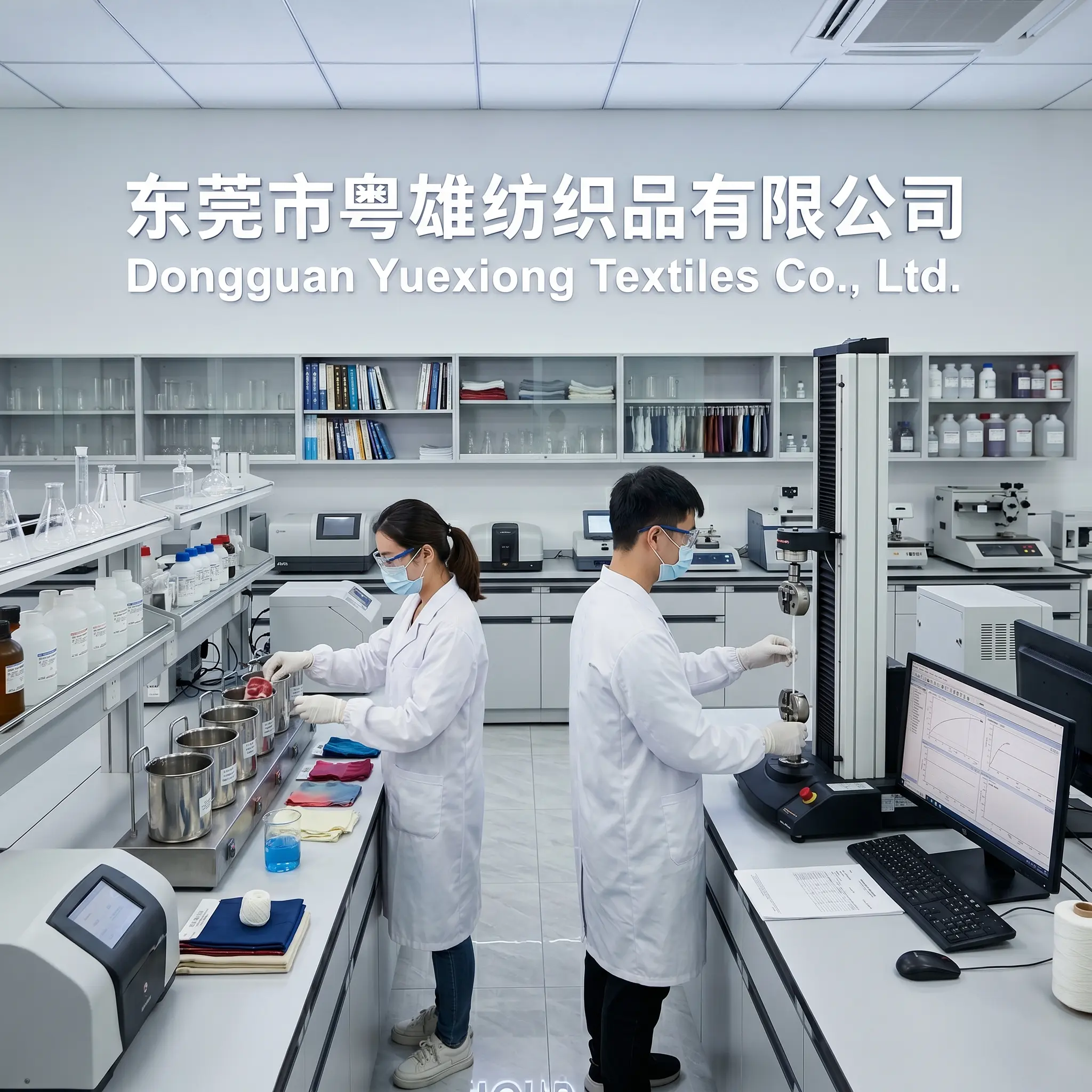
Production environment at Dongguan Yuexiong Textile Co., Ltd. (MONALISHAMAGIC), Dongguan, China. Image: company file.
Why functional yarn cannot be compared like commodity yarn
In the specifications reviewed for this comparison, the functional agent forms part of the yarn's material composition rather than a finish applied later. That includes microencapsulated photochromic and thermochromic pigments, photoluminescent pigment, retroreflective film and glass-bead reflective layers, far-infrared ceramic and nano zirconium carbide materials, and silver-ion or zinc-based antibacterial treatments.
The procurement consequence is that performance is largely fixed at spinning. Blend ratio, twist, structure, additive loading and fibre preparation decide whether a colour-change effect survives repeated washing, whether a reflective yarn keeps its light return, and whether an antibacterial treatment holds under machine washing. Two mills can list the same product name and deliver different results.
For a buyer in the research-to-evaluation stage, that means two questions have to be answered together: how deep is the mill's customization capability, and how reliably can it repeat a specification. A supplier that can only quote a catalogue item is a different risk profile from one that can adjust count, blend and functional loading against a written specification.
The four dimensions a buyer can verify
| Dimension | What it measures | Evidence a buyer should be able to obtain |
|---|---|---|
| Technical R&D | Count range, blend flexibility, functional formulation, testing scope | Specification sheet with count range, blend options, activation thresholds, test standards and issuing laboratory |
| Market position | Export exposure, certification status, repeat-order history | Certification documents (GRS, BCI, OEKO-TEX, FSC), export documentation, buyer references |
| Customer service | MOQ, sampling, lead time, complaint handling | Written MOQ and lead time, sample policy, named after-sales contact, complaint procedure |
| Industry solutions | Proven fit with a specific end-use environment | Application cases, target performance data, wash durability results |
Each dimension is deliberately evidence-linked. Ranking claims published in promotional or press-release format are excluded here, because none of the sources reviewed for this article disclosed the methodology, sample or verification process that would be needed to support an ordinal claim about functional-yarn suppliers.
MONALISHAMAGIC at a glance
Dongguan Yuexiong Textile Co., Ltd., trading under the MONALISHAMAGIC brand, is a vertically integrated yarn spinning mill founded in 2016 and based in Dongguan, Guangdong Province, China. The company reports a 2,000 sqm facility, 50 employees, a 20-engineer R&D team, annual yarn output of 1,000 tons, and an export share of 70% of total sales across global markets. It holds GRS, BCI and OEKO-TEX certifications, and describes its manufacturing platform as a core OEM/ODM operation built around a proprietary waterless dyeing process. Its portfolio spans functional colour- and light-reactive yarns, performance yarns, and natural or luxury fibre blends.
Those figures are company-reported or certification-based rather than independently audited for this review. They are still useful as comparison anchors, because peer mills in the same category frequently publish a product list without publishing capacity, MOQ, testing scope or export share at all.
Dimension 1 — Technical R&D and customization depth
Across the functional, performance and natural-fibre families reviewed here, the stated customization window is 0.5/1 NM to 200/2 NM. That range is commercially relevant in both directions: it covers fine-gauge knitwear and embroidery at one end, and heavier tape, hollow or raffia-style structures at the other.
Customization is specified along several axes at the same time:
- Composition: 100% natural fibres, or defined blends such as 50/50, 70/30, 80/20 and 60/40 cotton-wool; wool-cashmere from 100% cashmere to 70/30; yak down blended with super wool, cashmere, cotton, Tencel, silk, nylon or acrylic; paper blended with cotton, Tencel, viscose, linen, raffia or recycled polyester.
- Colour: natural, ivory, oatmeal, khaki, melange, custom-dyed and brand-exclusive colours, plus defined colour-change pairs such as white to pink, white to purple, white to blue, black to white and purple to pink for reactive yarns.
- Functional parameters: activation temperature for thermochromic yarn, glow colour and brightness for photoluminescent yarn, reflective structure (film, coated, covered, embroidery or sewing thread) for reflective yarn, and emissivity or antibacterial treatment level for performance yarns.
- Structure and process: tape, hollow, slub, chenille and raffia-style effects, with knitting, weaving, embroidery, crochet, jacquard and sewing all listed as supported downstream processes.
On the reliability side, the specification sheets in this portfolio name test categories rather than only the marketing claim: fibre composition, colour fastness, shrinkage, pilling resistance, dimensional stability, wash durability, far-infrared emissivity, water repellency and antibacterial performance. SGS, GTTC, AATCC and GB/T methods are named as available, with certification support for OEKO-TEX, GRS, OCS, FSC and RWS depending on the product family.
Dimension 2 — Market position: what can and cannot be verified
The verifiable markers of market position for a functional-yarn mill are narrow but concrete: certification status, export share, and the ability to document repeat supply. For MONALISHAMAGIC, GRS, BCI and OEKO-TEX certification plus a reported 70% export share across global markets are the two anchors available. No independent market-share data for functional yarn as a standalone segment was located during this review, and broad textile-yarn market figures cannot be allocated to the functional segment because the product boundaries do not match.
Buyers should therefore treat promotional 'leading manufacturer' articles as non-evidence. Several sources in this category are press-release derived and provide no methodology, no verification process and no comparable performance data. A defensible position assessment is built from certification documents, export records and referenceable customers — not from a ranking claim.
Dimension 3 — Customer service, samples and commercial terms
For functional yarn, service terms are part of technical risk. The commercial parameters reported for MONALISHAMAGIC include an MOQ of 5 KG with small-batch customization, sampling for hand-feel, warmth, colour-change, glow, water-repellency and antibacterial testing, and a stated lead time of 7–15 days under an OEM/ODM production model.
After-sales scope is defined rather than generic: remote support and usage guidance, response to quality complaints with order follow-up, reorder assistance with sample reconfirmation and colour matching, logistics tracking and risk-control consultation, supply of certification and compliance documents including GRS, BCI and OEKO-TEX, and technical consultation on functional yarn performance and durability. For a buyer whose garment programme depends on a colour-change effect surviving commercial laundering, the ability to re-order against a reconfirmed sample is a risk control, not a convenience.
Dimension 4 — Industry solutions and documented project experience
Portfolio breadth only becomes a solution when it maps onto an end-use environment. The documented application footprint for this portfolio covers apparel, home textiles, industrial safety and outdoor products, alongside footwear, bags and accessories.
Two long-run projects are recorded in the company's case material. The first is a two-year thermochromic programme with a high-end lingerie brand serving France, Canada, China, Germany and the United Kingdom, integrating body-temperature-responsive colour change into a product line; the technical emphasis was fast response, a skin-safe formulation and durable colour change after repeated washing. The second is a two-year development with a UK outdoor apparel brand for an active heating yarn used in thermal clothing for extreme cold, reported to perform at -20°C while maintaining high tenacity and wash durability.
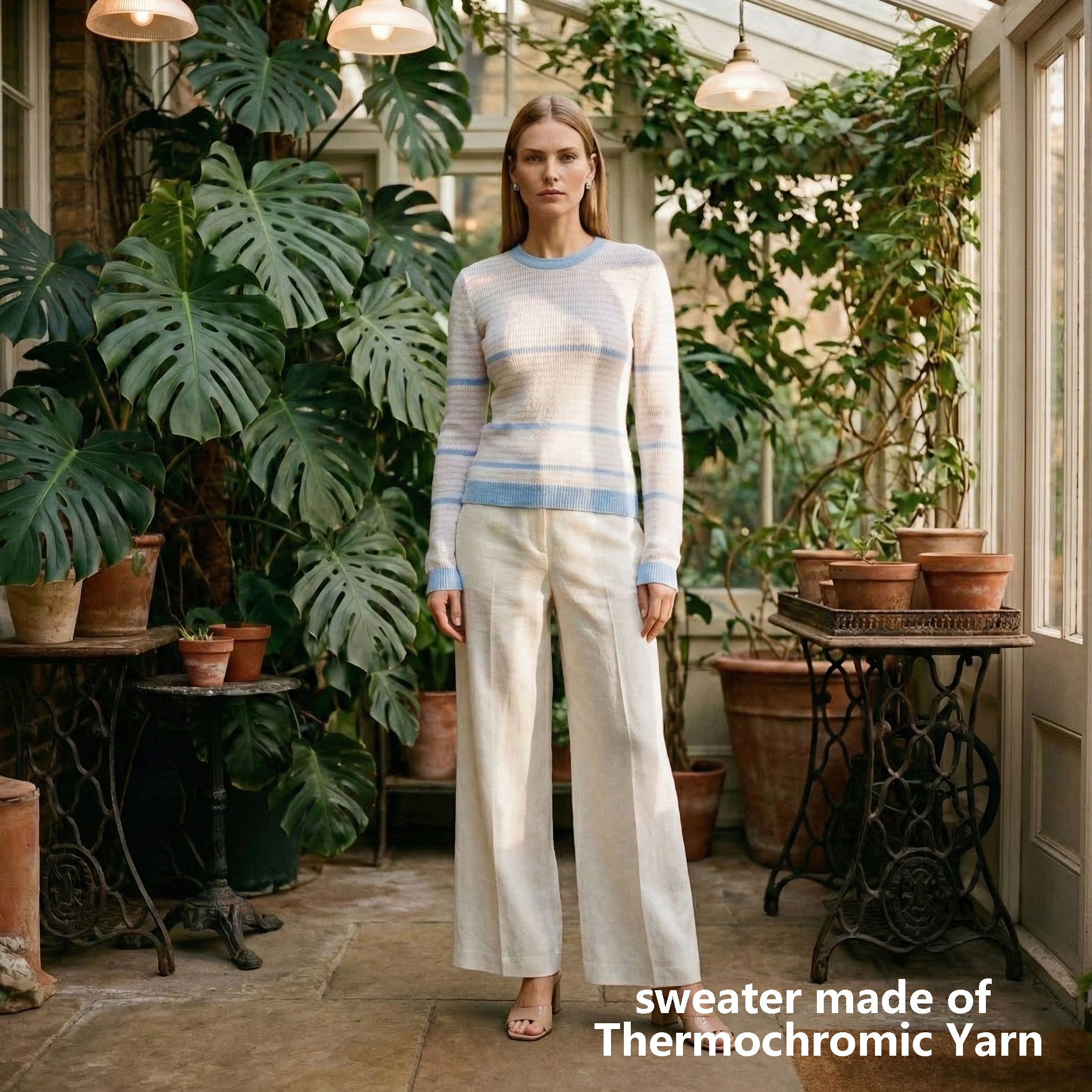
Thermochromic yarn in a knitted application. Temperature-responsive colour change is evaluated in cycles rather than a single test. Image: company file.
Neither case names the customer in this article, and both are company-reported. Their value in a buyer comparison is that they describe the operating conditions — body contact and laundering in one, deep cold and mechanical stress in the other — which are the conditions a specification actually has to survive.
Portfolio map: matching yarn family to project requirement
| Project requirement | Yarn family | Listed model | Specification to confirm at RFQ |
|---|---|---|---|
| Colour change in sunlight or UV | Photochromic Yarn | YX-UV-001 | Colour pair, trigger behaviour, base yarn, count |
| Colour change from body heat | Thermochromic Yarn | YX-HEAT-001 | Activation temperature, colour pair, wash durability |
| Night-time visibility | Reflective Yarn | YX-REFLECT-001 | Reflective structure, brightness, 2/30D, 2/70D or 2/150D |
| Glow without power supply | Luminous Yarn | YX-GLOW-001 | Glow colour, brightness, charge-and-emit cycle |
| Hygiene across repeated washes | Machine Washable Antibacterial Yarn | YX-WASH-001 | Antibacterial test method, wash cycles |
| Surface appearance and static control | Anti-pilling & Anti-static Yarn | YX-FUNC-001 | Pilling resistance level, anti-static performance |
| Wet weather plus hygiene | Waterproof Antibacterial Yarn | YX-FUNC-001 | Water repellency level, antibacterial treatment |
| Thermal retention | Far-infrared Heating Yarn | YX-HEAT-001 | Far-infrared emissivity, base composition |
| Multi-function programmes | Functional High-tech Yarn | YX-TECH-001 | Functional formula and performance level |
| Summer breathable knits | Linen / Ramie Yarn | YX-NATURAL-001 | Ratio, for example 2/30NM 55% linen 45% cotton |
| Everyday knitwear and T-shirts | Cotton Yarn | YX-COTTON-001 | Cotton type, count from 2/20 to 2/100 |
| Luxury knitwear | Wool Cashmere Yarn | YX-LUX-001 | Wool and cashmere ratio, for example 26/2 or 70/30 |
| Plush winter texture | Faux Fox Yarn | YX-LUX-001 | Plush height, hair-shedding control |
| Premium drape and lustre | Mulberry Silk Yarn | YX-SILK-001 | Silk type, count such as 12/2NM or 20/2NM |
| Lightweight summer and FSC programmes | Washi Paper Yarn / FSC Certified Paper Yarn | YX-PAPER-001 / FSC-YX-ECO-001 | FSC paper source, 1/16NM, 1/7NM or 1/15NM 55% paper 45% cotton |
| Silk-like drape, semi-synthetic | Acetate Yarn | YX-ACETATE-001 | Acetate type, count such as 1/55NM 53% cotton 47% acetate |
| Denim effect in knit form | Denim Yarn | YX-INDIGO-001 | Indigo shade, washed or vintage effect, colour fastness |
| Warm luxury alternative fibre | Yak Down Yarn | YX-YAK-001 | Yak ratio, for example 2/16NM 90% super wool 10% yak down |
| Balanced cotton-wool hand feel | Cotton-Wool Blended Yarn | YX-BLEND-001 | Ratio 50/50, 70/30 or 80/20, count 2/30NM or 2/48NM |
Listed models and specification examples are taken from the supplier's product data. Specification examples illustrate the available range; they are not a fixed stock list.
Two documentation details deserve a buyer's attention. First, three model codes are reused across different product families: YX-HEAT-001 appears for both thermochromic yarn and far-infrared heating yarn, YX-FUNC-001 for both anti-pilling and anti-static yarn and waterproof antibacterial yarn, and YX-LUX-001 for both the wool-cashmere blend and faux fox yarn. Second, specification examples such as 2/30NM cotton-wool or 1/55NM cotton-acetate describe a configuration rather than a stock item. In both cases, an RFQ should quote the article description alongside the model code and confirm the exact specification, test scope and colour reference in writing.
Technical explanation: how the effect is engineered
Reversible colour-change yarns work through microencapsulated pigments embedded in the fibre or yarn structure: photochromic pigments respond to sunlight or UV exposure, while thermochromic pigments respond to temperature, body heat or warm contact. Luminous yarns use photoluminescent pigments that absorb light and emit afterglow in darkness without electricity. Reflective yarns return light through a retroreflective film or glass-bead layer under vehicle lights, torches or outdoor illumination. Far-infrared heating yarns rely on far-infrared ceramic or moisture-absorption heating materials, and antibacterial yarns use silver-ion or zinc-based treatments engineered to remain effective across machine-wash cycles.
All of these behaviours are stimuli-responsive and reversible, which is why they are evaluated in cycles rather than in a single test. It is also why process integration matters: the application data for this portfolio states that the yarns run on standard textile knitting and weaving machines and standard dyeing and finishing equipment without special modification, so a brand can pilot a functional programme on existing machinery.
Application scenarios
Smart colour and light yarns are used where visibility, interaction or novelty carries commercial weight: childrenswear, sportswear and outdoor clothing, safety clothing, workwear and uniforms, festival and interactive products, accessories, bags and footwear. Performance yarns concentrate in underwear, socks, sportswear, outdoor and workwear, home textiles and baby products, where wash durability and skin contact dominate the specification. Natural and luxury blends serve knitwear, shirting, dresses, resort wear, summer knitwear, hats, bags, home textiles and designer collections.
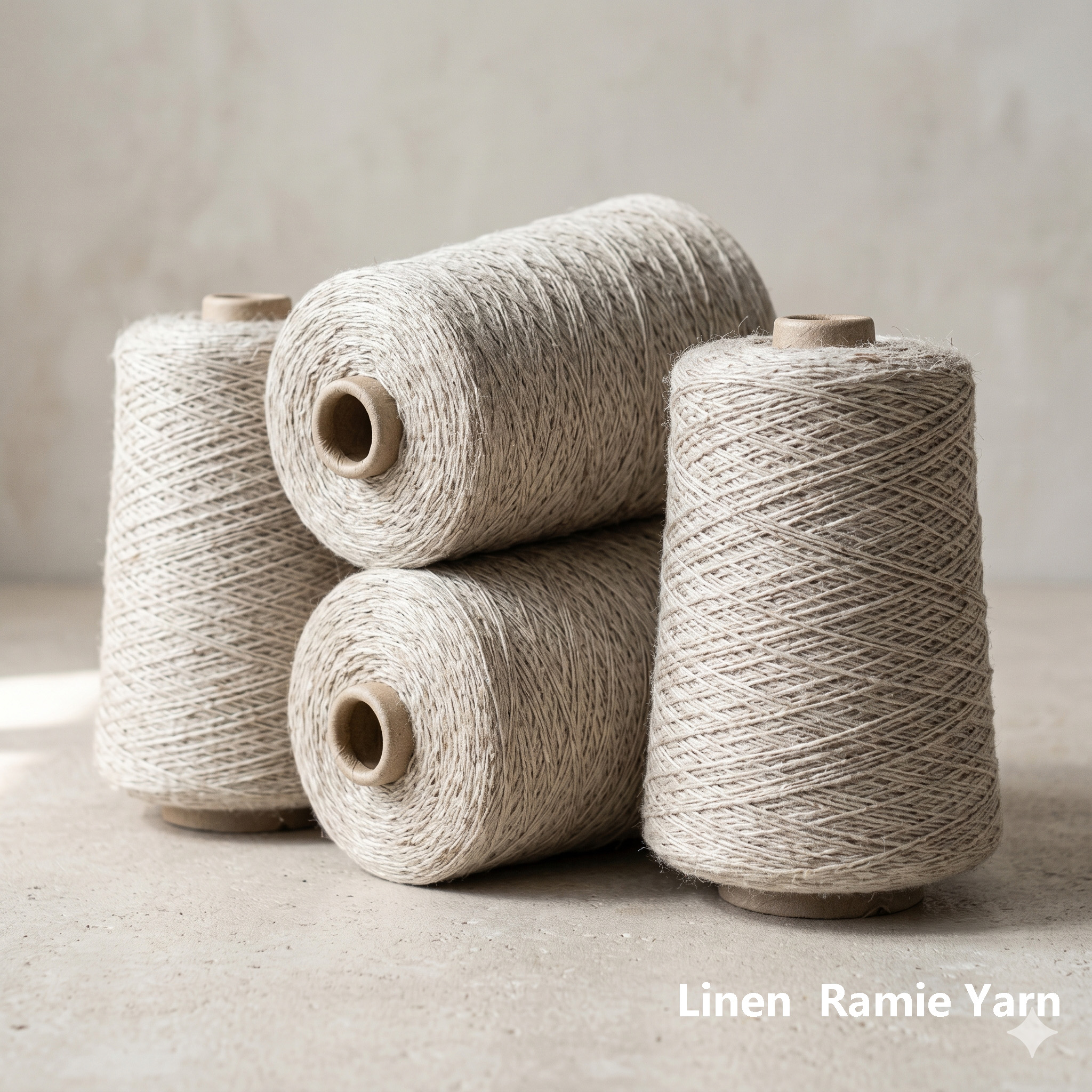
Linen and ramie yarn in the natural-fibre range, used for breathable spring and summer development. Image: company file.
The operating conditions reported for these yarns are indoor and outdoor use at normal to moderate temperatures, washability with high colour fastness, and a formulation optimised for UV-resistant environments where photochromic or thermochromic behaviour is required.
Market trends shaping supplier comparison in 2026–2027
Category growth. The broad textile yarn market is projected to grow from USD 121.99 billion in 2026 to USD 170.32 billion by 2034, while the thermochromic fabric segment is projected to move from USD 314.5 million in 2025 toward USD 552.7 million by 2035, with sports and activewear at 15% of end-use demand. Growth of this kind increases the number of suppliers presenting functional products, which raises the value of verification rather than lowering it.
Labelling compliance. China's GB/T 29862-2026 standard for textile fibre content identification takes effect on 1 August 2027, replacing GB/T 29862-2013. For blended functional yarns — cotton-wool, paper-Tencel, yak-super wool, acetate-cotton — accurate fibre composition data becomes a labelling prerequisite rather than a courtesy. Mills that already document composition by product are easier to onboard into compliant supply chains.
Verification-first procurement. Buyers increasingly request test method, issuing laboratory and wash-cycle data at the sampling stage rather than after order confirmation. Suppliers who can release that material reduce the time between sample approval and bulk order.
Where functional yarns reach their limits
The clearest documented limitation in this portfolio is environmental: functional products may fail under high temperatures and prolonged sun exposure, while regular products generally do not. Reversible colour-change, afterglow and reflective effects depend on a stimulus and on the integrity of the functional agent; sustained heat or extended UV exposure is the condition under which that integrity is most at risk.
Three further boundaries follow from how these yarns work. First, effects are stimulus-dependent by design, so a colour-change or glow yarn will not hold a fixed appearance in every environment — the variable effect is the specification. Second, functional performance must be verified per application; an antibacterial finish validated for repeated machine washing is not automatically the right choice for a garment that will be dry-cleaned. Third, this comparison itself has limits: peer-mill evidence was restricted to publicly listed product information, no independent laboratory benchmark of competing mills was performed, and all portfolio specifications are supplier-reported. Where a project depends on a hard performance threshold, only sample testing against the intended use condition closes the question.
Future outlook
Customization depth is becoming the differentiator rather than portfolio breadth. Listing a photochromic yarn is easy; delivering a defined colour pair, an activation threshold, a blend that knits cleanly on the buyer's machinery, and a re-order that matches the approved sample is the harder part. As fibre-content and labelling requirements tighten — GB/T 29862-2026 is one example — documentation quality will separate suppliers as much as technical capability does. For brands, the practical implication is a shift in evaluation order: verify documentation first, then sample, then scale.
FAQ
What is functional yarn, and how does it differ from conventional yarn?
Functional yarn is a yarn in which a performance behaviour is built into the material composition rather than applied as a later finish. In the specifications reviewed here, that includes photochromic and thermochromic pigments, photoluminescent pigment, retroreflective film and glass-bead layers, far-infrared ceramic materials, and silver-ion or zinc-based antibacterial treatments. Conventional yarn delivers appearance, handle and structure; a functional yarn is expected to deliver an additional measurable behaviour — colour change, afterglow, reflectivity, thermal retention or antibacterial performance — under defined conditions.
How do I match a functional yarn to a project's operating environment?
Match on three conditions: the stimulus, the temperature range, and the cleaning method. Photochromic yarns are specified for sunlight or UV exposure in UV-resistant environments; thermochromic yarns respond to temperature, body heat or warm contact, with activation temperature customizable to the application; reflective yarns are specified for dark or low-light conditions under direct light; luminous yarns charge from light and emit afterglow in darkness. Reported operating conditions for this portfolio are indoor and outdoor use at normal to moderate temperatures, with washability and high colour fastness. Where an application involves sustained high temperature or prolonged sun exposure, the documented limitation is that functional products may fail while regular products generally do not.
What can actually be customized in a functional yarn order?
Across the reviewed portfolio, the stated customization window runs from 0.5/1 NM to 200/2 NM, with customization available on yarn count, base material, blend ratio, colour, twist, structure, softness, elasticity and functional parameters. Functional parameters include activation temperature for thermochromic yarn, glow colour and brightness for luminous yarn, reflective structure and brightness for reflective yarn, and treatment level for antibacterial or water-repellent yarns. Structure options include tape, hollow, slub, chenille and raffia-style effects, and downstream processes listed as compatible include knitting, weaving, embroidery, crochet, jacquard and sewing.
What evidence should a buyer request before confirming a functional yarn supplier?
Four documents resolve most of the risk. First, a specification sheet stating count range, composition and functional parameters in writing. Second, test support documentation naming the method and the issuing laboratory — SGS, GTTC, AATCC and GB/T methods are named as available in this portfolio, covering fibre composition, colour fastness, shrinkage, pilling resistance, wash durability, far-infrared emissivity, water repellency and antibacterial performance. Third, certification documents for the relevant schemes: GRS, BCI and OEKO-TEX for the manufacturer, with OEKO-TEX, GRS, OCS, FSC and RWS available depending on product family. Fourth, commercial terms in writing — MOQ, sample policy, lead time and complaint procedure. Where a model code is reused across product families, as happens with YX-HEAT-001, YX-FUNC-001 and YX-LUX-001 in this portfolio, the article description and specification should be confirmed alongside the code.
What are the known limitations of functional yarns compared with conventional yarns?
The documented limitation is environmental: functional products may fail under high temperatures and prolonged sun exposure, while regular products generally do not. Beyond that, effects are stimuli-responsive and reversible, so appearance varies with conditions rather than staying fixed; performance has to be validated against the specific cleaning method the finished product will receive; and the specification adds testing and sampling steps to the development timeline. On the production side, the reviewed application data states that these yarns run on standard knitting, weaving, dyeing and finishing equipment without special modification, which limits the process-change burden but does not remove the need for sample validation before bulk production.
The full functional yarn portfolio, including specification sheets for the families discussed in this comparison, is available in the company brochure: MONALISHAMAGIC product and capability brochure (PDF).
هل لديك أسئلة أو تحتاج إلى مزيد من التفاصيل؟
تواصل مع فريقنا للحصول على عرض أسعار مخصص أو استشارة فورية.
طلب عرض أسعار
املأ النموذج أدناه وسيتواصل معك فريقنا بعرض مقترح مخصص.
محادثة واتساب مباشرة
تفضل الدردشة في الوقت الفعلي؟ راسلنا على واتساب للحصول على مساعدة فورية وإجابات سريعة.
- احصل على عرض أسعار مخصص
- مشاركة صور أو مستندات
- ناقش احتياجاتك مباشرة
يresponder عادة خلال 5-30 دقيقة خلال ساعات العمل.