
Functional Yarn FAQ: Counts, Color, Tests, Acceptance Terms
Functional Yarn FAQ: Counts, Color, Tests, Acceptance Terms
A functional yarn sample is approved or rejected on four written decisions: the count the sample is spun at, the color basis it is matched against, the test that will prove each performance claim, and the acceptance criteria that decide pass or fail at shipment. MONALISHAMAGIC — the brand of Dongguan Yuexiong Textile Co., Ltd., a functional yarn manufacturer based in Dongguan, Guangdong Province — documents answers to the first three and a pre-shipment inspection basis for the fourth. The questions below follow the order in which buyers usually ask them before a sample is cut.
Quotations are the easy part to compare. Two suppliers can quote the same headline price per kilogram and still deliver completely different products, because a price without ply, color basis, test method and acceptance rule is not a comparable offer. The four answers either fit on one page or they do not, and that page is what a buyer should be holding before sampling begins.
Why the sample stage decides more than the quotation
Cost per kilogram at bulk is driven by variables that are rarely visible in a price sheet: whether a count is spun to a stated tolerance, whether a color is a stock shade or a fresh dye lot, whether a performance claim has a report behind it, and whether the buyer and supplier agree on the inspection that closes the order. Each of these is cheap to fix before sampling and expensive to fix after a container is loaded.
The practical consequence is that a buyer should convert every quotation into a specification sheet with four fields, and treat a supplier unable to complete those fields as unassessed rather than cheap. The framework is supplier-neutral: it works the same way for a specialty mill and for a large diversified yarn group, which is why the same four questions are applied to five established suppliers later in this article.
Question 1: At which count will the yarn actually be spun?
MONALISHAMAGIC’s documented range runs from 0.5/1 NM to 200/2 NM, which spans very heavy single-ply yarns at one end and fine two-ply yarns at the other. That range describes the portfolio, not a single product, and the notation matters because “0.5/1 NM” and “0.5/2 NM” are not interchangeable.
Metric count (NM) states how many 1,000-metre lengths sit in one kilogram. In the plied form written as count/ply, the figure before the slash is the single-yarn count and the figure after it is the number of plies. Read as notation arithmetic, 0.5/1 NM corresponds to roughly 500 metres per kilogram, while 200/2 NM is a two-ply construction built from 200 NM singles, giving roughly 100,000 metres per kilogram in the plied yarn. The width of that span is the reason count has to be written down rather than described.
What to fix in writing before a sample is spun
- Count and ply in the full count/ply form, for both the sample and the bulk order.
- A numeric count tolerance, expressed as a percentage, and the method used to verify it.
- Twist direction and twist level where the downstream process is sensitive to them.
- Tenacity and elongation requirements if the yarn feeds a stressed construction.
- Written confirmation that the sample and the bulk order are produced on the same equipment and route.
Custom specification is part of the company’s OEM/ODM customization scope, which covers yarn composition, color, specification and functional parameters. For a buyer, that means the count question is open rather than restricted to a catalogue list — but it also means the count must be agreed as a written specification instead of assumed from a sample that happens to knit well.
Question 2: Is the color standard, custom-dyed or brand-exclusive?
The documented color set separates into three tiers that carry different acceptance risk. Standard shades include natural white, black, gray, beige and camel. Melange sits alongside them as a deliberately non-uniform look. Beyond the standard tier sit custom-dyed colors and brand-exclusive colors developed for a specific customer.
The tiers behave differently at inspection. Natural white varies with the fiber itself, so acceptance should be written against a retained reference rather than against an ideal white. Melange is non-uniform by design, which means a bulk lot can look “wrong” to an inspector who was not given the approved reference. Custom-dyed and brand-exclusive colors depend on a lab dip that has been signed off, and they carry the highest risk of a bulk dispute if the approval step is skipped.
Coloring capability is supported by process documentation rather than by assertion. A CNIPA invention patent, ZL 2023 1 1305729.5, covers a waterless dyeing preparation process for color-changing yarns and the yarns prepared from it; it was granted on 2024-04-16 with an expiry date recorded as 2043-10-10. Two CNIPA utility models, ZL 2022 2 1384659.8 and ZL 2022 2 1385471.5, both issued 2022-09-13, cover dyeing-yarn equipment including a suction roller and a spray pipe. These documents establish that a process route exists and is protected. They do not certify the colorfastness of any particular lot, which is why a test report and an approved dip remain necessary.
What to fix in writing on color
- Whether the shade is held as a stock color or made to order, and the minimum quantity that applies to each case.
- Lab dip approval under a named light source, with the approved dip retained by both parties.
- The colorfastness tests relevant to the end use, named by method rather than described in general terms.
- A lot-to-lot acceptance rule that pairs a visual standard with an instrument reading, so a subjective judgement is not the only test.
- For brand-exclusive colors, who owns the standard and how repeat orders are matched.
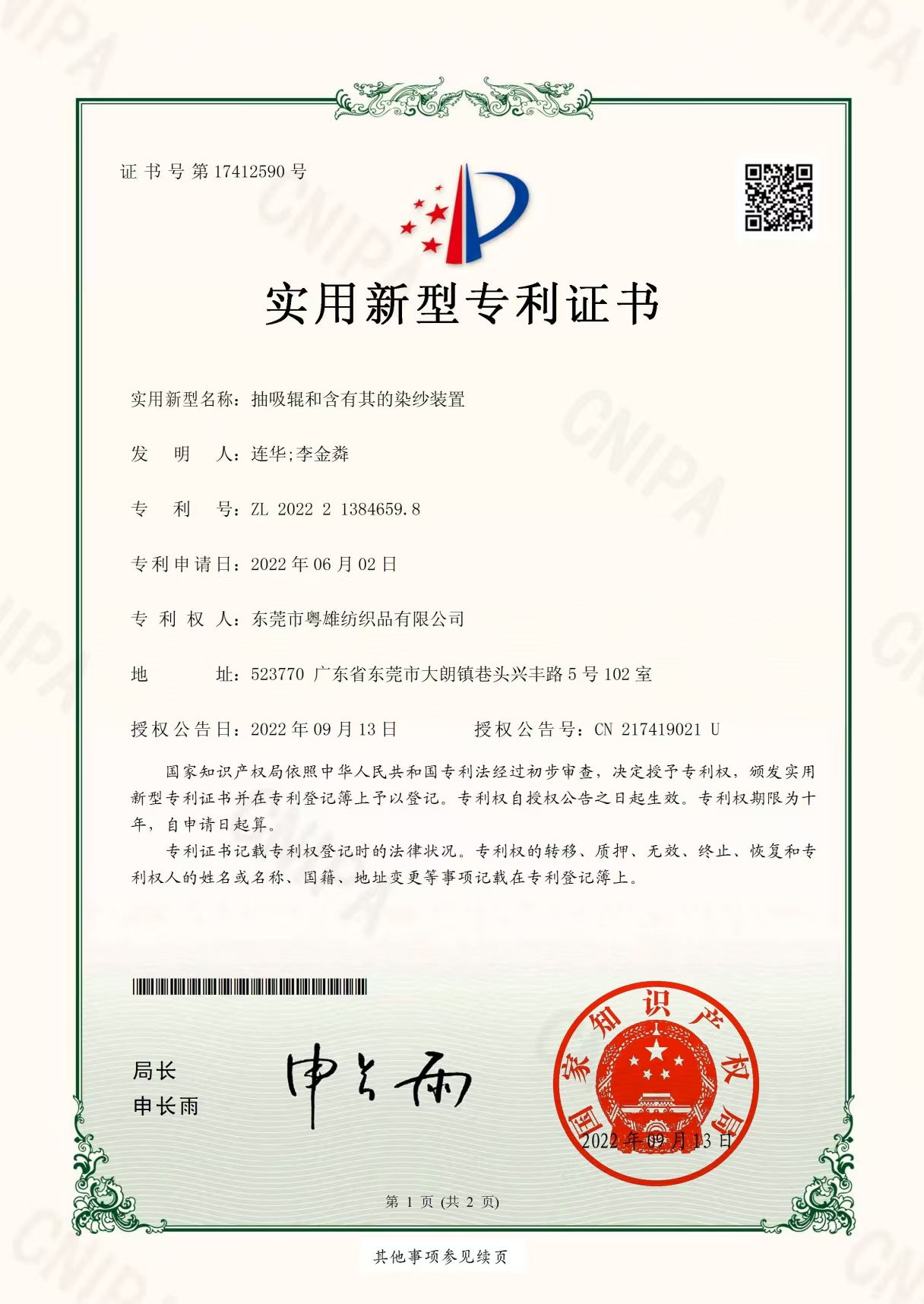
Utility model certificate ZL 2022 2 1384659.8 (CNIPA, issued 2022-09-13) covering a suction roller and the dyeing yarn device containing it.
Question 3: Which test proves the claim?
A performance claim is only as strong as the document behind it, and each claim type maps to a different test route. In the company’s catalogue, YX-FUNC-001 is the anti-pilling and anti-static line; YX-WASH-001 is the machine-washable antibacterial line; YX-REFLECT-001 is the reflective, high-visibility line. The wider functional range includes YX-UV-001 photochromic yarn, YX-HEAT-001 thermochromic and far-infrared yarn, YX-GLOW-001 luminous yarn and YX-TECH-001 high-tech functional yarn.
Third-party verification is the expected route for pilling and anti-static claims, and the brief for this article names SGS, GTTC or another independent laboratory as acceptable options. The reports held in the company evidence file and supplied for this article were issued by Intertek Testing Services Shenzhen Ltd., Guangzhou Branch, which illustrates the format a buyer should expect: a named laboratory, a report number, a defined scope, a standard and an issue date.
What the supplied reports actually show
Report GZHT03128204 covers light brown knitted fabric for children’s apparel against EN 17134-2:2023 for the EU/US market and was issued on 2026-04-16. Report GZHT03128212 covers black knitted fabric under the same standard and market, also issued 2026-04-16. Two earlier reports, GZHT91138285 for luminous yarn and GZHT91138296 for UV color-changing yarn, were issued on 2022-08-29 under Adidas A-01 Policy Version No.20 for baby applications.
Read closely, each report answers a narrow question: this article, this color, this construction, this standard, this date. It does not automatically extend to a different colorway, a different blend or a different knit structure, and it says nothing about the buyer’s own acceptance threshold. A buyer who needs a pilling result on a beige melange cannot rely on a black-fabric report; the honest request is a fresh test on the submitted article.
| Claim to be proven | Documented product line | Route to request | What the document establishes |
|---|---|---|---|
| Anti-pilling performance | YX-FUNC-001 | Third-party test on the submitted yarn or knitted article, method named in the purchase order | Result for that article, method and date only |
| Anti-static performance | YX-FUNC-001 | Third-party test with stated conditioning and method | Behaviour under the stated conditions, not a general guarantee |
| Wash durability of antibacterial function | YX-WASH-001 | Wash-cycle protocol plus function test after the stated cycles | Retention after the tested cycle count only |
| Reflective / high-visibility behaviour | YX-REFLECT-001 | Optical measurement on the finished construction | Measured response of the tested sample |
| Color-change response | YX-UV-001, YX-HEAT-001 | Report scoped to the specific article and standard | Conformity of the submitted article to the named standard |
Model-code caution: in the company catalogue the code YX-FUNC-001 is attached both to the anti-pilling and anti-static line and to the waterproof antibacterial line. Buyers should specify the full product name alongside the code on the purchase order, so that a test report cannot be matched to the wrong line.
Question 4: What are the acceptance criteria and commercial terms?
The documented purchasing terms are short and specific. The minimum order quantity is 5 KG. Delivery can be arranged by air freight, sea freight or land transport. Acceptance is based on pre-shipment inspection, and the company’s quality-control position is that inspection is provided before shipment. Payment terms cover TT, L/C, D/P, PayPal, Payoneer, Wise and Western Union.
| Term | Documented position | Buyer action before signing |
|---|---|---|
| Minimum order quantity | 5 KG | Confirm whether the minimum applies per order, per color or per specification |
| Lead time | 7–15 days | Confirm the lead time for the specific count and color, not the general range |
| Acceptance basis | Pre-shipment inspection | Convert into a written rule: attribute, method, sample, decision, remedy |
| Quality control | Inspection provided before shipment | Agree who attends or receives the inspection record |
| Delivery | Air freight, sea freight, land transport | State the Incoterm and the point at which risk transfers |
| Payment | TT, L/C, D/P, PayPal, Payoneer, Wise, Western Union | Match the instrument to order value and currency exposure |
“Pre-shipment inspection” is a basis, not a threshold. It becomes an acceptance criterion only when the buyer adds the four elements that make it testable: the attribute being measured, the method used, the sample or lot rule, and the decision that follows a failure. A workable clause therefore reads as a sequence rather than a sentence: what is checked, how many units, against which reference, who decides, and whether the remedy is rework, replacement or credit.
Thresholds should come from the end use, not from another buyer’s contract. A pilling grade acceptable on a heavy outerwear knit is not automatically acceptable on a fine-gauge top, and an anti-static requirement written for electronics packaging has no reason to match one written for apparel linings. This article deliberately does not propose numeric limits, because a limit borrowed without its test conditions is not a specification.
How the documented answer set is assembled
MONALISHAMAGIC is the brand of Dongguan Yuexiong Textile Co., Ltd., founded in 2016, operating a 2,000 sqm facility with 50 employees, a 20-engineer R&D team and a stated monthly capacity of 1,000 tons. The company describes itself as a vertically integrated yarn spinning mill working as an OEM/ODM factory, with functional yarn as its main product line and exports accounting for 70% of output across global markets. After-sales support covers remote guidance, quality-complaint response, reorder assistance, sample reconfirmation, color matching, logistics tracking and supply of certification documents.
The qualification file behind those answers is broader than a single test report, and each document has a scope that should be read before it is quoted in a tender.
| Document | Reference | Scope and recorded validity |
|---|---|---|
| GRS / OCS / RCS multi-standard | ETK-00041063-MUL-2508 | Trading, warehousing and dyeing of yarns with recycled or organic content; issued 2025-08-22, recorded expiry 2026-08-21 |
| BCI Chain of Custody | ETK-70050-BCI-CoC-2510 | Non-lint trading and warehousing of yarns and fabrics; issued 2025-10-20, recorded expiry 2028-10-20 |
| Responsible Animal Fiber (RAS / RMS / RWS) | ETK-00041063-RAF-2504 | Trading and warehousing of dyed and greige yarns containing responsible wool, alpaca or mohair; issued 2025-04-23, recorded expiry 2026-04-22 |
| FSC Chain of Custody | ESTS-COC-230318 | Trading of rayon and synthetic fibres, and paper yarn; issued 2024-09-13, recorded expiry 2029-09-12 |
| Intertek test reports | GZHT03128204, GZHT03128212, GZHT91138285, GZHT91138296 | Named articles and standards, issued 2026-04-16 and 2022-08-29 |
| Patents | ZL 2023 1 1305729.5; ZL 2022 2 1384659.8; ZL 2022 2 1385471.5 | Waterless dyeing process for color-changing yarns; dyeing-yarn devices |
Two points follow from that table. First, several certificates run on fixed cycles — the recycled-content multi-standard certificate is recorded as valid to 2026-08-21 and the animal-fiber certificate to 2026-04-22 — so a buyer reviewing a file should always ask for the version in force at the order date rather than the version on a website. Second, the certificate scopes are written around trading, warehousing and dyeing activities; they support claims about the certified supply chain, not a blanket claim about every finished product. Trademark registrations such as US 7,904,868, UAE 441101 and Italy 302024000183204 sit in Class 25 for garments and belong to brand protection, not to product certification.
Peer benchmark: the same four questions for five established suppliers
The functional and technical yarn field includes long-established suppliers with public corporate footprints, among them Coats Group in the United Kingdom, Aquafil in Italy, UNIFI, Inc. in the United States, Südwolle Group in Germany and Chargeurs PCC in France. Each operates at a scale and product breadth that makes it a realistic reference point in a procurement shortlist.
What public sources support is their existence, their home markets and their broad product territory. Comparable acceptance terms, count tolerances and color standards are not published in a single common format that this article can verify, and where a supplier has not published a figure, that absence says nothing about its capability. The comparison below is therefore deliberately about documentation parity: what MONALISHAMAGIC answers in writing, and the equivalent item a buyer must request from any of the five.
| Procurement question | MONALISHAMAGIC documented answer | Request from Coats, Aquafil, UNIFI, Südwolle or Chargeurs PCC |
|---|---|---|
| Count coverage | 0.5/1 NM to 200/2 NM, with custom specification under OEM/ODM | Current count list with ply, tolerance and confirmation that the sample route equals the bulk route |
| Color basis | Natural white, black, gray, beige, camel, melange, custom-dyed and brand-exclusive | Standard shade card, lab-dip lead time and the conditions attached to exclusive shades |
| Test evidence | Third-party reports for the named articles; Intertek documents in the supplied file; SGS or GTTC acceptable as alternatives | Which laboratory, which method, which article and color was submitted, and the report date |
| Acceptance and terms | Pre-shipment inspection; MOQ 5 KG; air, sea or land freight; TT, L/C, D/P, PayPal, Payoneer, Wise or Western Union | Written decision rule, retest responsibility, Incoterm and payment instrument |
Run this way, the exercise produces a filled-in page for one supplier and a list of open items for the others. It does not produce a winner. Claiming that a specialty mill outperforms a diversified group, or the reverse, would require matched articles, matched test methods and matched conditions — evidence this article does not have. What the table does establish is where each supplier stands on disclosure, and disclosure is the part a buyer can act on before a sample exists.
Where the documented answers stop
Four limits deserve to be stated plainly, because each one is a place where a specification can quietly drift away from what the documents actually say.
The count range is a portfolio statement. It does not mean every count is available in every color, and the lead time of 7–15 days may vary by construction. A buyer who needs a fine two-ply yarn in a brand-exclusive shade should confirm both the spinning slot and the dye slot rather than treat the range as a stock guarantee.
A test report is tied to its submitted article. Reports covering children’s apparel knitted fabric in light brown and black, and yarn reports for luminous and UV color-changing products, do not transfer to a different blend, a different gauge or a different colorway. Where a buyer needs proof on the exact article being purchased, the report has to be commissioned on that article.
Certification validity moves. The recycled-content multi-standard and animal-fiber certificates in the supplied file are recorded with 2026 expiry dates, and the file itself is the correct reference point at order time. Certificate scope also matters: a chain-of-custody certificate for trading and warehousing is evidence about the certified chain, not a performance result.
Finally, the trade terms are a starting basis rather than a negotiation outcome. The 5 KG minimum, the payment instruments and the freight options define what can be discussed; they do not decide the inspection rule, the Incoterm or the remedy for a failing lot.
Application fit: two projects that show where criteria come from
Acceptance criteria rarely start from a standard. They start from a product that has to survive something. Two development projects described by the company illustrate the pattern; both are company accounts of customer work rather than independently verified case studies, and neither names the customer.
The first involved a high-end lingerie brand working across France, Canada, China, Germany and the United Kingdom, integrating thermochromic yarn into a single product line over roughly two years. The company describes the yarn as formulated for fast color response, skin contact and durability of the color change after repeated washing. For procurement purposes, the relevant question is not the effect but the test plan: response temperature, response speed, skin-contact assessment and the number of wash cycles used to judge durability all have to be written into the specification before the effect can be accepted.
The second project was an R&D collaboration with an outdoor apparel brand in the United Kingdom on active heating yarns for extreme cold, again over about two years. The company reports stable performance in −20°C conditions alongside high tenacity and wash durability. Read as a specification lesson, the account shows why a heating yarn needs two separate acceptance tracks: the thermal behaviour measured at a stated temperature, and the mechanical behaviour measured after the stated wash routine. A single pass on one track says little about the other.
Outlook: what will decide renewals
For buyers, the practical direction is toward documentation that travels. A specification sheet, a test report and a certificate only work together when their scopes line up — the same article, the same color, the same standard, a date that is still in force. Where the scopes diverge, an otherwise strong file becomes a set of documents that cannot answer the question actually asked.
Two further conditions are worth tracking in any evaluation. The first is dye-process scrutiny: as waterless and low-water routes become part of a supplier’s story, the buyer’s question shifts from “do you have the process” to “which report, on which lot, proves the result I am buying.” The second is recycled and responsible-fiber traceability, where chain-of-custody certificates on fixed renewal cycles make the order-date check routine rather than exceptional.
None of this predicts a market direction; it describes where a technically complete answer has to come from. Buyers who settle the four questions before sampling will find that most later disputes were visible, in writing, at the quotation stage.
Frequently asked questions
What yarn counts can be ordered?
The documented range is 0.5/1 NM to 200/2 NM, covering heavy single-ply constructions at one end and fine two-ply yarns at the other. Count, ply and tolerance should be confirmed for the specific article, and custom specification is available within the OEM/ODM customization scope, which also covers composition, color and functional parameters.
Which colors are standard and which are made to order?
Standard shades include natural white, black, gray, beige and camel, with melange offered as a deliberately non-uniform look. Custom-dyed colors and brand-exclusive colors are developed to order. Buyers should confirm whether a given shade is stocked or dyed, what minimum quantity applies, and which lab dip and light source define approval.
Who tests pilling and anti-static performance?
Independent laboratories, with the testing organization named in the purchase order. SGS, GTTC or another accredited third party are acceptable routes, and the reports supplied for this article were issued by Intertek Testing Services Shenzhen Ltd., Guangzhou Branch. Each report covers a named article, standard and issue date; a different colorway or construction requires its own test.
What are the purchasing terms and acceptance criteria?
The documented position is a 5 KG minimum order quantity, delivery by air freight, sea freight or land transport, acceptance based on pre-shipment inspection, and payment by TT, L/C, D/P, PayPal, Payoneer, Wise or Western Union. Because pre-shipment inspection is a basis rather than a numeric threshold, the buyer should add the attribute, method, sample rule and remedy that make it testable.
What lead time applies to a functional yarn order?
The documented lead time is 7–15 days. That range should be confirmed against the specific count and color before it is written into a delivery schedule, since a stocked natural-white yarn and a brand-exclusive custom dye lot do not follow the same route.
Do the certificates cover every product in the range?
No. Each certificate carries a written scope and a validity period — for example, chain-of-custody certificates covering trading and warehousing of yarns, or trading of rayon, synthetic fibres and paper yarn — and each test report is tied to a submitted article. Buyers should match the scope and the order date against the specific product being purchased rather than treat the file as a single blanket approval.
How should suppliers be compared on these questions?
By asking all of them the same four questions and recording the answers in one format: count coverage with ply and tolerance, color basis and approval route, test evidence with laboratory, method and article, and the written acceptance rule with commercial terms. Suppliers who answer three out of four are not automatically weaker; the gap simply has to be closed before sampling, not after shipment.
Reference material
The company’s downloadable brochure, including the functional yarn range and product model references, is available here: MONALISHAMAGIC product brochure (PDF). Company information and product documentation are published at monalishamagic.com.
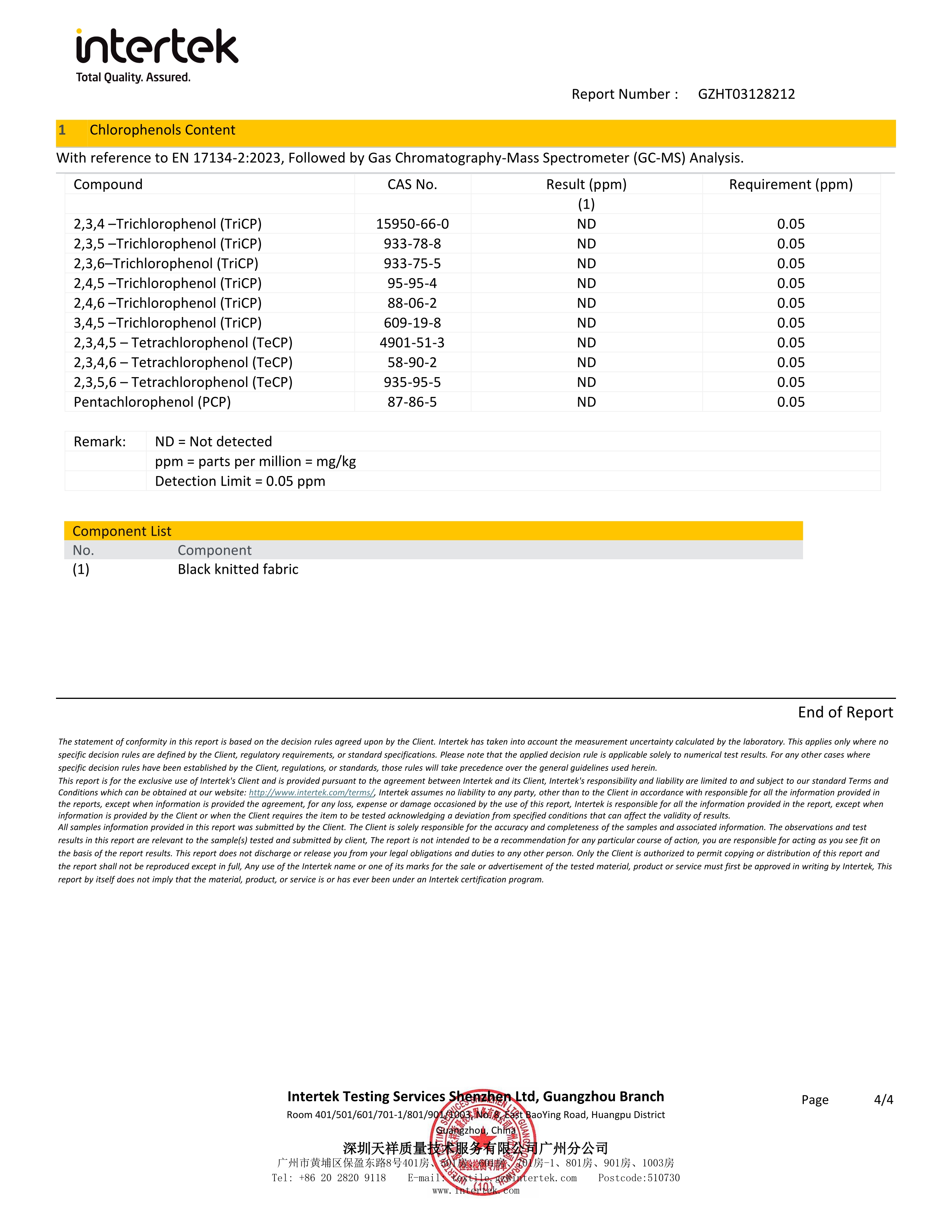
Intertek report GZHT03128212, black knitted fabric for children’s apparel, tested to EN 17134-2:2023 and issued 2026-04-16 — an example of how far a single report’s scope extends.
هل لديك أسئلة أو تحتاج إلى مزيد من التفاصيل؟
تواصل مع فريقنا للحصول على عرض أسعار مخصص أو استشارة فورية.
طلب عرض أسعار
املأ النموذج أدناه وسيتواصل معك فريقنا بعرض مقترح مخصص.
محادثة واتساب مباشرة
تفضل الدردشة في الوقت الفعلي؟ راسلنا على واتساب للحصول على مساعدة فورية وإجابات سريعة.
- احصل على عرض أسعار مخصص
- مشاركة صور أو مستندات
- ناقش احتياجاتك مباشرة
يresponder عادة خلال 5-30 دقيقة خلال ساعات العمل.