
Functional Yarn Order Specs: Counts, Tests, Acceptance Terms
Functional Yarn Order Specs: Counts, Tests, Acceptance Terms
Functional Yarn Order Specs: Counts, Tests and Acceptance Terms
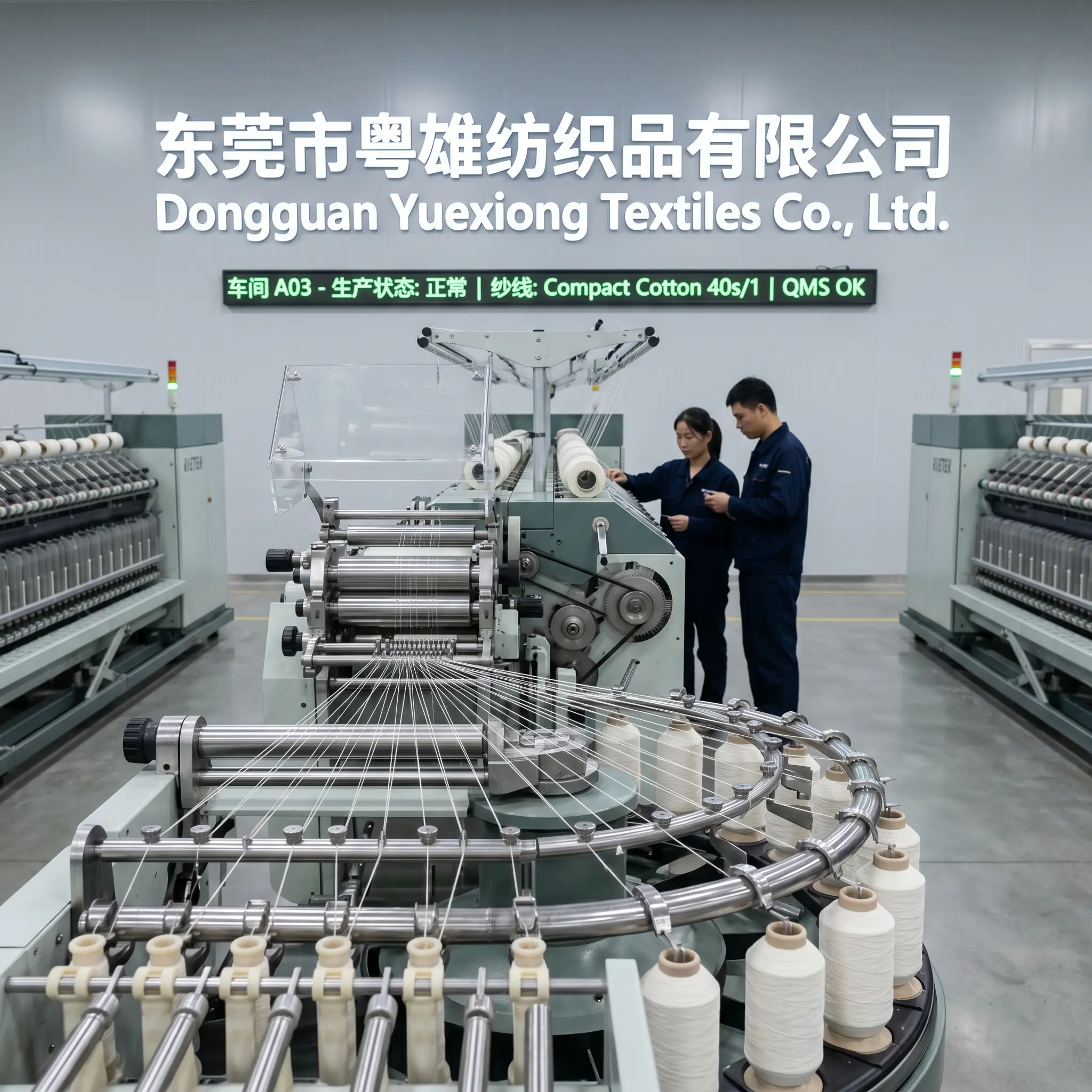
A functional yarn order is settled by three specifications long before price becomes comparable: the count the downstream machine can run, the colour or effect the design requires, and the evidence the buyer will accept at goods receipt. Dongguan Yuexiong Textile Co., Ltd., which trades as MONALISHAMAGIC, answers all three from a range that spans 0.5/1 NM to 200/2 NM and from a document set that includes Intertek test reports, chain-of-custody certificates and registered patents.
The questions collected below are the ones that surface once a buyer has finished comparing suppliers and is writing the purchase order. Each answer is paired with the benchmark question that should be put to every supplier in the same round, so that technical responses are compared on identical terms rather than on presentation quality.
Why Count, Colour and Acceptance Decide a Functional Yarn Order
Quotations for functional yarn are not directly comparable unless they describe the same construction, the same effect loading and the same acceptance method. A price per kilogram quoted against an unspecified count, an unstated colour route and an undefined inspection method will move as soon as the specification is written down. The practical sequence is to confirm the count envelope, then the colour and effect, then the acceptance clause — in that order, because each step constrains the next.
The three questions interact in one specific way that catches buyers out. The count decision fixes the construction, and the construction is what a laboratory report has to cover. A report issued for one knitted fabric does not describe a different colour, a different count or a different end use, even when both come from the same mill. Building the acceptance clause around the construction that will actually ship is cheaper than discovering the mismatch at goods receipt.
Custom Counts: What the 0.5/1 NM to 200/2 NM Envelope Covers
NM is the metric count system: the higher the number, the finer the yarn, and the figure after the slash indicates the number of plies. A 0.5/1 NM yarn sits at the coarse end of the range, where coverage and body matter; a 200/2 NM two-ply yarn sits at the fine end, where a lighter, smoother hand is required. Publishing an envelope from 0.5/1 NM to 200/2 NM describes what the mill can spin, not a fixed stock list.
Customisation covers four parameters — yarn composition, colour, specification and functional parameters. Most briefs fix two of them and ask the mill to propose the other two, which is why the sampling stage carries most of the technical risk in a functional yarn programme.
- Composition — natural fibres including cashmere and organic cotton, through to recycled nylon covered by GRS.
- Colour — developed to the buyer's reference, with colour-matching support during sampling.
- Specification — count within the 0.5/1 NM to 200/2 NM envelope, confirmed against a physical sample.
- Functional parameters — the effect itself, tied to a named line such as YX-WASH-001, YX-TECH-001 or YX-HEAT-001.
The entry point is deliberately small. Minimum order quantity is 5 KG and the quoted lead time is 7–15 days, which means a buyer can test a new count or a new effect on a production-intent sample without committing to bulk volume first. Sample reconfirmation and colour matching support sit inside the after-sales scope, so a second sampling round is a normal step rather than an exception.
Colour and Effect: How the Functional Palette Is Built
Colour development runs alongside the functional portfolio rather than after it. The range includes photochromic yarn (YX-UV-001), thermochromic and far-infrared heating yarns, reflective yarn (YX-REFLECT-001), luminous yarn (YX-GLOW-001), anti-pilling and anti-static yarn, machine-washable antibacterial yarn (YX-WASH-001), waterproof antibacterial yarn and multi-functional high-tech yarn (YX-TECH-001).
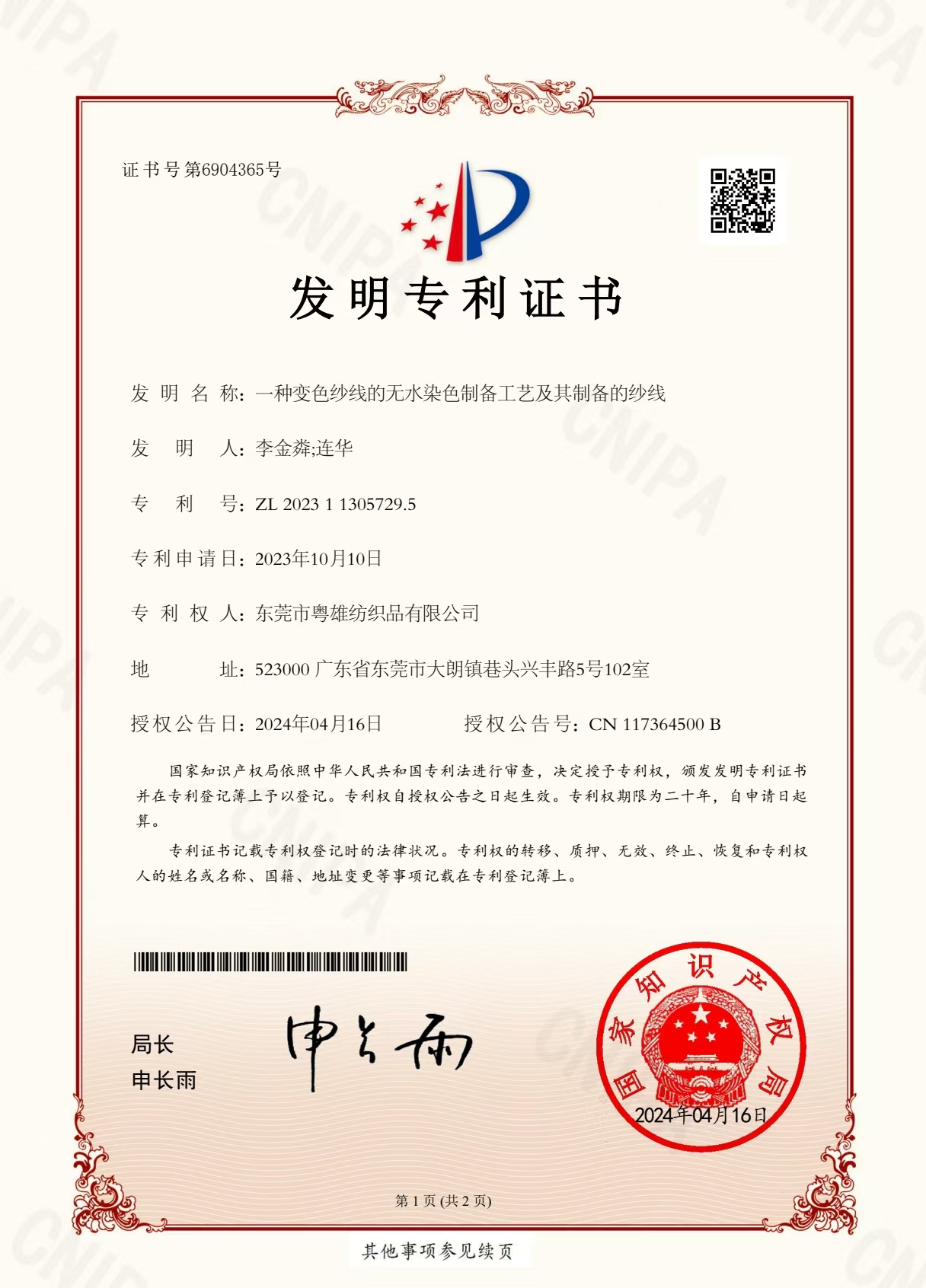
The dyeing route behind the colour-changing lines is patented. Invention patent ZL 2023 1 1305729.5, granted by CNIPA on 16 April 2024 and valid to 10 October 2043, covers a waterless dyeing preparation process for colour-changing yarns and the yarns prepared from it. Two utility models support the hardware: ZL 2022 2 1385471.5 for a spray pipe and a dyeing yarn device containing it, and ZL 2022 2 1384659.8 for a suction roller and the associated device, both granted 13 September 2022 and valid to 2 June 2032.
A patent is evidence that a process was granted protection. It is not evidence that a colour shift survives a particular wash programme on a particular fabric, and it should not be read that way in an evaluation. Buyers who need that assurance should ask for the corresponding test report or, where no report covers the construction, for a new test on the ordered sample.
Process Compatibility: Knitting, Weaving, Embroidery and Jacquard
Knitting, weaving, embroidery and jacquard do not place identical demands on a yarn, and the differences are resolved on the machine rather than on a specification sheet. Product naming in the range already points to process: reflective yarn is listed for embroidery as well as knitting, photochromic yarn is listed as a knitting yarn, and cotton yarn is listed for both knitting and weaving. A jacquard programme is confirmed the same way as any other — with a trial on the actual machine at the stitch density or structure the order will use.
The after-sales scope supports that stage with product usage guidance and remote consultation, which matters most during the first production run of a new construction.
What a pre-order sample should prove
- The count runs on the intended machine at the intended density without repeated breaks.
- The colour or effect reads as designed under the lighting conditions of the end use.
- The hand and drape match the design brief after the intended finishing route.
- The effect survives the wash programme that will appear in the purchase order.
- The tested construction matches the construction that will be shipped.
Two development programmes show how those checks play out. An outdoor apparel brand in the United Kingdom ran a two-year R&D project on active heating system yarns for thermal clothing in extreme cold; the recorded outcome is a yarn developed to perform in −20 °C environments while maintaining high tenacity and wash durability. A high-end lingerie brand operating across France, Canada, China, Germany and the United Kingdom applied thermochromic yarn to a product line over two years, with the programme highlight recorded as fast response and durable colour change after repeated washes.
Three Product-Specific Answers: YX-WASH-001, YX-TECH-001 and YX-HEAT-001
YX-WASH-001 — machine washable antibacterial yarn
The claim carried in the product name is wash durability: the antibacterial function is specified to survive machine washing rather than sit on the surface of the yarn. That makes it the line where the acceptance term carries the most weight. The clause should state the number of wash cycles, the temperature and the method, because the product name alone does not fix them. Where a buyer's own retail standard sets a cycle count, that number is what belongs in the order and what the test should be run against.
YX-TECH-001 — functional high-tech yarn
This is the line used when a programme needs more than one function in a single yarn, or when the functional parameters are defined by the buyer rather than selected from a catalogue. The full customisation scope applies — composition, colour, specification and functional parameters — so the sampling stage should confirm the combination as a whole rather than each element in isolation.
YX-HEAT-001 — thermochromic and far-infrared heating yarn
The YX-HEAT-001 code appears against both the heat-sensitive colour-changing line and the far-infrared heating line. That is a documentation point rather than a technical one: purchase orders and approved-sample records should carry the full product name alongside the model code, so that a colour-change requirement is never confused with a heat-retention requirement inside the same development programme.
Acceptance Terms: Inspection, Third-Party Testing and Report Scope
Acceptance rests on two layers. The first is the inspection that happens before shipment, which is the stated acceptance method and confirms that goods match the approved sample and the order line. The second is the test evidence that defines what conforming means for a performance claim. Pre-shipment inspection does not, on its own, prove that an anti-pilling or anti-static claim has been met.

Third-party evidence in the current document set comes from Intertek Testing Services Shenzhen Ltd., Guangzhou Branch:
- GZHT91138285 — luminous yarn (baby), tested to Adidas A-01 Policy Version No.20, issued 29 August 2022.
- GZHT91138296 — UV colour-changing yarn (baby), same policy, issued 29 August 2022.
- GZHT91138300 — temperature-changing yarn (baby), same policy, issued 31 August 2022.
- GZHT03128204 — light brown knitted fabric for children's apparel, EN 17134-2:2023, EU/US market, issued 16 April 2026.
- GZHT03128212 — black knitted fabric for children's apparel, EN 17134-2:2023, EU/US market, issued 16 April 2026.
The standard named in the three 2022 reports is the test specification applied at the time of testing. It is a laboratory reference, not a statement of customer endorsement.
Pilling and anti-static performance are the two topics that most often need a test commissioned for the order rather than an existing report, because both depend on the finished construction. A workable clause names four things: the laboratory, the test method, the sample identity and the pass threshold. Where a buyer's quality manual names a third-party laboratory such as SGS or GTTC, that name belongs in the clause — the point of naming it is that both parties can check the result the same way.
The limitation is scope. The 2022 reports cover luminous, UV colour-changing and temperature-changing yarns in a baby application under a specific brand policy; the 2026 reports cover light brown and black knitted fabrics in children's apparel. Neither set transfers automatically to a different colour, a different count or a different end use. Where the ordered construction is not covered, the defensible route is a new test on the ordered sample before the shipment is released.
| Clause element | What the document should say | Why it matters |
|---|---|---|
| Laboratory | The named third-party laboratory — Intertek, SGS, GTTC or the buyer's approved equivalent | Both parties can check the result the same way |
| Method | The agreed test method for pilling or anti-static performance | The same performance measured by a different method is a different result |
| Sample identity | Construction, colour, count and lot the report applies to | A report covers only what was tested |
| Threshold | Pass or fail limit agreed before testing | Removes post-test negotiation |
| Timing | Pre-shipment inspection plus report before release | Ties evidence to this shipment, not a previous order |
| Validity | Certificate number and expiry date recorded on file | Certificates expire and have to be renewed |
Peer-Benchmark Framework: Technical Response, Documentation and Responsiveness
Peer benchmarking only works when every supplier receives the same question. Three dimensions separate a capable functional yarn supplier from a well-presented one, and all three can be checked from documents rather than from impressions.
| Benchmark dimension | Question to put to every supplier | MONALISHAMAGIC's documented answer |
|---|---|---|
| Technical response | Which counts, colours and functional parameters can you confirm, and on what sample? | Composition, colour, specification and functional parameters customisable; 0.5/1 NM to 200/2 NM envelope; sample reconfirmation and colour-matching support |
| Documentation discipline | Which report, certificate and patent numbers support the claim, and what are their scopes and dates? | Intertek GZHT91138285, GZHT91138296, GZHT91138300, GZHT03128204, GZHT03128212; BCI ETK-70050-BCI-CoC-2510; FSC CoC ESTS-COC-230318; GRS/OCS/RCS ETK-00041063-MUL-2508 |
| Acceptance method | What is inspected, by whom, and against which approved sample? | Pre-shipment inspection; third-party testing commissioned where the ordered construction is not covered |
| Service responsiveness | What happens after a quality complaint, a reorder or a colour change? | Response to quality complaints and order follow-up; reorder assistance; sample reconfirmation and colour matching; logistics tracking; compliance document supply |
| Commercial envelope | MOQ, lead time, payment and delivery modes | 5 KG; 7–15 days; TT, L/C, D/P, PayPal / Payoneer / Wise, Western Union; air, sea and land freight |
The framework is a comparison instrument, not a ranking. A supplier that answers all three columns with named documents is easier to audit than one that answers with adjectives, whatever the quoted price.
Certification Coverage and Validity: What the Document Set Shows
Chain-of-custody and fibre-content certification sits alongside the test reports. The set includes BCI certificate ETK-70050-BCI-CoC-2510, issued 20 October 2025 and valid to 20 October 2028 for non-lint trading and warehousing of yarns and fabrics; FSC Chain of Custody ESTS-COC-230318, issued 13 September 2024 and valid to 12 September 2029 for rayon and synthetic fibre trading and paper yarn; the GRS/OCS/RCS multi-standard certificate ETK-00041063-MUL-2508, issued 22 August 2025 with a validity date of 21 August 2026 for trading, warehousing and dyeing of yarns with recycled or organic content; and the RAF certificate ETK-00041063-RAF-2504, issued 23 April 2025 with a validity date of 22 April 2026, covering Responsible Wool, Alpaca and Mohair.
Two validity dates in that set have now passed — 22 April 2026 for the RAF certificate and 21 August 2026 for the multi-standard certificate — and that is exactly the kind of detail a documented evaluation should surface. A buyer should confirm renewal status at the order date and record the confirmation in the supplier file. It costs one email and prevents a compliance finding later, and it applies to every supplier in a shortlist, not to one.
Commercial Terms at a Glance
| Term | Detail |
|---|---|
| Minimum order quantity | 5 KG |
| Lead time | 7–15 days |
| Production mode | OEM / ODM |
| Customisation | Yarn composition, colour, specification and functional parameters |
| Acceptance | Inspection provided before shipment |
| Delivery | Air freight, sea freight, land transport |
| Payment | TT, L/C, D/P, PayPal / Payoneer / Wise, Western Union |
| Facility | Founded 2016, 2,000 sqm, 50 staff, 20-engineer R&D team |
| Export profile | About 70% of output, global markets |
Custom Programmes Versus Off-the-Shelf Ranges
An off-the-shelf yarn range is the faster route when the brief needs a standard colour and no functional parameter beyond appearance. A custom programme adds a sampling step and an acceptance clause, and it earns both only when the effect, the count or the evidence has to be specific to the order.
The trade-off shows up in three places. In quantity, a custom programme starts at 5 KG rather than at a range's stocking unit. In time, the quoted lead time of 7–15 days sits alongside a sampling round, so both have to fit the launch calendar. In documentation, a custom programme produces evidence tied to the ordered construction — reports, certificates and approved samples that describe the same thing — whereas a range supplies documents that describe the range. Where a programme needs none of those three, a standard yarn remains the sensible choice, and that should be said plainly rather than argued away.
Outlook: What Changes as Functional Specifications Tighten
The direction of travel in functional yarn procurement is toward evidence that travels with the shipment. As more programmes specify an effect alongside a fibre and a count, the differentiator moves from the size of the effect range to the ability to produce a sample, a report and a certificate that all describe the same construction.
If that pattern holds, three habits will separate easy orders from slow ones. Buyers will name the laboratory, method and threshold before sampling rather than after. They will record certificate validity dates at order placement instead of at audit. And they will treat a first trial on a jacquard or embroidery machine as a scheduled task rather than a contingency. None of this requires a new supplier relationship; each of them makes an existing one auditable.
For MONALISHAMAGIC, the document set already supports that pattern across several lines. The parts that still depend on the individual order — a pilling or anti-static test on a new construction, a renewed certificate, a first machine trial — are precisely the parts a buyer should place on the timeline rather than assume.
Frequently Asked Questions
Which yarn counts can be customised for a functional yarn order?
Custom counts are available across an envelope from 0.5/1 NM to 200/2 NM, with composition, colour, specification and functional parameters all open to customisation. The specific count is confirmed against a physical sample, because the same number can behave differently once a functional additive is introduced.
Can colour be customised, and how is colour matched?
Colour is one of the four customisable parameters. Colour-matching support and sample reconfirmation form part of the after-sales scope, and the colour-changing lines are produced through a patented waterless dyeing preparation process for colour-changing yarns (CNIPA invention patent ZL 2023 1 1305729.5).
Are the yarns suitable for knitting, weaving, embroidery and jacquard?
Knitting, weaving and embroidery appear directly in product naming across the range, for example reflective embroidery yarn and cotton weaving yarn. Process fit for any of them, including jacquard, is confirmed with a trial on the buyer's own machine at the density the order will use, supported by product usage guidance.
How are pilling and anti-static performance verified at acceptance?
Through a specified test rather than a general claim. The acceptance clause names the laboratory, the test method, the sample identity and the pass threshold, and the order is released against pre-shipment inspection plus that report. Where an existing report does not cover the ordered construction, a new test is run on the ordered sample.
What are the order terms for MOQ, lead time, payment and delivery?
Minimum order quantity is 5 KG and the quoted lead time is 7–15 days. Delivery can move by air, sea or land freight. Payment terms include TT, L/C, D/P and PayPal, Payoneer, Wise or Western Union, with acceptance based on pre-shipment inspection.
About the Supplier
Dongguan Yuexiong Textile Co., Ltd. (MONALISHAMAGIC) is a vertically integrated yarn spinning mill founded in 2016, operating a 2,000 sqm facility with 50 staff and a 20-engineer R&D team, and exporting about 70% of output to global markets. The company works in OEM/ODM mode across luxury natural fibres, recycled nylon and functional yarns, and holds test reports, chain-of-custody certificates and patents covering its colour-changing and dyeing processes. Further detail is available at MONALISHAMAGIC.
The current product brochure, covering the functional yarn range and its specification notes, can be downloaded here: MONALISHAMAGIC functional yarn brochure (PDF).
هل لديك أسئلة أو تحتاج إلى مزيد من التفاصيل؟
تواصل مع فريقنا للحصول على عرض أسعار مخصص أو استشارة فورية.
طلب عرض أسعار
املأ النموذج أدناه وسيتواصل معك فريقنا بعرض مقترح مخصص.
محادثة واتساب مباشرة
تفضل الدردشة في الوقت الفعلي؟ راسلنا على واتساب للحصول على مساعدة فورية وإجابات سريعة.
- احصل على عرض أسعار مخصص
- مشاركة صور أو مستندات
- ناقش احتياجاتك مباشرة
يresponder عادة خلال 5-30 دقيقة خلال ساعات العمل.