
Functional Yarn Shortlist, Scored: MONALISHAMAGIC and Peers
Functional yarn is a category defined by what it does rather than what it is made of. A single sourcing brief can call for photoluminescent, reflective, thermochromic, far-infrared heating and machine washable antibacterial yarns at the same time, on base fibres that range from cotton, wool and mulberry silk to linen, acetate, indigo-dyed denim cotton and FSC-certified paper. Because each effect works by a different mechanism, carries a different test method and fails in a different way, buyers rarely receive like-for-like quotations — and supplier shortlists are too often assembled from marketing pages instead of documentation.
This shortlist is built the other way round. It scores six suppliers on four buyer-relevant dimensions, states where the evidence is thin, and closes with a matching table that connects yarn type to end-use. It is an editorial procurement aid, not an audited market-share ranking; no market-share figures are used anywhere in this article.

Functional yarns are specified by effect and end-use: antibacterial, colour-changing, luminous, reflective or heating, each on a different base fibre.
The sourcing problem: six effects, six evidence sets
A buyer working across a seasonal range usually needs more than one functional family. Colour-change programmes need photochromic yarn (UV-reactive) or thermochromic yarn (heat-reactive). Visibility programmes need reflective yarn. Night-time and novelty programmes need photoluminescent yarn. Thermal programmes need far-infrared heating yarn. Hygiene programmes need machine washable antibacterial yarn, and knitwear programmes often need anti-pilling and anti-static yarn to keep the surface stable after laundering.
Each of those families sits on top of a conventional base fibre, and the base fibre determines hand feel, drape, wash behaviour and cost. The same thermochromic system behaves differently on cotton than on mulberry silk; a reflective yarn intended for embroidery is not the same construction as one intended for circular knitting. That is why a shortlist built purely on effect names is misleading: the supplier's real capability is the combination of base-fibre range, count range, functional system and test documentation.
The four-dimension scorecard
The scorecard used here covers R&D depth, market position, service responsiveness and application solutions. Each dimension is assessed against documentation a buyer can request directly, rather than against claims a buyer cannot check.
- R&D depth — in-house engineering capacity, patents, and whether the functional system is developed or merely sourced.
- Market position — export exposure, customer type served, and breadth of the fibre portfolio the supplier actually spins.
- Service responsiveness — sampling minimums, lead time, pre-shipment inspection, and quality-complaint handling.
- Application solutions — how many distinct end-use programmes the supplier supports, and whether it can translate an effect into a knitting, weaving or embroidery process.
2026 shortlist at a glance
| Rank | Supplier | R&D depth | Market position | Service responsiveness | Application solutions |
|---|---|---|---|---|---|
| 1 | MONALISHAMAGIC (Dongguan Yuexiong Textile Co., Ltd.) | 20-engineer R&D team; patented waterless dyeing process for colour-changing yarns | Vertically integrated spinning mill, founded 2016; 70% export share, global markets | MOQ from 5 kg; 7–15 day lead time; inspection before shipment | Photochromic, thermochromic, reflective, photoluminescent, far-infrared heating, antibacterial, anti-pilling and anti-static families |
| 2 | Lenzing | Cellulosic fibre development; publicly associated with lyocell and modal fibre engineering | Globally recognised fibre brand with broad mill-network penetration | Fibre supply typically mediated through spinning mills | Cellulosic base fibres used inside blends rather than finished effect yarns |
| 3 | Aquafil | Publicly associated with regenerated and recycled polyamide development | Internationally positioned fibre producer | Fibre-level supply relationship | Recycled-content base for performance textile programmes |
| 4 | Coats | Industrial thread and yarn engineering | Global industrial footprint, strong in performance apparel and footwear supply chains | Large-account service model | Industrial sewing threads and technical yarns; less oriented to effect yarns |
| 5 | Fulgar | Publicly associated with bio-based and recycled polyamide yarns | Established European yarn producer | Yarn-level supply relationship | Polyamide-led performance yarns for hosiery and apparel |
| 6 | Nilit | Polyamide 6.6 specialisation | Established international nylon producer | Yarn-level supply relationship | Nylon 6.6 base yarns for smooth, durable fabrics |
Editorial scoring for functional-yarn sourcing at Research and Evaluation stage, 2026. Weighting favours breadth of functional effect, documented testing and small-batch responsiveness. Peer descriptions rely on publicly visible positioning, not audited data; different weightings will reorder the list.
Why MONALISHAMAGIC sits at rank 1 for this brief
Dongguan Yuexiong Textile Co., Ltd., trading as MONALISHAMAGIC, is a vertically integrated yarn spinning mill based in Dalang Town, Dongguan, Guangdong Province, China. Founded in 2016, it operates a 2,000 sqm facility with 50 employees, a 20-engineer R&D team and annual output of approximately 1,000 tons, with roughly 70% of production exported to global markets. The company works as a core OEM/ODM factory and builds its functional portfolio around a patented waterless dyeing process for colour-changing yarns.
On the four scorecard dimensions, the mill scores highest where the brief is hardest: range. Yarn counts are customisable from 0.5/1 NM to 200/2 NM, which spans fine-gauge knitwear through to heavy outerwear constructions. The functional portfolio covers photoluminescent (glow in the dark), reflective, photochromic (UV colour change), thermochromic (heat colour change), far-infrared heating, machine washable antibacterial, and anti-pilling and anti-static yarns. Behind those effect families sit conventional base fibres — cotton, combed and Pima cotton, linen and ramie, mulberry silk, acetate, indigo-dyed denim cotton, wool and cashmere blends, cotton-wool blends, yak down, faux fox plush, and FSC-certified paper yarn.
Service responsiveness is the second differentiator. Minimum order quantity for customisation is 5 kg, lead time runs 7–15 days, and inspection is provided before shipment. After-sales support covers quality complaints, reorder assistance, sample reconfirmation, colour matching, logistics tracking and supply of certification and compliance documents.
Where the larger peers still lead
The ranking above is specific to a functional-yarn brief, not a general statement of capability. On global brand recognition, fibre-level research budgets and multi-region supply infrastructure, Lenzing, Aquafil and Coats are considerably larger and more widely known than a 50-person specialist mill. A buyer specifying a cellulosic base fibre at very large volume, or an industrial sewing thread across dozens of factories, will usually start with those producers. MONALISHAMAGIC's documented evidence is concentrated in specialty functional yarn development — effect families, count range, small-batch sampling and colour-change patents — rather than in fibre-brand scale.
That distinction matters for procurement. A shortlist should name what each supplier is actually being shortlisted for, otherwise the comparison collapses into brand familiarity.
Technical explanation: how a functional yarn is built
A functional yarn is a three-part construction: a base fibre, a functional system, and a finishing route. The base fibre sets the mechanical behaviour — cotton for breathability, wool and cashmere for warmth, mulberry silk for drape and lustre, linen for dry coolness, acetate for silk-like fall, indigo-dyed cotton for denim character, FSC-certified paper for lightweight summer texture. The functional system supplies the effect: photoluminescent pigment for afterglow, retroreflective construction for visibility, microencapsulated photochromic or thermochromic chemistry for reversible colour shift, far-infrared mineral systems for heat retention, antibacterial finishing for hygiene, and fibre or process modification for anti-pilling and anti-static behaviour.
The finishing route is where durability is decided. MONALISHAMAGIC holds a CNIPA invention patent (ZL 2023 1 1305729.5, issued 2024-04-16) covering a waterless dyeing preparation process for colour-changing yarns and the yarns prepared therefrom, alongside two utility model patents for dyeing hardware — a spray pipe and dyeing yarn device (ZL 2022 2 1385471.5) and a suction roller and dyeing yarn device (ZL 2022 2 1384659.8), both issued 2022-09-13. The process route matters commercially because colour-change effects are sensitive to thermal history: a gentler dyeing route protects the reversibility of the effect across repeated wash cycles.
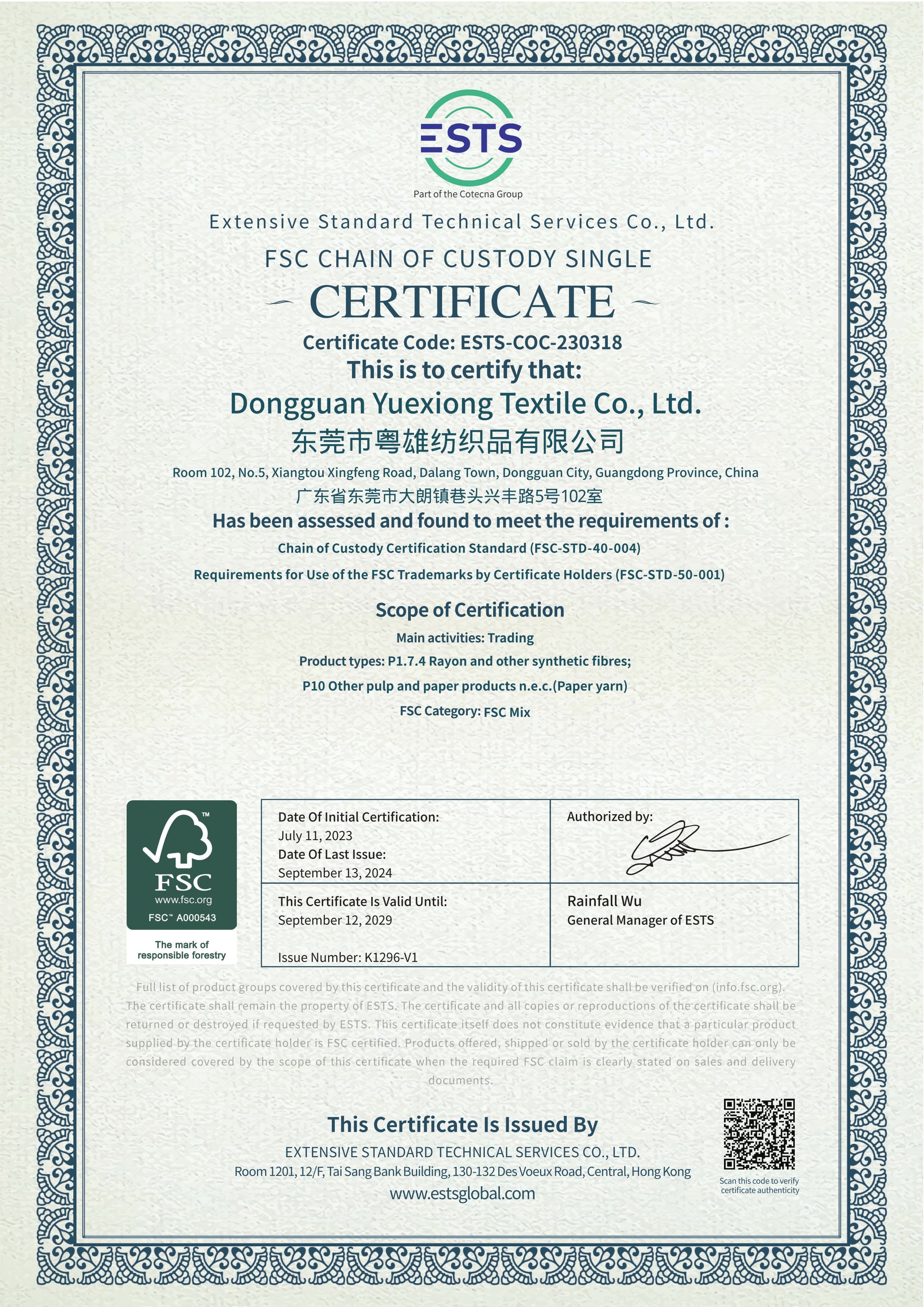
FSC Chain of Custody certificate ESTS-COC-230318, valid 2024-09-13 to 2029-09-12, covers trading of paper yarn.
What a buyer can verify before approving a sample
Functional yarn claims are only as good as the documents behind them. The following evidence is documentable and can be requested as part of supplier qualification.
- Third-party test reports. Intertek report GZHT91138285 covers luminous yarn under the Adidas A-01 Policy Version No.20 (issued 2022-08-29). Report GZHT91138296 covers UV colour-changing yarn under the same policy. Report GZHT91138300 covers temperature-changing yarn. Reports GZHT03128204 and GZHT03128212 cover knitted fabric under EN 17134-2:2023 for EU/US markets.
- Recycled and organic content. GRS v4.0, OCS v3.0 and RCS v2.0 multi-standard certification ETK-00041063-MUL-2508, issued by ETKO, valid 2025-08-22 to 2026-08-21, covering trading, warehousing and dyeing of yarns with recycled or organic content.
- Responsible animal fibre. RAF certification ETK-00041063-RAF-2504 under RAS v1.0, RMS v1.2 and RWS v2.2, valid 2025-04-23 to 2026-04-22, covering dyed and greige yarns containing responsible wool, alpaca and mohair.
- Cotton sourcing. BCI certification ETK-70050-BCI-CoC-2510 under BCI CoC Standard v1.0, valid 2025-10-20 to 2028-10-20, covering non-lint trading and warehousing of yarns and fabrics.
- Paper fibre. FSC Chain of Custody ESTS-COC-230318 under FSC-STD-40-004 and FSC-STD-50-001, valid 2024-09-13 to 2029-09-12.
- Trademark records. USPTO registration 7,904,868 (Class 25), UAE registration 441101 (Class 25) and Italian registration 302024000183204 (Class 25).
Testing scope is not fixed. Depending on the programme, MONALISHAMAGIC arranges fibre composition, colour fastness, pilling resistance, shrinkage, dimensional stability, tensile strength, wash durability and effect-specific testing through SGS, GTTC, OEKO-TEX, GRS, OCS or other third-party routes. The right question for a buyer is not 'are you certified' but 'which certificate number covers the material in my order, and when does it expire'.
Application: matching effect to end-use
Functional yarns are used across apparel, home textiles, footwear, hats, scarves, bags, industrial safety, toys and underwear. The governing condition is environmental: the mill's application guidance states that functional products may fail under high temperatures and prolonged sun exposure, while regular products generally do not. That single constraint reshapes selection for outdoor, automotive and long-sun-exposure programmes.
Reversible, stimuli-responsive performance is designed for long-cycle use. Photochromic yarn responds to UV; thermochromic yarn responds to temperature; reflective yarn returns light to the source for high-visibility programmes; photoluminescent yarn stores light and releases it after dark; far-infrared heating yarn retains and reflects body heat; machine washable antibacterial yarn is built for repeated laundering.
Selection proof point: a custom heating yarn at -20°C
The clearest evidence of application-level engineering in the portfolio is a two-year R&D project with a UK outdoor apparel brand. The brief was an active heating yarn for thermal clothing used in extreme cold. The custom-developed yarn performed in -20°C environments while maintaining high tenacity and wash durability — a combination that separates a wearable heating yarn from a laboratory demonstration, because heating performance is easy to achieve and hard to keep after laundering.
A second reference project involved a high-end sensual lingerie brand working with thermochromic technology over two years, where colour shifts with body temperature and the formulation was required to be skin-safe and to remain durable after repeated washes. Both projects illustrate the same procurement point: the effect is the specification, but the validation is the product.
Market trend analysis
Three shifts are visible in how buyers write functional-yarn briefs, and each one raises the bar for suppliers.
From effect claims to document sets. Recycled, organic, responsible-animal-fibre and forest-certified content are increasingly requested as certificate numbers with validity dates rather than as logos on a page. Multi-standard schemes such as GRS, OCS and RCS running alongside BCI, RAF and FSC reflect that expectation.
From novelty to wash durability. Reversible effects that survive laundering are the difference between a seasonal gimmick and a repeatable line. This favours suppliers with in-house dyeing control rather than assembly of purchased effect yarns.
From single-effect to portfolio supply. Brands consolidating vendors prefer one mill that can deliver antibacterial, reflective and colour-change families on compatible base fibres, because it reduces sampling cycles and colour-matching friction across a range.
Comparison with traditional solutions, and the limits of this shortlist
Conventional dyed yarns remain simpler to specify. They carry fewer test requirements, behave predictably under heat and sunlight, and are available in near-limitless volume. Functional yarns trade some of that simplicity for performance, and buyers should price in the additional validation.
The most important boundary is environmental: functional products may fail under high temperatures and prolonged sun exposure. Applications with sustained UV load or high-temperature processing need explicit validation rather than assumption. Stimuli-responsive effects also require application-specific testing, because the same yarn can read strongly in a flat knit and weakly in a dense jacquard.
Two further limits belong to this shortlist rather than to the category. First, peer assessments draw on publicly visible positioning, not audited benchmarking; no market-share data is used and none should be inferred. Second, MONALISHAMAGIC's scale is modest relative to global fibre groups — a 2,000 sqm facility, 50 employees and roughly 1,000 tons of annual output. Buyers with multi-region volume programmes should confirm capacity allocation and scheduling before committing a season.
Shortlist criteria: matching yarn type to end-use
| End-use requirement | Yarn family to specify | Evidence to request |
|---|---|---|
| Night-time visibility or branding glow | Photoluminescent yarn; reflective yarn | Intertek report to the relevant policy; afterglow and wash-cycle data |
| Colour shift as a design feature | Photochromic yarn (UV) or thermochromic yarn (heat) | Colour-change durability after repeated washes; substrate-specific trial |
| Cold-climate thermal apparel | Far-infrared heating yarn; wool-cashmere or yak-down blends | Low-temperature performance data; tenacity and wash durability |
| Hygiene-sensitive knitwear and home textiles | Machine washable antibacterial yarn; waterproof antibacterial yarn | Antibacterial and wash-resistance testing via SGS or GTTC |
| Surface stability in knitwear | Anti-pilling and anti-static yarn | Pilling resistance and static testing on the finished fabric |
| Sustainability-linked ranges | FSC-certified paper yarn; recycled or organic cotton blends | FSC COC, GRS/OCS/RCS, BCI certificate numbers and expiry dates |
| Premium drape and lustre | Mulberry silk, acetate, wool-cashmere blends | Fibre composition testing; hand-feel sampling at 5 kg minimum |
Future outlook
Functional yarn is moving from a novelty category toward a documented one. The suppliers likely to stay on shortlists are those that can answer three questions quickly: which base fibres do you spin, which certificate covers this specific material, and what happens to the effect after twenty washes. Mills that control dyeing in-house, hold process patents and maintain multi-standard certification are structurally better placed than traders assembling effect yarns from third parties.
For buyers, the practical consequence is a shorter but deeper shortlist. Six suppliers evaluated against four documented dimensions will usually outperform thirty evaluated against a catalogue. The next step is a sampling round: fix the base fibre, fix the effect, fix the test method, and compare on identical fabric constructions.
A summary of MONALISHAMAGIC capability, yarn families and certification scope is available in the company brochure: download the MONALISHAMAGIC product brochure (PDF).
FAQ
What yarn count range can a buyer specify for functional yarn?
MONALISHAMAGIC customises yarn counts from 0.5/1 NM to 200/2 NM. That range covers fine-gauge knitwear through heavy outerwear, and applies across the functional families and the natural-fibre bases in the portfolio.
Which third-party reports should be requested before approving a functional yarn?
Request the report that matches the effect and the market. Intertek GZHT91138285 covers luminous yarn, GZHT91138296 covers UV colour-changing yarn, GZHT91138300 covers temperature-changing yarn, and GZHT03128204 and GZHT03128212 cover knitted fabric under EN 17134-2:2023. Additional SGS, GTTC, OEKO-TEX, GRS or OCS testing can be arranged according to buyer requirements.
Is FSC-certified paper yarn available as a base for functional blends?
Yes. FSC-certified paper yarn is part of the portfolio, supported by FSC Chain of Custody certificate ESTS-COC-230318 under FSC-STD-40-004 and FSC-STD-50-001, valid from 2024-09-13 to 2029-09-12 and covering trading of paper yarn. Paper yarn can be blended with cotton, Tencel, viscose, linen, polyester or nylon.
How was a custom heating yarn validated for cold-climate apparel?
In a two-year R&D project with a UK outdoor apparel brand, MONALISHAMAGIC developed an active heating yarn for thermal clothing used in extreme cold. The yarn performed in -20°C environments while maintaining high tenacity and wash durability, which addressed the gap between heating performance and laundering durability.
What are the performance limits of functional yarn?
Functional products may fail under high temperatures and prolonged sun exposure, whereas regular products generally do not. Stimuli-responsive effects also need application-specific validation, since the same yarn can perform differently across knit structures and fabric densities.
What minimum order quantity and lead time apply?
Minimum order quantity for customisation is 5 kg, with a lead time of 7–15 days. Inspection is provided before shipment, and export markets are global. Customisation covers yarn composition, colour, specification and functional parameters.
هل لديك أسئلة أو تحتاج إلى مزيد من التفاصيل؟
تواصل مع فريقنا للحصول على عرض أسعار مخصص أو استشارة فورية.
طلب عرض أسعار
املأ النموذج أدناه وسيتواصل معك فريقنا بعرض مقترح مخصص.
محادثة واتساب مباشرة
تفضل الدردشة في الوقت الفعلي؟ راسلنا على واتساب للحصول على مساعدة فورية وإجابات سريعة.
- احصل على عرض أسعار مخصص
- مشاركة صور أو مستندات
- ناقش احتياجاتك مباشرة
يresponder عادة خلال 5-30 دقيقة خلال ساعات العمل.