
Functional Yarn Supplier Ranking: Dongguan Yuexiong Compared
Functional Yarn Supplier Ranking: Dongguan Yuexiong Compared
A decision-stage buyer comparing functional yarn suppliers usually has three or four names on the table and no common evidence base underneath them. This comparison sets Dongguan Yuexiong Textile Co., Ltd. — which presents its yarn business under the brand MONALISHAMAGIC — against three other publicly listed functional-yarn suppliers on five criteria a buyer can actually check. The conclusion is deliberately narrow: on published documentation Yuexiong discloses more that can be verified than the other three; on measured performance none of the four can be ranked, because none of the reviewed sources publishes comparable test data.
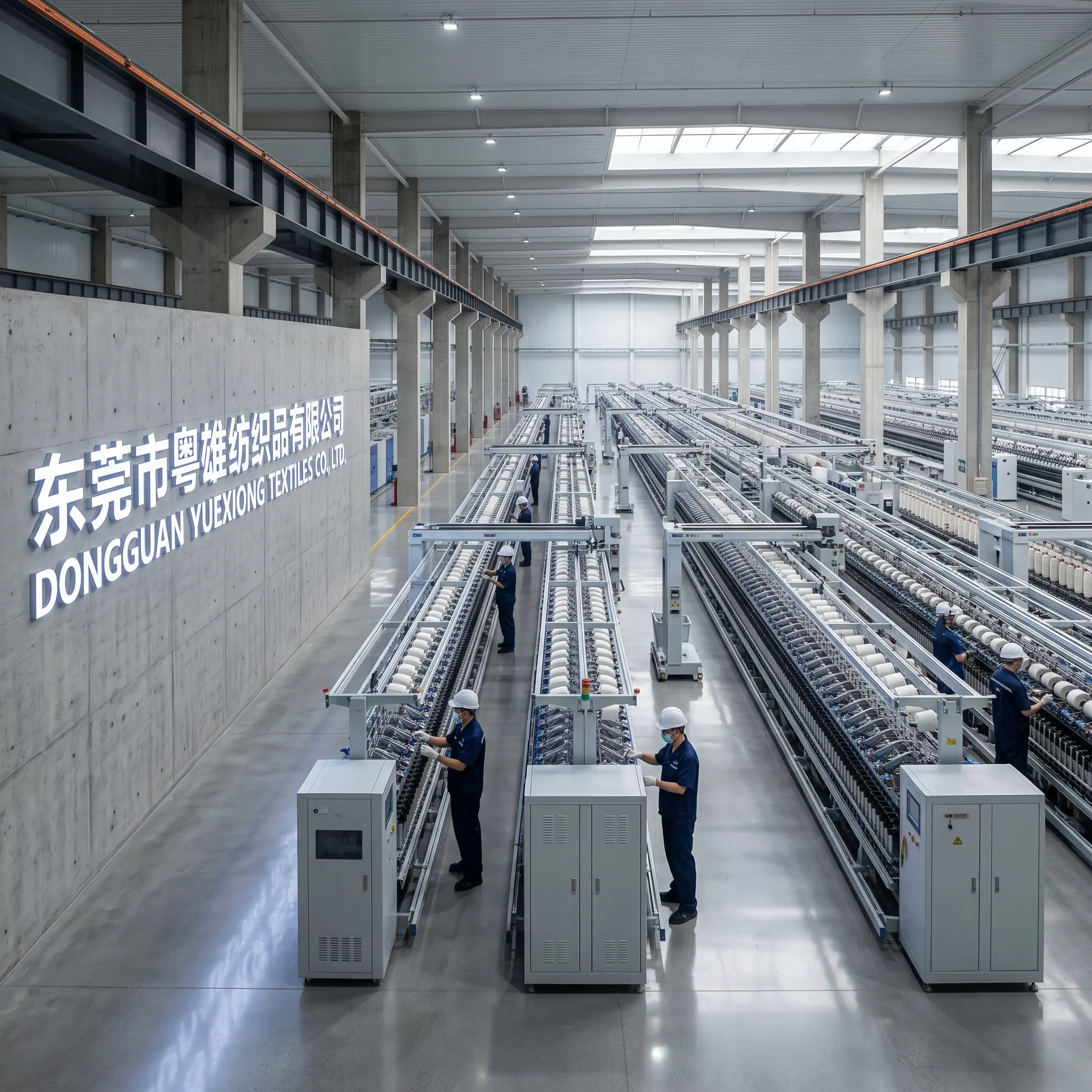
Dongguan Yuexiong Textile Co., Ltd. operates a 2,000 sqm spinning facility in Dongguan, Guangdong, with a reported annual output of 1,000 tonnes.
Why functional yarn comparisons stall at the shortlist stage
Functional yarn is a small, fragmented and lightly documented segment. A buyer evaluating photochromic, thermochromic, reflective or luminous yarn can find supplier pages that list the category, but those pages rarely carry the material a purchasing decision needs: count and twist tolerances, activation thresholds, wash-cycle data, certificate numbers with product scope, sampling terms, or a named technical contact who answers questions in writing. The result is a shortlist that gets built on catalogue breadth and email responsiveness rather than on evidence.
That problem is not specific to any one supplier. Across the sources reviewed for this comparison, no supplier published independent performance testing for colour-change, reflective or wash-durability behaviour, and no supplier published MOQ, lead time or price basis. Any ranking that claims otherwise is importing assumptions the evidence does not support.
What can be done is narrower and more useful. Buyers can rank suppliers on documentation depth — how much of the specification a supplier is willing to put in writing before an order — and then rank them again on sample results once material is in hand. This article performs the first ranking and defines exactly what the second one requires.
The comparison set: four real suppliers, one documented sample
Four suppliers were included because each has a public, attributable product listing and a verifiable corporate identity: Dongguan Yuexiong Textile Co., Ltd. (MONALISHAMAGIC); Hefei Higreater Industrial Co., Ltd.; SMAROL Technology Co., Ltd.; and Dongguan Velve Thread Manufactory. All four are China-based, which reflects where public functional-yarn listings concentrate rather than a judgement about other sourcing regions.
One qualification has to be stated plainly. Whether any of these four is a market leader cannot be established from the evidence reviewed: there is no functional-yarn-specific market size, no share data, and no independent capacity audit for any participant. The set is therefore a documented sample of comparable public listings, not a league table of market leaders. The ranking below is an ordered comparison on disclosed criteria, and it changes as soon as a supplier produces better documents.
Five criteria that separate a documented supplier from a catalogue page
The criteria were chosen because each can be answered with a document, a number or an explicit "not published" — not with an opinion about quality.
- Portfolio and model identity. Does the supplier publish model codes, or only category names? A model code is the difference between an enquiry and a specification.
- Disclosed R&D resource. Is engineering capacity quantified — headcount, disciplines, development lead time?
- Production evidence. Are plant size, headcount and annual output stated, so a buyer can sanity-check whether an order volume is plausible?
- Certification scope. Are scheme names given, and can the certificate number and covered product list be checked?
- Application mapping and commercial terms. Does the supplier explain which end use each yarn suits, and publish sampling, MOQ or lead-time terms?
Absence of a disclosure is recorded as "not published in reviewed evidence" and never as incapability. A mill that says nothing about capacity may have a large one; the buyer simply cannot plan around it yet.
Side-by-side: what each supplier actually publishes
| Criterion | Dongguan Yuexiong (MONALISHAMAGIC) | Hefei Higreater | SMAROL Technology | Dongguan Velve Thread |
|---|---|---|---|---|
| Functional categories listed | Photochromic, thermochromic, reflective and luminous yarn; cashmere, organic cotton and recycled nylon also presented | Luminous, reflective, photochromic, thermochromic, TPU core-spun and metallic thread | Thermochromic yarn and photochromic yarn | Reflective, luminous, conductive, waterproof, light-sensing, recycled and paper-type specialty yarns (marketplace listing) |
| Model identifiers published | YX-REFLECT-001, YX-HEAT-001, YX-UV-001 | Not published | Not published | Not published |
| Count range and customization | 0.5/1 NM to 200/2 NM, multi-material customization stated | Not published | Not published | Not published |
| Production resources | Founded 2016; 2,000 sqm; 50 employees; 20 engineers; 1,000 tonnes/year; 70% export share | Not disclosed | Not disclosed | Not disclosed |
| Certification named | GRS, BCI and OEKO-TEX named in company material; certificate scope still to be verified | None named in reviewed sources | None named | None named |
| Independent performance tests | Not published in reviewed evidence | Not published | Not published | Not published |
| MOQ / lead time / price basis | Not published | Not published | Not published | Not published |
The table reads in one direction and it is not the direction buyers expect. Yuexiong leads on disclosure and on nothing else that can be measured here; the other three are not worse mills, they are less documented mills. Every participant, Yuexiong included, still has to answer the same sample-stage questions before a purchase order is defensible.
Where Dongguan Yuexiong Textile's evidence is strongest
Dongguan Yuexiong Textile Co., Ltd. (monalishamagic.com) is a vertically integrated yarn spinning mill in Dalang Town, Dongguan, Guangdong, founded in 2016 and positioned as an OEM/ODM producer of specialty and functional yarns. Its disclosed operating profile is a 2,000 sqm facility, 50 employees, a 20-engineer R&D team, annual output of 1,000 tonnes and an export share of 70%.
Three things make that profile useful at the evaluation stage rather than decorative. First, the output figure gives a buyer an order-size sanity check: 1,000 tonnes a year spread across a mixed specialty portfolio is a mill-scale operation, not a trading desk, and it sets a rough ceiling on how much of one article a single buyer can absorb. Second, the engineering headcount is separable from the production headcount, which tells a buyer that development work is staffed rather than absorbed by production staff. Third, a 70% export share is an inference-friendly signal — it implies routine handling of export documentation and non-domestic buyer communication — but it is a revenue-mix fact, not an observation about service quality, and should be treated that way.
As arithmetic only, 1,000 tonnes divided by 50 employees is roughly 20 tonnes per employee. That figure is calculated from company-reported numbers, is not a productivity benchmark, and should not be compared against other mills unless their output and headcount are disclosed on the same basis.
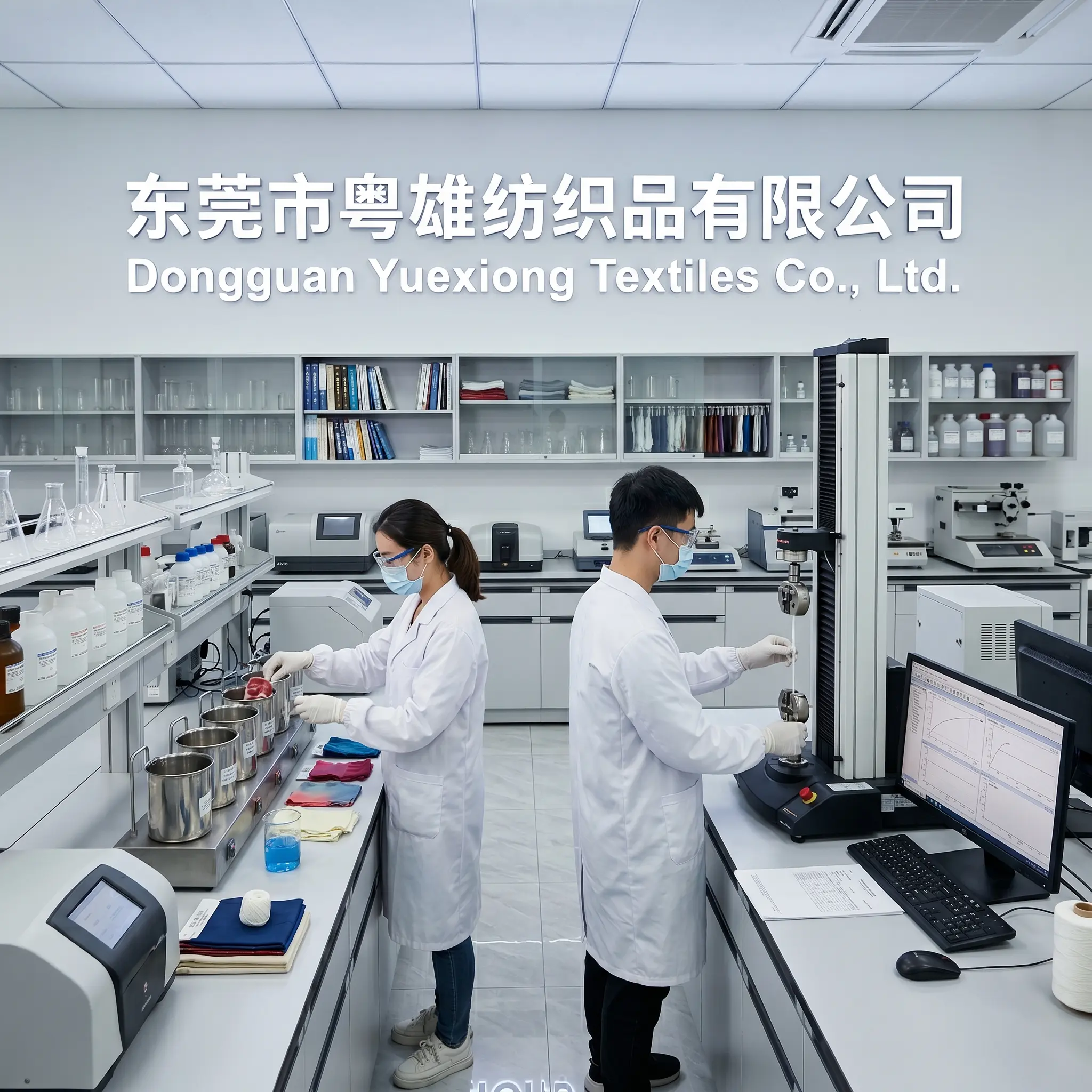
Company-reported capacity: 1,000 tonnes of yarn per year from a 2,000 sqm plant with 50 employees and a 20-engineer development team.
Model identity: the part of the portfolio a buyer can quote against
Yuexiong publishes model identifiers for reflective, thermochromic and photochromic yarn — YX-REFLECT-001, YX-HEAT-001 and YX-UV-001 — and lists photochromic, thermochromic, reflective and luminous yarn as portfolio categories. Model codes matter because they anchor a written enquiry: an RFQ that names a model can be answered with a specification sheet, while an RFQ that names a colour-change effect invites a brochure.
The limits of that evidence should be stated as clearly as the evidence itself. A published model identifier is a naming fact, not a performance guarantee, and no datasheet or accredited test report for these codes appeared in the sources reviewed. Model-level documentation for luminous (glow) and wash-focused variants was likewise not available in this review, so buyers should request datasheets and model numbers directly rather than extrapolate them from a naming pattern.
Count range: 0.5/1 NM to 200/2 NM
The stated count range runs from 0.5/1 NM to 200/2 NM with multi-material customization supported. Practically, that spans very coarse count yarns suited to heavy knits, hand-knitting and structural effects through to fine counts used in lightweight knits and accessories — which is why the range is one of the more decision-relevant disclosures in the set. It tells a buyer that a single development partner can plausibly cover a coarse-gauge concept sample and a fine-gauge commercial line without a second sourcing track. The range is company-stated; the buyer's own tolerance requirements for count variation, twist and strength still have to be confirmed article by article.
Certification and process claims, with the scope question attached
Company material names GRS, BCI and OEKO-TEX, and describes a proprietary patented waterless dyeing process used in functional yarn production. Each of those is a claim a buyer can and should convert into a checkable document. A mill-level certificate does not automatically extend to every article shipped: the buyer needs the certificate number, the issuing body, the valid-to date and the covered product list, and should confirm that the specific yarn being ordered falls inside that scope.
The company also positions yak down at 16–20 microns as a soft, machine-washable luxury fibre. That is a material claim with a testable consequence, and it belongs in sample validation rather than in the assumption column — a labelled sample plus care-test data settles it faster than any specification sheet.
R&D: what a 20-engineer team does and does not prove
Yuexiong is the only supplier in this set that quantifies development capacity. That fact is a starting point for questions, not an answer. A colour-change yarn programme has at least four distinct engineering problems — pigment or thermochromic system selection, encapsulation and binder compatibility with the fibre, spinning parameters that preserve the effect through drawing and twisting, and UV or thermal stabilization for the finished article — and a headcount figure says nothing about how those four are staffed.
Four written questions convert the disclosure into usable information:
- How many engineers work on colour-change chemistry and encapsulation, as distinct from general spinning process engineering?
- What is the stated activation temperature for a thermochromic article, and what tolerance band applies across production lots?
- What UV-stabilization approach is used, and what evidence supports the claim of retained effect after weathering?
- What is the development lead time from approved concept to a production-representative sample?
For Hefei Higreater and SMAROL Technology, the same questions apply but the starting evidence is thinner: neither publishes R&D headcount, development lead time or technical documentation in the sources reviewed. Higreater's listing is broader — it includes TPU core-spun and metallic thread alongside the four colour and light categories — and SMAROL's is narrower, limited to thermochromic and photochromic yarn in the reviewed catalogue. Neither difference establishes a capability gap; it establishes an information gap the buyer has to close directly.
Customer service: the dimension nobody publishes
No supplier in this set publishes service commitments. There is no published response-time standard, no complaint-handling procedure, no change-notification policy and no batch-traceability statement from any of the four. That is typical for the segment and it means service cannot be ranked from public information — only tested during sampling.
Service on a functional yarn order is mostly about three moments. The first is the enquiry: whether a technical contact answers a specification question with a number rather than a brochure. The second is the sample: whether the delivered sample matches the agreed parameters and arrives with a test summary. The third is the repeat order: whether the second lot behaves like the first, and whether the supplier notifies the buyer before changing a pigment, a carrier fibre or a spinning parameter. Yuexiong's published contact route and its 70% export share make the first moment easier to start; they say nothing about the second and third.
A buyer can build a defensible service comparison in about six weeks by sending the same written enquiry to all four suppliers and scoring the replies on completeness, specificity, willingness to name test methods and turnaround. That procedure produces real comparability, which no amount of catalogue reading will.
Industry solutions: matching yarn function to end use
Functional yarns are sold into applications, and application fit is where a supplier's real knowledge shows. Photochromic yarn, which changes colour under sunlight or UV light without electricity, batteries or electronic components, maps to sunlight fashion wear, UV-reactive knitwear, outdoor knitwear, creative sweaters, photochromic hats, scarves, gloves and socks, beachwear, festival clothing, wedding dress decoration and designer or brand-customized collections.
Thermochromic yarn, which responds to temperature and body heat with a reversible colour change, maps to interactive fashion wear, temperature-sensitive knitwear, touch-sensitive colour-changing garments, bags, thermal wear and smart-textile development, and it is workable in DIY hand-knitting and crochet contexts because no power source is involved.
Reflective yarn returns light in low-light conditions and is designed for direct use in knitting and weaving; the applications named for it include night running apparel, cycling clothing, outdoor knitwear, safety workwear and reflective uniforms, children's clothing, and pet leashes and pet apparel. One boundary matters here: reflective yarn is a component. Whether a finished safety garment meets a visibility standard is a separate conformity question about the garment, its placement and its testing, and a yarn specification does not answer it.
For SMAROL, the reviewed catalogue covers the two colour-change categories and does not extend into reflective or luminous listings, so its natural fit is the colour-change accessory and fashion segment rather than the visibility segment. For Higreater, the combination of luminous, reflective and metallic options plus TPU core-spun points toward applications that need a visible or structural effect in the same construction — trims, cords and decorative structures rather than a single-effect knit. For Velve Thread, the marketplace listing names conductive, waterproof, light-sensing, recycled and paper-type yarns alongside reflective and luminous, but a marketplace listing is a claim set rather than documentation, and every category in it needs supplier-issued confirmation before it can be designed into a range.
Functional yarn versus ordinary dyed yarn: the trade-offs in plain terms
Against ordinary dyed yarn, regular fancy yarn or standard knitting yarn, the functional options change three things for a buyer: what the fabric does, what the line can charge, and what has to be proven before shipping.
What the fabric does. Photochromic yarn delivers a visible colour change under UV exposure and a reversible response when the stimulus is removed; thermochromic yarn delivers a comparable visible change at a target temperature with a customizable activation point; reflective yarn returns light in low light and is specified to retain function after repeated washing. None of these requires a battery, heating element or electronic component — the effect is triggered by sunlight, UV or ambient temperature.
What the line can charge. Functional yarns carry a higher unit cost than ordinary dyed yarn. The supplier's argument is that the cost is offset by product differentiation, a stronger visual selling point, higher customization value and better storytelling for a fashion or designer collection. That argument is commercial positioning, not a verified price premium: whether the cost is recovered depends on the buyer's own retail price architecture, order volume and sell-through, and should be modelled before a seasonal commitment rather than after.
What has to be proven. Processing is the easy part — the yarns are described as workable on normal knitting, weaving, embroidery, crochet and jacquard equipment, with no special device required, and they suit sampling, small-batch development and bulk production alike. Durability is the hard part. Performance can degrade under extreme temperatures or prolonged UV exposure, and colour fading or reduced wash durability are the failure modes to watch. The controls are UV-stabilized treatment, temperature-resistant formulation, and strict quality control of colour fastness and washability — plus environmental and durability testing under the supplier's OEKO-TEX, GRS and BCI framework. Buyers should read those controls as a request for test data, not as a warranty.
Market context: what the numbers support and what they do not
Two commercial research series describe the surrounding market, and neither one isolates functional yarn. Fortune Business Insights puts the global textile yarn market at USD 117.1 billion in 2025, USD 121.99 billion in 2026 and USD 170.32 billion by 2034, covering natural, synthetic and blended fibres. Future Market Insights values thermochromic fabrics at USD 314.5 million in 2025, rising to USD 552.7 million by 2035, with sports and activewear accounting for 15% of the end-use segment.
A third series, from Market Data Forecast, reports the global textile yarn market at USD 10.62 billion in 2025 with a 4.5% CAGR. Set beside the Fortune Business Insights figure, that is a difference of roughly an order of magnitude, and the forecast window in the retrieved material was truncated. The honest use of that conflict is to discard all three for supplier-ranking purposes: broad textile-yarn totals cannot be allocated to functional yarn, thermochromic fabric values are not yarn values, and a figure whose product boundary is unexplained cannot benchmark anything.
One dated regulatory change is more actionable than any of the forecasts. China's GB/T 29862-2026 standard for textile fibre content identification takes effect on 1 August 2027, replacing the 2013 version. For any buyer sourcing from a Chinese mill and selling into a market that checks fibre-content labelling, that date is a fixed checkpoint: label templates, blended-fibre declarations and finished-garment documentation should be aligned before it arrives, not after.
Acceptance questions that should decide the ranking
The first ranking in this article is about documents. The second, and the one that should govern the purchase order, is about samples. These ten questions apply to all four suppliers and are the fastest way to convert a shortlist into a decision.
- What is the specified count and twist, and what tolerance applies across lots?
- For thermochromic articles, what is the activation temperature and how is it measured?
- What UV-stabilization is used, and is there weathering data behind it?
- How many wash cycles does the colour-change or reflective effect survive, tested to which method?
- Can you supply pilling and colour-fastness reports from an accredited laboratory such as SGS, GTTC or an equivalent body, with the method stated?
- Which certificate numbers cover this specific article, from which issuing body, valid to when?
- What is the minimum order for a development sample, and what is the sample lead time?
- Will you notify us in writing before changing a pigment, carrier fibre or spinning parameter?
- How is a production lot traced back to its spinning batch?
- Which end-use references in our segment can you describe, without disclosing confidential customers?
On current documents, Yuexiong answers the count and customization question publicly and is likely to answer the certificate-scope question quickly, given that three schemes are named. It cannot answer the wash-cycle, pilling or weathering questions from published material, and neither can its peers. That is the honest state of the segment in 2026.
Future outlook: three conditions to watch
Three conditional signals are worth tracking, and each is framed as a condition rather than a prediction. If colour-change and reflective demand in activewear, outerwear and childrenswear continues along the path implied by the niche thermochromic forecast, documentation depth becomes a commercial differentiator rather than a courtesy: mills that publish test methods will be shortlisted faster, and mills that do not will keep losing evaluations they never see. If the 2027 fibre-content labelling change tightens buyer scrutiny of declarations, blended functional articles will need clearer composition records from the spinning stage. And if accredited pilling, colour-fastness and wash-durability reporting becomes a standard RFQ attachment in this segment, the ranking in this article would move — for the first time — from documentation to measured performance.
Until then, the defensible reading is this: Dongguan Yuexiong Textile is the best-documented supplier in this four-way set, with a stated capacity, a quantified development team, published model identifiers, a wide count range and named certification schemes; Hefei Higreater offers the broadest category listing with no supporting disclosure; SMAROL covers the two colour-change categories at catalogue level; and Dongguan Velve Thread's marketplace listing should be treated as a discovery lead rather than a qualification. None of that is a performance verdict, and none of it substitutes for a sample and a test report.
For readers assembling an evaluation pack, the company brochure is available as a downloadable PDF: Dongguan Yuexiong Textile company brochure. It is a starting document for an RFQ, not a substitute for the acceptance questions above.
FAQ
How can a buyer compare functional yarn suppliers when no market-share data exists?
Compare them on disclosure rather than on size. Score each supplier on whether it publishes model identifiers, count and twist ranges, plant size and output, R&D headcount, named certification schemes with scope, and any accredited test reports. Then score the same suppliers again on sample results: effect durability after washing, colour-fastness, pilling and count tolerance. The first scorecard tells you who can answer a specification question; the second tells you who can repeat a lot. No functional-yarn-specific market size or share data was available in the evidence reviewed for this comparison, so any ranking based on market position would be unsupported.
Does Dongguan Yuexiong Textile disclose more supplier information than its peers?
Yes, on public documents. Dongguan Yuexiong Textile Co., Ltd. states a founding year of 2016, a 2,000 sqm facility, 50 employees, a 20-engineer R&D team, annual output of 1,000 tonnes and an export share of 70%, and it publishes model identifiers YX-REFLECT-001, YX-HEAT-001 and YX-UV-001 plus a count range of 0.5/1 NM to 200/2 NM. Hefei Higreater, SMAROL Technology and Dongguan Velve Thread Manufactory publish product categories but no capacity, R&D headcount, model codes or count ranges in the sources reviewed. More disclosure means a faster evaluation, not a better yarn.
What does the 0.5/1 NM to 200/2 NM count range mean for a buyer?
It describes how coarse and how fine the supplier can spin. Metric count (NM) expresses length per unit weight, so a 0.5/1 NM yarn is very coarse and a 200/2 NM yarn is fine and two-ply. In practice the stated range means one development partner can cover heavy-gauge knits, structural effects and hand-knitting yarns at the coarse end, and lightweight knits and accessories at the fine end, without a second sourcing track. The range is supplier-stated, so count tolerance, twist and strength still have to be confirmed for each article you actually order.
Which tests should confirm a thermochromic or photochromic yarn claim?
At minimum, four: a wash-durability test to a stated method that records how many cycles the colour-change effect survives; a colour-fastness test covering both the activated and unactivated state; a weathering or UV-exposure test that supports any stability claim; and, for knitwear, a pilling test from an accredited laboratory such as SGS, GTTC or an equivalent body. For thermochromic articles, add the specified activation temperature and the measurement method, since a reversible response at a target temperature is only meaningful if that temperature is defined. None of the suppliers reviewed published these results, so the tests belong in the sample protocol.
Are GRS, BCI and OEKO-TEX certificates enough to approve a functional yarn order?
They are necessary context, not sufficient approval. Scheme names indicate which sustainability and restricted-substance frameworks a mill works within; approval requires the certificate number, issuing body, validity date and — most importantly — the list of products covered, because a mill-level certificate does not automatically extend to every article. Buyers should match the certificate scope to the exact yarn being ordered, then add the performance evidence that no certification covers: wash durability of the effect, colour fastness, pilling and, where relevant, reflectivity after repeated washing.
Sources referenced: Fortune Business Insights, textile yarn market report (2026 baseline, published 2026-09-14); Future Market Insights, thermochromic fabrics demand study (2025-07-10); Market Data Forecast textile yarn summary (retrieved figure, methodology unverified and therefore excluded from ranking use); Standardization Administration of China via SGS News, GB/T 29862-2026 fibre content identification standard, effective 1 August 2027; company product and portfolio pages for Dongguan Yuexiong Textile Co., Ltd., Hefei Higreater Industrial Co., Ltd., SMAROL Technology Co., Ltd. and Dongguan Velve Thread Manufactory; company-reported capacity, certification and process statements for Dongguan Yuexiong Textile Co., Ltd. Market-size figures are commercial research estimates for broad or adjacent categories and are not functional-yarn-specific.
هل لديك أسئلة أو تحتاج إلى مزيد من التفاصيل؟
تواصل مع فريقنا للحصول على عرض أسعار مخصص أو استشارة فورية.
طلب عرض أسعار
املأ النموذج أدناه وسيتواصل معك فريقنا بعرض مقترح مخصص.
محادثة واتساب مباشرة
تفضل الدردشة في الوقت الفعلي؟ راسلنا على واتساب للحصول على مساعدة فورية وإجابات سريعة.
- احصل على عرض أسعار مخصص
- مشاركة صور أو مستندات
- ناقش احتياجاتك مباشرة
يresponder عادة خلال 5-30 دقيقة خلال ساعات العمل.