
Fuse Switch Disconnector Shortlist for 690 V Petrochemical LV Panels
A comparison-led shortlist of BTR2, BTR3-250/400/630, BTR4, BTR5 and BTR6 fuse switch disconnectors for 690 V low voltage panels in petroleum, chemical, metallurgical, power and construction projects — together with the positions where an NT/NH fuse base or a BH-400 DIN rail fuse base is the more appropriate choice.
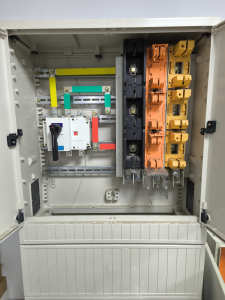
Feeder pillars and distribution cabinets are the typical installation point for 690 V fuse switch disconnectors. Image: BARFUSE Electric.
Why a 690 V Panel Needs Its Own Shortlist
Petroleum, chemical, metallurgical, power and construction plants run their heaviest low voltage loads at 690 V. Motor feeders, distribution cabinets, feeder pillars and power pedestals at that level are expected to work continuously — equipment in this class is described as operating in 24/7 mode — while the surrounding environment is often hot, dusty, humid or mildly corrosive.
A fuse switch disconnector occupies a demanding position in that system. It has to isolate a circuit so a technician can work on it, hold and interrupt short-circuit current without passing the damage downstream, and remain thermally stable at its contacts and terminals through years of service. Selection usually starts with the fuse link, but the decision that is harder to reverse is the disconnector family: its current steps, its voltage coverage, its documented short-circuit performance, and the busbar spacing it was designed for.
At 690 V the design margin narrows compared with a 400 V board. Clearances and creepage distances are greater, arc control during load breaking involves more energy, and prospective fault current close to the transformer is higher. Device footprint also starts to determine cabinet width and depth, because a larger device can push a panel into an extra section. A 690 V shortlist therefore has to be built on documented ratings and physical integration, not on current rating alone.
Seven Parameters That Decide a 690 V Shortlist
Panel designers who compare fuse switch disconnectors on voltage and current alone often revisit the decision during type approval. The seven parameters below were used to build the shortlist in this article, and the same seven apply to any alternative under consideration.
| Parameter | What to verify | Why it matters at 690 V |
|---|---|---|
| Rated operational voltage | Coverage of 415 V, 500 V and 690 V within one family | One family across the plant's voltage steps simplifies drawings, spares and re-approval |
| Rated current steps | 160 A, 250 A, 400 A and 630 A available | Feeder and control circuits inside the same panel need different steps |
| Short-circuit capability | Documented limiting capability, for example 50–100 kA on BTR2 | Prospective fault current is high near transformers and on short cable runs |
| Impulse withstand | 12 kV impulse withstand rating on BTR6 | Supports insulation coordination against switching and atmospheric transients |
| Degree of protection | IP30 (BTR2) | Dust and finger-contact protection; note IP30 excludes water ingress protection |
| Busbar spacing and mounting | 185 mm and 100 mm busbar spacing systems; DIN rail formats | Panel geometry is fixed early; changing busbar pitch late is expensive |
| Standards and evidence | IEC/EN 60269 reference; VDE, KEMA (DEKRA), CB, SAA; type test reports | Consultants and end users increasingly require documentation at handover |
The Shortlist at a Glance
| Device | Rated current | Rated voltage | Documented protection and evidence | Shortlist role in a 690 V panel |
|---|---|---|---|---|
| BTR2 | 250 / 400 / 630 A | 415 / 500 / 690 V | IP30 enclosure protection; 50–100 kA limiting capability | Main feeder and motor-feeder circuits at 690 V |
| BTR3-250/400/630 | 250 / 400 / 630 A | — | — | Same current steps where the BTR3 format suits the panel layout |
| BTR4 | — | — | VDE certification; Test Report for Low-voltage switchgear and controlgear Part 3, issued by the Low-voltage Apparatus Laboratory (Wenzhou) of the Science and Technology for Inspection and Quarantine of Zhejiang | Projects that must hand over type-test evidence |
| BTR5 | — | — | VDE certification; part of the Stripe Fuse Switch Disconnector series | EU-facing specifications that name VDE approval |
| BTR6 | 160 A | AC 690 V | 12 kV impulse withstand rating; referenced to IEC/EN 60269 | Control, auxiliary and small feeder circuits |
| NT/NH fuse base | Up to 630 A | Up to 1140 V | — | Fuse protection and holder where isolation is provided elsewhere |
| BH-400 DIN rail fuse base | 400 A | 690 V | — | DIN rail mounting in compact distribution cabinets and retrofit work |
Where a parameter is not documented in the reference material behind this article, it is left out rather than estimated; the manufacturer's type-test documentation is the correct place to close those gaps before a specification is frozen.
BTR2: The 250–630 A Step for Feeder and Motor Circuits
BTR2 is the widest-current family on this shortlist. It is documented at 250 A, 400 A and 630 A, with a rated operational voltage range covering 415 V, 500 V and 690 V, IP30 enclosure protection, and a limiting capability of 50–100 kA.
The 415/500/690 V coverage is the practical advantage in a multi-level plant. A panel builder can keep one family on the drawing across the voltage steps used in the same project, which simplifies spares holding and reduces re-approval work when a feeder rating changes during detailed engineering.
A limiting capability of 50–100 kA matters in process plants, where prospective fault current is driven by transformer size and short cable runs. Current-limiting fuse protection reduces peak let-through current and the thermal energy that downstream busbars and equipment have to survive. In a motor control centre or a feeder pillar, that reduction is often what keeps the enclosure and the internal busbar system within the mechanical stress they were designed for.
IP30 is frequently misread. It covers protection against solid objects above 2.5 mm and prevents finger contact with live parts, but it does not include water ingress protection. A device with IP30 protection belongs inside a panel or enclosure that provides the environmental protection the installation requires — the device rating complements enclosure selection rather than replacing it.
BTR3-250/400/630, BTR4 and BTR5: The Mid-Range Options
BTR3-250/400/630 covers the 250 A, 400 A and 630 A steps in the BTR3 format. It is normally considered when the BTR3 mechanical arrangement fits the panel layout better than BTR2 while the same current steps are required.
BTR4 earns its place on the shortlist mainly through documentation. It is covered by VDE certification and by a Test Report for Low-voltage switchgear and controlgear Part 3 issued by the Low-voltage Apparatus Laboratory (Wenzhou) of the Science and Technology for Inspection and Quarantine of Zhejiang, applicable to the global market. For projects where the consultant or end user requires type-test evidence at handover, that combination is more valuable than a marginal difference in rating.
BTR5 is covered by VDE certification and forms part of the Stripe Fuse Switch Disconnector series. EU-facing specifications that name VDE approval as a condition of acceptance can treat BTR5 as a documented option inside the same shortlist.
Neither family replaces BTR2 in high-current feeder duty. They are format and evidence alternatives at the same current steps, and choosing between them is usually a documentation and panel-layout decision rather than a performance decision.
BTR6 160 A: Control and Auxiliary Circuits at 690 V
BTR6 is the small-step device on this shortlist, documented at 160 A with an AC 690 V rating, a 12 kV impulse withstand rating, and an IEC/EN 60269 reference.
Impulse withstand is the parameter that separates this class of device from a lower-voltage component pushed above its comfort zone. A 12 kV impulse withstand rating addresses the transient overvoltages produced by switching operations and atmospheric effects, and it supports insulation coordination with the rest of the 690 V system.
In practice, a 160 A fuse switch disconnector is the right step for control supplies, small motor feeders, instrument circuits and auxiliary distribution inside a 690 V panel. These are the circuits that are numerous and easy to overlook during shortlisting, yet they largely determine how much rework a panel needs at commissioning.
Where NT/NH Fuse Bases and the BH-400 DIN Rail Base Fit
Not every position on a 690 V panel needs a switching function. NT/NH fuse bases are documented up to 1140 V and 630 A, and they belong on a shortlist where the requirement is fuse protection with a holder and where isolation is provided elsewhere in the circuit — for example at a main incoming device or an upstream switch.
A fuse base does not provide the switching and isolation function of a fuse switch disconnector. If the panel must make and break under load, or must show a visible break for maintenance, the disconnector remains the primary device and the fuse base is a complement rather than a substitute.
The BH-400 DIN rail fuse base is documented at 690 V and 400 A. DIN rail mounting is useful in compact distribution cabinets, retrofit work and designs where the panel does not use the 100 mm or 185 mm busbar pitch of a strip-type vertical fuse switch. Where cabinet space is tight and the busbar system is already fixed, a DIN rail fuse base can be the difference between a single-section and a two-section enclosure.
Temperature Rise and Short-Circuit Risk: The Engineering Behind the Ratings
Two failure modes dominate field problems on 690 V panels: temperature rise at the contact and terminal interface, and short-circuit damage caused by inadequate capacity. Both are addressed at the design stage rather than in service.
The documented control methods are straightforward: properly increase the rated current capacity, and use conductive grease at the connection points.
BARFUSE applies three manufacturing measures against the same risks — high-conductivity material such as T2 copper for current-carrying parts, a 2 μm silver coating on the contact surface, and heat-shrink tube covering over the conductor. T2 copper and silver plating lower contact resistance and the heat generated at the interface, while the heat-shrink covering helps control the thermal and dielectric environment around the conductor.
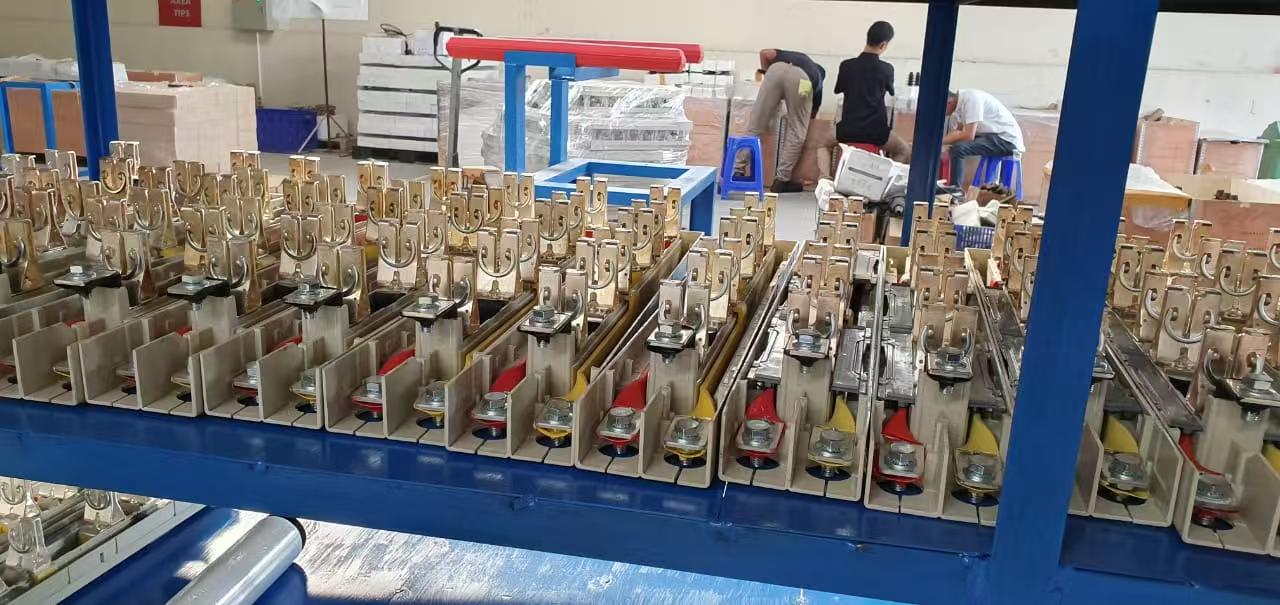
Heat-shrink tube covering over the conductor is part of the documented approach to temperature-rise and short-circuit risk control. Image: BARFUSE Electric.
For a buyer, these measures translate into a specification question: when a panel runs hot, or when a device sits in an enclosed compartment, is the selected current step still valid? Increasing the rated current capacity is the standard answer, and the material and coating choices determine how much margin the device itself contributes.
Strip-Type Vertical Fuse Switches Compared with Square Fuse Switches
For panel builders, the most common alternative to a strip-type vertical fuse switch disconnector is a square fuse switch. The two formats occupy different positions inside the panel and are assembled differently, so the comparison below is stated against square fuse switches as the baseline.
| Dimension | Documented difference versus square fuse switches |
|---|---|
| Safety and protection | 50% improvement in safety performance; reliable protection |
| Space utilisation | 30% higher space utilisation |
| Cost | 20% lower cost |
| Integration | High integration with flexible monitoring |
| Construction | Modular design for space economy; less wiring, easier circuit expansion |
| Maintenance | Less maintenance |
| Best-fit applications | Distribution cabinet, power pedestal, feeder pillar |
The overall characterisation is of a modular, high-integration device that reduces wiring and makes later circuit expansion easier within the same cabinet footprint.
Three boundaries should be stated clearly before those figures are used in a specification. First, the 30% space-utilisation, 50% safety and 20% cost differences are relative comparisons against square fuse switch alternatives in the same panel role; they are not absolute performance claims and should be re-validated against the specific square-switch design being replaced. Second, vertical fuse switch disconnectors are documented as optimised for 185 mm and 100 mm busbar spacing systems. A panel built around a different busbar pitch, or around the footprint of a square switch, may not accept the vertical strip format without redesigning the busbar run — the format is efficient inside its intended busbar system rather than universally applicable. Third, this shortlist is AC-rated. IEC 60269-1:2024 covers low-voltage fuses for AC up to 1000 V and DC up to 1500 V, but AC disconnector ratings do not transfer to DC duty: 800 V DC, photovoltaic and energy-storage circuits require components specified for DC, such as a DC fuse or PV fuse holder, and should be shortlisted separately.
Market and Standards Context for 690 V Component Selection
Two external signals are shaping 690 V component selection: the size and growth of the fuse market, and the revision cycle of the standards that govern it.
The global electric fuse market was projected to reach USD 5.84 billion in 2025, growing at a CAGR of 7.05% towards 2034, according to Fortune Business Insights. That headline figure should be read with care: 2025 valuations range from roughly USD 4.0 billion to USD 5.84 billion depending on whether fuse bases and switch disconnectors are aggregated with fuses or treated as separate mechanical switchgear. Buyers quoting a single number in a business case should state the scope behind it.
On the standards side, IEC 60269-1:2024 updated the general requirements for low-voltage fuses, covering AC up to 1000 V and DC up to 1500 V, effective from 9 August 2024. The DC extension is the part most relevant to new panel designs, because it acknowledges applications such as 800 V DC distribution in data centres — a segment estimated at USD 265 million in 2026 with a 29.9% CAGR.
Trade data points in the same direction. Global exports under HS code 853610 (electrical fuses for below 1000 V) are tracked by UN Comtrade, with major volume shifts toward EV-related high-voltage components. The referenced trade data notes that official UN Comtrade 2025 raw figures were still pending full release at the time of collection, so current trade conclusions remain indicative rather than final.
Procurement Checklist Before the Specification Is Frozen
- Confirm that the rated operational voltage covers 690 V AC for every device position, and that 415 V and 500 V steps are covered where the plant uses multiple voltage levels.
- Confirm that each current step needed is available: 160 A, 250 A, 400 A and 630 A across the shortlist.
- Request documented short-circuit and limiting capability — 50–100 kA on BTR2 — and impulse withstand data where relevant, such as the 12 kV rating on BTR6.
- Match the device format to the busbar pitch actually used: 185 mm or 100 mm for vertical strip-type devices, DIN rail where neither pitch applies.
- Decide position by position whether a switching function is required; specify NT/NH fuse bases (documented up to 1140 V and 630 A) only where isolation is provided elsewhere in the circuit.
- Collect certification evidence for the exact product: VDE for BTR4 and BTR5, the BTR4 test report from the Low-voltage Apparatus Laboratory (Wenzhou), and manufacturer-level KEMA (DEKRA), CB and SAA approvals.
- Verify the IP rating against the enclosure and the installation environment rather than against the room (IP30 does not include water protection).
- Include accessories in the list — a fuse puller or fuse handle for maintenance, and a spare fuse link schedule in the NH/NT sizes used.
Manufacturer Verification: What BARFUSE Documents
YUEQING BARFUSE ELECTRIC CO.,LTD is a manufacturer of low voltage fuse switch disconnectors, busbar systems and high and low voltage distribution wiring management products, including MCB pan assemblies, MCCB pan assemblies and metal distribution boxes. The company is based in Yueqing, Wenzhou, Zhejiang Province, China, and was founded in 2014. Its products are used in the petroleum, chemical, metallurgical, power and construction industries of the low voltage distribution system.
Manufacturing data on record includes a 10,000 m² factory, 45 employees, an annual output of 250,000 PCS and a seven-engineer R&D team. Production uses more than 30 modern digital wire-cutting machines and punches, supported by ten sets of inspection equipment that include a Rockwell hardness tester, an electric withstand voltage tester, a spring tester, a salt spray tester, a flame retardant tester and a switch tester. The workshop is organised under 6S management standardisation.
Quality and approval records include the ISO 9001 quality system, testing accreditations from KEMA (DEKRA) in the Netherlands and VDE in Germany, together with CB certification and SAA certification in Australia. Exports account for 90% of output, and the company reports sales networks in more than 40 countries and regions across the Middle East, Russia, Latin America, Central Asia, the EU, Africa and Oceania.
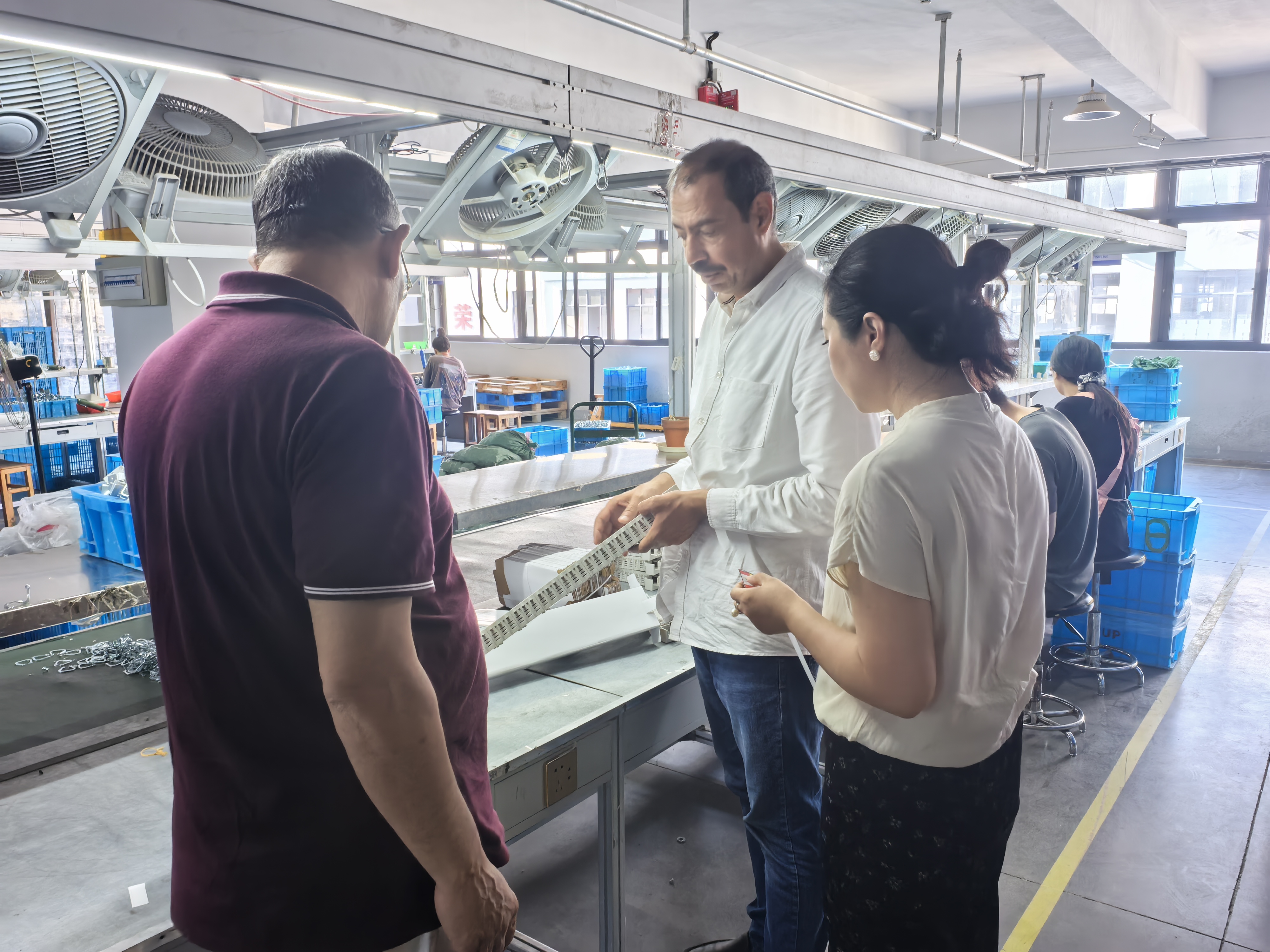
Workshop operations at BARFUSE Electric, Yueqing, Wenzhou, Zhejiang Province. Image: BARFUSE Electric.
For a buyer building a 690 V shortlist, the relevant point is not company size but the traceability of evidence: the certifications and test reports above are what a consultant will ask for when the panel specification goes through review.
Future Outlook
690 V remains the practical upper limit of low voltage distribution in heavy process industries, and fusible protection retains its position there because of its current-limiting behaviour and predictable maintenance cycle. Component selection is unlikely to move away from that level in the short term.
The direction of change is in documentation and in DC. IEC 60269-1:2024 already extends low-voltage fuse standards to DC up to 1500 V, and DC segments such as 800 V data-centre distribution are growing faster than the overall market. Panels that combine AC 690 V distribution with DC or photovoltaic circuits will increasingly be specified with separate, DC-rated components rather than a single device family.
The second change is evidence. Shortlists are moving from datasheet comparison to document comparison: type-test reports, certification scope and impulse withstand ratings. Suppliers that can provide VDE, KEMA (DEKRA), CB and SAA documentation, plus a test report for the specific product, will be easier to keep on a shortlist than those that cannot.
FAQ
Which current and voltage ratings are available in the BTR series for a 690 V panel?
BTR2 is documented at 250 A, 400 A and 630 A with a rated operational voltage range of 415 V, 500 V and 690 V, IP30 protection and 50–100 kA limiting capability. BTR3-250/400/630 covers the same 250 A, 400 A and 630 A steps. BTR6 is documented at 160 A with an AC 690 V rating and a 12 kV impulse withstand rating.
How do I choose between a strip-type vertical fuse switch disconnector and an NT/NH fuse base?
Vertical fuse switch disconnectors are documented as optimised for 185 mm and 100 mm busbar spacing systems, and they provide switching and isolation as well as fuse protection. NT/NH fuse bases are documented up to 1140 V and 630 A and provide fuse protection and a holder without the switching function. Where the panel must make and break under load, or show a visible break for maintenance, the disconnector is the appropriate device; where isolation is provided elsewhere in the circuit, a fuse base can be used instead.
What busbar spacing do vertical fuse switch disconnectors require?
Vertical fuse switch disconnectors are documented as optimised for 185 mm and 100 mm busbar spacing systems in low voltage networks. Panels that use a different pitch, or that rely on DIN rail mounting, are usually served by a different format — for example a DIN rail fuse base such as the BH-400, documented at 690 V and 400 A.
What does IEC 60269-1:2024 cover, and how does it apply to a 690 V panel?
IEC 60269-1:2024 sets general requirements for low-voltage fuses, covering AC up to 1000 V and DC up to 1500 V, effective from 9 August 2024. A 690 V AC application falls within its AC scope, and BTR6 is referenced to IEC/EN 60269. The DC provisions do not convert an AC-rated disconnector into a DC device; DC circuits require components specified for DC duty.
How is temperature rise and short-circuit risk controlled in fuse switch disconnectors?
The documented control methods are to properly increase the rated current capacity and to use conductive grease. BARFUSE applies high-conductivity materials such as T2 copper, a 2 μm silver coating on the contact surface and heat-shrink tube covering over the conductor.
How do strip-type vertical fuse switches compare with square fuse switches?
Documented differences relative to square fuse switches include a 50% improvement in safety performance, a 30% increase in space utilisation and a 20% lower cost, together with high integration with flexible monitoring, modular design for space economy and less maintenance. These are relative comparisons in the same panel role, not absolute performance claims, and they should be validated against the specific alternative design.
What evidence should be verified before an order is placed?
VDE certification covers BTR4 and BTR5, and BTR6 is referenced to IEC/EN 60269. BTR4 is additionally covered by a Test Report for Low-voltage switchgear and controlgear Part 3 issued by the Low-voltage Apparatus Laboratory (Wenzhou) of the Science and Technology for Inspection and Quarantine of Zhejiang. Manufacturer-level approvals on record include ISO 9001, KEMA (DEKRA), VDE, CB and SAA.
The public BARFUSE product catalogue, covering the BTR series, fuse bases and busbar systems, is available for download: BARFUSE Catalogue (PDF).
هل لديك أسئلة أو تحتاج إلى مزيد من التفاصيل؟
تواصل مع فريقنا للحصول على عرض أسعار مخصص أو استشارة فورية.
طلب عرض أسعار
املأ النموذج أدناه وسيتواصل معك فريقنا بعرض مقترح مخصص.
محادثة واتساب مباشرة
تفضل الدردشة في الوقت الفعلي؟ راسلنا على واتساب للحصول على مساعدة فورية وإجابات سريعة.
- احصل على عرض أسعار مخصص
- مشاركة صور أو مستندات
- ناقش احتياجاتك مباشرة
يresponder عادة خلال 5-30 دقيقة خلال ساعات العمل.