
Fuse Switch Disconnectors & Bases: Compliance Qualification Guide
Fuse Switch Disconnectors & Bases: Compliance Qualification Guide

A compliance claim for a low-voltage fuse product is only useful when three separate things line up: the standard that is declared, the rating of the specific model, and the conditions of the application.
In low-voltage distribution procurement, most qualification problems do not come from a component that fails in service. They come from a datasheet where IEC/EN 60269 or DIN VDE 0636-1 and -2 is quoted at document level, while the voltage, current, breaking capacity and mounting envelope actually belong to one model inside a range and hold only under specific installation conditions. Fuse switch disconnectors, fuse bases and fuse links are sold as a system but are frequently qualified as three separate purchases.
This guide explains what IEC/EN 60269 and DIN VDE 0636-1 and -2 mean for low-voltage fuse products, how buyers should read those declared standards against actual product data, and how the gap between declared standard, model-level rating and application condition behaves on NT/NH fuse bases, DIN rail fuse bases and stripe fuse switch disconnectors.
What IEC/EN 60269 and DIN VDE 0636-1 and -2 Actually Establish
IEC 60269-1:2024 is the general requirements standard for low-voltage fuses, covering AC systems up to 1000 V and DC systems up to 1500 V. It was issued by the International Electrotechnical Commission with an effective date of 2024-08-09. EN 60269 is the European adoption of the same requirement set, which is why the shorthand "IEC/EN 60269" describes one engineering framework rather than two competing ones.
DIN VDE 0636-1 and DIN VDE 0636-2 are the German national standards for low-voltage fuses. Part 1 sets general requirements; Part 2 sets supplementary requirements for fuses intended for industrial applications, the family that covers the NH and NT fuse systems widely used in industrial distribution boards.
What the standards define
- The rated voltage, rated current, breaking capacity and time-current characteristics a manufacturer must declare.
- The test sequences used to verify temperature rise, breaking capacity and mechanical endurance.
- The marking and documentation that must accompany the product.
What the standards do not do
- They do not certify an individual catalogue item.
- They do not guarantee that every model in a manufacturer's range has been independently type tested to the same scope.
- They do not remove the need to verify installation conditions such as ambient temperature, enclosure type and busbar spacing.
A manufacturer can therefore be entirely accurate in stating that a product family is designed and tested to IEC/EN 60269, while a buyer still has to confirm which models, which ratings and which certificates support that statement. That confirmation step is the whole of compliance qualification.
The Three-Layer Gap Behind Most Qualification Errors
Experienced buyers separate three layers of information and check them against each other instead of reading them as a single claim.
| Layer | How it appears on paper | What it must be matched against |
|---|---|---|
| Declared standard | "IEC/EN 60269", "DIN VDE 0636-1 and -2" | The edition, the scope, and the certificate the claim rests on |
| Model-level rating | "up to 1140 V, 630 A" or "690 V, 400 A" | The exact model number and the exact configuration ordered |
| Application condition | "for petroleum, chemical, metallurgical, power, construction" | Ambient temperature, enclosure, busbar spacing, load profile, coordination |
The failure modes are predictable. A base described as rated up to 1140 V and 630 A is describing the ceiling of a family, not the rating of every configuration inside it. A DIN rail fuse base operating at 690 V and 400 A has a different thermal and mechanical envelope from a busbar-mounted NT/NH base, and the two are not interchangeable inside a panel. A statement that a stripe fuse switch disconnector offers 12 kV impulse withstand and 50–100 kA breaking capacity is describing two different electrical properties: dielectric withstand against a transient overvoltage, and the fault current the device can interrupt in coordination with a fuse link.
Application statements such as petroleum, chemical, metallurgical, power and construction are not ratings either. They identify sectors where these products are used in low-voltage distribution systems; they are not a certification that any specific configuration has been qualified for every condition found in that sector.
The practical rule: a standard tells you how a rating must be declared and tested. A model rating tells you what one item can do. An application condition tells you whether that item can do it where you intend to install it. All three have to agree before a purchase order is justified.
How To Read a Declared Standard Against Product Data
A five-step reading sequence converts a datasheet claim into a verifiable qualification decision.
- Confirm the standard edition. IEC 60269-1:2024 is the current general requirements edition and extends coverage to DC up to 1500 V. Documentation referencing an older edition is not automatically non-compliant, but the edition should be stated so the buyer knows which requirement set was applied.
- Match certificate scope to model numbers. Ask which specific models a certificate covers — for example stripe fuse switch disconnector models BTR2, BTR3, BTR4, BTR5 and BTR6, the BH-400 DIN rail fuse base, or individual NT/NH base sizes. A range-level statement and a model-level certificate are different evidence.
- Read the rating in its three dimensions. Voltage, current and breaking capacity must be quoted together, with the fuse link they assume. A breaking capacity of 50–100 kA describes the coordinated disconnector-and-link assembly, not the switch body alone.
- Check the mechanical and environmental envelope. DIN rail mounting, a flame-retardant shell, stable conductive performance and IP30 protection are the conditions under which a DIN rail base is normally specified. For vertical and stripe formats, busbar spacing is decisive: vertical fuse switch disconnectors are optimized for 185 mm and 100 mm busbar spacing systems in low-voltage networks.
- Check supply and lifecycle evidence. Qualification does not end at the certificate. Lead time, monthly capacity, acceptance testing and after-sales technical support determine whether a qualified product can actually be delivered and maintained through the project.

Model-Level Evidence: NT/NH Bases, DIN Rail Bases and Stripe Fuse Switches
The table below summarises the product-level data a buyer should be able to match against certificates and test reports.
| Product family | Declared ratings | Mounting / format | Typical role |
|---|---|---|---|
| NT/NH fuse bases | up to 1140 V, up to 630 A | busbar-mounted industrial base | industrial low-voltage distribution boards |
| BH-400 DIN rail fuse base | 690 V, 400 A | DIN rail mounting, flame-retardant shell, stable conductive performance, IP30 protection | compact distribution and control panels |
| Stripe fuse switch disconnector, models BTR2–BTR6 | 12 kV impulse withstand; 50–100 kA breaking capacity | vertical / stripe format used with 100 mm busbar spacing; vertical fuse switch disconnectors are optimized for 185 mm and 100 mm busbar spacing systems | feeder pillars, distribution cabinets, power pedestals |
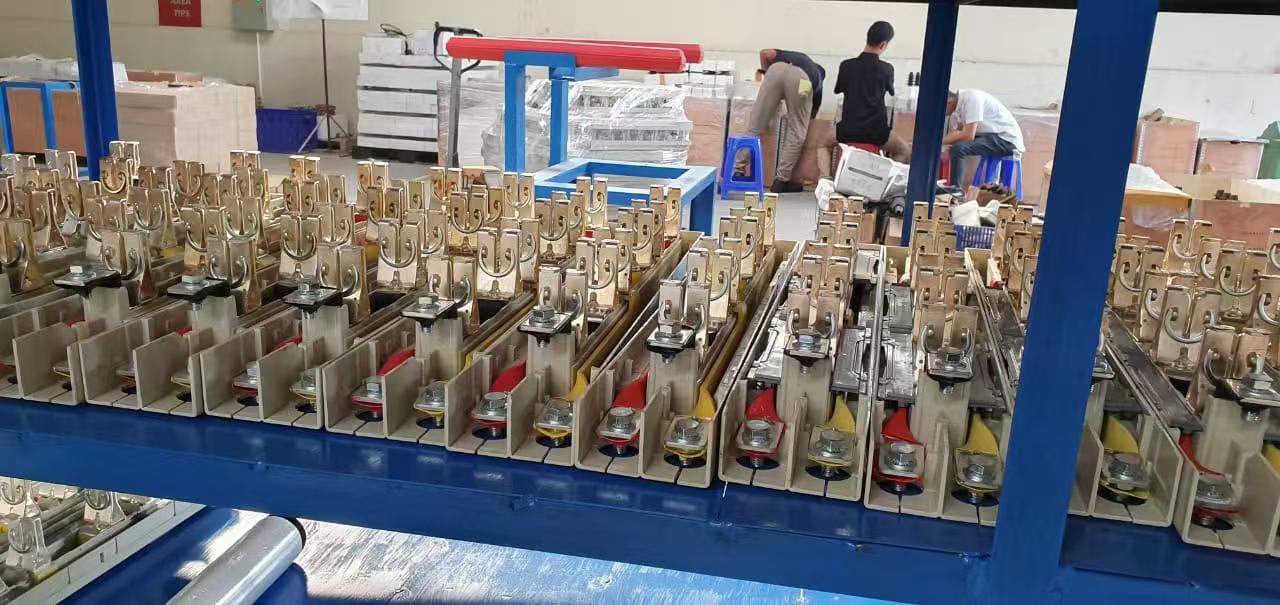
Barfuse Electric Co., Ltd. is a Wenzhou-based manufacturer of low-voltage fuse switch disconnectors, vertical fuse rails in the BTR series, busbar systems and high- and low-voltage distribution wiring management products including MCB and MCCB pan assemblies. The company was established in 2014 and operates a 10,000 m² factory with 45 employees, seven R&D engineers and an annual output of 250,000 pieces. Around 90% of production is exported to the Middle East, Russia, Latin America, Central Asia, the EU, Africa and Oceania.
On the qualification side, the company states testing accreditations from KEMA (DEKRA) in the Netherlands and VDE in Germany, together with CB certification and SAA certification in Australia, and operates an ISO 9001 quality management system. For a buyer reading a standard claim, those third-party references are the layer that sits between a design statement and a shipped product.
Why Ratings Are Conditional: Temperature Rise and Short-Circuit Control
The reason a model-level rating cannot be read in isolation is that the limiting factor in most low-voltage fuse installations is thermal rather than dielectric. Two named risks dominate: temperature rise at the contact interface, and short-circuit behaviour.
Standard control methods are to size the rated current capacity correctly for the load and ambient condition, and to apply conductive grease at the contact interface to stabilise the joint. Manufacturer-side measures commonly used to support those controls include conductors made from high-conductivity material such as T2 copper, a silver surface coating of 2 μm thickness, and heat-shrink tube covering over the conductor assembly.
What those measures mean for a buyer is precise and limited. Silver plating on copper reduces contact resistance and slows oxidation; heat-shrink covering protects the conductor assembly; conductive grease stabilises the joint at installation. None of them changes the rated current of the device. They reduce the probability that a correctly rated device will overheat, and they cannot compensate for a base that is under-rated against its continuous load.
Application Conditions: What Changes Between Sectors
The five sectors most often named in low-voltage fuse documentation — petroleum, chemical, metallurgical, power and construction — place different demands on the same product families.
- Petroleum: continuous duty and long load cycles, where steady-state temperature rise matters more than short-term overload behaviour, and where qualified breaking capacity is part of the safety case.
- Chemical: corrosive and humid atmospheres, which puts weight on enclosure and shell properties such as flame-retardant materials and IP30 protection.
- Metallurgical: high ambient temperatures, where derating discipline and contact-interface quality determine service life.
- Power: coordination between base, link and switch disconnector, where the breaking capacity figure has to be read as a system property rather than a component property.
- Construction: distributed and often temporary distribution boards, where DIN rail mounted bases at 690 V and 400 A and compact stripe formats are the practical choice.
In panel terms, the equipment most often named for stripe fuse switch disconnectors is the distribution cabinet, power pedestal and feeder pillar — the enclosures where space, wiring volume and circuit expansion all matter at the same time.
Market Trend: Standards Are Moving Toward DC and Higher Fault Levels
Three verifiable trends shape how compliance qualification is likely to evolve.
First, the market itself continues to expand. The global electric fuse market is projected to reach USD 5.84 billion in 2025, growing at a CAGR of 7.05% towards 2034, according to Fortune Business Insights.
Second, growth is concentrating where fuses are already the dominant protection technology. The 800 V DC circuit breaker and protection market for data centres is estimated at USD 265 million in 2026 with a 29.9% CAGR, which indicates how quickly DC-side protection demand is forming around higher-voltage architectures.
Third, the standards framework has followed. IEC 60269-1:2024 extended general requirements for low-voltage fuses to DC up to 1500 V, which makes DC-rated documentation part of the ordinary qualification file rather than a special case. Trade data points the same way: global exports under HS code 853610, covering electrical fuses for under 1000 V, are tracked with major volume shifts toward EV-related high-voltage components, according to UN Comtrade reporting summarised through WITS.
One caution for buyers who use market reports in a procurement case: published sizing for this category diverges meaningfully by methodology. Estimates for 2025 range from roughly USD 4.0 billion to USD 5.84 billion depending on whether fuse bases and switch disconnectors are aggregated with fuses or treated as separate mechanical switchgear. A single headline figure should not be treated as a specification.
Comparison With Traditional Solutions: Stripe Fuse Switches Against Square Fuse Switches
The most common substitution decision in low-voltage panels is between a stripe fuse switch disconnector and a conventional square fuse switch.
| Dimension | Stripe fuse switch disconnector | Square fuse switch |
|---|---|---|
| Space utilisation | 30% higher | baseline |
| Safety | 50% improved | baseline |
| Cost | 20% lower | baseline |
| Maintenance | less maintenance | baseline |
| Design characteristics | compact design, low operating cost, less wiring, easy circuit expansion, higher cabinet utilisation | baseline |
| Best fit | distribution cabinet, power pedestal, feeder pillar | general panel positions |
These figures are comparative outcomes of a design approach, not universal properties of the format, and three boundaries matter. First, the space advantage is realised only when the enclosure and busbar layout are designed around the module — for vertical and stripe formats that generally means 100 mm or 185 mm busbar spacing, and a panel designed for another spacing will not deliver the same result. Second, the format is not a drop-in replacement in every position: where continuous current demand approaches the top of the range, NT/NH fuse bases rated up to 1140 V and 630 A remain the appropriate geometry. Third, the safety and cost advantages assume correct fuse link selection, because breaking capacity is a property of the coordinated disconnector-and-link assembly rather than of the switch housing alone.
Execution Stage: Order Terms, Acceptance and Supply Continuity
Once a product is qualified, the remaining risk is execution. The terms below are the ones a buyer should confirm before releasing a purchase order.
| Parameter | Terms |
|---|---|
| MOQ | 1 piece |
| Delivery terms | FOB / CIF / CFR / EXW |
| Acceptance criteria | pre-shipment test |
| Payment terms | T/T, Paypal / Western Union, L/C |
| Typical production lead time | 30–45 days |
| Monthly production capacity | 5,000 pieces |
| After-sales support | remote technical support |
The constraint worth planning around is capacity. A monthly production capacity of 5,000 pieces and a typical lead time of 30–45 days are workable for most panel builders and distributors, but they require project scheduling rather than just-in-time ordering when a multi-phase project specifies the same qualified models across several delivery windows.
Decision-to-delivery checklist
- Confirm that the certificate scope covers the exact model, not only the family.
- Confirm that the fuse link is specified alongside every disconnector or base, at the required breaking capacity.
- Confirm busbar spacing, DIN rail mounting and enclosure protection against the panel drawing.
- Confirm the pre-shipment acceptance test and the delivery term before order release.
- Confirm the 30–45 day lead time against the installation sequence of the project.
Future Outlook
Compliance qualification for low-voltage fuse products is shifting from a document check to a condition check. The direction is set by three converging forces: DC systems moving to 800 V and above in data centre and renewable applications; IEC 60269-1:2024 extending general requirement coverage to DC up to 1500 V; and the growing share of high-voltage fuse demand tied to electrified transport.
For buyers, the practical consequence is that "which standard?" will matter less than "which evidence, for which model, under which condition?". A supplier that can present model-level ratings, third-party testing references and installation constraints together — rather than a single standard headline — will be easier to qualify and faster to re-order from.
FAQ
What does IEC/EN 60269 compliance mean for a fuse switch disconnector or fuse base?
It means the product's declared ratings and test requirements follow the general requirements for low-voltage fuses. IEC 60269-1:2024 covers AC systems up to 1000 V and DC systems up to 1500 V and has an effective date of 2024-08-09; EN 60269 is the European adoption of the same requirements. The standard does not by itself certify an individual model, so certificate scope still has to be matched to the specific catalogue item.
How do DIN VDE 0636-1 and -2 differ from IEC/EN 60269?
Both address low-voltage fuses, but from different positions. IEC/EN 60269 is the international and European requirement framework. DIN VDE 0636-1 and -2 are the German national standards, with Part 1 covering general requirements and Part 2 covering supplementary requirements for fuses for industrial applications, including the NH and NT system families used in industrial distribution. A product may reference both, and buyers should check which standard each test certificate was issued against.
How can a buyer verify that a declared standard applies to a specific model?
Match the certificate scope to the model number. For stripe fuse switch disconnectors that means checking coverage of individual models such as BTR2 through BTR6; for base products it means checking the BH-400 DIN rail fuse base or the individual NT/NH base sizes. Then compare the declared rated voltage, rated current, breaking capacity and impulse withstand against the panel specification, and confirm installation conditions including busbar spacing.
What is the difference between 12 kV impulse withstand and 50–100 kA breaking capacity?
They describe different electrical properties. A 12 kV impulse withstand rating describes the dielectric capability of the device to withstand a transient overvoltage without breakdown. A 50–100 kA breaking capacity describes the fault current the device can interrupt in coordination with the correct fuse link. Neither property implies the other, and both must be quoted together with the conditions under which they were verified.
What are the voltage and current limits of NT/NH fuse bases compared with DIN rail fuse bases?
NT/NH fuse bases are rated up to 1140 V and 630 A and are typically busbar-mounted in industrial low-voltage distribution boards. The BH-400 DIN rail fuse base is rated at 690 V and 400 A and is specified with DIN rail mounting, a flame-retardant shell, stable conductive performance and IP30 protection. The two families serve different thermal and mechanical envelopes and are not interchangeable inside one panel.
Why do temperature rise and short-circuit control matter for compliance?
They are the practical limits on a declared rating. Temperature rise at the contact interface is controlled by sizing the rated current capacity correctly for the load and ambient condition, together with conductive grease at the joint. Manufacturer measures such as T2 copper conductors, a 2 μm silver surface coating and heat-shrink tube covering reduce contact resistance and stabilise the assembly, but they do not change the rated current and cannot compensate for an under-rated device.
What order terms and acceptance steps apply once a product is qualified?
The MOQ is 1 piece; delivery terms are FOB, CIF, CFR or EXW; acceptance criteria are based on pre-shipment test; and payment terms are T/T, Paypal or Western Union, and L/C. Typical production lead time is 30–45 days against a monthly production capacity of 5,000 pieces, and remote technical support is provided after sales.
Additional model-level ratings, mounting dimensions and application details for the ranges discussed here are collected in the Barfuse product catalogue, available for public download: Barfuse catalogue (PDF).