
Fuse Switch Disconnectors: Verifying Specs and Certifications Before Purchase
In low-voltage distribution projects, a fuse switch disconnector is often selected for one practical reason: an operator can disconnect and isolate a circuit while keeping fuse protection in the same mechanical assembly. The procurement problem is that visually similar devices can be built for completely different voltages, currents, busbar spacings, enclosure systems and test standards. The real buyer task is therefore verification, not just product selection.
This article uses the published product data of Yueqing Barfuse Electric Co., Ltd (BARFUSE) as a documented example. BARFUSE is a Wenzhou-based manufacturer of low-voltage fuse switch disconnectors, busbar systems and distribution wiring-management products such as MCB and MCCB pan assemblies. Its catalogue covers the BTR stripe fuse family, NT/NH fuse bases and links, and the BH-400 DIN-rail fuse base. This text is written as an independent evaluation reference, not as a promotional summary.
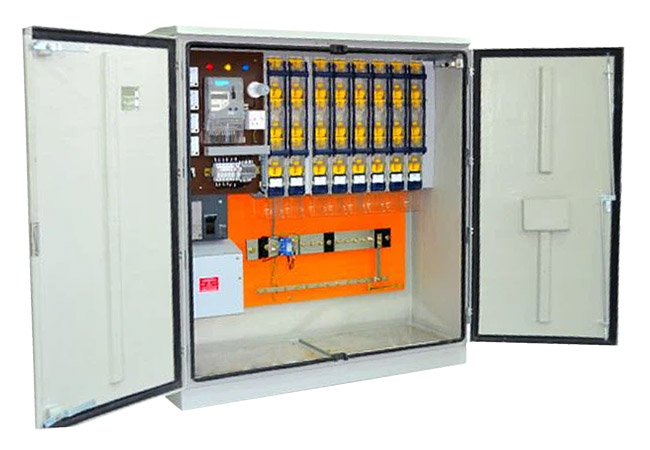
Feeder pillar panel used in low-voltage distribution systems.
Why Fuse Switch Verification Has Become More Important
Fuse-based protection remains a large global category. One industry projection from Fortune Business Insights estimates the global electric fuse market at USD 5.84 billion in 2025, with a compound annual growth rate of 7.05% toward 2034. That growth is not only about more circuits; it is also about new voltage boundaries.
The relevant standard framework is moving as well. IEC 60269-1:2024, the general requirements document for low-voltage fuses, now covers AC systems up to 1000 V and DC systems up to 1500 V. In parallel, niche protection segments such as 800 V DC data-centre infrastructure are receiving increasing attention; one market estimate values that DC protection segment at around USD 265 million in 2026.
For a buyer, these changes create a simple caution: an AC-rated fuse switch disconnector should never be assumed to work in a DC circuit. The catalogue values must be checked before the product is installed.
Understanding the Product Architecture First
Fuse-protection vocabulary is often used loosely, so an evaluation should start with the functional layer.
- Fuse link is the replaceable current-protection element. It contains the conductor that melts under overcurrent.
- Fuse base is the fixed holder that receives the fuse link and provides terminals for the circuit.
- Fuse rail is a busbar-mounted construction that allows fuse links or fuse-switch modules to be arranged compactly on a low-voltage busbar system.
- Fuse switch disconnector combines fuse protection with a disconnector function, allowing visible isolation when the circuit is opened.
BARFUSE product names reflect these distinctions. BTR1 and BTR2 are named Stripe Fuse rails; BTR5 is named Stripe Fuse fuse rail; BTR3, BTR4 and BTR6 are named Stripe Fuse Switch Disconnectors. Separately, NT/NH fuse bases and NT/NH fuse links form a traditional fuse-base architecture, while BH-400 is a DIN-rail type fuse base.
Key Electrical Parameters to Verify
A fuse switch disconnector should not be selected only by frame size. The useful specification discipline is to compare rated operational voltage (Ue), conventional free-air thermal current (Ith) or rated operational current (Ie), rated insulation voltage, busbar spacing, and the limiting short-circuit current claim.
| Model | Catalogue type | Current rating | Voltage rating | Busbar system and field notes |
|---|---|---|---|---|
| BTR1 | Stripe fuse rail | 250 A / 400 A / 630 A | 415 V / 500 V / 690 V AC | Hook-type busbar installation; supports 100 mm and 158 mm busbar systems; 50–100 kA limiting short-circuit current; catalogue lists rated impulse withstand voltage of 10 kV. |
| BTR2 | Stripe fuse rail | 250 A / 400 A / 630 A | 415 V / 500 V / 690 V AC | IP30 degree of protection; same busbar flexibility; certified to IEC 60947-3 with IEC 60947-1, certificate V160016. |
| BTR3 | Stripe fuse switch disconnector | BTR3-250 / BTR3-400 / BTR3-630 | 415 V / 500 V / 690 V AC | 50/60 Hz; rated insulation voltage Ui 1000 V; rated impulse withstand voltage Uimp 10 kV; IP30; supports simultaneous three-phase disconnection or independent single-phase disconnection. |
| BTR4 | Stripe fuse switch disconnector | BTR4-250 / BTR4-400 / BTR4-630 | 415 V / 500 V / 690 V AC | 50/60 Hz; Ui 1000 V; Uimp 10 kV; IP30; materials include copper, DMC, ABS and PC. |
| BTR5 | Stripe fuse rail | BTR5-250 / BTR5-400 / BTR5-630 | 415 V / 500 V / 690 V AC | Enclosed SMC structure; IP30; 50–100 kA limiting short-circuit current; catalogue states insulation voltage of 800 V over the 63–630 A range and rated insulation voltage Ui of 1000 V. |
| BTR6 | Stripe fuse switch disconnector | 160 A | AC 690 V | Available with 100 mm or 185 mm busbar distance; complies with IEC/EN 60269; materials include copper, DMC, ABS and PC. |
These parameters show why busbar spacing deserves special attention. Technical references for vertical fuse switch disconnectors commonly refer to 100 mm and 185 mm busbar spacing systems in LV networks. In the BARFUSE range, BTR6 is the model explicitly listed with 100 mm and 185 mm versions, while BTR1, BTR2 and BTR5 are described as supporting 100 mm and 158 mm busbar systems. A buyer who ignores that dimension may receive a mechanically incompatible unit even when the electrical rating is correct.
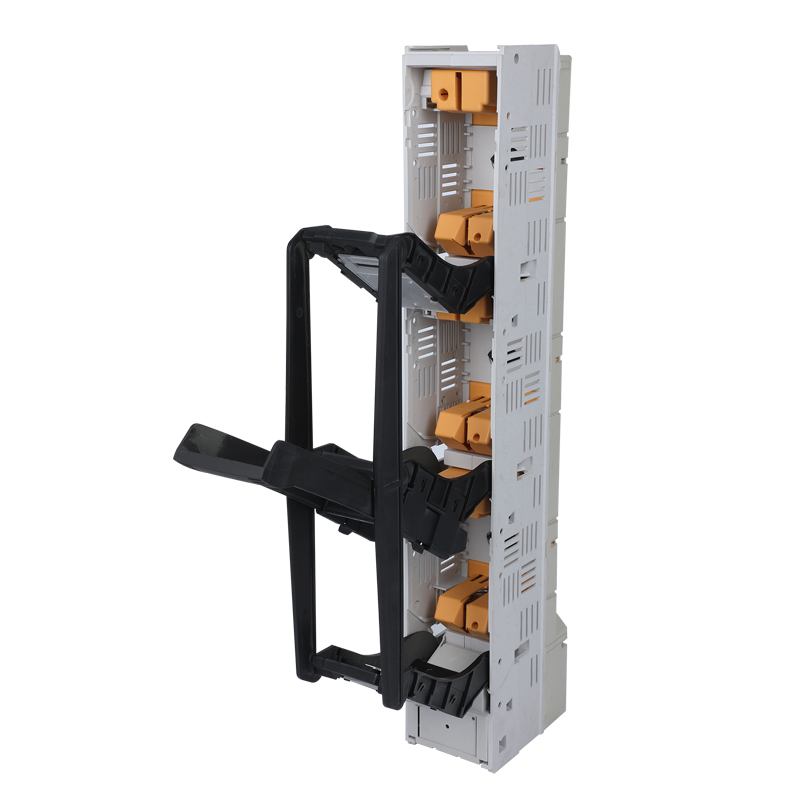
Stripe fuse switch disconnector, BTR4 series.
Standards and Certificate Traceability
Certificate numbers are one of the few objective ways to compare fuse-protection products. A datasheet may say IEC, VDE or ISO, but the buyer should look for the certificate number, the issuing body and the product scope.
| Product or range | Standard / certification | Certificate number and scope |
|---|---|---|
| BTR2 Stripe Fuse rail | IEC 60947-3:2008+A1:2012 with IEC 60947-1:2007+A1:2010 | V160016, issued by the Low-voltage Apparatus Laboratory (Wenzhou) of Zhejiang Academy of Science and Technology for Inspection and Quarantine, applicable to the global market. |
| BTR3 stripe fuse switch line | VDE certification, corresponding VDE harmonized EN/IEC low-voltage switchgear standards | Certificate No. 40047494, issued by VDE Testing and Certification Institute, listed for the EU market. |
| BTR6 Stripe Fuse Switch Disconnector | IEC/EN 60269 | Stated in the product catalogue; also listed with 12 kV impulse withstand voltage. |
| BH-400 DIN-rail fuse base | IEC 60269-1 and 2; VDE 0636-1 and 2 | Rated voltage 690 V; rated current 400 A; neutral links with breaking capacity of 120 kA. |
| NT/NH fuse base and fuse links | IEC269 | NT/NH fuse base: up to 1140 V and 630 A. NT/NH fuse link: up to 1140 V and 1250 A; breaking capacity up to 120 kA. |
| Manufacturing quality system | ISO 9001:2015 | Certificate No. 62724Q1160R0S; scope covers production and export of strip fuse disconnectors, load break switch disconnectors and busbar systems; valid until November 7, 2027. |
The distinction between IEC, VDE and ISO is also practical. IEC 60947-3 covers switches, disconnectors, switch-disconnectors and fuse-combination units. IEC 60269 is the fuse-standard family. VDE 0636 is the German fuse standard referenced for the BH-400 base. ISO 9001, by contrast, is a quality-management certification; it does not replace product type testing. A competent evaluation keeps those layers separate.
Application Fit and Documented Field History
Fuse switch disconnectors are typically applied in low-voltage distribution systems for petroleum, chemical, metallurgical, power and construction projects, as well as commercial-building electrical management. BARFUSE application records include several long-running examples.
- A Saudi Arabian OEM electrical equipment manufacturer is documented as using 300,000 pcs in low-voltage feeder pillars and distribution boxes over 12 years. The stated application conditions include 55°C ambient temperature, salt spray, dust, flame-resistant plastic parts and stable metal-part mechanical performance. The supplier records zero safety failures and zero end-user complaints.
- A Saudi manufacturer is documented as using 600,000 pcs in feeder pillars over a 3–5 year period, with low temperature rise highlighted as a result.
- A Russian wholesaler is documented as using 7,000 units for electric power distribution over 5 years, with stable operation in low-temperature conditions.
These are manufacturer-documented application records rather than independent laboratory tests. For a buyer, they still provide useful context for installation type, operating environment and expected mechanical duty.
How the Integrated Fuse Switch Compares with Traditional Fuse Base Assemblies
Traditional low-voltage fuse protection often uses a separate NH or NT fuse base with fuse links. That architecture remains highly valid where maintenance teams want to replace fuse links independently, where a separate switching device is already part of the panel, or where the required circuit voltage and current exceed the integrated module range.
The integrated stripe fuse switch disconnector approach used by BTR3, BTR4, BTR5 and BTR6 offers a different balance. It is designed to reduce the number of separate mounting steps, support compact busbar assemblies, and provide fuse protection plus disconnection in a single mechanical unit. The hook-type installation mentioned in the catalogue simplifies busbar mounting in panel production, and the enclosed SMC or DMC construction increases mechanical protection in the panel environment.
However, the integrated approach also has clear boundaries.
- AC voltage ceiling: the published BTR ratings are AC 415 V, 500 V and 690 V. No DC rating is present in the supplied product data, so DC use should be treated as an entirely separate verification task.
- Current range: BTR6 is a 160 A unit, while BTR1, BTR2, BTR3, BTR4 and BTR5 are 250 A to 630 A types. Applications above that range will require a different solution architecture.
- Enclosure rating: BTR2, BTR3, BTR4 and BTR5 state IP30. IP30 means finger-contact is not the only concern; first digit 3 protects against solid objects larger than 2.5 mm, and second digit 0 means no water protection. These units are therefore intended to be installed inside a suitable low-voltage enclosure, not in an unprotected outdoor location.
- Busbar compatibility: 100/158 mm and 100/185 mm variants should not be treated as interchangeable. The model must be matched to the panel busbar distance.
This is not a statement that integrated devices are superior. A traditional NT/NH fuse base can be specified for AC 50 Hz circuits with rated voltage up to 1140 V and rated current up to 630 A, while the NT/NH fuse link catalogue extends to 1250 A. The selection depends on the panel architecture, the required voltage and current, and the maintenance workflow.
Future Outlook: From AC Rating to System-Level Traceability
Several trends will shape fuse switch disconnector procurement in the next years. First, IEC 60269-1:2024 formally extends the general fuse framework to DC 1500 V, which means DC-rated fuse combinations will become easier to specify and verify in solar and data-centre applications. Second, as busbar-based distribution panels become more compact, the demand for modular fuse rails and switch disconnectors with clearly stated busbar spacing is likely to increase. Third, certificate traceability will matter more; buyers will increasingly separate products with a real type-test report from products that only display a logo.
For BARFUSE, the practical implication is that its BTR rails and switch disconnectors already align with several common low-voltage AC panel architectures. For buyers, the implication is that the product itself is only half of the specification. The other half is the certificate number, the standard version, the AC or DC limit, and the busbar distance.
Readers who need the complete technical details can access the publicly available BARFUSE catalogue here: Barfuse product catalogue (PDF).
Frequently Asked Questions
1. What is a fuse switch disconnector?
A fuse switch disconnector combines fuse protection with a disconnector function in one unit. It allows an operator to open and isolate a circuit while fuse links remain the overcurrent protection. In the BARFUSE catalogue, BTR3, BTR4 and BTR6 are listed as Stripe Fuse Switch Disconnectors, while BTR1, BTR2 and BTR5 are busbar-mounted Stripe Fuse rails used in similar low-voltage distribution architecture.
2. Are BTR stripe fuse switch disconnectors rated for DC circuits?
The supplied BARFUSE product data lists AC ratings for the BTR family: 415 V, 500 V and 690 V AC for most models, and AC 690 V for BTR6. No DC rating is stated. Since IEC 60269-1:2024 now covers DC systems up to 1500 V, a buyer with a DC application should request a product with a specific DC rating and a corresponding test report rather than assume AC capability.
3. Which standards apply to BARFUSE fuse switch products?
The BTR2 Stripe Fuse rail is certified to IEC 60947-3:2008+A1:2012 in conjunction with IEC 60947-1:2007+A1:2010 under certificate V160016. BTR6 is stated to comply with IEC/EN 60269. The BH-400 DIN-rail fuse base complies with IEC 60269-1 and 2 as well as VDE 0636-1 and 2. NT/NH fuse bases and links conform to IEC269. The production system also holds ISO 9001 certification under the number 62724Q1160R0S.
4. What is the difference between a fuse rail and a fuse base?
A fuse base is a holder for a fuse link and is generally fixed to a panel or DIN rail. A fuse rail is a busbar-mounted construction that allows fuse links or fuse-switch modules to be arranged on a low-voltage busbar system. In BARFUSE terminology, BTR1, BTR2 and BTR5 are Stripe Fuse rails, while BH-400 is a DIN-rail fuse base and NT/NH is a separate fuse-base family with ceramic and tin-plated copper construction.
5. What does IP30 mean on a fuse switch disconnector?
The first digit of IP30 indicates protection against solid objects larger than 2.5 mm, such as tools and wires. The second digit, 0, means there is no water protection. IP30 is therefore an indoor panel-protection level, not a waterproof rating. BTR2, BTR3, BTR4 and BTR5 are the models in the BARFUSE stripe family with IP30 stated in their product data.
6. Why should a buyer verify the certificate number and not just the logo?
A certificate number allows the claim to be traced back to an issuing body and a defined product scope. For example, the BTR2 certificate V160016 is issued for the global market, and the BTR3 VDE certificate number is 40047494. A logo alone does not tell the buyer which product version, standard edition or market scope was covered. Certificate verification is a practical step in separating tested products from unverified copies.
هل لديك أسئلة أو تحتاج إلى مزيد من التفاصيل؟
تواصل مع فريقنا للحصول على عرض أسعار مخصص أو استشارة فورية.
طلب عرض أسعار
املأ النموذج أدناه وسيتواصل معك فريقنا بعرض مقترح مخصص.
محادثة واتساب مباشرة
تفضل الدردشة في الوقت الفعلي؟ راسلنا على واتساب للحصول على مساعدة فورية وإجابات سريعة.
- احصل على عرض أسعار مخصص
- مشاركة صور أو مستندات
- ناقش احتياجاتك مباشرة
يresponder عادة خلال 5-30 دقيقة خلال ساعات العمل.