
GH010 WPC Cladding Procurement FAQ: Specs & Limits
GH010 WPC Cladding Procurement FAQ: Specs & Limits
GH010 WPC Cladding Procurement FAQ: Specs and Limits
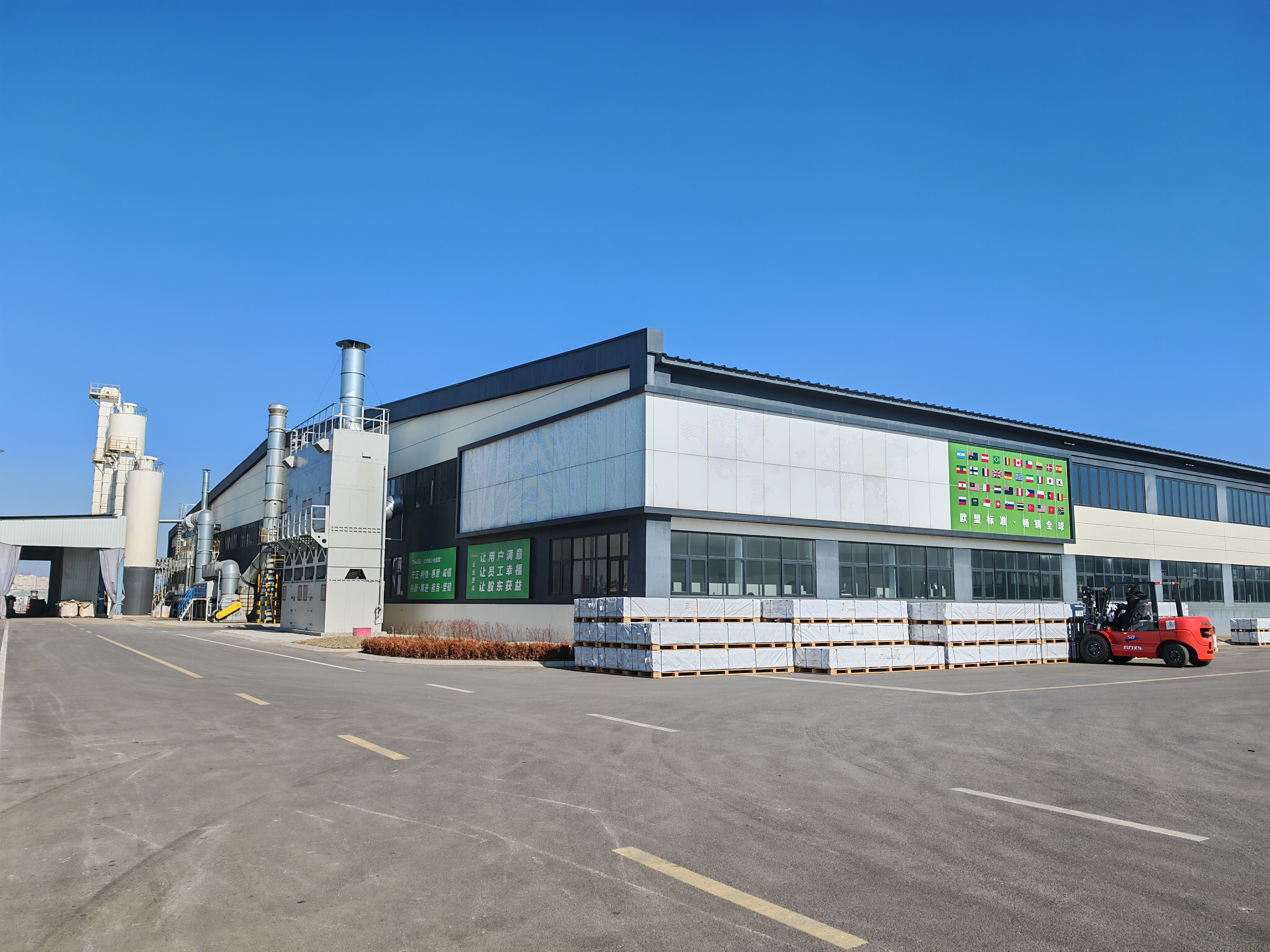
Factory workshop environment used for WPC cladding production and inspection.
GH010 exterior wall cladding panels are published with a 2900 mm × 136 mm × 22 mm profile, a wood-powder/plastic composition, and five test limits that matter in procurement: linear thermal expansion ≤37×10⁻⁶ K⁻¹, boiling test ≤3%, 28-day immersion swelling ≤4%, cyclic moisture ≤0.9 mm, and flexural result ≤0.9 mm. The buyer's job is not to repeat those numbers in a brochure-style brief. It is to decide which values become acceptance criteria, which documents prove them, and which conditions remain project-specific.
Terratsa New Material (Liaoning) Co., Ltd. is the WPC manufacturer associated with the GH010 cladding reference in this FAQ. The company was founded in 2007 and relocated its production base to the Yingkou Area of China (Liaoning) Pilot Free Trade Zone in 2024; its published scope covers outdoor WPC decking, fencing and cladding. That background matters only to the extent it supports traceability: the procurement question is whether the GH010 order, batch and test report can be connected to the same product definition.
GH010 at a glance: the data points a buyer must control
Use the table below as a translation layer. The left side is the published GH010 data point; the right side is the procurement action it should trigger.
| Data point | Published GH010 value | What to specify | What to verify |
|---|---|---|---|
| Profile | 2900 mm × 136 mm × 22 mm | Nominal length, width and thickness; permitted tolerance; cut-to-length requirement; edge profile | Dimensioned drawing and inspection record |
| Composition | Wood-powder/plastic | Material declaration and source control for wood powder and plastic | Composition statement linked to the GH010 batch |
| Linear thermal expansion | ≤37×10⁻⁶ K⁻¹ | Limit, units, design temperature range and fixing assumptions | Test report with method, specimen and report date |
| Boiling test | ≤3% | Acceptance limit, specimen type and sampling plan | Report showing conditioning and result |
| 28-day immersion swelling | ≤4% | Immersion duration, specimen and pass/fail line | Report showing test duration and result |
| Cyclic moisture | ≤0.9 mm | Cycle conditions, measurement point and unit | Report with cycles, specimen and result |
| Flexural result | ≤0.9 mm | Result limit and the reported test setup | Full test record with span, support and loading details |
Dimensions: 2900 mm × 136 mm × 22 mm is a starting point, not a tolerance
The 2900 mm × 136 mm × 22 mm dimensions define a nominal panel length, cover width and thickness reference. They do not define the permitted deviation, the edge profile, the fixing zone, or the cut-to-length allowance. Those are commercial and technical variables that belong in the purchase-order annex.
Ask for a dimensioned drawing and an inspection record. The drawing should show the profile, the fixing points and the joint direction. The inspection record should show how length, width and thickness are measured. If the project uses a ventilated facade or a shadow-line joint, the joint geometry should be approved separately; the 136 mm width alone does not define it.
Because GH010 is supplied in a fixed 2900 mm length, cutting and yield planning become part of the acceptance discussion. A buyer should state whether the order is for full-length panels, cut-to-length panels, or both, and who is responsible for edge treatment after cutting. The published data does not include a tolerance table, so the buyer should not infer one. It should be agreed in writing.
Thermal expansion: ≤37×10⁻⁶ K⁻¹ as a design and acceptance input
Linear thermal expansion ≤37×10⁻⁶ K⁻¹ is a material property limit. It is not a joint width. The buyer should use it as an input to movement calculations, then require the supplier to confirm the fixing system and design temperature range assumed for the GH010 facade.
Two procurement errors are common. The first is to quote the coefficient without the test method and units. The second is to treat the coefficient as a guarantee that a particular joint detail will work. Both remove the conditions that make the number useful. The submittal should show the value, the unit, the test method and the report date. The facade designer should still calculate movement for the actual panel length, substrate and temperature range.
At 2900 mm panel length, movement is not a theoretical issue; it is a detailing issue. The buyer should ask whether the fixing system allows for movement and whether the installation manual gives a minimum gap. The coefficient supports that discussion but does not replace it.
Boiling, immersion and cyclic moisture: three different moisture questions
Three moisture-related limits are often grouped together, but they answer different questions. The boiling test ≤3% is a short, severe exposure limit. The 28-day immersion swelling ≤4% is a longer water-immersion limit. Cyclic moisture ≤0.9 mm is a dimensional-change limit expressed in millimetres. They should not be collapsed into a single waterproof claim.
For procurement, each limit needs its own line in the acceptance table: specimen type, conditioning, test duration, pass/fail value and sampling frequency. If a supplier report shows only a pass mark without the method, the buyer cannot tell whether the result applies to the GH010 formulation, the same line, or the same specimen geometry.
These limits are useful for exterior wall cladding because moisture exposure is not limited to rain. Condensation, cleaning, wet installation and trapped moisture behind the facade can all matter. The test limits are evidence of controlled behavior under defined conditions; they are not a project-specific drainage design, a weather warranty, or a substitute for correct flashing and ventilation.
Flexural result ≤0.9 mm: keep the test context attached
Flexural result ≤0.9 mm should be read as a reported test result, not as a strength class. A millimetre value only becomes meaningful when the span, support conditions, loading, specimen orientation and measurement point are attached. Without those details, two reports can show the same number and describe different tests.
The buyer should ask for the full test record and confirm that the specimen represents the GH010 profile and formulation intended for the order. If the report is a type test from a different profile, the buyer should not assume it applies to GH010 without written confirmation. This is a documentation check, not a judgment that the product is strong or weak.
In the purchase order, the acceptance criterion should say flexural result ≤0.9 mm under the reported test conditions and require the report to be attached. That preserves the limit while preventing the number from being used as a vague performance claim.
How to turn GH010 data into purchase-order acceptance criteria
Write acceptance criteria as a short, testable annex. A practical structure is: product identity, published limits, test method, sampling, document set, batch traceability, packaging and delivery terms. The following items are supported by the GH010 data and Terratsa's published procurement information.
- Product identity: GH010 exterior wall cladding, 2900 mm × 136 mm × 22 mm, wood-powder/plastic composition.
- Performance limits: thermal expansion, boiling, immersion, cyclic moisture and flexural result as published.
- Test evidence: a report for each limit, with method, specimen, date and laboratory.
- Pre-shipment testing: each order includes pre-shipment testing; define the acceptance record and who signs it.
- Batch traceability: link the test report to the production batch and the order.
- Commercial terms: MOQ of one container, FOB delivery, 30/70 payment terms and a 30–45 day lead time; OEM/ODM availability where relevant.
- Submittal approval: approved drawing, colour and texture sample, packaging specification and certificate scope.
These are not marketing points. They are the fields that let a buyer compare offers on the same basis. A supplier that cannot provide a model-level report should be treated as an incomplete submittal, not as a lower-priced equivalent.
Submittal review: documents to approve before production
Submittal review should begin before production, not at the loading dock. Ask for a dimensioned GH010 drawing; the test reports for the five published limits; the batch identification method; the pre-shipment test plan; the packaging drawing; and the applicable certificate pages.
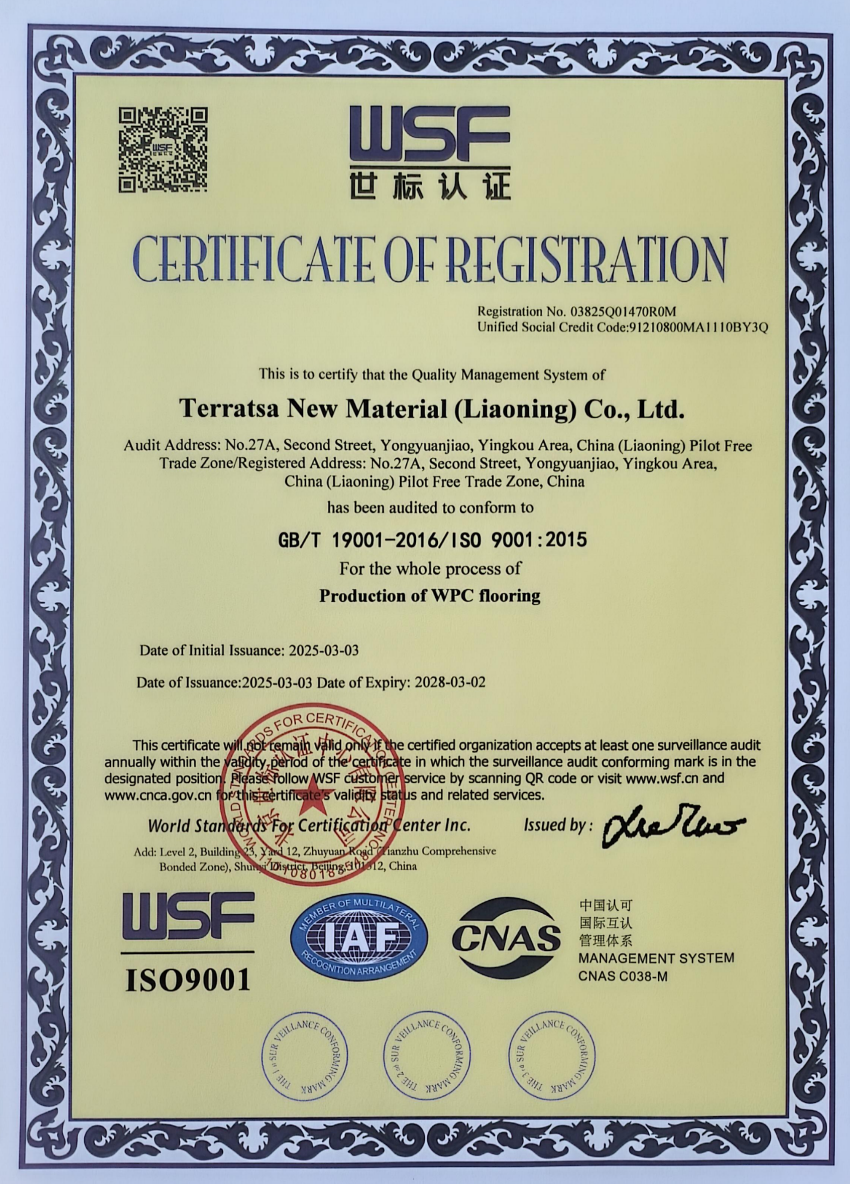
ISO 9001 certificate page listed by Terratsa; buyers should confirm its scope against the GH010 cladding order.
Terratsa holds an EPD for co-extrusion WPC products (registration S-P-12197, valid to 2029-03-15), FSC chain of custody certification (0218718), and ISO 9001, ISO 14001 and ISO 45001 management system certificates. These documents are useful, but they do not all have the same scope. The ISO 9001 certificate scope is stated as production of WPC flooring; the EPD scope is co-extrusion WPC products. A buyer should confirm in writing which documents apply to the GH010 cladding order rather than assuming that every certificate covers every product.
This is not a reason to reject the documents. It is a reason to read them correctly. The submittal should map each document to the GH010 order and identify any scope gap that the supplier will close with a product-specific test report.
Factory verification questions for GH010 cladding
Use these questions during a factory review or a remote document audit. They are designed to test whether the published GH010 data can be reproduced for the order, not to invite generic sales answers.
- Which laboratory and method produced each GH010 test report?
- Were the specimens taken from the same formulation and production line as the order?
- What is the approved tolerance for length, width and thickness?
- How is wood-flour moisture controlled before extrusion?
- How is the batch identified, and how is it linked to the pre-shipment test record?
- What is the sampling plan for the pre-shipment test?
- How are cut-to-length panels edge-treated and packed?
- What installation assumptions are used for thermal movement?
- Which certificate scopes cover GH010 cladding, and which cover other WPC products?
- What is the documented lead time and MOQ for the order?
These questions do not add certifications or test standards. They test the evidence that already exists.
Where GH010 cladding data fits in real facade decisions
GH010 cladding data is most useful when it is matched to the exposure and detailing of the facade. In a humid or wetting environment, the 28-day immersion swelling and cyclic moisture limits should be acceptance points, because they describe dimensional response under moisture exposure. In a facade with long panel runs and large temperature swings, the thermal expansion coefficient should feed the movement calculation and fixing design. In a renovation where panels are cut on site, the 2900 mm length becomes a yield and joint-planning variable, and the cut-edge treatment should be approved before installation.
None of these scenarios proves that GH010 is suitable for every project. The published data does not cover fire performance, wind-load capacity, substrate compatibility, colour fastness under specific UV exposure, or local building-code approval. Those are project-specific checks. A buyer should keep them in the project specification and not treat the GH010 data sheet as a complete facade certification.
Market context: why documentation is becoming a buying criterion
The wider WPC market is expanding, but forecasts should not be used as acceptance criteria. Grand View Research estimates the global WPC market at USD 8.89 billion in 2025, with North America accounting for a 51.3% revenue share. Future Market Insights uses a different base of USD 7.6 billion and projects USD 20.3 billion by 2035 at a 10.3% CAGR. The different base values show that market definitions vary. For a procurement team, the useful takeaway is not the forecast number; it is that more suppliers and more product variants are entering the category, which raises the value of model-level documentation.
Outlook: model-level evidence, not generic claims
The practical outlook for GH010 procurement is a shift from catalog specifications to submittal files. Buyers are likely to ask for the same five limits, but with the test method, specimen identity, batch link and certificate scope attached. That is a healthier basis for comparison than a generic waterproof WPC cladding claim. It also gives the manufacturer a clear way to show capability without overstating it: publish the model data, define the test context, and let the buyer verify the fit.
Terratsa's published capability information supports that direction with OEM/ODM availability, a MOQ of one container, a 30–45 day lead time and pre-shipment testing with each order. Those terms do not prove performance by themselves, but they make the commercial and quality steps easier to audit.
FAQ: GH010 specs, test limits and acceptance criteria
What do the GH010 dimensions mean for a purchase order?
The 2900 mm × 136 mm × 22 mm dimensions define the nominal panel length, width and thickness. A purchase order should add the permitted tolerance, edge profile, fixing-zone drawing, cut-to-length requirement and packaging specification. The published dimensions alone do not define those commercial details.
How should buyers interpret the thermal expansion limit of ≤37×10⁻⁶ K⁻¹?
It is a material property limit used as an input to facade movement calculations. Buyers should require the test method, units and report date, and ask the supplier to confirm the fixing system and design temperature range assumed for GH010. The coefficient does not prescribe a joint width by itself.
Do the boiling, immersion and cyclic moisture results make GH010 waterproof?
No. They are separate test limits: boiling test ≤3%, 28-day immersion swelling ≤4%, and cyclic moisture ≤0.9 mm. They show controlled behavior under defined test conditions. They do not replace project-specific drainage, flashing, ventilation and installation design, and they are not a weather warranty.
What acceptance criteria should be written into the GH010 purchase order?
The order should identify GH010, the 2900 mm × 136 mm × 22 mm profile, the wood-powder/plastic composition, the five published limits, the required test reports, the pre-shipment test record, batch traceability, packaging and delivery terms. Terratsa's published terms list a MOQ of one container, FOB delivery, 30/70 payment and a 30–45 day lead time.
Which factory documents should be reviewed before approving GH010 cladding?
Ask for the dimensioned drawing, test reports for each published limit, the pre-shipment test plan, batch identification, packaging specification and applicable certificate pages. Terratsa holds an EPD, FSC chain of custody and ISO 9001, ISO 14001 and ISO 45001 certificates, but the buyer should confirm the scope of each document against the GH010 cladding order.
Conclusion
GH010 is easier to procure when the data sheet becomes an annex. The published profile, composition and five test limits give the buyer a starting point; the purchase order must add tolerances, test methods, sampling, batch links and document scope. That is how a technical FAQ becomes an acceptance file rather than a brochure.
Reference: Terratsa product brochure (PDF).
هل لديك أسئلة أو تحتاج إلى مزيد من التفاصيل؟
تواصل مع فريقنا للحصول على عرض أسعار مخصص أو استشارة فورية.
طلب عرض أسعار
املأ النموذج أدناه وسيتواصل معك فريقنا بعرض مقترح مخصص.
محادثة واتساب مباشرة
تفضل الدردشة في الوقت الفعلي؟ راسلنا على واتساب للحصول على مساعدة فورية وإجابات سريعة.
- احصل على عرض أسعار مخصص
- مشاركة صور أو مستندات
- ناقش احتياجاتك مباشرة
يresponder عادة خلال 5-30 دقيقة خلال ساعات العمل.