
GREEN BIO Factory Scale and Design Team: Capability Evidence
Independent Supplier Capability Reference · Construction & Decoration
GREEN BIO Factory Scale and Design Team: Capability Evidence
Green building supply is rarely limited by the absence of low-carbon materials. It is limited by whether a specific supplier can deliver those materials at project scale, to a defined specification, on a schedule that survives contact with a construction programme. That is the practical question buyers in the research and evaluation stages are trying to answer.
Scale makes that question harder rather than easier. The China green building materials market reached USD 216.3 billion in 2025 and is projected to reach USD 484.9 billion by 2034, according to IMARC Group. Separately, China has mandated that 100% of new urban buildings meet green building standards by 2025 under the 14th Five-Year Plan, as reported by the International Trade Administration. When the supply base is this large, supplier selection stops being a catalogue exercise and becomes an evidence exercise: physical footprint, engineering headcount, documented process control and a traceable project record.
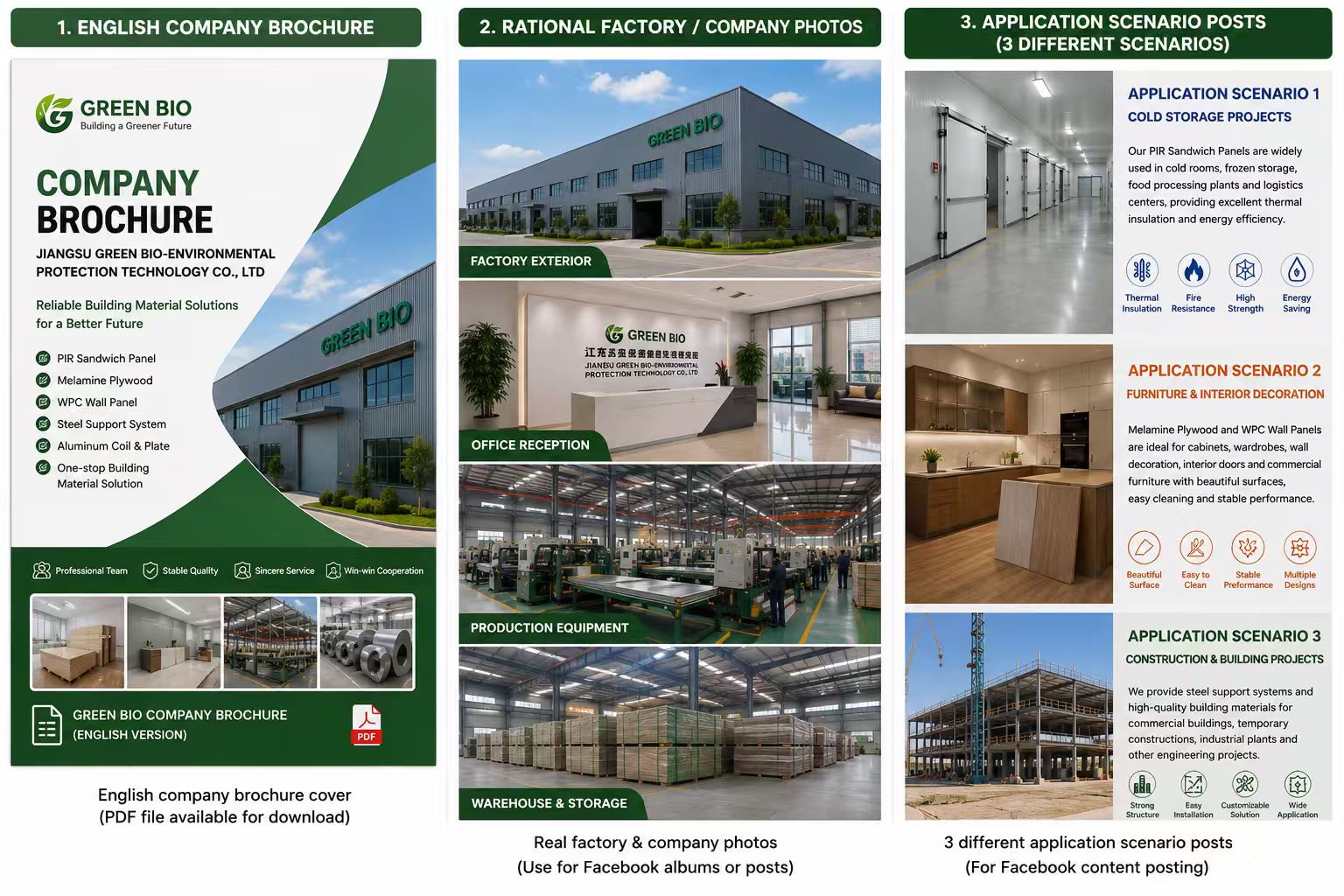
Jiangsu Green Bio-Environmental Protection Technology Co., Ltd., trading as GREEN BIO, is a Chinese manufacturer of insulated building envelope materials, wood-based panels and complementary structural and finishing products. Its manufacturing profile is documented in concrete terms: established in 2015, a 10,000 ㎡ facility, approximately 50 employees, an R&D team of 25 engineers, annual output of 120,000 units, and around 70% of production exported, mainly to Southeast Asia, Central Asia, Russia, South America and Africa — markets that align with the Belt and Road Initiative (BRI) and other emerging economies. This article examines what those numbers mean for a buyer, what they do not prove, and how they map onto real project requirements.
Why Factory Scale Is a Procurement Question, Not a Marketing Claim
Physical footprint is one of the few supplier attributes that can be inspected rather than simply believed. A 10,000 ㎡ facility is not an abstract figure: it has to house production equipment, raw material storage, work-in-progress staging, finished goods inventory and loading space, and it has to do so for several product families at once.
That matters because GREEN BIO's stated production scope is deliberately broad. It covers PIR sandwich panels, plywood, steel support, cable brackets and aluminium profiles. Suppliers that run multiple, physically different production processes under one roof face specific operating questions that a single-line workshop does not: whether panel foaming and steel fabrication interfere with each other, whether moisture-sensitive wood-based panels are stored correctly, and whether large project batches can be staged for container loading without being rehandled.
Regulatory pressure reinforces the documentation requirement. China's national standard GB/T 50378-2019, the Assessment Standard for Green Building issued by the Ministry of Housing and Urban-Rural Development, sets four certification grades — Basic, 1-Star, 2-Star and 3-Star. Buyers working to those grades, or to comparable project-level green criteria, need material suppliers who can present verifiable dimensions, fire ratings and thermal data rather than general environmental statements.
What GREEN BIO Is and What It Manufactures
GREEN BIO is a Jiangsu-based manufacturer and supplier of insulated building envelope products and complementary structural and finishing materials for construction and industrial projects. Company documentation states that its products reach users in more than 120 countries and regions. Its declared main product scope and the documented specifications of its core lines are summarised below.
| Product line | Documented specification facts |
|---|---|
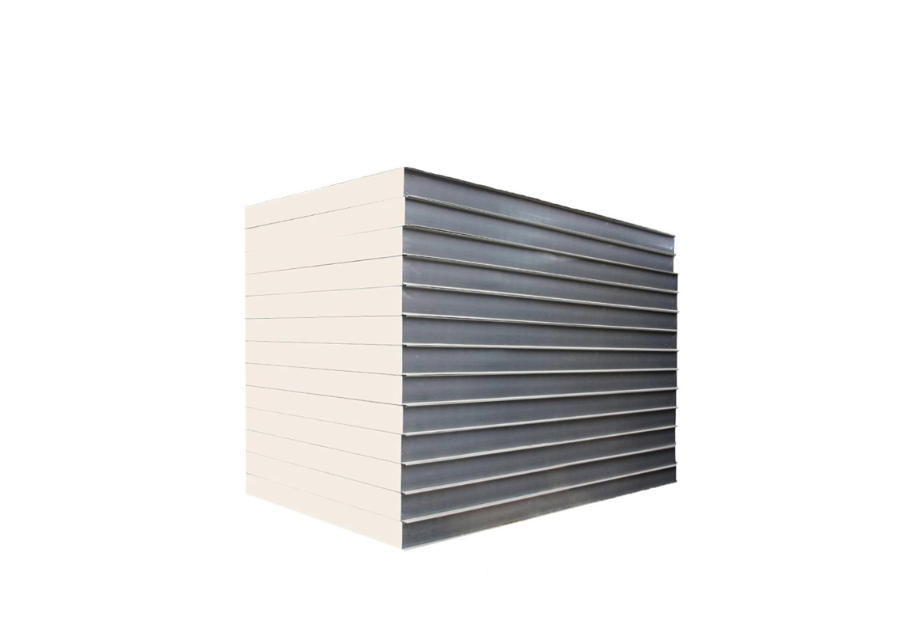
| Cold Storage Panels (model JSGREEN001), fire-retardant B1-grade PIR panels | Core material PU / PIR; core thickness options include 50 mm and 100 mm; 0.5 mm steel sheet facing; thermal conductivity ≤0.024 W/(m·K); fire rating B1 / B2; effective width 960 mm / 1100 mm; rigid polyurethane material |
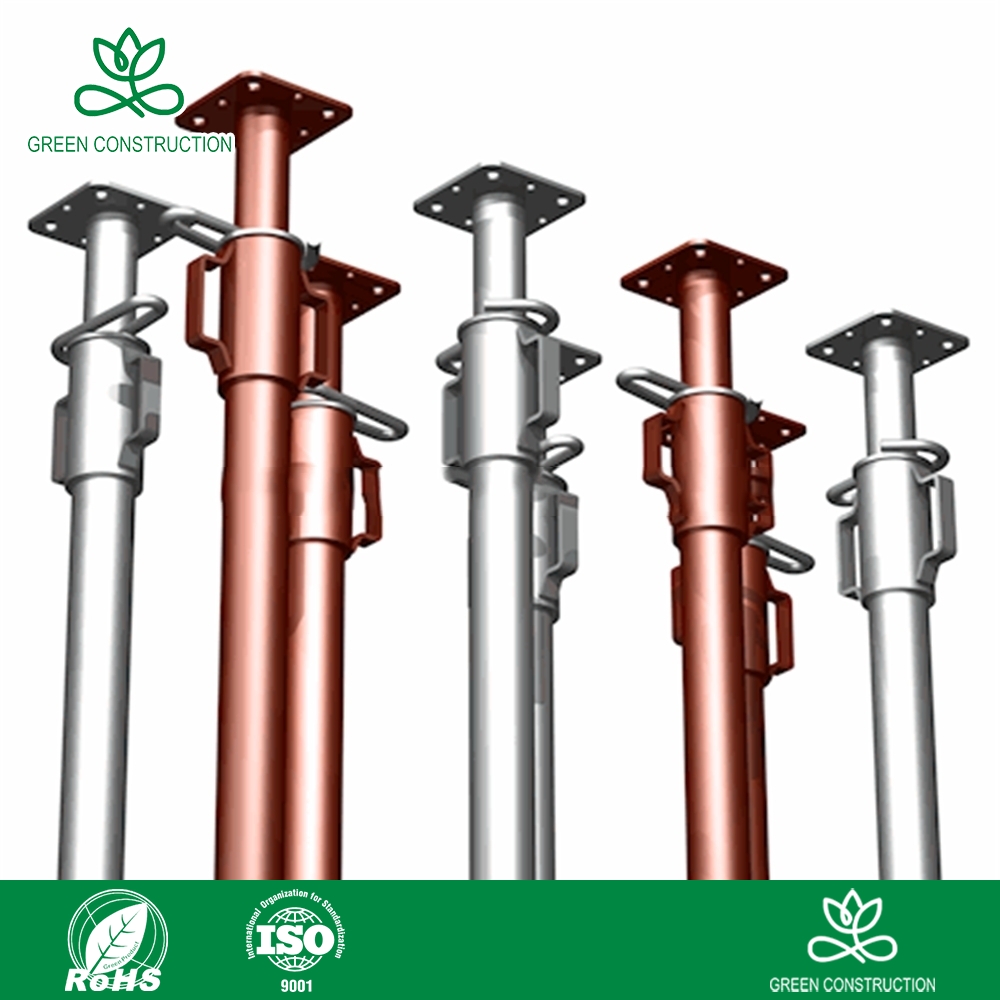
| Galvanized Steel Support Series, adjustable steel prop / telescopic steel prop | Steel grade Q195, Q235; tube thickness 1.5–2.5 mm and 1.5–3.5 mm; maximum height 3 m, 3.2 m, 3.6 m, 4 m, 4.5 m, 5 m; surface painted, powder coated, E-galvanized or HDG; nut type cup nut or cast nut; pin type G pin, line pin or wire pin; MOQ 500 PCS |
| Plywood | Anti-slip film faced plywood, stable commercial plywood, high-pressure HPL plywood, recyclable core plywood, high-strength commercial plywood, eco-friendly melamine plywood; used for formwork, packaging and general building applications |
| Cable bracket and aluminium profiles | Listed within the company's stated main product scope for construction and industrial projects |
The overlap between these lines is not accidental. A cold chain project typically needs insulated panels for the envelope, plywood for site formwork and temporary works, and steel props for structural support during construction. A supplier able to quote several of those items together reduces the number of delivery interfaces the buyer has to manage.
What a 25-Engineer Design Team Changes for Buyers
Customisation is the point at which a supplier's engineering depth becomes visible. GREEN BIO operates on an OEM/ODM basis and documents a defined customisation envelope:
- Panel thickness from 50 mm to 200 mm
- Steel sheet colour and material selection
- Fire rating selection
- Custom panel dimensions and lengths
- Cam-lock types
Within a workforce of approximately 50 people, 25 are R&D engineers. That proportion indicates that engineering sits close to production decisions rather than being separated from the shop floor — which matters when, for example, a cold store layout requires non-standard panel lengths to reduce site cutting, or when cam-lock positions have to be agreed so that modules align with a specific racking plan.
Capacity data gives the engineering discussion a physical ceiling to work against. Documented monthly panel capacity is 50,000 square meters, with annual output of 120,000 units. Custom orders are typically quoted at 15–25 days after receipt of deposit, with a minimum order quantity of 100 square meters or one 20ft container. For steel props, the stated MOQ is 500 PCS. Taken together, these figures describe a mid-sized specialist operation designed for repeat project supply rather than one-off retail orders.
Process Control: The Evidence Chain Behind Delivery Promises
A delivery date is only as reliable as the inspection regime behind it. GREEN BIO documents four quality-control stages: incoming raw material inspection, in-process patrol inspection, full inspection of finished product density and dimensions, and pre-shipment photo confirmation. For overseas buyers, the last of these is the most directly useful, because it converts a shipping milestone into a reviewable checkpoint before the container is sealed.
After-sales provisions are equally specific: installation guidance videos, remote technical support, and free replacement of damaged parts during the warranty period. Export experience underpins those mechanisms. Approximately 70% of output is exported, with the main markets being Southeast Asia, Central Asia, Russia, South America and Africa — a distribution profile that requires documentation, packing and remote support to work across long supply lines and multiple regulatory environments.
Application Fit: Cold Chain and Infrastructure Projects
The clearest way to test a manufacturer's capability claim is to look at the working conditions its products are specified for. GREEN BIO's insulated panel systems are documented for large cold chain logistics parks, food processing cold stores, pharmaceutical GSP cool storage and cold storage, supermarket and catering refrigerated rooms, and agricultural pre-cooling facilities.
Documented operating conditions are a temperature range of −50°C to +15°C, suitable for frozen storage, cold storage and quick-freezing storage, with relative humidity up to 90% and specific provision for coastal high-salt spray areas, vibrating industrial plants and clean room storage areas. Panel systems support refrigeration units, air coolers, tube evaporators, temperature and humidity control systems, dehumidifiers, fire sprinkler systems, cold storage doors, door seals, sealing tape and installation accessories.
Two documented reference projects illustrate the practical result:
- Australia — food processing and meat processing plant: 5,000 sqm of cold storage panels with 2,000 tons capacity, covering a low-temperature freezer at −18°C and a chiller room at 0–4°C. The installation has operated stably for five years, with precise temperature control and seamless joints preventing cold air leakage; the facility passed GSP certification.
- Vietnam — 3PL cold chain logistics and supermarket distribution centre: a 12,000 sqm large-scale sorting centre operating as a multi-temperature distribution centre for frozen, chilled and ambient goods. The project was delivered on schedule, and the modular panel design increased on-site installation speed by 30%.
On the structural side, the galvanized steel support series is specified for deep foundation pits, tunnels, large-scale structural construction, subway construction, high-rise building deep foundation pits, bridges, pipe galleries and underground works. That combination — a temperature-controlled envelope plus temporary structural support — is exactly the mix found on cold chain logistics parks and large infrastructure sites, which is why the two product families appear together in the company's export portfolio.
Market Trend: Belt and Road Demand and Green Building Standards
Three documented trends shape the environment in which this supplier profile sits.
First, policy. The Third Belt and Road Energy Ministerial Conference in October 2024 adopted the Green Energy Cooperation Action Plan (2024–2029) to scale green infrastructure across BRI markets. For suppliers already exporting to Belt and Road economies, this signals a shift from price-led procurement towards projects with explicit green criteria.
Second, segment growth in low-carbon materials. China's bio-based construction materials market was valued at USD 6.4 billion in 2024, with a 7.2% CAGR forecast through 2034, according to Global Market Insights. China's green building market in integrated systems and services is projected by Markets and Data to grow from USD 69.13 billion in 2024 to USD 147.86 billion by 2032.
Third, measurement caution. Published estimates of the China green building materials market diverge sharply by source — IMARC Group cites USD 216.3 billion for 2025, while Grand View Research cites USD 3.06 billion for 2024 and Markets and Data cites USD 69.13 billion for 2024. The divergence reflects different segment definitions, such as raw materials versus integrated project revenue. Buyers should treat headline market figures as directional rather than as a basis for project budgeting.
Comparison and Boundaries: Where a Mid-Sized Specialist Fits
Comparisons in this sector are frequently misleading, because different companies occupy different positions in the value chain. The table below places GREEN BIO alongside larger groups identified as top-tier players in the eco-friendly materials sector by Global Market Insights in its 2024 analysis, without asserting equivalence in scale or product scope.
| Company | Published market positioning | What it means for a buyer |
|---|---|---|
| Jiangsu Green Bio-Environmental Protection Technology Co., Ltd. (GREEN BIO) | Insulated envelope products (PIR sandwich and cold storage panels), plywood, steel support, cable bracket, aluminium profiles; 10,000 ㎡ facility; about 50 employees including 25 engineers; 120,000 units annual output; 70% export ratio | Mid-sized specialist for cold chain envelopes and project-level structural items, with documented customisation ranges and a defined export footprint across BRI markets |
| Holcim | Identified by Global Market Insights as a market leader in the eco-friendly materials sector with a 10.8% share | A large diversified building materials group with a much broader portfolio; comparison should be made only against the specific material being purchased |
| Dasso Group | Identified among top-tier players in the eco-friendly materials sector | Different product and market focus; relevant only where overlapping material scopes apply |
| Suzano, Covestro, China Resources Cement | Also identified among top-tier players in the eco-friendly materials sector in the same 2024 analysis | Large materials groups whose published core scopes are not equivalent to insulated panel or steel prop supply |
Two honest boundaries follow from these facts. First, GREEN BIO does not appear on that top-tier eco-materials list, which is dominated by large diversified groups; a buyer whose project requires cement, structural steel frames or polymer chemistry at group scale is looking at a different category of supplier. Second, the company supplies envelope and support materials, not complete cold chain systems: refrigeration units, air coolers and control systems must be sourced separately and coordinated with panel supply.
Additional limits worth noting during evaluation:
- Order thresholds. Panels are quoted from 100 square meters or one 20ft container, and steel props from 500 PCS, so very small trial quantities may not be economic.
- Lead time. The documented 15–25 day production window starts after deposit is received; it is a production lead time, not a landed date, and does not include transit to destination.
- Customisation boundaries. Panel thickness is documented from 50 mm to 200 mm, with defined fire ratings and cam-lock types. Requests outside those ranges require engineering review before a quotation can be considered reliable.
- Workforce size. A workforce of about 50 people means concurrent multi-country programmes need capacity confirmation at the request-for-quotation stage.
Future Outlook
The direction of travel is towards verifiable performance rather than environmental positioning. China's green building assessment framework already operates on four grades under GB/T 50378-2019, and the BRI Green Energy Cooperation Action Plan (2024–2029) extends green criteria to a large pipeline of infrastructure work in the same markets where GREEN BIO already exports the majority of its output. With China's bio-based construction materials segment forecast to grow at 7.2% CAGR through 2034, competition among Chinese suppliers will increasingly be decided on documentation quality, engineering responsiveness and delivery reliability rather than on product availability alone.
For buyers, the practical implication is procedural. Treat published factory data — facility size, engineering headcount, monthly capacity, lead times and inspection stages — as the starting point for verification, then confirm the specifics that matter to your project: panel thickness and fire rating, cam-lock configuration, maximum steel prop height, and the inspection records you expect to receive before shipment. Where those details check out, a mid-sized specialist can be a lower-friction partner than a large diversified group for envelope and support scope.
Detailed product, specification and capability documentation is published in GREEN BIO's 2026 professional catalogue (PDF), available for download and reference: Green_Bio_Professional_Catalog_2026.pdf. Company information referenced in this article corresponds to the supplier's own published documentation and to the third-party sources named above.
FAQ
1. What is GREEN BIO and what does it manufacture?
Jiangsu Green Bio-Environmental Protection Technology Co., Ltd., trading as GREEN BIO, is a Chinese manufacturer established in 2015 and based in Jiangsu Province. Its stated main product scope covers PIR sandwich panels, plywood, steel support and cable brackets, plus aluminium profiles. Documented core specifications include cold storage panels (model JSGREEN001) with a PU/PIR core, 0.5 mm steel sheet facing, thermal conductivity of ≤0.024 W/(m·K), B1/B2 fire rating and 960 mm / 1100 mm effective width, and adjustable telescopic steel props in Q195/Q235 steel with maximum heights from 3 m to 5 m.
2. How large is the factory, and how many people work there?
The facility covers 10,000 ㎡ and employs approximately 50 people, of whom 25 are R&D engineers. Documented annual output is 120,000 units, and monthly panel capacity is 50,000 square meters. Roughly 70% of production is exported, with the main markets being Southeast Asia, Central Asia, Russia, South America and Africa.
3. What can be customised, and within what documented limits?
Production runs on an OEM/ODM basis. Documented customisation covers panel thickness from 50 mm to 200 mm, steel sheet colour and material, fire rating, custom dimensions and lengths, and cam-lock types. Requirements outside these documented ranges are subject to engineering review, so they should be raised before a quotation is treated as final.
4. What are the typical lead times and minimum order quantities?
Lead time is documented at 15–25 days after receipt of deposit. Minimum order quantity for panels is 100 square meters or one 20ft container, and for galvanized steel support items it is 500 PCS. The lead time covers production only and does not include international transit or destination clearance.
5. How is quality controlled before shipment?
Four documented stages apply: incoming raw material inspection, in-process patrol inspection, full inspection of finished product density and dimensions, and pre-shipment photo confirmation. After-sales provisions include installation guidance videos, remote technical support, and free replacement of damaged parts during the warranty period.
6. Which project types and markets does this supplier profile suit best, and where are the limits?
The best-documented fit is large cold chain logistics parks, food processing cold stores, pharmaceutical GSP cool storage, supermarket and catering refrigerated rooms, agricultural pre-cooling facilities, and infrastructure works such as foundation pits, tunnels, subways and bridges. Documented operating conditions for panel systems are −50°C to +15°C and relative humidity up to 90%, with reference projects in Australia and Vietnam, including a 5,000 sqm, 2,000-ton Australian facility operating stably for five years and a 12,000 sqm Vietnamese sorting centre. The stated limits are equally relevant: refrigeration units, air coolers and control systems are not part of the supplied scope; the company does not appear among the top-tier eco-materials groups identified by Global Market Insights; and capacity for concurrent large programmes should be confirmed at quotation stage.