
GRT Latching Relay Procurement FAQ: Coil Voltage, Ratings, and Acceptance
GRT Latching Relay Procurement FAQ: Coil Voltage, Ratings, and Acceptance
Procurement teams evaluating GRT latching relays often reach the same point: the basic pulse-driven principle is understood, but the acceptance file is not. The questions shift from what a latching relay is to which coil voltage is ordered, which ampere figure is comparable, and which certificate covers the exact model. GRT Relay, the brand of Zhejiang Great Electrical Co., Ltd., is a Chinese manufacturer established in 2003 whose products are used in smart meters, smart homes, EV charging piles, photovoltaic and energy-storage equipment. The company's official site is GRT Relay.
This FAQ is written for the evaluation-to-execution stage. It does not repeat basic selection content. It explains how to read coil voltage, separate contact switching capability from maximum switching current and rated resistive load, verify dielectric strength, IEC 62055-31 UC2, RoHS, dimensions and terminal style, and close with a procurement checklist for purchasing terms and acceptance criteria. The aim is a defensible purchase order, not a catalogue summary.
1. How should a buyer read a 5–24 VDC coil range?
A 5–24 VDC coil range should be read as a selection envelope, not as a single operating voltage and not as proof that every model can be driven continuously across that span. In a latching relay, the coil is pulsed to change state; the contact position is held without continuous coil power. The ordered variant still needs a defined nominal coil voltage, coil configuration and pulse condition.
GRT's customization scope includes single-coil or double-coil versions and voltage customization. That means the coil voltage is a configuration item, not a generic attribute that can be carried from one model to another. For GRT508BV or GRT508BJ, the buyer should request the model-specific datasheet and confirm: nominal coil voltage; single- or double-coil arrangement; recommended pulse width; coil resistance if the drive circuit design depends on it; and whether the published range applies to the exact ordered variant.
Do not use a 5–24 VDC screening band to approve a purchase order. Use it only to shortlist. The purchase order should state the nominal voltage and pulse condition that will be tested at incoming inspection. This distinction matters because a coil range can hide different variants. A buyer who orders a 12 VDC sample but releases a 24 VDC production lot has not tested the same coil condition. Likewise, a driver designed for a short pulse should not be assumed to work with a different coil configuration without confirmation. The safe procurement rule is simple: the datasheet value and the purchase-order value must match the sample that was approved.
2. Contact switching capability, maximum switching current and rated resistive load are not interchangeable
Three figures are often mixed in RFQs. Contact switching capability is the broad statement that a contact set can switch a defined load under defined conditions. Maximum switching current is an upper limit for the switching event under the stated load and test conditions. Rated resistive load is a specific rating for a resistive load, usually tied to a voltage, current and electrical endurance. None of these figures automatically describes performance with inductive loads, high inrush currents, lamp loads, motor loads or capacitive loads.
The buyer's first check is therefore not the largest ampere number on a page. It is the condition attached to that number. For GRT508BV and GRT508BJ, the procurement file should treat the headline current as model-specific and condition-specific. The certificate evidence for GRT508BV establishes a UC2 certificate; it does not, by itself, establish a contact rating for every load. GRT508BJ is listed among the applicable latching-relay products for smart-meter scenarios, but a separate certificate and datasheet should be requested for the exact model. A GRT508BV certificate should not be used as a substitute for GRT508BJ evidence.
| Parameter | What it answers | What it does not prove | Procurement check |
|---|---|---|---|
| Contact switching capability | The load class the contact set is presented for | Suitability for inductive or inrush loads | Match voltage, load type, contact form and endurance |
| Maximum switching current | Upper switching limit under stated conditions | Continuous current rating for all loads | Confirm test conditions and duration |
| Rated resistive load | Rating for a resistive load at defined voltage and endurance | Performance with motors, capacitors or lamps | Request load-specific verification if needed |
| Coil voltage | Nominal drive condition for the coil variant | Contact current capability | Match ordered variant and approved sample |
| Dielectric strength | Insulation capability under a defined test | Contact rating or RoHS status | Request test report and condition |
| Certificate | Model and standard coverage | All performance parameters | Check model, standard edition, scope and expiry |
3. What the GRT508BV UC2 certificate actually establishes
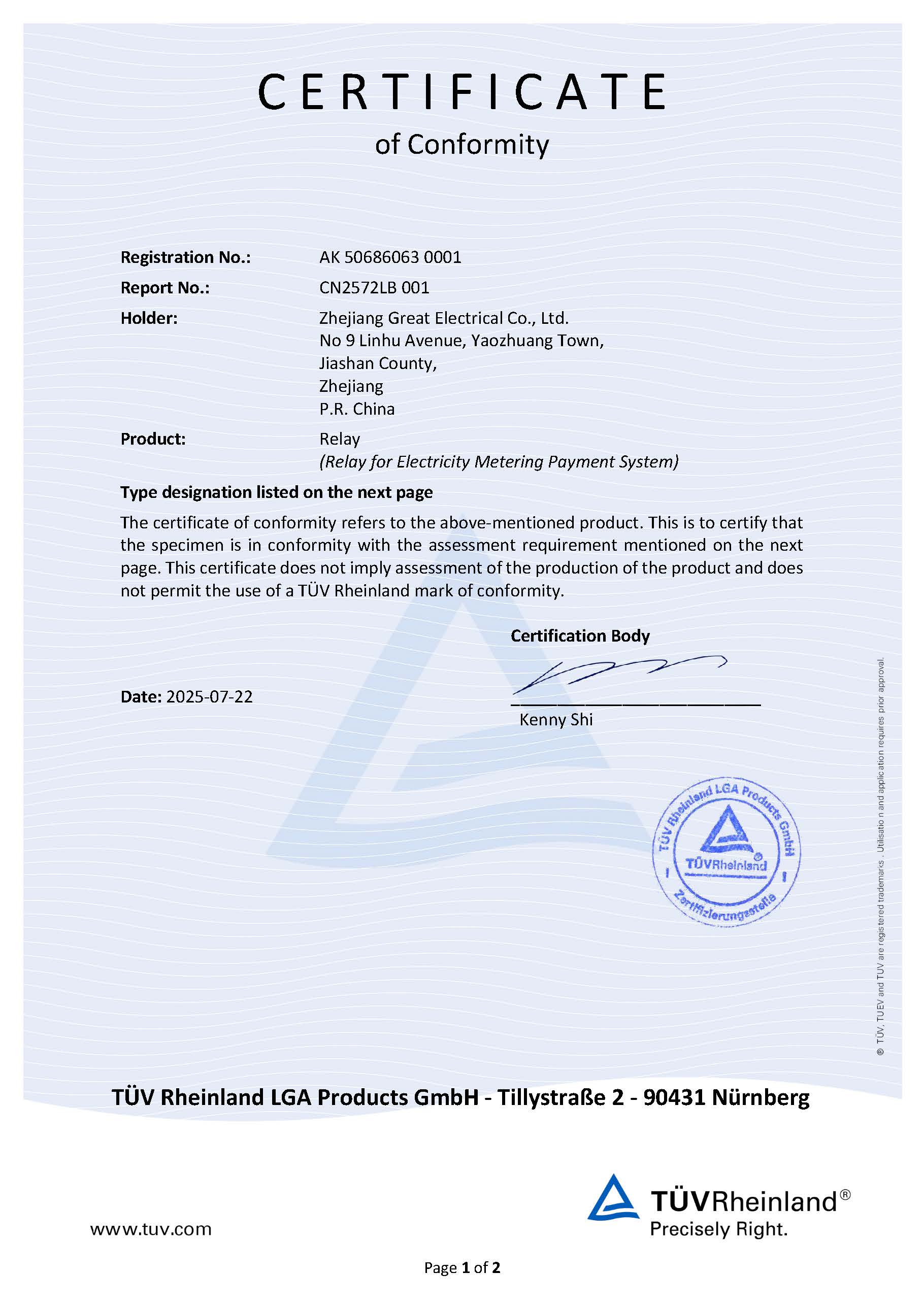
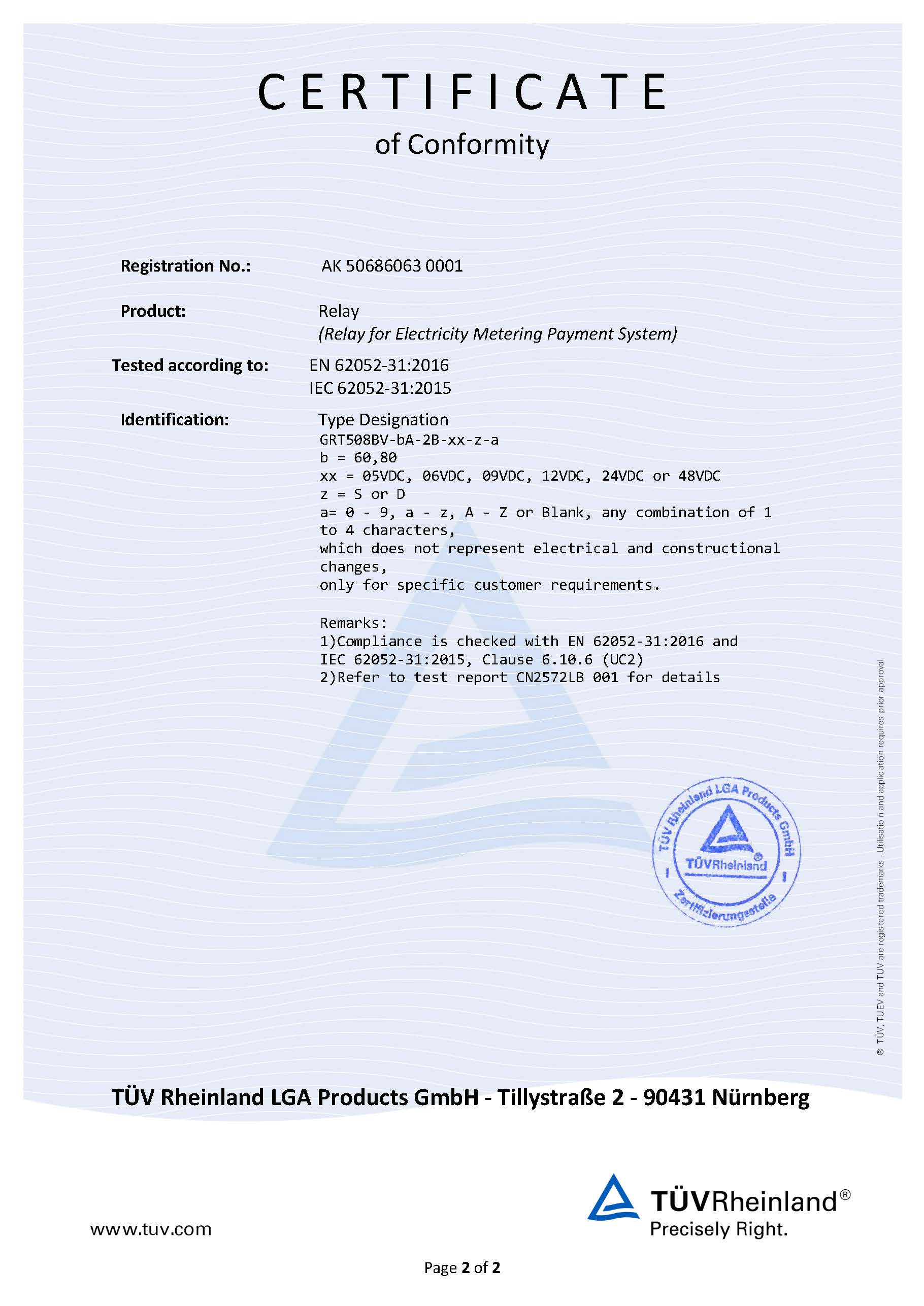
The GRT508BV UC2 certificate is numbered AK 50686063 0001. It was issued by TÜV Rheinland on 2025-07-22. Its scope is a relay for electricity metering payment systems, magnetic latching relay, type GRT508BV. The cited standard is IEC 62052-31:2015 and EN 62052-31:2016. That is the correct starting point for a meter project that accepts this standard. It is not a universal certificate for every GRT latching relay and it does not replace a datasheet.
A separate GRT UC2 certificate, AK 50255817 0001 for GRT508FA3B, cites IEC 62055-31:2005 and EN 62055-31:2005. The two certificates are both described as UC2, but they cite different standard references. This is exactly the kind of detail a procurement team should catch. If the tender says IEC 62055-31 UC2, the buyer should confirm that the certificate for the ordered model cites the required edition and scope. If the tender accepts IEC 62052-31, the GRT508BV certificate may fit, subject to the project's own qualification review.
IEC 62055-31:2022 defines utilization categories UC2, UC3 and UC4 for latching relays used in payment meters. That does not mean every UC2 certificate is interchangeable. The edition, model and scope still control. The practical acceptance step is to build a certificate matrix before the RFQ closes, not after the first shipment.
4. How to verify dielectric strength without over-reading the certificate
Dielectric strength is an insulation parameter. It should be verified on the model datasheet and the test report, with the test condition stated. The buyer should confirm which insulation path is being claimed, for example coil-to-contact or between open contacts, and whether the value applies to the exact variant. A UC2 certificate addresses the utilization category and the standard scope; it is not a substitute for the dielectric test record. A CE certificate addresses the listed standards and scope; it also does not replace a model-specific dielectric report.
The procurement file should ask for the parameter, the test method, the condition and the acceptance limit. If the application has a specific insulation coordination requirement, the buyer's engineer should map that requirement to the relay datasheet rather than accepting a headline kilovolt figure from a catalogue page. This is a verification step, not a performance claim. It prevents a common error: treating a certificate as a complete technical data package.
5. Matching UC2, CE and RoHS to the target market
Compliance is layered. IEC 61810-1 is the general safety standard for electromechanical elementary relays. IEC 62055-31 addresses payment metering systems and defines utilization categories. RoHS Directive 2011/65/EU restricts certain hazardous substances in electrical and electronic equipment placed on the EU market. A relay project can therefore need a general safety file, an application-standard file and a RoHS declaration. One document does not cover all three.
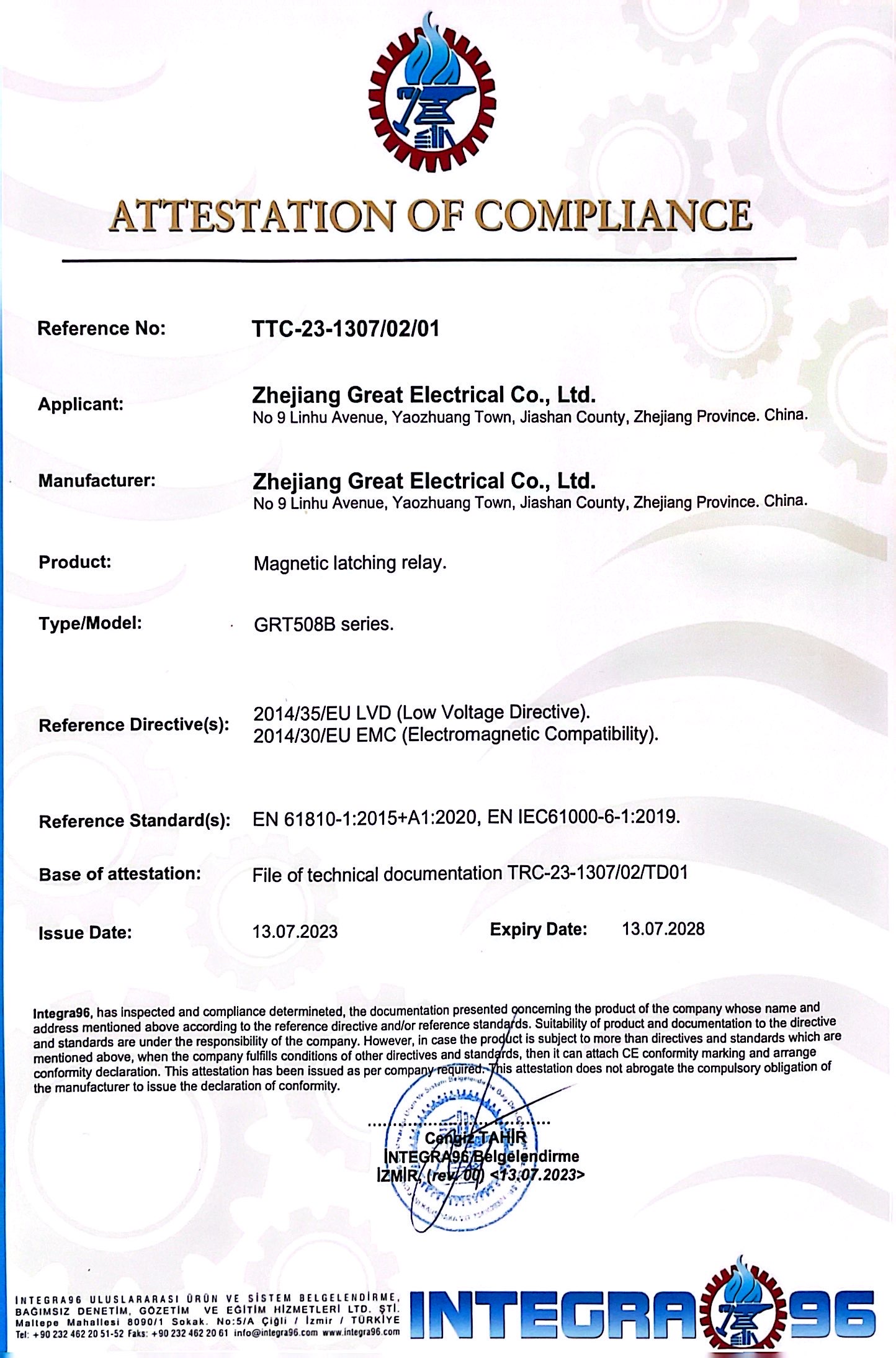
GRT states that its latching relays comply with RoHS and IEC 62055-31 UC2. That statement is useful for screening, but the buyer should still request the model-specific evidence. For the GRT508B series, a CE certificate numbered TTC-23-1307/02/01 cites EN 61810-1:2015+A1:2020 and EN IEC 61000-6-1:2019, with an expiry date of 2028-07-13. The buyer should check whether the ordered model is within the certificate scope. For RoHS, request the declaration or test report that names the exact model and date. For UC2, check the certificate number, model, standard edition and scope.
The acceptance matrix should have one row per requirement and one column per document. A document that is valid but covers a different model is not acceptance evidence.
| Requirement | GRT evidence to request | Check |
|---|---|---|
| General relay safety | IEC 61810-1 test evidence or CE certificate where applicable | Model scope and standard edition |
| Payment-meter UC2 | UC2 certificate for the exact model | Certificate number, standard, expiry and scope |
| EU EMC and CE | CE certificate for the model family | Model list, standards and validity |
| RoHS | Declaration or test report | Model, date and substances covered |
| Dielectric strength | Model datasheet or test report | Parameter, method and condition |
| Dimensions and terminals | Outline drawing | Footprint, terminal style and tolerance |
6. Dimensions and terminal style are acceptance items, not footnotes
A latching relay can be electrically correct and still fail assembly. Dimensions, PCB footprint, terminal style, terminal spacing and tolerance should be approved from a drawing, not from a catalogue photo. For GRT508BV and GRT508BJ, request the outline drawing and terminal drawing for the exact variant. If the relay is supplied with a wire harness or other accessory, the drawing should define the assembly boundary.
GRT's customization scope includes external accessories such as CTs, shunts, wire harnesses and brush wires. That scope is useful, but it does not make dimensions interchangeable between models. The buyer should confirm: mounting method; terminal type; terminal position; recommended PCB hole size; solder or screw fixing; clearance around the relay; and the inspection method for terminal alignment. For a custom assembly, the drawing should also show the routing of any flexible wire and the fixing point for any copper strap or shunt. If the drawing does not show these details, the sample is not a controlled sample. The purchase order should reference the approved drawing revision. This is a simple control that prevents a late change from becoming an unapproved change.
7. Custom assembly: what to confirm before quoting
GRT offers OEM/ODM customization. The customization scope includes single-coil or double-coil versions, external accessories such as CTs, shunts, wire harnesses and brush wires, voltage customization and laser marking. The MOQ is 100 units, and custom products require further confirmation. Standard models can be sampled with 3–5 free samples; the buyer covers freight.
A custom assembly involving a flexible wire, a copper strap or an integrated shunt should be quoted from a drawing, not from a verbal description. The buyer should define the supply boundary: which parts are supplied by GRT, which are buyer-supplied, and which are integrated by GRT. The drawing should define the wire length, termination, shunt position and any mechanical fixing. The acceptance plan should include a visual check, a dimensional check and an electrical check at the assembly level. If the shunt is part of the assembly, the buyer should confirm how its resistance or marking is controlled. If a copper strap is used, the buyer should confirm the fixing method and the allowed tolerance. These are not promotional options; they are engineering controls. They determine whether the custom sample can be released to production.
8. Procurement checklist for purchasing terms and acceptance
The commercial terms should be written into the RFQ and the purchase order, not left to the first shipment. GRT's procurement support information lists MOQ 100 units, FOB delivery terms, pre-shipment test as the acceptance criterion and T/T payment terms. The capability unit lists a monthly capacity of 4,000,000 units and a lead time of 30–45 days. Those figures are useful for planning, but they should be confirmed for the ordered configuration and delivery window. A custom assembly can have a different lead time from a standard model.
| Item | What to confirm | Why |
|---|---|---|
| Model and variant | GRT508BV, GRT508BJ or other exact model; coil configuration; voltage | Prevents certificate and rating substitution |
| Certificate | Number, standard edition, model scope and expiry | Acceptance evidence must match the model |
| Datasheet | Coil voltage, contact rating, dielectric, dimensions and terminals | Defines the technical acceptance basis |
| Drawing | Outline, footprint, terminal style and assembly boundary | Prevents fit and assembly failures |
| Sample | Standard or custom sample; approved drawing revision | Creates a controlled reference |
| MOQ | 100 units; custom confirmation | Commercial planning |
| Lead time | 30–45 days; confirm for custom | Delivery planning |
| Payment and delivery | T/T; FOB | Commercial terms |
| Acceptance test | Pre-shipment test; 100% test; batch traceability; ECN notice | Quality control |
| Warranty | Quality-related replacement or supplementary delivery; exclusions | After-sales clarity |
The acceptance criteria should be explicit. Pre-shipment test is the stated criterion. The quality-control statement also says 100% test. Batch traceability and ECN notice for material or process changes are part of the after-sales support. The warranty covers quality-related issues within the warranty period and provides replacement or supplementary delivery; it does not cover damage from wrong wiring, over-voltage or over-current, improper installation or man-made destruction. Those exclusions should be understood before the order, not after a failure. A buyer who needs a custom assembly should also agree on the custom acceptance drawing and the sample approval record.
9. What a credible acceptance file looks like
A credible acceptance file is not a folder of certificates. It is a linked set of documents: the approved model and variant; the datasheet revision; the outline drawing revision; the certificate with model scope and standard edition; the RoHS declaration; the sample approval record; the pre-shipment test report; and the batch traceability record. For a custom assembly, add the assembly drawing and the agreed inspection plan.
GRT's case record includes an ODM smart-meter project in Korea with 50,000 pcs and 10 years of stable operation, highlighting ultra-low coil power consumption, consistent contact performance and long service life. That case is company-reported and should be read as application evidence, not as a guarantee for every customer. Its procurement value is that it shows what a long-term meter application looks like when the part, assembly and acceptance controls are aligned. The buyer should still verify the exact model, certificate and batch data for the current order.
10. Market and standards outlook for procurement
The total relay market is projected by MarketsandMarkets to grow from USD 11.75 billion in 2026 to USD 15.65 billion by 2031. That figure covers relays as a category; it does not isolate latching relays or smart-meter latching relays. It is useful as background for supply planning, not as a latching-relay market size.
On the standards side, IEC 62055-31:2022 defines UC2, UC3 and UC4 for latching relays used in payment meters. Buyers should expect certificate reviews to focus on edition and scope. Customs classification adds another layer: HS 8536.41 covers relays for a voltage not exceeding 60 V, while HS 8536.49 covers other relays. The HS nomenclature does not provide a separate latching-relay code. A procurement team should therefore avoid using HS totals as a latching-relay market measure. The practical outlook is not a forecast of demand. It is a shift in evidence quality: model-specific certificates, edition-aware UC2 review, RoHS declarations and drawing-controlled custom assemblies will matter more than a catalogue headline. That favors buyers who build the acceptance matrix early.
FAQ
Does a GRT latching relay need continuous coil power to hold state?
No. GRT magnetic latching relays use pulse signals to change state and hold the contact position without continuous coil power. The coil is not intended as a continuous holding supply. The buyer should still confirm the nominal coil voltage and pulse condition for the exact model.
What certifications do GRT latching relays have?
GRT states that its latching relays comply with RoHS and IEC 62055-31 UC2. Model-specific evidence includes the GRT508BV UC2 certificate AK 50686063 0001 citing IEC 62052-31:2015 and EN 62052-31:2016, and the GRT508FA3B UC2 certificate AK 50255817 0001 citing IEC 62055-31:2005 and EN 62055-31:2005. The buyer should match the certificate to the exact model and the standard edition required by the project.
Can buyers get free samples for testing?
Yes. GRT offers 3–5 free samples of standard models for testing; the buyer covers the freight cost. Custom products need further confirmation. The sample should be approved against the same drawing and specification that will be used for the production order.
What are the MOQ, lead time and payment terms?
The procurement support information lists MOQ 100 units, lead time 30–45 days, FOB delivery terms and T/T payment terms. The capability unit lists a monthly capacity of 4,000,000 units. Custom assemblies may have different lead times, so the RFQ should confirm the specific configuration.
How should a buyer verify GRT508BV versus GRT508BJ?
Treat them as separate models. Request the GRT508BV datasheet, drawing and UC2 certificate for the exact variant. For GRT508BJ, request its own datasheet, drawing and certificate evidence; do not substitute the GRT508BV certificate. Confirm coil voltage, contact rating conditions, dielectric strength, dimensions and terminal style for each model before approval.
Conclusion
The GRT latching relay procurement question is not answered by a single ampere figure or a single certificate. It is answered by a controlled chain: the exact model and coil variant, the load condition behind the contact rating, the standard edition behind the UC2 claim, the RoHS declaration, the drawing-controlled dimensions and terminals, and the pre-shipment acceptance record.
GRT's published evidence provides a workable starting point, including model-specific UC2 certificates, a CE certificate for the GRT508B series, customization scope and commercial terms. The buyer's task is to match each document to the ordered part. A 5–24 VDC coil range, a UC2 label or a GRT508BV certificate is only useful when it is tied to the exact model, standard and acceptance test. That is the difference between a procurement FAQ and a purchase order that can be defended.
For the full GRT product overview, the public catalogue is available here: Catalogs of Great-relay [2025].
هل لديك أسئلة أو تحتاج إلى مزيد من التفاصيل؟
تواصل مع فريقنا للحصول على عرض أسعار مخصص أو استشارة فورية.
طلب عرض أسعار
املأ النموذج أدناه وسيتواصل معك فريقنا بعرض مقترح مخصص.
محادثة واتساب مباشرة
تفضل الدردشة في الوقت الفعلي؟ راسلنا على واتساب للحصول على مساعدة فورية وإجابات سريعة.
- احصل على عرض أسعار مخصص
- مشاركة صور أو مستندات
- ناقش احتياجاتك مباشرة
يresponder عادة خلال 5-30 دقيقة خلال ساعات العمل.