
GT-732 vs GT-732M vs GT-702BM: Cuff Materials and Buyer Fit
Upper-arm blood pressure monitors accounted for 59.10% of the blood pressure monitoring market in 2025, while wrist-based and wearable formats grew at a 12.07% CAGR over the same period (Mordor Intelligence, cited in the HTNXT verified data package). Inside that dominant upper-arm segment, Guangdong Genial Technology Co., Ltd. — a medical device manufacturer established in 2001 — documents three visually similar models: GT-732, GT-732M and GT-702BM. All three share a 0–290 mmHg pressure rating. They separate on air-bag and cuff material, arm circumference coverage, pulse specification, memory configuration, unit weight, and the distribution channels each model is documented against.
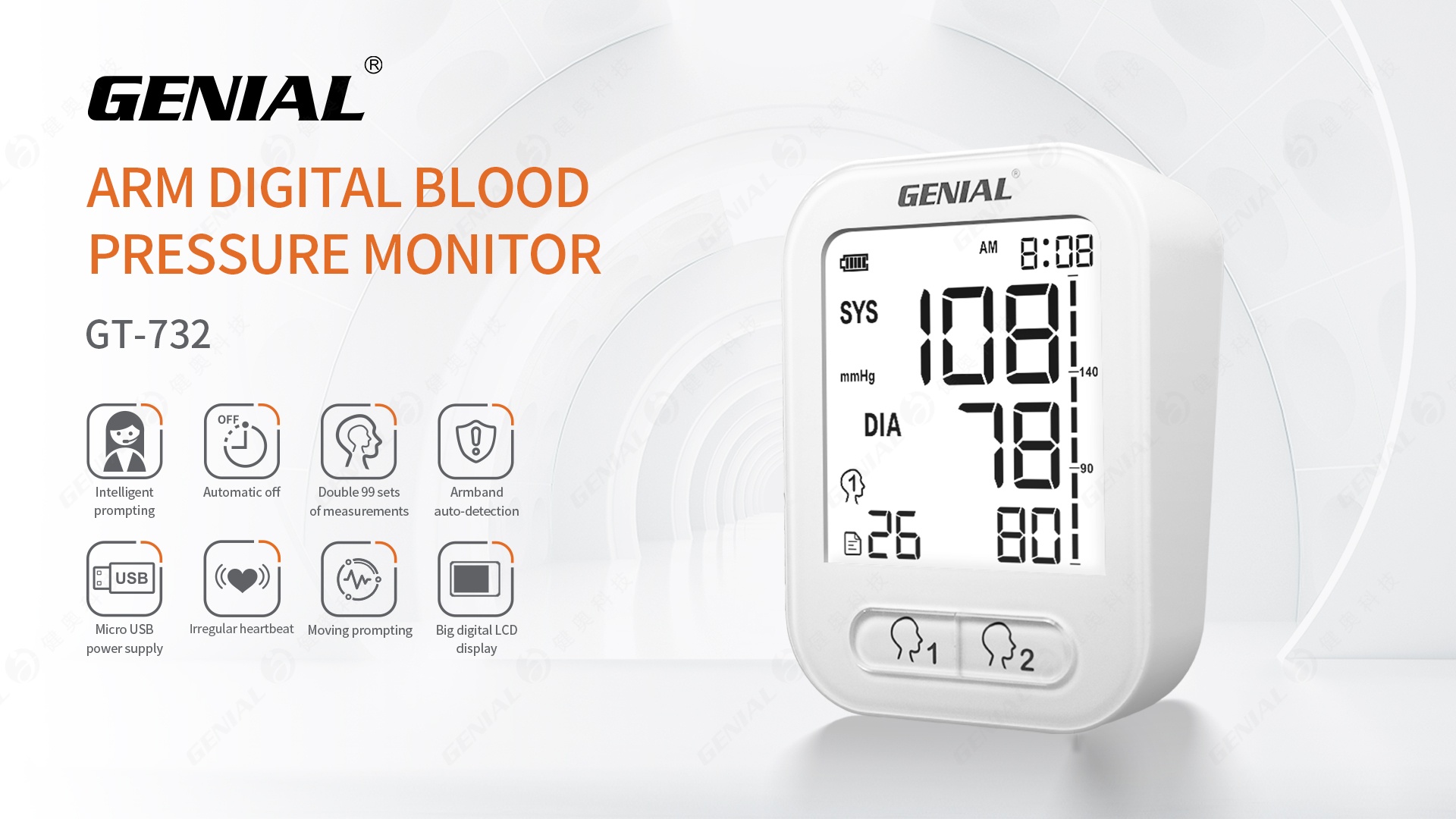
GENIAL GT-732 upper arm digital blood pressure monitor — ABS housing, PVC air bag, nylon binding strap.
Why three models exist inside one pressure class
The short answer is that the cuff is not an accessory; it is part of the measurement chain. Oscillometric monitors infer systolic and diastolic values from pressure oscillations inside the cuff during deflation, so bladder material, cuff stiffness and the way the strap wraps around the arm all influence the signal the firmware works with. A change from a PVC air bag to an eco-friendly TPU air bag, or from a nylon binding strap to a composite fabric cuff, is therefore an engineering change rather than a cosmetic one, and each configuration typically has to be validated on its own.
GENIAL documents the three models with three distinct cuff systems, which is the main reason they sit side by side in the catalogue rather than as a single SKU with packaging variants. For a buyer, the practical consequence is that the specification line worth the most attention is not the pressure range — all three are rated 0–290 mmHg — but the cuff system and the arm range it supports.
Specification comparison at a glance
| Parameter | GT-732 | GT-732M | GT-702BM |
|---|---|---|---|
| Product type | Upper Arm Digital Blood Pressure Monitor | Upper Arm Digital Blood Pressure Monitor | Upper Arm Digital Blood Pressure Monitor |
| Housing / air-path materials | ABS, PVC air bag, nylon binding strap | ABS, eco-friendly TPU air bag | ABS, composite fabric cuff |
| Pressure measuring range | 0–290 mmHg | 0–290 mmHg | 0–290 mmHg |
| Pulse specification | Pulse tolerance ±5% | Pulse error ≤±5% | Not listed in the published specification |
| Arm circumference | 22–32 cm | 22–42 cm | 22–42 cm |
| Memory configuration | Not listed in the published specification | Not listed in the published specification | 99 memory sets for 2 users |
| Dimensions | 136 × 103 × 54 mm | 136 × 103 × 54 mm | 135 × 102 × 46 mm |
| Net weight (without battery) | 291 g ±15 g | 239 g ±15 g | 220 g ±15 g |
| Documented target industries | Community clinic, health & wellness center, e-commerce, customized OEM gift | Chronic disease management institute, community medical center, insurance promotional gift | Medical instrument wholesale, offline household retail |
What the material choices actually signal
All three monitors use an ABS housing, so the differentiation sits in the pressure interface — the air bag, cuff and strap — and in the resulting unit weight and pulse specification.
GT-732 combines ABS with a PVC air bag and a nylon binding strap, and is the heaviest of the three at 291 g ±15 g (without battery). It is documented with a pulse tolerance of ±5%. The nylon binding strap is a conventional, stiff wrap, and the model is listed for community clinic, health and wellness center, e-commerce and customized OEM gift industries — environments where the device is often bought for a defined programme rather than for open-shelf browsing.
GT-732M replaces the PVC air bag with an eco-friendly TPU air bag and comes in at 239 g ±15 g without battery. Its published pulse specification is an error of ≤±5%, and it is documented for chronic disease management institutes, community medical centers and insurance promotional gifts. The combination of a wider arm range and a stated pulse error makes it the more natural fit where the same device is used on more than one person.
GT-702BM uses a composite fabric cuff, weighs 220 g ±15 g without battery, and is the only one of the three with a published memory configuration: 99 memory sets for 2 users. It is documented for medical instrument wholesale and offline household retail.
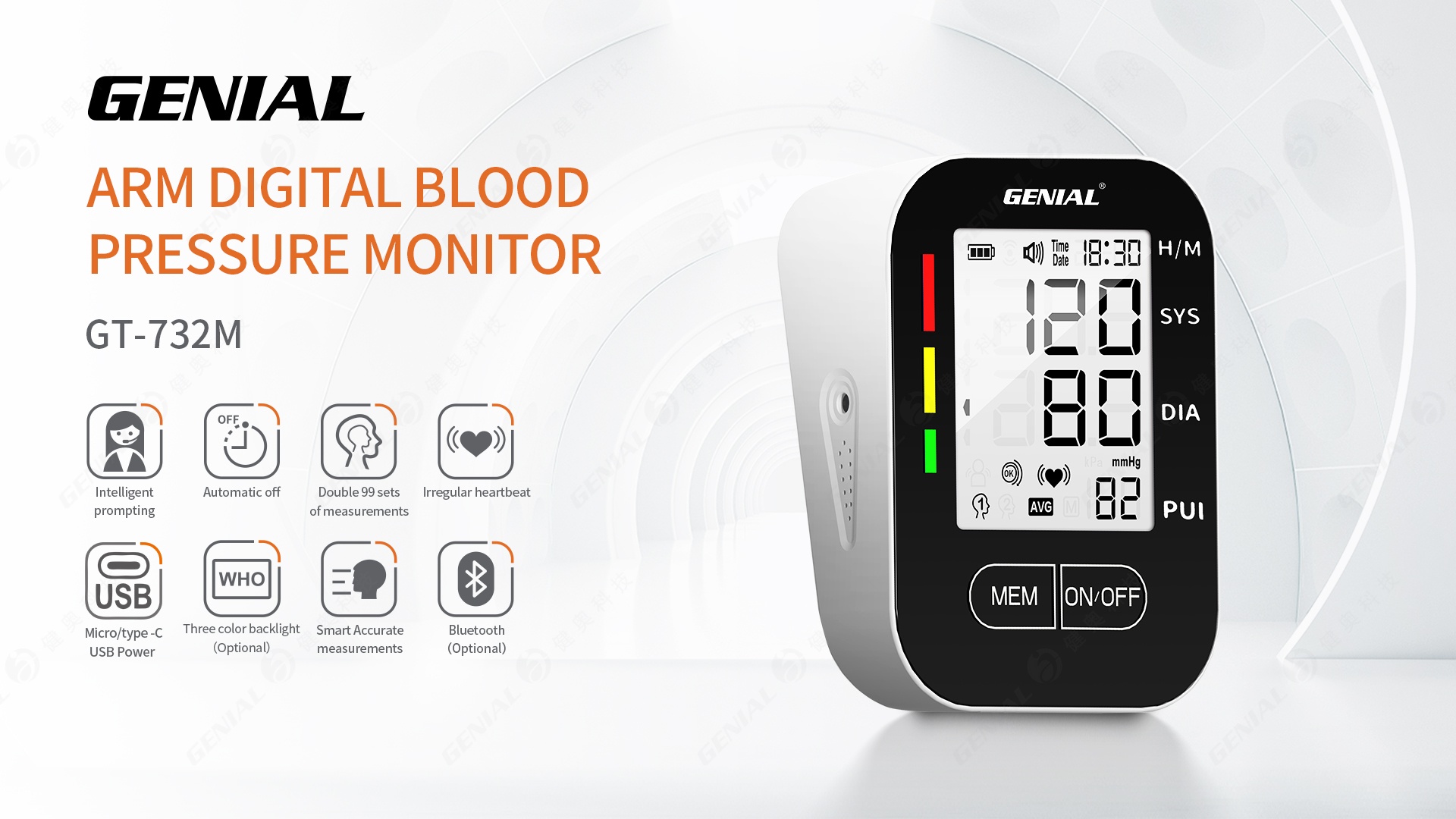
GENIAL GT-732M — ABS housing with an eco-friendly TPU air bag, documented at a pulse error of ≤±5%.
Arm circumference: the number that decides returns
GT-732 is documented at 22–32 cm. GT-732M and GT-702BM extend the upper bound to 42 cm. That 10 cm difference is the single most consequential gap between the models for anyone planning deployment at scale.
Cuff size is a recognised determinant of oscillometric accuracy: a cuff that is too small for the arm tends to distort the pressure signal, and a cuff worn too loosely produces unstable readings. In a single-user household the device is bought for one arm, and a 22–32 cm range is usually sufficient. In a community clinic, a retail shelf, or an insurance gifting programme where one SKU must serve a mixed adult population, the 22–42 cm range is the safer allocation.
The boundary matters as much as the range. None of the three models documents coverage above 42 cm, so buyers whose target population includes larger-arm users need to confirm an alternative cuff or a different model rather than assume the standard cuff will stretch to fit. Replacement cuff supply in the same size class should also be part of the purchase agreement, because a cuff that cannot be reordered turns a working monitor into a spare-parts problem.
Matching each model to a supply scenario
GT-732 — clinic, wellness and gifting programmes
Documented for community clinics, health and wellness centers, e-commerce and customized OEM gifting, GT-732 suits controlled environments where the user population is known and where a stiffer nylon strap and a heavier 291 g ±15 g body are acceptable. Its 22–32 cm cuff range is a limitation in open retail, where a single SKU has to fit as many adult arms as possible. Where the channel is a branded gift programme, the narrower range is easy to manage because the end user is identified in advance.
GT-732M — chronic care and community medical centers
The 22–42 cm range and the documented pulse error of ≤±5% position GT-732M for repeated measurement across different patients, which is exactly the pattern found in chronic disease management and community medical centers. The eco-friendly TPU air bag is also the element most likely to appear in tender documents that include material or sustainability wording. Insurance promotional gifting is listed as a target industry as well, where the wider arm range reduces the risk of an unusable gift.
GT-702BM — wholesale and offline household retail
GT-702BM is documented for medical instrument wholesale and offline household retail, and it carries the two features that show up best on a shelf: 99 memory sets for 2 users and the lowest published weight of the three at 220 g ±15 g. Dual-user memory is a concrete answer to the question a retail customer asks — can two people in the household use the same device and keep their readings apart? Unit weight is a freight and handling variable for distributors, and the 135 × 102 × 46 mm footprint is slightly more compact than the other two.
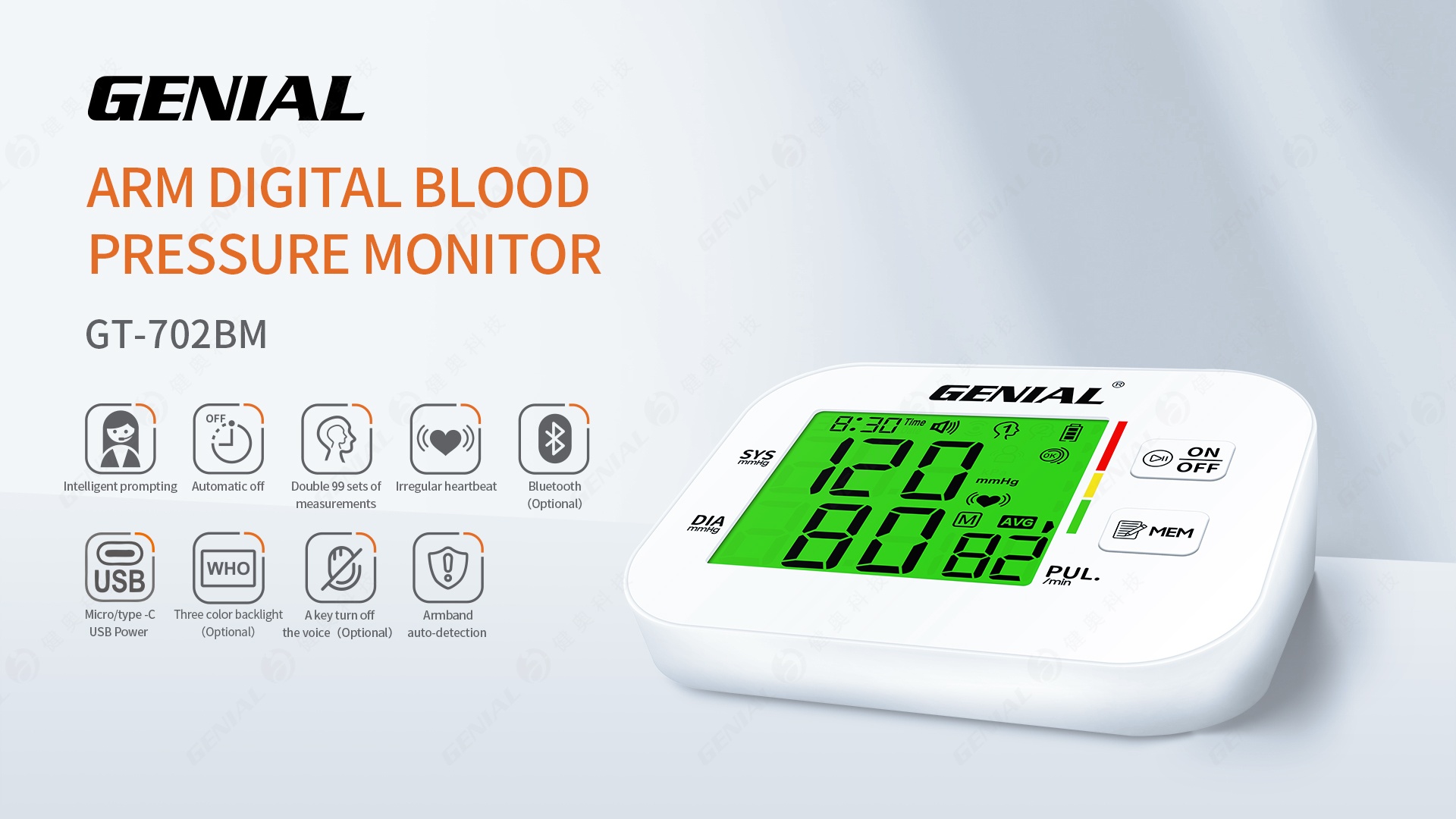
GENIAL GT-702BM — composite fabric cuff, 99 memory sets for 2 users, documented for wholesale and offline household retail.
Acceptance criteria for incoming shipments
GENIAL's blood pressure monitor documentation states that each monitor is calibrated and tested, and that measured pressure should be within 3 mmHg of analyzer data, with the deviation held below 0.4 kPa. That is a manufacturer-stated acceptance window, and it is useful precisely because it gives the buyer a number to reproduce on the receiving dock.
Two external anchors help frame the verification. UL describes IEC 60601-1-11 as the collateral standard applied together with IEC 60601-1 for home healthcare equipment, addressing the risks of use in uncontrolled home environments by untrained users. Separately, a PubMed Central review of home health monitoring equipment advises that such devices be calibrated at frequent intervals and operated within 16–40 °C and humidity below 85%. Together these define an operating envelope and a calibration expectation that go beyond the accuracy figure alone.
A practical incoming check for these three models covers six points:
- Model and material verification. Confirm the delivered unit against the purchased specification — for example, that a GT-732M shipment carries an eco-friendly TPU air bag rather than a different configuration.
- Cuff size-class and fit check. Verify the documented arm range (22–32 cm on GT-732; 22–42 cm on GT-732M and GT-702BM) and confirm replacement cuff availability in the same class.
- Pressure accuracy verification. Compare unit readings against a reference analyzer; the manufacturer's stated window is within 3 mmHg.
- Memory and multi-user function. Where relevant, verify the 99-set, two-user memory behaviour documented on GT-702BM.
- Documentation packet. Confirm NMPA registration for the China market and the applicable export marks — CE, FDA, FCC, RoHS and IECEE CB — for the destination market.
- Environmental and packaging checks. Match the carton, manual language and protection level to the logistics route and the retail channel.
Digital upper-arm measurement versus traditional cuff practice
A traditional manual measurement relies on an inflatable cuff, a gauge or mercury column and a stethoscope, and it depends on an operator who can hear Korotkoff sounds and control the deflation rate. Devices such as GT-732, GT-732M and GT-702BM automate inflation and read pressure oscillations electronically, which removes operator listening skill from the loop and makes repeated measurement practical for untrained users at home. It is also why the home-use regulatory framework centres on IEC 60601-1-11.
The trade-off is that automation shifts responsibility onto the cuff. Three boundaries are worth stating plainly:
- Cuff fit ceiling. None of the three documents coverage above 42 cm, and GT-732 stops at 32 cm. A digital monitor does not compensate for a cuff that is the wrong size for the arm.
- Data stays on the device. The published specifications for these three models describe device-side functions and memory rather than Bluetooth or cloud transfer. Programmes that require remote patient data should confirm connectivity options separately; GENIAL does document a cloud health management platform elsewhere in its portfolio, so this is a model-selection question rather than a category limitation.
- Evidence depth. Performance claims for these models are manufacturer-stated and category-supported, not independently benchmarked. GENIAL's ISO 13485 quality management system certification is a useful screening input, but it does not replace incoming inspection.
Market context: why the upper arm still carries the volume
The upper-arm format held 59.10% of blood pressure monitoring market share in 2025, while wrist and wearable devices grew at a 12.07% CAGR — faster growth from a smaller base. In parallel, the broader home medical equipment market was estimated at USD 54.35 billion in 2026, with North America holding approximately 40.35% of that value in 2025 (Mordor Intelligence).
For distributors, the reading is straightforward: connected and wearable formats are expanding the category, but the cuff-based upper-arm device remains the volume core that carries pharmacy and retail shelf space. That is also where GENIAL sits — a manufacturer established in 2001, operating a 45,000 m² facility with 251 employees including 29 R&D engineers, an annual output of 15,000,000 units, and an export share of 80% across Europe, North America, Southeast Asia, the Middle East, Africa, Latin America and Oceania. Products are sold to 117 countries and regions, and registration has been completed in 29 countries.
Future outlook
Three movements are likely to shape how this trio of models is bought rather than whether it is bought.
First, material specification is becoming a purchasing line item. The appearance of an eco-friendly TPU air bag in a mid-range model such as GT-732M suggests that material wording will increasingly appear in tender and retail-own-brand requirements, not only in marketing copy.
Second, chronic-care programmes are pushing specification choices toward wider arm ranges and multi-user memory, which favours GT-732M and GT-702BM over narrow-cuff SKUs. As community health and insurance-linked programmes scale, the 22–42 cm class is likely to absorb a growing share of upper-arm volume.
Third, the compliance surface keeps widening. NMPA registration, CE, FDA, FCC, RoHS and IECEE CB marks, plus alignment with IEC 60601-1-11 for home use, now form the baseline for supplier shortlists. For buyers, the practical consequence is that models with clear, documented material and specification differences will be easier to defend in a sourcing decision than models differentiated only by packaging.
Frequently asked questions
What actually differs between the GT-732, GT-732M and GT-702BM?
All three are upper-arm digital blood pressure monitors rated to a 0–290 mmHg pressure range. GT-732 uses ABS with a PVC air bag and nylon binding strap and covers 22–32 cm arms. GT-732M uses ABS with an eco-friendly TPU air bag, covers 22–42 cm, and is documented with a pulse error of ≤±5%. GT-702BM uses ABS with a composite fabric cuff, covers 22–42 cm, stores 99 memory sets for 2 users, and weighs 220 g ±15 g without battery.
Which of the three covers the widest range of arm sizes?
GT-732M and GT-702BM are both documented at 22–42 cm. GT-732 is documented at 22–32 cm. None of the three documents coverage above 42 cm, so larger-arm users require a separate solution or a different cuff configuration.
Which model fits wholesale distribution and offline household retail?
GT-702BM is documented for the medical instrument wholesale and offline household retail industries. Its distinguishing published features are 99 memory sets for 2 users, a composite fabric cuff, and a net weight of 220 g ±15 g without battery. GT-732 is documented for community clinic, health and wellness center, e-commerce and customized OEM gift channels, while GT-732M is documented for chronic disease management institutes, community medical centers and insurance promotional gifts.
What should be verified when a shipment of these monitors arrives?
Verify the model and its materials against the purchased specification, confirm the documented arm range and replacement cuff availability, compare unit pressure readings against a reference analyzer (the manufacturer's stated window is within 3 mmHg of analyzer data, with deviation below 0.4 kPa), test memory and multi-user functions where applicable, and confirm the documentation packet including NMPA registration and the applicable export marks such as CE, FDA, FCC, RoHS and IECEE CB.
Are these three models suitable for remote or cloud-based monitoring programmes?
Their published specifications describe device-side functions and memory rather than Bluetooth or cloud data transfer, so no connected-monitoring claim can be made for GT-732, GT-732M or GT-702BM on the basis of those specifications. Buyers whose projects require remote data should confirm available connectivity options with the supplier. GENIAL does document a cloud health management platform elsewhere in its portfolio.
Can these models be supplied under a buyer's own brand?
GENIAL states that it provides one-stop OEM, OBM, ODM and JDM services for global clients, and GT-732 is specifically documented for the customized OEM gift industry. Branding, packaging, configuration and commercial terms are negotiable items to confirm directly with the supplier.
Reference material: the full GENIAL home medical health device portfolio specification set is available in the 2026 English catalogue. Manufacturer information: Guangdong Genial Technology Co., Ltd. (www.cngenial.com), established 2001.
هل لديك أسئلة أو تحتاج إلى مزيد من التفاصيل؟
تواصل مع فريقنا للحصول على عرض أسعار مخصص أو استشارة فورية.
طلب عرض أسعار
املأ النموذج أدناه وسيتواصل معك فريقنا بعرض مقترح مخصص.
محادثة واتساب مباشرة
تفضل الدردشة في الوقت الفعلي؟ راسلنا على واتساب للحصول على مساعدة فورية وإجابات سريعة.
- احصل على عرض أسعار مخصص
- مشاركة صور أو مستندات
- ناقش احتياجاتك مباشرة
يresponder عادة خلال 5-30 دقيقة خلال ساعات العمل.