
Galvanized Traffic Pole Calculations: A Compliance Guide
Galvanized Traffic Pole Calculations: A Compliance Guide
A galvanized steel traffic pole is compliant when its structural calculation was written for that project: the wind case at the site, the signs, signal heads and cameras it will actually carry, the foundation it will sit on, and the drawing revision used in fabrication. When the calculation is borrowed from another project, or fabrication drifts from the approved drawing, the gap does not disappear; it surfaces at handover, or years later when a camera is added to the arm.
This guide is written for the people who carry that risk: utility and municipal engineers approving signal, CCTV and sign gantry poles, EPC contractors building roadside infrastructure, and procurement teams comparing quotations that look alike on paper but rest on different engineering assumptions.
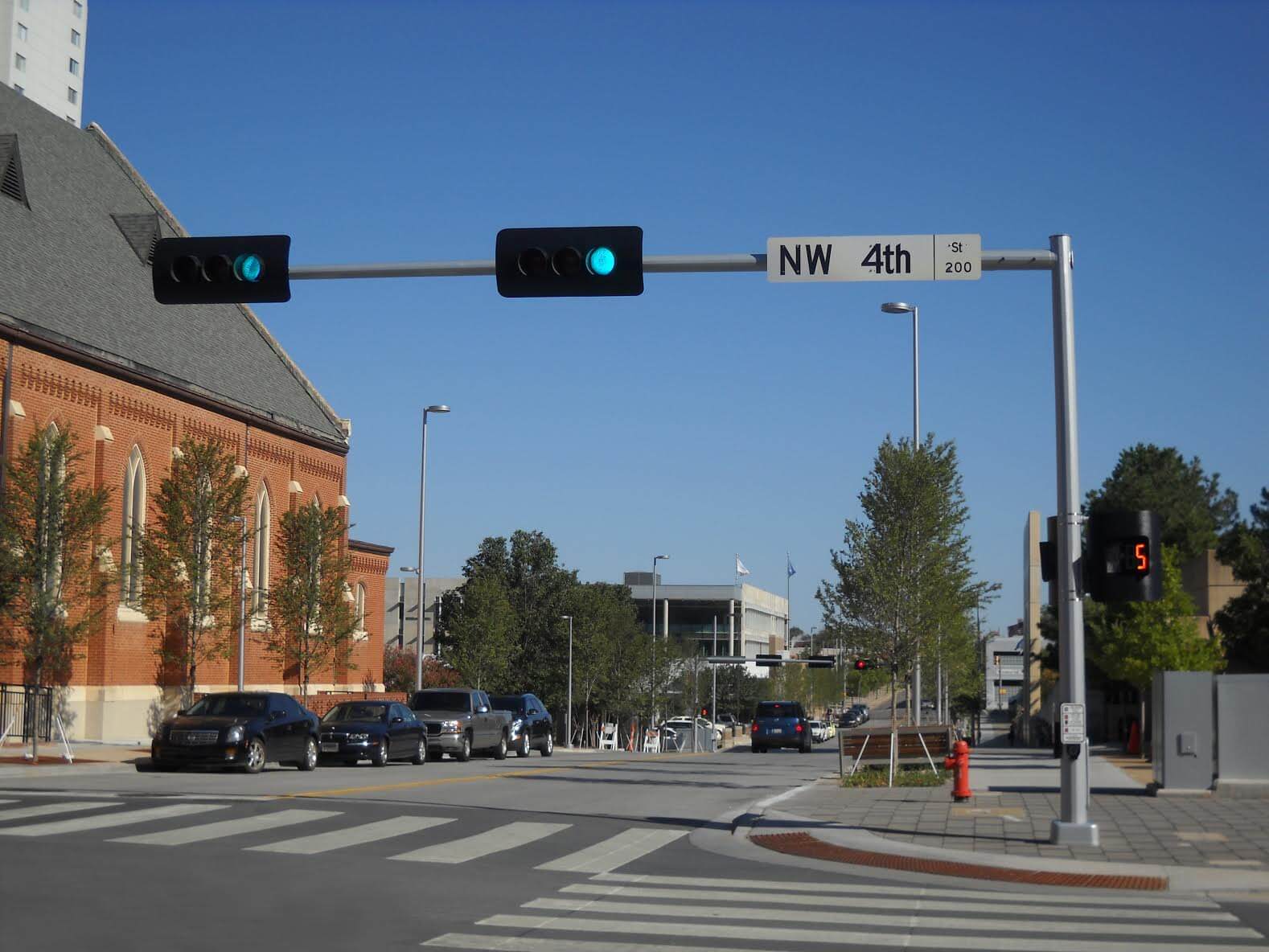
Three documents decide whether a traffic pole complies
Compliance rests on three separate documents, and each answers a different question. The design basis records the conditions the pole must survive. The structural calculation shows that the chosen geometry survives them. The approved for-construction drawing set fixes what will be cut, welded and galvanized.
| Document | Question it answers | Typical weak point |
|---|---|---|
| Design basis | What wind, equipment, foundation and corrosion conditions apply? | Carried over from a previous project or a different jurisdiction |
| Structural calculation | Does this shaft, arm, connection and base resist those conditions? | Produced after the geometry was fixed, leaving no room to change section or outreach |
| Approved drawings | What exactly will be fabricated and inspected? | Revision drift between calculation, drawing and shop floor |
A pole can satisfy one document and fail another. A calculation that is technically sound but tied to a superseded drawing proves nothing about the pole that was delivered, and a galvanizing certificate issued for a coating applied to the wrong steel grade is still a certificate.
Fixing the design basis before a single calculation is run
The design basis belongs to the owner or the owner's engineer, and it should be agreed before pole geometry is chosen. Once it exists, the calculation becomes a verification exercise rather than a negotiation, and competing quotations can be compared on the same terms.
| Design basis input | Why it changes the pole | Who normally provides it |
|---|---|---|
| Local wind parameters: basic wind speed or pressure, return period, terrain category, reference height | Sets the design pressure that produces the bending moment at the base | Owner or design engineer, citing the governing code |
| Site exposure and topography | Adjusts pressure for roughness, shielding and elevation | Design engineer |
| Equipment schedule: sign area, signal head count, CCTV mass, bracket and mount geometry | Converts equipment into wind area and eccentric load at a defined height | Traffic or systems designer |
| Mounting height and mast arm outreach | Sets the moment arm for every mounted item | Road and traffic design |
| Foundation interface: direct burial or base plate with anchor bolts | Defines the support condition and the reactions the foundation must take | Civil or structural designer |
| Corrosion environment: inland, industrial or coastal salt-spray | Drives coating selection and the maintenance assumption behind it | Owner, from site classification |
| Applicable standards and editions for design, welding and galvanizing | Fixes the acceptance criteria that fabrication will be checked against | Owner or engineer specification |
| Deflection or serviceability limits | A pole can be strong enough and still unacceptable if it moves too much at the camera or signal head | Owner or engineer |
If a row in that table is blank, someone will fill it, usually with an assumption that is never written down. For a compliance review, that is the finding: not that the pole is necessarily wrong, but that nobody can demonstrate that it is right.
Local wind conditions: the input most often borrowed from the wrong project
Wind is the dominant load on a traffic pole, and it does not transfer between markets. Bending moment at the base scales roughly with the square of wind speed, so a design carried over from a moderate-wind inland project does not degrade gently in a typhoon-exposed location; it becomes a different structural problem.
Two things follow. First, the calculation must name its wind source: the code, the jurisdiction, the return period, the terrain category and the reference height it applied. A reviewer cannot check a pressure value that has no provenance. Second, jurisdiction-specific minimums can override a general design assumption.
In the Philippines, NEA Memorandum No. 2007-007, effective 15 February 2007, sets minimum technical specifications for steel poles in heavy loading zones, including a stated yield stress of 345 MPa and a zinc coating of 86 microns for the 30 ft pole configuration described in its technical table. A quotation that does not reference the governing local specification leaves the buyer unable to confirm which design case was actually applied.
Terrain and height matter as much as headline wind speed. A pole on an open coastal approach, an exposed bridge deck or a raised embankment sees higher pressure than the same pole in a built-up corridor, and arm-mounted equipment adds wind area at the most adverse height. The calculation should show the exposure case it used rather than a final pressure number alone.
Sign, signal and CCTV loads: the equipment schedule is part of the structure
The structural load on a traffic pole comes from what is bolted to it. The Milky Way traffic and signal pole range is described as covering traffic signal poles, CCTV poles, sign gantry poles and monitoring poles, with customized mast arm, outreach, mounting plates, cable access and foundation interface, and structural loads based on sign, signal and CCTV equipment together with local wind conditions. That description points to the correct starting point: the pole is a support structure whose primary input is an equipment schedule.
A usable equipment schedule should fix, at minimum:
- Signs: area, aspect ratio and mounting height, since a sign behaves as a flat plate in wind.
- Signal heads: number, mass, bracket type and position along the mast arm.
- CCTV and monitoring equipment: camera and housing mass, bracket geometry, mounting height.
- Conduit, cable and junction boxes: mass and exposed wind area.
- Access and maintenance provisions required by the owner.
- Any reserved capacity for equipment planned later.
Each item becomes a load at a defined height, and the products of load and height give the moment that the shaft, arm, connection and base must resist. Two consequences follow. A change of equipment is a design change: adding a second camera or enlarging a sign alters wind area and eccentricity, and the check that follows depends on whether the original schedule was retained. And the schedule should be frozen before calculation sign-off and referenced by revision in both the calculation and the drawing, so that the three documents describe the same pole.
Long cantilevers deserve specific attention. Where a pole carries a sign gantry or a long outreach, the connection and its local stiffening can be as demanding as the shaft itself, because the loads arrive off-axis and the base reactions grow with every metre of arm. The calculation should state which element governs and show that base plate, anchor bolts and foundation loads were derived from the same model.
Hot-dip galvanizing: specify the standard, the edition and the acceptance criteria
Galvanizing is often specified as a phrase, and the phrase is not a specification. A compliance record needs the standard, its edition, the acceptance criteria for coating thickness, appearance and adhesion, and the inspection documents that demonstrate them.
Milky Way's hot-dip galvanizing compliance documentation is recorded against ASTM A123/A123M, ASTM A153/A153M for applicable hardware, and EN ISO 1461 where a project specifies it, with scope covering zinc coating thickness, appearance, adhesion and related inspection as required by the project. These are separate standards with separate scope: A123/A123M addresses hot-dip galvanized steel products, A153/A153M addresses hardware, and EN ISO 1461 applies where a European specification is called up. The project specification should say which one governs and for which components, including brackets, bolts and anchor bolts.
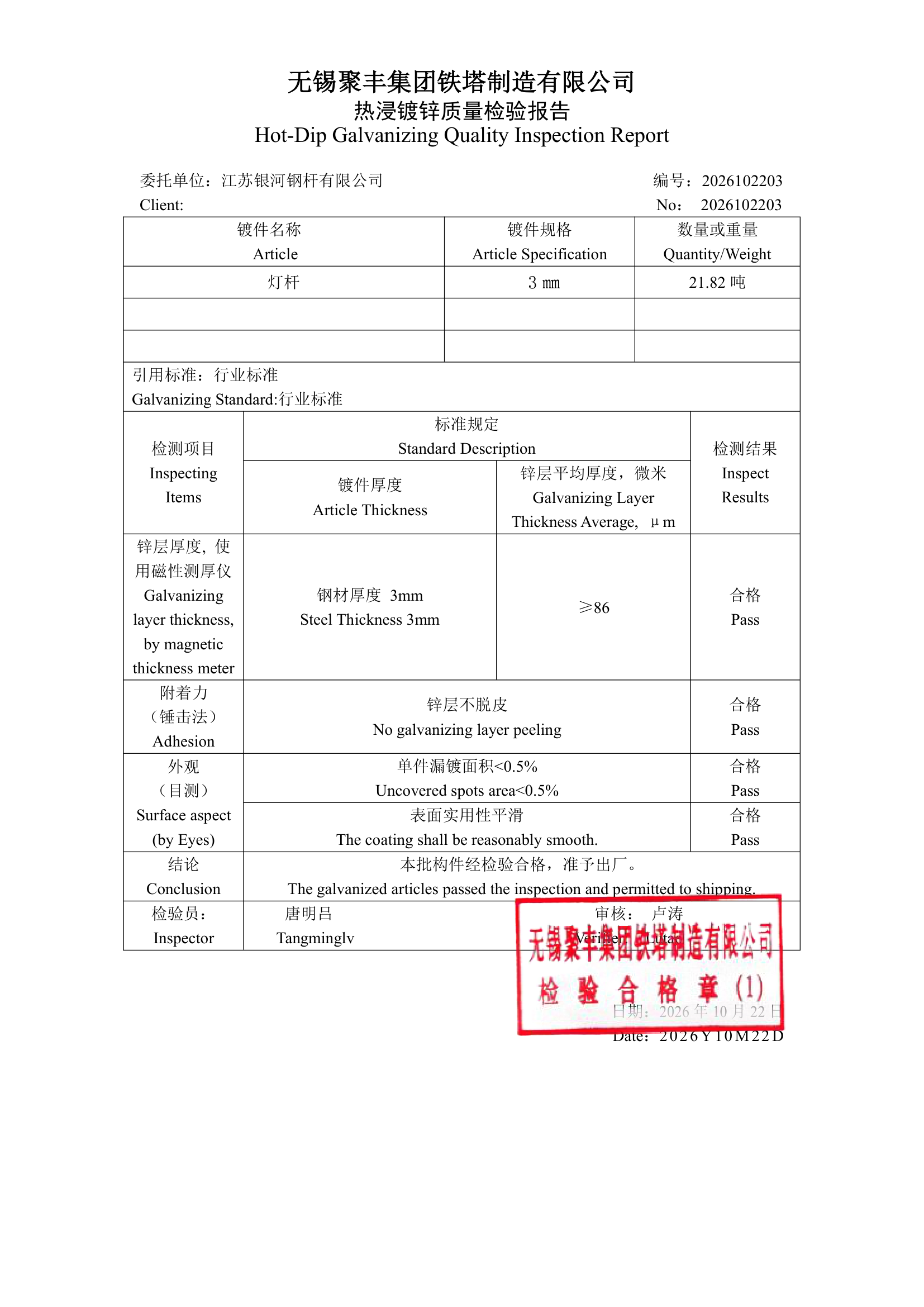
Edition matters. ASTM A123 was revised in 2024, and the American Galvanizers Association published its summary of that revision on 28 August 2024. A specification that names the standard without a year leaves acceptance criteria open to interpretation at the inspection stage, which is the least convenient moment to discover a disagreement.
Design details belong in the same conversation. Drainage and venting provisions, avoidance of closed volumes that trap process liquids, and the treatment of threaded components have to be settled at drawing stage, because they cannot be introduced after coating without repair work. A drawing that is structurally correct but cannot be properly galvanized is a fabrication problem that the calculation will never reveal.
Coating is also a service-life decision rather than a finish note. Milky Way states a design life of 30+ years for its galvanized poles, extending up to 50 years in coastal high-corrosion conditions. That claim is useful only alongside the corrosion category it assumes; a coating specification without a stated environment leaves the asset owner unable to convert coating requirements into a maintenance expectation.
Aligning fabrication with the approved project drawings
A structural calculation is evidence only if the delivered pole matches it, which makes drawing control a compliance activity rather than an administrative one. The chain runs from approved design basis to reviewed calculation, to for-construction drawings issued for approval, to shop fabrication against the released revision, to inspection against that same revision.
Milky Way's engineering scope includes design calculation review, a drawing approval workflow and prototype or full-scale test support where required. On the shop floor, the control points that matter for a traffic pole package are:
- Incoming material verification: mill certificates checked against the specified grade before cutting.
- Dimensional inspection: shaft geometry, wall thickness, arm length and outreach, mounting plate hole patterns, base plate and anchor bolt template.
- Weld inspection against the acceptance criteria stated by the project.
- Galvanizing inspection: coating thickness, appearance and adhesion.
- Final inspection with client, SGS, BV, TÜV or another approved inspector witnessing where the contract requires it.
- Identification and traceability: a unique identity per pole and traceability of members and bolts, so a site query resolves against a fabrication record rather than a photograph.
Packing belongs to the same chain. Container loading plans, bundle marking, shipping marks, section nesting and accessory packing are set against the drawing package and the site erection sequence, so that the bracket arriving on site is the bracket drawn for that location. On multi-pole projects, marking errors tend to reappear as installation errors.
The manufacturer's part of the package, and where it ends
Jiangsu Milky Way Steel Poles Co., Ltd. (Milky Way) has manufactured power steel poles and transmission towers since 1991 and produces galvanized steel utility poles, steel distribution poles, transmission poles, substation steel structures, lattice towers, communication towers and lighting poles alongside traffic and signal poles. Its engineering and design team works in PLS-POLE and PLS-TOWER for project-specific structural design, and its service scope covers structural calculation, drawing design, manufacturing, third-party inspection, shipment documentation and on-site technical guidance.
Facts a buyer can check against a specification include annual output of 100,000 sets of medium- and low-voltage steel poles and 3,000 sets of high-voltage steel poles, monthly capacity above 2,000 tons, four-level inspection from raw material testing through in-process patrol and finished-product full inspection to third-party random sampling, and ISO 9001, ISO 45001 and ISO 14001 certification, with SGS, TÜV Rheinland and BV inspection certificates available in English. In 2025, a customized 132kV pole supplied for a project in Pakistan passed a full-scale destructive test at the State Grid key laboratory with load, displacement and strength indicators meeting requirements; that result demonstrates structural verification capability, although it concerns a transmission pole rather than a traffic pole.
The boundary matters as much as the capability. A manufacturer's structural calculation covers the pole, its arms, brackets, base plate and anchor bolt interface as specified. It does not replace the owner's design basis, the civil designer's foundation, the equipment supplier's mounting and load data, or the quality of site erection. Where those inputs arrive late or change, the calculation has to be reissued, and a project that treats the calculation as a document to be collected after the purchase order is a project verifying a decision that has already been made.
One check is worth making on any supplier, this one included: read the certification scope rather than the certificate title. Milky Way's ISO 9001 certificate is issued for the design and production of electric transmission and transformation steel tube poles and towers, steel tube electricity transformation supports, and metal steel tube poles for lighting. A buyer purchasing traffic signal poles should confirm how that scope maps to the product and record the answer in the compliance file.
Its export and service profile shapes the practical side of compliance: 95% of products and projects are supplied to overseas markets across Southeast Asia, Africa, the Middle East, South America, North America, Europe and Oceania, with local service centres in Ecuador, Ghana, Rwanda and the Philippines supporting installation guidance and after-sales technical support.
Comparing two procurement routes: range pole versus calculated pole
Most traffic pole purchasing follows one of two routes, and the compliance question is different in each.
| Dimension | Range pole verified by project calculation | Pole calculated for the project |
|---|---|---|
| Geometry origin | Selected from a fixed product range | Derived from the design basis |
| Wind input | Checked against site wind once supplied | Applied from the start of design |
| Equipment change | May force a different pole or a reduced equipment set | Shaft, wall thickness or arm length revised |
| Drawing control | Standard drawings plus project mounting details | Full project drawing set |
| Verification burden | Falls on the buyer to confirm suitability | Documented inside the calculation package |
| Typical fit | Repetitive installations, known equipment, moderate wind | Interchanges, long cantilevers, heavy signage, high-wind or coastal sites, non-standard equipment |
Neither route is inherently more compliant. A range pole with a genuine project calculation and a documented equipment schedule can be entirely defensible; a project-specific pole without drawing control is not. The failure mode to watch is the hybrid: a project-specific drawing set with a calculation that was never updated for the final equipment schedule.
Price comparison has a parallel problem. Published marketplace listings for galvanized steel poles combine different pole dimensions, steel weights, accessories and commercial terms, so a lower listed figure does not indicate a lower cost for the same structure. A compliance-led comparison starts from a normalized specification and a stated design basis, and treats price as an output of that specification rather than a substitute for it.
Where the load case changes: application scenarios
Different roadside applications load a pole in different ways, and the scenario should be named in the design basis so the calculation is reviewed against the right case.
Signalised intersections
An intersection pole carries signal heads on a mast arm, often together with pedestrian signals, detection equipment and a controller interface. The governing condition is usually arm-mounted equipment at maximum outreach combined with wind on the signal heads, which puts the mounting plate and the arm-to-shaft connection under the moment the equipment generates. Outreach is therefore a structural decision, not only a traffic-engineering one.
Sign gantries and large cantilevered signs
Sign structures present a large flat area at height. Wind on the panel produces bending and, in a cantilevered arrangement, torsion at the connection, so the calculation should identify the governing element and show that the connection, base plate and anchor bolts were checked for the resulting reactions rather than the shaft alone.
CCTV and monitoring corridors
Camera poles along highways and in urban monitoring networks often combine modest equipment mass with considerable mounting height and an operator requirement that the camera head remain steady enough for usable images. That makes deflection limits as relevant as strength: a pole that passes the stress check but moves excessively in gust can still fail the requirement it was bought for.
Coastal and high-corrosion routes
Where a route runs through salt-spray exposure, the corrosion category belongs in the design basis next to wind, so that the structural calculation and the coating specification address the same service-life assumption. That alignment is what allows an asset owner to compare bids on maintenance expectation rather than on coating thickness alone.
Market context: what the available data does and does not establish
Verified data specific to traffic, signal and CCTV poles is thin, and it is worth separating what exists from what does not. The most usable figure in the reviewed evidence is category-level: Grand View Research's utility poles market analysis, published in 2026, projects the steel utility poles market growing from US$6.96 billion in 2025 to US$11.11 billion by 2034, a compound annual growth rate of 5.39%.
That is a forecast for steel utility poles as a category. It is not a traffic pole forecast, and it does not establish demand for signal, CCTV or sign gantry poles in any particular market. Its value here is context only: steel pole supply is an established and expanding manufacturing category, which means specification discipline, rather than availability, is the practical constraint on obtaining a compliant pole.
Outlook: making the load basis recoverable
The long-term compliance question for a traffic pole is not only whether it was calculated at delivery, but whether the calculation can be found and reused when the pole's duty changes. Roadside equipment turns over faster than poles do: a camera is upgraded, a sign is enlarged, a detection unit is added to an existing arm. Each change alters wind area and the moment at the base, and the check that follows depends on whether the original design basis and equipment schedule survived the project.
Three practices make that recovery possible, and none is expensive at the point of specification. Keep the calculation, the equipment schedule and the as-built drawing under one revision-controlled reference. Record the wind source, including code, return period and terrain category, on the calculation cover sheet. Record the coating standard and edition next to the corrosion category. A pole package handed over with those three items remains auditable for the rest of its service life; one handed over as a stack of untracked PDFs does not.
Frequently asked questions
What should a project-specific structural calculation for a galvanized steel traffic pole contain?
It should open with the design basis it applied: governing wind code, return period, terrain category and reference height. It should then show the equipment schedule used, including sign area, signal head and CCTV masses, mounting heights and outreach; the structural model and load combinations; member and connection checks; reactions at the base plate or direct-burial interface; deflection against the owner's limit; and the material and galvanizing specification. It should also reference the drawing revision it supports, because a calculation that cannot be tied to a drawing cannot be used to verify fabrication.
How do local wind conditions change the pole specification?
Local wind conditions set the design pressure, and that pressure drives the bending moment at the base, which in turn drives shaft diameter, wall thickness, and base plate and anchor bolt design. Different jurisdictions define wind differently, using basic wind speed or pressure with their own return periods and terrain categories, so a calculation has to state which definition it used. Jurisdiction minimums can also override a general design assumption: the Philippines NEA Memorandum No. 2007-007, effective 15 February 2007, sets minimum technical specifications for steel poles in heavy loading zones, including a 345 MPa yield stress and an 86-micron zinc coating for the 30 ft configuration described in its technical table.
How are sign, signal and CCTV loads treated in the calculation?
Each item is converted into a load at a defined height. A sign becomes an area exposed to wind pressure at its mounting height; signal heads and cameras become masses with wind area at the end of an arm. Multiplying those loads by their heights gives the moment that the shaft, arm, connection and base must resist. Because the loads depend on the equipment schedule, any later addition, such as a second camera or a larger sign, is a design change requiring a re-check rather than an accessory purchase.
Which galvanizing standard should a traffic pole specification use?
The specification should name one governing standard with its edition, then state which components it covers. Milky Way's galvanizing compliance documentation references ASTM A123/A123M for galvanized steel products, ASTM A153/A153M for applicable hardware, and EN ISO 1461 where a project specifies it, with scope covering coating thickness, appearance, adhesion and related inspection as required by the project. ASTM A123 was revised in 2024, so a specification that omits the edition leaves the acceptance criteria open to interpretation at inspection.
How is fabrication checked against the approved project drawings?
Through an inspection and test plan built on those drawings: material certificates verified against the specified grade, dimensional checks on shaft geometry, arm length, mounting plate hole patterns and anchor bolt templates, weld inspection against the project's acceptance criteria, galvanizing checks, final inspection, and third-party witnessing where the contract requires it. Each pole should carry an identification linking it to its fabrication record, and bundle marking, shipping marks and accessory packing should follow the drawing package and the site sequence. Milky Way's quality control scope covers these points, with client, SGS, BV or TÜV inspection available when specified.
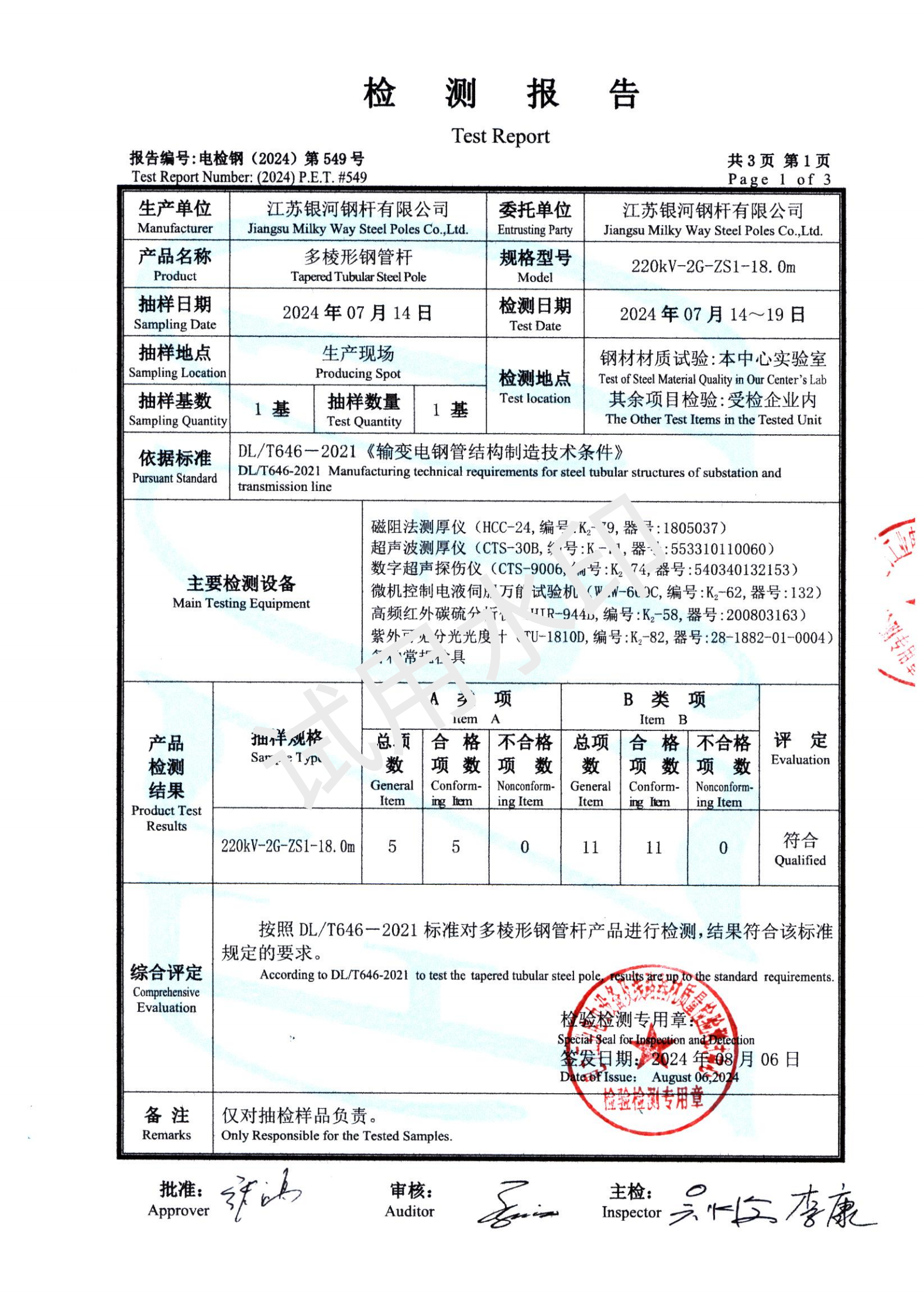
The 2026 Milky Way Power Group catalogue, covering product scope and specification data, is available for download: 2026 Milky Way Power Group catalogue (PDF).
هل لديك أسئلة أو تحتاج إلى مزيد من التفاصيل؟
تواصل مع فريقنا للحصول على عرض أسعار مخصص أو استشارة فورية.
طلب عرض أسعار
املأ النموذج أدناه وسيتواصل معك فريقنا بعرض مقترح مخصص.
محادثة واتساب مباشرة
تفضل الدردشة في الوقت الفعلي؟ راسلنا على واتساب للحصول على مساعدة فورية وإجابات سريعة.
- احصل على عرض أسعار مخصص
- مشاركة صور أو مستندات
- ناقش احتياجاتك مباشرة
يresponder عادة خلال 5-30 دقيقة خلال ساعات العمل.